Pay As You Go - AI Model Orchestration and Workflows Platform



AI workflow systems are transforming how businesses operate, combining automation with advanced decision-making. This guide examines the leading platforms that integrate Large Language Models (LLMs) to process tasks like unstructured data handling, IT support, and sales automation. Here’s a quick overview:
These platforms cater to various needs, from small teams to enterprises, offering tools to save time, reduce costs, and improve efficiency. Below, explore their features, pricing, and use cases to find the right fit for your organization.

AI Workflow Systems Comparison: Features, Pricing, and Best Use Cases
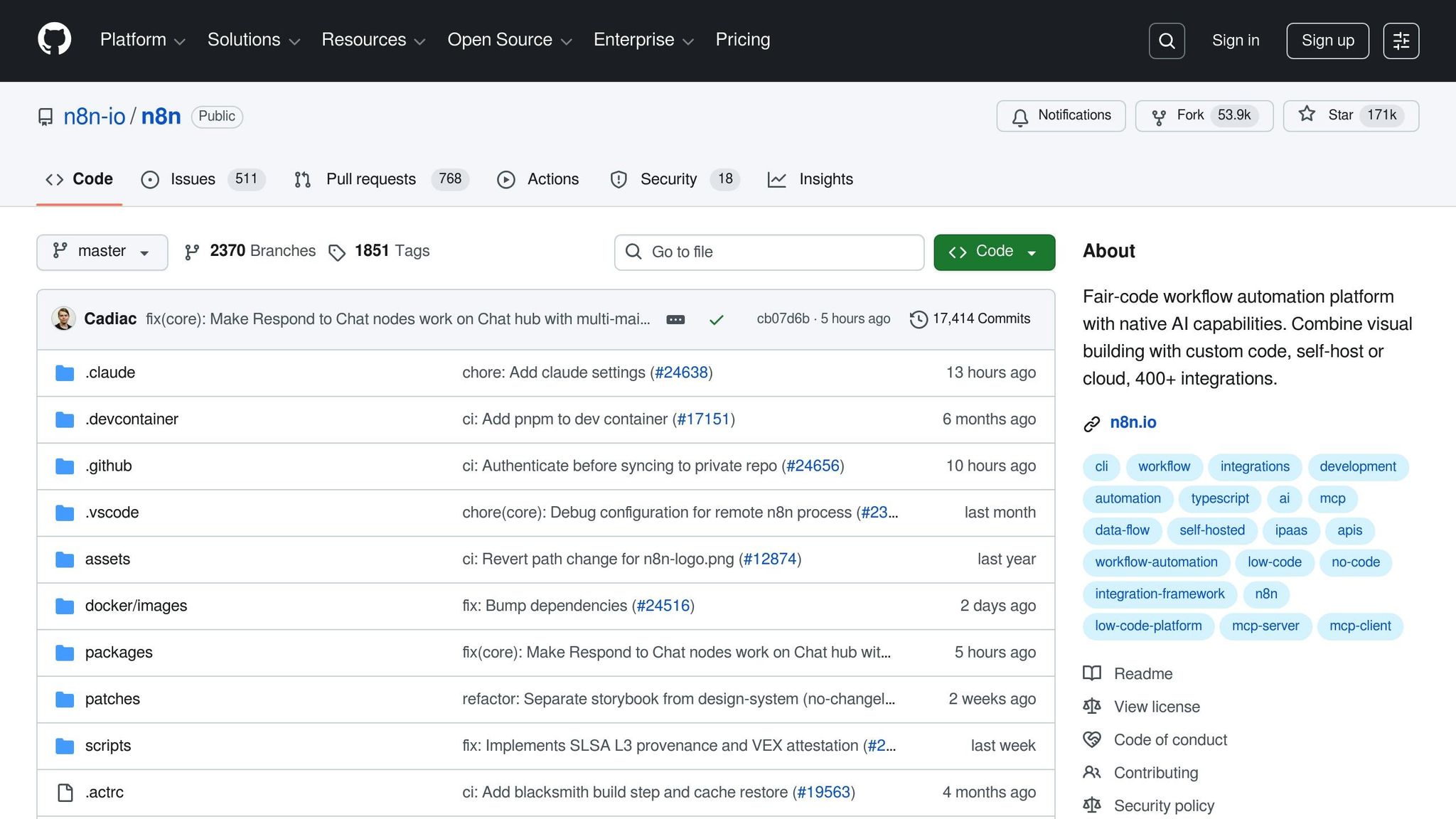
n8n is an open-source workflow automation platform that strikes a balance between the precision of coding and the speed of visual design. With over 170,000 GitHub stars and a thriving community of 200,000 members, it stands as one of the leading AI-powered workflow solutions. Capable of executing up to 220 workflows per second on a single instance, n8n is built for handling high-demand operations.
With more than 400 pre-configured integrations and a versatile HTTP request node for any REST API, n8n provides a robust toolkit for automation. A standout feature is its MCP Server Trigger, enabling external AI systems to directly initiate n8n workflows - offering a level of architectural adaptability that’s hard to find elsewhere. Additionally, users can access over 1,700 workflow templates, making it easier to kickstart projects.
In 2024, Luka Pilic, Marketplace Tech Lead at StepStone, shared how n8n transformed their operations:
"We've sped up our integration of marketplace data sources by 25X. It takes me 2 hours max to connect up APIs and transform the data we need. You can't do this that fast in code."
By leveraging n8n, StepStone reduced tasks that once took two weeks to just two hours, demonstrating the platform's efficiency in managing complex integrations.
n8n integrates LangChain to allow users to build modular AI applications, multi-step agents, and seamless chains for workflows. It offers specialized AI nodes for working with LLMs, vector stores, and document loaders, making it an excellent choice for creating RAG (Retrieval-Augmented Generation) systems. The AI Workflow Builder simplifies development by allowing users to create, refine, and debug workflows using natural language.
In 2024, SanctifAI, a leader in Human-AI collaboration, built their first AI-powered workflow in just 2 hours, a process that would have taken three times as long using Python for LangChain. This speed empowered product managers to design and test workflows without needing extensive engineering support, even across a team of 400+ employees.
n8n offers powerful customization features through its Code Node, supporting JavaScript and Python for custom transformations. For self-hosted setups, users can enhance functionality by adding npm or Python libraries. The platform also supports "human-in-the-loop" interventions, enabling teams to introduce approval steps or manual overrides before AI actions are executed - essential for maintaining compliance and safety.
Dennis Zahrt, Director of Global IT Service Delivery at Delivery Hero, noted the impact of n8n on their operations:
"We have seen drastic efficiency improvements since we started using n8n for user management. It's simple to use."
By implementing a single ITOps workflow, Delivery Hero saved 200 hours each month through automated user management.
n8n is tailored for technical teams and developers who need the control of coding combined with the speed of visual workflows. Its self-hosting capabilities make it especially appealing to industries like Finance and Healthcare, where data privacy is critical. DevOps and IT teams use n8n for tasks such as incident response, infrastructure monitoring, and user management, while marketing and operations teams rely on it for executing complex AI-driven campaigns without incurring high costs for each step.
n8n employs an execution-based billing model, charging per completed workflow rather than per individual step. This approach can lead to significant savings for users managing complex workflows.
| Plan | Price | Executions | AI Builder Credits | Key Features |
|---|---|---|---|---|
| Starter | $20/mo | 2,500 | 50 | 1 shared project, 5 concurrent executions |
| Pro | $50/mo | 10,000 | 150 | 3 shared projects, 20 concurrent executions, search |
| Business | $800/mo | 40,000 | Coming Soon | 6 shared projects, SSO/SAML, Git version control |
| Enterprise | Contact Sales | Custom | 1,000 | Unlimited projects, 200+ concurrent executions, log streaming |
With a 4.9/5 star rating on G2, n8n is celebrated for its adaptability and cost-efficiency, making it a trusted choice for scaling automation workflows.
Zapier stands out as a widely-used automation platform, connecting over 8,000 apps and powering more than 350 million AI tasks as of late 2025. It’s an excellent choice for teams seeking quick and user-friendly automation solutions.
Zapier connects with a massive ecosystem of over 8,000 apps, including nearly 500 AI-specific integrations. A key feature is Zapier MCP (Model Context Protocol), which acts as a bridge, enabling AI platforms like ChatGPT, Claude, and Cursor to perform over 30,000 actions within Zapier’s network. This eliminates the need for custom API setups, allowing users to trigger workflows with their preferred AI tools seamlessly.
The platform also supports Knowledge Sources, pulling context from internal data stored in tools like Google Drive, Notion, and Confluence. This ensures AI-generated responses are grounded in your organization’s specific information, avoiding generic outputs.
In April 2025, Vendasta implemented an AI-driven lead enrichment system designed by Marketing Operations Specialist Jacob Sirrs. This workflow captures leads from forms, enriches them using Apollo and Clay, and leverages AI to summarize the data before routing it to sales teams. The system recovered $1 million in potential revenue and saved 282 working days annually.
Zapier integrates with leading LLMs, offering built-in access to models like OpenAI’s GPT, Anthropic’s Claude, Google’s Gemini, and Azure OpenAI. Users can utilize models like GPT-4o mini and Gemini 2.0 Flash for free or connect their own API keys for other models. The platform includes a Prompt Assistant, which refines instructions for optimized LLM outputs with a built-in strength indicator.
Zapier Agents take automation further by enabling AI to handle complex, research-heavy tasks, offering dynamic and context-driven decision-making capabilities.
For example, in April 2025, Remote.com launched an AI-powered IT helpdesk led by Marcus Saito, Head of IT and AI Automation. The system processes requests from Slack and email, categorizes and prioritizes them using AI, and resolves 27.5% of all tickets autonomously. Supporting a workforce of 1,700 employees with just three IT staff members, the system saved $500,000 in annual hiring costs.
"Zapier makes our team of three feel like a team of ten." - Marcus Saito, Head of IT and AI Automation, Remote
Zapier offers Copilot, an AI assistant that can design entire multi-product systems based on natural language prompts. Users simply describe their needs, and Copilot generates workflows, forms, chatbots, and more. For visualizing complex processes, Zapier Canvas lets teams map out AI-driven workflows, identify bottlenecks, and align on execution before building.
For those needing advanced customization, Zapier Functions allows users to run Python scripts, including libraries like Pandas, NumPy, and TensorFlow, within workflows. Additionally, the platform supports human-in-the-loop workflows through Slack integration, enabling manual approval steps before AI actions are executed.
In April 2025, Okta implemented a Slack-based escalation bot led by Senior Manager Korey Marciniak. This system streamlined case escalations, cutting the time per ticket by 10 minutes. Currently, 13% of all Okta Workforce Identity escalations are handled through this automation.
Zapier is designed for non-technical users and business teams who want to automate workflows without requiring engineering support. It’s particularly popular among marketing, operations, and customer success teams who need to orchestrate AI-powered workflows across numerous apps. The platform’s natural language tools make it ideal for product managers and operations specialists who want to test and deploy automations in hours rather than weeks.
Zapier operates on a task-based billing model, where each action in a workflow counts as one task. The pricing tiers are as follows:
| Plan | Price (Annual) | Tasks/Month | Key AI Features |
|---|---|---|---|
| Free | $0 | 100 | Unlimited Zaps/Tables/Forms, Zapier Copilot, Two-step Zaps |
| Professional | Starting at $19.99 | Varies | Multi-step Zaps, AI fields in Tables, Webhooks |
| Team | Starting at $69 | Varies | 25 users, Shared connections, Premier Support |
| Enterprise | Contact Sales | Custom | Unlimited users, Advanced permissions, VPC Peering |
With a 4.5/5 rating on G2 and 4.7/5 on Capterra, Zapier is celebrated for its ease of use and vast app directory, though costs can escalate with high task volumes.
Make stands out among automation platforms by blending AI integration with an intuitive visual workflow design, streamlining operations like never before. This platform enables users to create AI-driven workflows in real time, connecting over 3,000 pre-built apps and offering 400+ AI-specific integrations. These include well-known tools like OpenAI (ChatGPT, Sora, DALL-E, Whisper), Anthropic Claude, Google Vertex AI (Gemini), Azure OpenAI, and Perplexity AI.
Make offers over 30,000 possible actions across its ecosystem, with AI usage in workflows projected to quadruple throughout 2024. Its extensive library of 7,500+ pre-built templates speeds up deployment significantly. A key feature is the Model Context Protocol (MCP), a cloud-hosted server that securely connects internal and external services. This allows users to access Make scenarios from any AI interface without the hassle of managing infrastructure.
For example, Teleclinic, a German telehealth provider, leveraged Make to scale its operations. Under the guidance of Philipp Weidenbach, Head of Operations, the platform helped reduce process friction, cut costs, and free up the support team from repetitive tasks.
"Make really helped us to scale our operations, take the friction out of our processes, reduce costs, and relieved our support team." - Philipp Weidenbach, Head of Operations, Teleclinic
With these integrations, Make empowers users to achieve more with their AI-driven workflows.
Make enables users to create AI agents capable of dynamic reasoning, moving beyond rigid rule-based systems. These agents can integrate existing Make scenarios as modular tools, performing tasks like inventory checks or order placements. The platform also features Maia, an AI assistant that simplifies error resolution and scenario creation through natural language commands, drastically reducing development time.
Another standout feature is the Human in the Loop app, which ensures manual review of AI-generated outputs before they proceed. This feature helps prevent inaccuracies and maintains consistency in customer-facing content. Additionally, Make provides advanced data manipulation tools and conditional logic for precise control over workflows.
Make’s visual canvas offers users complete control over their workflows, allowing them to design modular scenarios tailored to their needs. Users can define agent behavior with global prompts, set specific rules, and integrate any of the 3,000+ available apps. For teams with unique requirements, Make supports custom API connections, enabling seamless integration of proprietary systems.
Shop Accelerator Martech experienced transformative results with Make. According to Cayden Phipps, COO, some customers saw their revenue grow by 10x thanks to the platform’s AI-driven automations.
"Make drives unprecedented efficiency within our business in ways we never imagined. It's having an extra employee (or 10) for a fraction of the cost." - Cayden Phipps, COO, Shop Accelerator Martech
Make is built for business teams and citizen developers looking to create advanced automations without needing programming expertise. Its user-friendly visual interface caters to operations managers, marketers, and product owners who need to iterate quickly. Organizations aiming for centralized automation across departments will find features like Make Grid invaluable for providing a clear view of their automation landscape.
Make uses a credit-based pricing model, where operations consume credits depending on their complexity. The platform offers five pricing tiers:
| Plan | Price/Month | Credits/Month | Key Features |
|---|---|---|---|
| Free | $0 | 1,000 | AI Agents, unlimited scenarios |
| Core | $10.59 | 10,000 | Unlimited active scenarios |
| Pro | $18.82 | 10,000 | Priority execution |
| Teams | $34.12 | 10,000 | Team roles, shared templates |
| Enterprise | Custom | Custom | 24/7 support, SSO, GDPR/SOC 2 compliance |
With a 4.8/5 rating on Capterra (404 reviews) and a 4.7/5 on G2 (238 reviews), Make is praised for its ease of use and versatility. However, some users mention a steep learning curve and an interface that may feel dated compared to newer AI-native platforms.
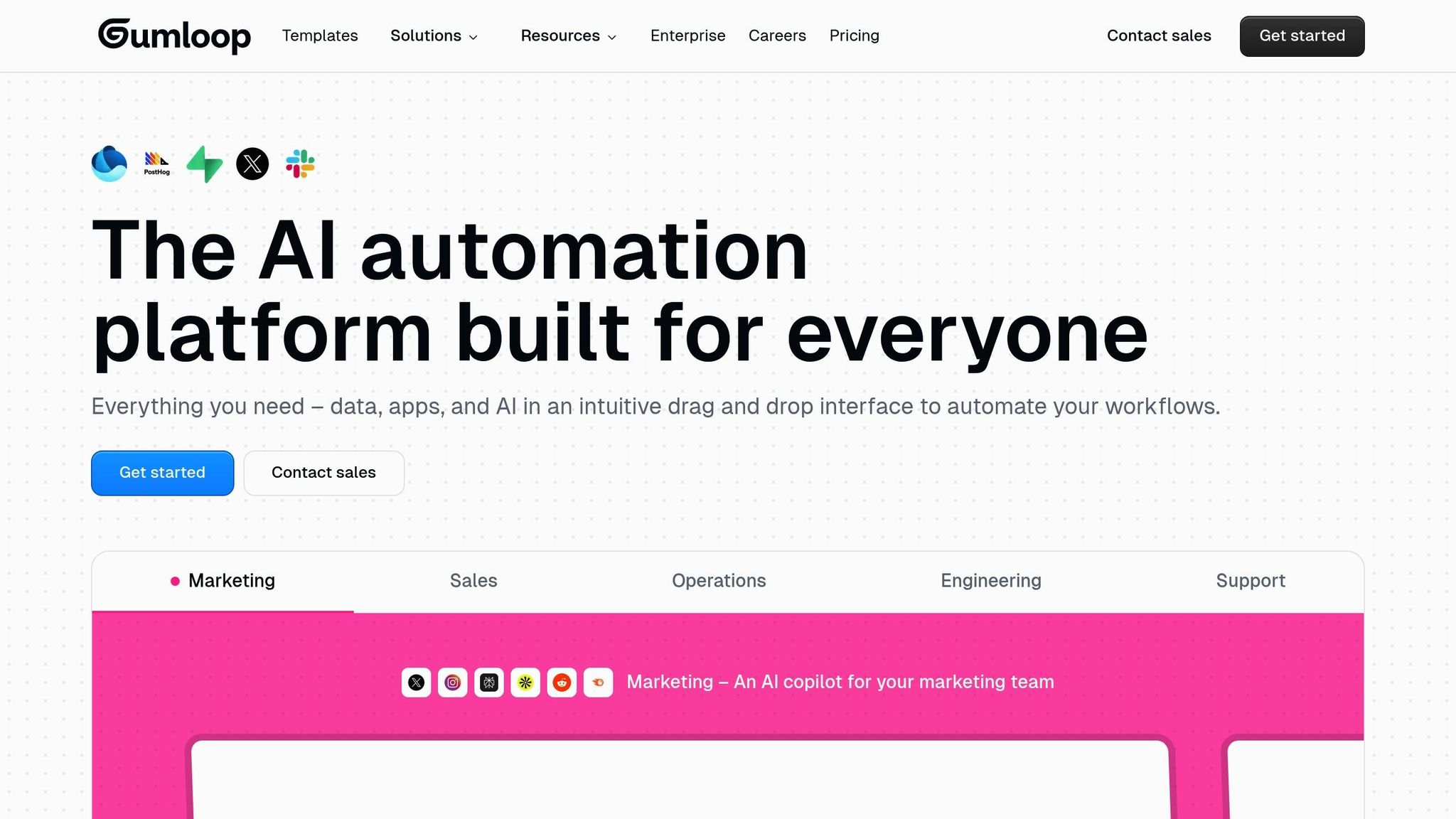
Gumloop is an AI-powered automation platform designed to make leveraging large language models (LLMs) accessible to teams without coding expertise. Launched in 2023, Gumloop has already automated over 400 million tasks, earning the trust of major brands like Instacart, Webflow, and Shopify. Its strength lies in offering enterprise-grade features while remaining user-friendly for non-technical professionals. This approach allows seamless integration across a variety of business systems.
Gumloop offers 120+ pre-built nodes to connect widely-used business tools like Salesforce, Apollo, Gmail, Slack, and Airtable. For even greater flexibility, its guMCP feature enables integration with any application that supports an MCP server. Automations can be triggered through webhooks, REST APIs, or SDKs, while the platform’s AI Router intelligently determines the next steps based on context.
One of Gumloop’s standout features is its support for multiple LLMs, including ChatGPT, Claude, Gemini, Grok, and Deepseek. These models are available under a single subscription, eliminating the hassle of managing separate API keys. Additionally, the AI Proxy feature allows organizations to route requests through their own proxies, keeping API key management under their control.
Gumloop simplifies AI model integration with tools like Gummie, an AI assistant that helps users build automations and debug errors using natural language commands. Users can describe their workflows in plain English, and Gummie automatically generates the necessary node structure. All paid plans include access to advanced LLMs such as GPT o3-pro, Claude 4 Sonnet, and Gemini 2.5 Pro without additional fees for individual models.
"Gumloop has been critical in helping all teams at Instacart - including those without technical skills - adopt AI and automate their workflows, which has greatly improved our operational efficiency." - Fidji Simo, CEO, Instacart
For developers, the Resume feature (Cmd/Ctrl + Shift + Enter) streamlines testing by allowing users to jump directly to specific nodes, saving both time and credits.
Gumloop’s visual canvas makes building complex workflows straightforward. Users can drag and drop elements to create workflows, with modular Subflows available for reuse across projects. For workflows with over 10-15 nodes, breaking them into Subflows enhances organization and ease of maintenance. The Interfaces feature transforms workflows into user-friendly apps, enabling team members to interact with automations without needing to understand the underlying logic.
"Gumloop wins time back across an org. It puts the tools into the hands of people who understand a task and lets them completely automate it away." - Bryant Chou, Co-Founder, Webflow
Additional features include a Chrome extension for recording browser actions on sites without APIs and the ability to create custom nodes, allowing organizations to integrate proprietary tools and databases seamlessly.
Gumloop is tailored for non-technical professionals such as marketers, founders, HR managers, sales teams, and customer support staff. It excels in automating tasks like sales prospecting, monitoring marketing trends, syncing real-time operations data, and triaging customer support inquiries. Teams at Albert have particularly benefited from the platform’s accessibility.
"With Gumloop, any team member can now identify a manual process and turn it into an automated workflow without writing a single line of code." - David Phelps, VP, Academics, Albert
Gumloop uses a credit-based pricing structure with four tiers:
| Plan | Monthly Price | Credits/Month | Key Features |
|---|---|---|---|
| Free | $0 | 2,000 | 1 seat, 1 active trigger, premium LLM access |
| Solo | $37 | 10,000+ | Unlimited triggers, 4 concurrent runs, webhooks |
| Team | $244 | 60,000+ | 10 seats, 5 concurrent runs, dedicated Slack support |
| Enterprise | Custom | Custom | SOC 2/GDPR compliance, VPC deployment, audit logging |
While users appreciate the platform’s clean interface and powerful AI assistant, some note that the learning curve can be steeper compared to more traditional automation tools. As a newer platform, Gumloop’s UI continues to evolve as new features are introduced.
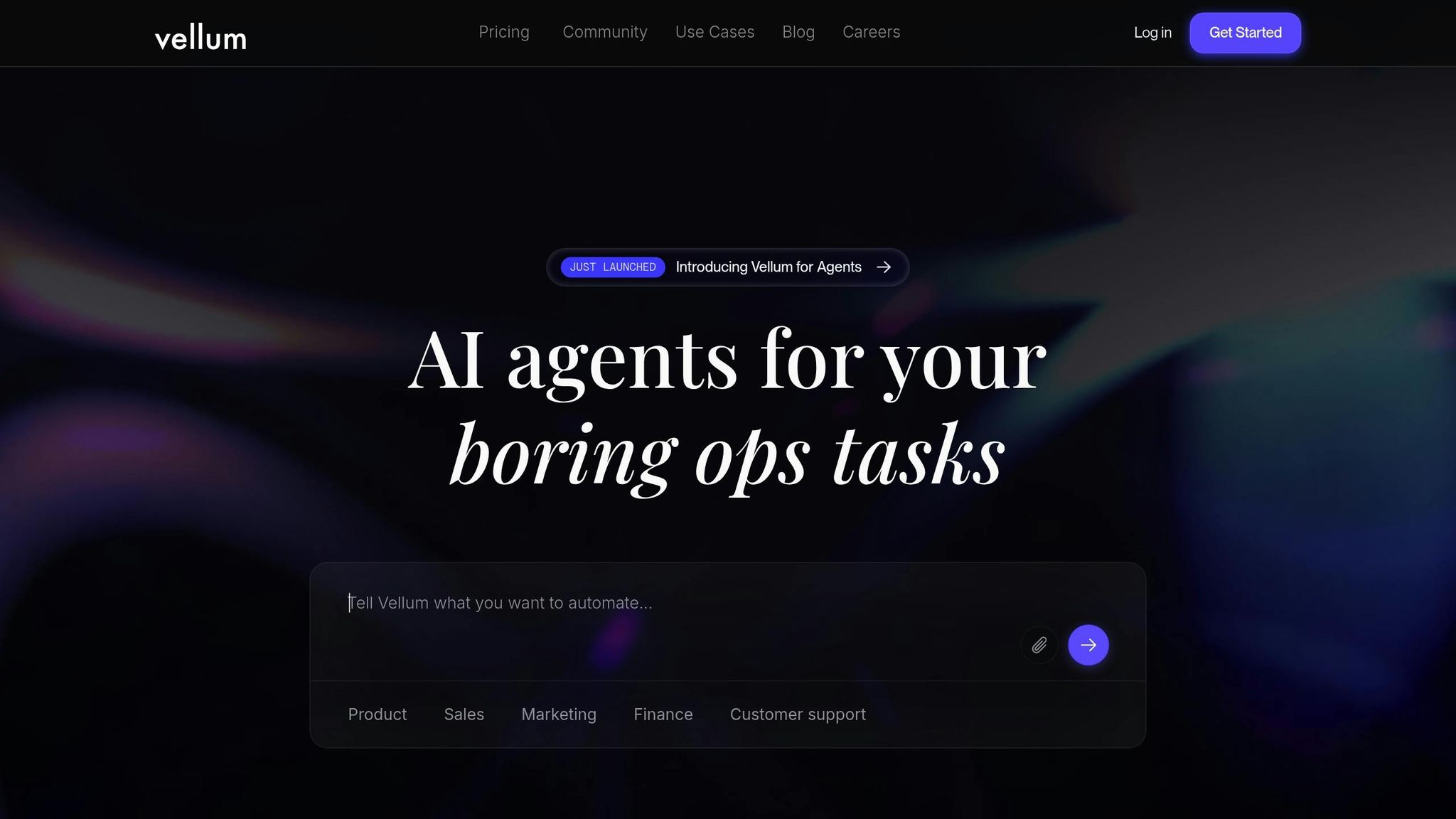
Vellum AI is a robust platform designed to streamline the deployment of AI agents and LLM applications at scale. Its control flow architecture prioritizes defining operation sequences over simple data transformations. This enables advanced capabilities like loops, recursion, state forking, and parallel execution - key features for creating autonomous AI systems capable of handling multi-step actions across diverse platforms.
Vellum integrates seamlessly with over 40 native systems using an extensible node framework. These include API Nodes for making HTTP requests, Code Execution Nodes for running custom Python or TypeScript logic, and Search Nodes for connecting workflows to document indexes. The platform also supports bidirectional sync between its visual editor and TypeScript/Python SDKs, making it easy for engineers and non-technical users to collaborate.
This collaborative approach allows engineers to handle complex logic while non-technical users tweak prompts directly in the interface. All updates hot-reload instantly, ensuring smooth transitions between environments. For example, Woflow leveraged Vellum to accelerate AI development by 50%, decoupling updates from release cycles, as noted by CTO Jordan Nemrow in 2025. These integration capabilities, combined with flexible model orchestration, make Vellum a standout choice for teams building Retrieval-Augmented Generation (RAG) pipelines and other AI workflows.
Vellum's model-agnostic orchestration empowers teams to use multiple LLMs - like those from OpenAI, Anthropic, Google, IBM, and Meta - within a single workflow. This flexibility allows teams to pair low-cost models for simpler tasks, like categorization, with high-reasoning models for more complex outputs, all without juggling multiple API integrations. The platform also includes a natural language Agent Builder, which transforms plain-English descriptions into production-ready workflows.
"We accelerated our 9-month timeline by 2x and achieved bulletproof accuracy with our virtual assistant. Vellum has been instrumental in making our data actionable and reliable." - Max Bryan, VP of Technology and Design
For production environments, Vellum offers Evaluations for rigorous testing, one-click rollbacks for version control, and comprehensive observability to track inputs, outputs, and performance metrics. GravityStack utilized these features to reduce credit agreement review times by 200% for a financial institution in 2025. This approach underscores Vellum's dedication to creating interoperable, intelligent workflows.
Vellum provides Subworkflows, reusable components that streamline logic and maintain consistency across teams. For critical processes, such as legal or financial approvals, the Human-in-the-loop feature pauses workflows, allowing for manual review before proceeding. Additionally, Prompt Diffing enables teams to compare version changes, ensuring safe updates from development to production.
The platform supports flexible deployment options, including cloud, private VPC, hybrid, and on-premises setups - even air-gapped environments for maximum security. Enterprise-grade features like Role-Based Access Control (RBAC), SSO/SCIM, audit trails, and approval workflows cater to organizations with stringent compliance and data residency requirements.
Vellum is tailored for cross-functional teams, enabling engineers, product managers, operations leaders, and business analysts to collaborate effectively on AI projects. It excels in applications like customer support chatbots, legal and document review automation, compliance workflows, and healthcare virtual assistants. For instance, Miri Health used Vellum to develop an AI-powered wellness chatbot, allowing non-engineering stakeholders to actively contribute to product development.
"Vellum made it so much easier to quickly validate AI ideas and focus on the ones that matter most. The product team can build POCs with little to no assistance within a week!" - Pratik Bhat, Senior Product Manager, AI Product
Industries like finance, healthcare, legal, retail, edtech, and public sector organizations benefit the most from Vellum's enterprise-grade governance and rapid AI iteration capabilities.
Vellum offers a free tier for initial testing, with paid plans starting at $25/month. Enterprise plans are available with custom pricing for organizations needing advanced governance, SOC 2 or HIPAA compliance, and flexible deployment options. Pricing scales based on usage and team size, with enterprise customers receiving dedicated support and custom SLAs.
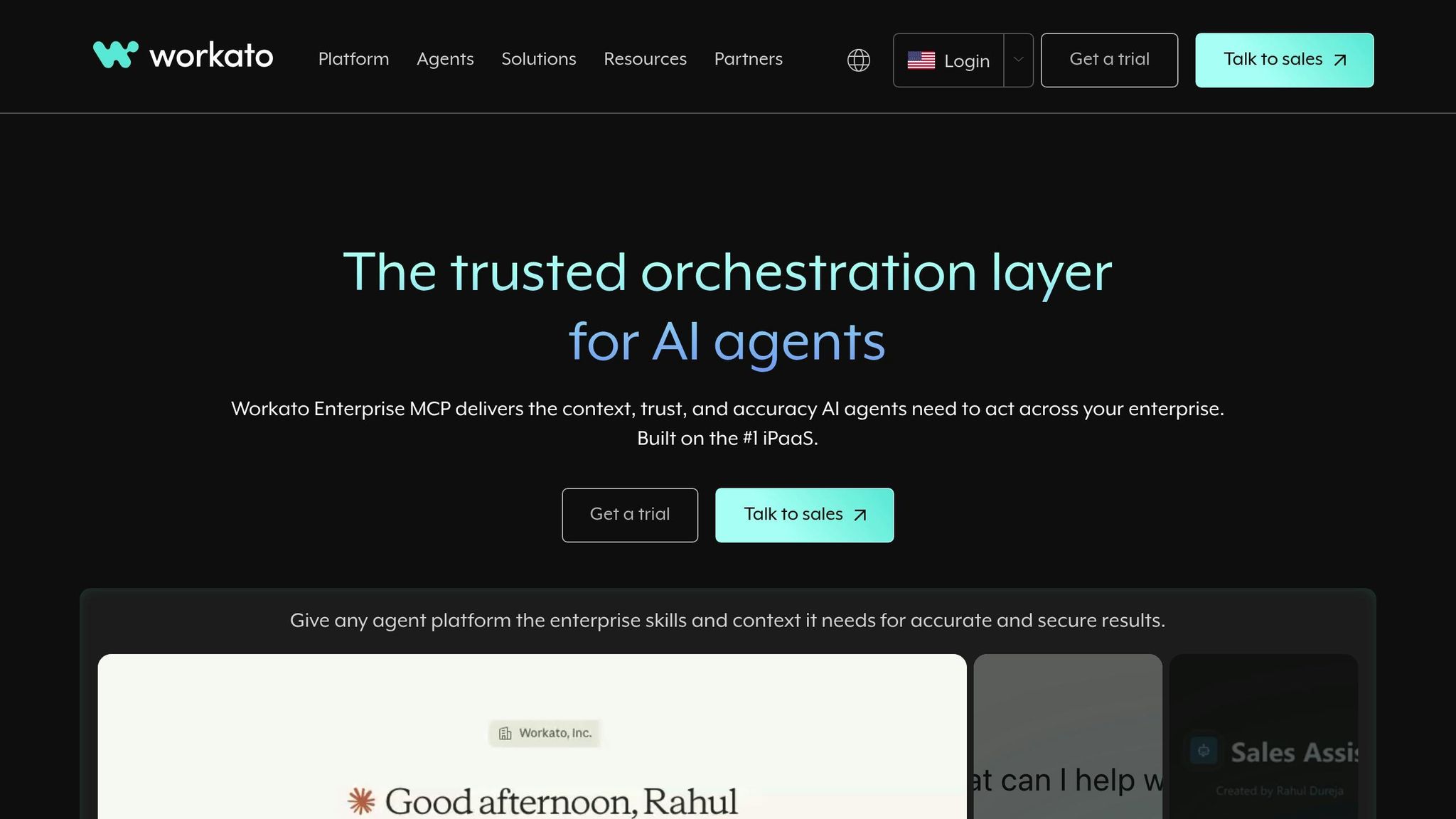
Workato is a powerful integration platform designed for enterprise-level automation, offering Universal Connectivity to link modern SaaS tools, on-premise ERPs, data warehouses, and even older legacy systems. With over 1,200 pre-built connectors for platforms like Salesforce, Workday, SAP, ServiceNow, Snowflake, and Redshift, it provides a comprehensive solution for businesses managing intricate tech ecosystems. Recognized as a Leader in the Gartner Magic Quadrant for Integration Platform as a Service (iPaaS) for seven years straight, Workato has proven its reliability and scalability in enterprise environments. Below, we explore the platform's standout features.
Workato's Enterprise MCP (Model Context Protocol) acts as an orchestration layer, enabling AI agents to perform tasks with contextual precision while ensuring security and auditability. This system differentiates between two types of AI functionalities: Copilots, which use generative AI to create and document workflows, and Agentic AI, autonomous agents developed in Agent Studio to handle multi-step workflows. The MCP Gateway securely exposes APIs and workflows to large language models (LLMs), allowing AI agents to interact with enterprise systems while maintaining strict governance controls like authentication, rate limiting, and compliance monitoring.
The AI by Workato utility connector integrates seamlessly with Anthropic (Sonnet 4) and OpenAI (GPT-4o mini) for tasks such as text analysis, classification, summarization, and translation. It also supports OpenAI, Claude, Llama, and Ollama for actions like chat completion and embedding generation. Agent Studio provides a low-code environment for creating, testing, and deploying AI agents - referred to as "Genies" - customized for business needs like HR onboarding, IT password resets, and sales research. To maintain compliance, Workato enforces data residency, ensuring AI data processing occurs within the source region's data center in the US or EMEA. These AI features help businesses simplify and accelerate even the most complex processes.
Workato is designed to meet the needs of both business and IT teams. Business users benefit from no-code accelerators, while IT teams can leverage the platform's robust governance tools and Connector SDK. Companies have reported processing employee relocation requests 98% faster and saving over 100,000 hours through automation.
"Business users quickly adopt Workato and become champions for broader team empowerment." - Mohit Rao, Head of Intelligent Automation
Workato follows a plan-based pricing structure, with details available through direct sales contact. AI capabilities are included in select plans, with specific rate limits depending on the customer tier. The platform is built with enterprise-grade security, featuring SOC 2 Type II, ISO 27001, and GDPR compliance to ensure data protection and trustworthiness.
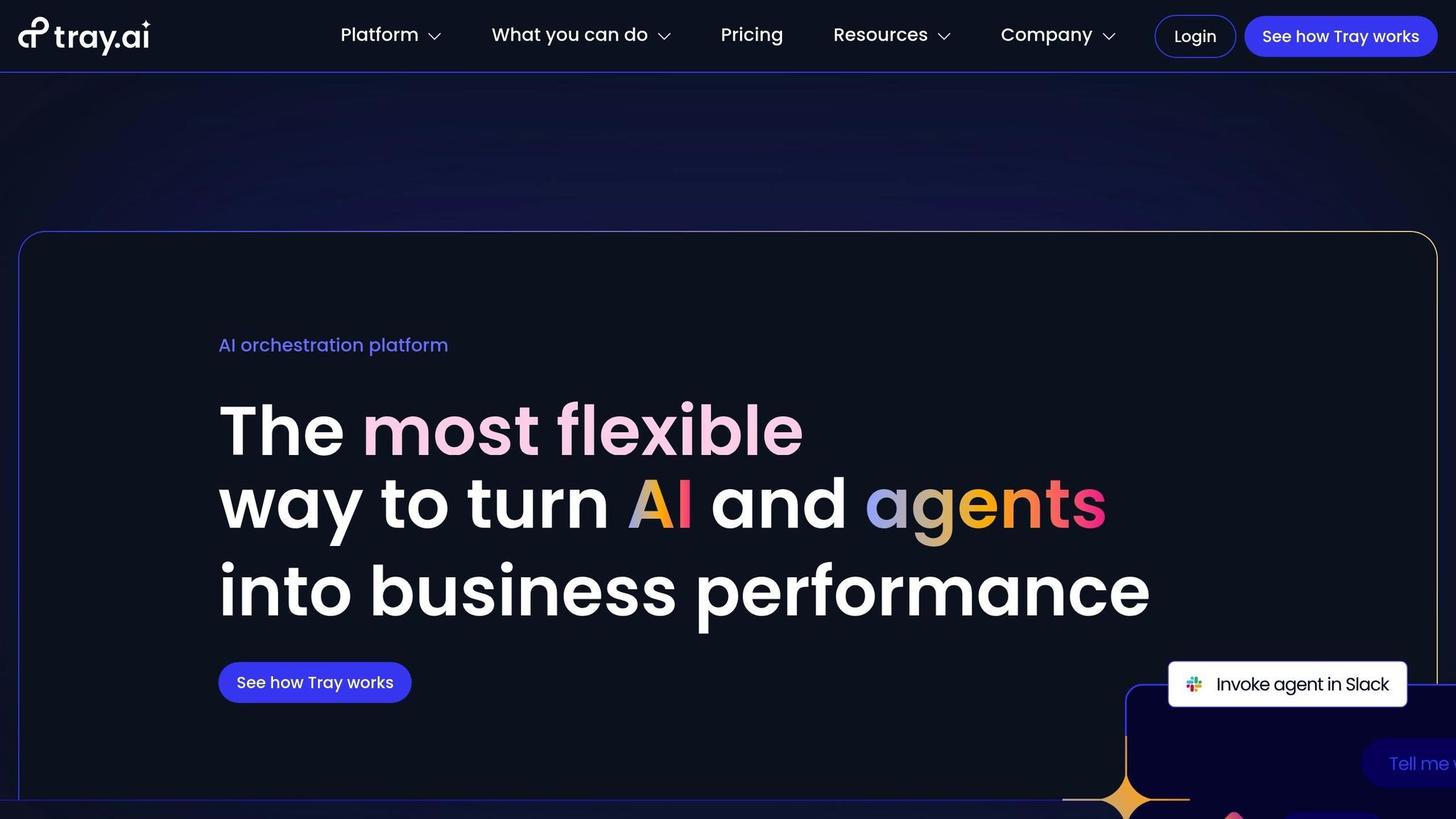
Tray.io is a powerful integration platform equipped with over 700 connectors and advanced AI orchestration tools, catering to both business users and developers. With a customer base exceeding 1 million, it has earned the title of "AI-ready iPaaS." One standout feature is the Merlin Agent Builder, a no-code tool that allows users to create and deploy AI agents capable of analyzing company data and performing tasks across popular platforms like Salesforce, HubSpot, Workday, and NetSuite.
Tray.io’s Agent Gateway gives IT teams centralized oversight of Model Context Protocol (MCP) servers and tools, ensuring strong governance and transparency as AI capabilities grow. The platform provides native connections to top large language models, including OpenAI (GPT), Amazon Bedrock, and Claude Sonnet 4.5. Its Hybrid Connectivity feature securely links on-premises databases and legacy systems to cloud workflows without exposing them to the public internet. Developers can also leverage the Connector Development Kit (CDK) to create or import integrations using TypeScript or OpenAPI. These tools form the backbone of Tray.io’s integration and AI capabilities.
Tray.io builds on its integration strengths with the AI Palette, enabling teams to quickly prototype AI-enhanced workflows and adapt to the latest large language model (LLM) advancements in minutes. The platform uses Vector Tables and Memory and Knowledge features to ground AI agents in enterprise data, ensuring accurate and context-aware responses. For example, Apollo, a Tray.io customer, reduced IT ticket volume by nearly 40% by deploying an AI agent built on the platform. To safeguard sensitive information, the Merlin Guardian feature offers encryption, tokenization, and redaction, while maintaining compliance with SOC 1, SOC 2 Type 2, GDPR, HIPAA, and CCPA standards.
Tray.io is designed for both IT teams that prioritize governance and security and business teams in departments like Sales, Marketing, HR, and Finance that benefit from no-code automation. Revenue Operations teams use the platform to streamline lead-to-cash processes, while HR teams integrate tools like Workday, Greenhouse, and BambooHR to improve applicant tracking. Product teams can embed integrations directly into their software, enabling customers to connect systems without leaving the app. The Agent Hub further simplifies the process by offering reusable components and data sources to speed up the creation of custom AI agents.
Tray.io follows an enterprise pricing model based on workspaces and task volume. It supports regional hosting in the US, EU, and APAC to meet data residency requirements. Additionally, its Elastic Execution feature ensures automatic scaling during peak usage, eliminating the need for manual server management.
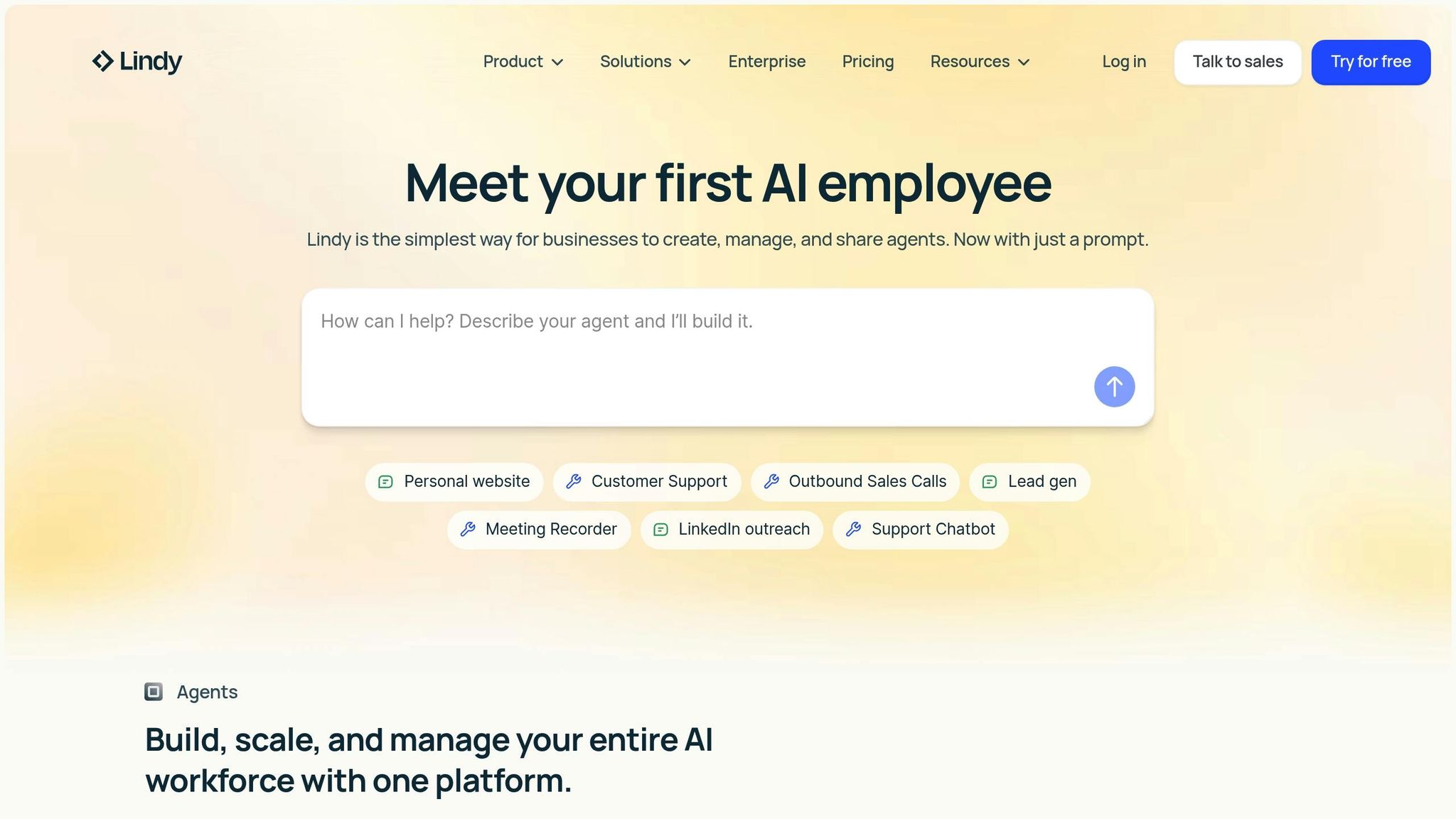
Lindy.ai approaches workflow automation with a fresh perspective, relying on AI agents that learn and adapt instead of sticking to fixed, pre-programmed rules. Designed for non-technical teams and knowledge workers - who often spend nearly 40% of their time on repetitive tasks - Lindy.ai stands out by offering agents with persistent memory and context. This means they can make smarter decisions based on prior interactions, even when faced with unexpected inputs, unlike traditional automation tools that may falter in such scenarios.
Lindy.ai connects seamlessly with over 3,000 apps right out of the box and extends to 7,000+ integrations across 1,600+ apps through native connectors, Pipedream partnerships, APIs, and webhooks. Its standout feature is multi-agent collaboration, where specialized AI agents work together in what Lindy calls "agent societies." For instance, one agent might research a lead, another drafts an email, and a third updates the CRM - all operating in sync. The Autopilot feature adds another layer of flexibility by allowing agents to use their own virtual "computers in the cloud" to handle tasks that lack direct API integrations. This extensive integration ecosystem enhances Lindy.ai’s ability to streamline workflows across various platforms.
Lindy.ai taps into the power of large language models like GPT and Claude to process unstructured data and handle unpredictable inputs that would typically disrupt rule-based systems. This AI-first approach can cut task processing times by 67% and deliver organizations a 30–200% ROI within the first year. These agents function more like human assistants, thinking and adapting in real time. Their versatility shines in applications such as sales lead enrichment, customer support ticket prioritization based on sentiment and urgency, recruitment workflows, and operational tasks like managing emails or taking meeting notes.
Lindy.ai makes customization easy with an intuitive agent builder. Users can create agents using simple natural language prompts or a drag-and-drop visual editor, making it especially user-friendly for non-technical individuals. The platform adheres to strict compliance standards, including SOC 2, HIPAA, GDPR, PIPEDA, and SOX, making it a trusted choice for industries like healthcare and finance that handle sensitive data.
Lindy.ai offers a free plan that includes 400 credits per month. For those needing more, the paid plan starts at $49/month, covering up to 5,000 tasks. This pricing structure ensures accessibility for small teams and individual professionals looking to automate repetitive tasks efficiently.
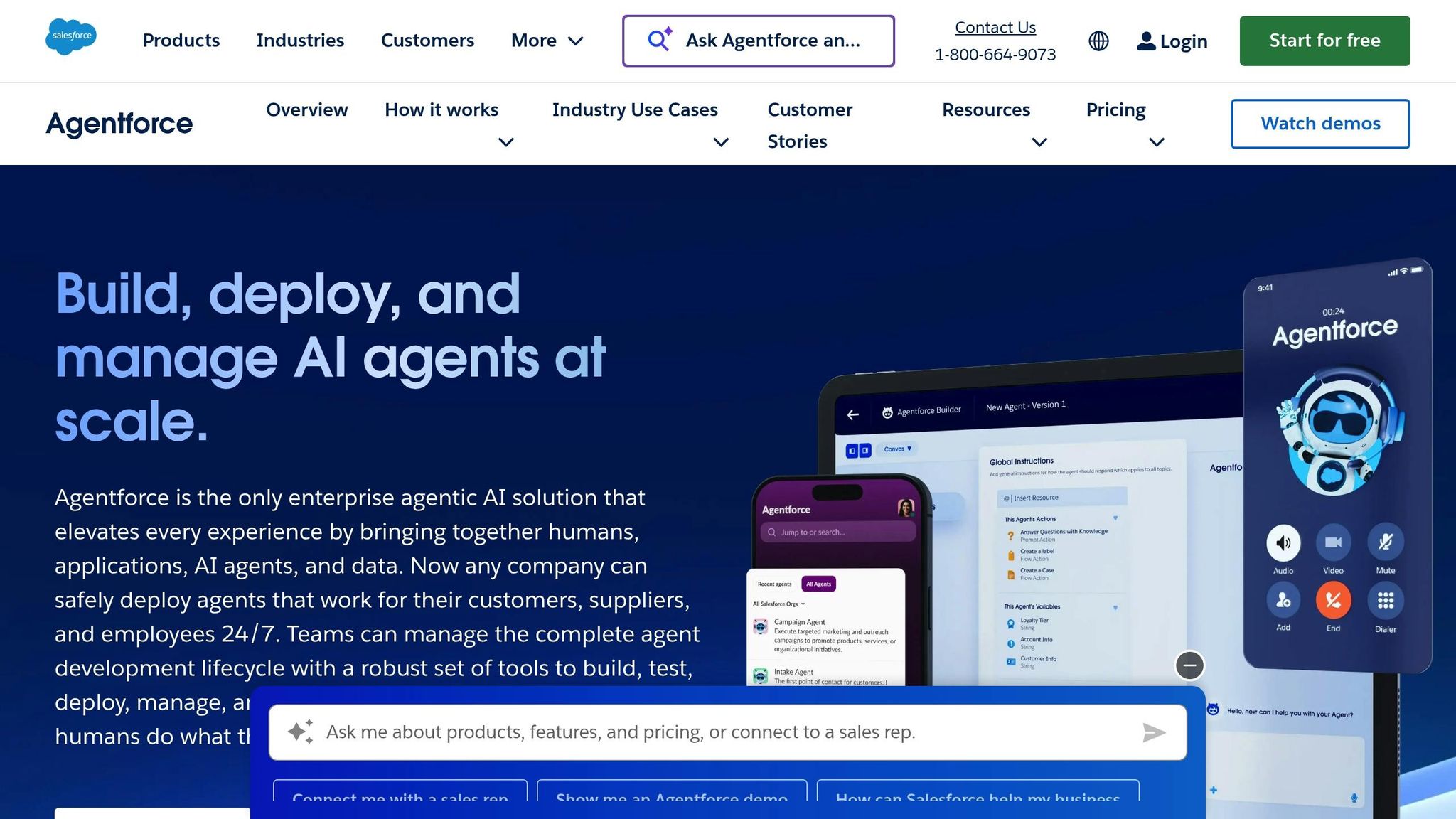
Agentforce integrates directly with Salesforce Customer 360, bringing advanced AI capabilities to streamline workflows across Sales, Service, Marketing, and Commerce. Powered by the Atlas Reasoning Engine, it simplifies complex processes by breaking them into manageable steps, evaluating execution strategies, and autonomously completing multi-step tasks. Its deep connection with Salesforce ensures secure and efficient automation tailored for enterprise needs.
Agentforce extends its functionality beyond Salesforce using MuleSoft Agent Fabric and API connectors, enabling seamless communication with legacy systems and external databases. With Data 360, structured and unstructured data can be unified for Retrieval-Augmented Generation (RAG) without duplicating data, saving both time and resources. Security is a top priority, with the Einstein Trust Layer offering features like toxicity detection, zero data retention, and dynamic grounding to safeguard sensitive enterprise information during interactions with large language models (LLMs). The platform also supports the Model Context Protocol (MCP), an open standard that facilitates secure context-sharing between various agents, models, and tools.
Agentforce combines deterministic workflows with the flexibility of LLMs through its hybrid reasoning approach. Developers can define step-by-step business logic using "Agent Script", while LLMs handle conversational elements, ensuring reliability for critical operations. According to Salesforce, this approach allows businesses to create AI agents 16 times faster than traditional methods. A real-world success story comes from Wiley, the publishing company, which reported a 40% boost in case resolution during their back-to-school season in September 2024 by using Agentforce to manage routine account access and payment inquiries.
Designed for both low-code Salesforce administrators and pro-code developers, Agentforce is versatile enough to serve industries like healthcare, banking, retail, and finance. By automating repetitive and time-consuming tasks, it helps companies reclaim time for higher-value work. For example, healthcare providers can use it to handle patient inquiries, banks can streamline client requests, retailers can gain campaign insights, and finance teams can detect fraud more effectively. Notable users include OpenTable, which leverages Agentforce to support restaurants and diners, and Saks Global, which uses it to enhance personalized luxury retail experiences.
Agentforce operates on a consumption-based pricing model, starting at $2 per conversation, with volume discounts available for larger enterprises. To help businesses explore its capabilities, Salesforce offers Salesforce Foundations as a $0 add-on for Enterprise Edition and higher, including credits for the first 1,000 conversations. Pricing options are flexible, with choices like per-conversation billing or per-user licensing. Agentforce has also earned recognition as the top platform in Agentic AI on G2, further solidifying its reputation in the market.
Getint sets itself apart by prioritizing high-quality, synchronized data, a cornerstone for effective AI agents. While many platforms focus heavily on automation triggers and actions, Getint takes a different route, emphasizing bi-directional synchronization across work management, ITSM, and development tools. This ensures that issues, incidents, changes, and tasks remain perfectly aligned across systems, creating a solid foundation for smooth integrations and dependable AI performance.
Getint delivers two-way, field-level synchronization, handling complex data structures and custom fields effortlessly. Unlike tools that rely on one-way automation, Getint dives deeper, ensuring comprehensive synchronization for intricate objects. This is particularly important for AI agents operating in fragmented tool environments. Security is a top priority, with ISO 27001, SOC 2 Type II, and GDPR compliance, alongside AES-256 encryption for data at rest and Cloud Fortified Status to enhance trust.
The platform plays a crucial role in AI-driven workflows by guaranteeing real-time, accurate data - a must for large language models (LLMs). When AI agents rely on data from multiple systems, inconsistencies or outdated information can lead to poor decisions or even hallucinations. Getint eliminates these risks by keeping data synchronized and contextually complete, ensuring AI workflows are built on a dependable, high-quality data foundation.
Getint is designed for ITSM, development, operations, and PMO teams that need more than basic automation. It’s particularly valuable for teams that require seamless alignment of issues, incidents, and tasks across systems, ensuring no context is lost during integrations.
Getint complements its technical capabilities with connection-based pricing that includes unlimited users. This predictable model simplifies budgeting for enterprise-scale deployments, as teams can grow without the worry of escalating per-user costs.
Different platforms bring unique strengths to the table, often influenced by factors like technical skills, budget, and integration needs. Zapier stands out with its impressive library of nearly 8,000 app integrations and an intuitive no-code interface, making it a top choice for non-technical teams. However, its costs can escalate significantly as usage scales.
On the other hand, platforms like n8n and Make (Integromat) cater to users who prioritize customization. These tools offer self-hosting options and visual workflow builders, giving developers the flexibility to go beyond pre-built connectors. For teams working on AI-intensive workflows, Gumloop simplifies API management by bundling premium access to LLMs like OpenAI and Anthropic within its subscription.
For enterprises, Workato provides a strong focus on governance and seamless integration with legacy systems, though pricing typically requires direct consultation. Meanwhile, specialized platforms like Vellum AI and Lindy.ai address niche needs. For instance, Lindy.ai offers pre-built AI agents designed to handle repetitive tasks like email triaging.
When choosing an AI workflow system, it's essential to align your selection with your team's technical expertise, budget, and compliance requirements. Zapier is a standout option for no-code teams, offering connectivity with over 8,000 apps. However, as usage increases, costs can rise significantly. For teams that need more control and self-hosting capabilities, n8n provides flexibility and affordable hosting options, making it a solid choice.
Enterprise organizations in regulated industries, such as banking or healthcare, should focus on platforms with robust governance and compliance features. Workato and Tray.io shine in hybrid setups, offering secure on-premises connectivity. On the other hand, Vellum AI caters to engineering-driven teams, offering tools for complete pipeline monitoring and prompt experimentation.
For teams heavily reliant on AI workflows, Gumloop simplifies operations by bundling premium LLM access into its subscription, eliminating the hassle of managing multiple API keys. If you're working within a tighter budget, Make is worth exploring. It offers over 7,500 templates starting at $10.59/month, though it may require more time to master compared to other options. Lastly, for specialized needs like email triaging or automating repetitive tasks, Lindy.ai provides pre-built AI agents, with Pro plans starting at $49.99/month.
When selecting an AI-powered workflow system, it's important to zero in on the features that will drive efficiency and align with your organization's objectives. Start with integration capabilities - the system should connect effortlessly with your current tools, data sources, and AI models, ensuring smooth automation and uninterrupted data flow.
Equally important is adaptability. The platform should be able to adjust to evolving inputs or conditions, making it possible to support dynamic and ever-changing workflows.
Don't overlook automation, security, and cost management. A top-tier system will include advanced automation features, strong security protocols to safeguard your data, and tools to monitor and manage expenses effectively.
Lastly, think about user experience and scalability. An intuitive interface simplifies adoption across teams, while scalability ensures the system can handle increasing workloads and meet future demands. By focusing on these aspects, you’ll be better equipped to choose a solution that strengthens AI-driven processes and aligns with your long-term goals.
AI workflow platforms like n8n and Zapier serve different audiences by prioritizing usability and cost in unique ways. n8n stands out with its flexible, visual design and advanced customization features, making it a go-to choice for technical users or teams handling more intricate workflows. It also supports self-hosting, giving users greater control over their data and infrastructure - a major perk for those comfortable with technical configurations.
Zapier, by contrast, prioritizes simplicity and accessibility. Its user-friendly interface connects thousands of apps with minimal effort, making it an excellent option for non-technical users who want quick, hassle-free automation.
When it comes to pricing, n8n employs a workflow execution-based model and offers free self-hosting, which can be a cost-efficient choice for managing large-scale or complex workflows. Zapier, on the other hand, uses a task-based pricing structure with predictable subscription tiers. While these tiers are straightforward, costs can rise significantly as the number of executed tasks increases.
In essence, n8n is ideal for those who value customization and scalability, while Zapier shines in its ease of use and straightforward setup process.
For large enterprises, choosing an AI workflow system that integrates seamlessly into complex operations is crucial. Opus stands out as a top-tier solution, offering an enterprise-grade platform tailored to industries like healthcare, banking, and energy. With a focus on rapid deployment, strict compliance, and secure automation, it’s well-suited for managing large-scale workflows efficiently.
Another noteworthy option is IBM's watsonx Orchestrate, designed for smooth integration across various AI tools and models. It supports multi-agent orchestration while addressing critical enterprise needs such as governance, scalability, and observability.
For organizations juggling multiple AI tools, MuleSoft's Agent Fabric offers centralized control and oversight. It simplifies orchestration across disparate AI systems, ensuring both efficiency and compliance. These platforms cater to the complex demands of large enterprises, delivering the security, adaptability, and intelligent automation required for success.