Pay As You Go - AI Model Orchestration and Workflows Platform


AI platforms with usage and tracking tools are transforming how businesses manage artificial intelligence. They address issues like security risks, compliance challenges, and spiraling costs while improving oversight and efficiency. Here's why they matter:
With over 65% of organizations citing AI monitoring as a challenge, these platforms provide the structure to scale AI safely and efficiently, cutting costs and improving governance.
5 Key Benefits of AI Platforms with Usage Tracking and Monitoring
When AI systems lack proper oversight, they can quickly become unpredictable. Real-time tracking changes the game by turning raw platform data into insights that are easy for everyone - engineers, finance teams, and more - to grasp. Instead of juggling scattered data sources, a unified dashboard brings together metrics, usage patterns, and financial data into one clear view, making it easier to track and improve performance.
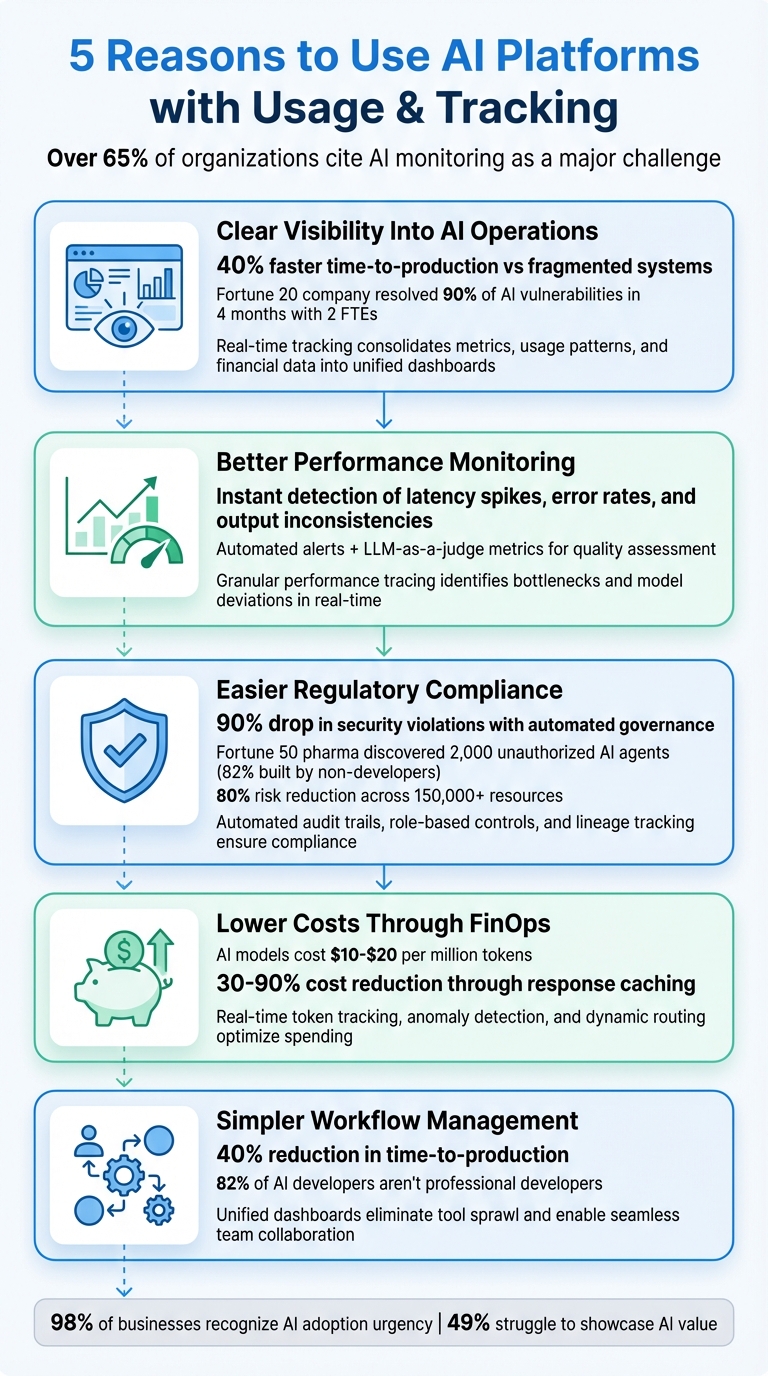
Take this example: In 2024, a Fortune 20 Technology company used real-time monitoring to address 90% of its AI vulnerabilities in just four months. Remarkably, this was achieved with only two full-time employees managing the entire program. As their AI operations expanded by 280% over the next year, self-service tools and automated fixes scaled seamlessly to meet the demand. Similarly, a Fortune 50 Financial Services firm reduced their overall risk by 80% across more than 150,000 resources. They achieved this by identifying and addressing issues like over-shared data access and misconfigured AI agents through enhanced visibility.
These platforms go beyond surface-level metrics. Step-level behavioral monitoring, for instance, provides a detailed view of how AI agents operate - tracking every decision, from tool usage to memory updates and retrieval-augmented generation (RAG) queries. This kind of granular tracking doesn’t just show what an AI agent did; it explains why it made specific decisions. Companies that adopt such comprehensive tools report a 40% faster time-to-production compared to those using fragmented systems.
Distributed tracing offers an even deeper level of insight, capturing the entire execution path of an AI process - from the initial prompt to the final response. Meanwhile, audit logs document critical details like user IDs, timestamps, and request origins, ensuring full transparency and accountability across deployments . This robust tracking framework is essential, especially when over 65% of organizations deploying AI systems cite monitoring and quality assurance as their biggest technical hurdle. With this level of visibility, businesses can ensure their AI operations are not only secure but also highly efficient.
When AI models are deployed in production, unexpected issues like latency spikes, rising error rates, or output inconsistencies can occur. Platforms equipped with real-time monitoring tools can detect these problems as they arise, rather than days later when users have already encountered them. Automated alerts notify teams instantly if critical metrics - such as prediction/online/error_count or prediction/online/prediction_latencies - exceed predefined limits. This quick response helps teams resolve problems before they escalate into significant disruptions. Additionally, detailed data tracing supports fine-tuned performance adjustments.
While alerts handle immediate concerns, in-depth diagnostics uncover the root causes. Performance tracing goes a step further by recording the inputs, outputs, and metadata of every single request. This granular data helps identify where models deviate, whether the issue lies in retrieval processes, tool integrations, or prompt execution. For example, tracking metrics like "first token latency" and "token throughput" can highlight response delays and pinpoint bottlenecks.
Advanced platforms also leverage "LLM-as-a-judge" metrics to automatically assess response quality, relevance, and hallucination rates . This structured evaluation allows teams to compare the performance of different model versions, link metrics back to specific datasets, and revert to earlier checkpoints if a new deployment falls short. These tools ensure that AI systems remain efficient and reliable, even as they evolve.
Meeting regulatory requirements becomes far simpler when platforms automatically document key aspects like model intent, risk assessments, training data, and evaluation processes. Detailed audit trails capture everything: who performed an action, when it happened, what changes were made, and whether the operation was successful or not. These practices ensure a clear record of activities, offering the transparency and oversight essential for governance.
But compliance isn’t just about keeping records. Advanced platforms can automatically detect unauthorized "shadow AI" agents operating within an organization. In 2025, a Fortune 50 Pharmaceutical company uncovered 2,000 instances of AI agents being shared across its departments without proper oversight. Alarmingly, 82% of these systems were developed by individuals who were not professional developers. By implementing automated AI security and governance tools, organizations have reported a 90% drop in security violations, with up to 95% of high-risk issues being resolved automatically, without the need for manual intervention.
"Model governance is a framework that gives systematic visibility into machine learning (ML) model development, validation, and usage."
Role-based access controls further strengthen compliance by restricting system modifications to authorized users only. Additionally, lineage tracking provides a complete view of an AI model's lifecycle - from data collection to deployment - ensuring every decision can be traced back to its source. This level of traceability is exactly what regulators demand. For instance, a Fortune 50 financial services company reduced risk by 80% across a tenant with over 150,000 resources through centralized AI management.
As AI expenses climb, keeping costs under control has become a top priority. With models typically costing between $10 and $20 per million tokens, effective financial management tools are no longer optional - they’re essential.
Platforms equipped with integrated FinOps tools transform unpredictable monthly costs into actionable, real-time insights. By tracking tokens at a granular level, these tools log every input, output, and even request metadata, including latency. This level of detail allows spending to be mapped to specific workspaces, projects, users, or agents, eliminating hidden usage and enabling precise chargeback models across departments. Such transparent financial tracking naturally paves the way for automated cost management, adding even more value to the platform.
"AI cost observability... turns cost from a post-facto finance report into a real-time operational signal."
To further protect budgets, automated anomaly detection identifies unexpected spending spikes or misconfigurations. Dynamic routing optimizes costs by directing simple tasks to more affordable models while reserving advanced models for complex jobs. Additionally, response caching for frequently asked queries can reduce costs by 30% to 90%. Teams using tools like n8n report more predictable expenses once cache hit rates surpass 30%.
Pay-as-you-go pricing offers another layer of flexibility by tying costs directly to actual usage. Organizations can set soft spending limits, triggering alerts when budgets hit thresholds like 80%, ensuring no surprises while keeping critical operations running smoothly. For non-urgent tasks, options like spot instances and batch endpoints provide discounted rates, further reducing costs without compromising efficiency.
"Tokens are the meter, and if the meter is hidden, the bill surprises never end."
Juggling multiple platforms like billing dashboards, code repositories, and monitoring systems can eat up valuable time. By integrating usage tracking into a single dashboard, teams gain a centralized view that simplifies collaboration and boosts workflow efficiency. This consolidation becomes especially important as AI projects grow, considering that 82% of individuals developing AI systems aren't professional developers.
Features like audit trails and team activity logs add a layer of accountability by linking every action - whether it’s training a model, publishing workflows, or making configuration changes - to specific users and timestamps. These tools, seamlessly woven into daily workflows, provide real-time oversight that aids both security and troubleshooting. For instance, a Fortune 20 technology company resolved 90% of its AI vulnerabilities within just four months by leveraging automated observability and self-service remediation tools. These capabilities not only enhance accountability but also ensure smoother operations by integrating detailed activity logs and audit trails.
Unified AI platforms can cut time-to-production by 40%, thanks to features like prompt versioning, role-based access, and human-in-the-loop workflows that simplify coordination. By offering a single source of truth, these platforms reduce deployment cycles and lay the groundwork for scalable and secure AI operations. With streamlined workflows, teams can move faster and with greater confidence.
Every advantage of integrated AI management - from enhanced oversight to smoother workflows - works in harmony to establish a strong, efficient AI ecosystem. These tools directly tackle the challenges of monitoring and managing AI systems, ensuring organizations stay ahead in a competitive landscape.
AI platforms equipped with usage tracking redefine how AI is managed by delivering key benefits. Centralized visibility replaces scattered tools, allowing for seamless performance optimization and early issue detection. Automated audit trails and version control simplify compliance, while real-time cost tracking ensures every dollar spent on compute, storage, and API calls is accounted for. A single, unified dashboard enhances team collaboration and workflow efficiency.
Organizations that adopt comprehensive AI observability report marked improvements in security and operational performance. With 98% of businesses recognizing the urgency of AI adoption and 49% struggling to showcase its value, achieving success hinges on clear visibility and control. Platforms with integrated tracking tools enable you to measure, refine, and demonstrate the impact of AI with confidence.
AI platforms are essential for organizations aiming to uphold compliance and solid governance standards. They come equipped with tools to track model usage, manage versioning, and maintain detailed audit logs, allowing businesses to keep an eye on critical factors such as fairness, accuracy, data drift, and performance.
These platforms also streamline the documentation of model lineage and the application of policy controls, which helps organizations meet regulatory demands more efficiently. By automating these tasks, businesses can enhance transparency, minimize risks, and confidently prove their compliance efforts.
AI platforms equipped with usage tracking tools give businesses a clear way to monitor and manage their AI spending. By tracking token usage, these platforms break down every prompt and response into measurable units, translating them into dollar amounts. A centralized dashboard consolidates this data across various models, allowing developers to pinpoint inefficiencies and adjust usage on the spot.
To keep spending in check, these platforms include features like budget alerts and spending controls. Users can set dollar-based limits or warnings, and the system can notify relevant team members - or even pause activity - once thresholds are met. Purchasing token bundles at discounted rates is another option to avoid unexpected overages and lower overall costs.
These tools also simplify cost management by centralizing usage logs, enabling cost-center tagging, and generating exportable reports for audits. What used to be a tedious, manual process is now automated and efficient, helping businesses stay on budget while getting the most out of their AI investments.
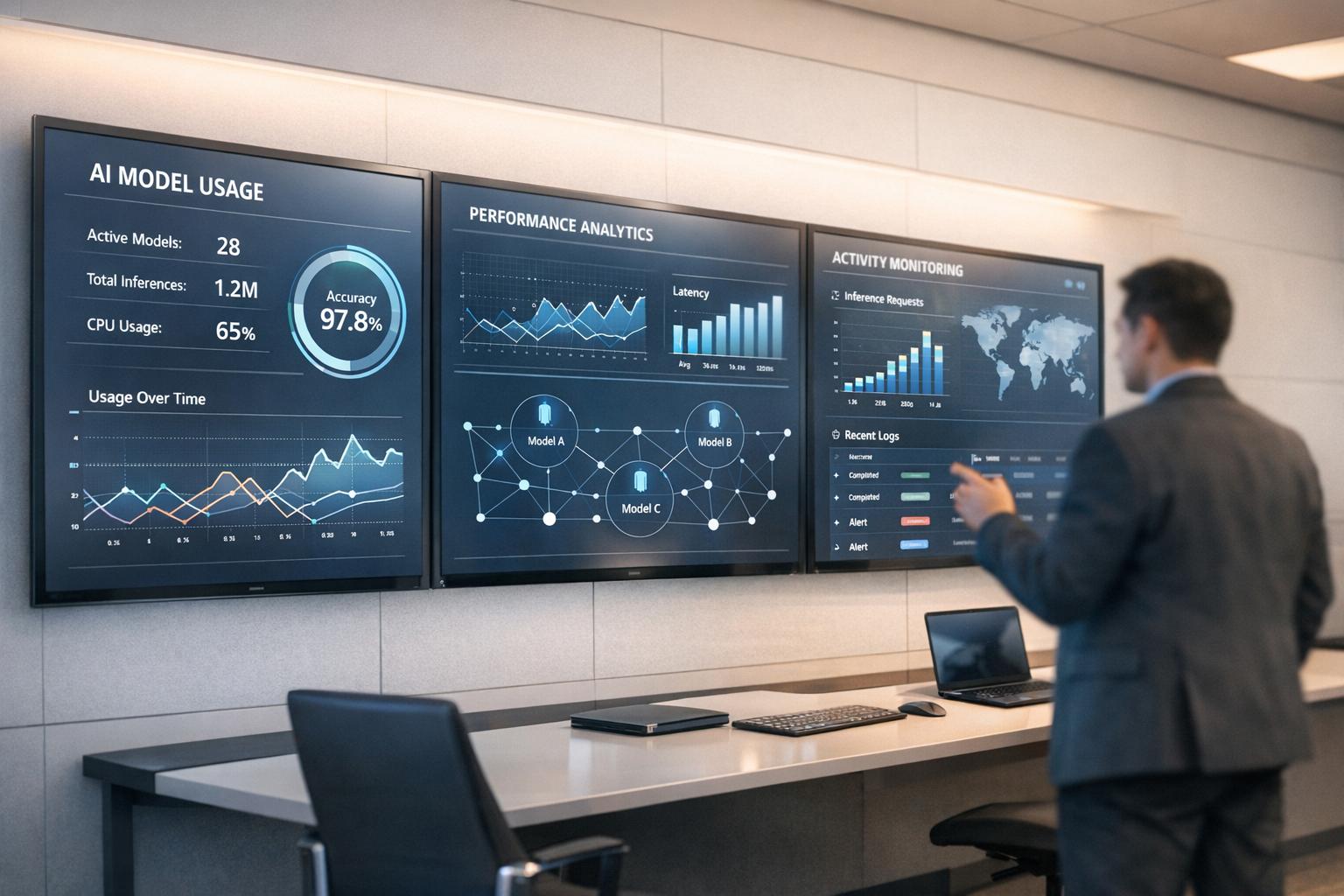
Centralized dashboards offer a clear, unified view of AI model performance by bringing together essential metrics like usage, latency, error rates, and costs into one intuitive interface. This real-time access allows teams to quickly pinpoint bottlenecks, monitor resource usage, and adjust models proactively to prevent potential issues. With interactive charts and tables, engineers can analyze data effectively and make precise adjustments to improve both accuracy and efficiency.
These dashboards also simplify teamwork by acting as a single source of truth for all stakeholders - whether they’re data scientists, developers, product managers, or compliance officers. Instead of relying on scattered spreadsheets or inconsistent reports, everyone can view the same metrics, identify anomalies, and collaborate on solutions in one central hub. This approach minimizes miscommunication, accelerates decision-making, and promotes accountability. By leveraging these tools, organizations can achieve smoother operations, better-performing models, and more efficient budget control.