Pay As You Go - AI Model Orchestration and Workflows Platform



AI tools are reshaping how businesses function by cutting costs, saving time, and increasing productivity. Companies using these solutions report up to 30% lower operational costs and a 25% productivity boost. With AI expected to add $13 trillion to the global economy by 2030, adopting the right tools can give your business a competitive edge.
These tools tackle inefficiencies like repetitive tasks and disconnected systems, helping businesses achieve faster results, better compliance, and significant cost savings. Whether your focus is on automating workflows, improving customer experiences, or scaling AI usage, this list offers solutions tailored to your needs.
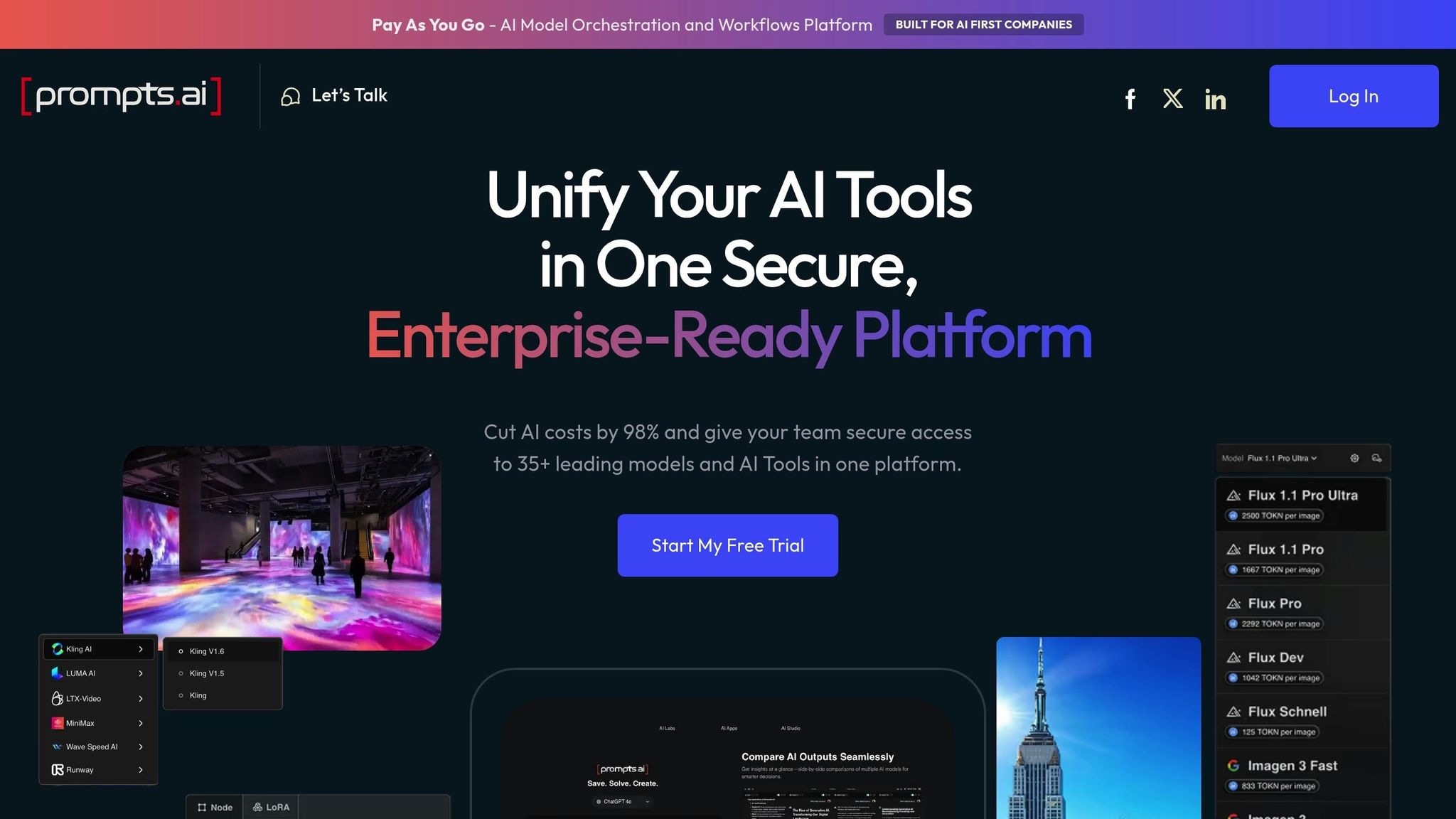
Prompts.ai is an enterprise-grade AI orchestration platform that brings together over 35 leading large language models - including GPT-5, Claude, LLaMA, Gemini, Grok-4, and Flux Pro - within a single, secure interface. By consolidating access to these models in one dashboard, it eliminates the hassle of juggling multiple subscriptions and significantly reduces costs.
The platform's multi-model flexibility allows businesses to select the most suitable AI model for each task, avoiding vendor lock-in. For instance, marketing teams can rely on Claude for crafting detailed content, data analysts can extract insights using GPT-5, and developers can compare and refine prompts across LLaMA and Gemini. This tailored approach ensures every task benefits from the best-fit model, moving beyond one-size-fits-all solutions.
Prompts.ai offers real-time FinOps tracking to monitor token usage across models and teams. Its pay-as-you-go TOKN credit system replaces recurring subscription fees, so you only pay for what you use. By consolidating multiple licenses into one platform with transparent usage metrics, businesses can cut AI software expenses by as much as 98%.
At its core, the platform prioritizes enterprise-grade governance. It provides detailed audit trails that document every AI interaction, helping organizations meet compliance standards and adhere to internal security policies. Administrators can manage access to specific models, enforce spending limits, and track usage patterns - all while ensuring sensitive data remains secure and never shared with third parties.
Prompts.ai goes beyond just model access and cost management. It includes curated prompt workflows and offers a Prompt Engineer Certification program to establish best practices. Teams can quickly implement repeatable, compliant processes, transforming experimental efforts into scalable operations. Designed to serve a wide range of organizations - from Fortune 500 companies to creative agencies - the platform delivers both efficiency and adaptability.
Vellum AI is designed to help enterprises move their AI workflows from experimental stages to full-scale production. This platform tackles a significant hurdle in the industry: 95% of generative AI pilot projects fail to make it to production. Supporting a range of foundation models, including OpenAI, Anthropic, and Google, as well as custom models, Vellum empowers teams to select the most suitable AI for each specific task.
Vellum’s platform is built to work seamlessly with multiple models. It intelligently routes each step of a workflow to the best-suited model - whether it’s for data extraction, content creation, or other tasks. To ensure smooth operations, it also includes fallback mechanisms that keep workflows running without disruption.
For industries like finance and healthcare that require strict regulatory compliance, Vellum offers built-in support for SOC 2, GDPR, and HIPAA standards. The platform maintains immutable audit logs for all prompts and actions, and access is tightly controlled through RBAC, SSO/SAML, and SCIM protocols. Deployment options are flexible, including cloud, private VPC, and on-premise setups, even in air-gapped environments for organizations with stringent data residency rules.
Vellum provides detailed cost tracking for every run and agent across teams and projects. Features like budget caps and usage alerts help avoid unexpected expenses, while tools such as semantic caching and token optimization work to lower compute costs. The platform’s pricing starts at $25 per month, with a free tier available for testing and smaller-scale projects.
With a no-code visual builder and developer SDKs for TypeScript and Python, Vellum makes it easy to turn natural language workflow descriptions into production-ready processes. Optional human-in-the-loop approvals add an extra layer of control. This hybrid approach ensures accessibility for non-technical users while giving developers the tools they need for more advanced integrations. These features position Vellum as a versatile solution for streamlining AI-driven business operations.
HubSpot's AI suite, Breeze, combines autonomous agents, an AI companion, and a centralized control center to streamline workflows across marketing, sales, and service. Breeze Agents handle end-to-end processes in these areas, leveraging multiple advanced large language models. Transparency is a key feature, with "model cards" explaining how the models process information. This cohesive system forms the backbone of Breeze's capabilities across operational functions.
Breeze Studio acts as the hub where businesses can explore, customize, and deploy AI agents tailored to their specific needs. Companies can define their brand voice, establish operational guidelines, and select from pre-built agents or design custom assistants. The platform also includes Breeze Copilot, an AI companion integrated into mobile and desktop platforms, which uses CRM data to assist in real-time with tasks like meeting prep, data analysis, and content creation.
For example, Lean Labs employed a team of four AI agents to automate their content production process. These agents handled tasks such as grading questionnaires, creating outlines, reviewing drafts, and producing final copies, cutting turnaround times from weeks to mere days. Similarly, ResellerRatings utilized the Breeze Prospecting Agent to send outreach emails, achieving better results than their US-based representatives in just one week.
Breeze Studio incorporates built-in guardrails and approval workflows, ensuring that human oversight is maintained when necessary. Performance metrics are clearly displayed, and teams are notified whenever intervention is required. HubSpot emphasizes:
"Breeze Agents are built and run on their own, but you'll always stay in control with clear guardrails, approvals, and visibility every step of the way".
Users of Breeze report significant time and cost savings. On average, marketers save 12.5 hours per week - equivalent to 26 workdays annually. HubSpot partners have seen a 60% reduction in non-billable work, with some increasing client capacity by 40% without additional resources. A standout example is Fuelius, an Elite Solutions Partner, which developed a custom onboarding agent in 2025. This agent automated the InfoSec questionnaire process, saving 200 hours per client and generating an extra $200,000 in revenue by reallocating time to billable tasks.
Breeze AI is available with a free tier offering basic features, while advanced tools are included in Professional and Enterprise editions, priced between $18 and $100 per month depending on the scale.
ServiceNow brings together IT, HR, finance, and customer service functions, breaking down data silos that often hinder enterprise efficiency. By creating a unified foundation, the platform allows AI agents to operate seamlessly across departments, avoiding the fragmentation that typically slows down operations. Impressively, 85% of Fortune 500 companies rely on ServiceNow to modernize their technology infrastructure.
ServiceNow’s platform takes an open approach to large language models (LLMs). It supports native ServiceNow LLMs, third-party models like those from OpenAI, Google Cloud, and Azure OpenAI, as well as custom models. This approach gives businesses the flexibility to choose the most cost-efficient AI model for each task while ensuring governance remains intact. As ServiceNow aptly puts it:
"AI is only as powerful as the platform it's built on." - ServiceNow
This adaptability is key to maintaining strong governance and compliance across AI operations.
ServiceNow reinforces its flexible model support with robust governance tools. The AI Control Tower provides a centralized dashboard to oversee and manage all AI assets - whether native or third-party - reducing the risks of "shadow AI" that can lead to uncontrolled costs or compliance breaches. For added security, Now Assist Guardian protects against prompt injection attacks and filters harmful content. The platform also integrates with ServiceNow's Integrated Risk Management (IRM) system, aligning AI governance with an organization’s compliance requirements.
Real-world use cases showcase the platform's effectiveness. Accenture, for example, manages 1.7 million monthly tickets and 90 business applications on ServiceNow’s AI Platform, achieving a 50% reduction in P1 incidents and speeding up employee onboarding. Similarly, the University of California, Irvine streamlined HR systems for 24,000 employees, reaching a 35% self-service rate for HR inquiries in just three months.
ServiceNow empowers even non-technical users to design apps and automate workflows through tools like App Engine Studio and Flow Designer, which use natural language interfaces. The platform earned the top ranking for "Building and Managing AI Agents" in the 2025 Gartner Critical Capabilities report. Additionally, AI-powered workflows run significantly faster - 27 times faster - when utilizing RaptorDB.
Several examples demonstrate the platform’s transformative impact. Novant Health optimized IT workflows, freeing up 62,000 clinician hours annually for patient care. Experian consolidated operations into a single platform across 37 countries, cutting IT incident resolution time by 50%. The NHL, meanwhile, developed a game-day coordination app for 32 arenas in just 10 weeks using ServiceNow Field Service Management.
The AI Control Tower also helps businesses manage AI expenses by integrating with IT Asset Management to identify inefficiencies. Finance and Supply Chain agents streamline manual processes, unlocking savings. To assist organizations in estimating potential returns, ServiceNow offers a Value Calculator. Research shows that 54% of businesses using AI reported at least a 1% cost reduction, while 14% achieved savings of 11% or more.
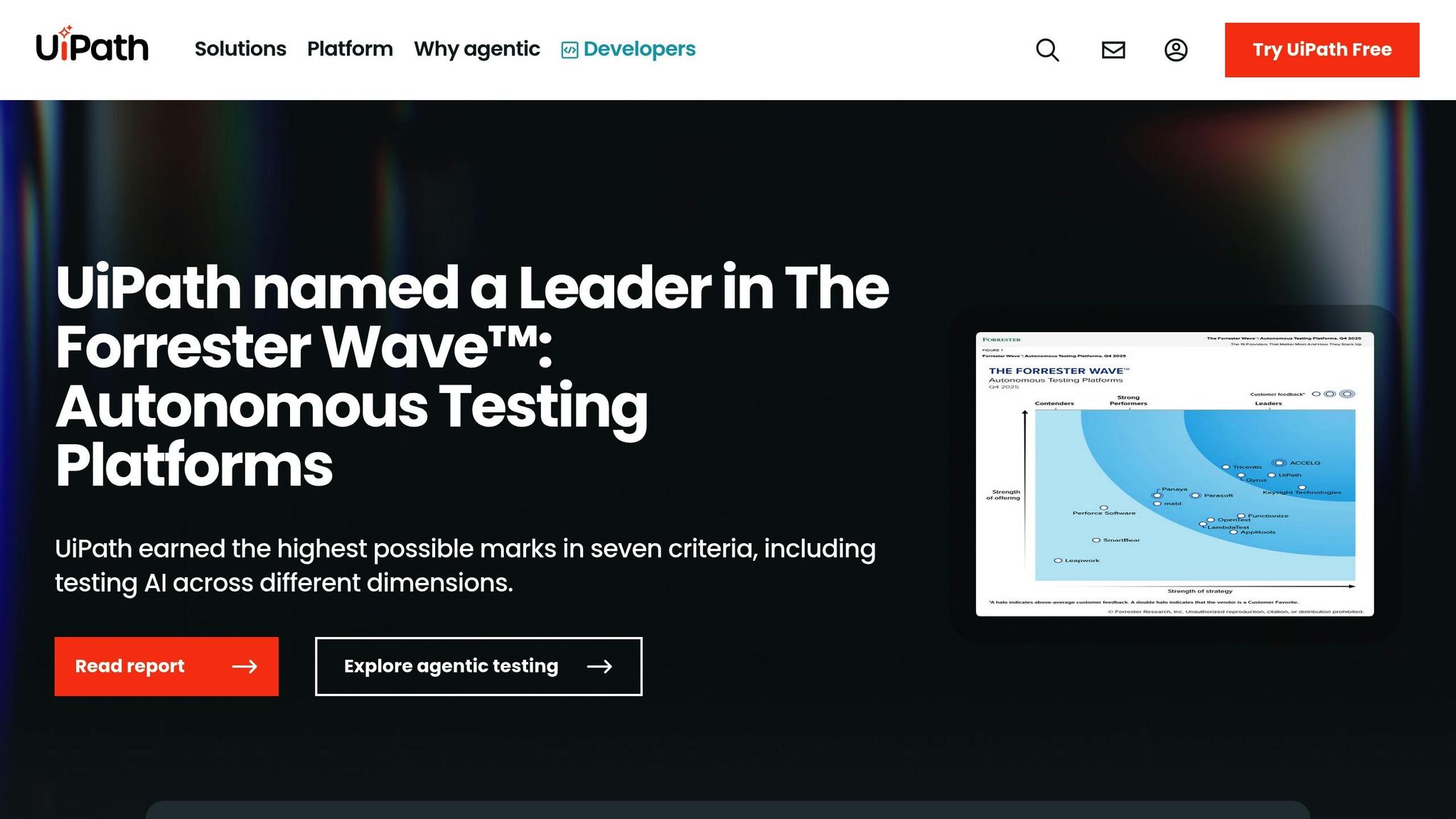
UiPath is shaping the future of automation by combining AI agents, robotic processes, and human oversight into what it calls "agentic automation". This layered approach addresses a pressing demand: 90% of U.S. IT executives believe their business processes could be improved with agentic AI, while 87% emphasize the importance of interoperability between different AI technologies.
The platform’s Maestro tool orchestrates AI agents, robots, and human workers across complex workflows. UiPath’s open, standards-based architecture integrates seamlessly with existing technology ecosystems, ensuring flexibility while avoiding vendor lock-in. Using AI Fabric, organizations can enhance their automations with either custom machine learning models or prebuilt AI services. Additionally, UiPath blends traditional AI - like OCR and computer vision - with generative AI to enable advanced reasoning and content creation.
UiPath prioritizes governance with features like SOC 2 certification, encryption, and detailed audit trails. It supports self-hosting for industries with strict regulatory requirements and ensures safe coordination of hybrid work environments. These controls are tightly integrated into UiPath’s automation ecosystem, enabling scalable and efficient operations.
The Healing Agent ensures automation remains uninterrupted by adapting to UI changes. For instance, a healthcare provider used this capability to automate medical document processing and clinical summaries, achieving a 99% approval rate for AI-generated content. This saved 11,000 nursing hours and nearly $800,000. Meanwhile, Agent Builder lets businesses create custom AI agents tailored to specific workflows. Additionally, Autopilot™ offers a natural language interface, empowering users at any skill level to trigger automations with ease.
UiPath’s Process Mining and Intelligence tools help identify inefficiencies and uncover major automation opportunities. For example, a Fortune 500 company automated contract reviews, processing over 900 contracts per month, reducing legal review time by 60%, and improving compliance by 40%. In the financial sector, a leading firm used generative AI and Intelligent Document Processing for merchant classification, achieving a 98% automation rate. This saved the company between $10 million and $12 million annually while eliminating 12,000 hours of manual work. Akash Rana, Senior Manager IT Digital Automation at Regal Rexnor, highlighted the transformative impact:
"Leveraging agentic automation in our UiPath integration is providing massive ROIs. Exploring applications in sales and customer service is proving especially promising. These automated agents carry out the heavy lifting, allowing our sales team to focus on driving revenue."
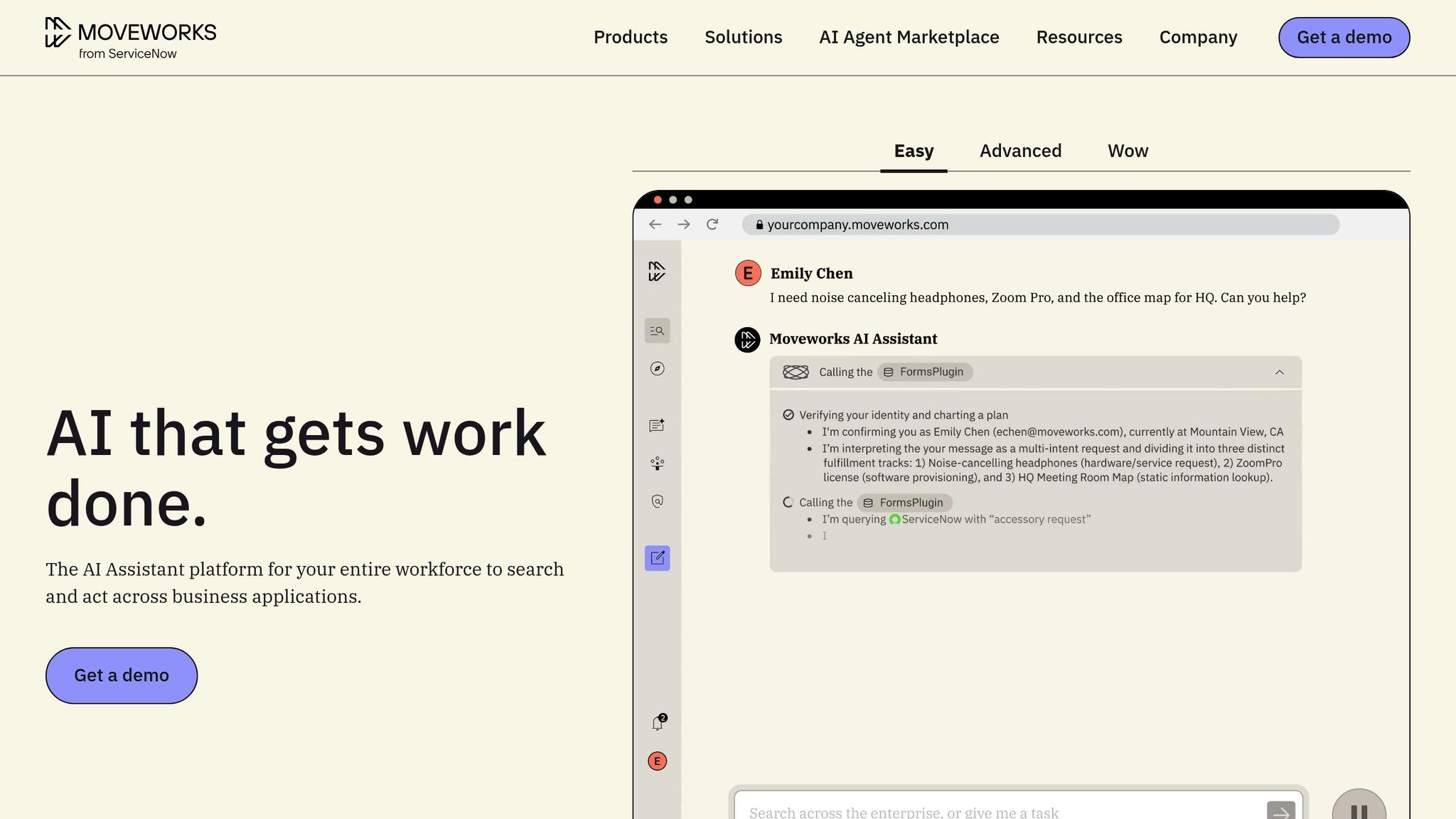
Moveworks is making waves in the world of workflow automation by using advanced agent technology to simplify enterprise support. Its reasoning engine is designed to tackle complex, multi-step workflows without relying on manual scripts or rigid programming. With a single conversational interface, users can search for information and perform actions across HR, IT, Finance, and Sales systems. Today, more than 5 million employees depend on Moveworks for workplace support. In late 2025, the company was acquired by ServiceNow for $2.85 billion.
Moveworks integrates third-party advanced models with its proprietary, fine-tuned natural language understanding and search models, delivering context-aware and reliable support. Its multi-agent orchestration system employs specialized agents that handle perception, reasoning, and system actions collaboratively. Supporting over 100 languages and offering more than 1,000 pre-built integrations, the platform is built for global enterprises. With its Agent Studio, teams can easily create and deploy custom AI agents for specific business needs in a low-code/no-code environment. Over 10,000 specialized AI agents have already been developed on the platform.
Moveworks delivers tangible results quickly, often achieving ROI in just 8 weeks by automating tier-1 support tasks and cutting operational costs. For instance, it resolves 57% of IT issues in under a minute. At Procore, the platform saved 4,000 hours of support time per quarter across IT, HR, payroll, and workplace support. MANTECH reported a 52% reduction in Tier 1 support costs, with one AI agent alone reducing the time for generating HR employee verification letters to just 60 seconds, saving over 1,000 hours of manual effort. Coca-Cola Consolidated’s IT Director highlighted the efficiency gains:
"The biggest impact, especially looking inward to just IT, we did not have to increase our service desk at all."
Moveworks prioritizes enterprise-grade security with compliance certifications including ISO 27001, SOC 2, HIPAA, GDPR, and FedRAMP "In Process" status. Role-based access controls (RBAC) ensure that users only access authorized data, while end-to-end encryption protects information both in transit and at rest. Regular security audits and vulnerability testing further strengthen its defenses. The platform also includes safety guardrails to prevent prompt injection attacks and provides detailed audit trails for accountability. With data residency options, Moveworks helps global businesses meet regional data storage requirements.
Moveworks uses agentic Retrieval-Augmented Generation (RAG) to deliver precise, context-aware answers, complete with direct citations from connected knowledge bases. The platform has achieved a 90% deployment rate across enterprises. At West Monroe, it resolved 8,000 IT tickets and expedited 4,000 more in 2025, cutting resolution times from days to minutes and saving $1.4 million annually. These results highlight the platform’s real-world impact. AkzoNobel’s Domain Lead for AI & Automation reflected on its adaptability:
"We were not looking for an IT or HR agent, we were looking for a true enterprise assistant... simple conversations can trigger actions, can trigger conversations, can trigger responses and also keep the data safe."
Workato is a robust enterprise integration platform offering over 1,200 pre-built connectors that link on-premises systems with SaaS applications, including AWS services like S3, SQS, and Lambda. It has consistently been recognized as a Leader in the Gartner® iPaaS Magic Quadrant™ for seven years straight and currently holds the top spot on G2's Enterprise iPaaS Grid® in the Winter 2025 Ranking. Like other AI solutions in this space, Workato focuses on optimizing operations through seamless integrations and efficient management.
With its low-code/no-code tools, Workato empowers business teams to design and adapt automations easily. Its Workbot feature integrates AI directly into Slack and Microsoft Teams, enhancing both security and accessibility. The AI@Work suite provides pre-built connectors for large language models, such as OpenAI's GPT-4 and DALL-E, enabling text and image generation to simplify workflows further.
A standout example is Atlassian, which transitioned over 50 integrations to Workato in under nine months, saving an impressive 25,000 hours. Mohit Rao, Head of Intelligent Automation, shared:
"Business users have organically started using Workato. Once we identify those business users, we elevate them to be champions to empower other teams or other people, and use them to get the next wave of scale."
Beyond automation, Workato delivers a suite of governance tools to ensure secure and compliant operations. Administrators can set granular access controls, defining specific actions for AI agents, making all processes traceable, auditable, and reversible. Role-based access control (RBAC) allows agents to act on behalf of users while leveraging existing authentication frameworks. Additional safeguards include Enterprise Key Management and fine-grained access controls to protect sensitive data and personally identifiable information (PII).
For testing and validation, the Workato Sandbox provides a dedicated environment to evaluate agent behavior before deploying to production. With SOC2 and ISO compliance certifications, Workato ensures enterprise-grade security standards are met.
Workato also stands out for its cost management features. The Workato Usage Dashboard tracks billing metrics and usage to prevent unexpected overages, while Workato Insights delivers real-time analytics and dashboards to simplify trend analysis and calculate ROI. The AI Gateway enables secure connections to multiple AI/LLM services, helping businesses manage the lifecycle and costs of AI applications in production.
In 2024, the platform saw data pipelines grow by over 220%, alongside the rollout of 786 product updates and 12 major features within just 12 months. This rapid development underscores Workato's commitment to delivering value and keeping pace with enterprise needs.
CrewAI is an open-source framework that manages 12 million tasks daily through multi-agent collaboration. Unlike traditional automation tools that depend on rigid, graph-based workflows, CrewAI employs a system of specialized AI agents working together to tackle complex and unpredictable business challenges. The platform boasts 5x faster execution with minimal overhead compared to other agentic frameworks, enabling developers to deploy complete AI workflows in under 10 minutes.
CrewAI Flows combines coding tasks, LLM calls, and autonomous agents into event-driven workflows, using decorators like @start(), @listen(), and @router() to define dynamic and conditional logic. Ben Tossell, Founder of Ben's Bites, shared his enthusiasm:
"It's the best agent framework out there and improvements are being shipped like nothing I've ever seen before!"
For handling intricate operations, CrewAI supports both unstructured (dictionary-based) and structured (Pydantic-based) state management, enabling seamless data sharing across tasks. The @persist decorator ensures that flow states are automatically saved to SQLite, allowing workflows to recover and resume even after interruptions. Common applications include agentic OCR for document processing, automated invoice parsing for financial systems, and email automation that adapts to real-time business rules. This adaptable orchestration paves the way for extensive LLM integration.
CrewAI is LLM-agnostic, meaning it supports models such as OpenAI, Anthropic, and Amazon Nova Pro. This flexibility helps organizations tailor solutions to specific tasks while balancing performance and API costs. For instance, in September 2025, a multi-agent system built with CrewAI and Amazon Bedrock automated regulatory compliance for financial institutions. This setup used three specialized agents to monitor AML/BSA rules, translate requirements into policies, and design security controls.
CrewAI prioritizes security and compliance with features like RBAC (Role-Based Access Control) and team management tools. The platform provides detailed execution traces, real-time monitoring, and OpenTelemetry logs to ensure transparent audit trails of agent activities and decisions. To safeguard sensitive workflows, it includes "Hallucination Guardrails" and integrates with Amazon Bedrock Guardrails to filter out PII, hate speech, and inappropriate content. For added oversight, CrewAI supports Human-in-the-Loop (HITL) triggers, allowing human intervention at critical decision points.
n8n is a workflow automation platform that combines a visual builder with over 400 integrations, offering both cloud-hosted and self-hosted options for greater control over data and computing resources. Pricing starts at $20 per month for 2,500 executions.
n8n stands out with its adaptable deployment options and a robust AI workflow builder designed for advanced automation. The platform supports multi-agent orchestration and Retrieval-Augmented Generation (RAG) through LangChain nodes. Users can craft intelligent workflows by incorporating custom JavaScript or Python code, offering a level of technical depth that surpasses many basic automation tools. With over 4,000 expert templates readily available, workflow creation is streamlined, while npm libraries allow for extensive customization. As Scalevise aptly noted:
"Unlike rigid SaaS automation tools, [n8n] allows full control over data, logic, and integrations".
This flexibility makes n8n a strong contender for enterprises seeking tailored automation solutions.
n8n helps businesses cut costs by optimizing API usage and resource allocation. It achieves this through webhooks, concurrency throttling to minimize redundant API calls, and modular workflows that prevent unnecessary full reruns. Additionally, reserved instances can deliver savings of 50-75%, while caching and retention policies help avoid database bloat.
Designed with enterprise security in mind, n8n meets SOC 2 standards and offers Role-Based Access Control (RBAC) for precise user permissions. Secure credential handling integrates with external vaults such as AWS, GCP, Azure, and HashiCorp Vault. Self-hosting provides organizations in regulated industries with complete data sovereignty, ensuring compliance with strict residency requirements. Data security is reinforced through encryption for both data at rest and in transit, and audit logs provide comprehensive tracking of workflow activity. Importantly, when using the AI workflow builder, n8n protects sensitive information by ensuring credential details and past execution data are not sent to the Large Language Model.
Make is a platform designed for visual workflow automation, seamlessly linking over 2,000 applications - including more than 200 AI tools such as OpenAI, Anthropic (Claude), Google Gemini, and Perplexity. Its scenario builder allows users to create complex, no-code automations by connecting app modules. Pricing begins at $0 per month for the free plan, with paid options starting at $10.59 per month. Below are key features that highlight how Make simplifies workflows, reduces costs, and ensures strong oversight.
Make's visual scenario builder offers powerful tools like branching paths, conditional logic, loops, and custom variables, enabling users to design intricate automations. Its AI assistant can generate workflows from natural language inputs, while the "Fill by AI" feature translates plain language into detailed formulas. With over 7,500 pre-built templates, users can quickly implement complex automations. In 2024, the use of AI-powered scenarios on Make surged fourfold, showcasing the increasing reliance on intelligent automation.
Make empowers businesses to expand operations without adding staff. Many users have grown their revenue tenfold by leveraging AI automation while maintaining the same team size. The platform also optimizes financial processes like revenue collection, reporting, and data analysis, minimizing errors and boosting productivity. Freelance B2B SaaS content writer Siew Ann Tan noted:
"AI automations help you handle more business operations with the same amount of or even fewer resources, and keep costs down".
Beyond automation, Make includes features to maintain oversight and security. The "Human in the Loop" app introduces manual review steps into workflows, allowing users to edit and approve AI-generated outputs before they advance. Data security is ensured with TLS 1.2 and 1.3 protocols alongside AES 256 encryption during processing. For advanced AI agents, Make provides tools like the "MCP server" and "Make Grid" to manage and scale their behavior. Its integration with leading AI models, including OpenAI, Anthropic (Claude), and Google Gemini, lets businesses choose the best options for their compliance and performance needs.
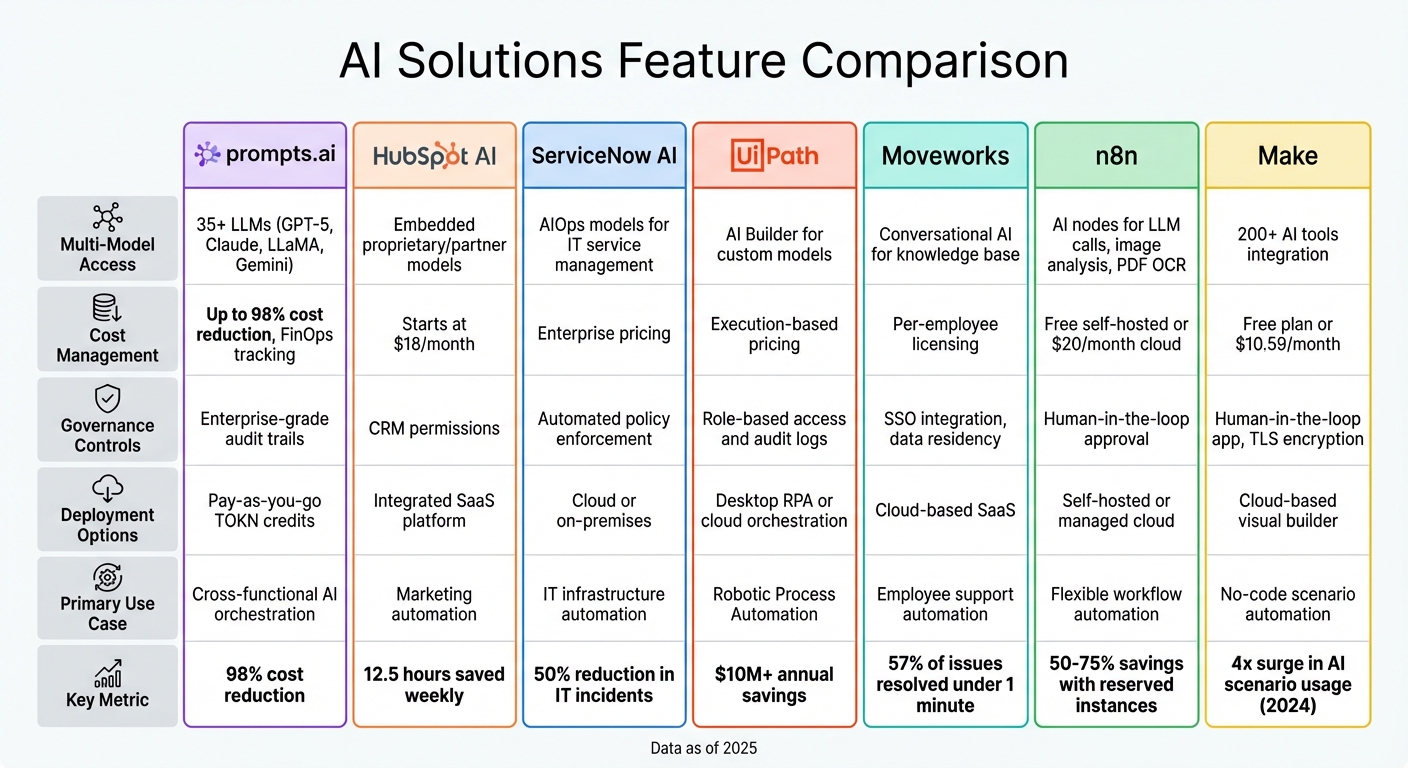
AI Business Solutions Comparison: Features, Pricing, and Use Cases
Explore how each platform handles multi-model access, cost management, governance, deployment, and primary use cases. The table below outlines these essential differences, helping you determine which tool best suits your operational goals.
| Solution | Multi-Model Access | Cost Management | Governance Controls | Deployment Options | Primary Use Case |
|---|---|---|---|---|---|
| prompts.ai | Unified access to 35+ LLMs (GPT-5, Claude, LLaMA, Gemini) | FinOps tracking with real-time token monitoring; reduces AI software costs by up to 98% | Enterprise-grade audit trails and compliance enforcement | Pay-as-you-go TOKN credits; no vendor lock-in | Cross-functional AI orchestration with cost transparency |
| HubSpot AI | Embedded proprietary/partner models within CRM | Campaign-level ROI tracking; starts at $18/month | CRM permissions and data access controls | Integrated SaaS platform | Marketing automation and predictive sales analytics |
| ServiceNow AI | AIOps models for IT service management | - | Automated policy enforcement for IT workflows | Cloud or on-premises deployment | IT infrastructure automation and root-cause analysis |
| UiPath | AI Builder for custom models (form processing, object detection) | Execution-based pricing per bot/automation | Role-based access and audit logs | Desktop RPA agents or cloud orchestration | Robotic Process Automation for repetitive tasks |
| Moveworks | Conversational AI for knowledge base queries | Per-employee licensing model | SSO integration and data residency options | Cloud-based SaaS | Employee support automation (47% of workers struggle to find information) |
| n8n | AI nodes for LLM calls, image analysis, PDF OCR | Self-hosted (free) or cloud plans starting at $20/month | Human-in-the-loop approval steps | Self-hosted or managed cloud | Flexible workflow automation with API integrations |
| Make | Integration with 200+ AI tools (OpenAI, Anthropic, Google Gemini) | Free plan available; paid plans start at $10.59/month | Human-in-the-loop app and TLS 1.2/1.3 encryption | Cloud-based visual builder | No-code scenario automation across 2,000+ apps |
This breakdown underscores the unique strengths of each platform, simplifying the decision-making process for integrating AI into your operations.
prompts.ai sets itself apart with its unified FinOps layer, offering unmatched transparency and control. By tracking every token in real time, the platform helps organizations reduce costs significantly through its pay-as-you-go TOKN credits. It also provides enterprise-grade audit trails while eliminating vendor lock-in, allowing teams to switch models or scale usage effortlessly. This combination of centralized control and flexibility ensures streamlined operations across departments.
When choosing a solution, it’s important to consider how well it integrates with your existing tech stack to prevent data silos. For structured, repetitive tasks, platforms like UiPath excel with desktop RPA tools. On the other hand, n8n and Make offer API-driven flexibility, enabling seamless connections across thousands of apps. Meanwhile, prompts.ai delivers centralized model access, cost tracking, and compliance - all in one place. This allows businesses to focus on driving innovation while minimizing administrative complexity. These distinctions help ensure you select the platform that aligns best with your specific needs.
AI solutions are transforming the way businesses operate by simplifying processes, reducing expenses, and enhancing decision-making. The numbers speak volumes: companies can cut costs by up to 30%, increase productivity by 25%, achieve revenue growth 2.5 times faster, and 94% of business leaders now see AI as essential. The challenge lies in selecting tools that address your specific operational needs and align with your goals.
Finding the right AI solution starts with identifying your biggest challenges and understanding your growth objectives. For instance, robotic process automation (RPA) is ideal for eliminating repetitive tasks like manual data entry, delivering quick returns on investment. On the other hand, conversational AI can handle routine customer inquiries 24/7, freeing up your team for more complex tasks. However, technology alone accounts for just 20% of automation’s value; the remaining 80% comes from rethinking workflows and managing organizational change. Before automating any process, ensure it’s optimized manually - automating inefficiencies only amplifies them. Begin with one critical bottleneck, measure the results, and expand gradually across other areas.
The shift from automating individual tasks to orchestrating entire workflows is gaining momentum. By 2027, 86% of executives anticipate that AI agents will significantly improve process automation and workflow reinvention. This highlights the importance of choosing solutions that integrate smoothly with your existing tools, such as CRM systems, project management software, and communication platforms. Seamless integration avoids data silos and ensures a consistent flow of information.
When selecting a platform, consider your organization’s level of maturity, technical expertise, and budget. Whether your focus is on streamlining workflows, leveraging advanced analytics, or adopting comprehensive AI orchestration, the right tools can elevate your operations, driving efficiency and paving the way for scalable growth.
AI has the potential to cut operational costs by taking over repetitive tasks, streamlining supply chain management, and boosting workforce efficiency. Tasks like data entry, inventory monitoring, and scheduling can be managed by AI tools, allowing employees to dedicate their energy to more strategic and impactful work.
AI-driven systems also speed up processes such as claims processing and customer service interactions, trimming down both time and labor expenses. Some companies have reported cost reductions of 20–30%, with a few seeing decreases as high as 40% when they effectively integrate AI into their operations. These savings not only strengthen financial performance but also drive productivity and encourage innovation across the board.
When choosing an AI platform for your business, it’s essential to ensure it aligns with your specific goals - whether that’s streamlining workflows, making smarter decisions, or elevating customer experiences. Look for solutions that are easy to use, offering natural language commands or low-code interfaces, so your team can get started without needing deep technical expertise.
Seamless integration is a must. The platform should work smoothly with the tools you already rely on, such as CRM software, email platforms, or collaboration apps. Also, think about scalability. As your business grows, the platform should be able to handle increasing data volumes and tackle more complex tasks effortlessly.
Another key consideration is the cost versus value. Review pricing structures, such as per-user fees or tiered plans, and weigh them against the tangible benefits - like cutting down on manual work or reducing operational costs. Prioritize platforms that offer robust security, ensure compliance with U.S. regulations, and come with dependable vendor support to set your business up for long-term success.
HubSpot AI is fully embedded into HubSpot’s CRM and marketing suite, providing features like generative text, predictive lead scoring, and workflow automation - all accessible directly within the platform. Thanks to its open APIs and built-in connectors, HubSpot AI effortlessly integrates with tools such as Gmail, Google Calendar, Slack, and other third-party apps. This enables no-code automation for tasks like outreach, follow-ups, and reporting, allowing users to manage everything without leaving the platform.
ServiceNow AI, driven by its AI Agent Studio, incorporates intelligent agents across various modules, including IT service management, HR, and customer service workflows. Using its Integration Hub, these agents can link to external APIs, synchronize data with ERP or CRM systems, and automate actions across the organization. This creates a cohesive, AI-powered operations layer that works seamlessly with existing business tools to improve efficiency and connectivity.