Pay As You Go - AI Model Orchestration and Workflows Platform



AI is transforming how businesses manage operations by automating repetitive tasks, integrating systems, and reducing costs. Companies face challenges like fragmented tech stacks, manual workflows, and rising labor expenses. AI platforms address these issues by streamlining processes, improving accuracy, and offering real-time insights.
Key Highlights:
Prompts.ai enables enterprises to unify AI workflows, manage costs, and maintain security, helping teams scale AI efficiently while improving productivity. Start small with high-impact workflows like ticket management or invoice processing to see measurable ROI.
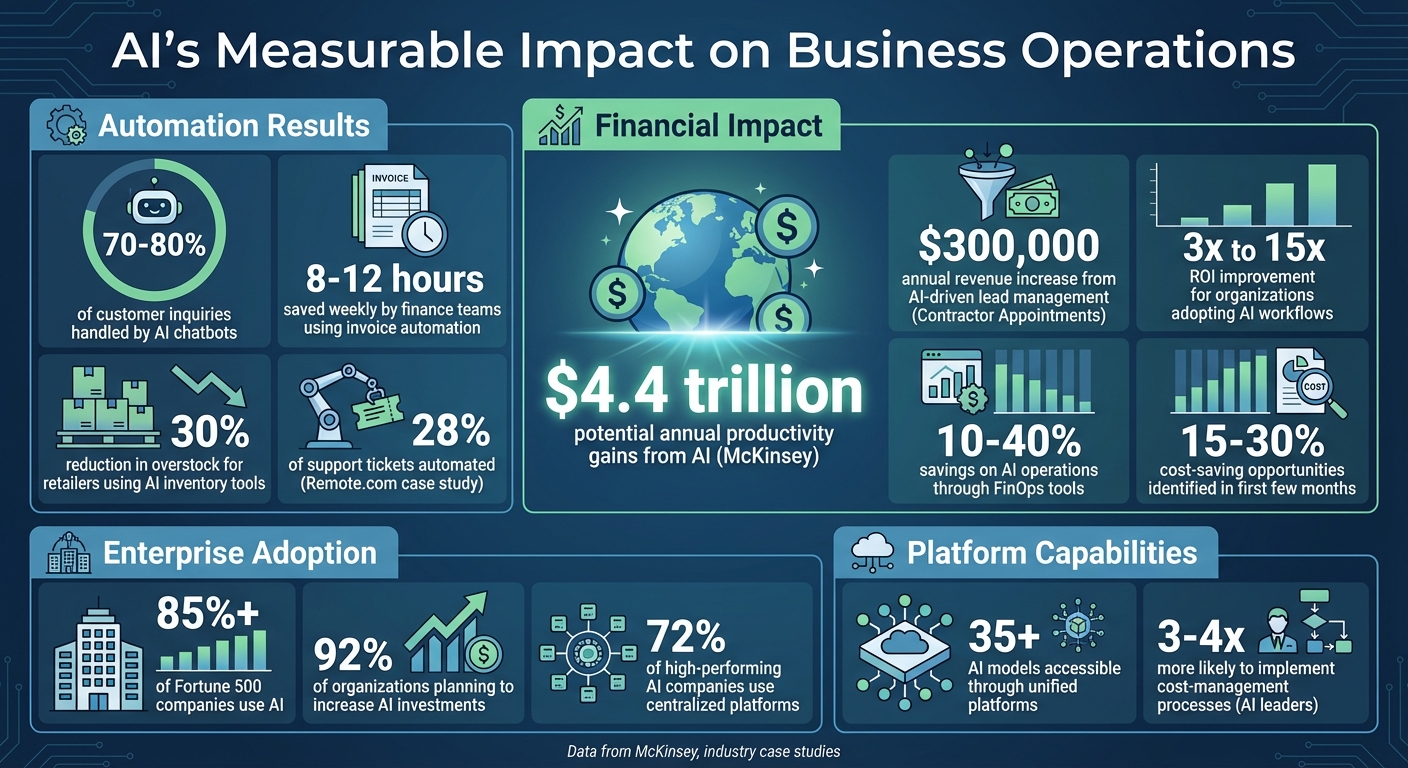
AI Business Operations Impact: Key Statistics and ROI Metrics
AI workflow platforms simplify operations by offering centralized access to multiple large language models through a single interface. This eliminates the hassle of managing separate accounts, APIs, and billing systems. Teams can choose the best model for each task - for instance, using a high-performance model for complex financial analysis, a different one for document summarization, and a more budget-friendly option for bulk email classification. This setup allows seamless switching between models without the need to rebuild workflows.
The balance between cost and performance is crucial. Tasks can be routed based on budget limits (in USD), latency requirements, or data residency preferences, ensuring spending stays under control without compromising results. For example, routine customer inquiries might be directed to a cost-efficient model, while premium models are reserved for high-value interactions. With 92% of organizations planning to increase AI investments, unified access to models helps businesses scale efficiently by reducing vendor complexity. This approach lays the groundwork for streamlined workflow automation that balances quality with affordability.
AI workflow platforms enable organizations to connect SaaS applications, internal APIs, and AI tools into automated, repeatable workflows. Using a visual builder, teams can create workflows without writing code - simply dragging and dropping blocks for tasks like data ingestion, model calls, conditional logic, approvals, and system updates. These workflows can be triggered by events in commonly used SaaS applications, making integration straightforward.
The results speak for themselves. Remote.com’s IT team, for instance, automated 28% of support tickets, allowing staff to focus on higher-value tasks. Similarly, Contractor Appointments boosted annual revenue by $300,000 by implementing AI-driven lead management workflows that automatically qualified and routed leads. Organizations adopting AI across multiple workflows have reported ROI improvements ranging from 3x to 15x their initial investment. High-volume, rules-based processes - like support ticket triage, invoice processing, lead qualification, or HR intake - are ideal starting points for automation, delivering measurable time and cost savings. These workflows also integrate seamlessly with enterprise security and governance frameworks, ensuring smooth operations at scale.
For U.S. enterprises, strong security and compliance measures are non-negotiable. AI workflow platforms address these needs with features like role-based access control, single sign-on through providers such as Okta or Azure AD, and end-to-end encryption. Comprehensive audit logs track every prompt, model call, output, and administrative action, supporting both incident investigations and compliance reviews. To protect sensitive data - such as PII, PHI, or financial information - data masking and redaction features ensure such information is safeguarded before being processed by third-party models.
Regulatory compliance is another critical consideration. Platforms serving the healthcare sector must support HIPAA requirements and Business Associate Agreements (BAAs), while financial services often need to comply with GLBA regulations. Certifications like SOC 2 Type 2 and ISO 27001 demonstrate adherence to established security practices, change management procedures, and incident response protocols. For example, Prompts.ai has initiated its SOC 2 Type 2 audit and incorporates best practices from frameworks like SOC 2 Type 2, HIPAA, and GDPR. Governance tools, including model usage policies, content filters, and approval workflows, provide IT and compliance teams with the visibility and control they need to scale AI safely and responsibly.
AI solutions for business operations can be grouped based on how they interact with systems and the type of tasks they manage. Recognizing these categories allows businesses to make informed technology investments to address specific operational needs. These groupings lay the groundwork for smoother, more integrated operations across industries.
These platforms are designed to create and manage workflows that streamline the deployment, scaling, monitoring, and governance of AI models. By automating complex AI pipelines, orchestration platforms reduce operational hurdles and speed up integration processes. They also help control costs by efficiently allocating resources, making it simpler for businesses to scale their AI projects. Modern platforms often combine various AI technologies, such as Natural Language Processing (NLP) and Machine Learning (ML), to achieve advanced levels of automation.
AI agent platforms focus on automating repetitive tasks like ticket triage, lead routing, and approval processes, freeing up human resources for more strategic work. These agents can operate autonomously or in collaboration with humans, depending on the level of oversight required. This flexibility ensures that high-volume, rules-based tasks are handled quickly and consistently. Additionally, industry-specific configurations enhance their ability to address unique operational demands.
These tools are tailored to meet the specific needs of industries such as finance, healthcare, manufacturing, and education. By leveraging technologies like machine learning, natural language processing, and predictive analytics, they automate processes, improve decision-making, and optimize operations within their respective fields. The advantages are clear: increased efficiency, improved accuracy, enhanced security, and higher customer satisfaction - all while cutting costs.
For instance, financial services use AI to detect fraud and assess risks, healthcare facilities rely on it for diagnostic support and patient scheduling, and manufacturers use it for predictive maintenance and supply chain management. Together, these categories showcase the adaptable framework driving platforms like Prompts.ai to deliver operational excellence.
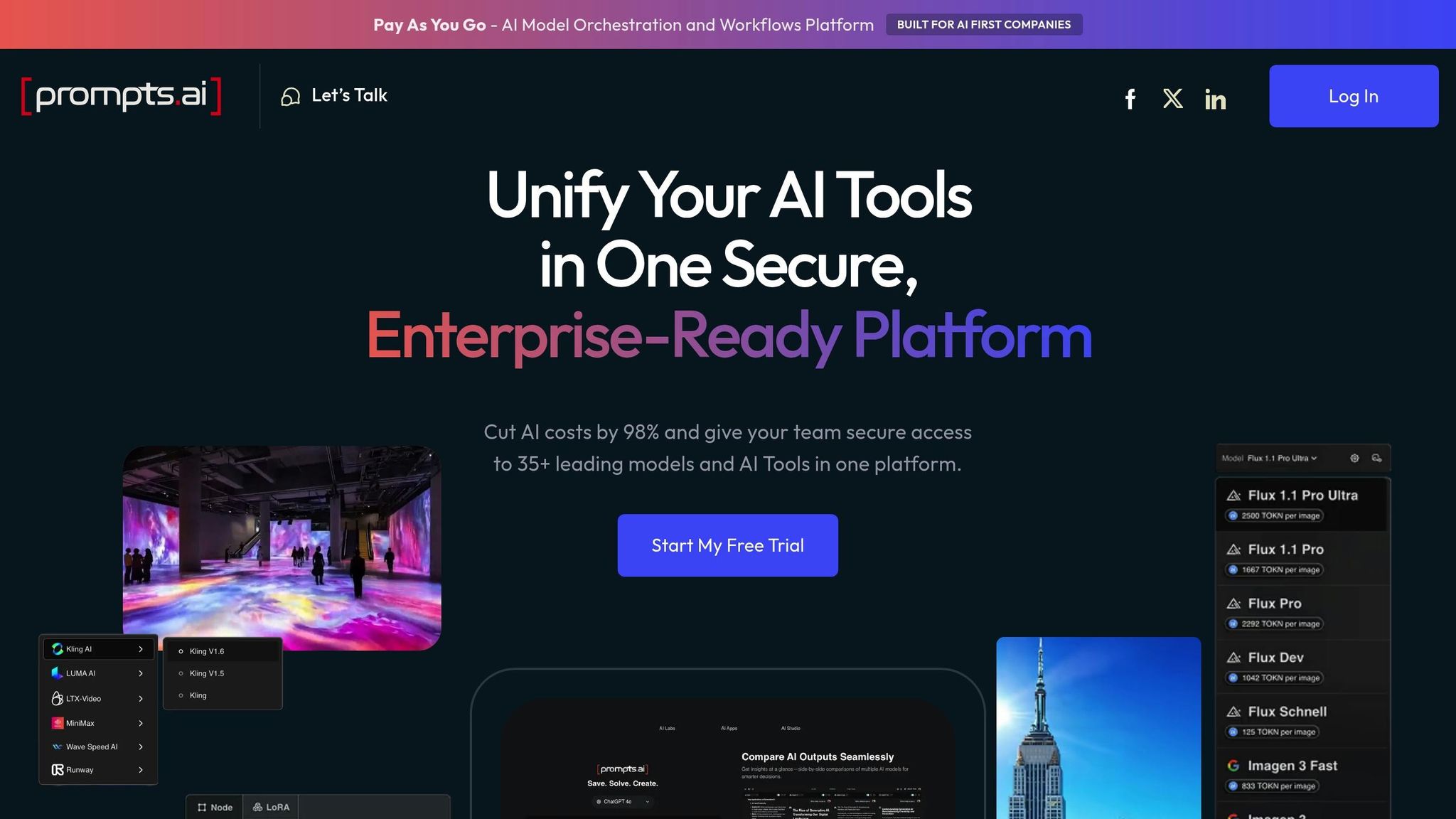
Prompts.ai addresses critical challenges in AI integration, cost management, and compliance by combining model access, financial oversight, and governance into a single platform. With this unified interface, users can connect to over 35 advanced language models, including GPT-5, Claude, LLaMA, and Gemini.
Prompts.ai serves as a centralized hub, allowing teams to access, compare, and deploy more than 35 language models. This side-by-side comparison feature helps U.S. businesses quickly assess performance, latency, and cost per 1,000 tokens, significantly cutting down the time needed for model selection. According to McKinsey's 2025 State of AI survey, about 72% of high-performing AI companies rely on centralized platforms or shared services to distribute AI capabilities across departments. When one team identifies an effective model configuration, others can immediately adopt it, creating a ripple effect that boosts organizational efficiency. For instance, customer service teams can launch AI chatbots in just days, supply chain teams can integrate predictive analytics, and finance departments can automate invoice processing to save 8–12 hours per week. This streamlined access to models also helps organizations monitor and manage AI-related costs more effectively.
Prompts.ai includes real-time dashboards that track API expenses in USD, enabling organizations to set budget limits, receive alerts as spending approaches thresholds, and analyze cost trends for better forecasting. This FinOps approach, which has already demonstrated 10–40% savings in cloud infrastructure, is now applied to AI workloads. Many U.S. companies uncover 15–30% in cost-saving opportunities within the first few months by identifying inefficient workflows or discovering that lower-cost models can perform just as well as premium ones for specific tasks. The platform’s cost allocation features also support departmental chargebacks, turning AI expenses into predictable and manageable costs. Notably, AI leaders are 3–4 times more likely to implement formal cost-management processes, such as tracking model usage and monitoring team expenditures. Building on this foundation, Prompts.ai also ensures robust security and compliance for enterprise AI operations.
Designed with enterprise needs in mind, Prompts.ai incorporates governance features rooted in industry best practices. The platform adheres to frameworks such as SOC 2 Type II, HIPAA, and GDPR, and officially began its SOC 2 Type II audit on June 19, 2025. For added security, Virtual Private Cloud (VPC) deployment options allow organizations to keep sensitive data and workflows isolated within their own infrastructure, avoiding third-party exposure. Role-based access controls provide granular permission settings, ensuring that access to specific models, workflows, or sensitive data is restricted based on roles or project needs. Additionally, comprehensive audit trails document every AI system activity, from data access to model usage and output generation, creating a transparent log for audits and regulatory reviews. Together, these features - VPC isolation, access controls, and detailed audit logs - equip enterprises to deploy AI confidently while maintaining data integrity and meeting compliance standards.
AI is reshaping how U.S. businesses operate by automating repetitive tasks, improving decision-making with predictive analytics, and cutting operational costs. According to McKinsey, AI-driven productivity gains could add up to $4.4 trillion annually when fully implemented at scale. It’s no surprise that over 85% of Fortune 500 companies now use AI to boost efficiency and spur innovation. These advancements highlight the need for a platform that brings all these benefits together under one unified solution.
Prompts.ai rises to meet this challenge, offering streamlined access, cost control, and enterprise-grade security to revolutionize operational efficiency. The platform simplifies AI workflows by connecting users to over 35 top-tier models, enabling real-time FinOps cost tracking, and ensuring compliance with critical frameworks like SOC 2 Type II, HIPAA, and GDPR. By consolidating tools and eliminating inefficiencies, Prompts.ai helps businesses transition from isolated experiments to fully integrated, everyday AI operations across various departments. Whether it’s automating back-office processes, enhancing customer service with chatbots, or fine-tuning supply chain logistics, the platform enables effortless scaling.
Its design ensures compatibility with emerging AI models and features, allowing businesses to scale without disrupting existing workflows. This flexibility is crucial as advancements in foundation models and agentic AI continue to evolve, demanding a robust orchestration layer that can keep pace.
To put these benefits into action, businesses can start small by focusing on 2–3 high-impact workflows, such as support ticket management or invoice processing. Running these pilots on Prompts.ai provides centralized oversight, cost management, and governance from the outset. This approach not only demonstrates measurable ROI but also creates a foundation for broader AI adoption. With Prompts.ai, U.S. enterprises can scale AI confidently, balancing risk, managing costs, and achieving tangible operational improvements.
AI platforms offer businesses a practical way to cut down on operational costs by automating repetitive tasks. This not only reduces labor expenses but also helps minimize mistakes caused by human error. Beyond automation, these platforms ensure resources - like time, money, and materials - are used more efficiently, leading to better overall management.
AI also plays a key role in improving decision-making and enabling predictive maintenance. By identifying potential equipment issues before they escalate, businesses can avoid expensive failures and limit downtime. With streamlined workflows and improved productivity, companies can maintain high-quality operations while keeping costs under control.
AI workflow platforms are designed with strong security features to safeguard sensitive data and meet industry regulations. Key protections include end-to-end encryption, which secures data both during transmission and while stored, and role-based access controls (RBAC) to restrict system access to authorized personnel.
Many platforms also adhere to major regulatory frameworks like GDPR, HIPAA, or SOC 2, tailored to the industries they support. To promote accountability, they often include audit trails that log system activity. These tools not only help businesses stay compliant but also build confidence among users by ensuring data protection.
Centralizing access to AI tools simplifies workflows, cutting down on unnecessary steps, reducing errors, and automating repetitive tasks. This shift frees up teams to concentrate on strategic, impactful projects that contribute to business growth.
With AI integrated into one unified platform, businesses benefit from streamlined collaboration, quicker decision-making, and consistent operations. The result? Smoother workflows and a noticeable boost in productivity.