Pay As You Go - AI Model Orchestration and Workflows Platform



AI dashboards and workflow platforms are transforming how businesses operate, offering smarter solutions to automate repetitive tasks, manage costs, and improve efficiency. Here's what you need to know:
AI is no longer just a tool - it's a business advantage. By automating complex processes and ensuring compliance, these platforms help enterprises scale without added stress.

AI Dashboard Adoption Statistics and Business Impact 2024-2026
AI-powered dashboards and workflow platforms deliver measurable advantages in cost efficiency, governance, and scalability. These benefits are especially critical for organizations juggling tight budgets and navigating intricate regulatory landscapes.
AI workflow platforms do more than save time - they drive profitability. Companies adopting these platforms report a 15% increase in profitability, compared to just 8% for non-adopters. Additionally, businesses leveraging advanced analytics have seen forecasting accuracy improve by 80%.
In specific areas like localization and translation, AI-assisted tools have slashed localization costs by over 60% while reducing time-to-market by 80%. These savings not only streamline operations but also provide a competitive edge.
Adhering to regulatory standards is non-negotiable, as the financial stakes are high. For instance, GDPR violations can result in fines of up to 7% of global revenue or €35 million. In the U.S., state laws like the CCPA and VCDPA impose penalties of up to $7,500 per violation.
Modern AI platforms incorporate global compliance frameworks such as GDPR, HIPAA, PCI, and SOC 2. They include built-in audit trails using LQA systems to monitor errors and identify hallucinations, ensuring strict adherence to data usage policies. Sensitive enterprise data is safeguarded from being used to train public AI models, and mechanisms are in place to prevent inaccurate or fabricated data from entering workflows.
For industries with stringent regulations, AI-powered Quality Estimation (QE) tools predict the reliability of outputs and flag segments requiring human review. This is particularly valuable for handling complex or culturally nuanced content.
Caoimhse McGrath, Translation Center of Excellence Program Manager at Johnson Controls, highlights: "Reducing turnaround times and controlling costs allow us to reach our customers faster and more efficiently. With full control over our translation memory, we ensure that every term, particularly industry-specific ones, is translated with accuracy and consistency."
AI dashboard and workflow platforms empower organizations to scale their AI initiatives with ease. These platforms provide robust version control, enabling seamless content management across multiple languages and ensuring real-time updates across regions. AI QA tools further enhance scalability by identifying and correcting stylistic inconsistencies, ensuring a unified brand voice even in large-scale projects.
Such automation and consistency are nearly impossible to achieve manually, especially as businesses expand into diverse markets and geographies. These capabilities make AI platforms indispensable for organizations aiming to grow while maintaining operational efficiency.
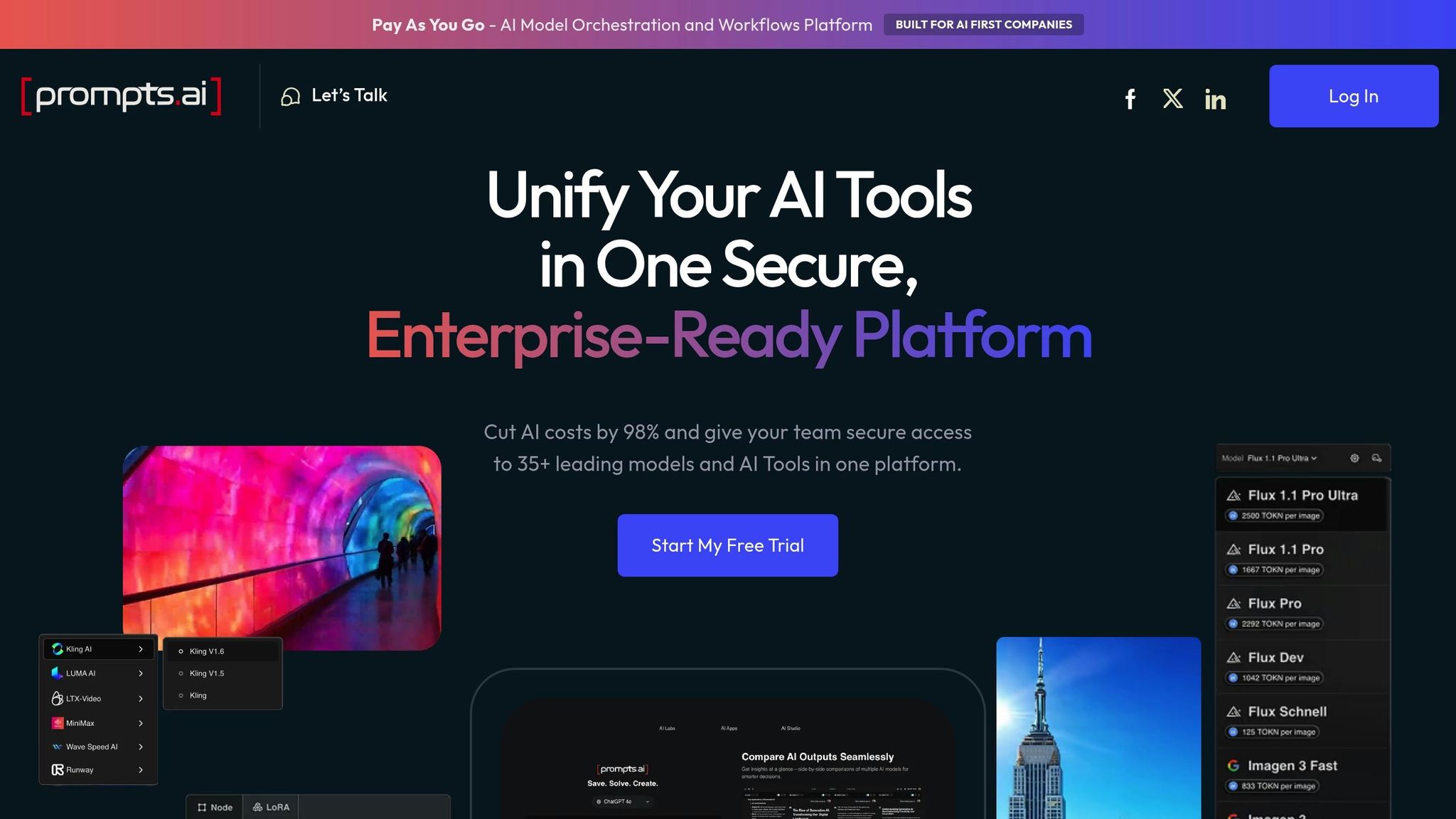
Prompts.ai simplifies the chaos of managing multiple AI tools by bringing together access to over 35 leading LLMs, including GPT-5, Claude, LLaMA, and Gemini. With this centralized platform, enterprises can easily choose the best AI model for each task, streamlining operations and maximizing efficiency.
Prompts.ai offers a suite of features designed to enhance productivity and control costs:
These features enable businesses in various industries to optimize their processes with ease.
Companies across different sectors use Prompts.ai to streamline their workflows and boost productivity. For example, creative agencies benefit from the platform's cost management tools and unified workflows, allowing them to focus on innovation while maintaining clear oversight of AI-related expenses.
Prompts.ai offers flexible pricing options tailored to both individuals and enterprise teams, ensuring accessibility for a wide range of users.
| Plan Type | Monthly Cost | Best For | Key Features |
|---|---|---|---|
| Pay As You Go | $0 | Testing & exploration | Access to 35+ LLMs, no commitment |
| Creator | $29 | Individual professionals | Personal workflow templates, cost tracking |
| Core | $99/member | Team collaboration | Shared workflows, governance |
| Pro | $119/member | Knowledge workers | Automation, enhanced security |
| Elite | $129/member | Creative teams | Full suite of AI tools, priority support |
Start by equipping your team with a clear understanding of how AI workflows function and where human oversight fits in. Effective onboarding doesn’t need to rely on lengthy manuals; instead, focus on demonstrating the AI’s decision-making process, the tasks it handles independently, and when it escalates issues to a person. This level of transparency fosters trust and encourages faster adoption across various departments.
Structured onboarding can lead to measurable results. For example, ActiveCampaign tackled a 25% churn rate by introducing an AI-driven onboarding system. This system categorized users by language and enrolled them in tailored webinars, leading to a 440% increase in webinar attendance and a 15% drop in 90-day churn rates.
Once your team is trained, the next step is to design workflows that capitalize on these gains.
Identify tasks that are repetitive but require a touch of human reasoning - like sorting support tickets, summarizing feedback, or routing leads based on intent. These are prime candidates for AI workflows because they’re time-intensive yet follow predictable patterns. Start small by focusing on one or two high-impact processes to build confidence before expanding further.
Having clean, well-organized data is essential for success. Pilot testing allows you to identify and address potential edge cases before rolling out a full implementation. For example, Jason Alvarez-Cohen, CEO of Popl, created over 100 workflows to manage demo requests and enhance lead data. By replacing expensive custom integrations, this approach saved the company $20,000 annually.
"It's not just about doing more. It's about doing it better, faster, and with fewer resources".
For workflow types, use standard workflows for structured, repetitive tasks like lead routing. For more dynamic scenarios where adaptability is key, agentic workflows are a better fit. These systems adjust their approach mid-task, making them ideal for complex processes.
After workflows are in place, regular performance monitoring ensures they continue to operate efficiently.
AI workflows demand constant oversight to maintain their effectiveness. Keep an eye on metrics like time saved, accuracy rates, and the frequency of manual interventions. Establish checkpoints and fallback mechanisms to handle situations where the AI encounters ambiguous inputs. These guardrails minimize errors and maintain quality.
Regularly gather feedback and refine workflows based on insights. This continuous improvement not only enhances performance but also encourages greater adoption. With nearly two-thirds of organizations now prioritizing AI adoption and 84% of enterprises planning to increase their investments in AI systems by 2026, staying ahead with ongoing optimization is critical for staying competitive.
As AI workflow platforms continue to evolve, they are poised to redefine automation on an even broader scale. These cutting-edge platforms now utilize event-driven, agent-compatible infrastructures capable of autonomously managing tasks. Unlike traditional, rule-based systems, these platforms adjust seamlessly to dynamic factors such as shifts in customer sentiment, supply chain disruptions, or support ticket trends. Early adopters have already reported impressive results, achieving workflow cycles that are 20%–30% faster and accelerating overall business processes by 30%–50%. This new approach paves the way for smarter integration and deeper interoperability.
A key advancement is the use of LLM-powered connectors, which can generate APIs for legacy systems, effectively turning AI into a bridge between old and new technologies. This eliminates the need for costly system overhauls, allowing modern AI agents to interact with decades-old platforms. Open agent architectures and standardized frameworks, such as the Model Context Protocol (MCP), further enhance this capability, enabling developers to unify thousands of tools and APIs into a single, AI-driven ecosystem.
Industry leaders are taking note of these groundbreaking changes.
"AI agents are transforming core technology platforms like CRM, ERP, and HR from relatively static systems to dynamic ecosystems that can analyze data and make decisions without human intervention." - Neveen Awad, Mahmood Serry, and Joe Vasquez, Boston Consulting Group
Compliance and governance are also becoming integral to these platforms rather than being added as an afterthought. Regulatory requirements are driving platforms to adopt standardized data formats and modular API capabilities, ensuring transparency and accountability. To meet these demands, many platforms are shifting to "declarative" designs, where AI agents automatically inherit the security, compliance, and Responsible AI frameworks of their host systems. This evolution is critical, as agentic AI can significantly reduce human error and free up 25% to 40% of time spent on low-value tasks.
The role of community-driven innovation is expanding rapidly, fueling advancements at an extraordinary rate. Open-source platforms like n8n, supported by a vibrant developer community, exemplify this trend. These platforms offer extensive libraries of over 5,000 pre-built workflow templates, covering use cases from SEO analysis to sentiment tracking. Such resources enable organizations to quickly implement complex automations without starting from scratch, setting the stage for enterprise-scale applications. Additionally, natural language tools are empowering non-technical users to actively shape and refine automation processes, making the ecosystem more inclusive and versatile.
AI dashboards and workflow services have transitioned from niche tools to essential infrastructure for enterprises aiming to scale efficiently without overwhelming their teams. Companies using these platforms often achieve 40% boosts in operational efficiency and realize 25–50% cost savings by automating repetitive tasks and minimizing errors. The case for adopting centralized, intelligent automation is becoming increasingly compelling.
The move from static, rule-based systems to autonomous, adaptive workflows allows AI to take on more complex tasks, such as triaging support tickets, routing leads based on company size, or identifying compliance risks. This capability enables AI to make informed decisions, saving organizations thousands of hours annually while cutting operational costs. This evolution has fundamentally transformed enterprise automation, shifting expectations and expanding possibilities.
The efficiency improvements highlight the importance of centralized AI platforms. These systems excel at integrating governance, cost management, and performance tracking into a single framework. With 88% of senior leaders already dedicating at least 5% of their budgets to AI - and half planning to increase this to 25% or more by 2025 - the demand for transparent financial operations and compliance tools is more critical than ever. Platforms offering features like audit trails, role-based permissions, and real-time spending insights turn AI into a strategic advantage for modern enterprises.
AI dashboards offer a practical way for businesses to manage costs by providing a real-time snapshot of how AI resources are being used. Tools like prompts.ai bring multiple AI models together in one streamlined interface, making it easier for teams to monitor expenses, handle licenses, and shift workloads to more budget-friendly options - all while maintaining top-notch performance.
These dashboards also help pinpoint inefficiencies, such as unused resources or workflow bottlenecks, allowing companies to reallocate efforts and cut unnecessary expenses. By automating repetitive tasks, businesses can save significant time - up to 40–60 minutes per employee each day - giving staff the freedom to focus on more meaningful work and reducing the need to expand the workforce. With these advantages, AI dashboards become an essential tool for lowering operational costs and boosting productivity.
AI workflow platforms streamline compliance by offering a centralized hub for managing data and processes. By establishing a single source of truth with immutable audit logs, these platforms make it straightforward to track who accessed or modified data and when. This level of transparency is essential for adhering to regulations such as GDPR, CCPA, and HIPAA. Built-in governance controls enforce consistent data-handling practices, minimizing the risk of policy breaches and enabling automated actions like redacting sensitive information.
Many platforms also include tools designed with compliance in mind, such as cost tracking and usage monitoring. These features provide teams with real-time insights into spending, model performance, and potential biases. This not only keeps businesses prepared for audits but also ensures they meet internal standards and adjust to new regulations without disrupting existing workflows.
AI dashboards are crafted to simplify complex data, making it usable for everyone, even those without technical expertise. They take raw data and transform it into clear visuals and straightforward insights, eliminating the need for coding or advanced analytical skills. From a single screen, users can monitor essential metrics, spot trends, and receive actionable recommendations, such as "increase budget by $5,000" or "focus on the top-performing campaign."
These dashboards don't just display data - they also streamline tasks. Users can take immediate action, like sending emails or updating records, straight from the interface. By automating repetitive processes and integrating smoothly with existing tools, AI dashboards save valuable time, enabling teams to focus on strategic decisions. This combination of ease and efficiency makes them a highly effective resource for enhancing productivity and building team confidence.