Pay As You Go - AI Model Orchestration and Workflows Platform



AI platforms are transforming how businesses manage workflows, replacing rigid rule-based systems with smarter, context-aware automation. Tools like Prompts.ai and IBM watsonx Orchestrate are leading the way by simplifying operations, cutting costs, and boosting productivity.
Key Benefits:
Quick Overview of Platforms:
Choosing the right platform depends on your priorities - whether it’s simplifying AI management, integrating existing systems, or ensuring compliance.
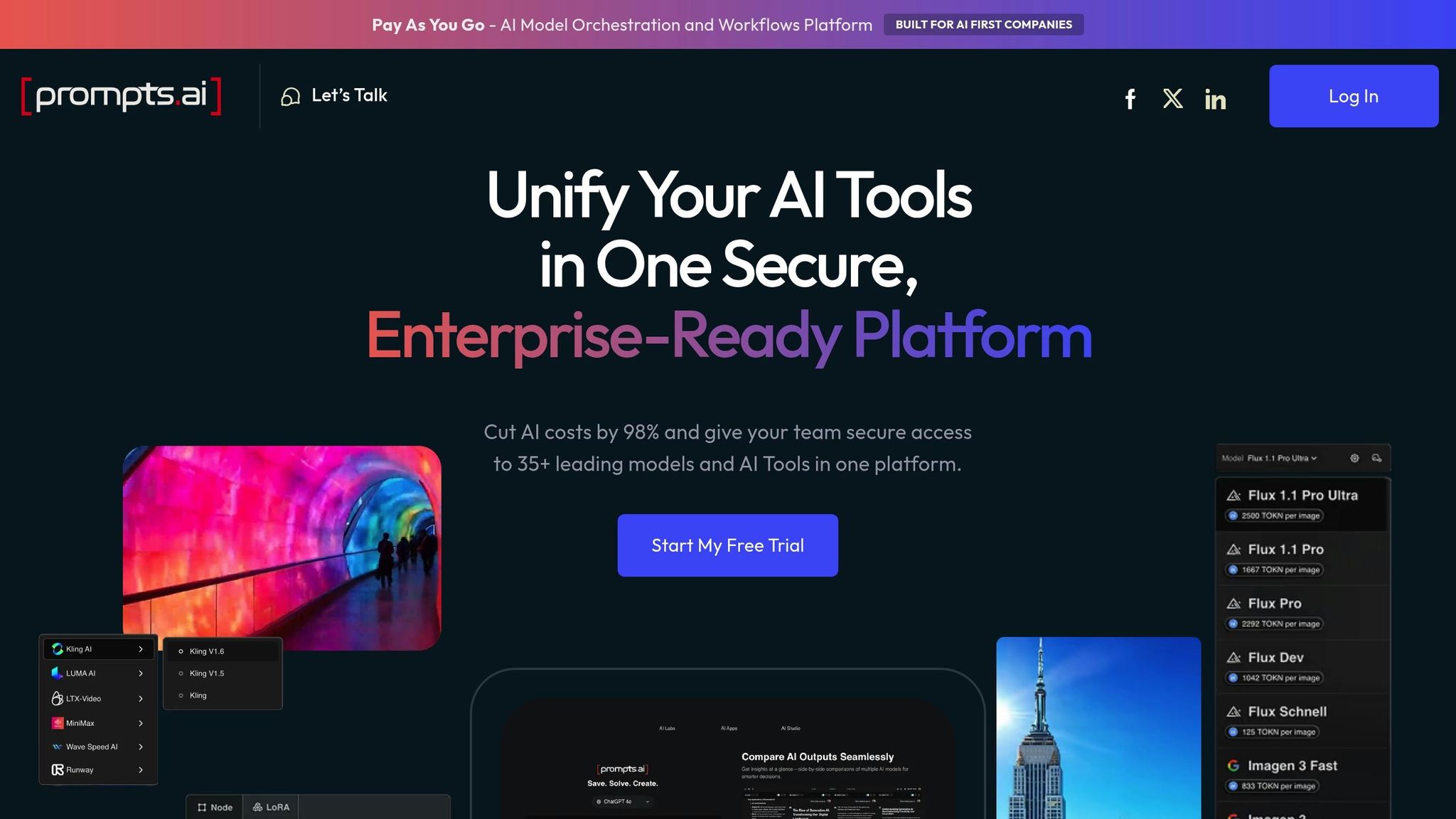
Prompts.ai brings together over 35 top-tier large language models - such as GPT-5, Claude, LLaMA, Gemini, Grok-4, Flux Pro, and Kling - into one secure and unified platform. By doing so, it eliminates the hassle of juggling multiple vendor accounts, API keys, and billing systems. Teams can seamlessly switch between models without the need for reconfiguration, simplifying workflows and saving time.
This platform is built for a wide range of organizations, from Fortune 500 giants to creative agencies and research labs. By centralizing access to various AI models, it not only streamlines tool management but also safeguards sensitive data. For example, your team can test a prompt with Claude, compare the results with GPT-5, and deploy the best-performing option - all within the same platform. This ensures that proprietary information stays protected and avoids exposure to multiple third-party services. This level of integration lays the groundwork for advanced model orchestration capabilities.
Prompts.ai doesn’t tie you to a single AI vendor. Instead, it allows you to compare responses from dozens of models in real time, helping you choose the one that delivers the best balance of quality, speed, and accuracy for your specific needs. This flexibility is especially valuable for organizations with diverse requirements - creative teams might lean toward models that excel in generating imaginative content, while finance teams may prioritize precision and strict compliance.
The platform also offers a library of expert-designed prompt workflows, branded as "Time Savers." These workflows encapsulate best practices, enabling teams to move from ad-hoc testing to standardized, scalable processes. Additionally, the Prompt Engineer Certification program equips internal team members with the skills to design and fine-tune workflows tailored to their organization’s goals. This combination of tools and training turns AI experimentation into a structured and repeatable process, further enhancing operational efficiency.
Prompts.ai integrates enterprise-level governance into every aspect of its workflows. Features such as activity logs, role-based access controls, and audit trails ensure that all AI interactions and data flows are meticulously documented. These safeguards enable organizations to meet strict regulatory standards without slowing down innovation.
By centralizing all AI activity, the platform gives compliance teams the ability to monitor usage, enforce data policies, and generate audit-ready reports. This centralized oversight minimizes the risk of shadow AI - unauthorized tools that bypass security protocols - and ensures that every prompt, response, and model switch is logged and auditable. Built-in governance tools make it easier to maintain security and compliance while keeping operations efficient and transparent.
Prompts.ai includes a real-time FinOps layer that tracks token usage, linking costs directly to teams, projects, and outcomes. By replacing recurring fees for multiple tools with pay-as-you-go TOKN credits, the platform can reduce AI costs by up to 98% compared to maintaining separate subscriptions for each vendor or model.
This cost transparency allows teams to pinpoint which workflows are driving expenses and adjust them before costs spiral out of control. Real-time insights into usage data help finance teams forecast spending accurately, while engineering teams can experiment with cost-effective models without waiting for monthly billing cycles. By turning AI spending into a clear and manageable expense, prompts.ai empowers organizations to innovate sustainably while keeping budgets in check.
Unlike Prompts.ai's focus on unified model management, this platform prioritizes open integration and scalable orchestration.
IBM watsonx Orchestrate takes an "open solution" approach, allowing it to connect seamlessly with any AI agent, assistant, or workflow already in use. This design avoids the need for system overhauls or vendor lock-in, integrating effortlessly with existing systems through standard interfaces. This flexibility forms the foundation for the diverse integrations it supports.
Zapier further enhances interoperability by serving as an orchestration layer that links to over 8,000 apps, including more than 300 AI tools like ChatGPT, Claude, and Gemini. For instance, Popl, a digital business card company, used Zapier to integrate HubSpot and Salesforce, saving $20,000 annually. Similarly, UltraCamp, a summer camp management company, utilized ChatGPT to streamline its onboarding process, reducing manual work by an hour for every new customer.
Beyond integration, IBM watsonx Orchestrate excels at unifying multiple AI agents and workflows. It supports both no-code and code-based environments and provides access to over 100 domain-specific agents and 400+ prebuilt tools. These capabilities enabled Dun & Bradstreet to reduce procurement task times by 20% and allowed IBM's HR department to instantly resolve 94% of 10 million annual requests.
IBM watsonx Orchestrate also incorporates a centralized dashboard for managing and monitoring AI agents across an organization. This dashboard includes built-in guardrails to prevent unauthorized actions. Automated systems ensure corporate and regulatory policies are consistently applied, keeping operations aligned with industry standards.
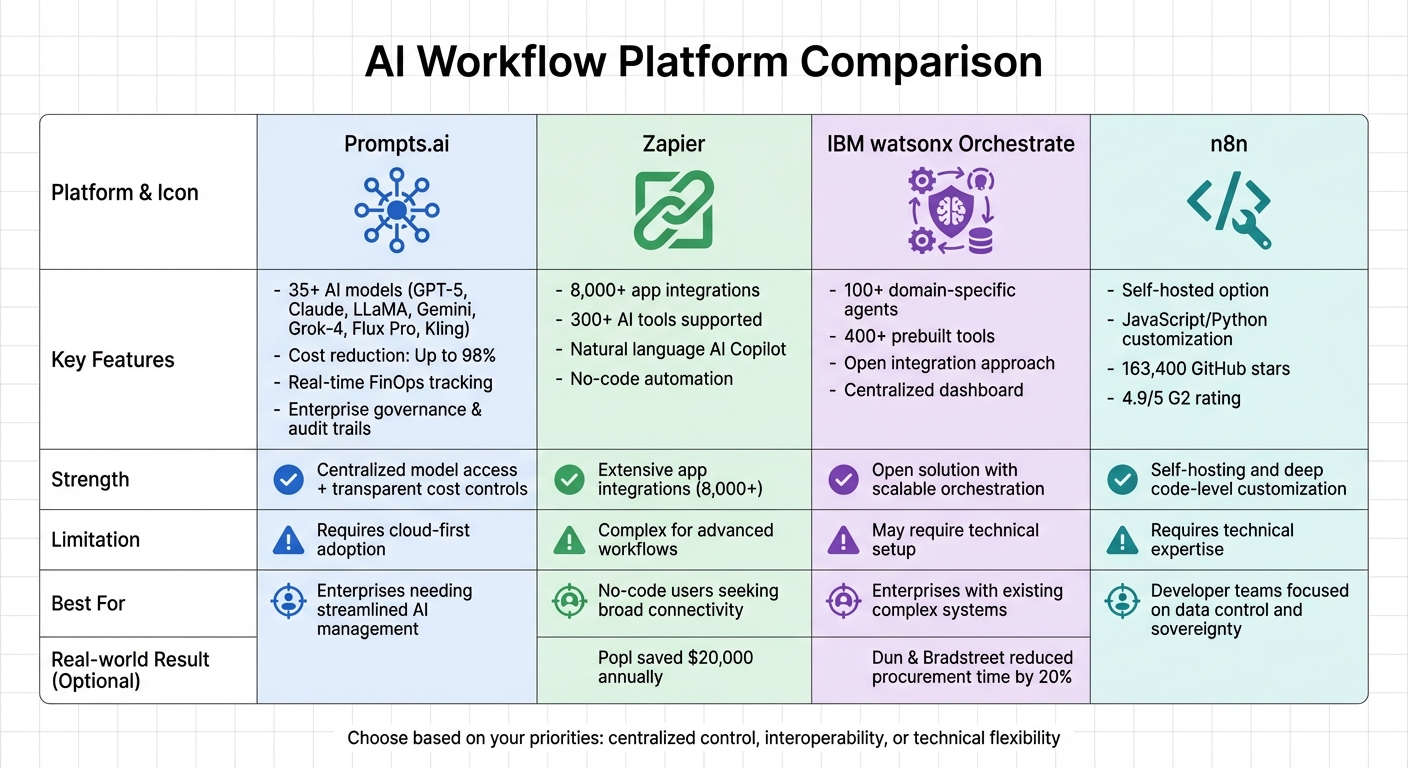
AI Workflow Platform Comparison: Features, Strengths and Best Use Cases
This section delves into the unique benefits and challenges of the platforms discussed earlier, highlighting what sets them apart and where they may fall short.
Each AI workflow platform offers its own mix of strengths and compromises. Prompts.ai excels in simplifying access to multiple AI models while ensuring spending remains transparent. By centralizing operations, it eliminates the chaos of managing multiple tools and provides real-time insights into usage and costs across teams and models.
Zapier, on the other hand, shines in its ability to connect over 8,000 apps, making it a go-to choice for no-code users who need to link various systems quickly. However, this extensive connectivity can introduce complexity, particularly when managing advanced, multi-step workflows that require custom logic or detailed error handling.
While having broad interoperability is a major advantage, challenges like maintaining data integrity and integrating with older systems remain. Even with robust integrations, platforms depend on clean, structured data to perform effectively. For instance, standard machine translation tools fail to accurately process industry-specific jargon 82% of the time. Without safeguards like kill switches or spending caps, automation can lead to cascading errors, underscoring the importance of built-in guardrails.
Legacy system integration presents another common obstacle. Many organizations find it difficult to bridge modern AI tools with outdated infrastructure, leading to fragile and inefficient setups. Platforms like n8n address this issue by offering self-hosting capabilities and code-level control with languages like JavaScript or Python. This flexibility has earned n8n widespread recognition, including over 163,400 stars on GitHub and a 4.9/5 rating on G2. However, this level of control comes with a learning curve, requiring technical teams to invest time and effort before they can fully leverage its potential.
Below is a summary of each platform's main advantages, limitations, and ideal use cases:
| Platform | Strength | Key Limitation | Best For |
|---|---|---|---|
| Prompts.ai | Centralized model access + transparent cost controls | Requires cloud-first adoption | Enterprises needing streamlined AI management |
| Zapier | Extensive app integrations (8,000+) | Complex for advanced workflows | No-code users seeking broad connectivity |
| n8n | Self-hosting and deep code-level customization | Requires technical expertise | Developer teams focused on data control and sovereignty |
The right choice ultimately hinges on finding the right balance between centralized control, interoperability, and technical flexibility to meet your specific needs.
Choosing the right AI platform hinges on evaluating technical capabilities, compliance needs, and budget constraints. The case studies discussed here underscore the advantages of centralized management, broad integrations, and tailored technical solutions.
Prompts.ai is a standout choice for enterprises seeking centralized access to over 35 leading AI models. It simplifies operations with transparent cost controls and real-time spending insights, eliminating the hassle of managing multiple subscriptions while ensuring unified governance. This approach aligns with earlier discussions on maintaining spending clarity and robust compliance.
For non-technical teams in areas like sales, marketing, or operations, Zapier offers unmatched ease of use. With over 8,000 integrations and its natural language "AI Copilot", Zapier enables quick workflow automation. For example, Popl's sales team saved $20,000 annually by automating over 100 workflows, including triaging inbound emails and routing demo requests from HubSpot.
Meanwhile, technical teams prioritizing data sovereignty and cost efficiency should consider n8n. Its self-hosted option addresses data residency concerns, and its execution-based pricing makes it a cost-effective choice for high-volume processes. With code-level customization, n8n caters to developer-centric organizations, though it does require a higher upfront technical effort.
For industries with strict regulations, such as healthcare or finance, platforms with strong audit trails and "human-in-the-loop" safeguards are critical. Tools like Stack AI deliver essential security certifications, including SOC 2 Type II, GDPR, and CCPA compliance, along with explainability features to meet regulatory demands. Notably, while 89% of small businesses utilize AI, 74% struggle to demonstrate measurable ROI. This highlights the importance of starting with a few high-impact, repeatable processes rather than attempting sweeping transformations from the outset.
Prompts.ai places a strong emphasis on data security and regulatory compliance, ensuring protection and accountability across its platform. By leveraging a centralized system, it incorporates role-based access, end-to-end encryption, and continuous audit logging to give organizations complete transparency over data access and usage.
The platform is crafted to align with major industry standards such as HIPAA for healthcare and GDPR for data privacy. It includes built-in policy controls, options for data residency, and automated compliance reporting, making it easier for businesses to meet U.S. legal and regulatory requirements. These tools empower organizations to expand their AI workflows with confidence, all while protecting sensitive data.
Prompts.ai offers a cost-effective solution by consolidating over 35 AI models into a single, pay-as-you-go platform. This setup eliminates the hassle of juggling multiple subscriptions and the complexity of managing various tools. Businesses also gain the ability to monitor token usage and spending in real time, helping them stick to budgets and sidestep unexpected expenses.
Starting at just $99 per member per month, this platform replaces the need for multiple vendor licenses with a straightforward, predictable cost. Companies using Prompts.ai typically experience up to a 95% reduction in AI-related expenses, a 31% drop in operational costs, and a 40% boost in employee productivity. Additionally, built-in compliance tools help avoid fines and reduce redundant work, ensuring you get the most out of your investment.
Prompts.ai brings order to AI model management by uniting your models, prompts, and agents in one streamlined workspace. Supporting over 35 large language models (LLMs), including GPT-4 and Claude, the platform makes it simple to track versions, monitor updates, and collaborate effectively - all while tackling the challenge of "prompt sprawl." Features like built-in version control and performance analytics empower you to fine-tune models, optimizing both speed and costs.
With real-time cost tracking in U.S. dollars, Prompts.ai keeps you informed about spending, offering pay-as-you-go financial controls that can cut expenses by up to 98%. Its modular components and reusable workflows simplify operations across departments - whether it's content creation, customer support, or multi-agent systems - eliminating the need to rebuild pipelines. By centralizing these processes, the platform enhances productivity, reduces redundancy, and enables U.S. enterprises to scale AI initiatives securely and efficiently.