Pay As You Go - AI Model Orchestration and Workflows Platform



AI-powered workflow automation is transforming businesses but introduces security risks like data breaches, prompt injections, and shadow AI. The stakes are high - 81% of enterprises are adopting AI, yet over a third report increased risks. In 2025, "LLMjacking" caused daily losses of $46,000 to $100,000, underscoring the need for robust solutions.
This article highlights seven platforms tackling these challenges:
Each platform addresses AI security through threat detection, governance, integration, and compliance, ensuring safer workflows without compromising efficiency.
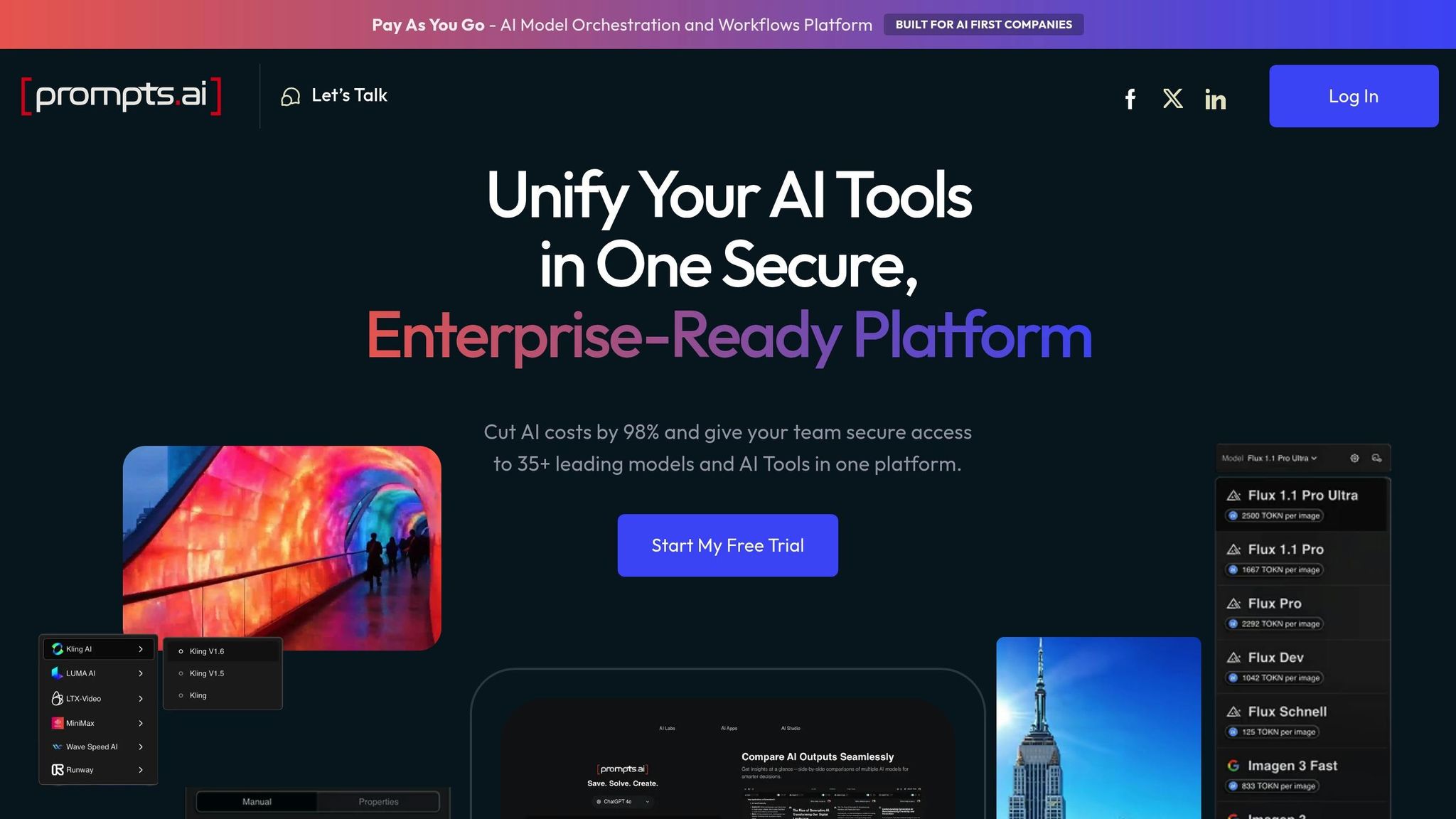
Prompts.ai addresses AI security challenges in workflow automation by centralizing the management of over 35 top language models - including GPT-5, Claude, LLaMA, and Gemini - on a single, enterprise-ready platform. This streamlined system allows organizations to handle AI interactions effortlessly, minimizing the risks of scattered tools while ensuring thorough oversight for teams and various applications.
The platform embeds enterprise-level governance into every workflow. It provides detailed audit trails that track which models are accessed, the prompts used, and how data moves within automated processes. This level of transparency helps mitigate the risks of shadow AI, where unauthorized use of public AI tools could expose sensitive information. By aligning workflows with organizational policies and incorporating compliance checks, Prompts.ai ensures AI operations can scale securely.
Prompts.ai simplifies security by offering a unified interface that eliminates the chaos of managing multiple tools. Instead of juggling separate API keys and access points for various AI services, organizations can channel all interactions through one secure gateway. This approach not only streamlines integration with existing security systems but also guarantees consistent enforcement of policies across automated workflows.
Real-time FinOps cost controls provide businesses with the financial insights needed for regulatory reporting. By tracking token usage and linking AI expenses to business outcomes, the platform ensures transparency. Its pay-as-you-go TOKN credit system removes the burden of recurring fees while maintaining detailed audit trails essential for compliance. Additionally, data handling controls ensure sensitive information stays within organizational boundaries, enabling teams to deploy secure and compliant AI workflows with confidence.
Arctic Wolf has established itself as a leader in the realm of AI-driven automation with its advanced, integrated security solutions. Its Aurora Platform processes an impressive 9 trillion security events every week through the Alpha AI engine, ensuring robust protection for automated workflows. This system automates critical security tasks, handling 7 million alerts and performing 2 million remediations annually, leveraging deep security insights to detect and neutralize threats before they disrupt operations.
The Alpha AI engine is at the heart of Arctic Wolf’s threat detection capabilities. It excels at zero-day threat prevention and large-scale behavioral analysis, enriching event data for streamlined review. Collaborating with Databricks in 2024-2025, Arctic Wolf unified telemetry for more than 10,000 organizations, enabling analysts to run advanced machine learning detections with just a click - eliminating the need for manual scripting and significantly speeding up incident response. Additionally, the AI Security Assistant, developed in partnership with Anthropic, provides 24/7 real-time threat analysis. It simplifies complex alerts and CVEs into actionable insights, helping reduce analyst workload and fatigue.
Arctic Wolf’s open XDR architecture enhances its functionality by seamlessly integrating with over 250 third-party tools. These include key systems like Microsoft Defender XDR, Oracle Cloud Guard, OneLogin, and CyberArk, covering endpoint, network, cloud, and identity systems. This approach avoids the need for costly infrastructure replacements, instead unifying telemetry into a single, consolidated system of record. Such integrations not only strengthen security but also support compliance efforts.
The Aurora Platform offers unlimited data retention with easy, on-demand log access, all under a flat-fee pricing model. This eliminates the unpredictability of volume-based costs. With Unity Catalog integration, organizations can centralize data governance and manage security permissions across their entire data landscape. The AI Security Assistant further simplifies compliance by summarizing action items from "Security Journeys" and providing detailed MITRE ATT&CK context for CVE documentation. These features ensure that workflows are audit-ready, meeting the stringent regulatory requirements of industries like healthcare, finance, and government.
Cato Networks leverages its SASE Cloud Platform to unify AI-driven security, ensuring 99.999% uptime while managing global security events. Its platform integrates threat detection, governance controls, and seamless integration into a single, efficient system. Notably, in April 2025, CloudFactory adopted Cato's GenAI controls through its shadow AI dashboard, enabling secure and risk-managed use of GenAI tools.
Cato Networks tackles modern threats with its advanced AI-powered detection tools, built into its unified platform.
The platform's AI engines process hundreds of threat intelligence feeds, maintaining a global blacklist of over 5 million entries without human oversight. By assigning maliciousness scores, Cato identifies machine-generated domains and cybersquatting attempts, outperforming static blacklists by blocking 3 to 6 times more malicious domains. Its Storyteller AI feature translates raw incident data into clear, actionable narratives aligned with the MITRE ATT&CK framework, speeding up remediation for security teams managing automated workflows.
To address AI-specific risks, Cato deploys runtime guardrails that detect unsafe actions, including prompt injections and jailbreak attempts within automated workflows. Its AI-powered Data Loss Prevention (DLP) system uses Large Language Models to understand the context of sensitive documents - whether financial, medical, or HR-related - and enforces policies to prevent data leakage into public AI models.
Cato's Autonomous Policies engine enhances security by optimizing and automating network and access policies. It identifies and removes redundant or risky firewall rules, reducing "rule bloat" and implementing zero-trust policies automatically. As Ofir Agasi, Vice President of Product Management at Cato Networks, explained:
"For years, IT leaders have chased the dream of autonomous networking and security - only to hit a wall of complexity. With Cato Autonomous Policies, we finally cross that threshold."
The Shadow AI dashboard monitors and categorizes over 950 GenAI applications, allowing for detailed control over user actions. Role-based access control ensures least-privilege access, offering predefined roles such as Account Admin, Security Admin, Network Admin, and Viewer, with the option to create custom roles. Additional safeguards, like multi-factor authentication and an Audit Trail under the Monitoring tab, ensure all policy changes are tracked and accountable.
Cato's Model Context Protocol (MCP) server simplifies interactions between AI agents and the Cato environment, enabling natural language commands instead of complex scripts. This Docker-based server integrates seamlessly with Cato's insights and third-party systems like SIEM, supporting data extraction, automated configurations, and custom integrations. These features streamline data processing and routine security tasks.
In May 2025, chemical manufacturer ESI used Cato’s unified management and automated policy tools to reduce the time needed to integrate newly acquired companies into its secure network by 80%. The platform also provides continuous visibility into the "agentic ecosystem", identifying shadow agents, unmanaged MCP servers, and custom-built agents across cloud and local environments. Developers benefit from inline runtime guardrails that protect agent reasoning and tool usage within their workflows.
In addition to its technical defenses, Cato simplifies compliance management and auditing.
The platform maintains clean rulesets and offers real-time visibility into AI usage across an enterprise, easing the burden of compliance audits. Its AI-powered DLP detects sensitive content and enforces corporate policies, preventing unauthorized uploads to public AI models. According to Gartner, by 2027, over 40% of AI-related data breaches will stem from improper GenAI use across borders, making these controls indispensable for regulated industries.
Cato’s unified management consolidates configuration, analytics, and auditing into a single interface. For example, in 2025, law firm Fidal transitioned from legacy MPLS architecture to Cato SASE, reducing WAN and security costs by 50% while improving network performance and visibility. Additionally, the platform’s rapid virtual patching through its IPS layer neutralizes vulnerabilities within hours, ensuring automated workflows remain secure against new threats.
Cisco AI Defense secures automated workflows by embedding protection directly into the network infrastructure, eliminating the need for agents or code changes. The platform inspects every AI interaction - whether it’s prompts, responses, or data flows - across major cloud providers like AWS, Azure, and GCP. As Chuck Robbins, Chair and CEO of Cisco, highlighted:
"Our unique ability to bring together networking, security, observability, and data enables Cisco to offer our customers digital resilience for the AI era."
Cisco AI Defense is purpose-built to secure automated AI workflows. Its algorithmic red teaming can test models against more than 200 attack techniques in seconds, replacing what would traditionally take weeks of manual effort. The system identifies a wide range of threats, including over 45 prompt injection methods, 30 data privacy risks, 20 security vulnerabilities, and 50 safety threats. This ensures a broad and thorough approach to threat detection.
The platform’s runtime protection operates at the network layer, inspecting all AI traffic without requiring additional agents. It proactively blocks threats such as model denial of service (DoS) attacks, prompt extraction attempts, command execution exploits, and data poisoning before they can impact production systems. Output sanitization further ensures sensitive data like PII, PHI, or source code is not disclosed. Cisco Talos, along with a dedicated AI research lab, continuously updates the platform with the latest adversarial tactics, techniques, and procedures.
The AI Defense console provides a centralized view of an enterprise's AI security posture. Its AI Cloud Visibility feature automatically detects unauthorized AI models across cloud environments, addressing gaps that traditional security tools often overlook. Through the Policies tab, security teams can establish unified data protection and compliance rules, applying them across both Gateway and API-enforced connections.
Kent Noyes, Global Head of AI and Cyber Innovation at World Wide Technology, commented on the platform’s significance:
"The adoption of AI exposes companies to new risks that traditional cybersecurity solutions don't address. Cisco AI Defense represents a significant leap forward in AI security, providing full visibility of an enterprise's AI assets and protection against evolving threats."
The platform offers two enforcement methods: Gateway-enforced runtime, which intercepts and automatically blocks traffic at the network level, and API-enforced runtime, which integrates directly into applications, enabling developers to implement custom security logic. This dual approach lets organizations enforce enterprise-wide policies while accommodating application-specific needs, ensuring comprehensive oversight.
Cisco AI Defense expands its protection through seamless integrations, complementing its detection and governance features. It provides native integration with leading LLM providers like AWS Bedrock, safeguarding model interactions without disrupting workflows. GitHub integration automates scanning of AI model files, MCP code, and registries, identifying malicious content and ensuring license compliance before deployment.
The AI Defense Inspection API allows developers to embed security measures directly into applications. Meanwhile, the platform’s Multicloud Defense approach enforces policies at the network fabric level without requiring any code changes. Integration with Splunk centralizes logging and provides detailed insights into AI-related security events. Additionally, Cisco AI Defense works alongside Cisco Secure Endpoint and Cisco Email Threat Defense to address supply chain risks and manage malicious AI model files. Currently, the platform supports content inspection in both English and Japanese.
In addition to its threat detection capabilities, Cisco AI Defense helps organizations align with key regulatory frameworks, including the NIST AI Risk Management Framework (AI-RMF), MITRE ATLAS, and the OWASP Top 10 for LLM Applications. The platform includes guardrails to prevent the leakage of regulated data, such as PII, PHI under HIPAA, and PCI data for financial services.
Automated compliance assessments generate real-time vulnerability reports, evaluating the compliance status of AI applications. The platform’s supply chain governance features scan AI model files for software license compliance and geopolitical origin risks before they are introduced into enterprise networks. With hundreds of preconfigured protection rules that can be tailored to specific model vulnerabilities, Cisco AI Defense ensures runtime guardrails address the unique risks of each deployed model. This approach safeguards agent-based AI workflows and Retrieval-Augmented Generation (RAG) applications from malicious prompts and data exposure, all while maintaining audit-ready documentation.
CrowdStrike takes AI security to the next level with its Falcon platform, designed to protect automated workflows and streamline security operations.
The Falcon platform uses an agent-based security architecture to tackle tasks autonomously, reducing the need for constant human oversight. Its Charlotte AI feature allows security teams to leverage large language models within Falcon Fusion SOAR. This capability processes unstructured data and automates complex responses, eliminating the need for manual intervention. As Lucia Stanham from CrowdStrike puts it:
"Charlotte AI goes beyond copilots, representing a new class of agentic AI that operates within expert-defined parameters to accelerate outcomes across the SOC."
CrowdStrike has developed AI Detection and Response (AIDR) to secure the "prompt layer" where language models interact with automated workflows. This layer is protected against threats like prompt injection, jailbreaks, and model manipulation. With a database tracking over 180 prompt injection techniques, the platform continuously refines its defenses. The Falcon Data Protection tool uses machine learning to detect unusual behavior in data movement across users, peers, and organizations, triggering automatic responses to suspicious activities.
The platform deploys specialized agents for specific tasks. For instance, the Workflow Generation Agent translates natural language commands into automated SOAR workflows, while the Malware Analysis Agent reviews suspicious files and connects them to known threats. Charlotte AI Detection Triage filters out false positives, saving security teams over 40 hours per week and delivering 75% faster answers about their security environment. With nearly 45% of employees using AI tools without notifying management, the platform’s shadow AI detection fills critical visibility gaps in enterprise operations.
These detection capabilities are built on a unified data model, enabling seamless workflow automation across the board.
The Falcon Fusion SOAR framework offers native integrations without extra licensing fees, allowing security teams to create automated workflows using an intuitive interface and pre-built templates. The platform’s Enterprise Graph consolidates telemetry data from endpoints, identities, cloud services, SaaS tools, and third-party systems, making all signals actionable in real-time.
The Data Transformation Agent ensures data consistency across various third-party tools, eliminating formatting issues that could disrupt automation. CrowdStrike integrates directly with widely-used enterprise tools like ServiceNow for incident ticketing, Slack for notifications, and Jira for task management. The Microsoft Teams integration provides Enhanced Privileged Access, enabling users to request and receive elevated privileges directly within Teams. Additionally, the Agentic Response Collaboration feature allows Charlotte AI to securely interact with trusted third-party agents and human analysts during complex investigations. This ensures adherence to the 1-10-60 rule: detecting threats within 1 minute, investigating within 10 minutes, and isolating them within 60 minutes.
CrowdStrike’s platform automates incident response tasks - such as threat detection, endpoint isolation, and malware removal - to ensure regulatory compliance. It has earned ISO 42001 certification, a global standard for AI governance, reflecting its dedication to responsible AI practices. Security automation enforces policy controls and checks configurations in real-time, maintaining audit readiness and meeting compliance standards.
The platform addresses the challenge of managing massive volumes of security data, which impacts 62.5% of security teams. With organizations receiving an average of 4,500 alerts daily, and 30% of these going uninvestigated due to limited resources, automation becomes essential. By handling routine tasks like alert triage and data correlation, CrowdStrike improves consistency and reduces human error. All automated actions are documented with full audit trails, ensuring transparency and meeting regulatory requirements. The platform’s "bounded autonomy" settings restrict agents to predefined limits, requiring human approval for high-impact actions that could affect security or compliance.
SentinelOne’s Purple AI platform takes automation to the next level by autonomously managing complex security tasks. Its Singularity Hyperautomation engine turns AI insights into actionable workflows, enabling real-time responses like isolating compromised endpoints or revoking user access - completely hands-free. This unified approach streamlines detection, response, and compliance processes.
The Purple AI Agentic Framework mimics the decision-making of seasoned SOC analysts, automatically triaging, investigating, and responding to threats. It conducts multi-step investigations by analyzing device logs, user behavior, and network activity to create a detailed incident narrative before suggesting responses. Its AI Similarity Analysis leverages trillions of data points and global intelligence to assess whether alerts are genuine, allowing security teams to focus on actual risks.
SentinelOne’s capabilities were highlighted in the MITRE Engenuity ATT&CK Enterprise Evaluation 2024, where it achieved 100% detection with zero delays. Organizations using Purple AI report an annual productivity boost of $435,000, while the platform reduces false alerts by 88% compared to industry standards, significantly easing alert fatigue. CEO Tomer Weingarten encapsulates this vision:
"At SentinelOne, we believe AI should do more than just assist security teams – it should act as an extension of every analyst, reasoning and acting like an experienced human defender."
The Singularity Hyperautomation platform offers over 100 pre-built integrations and a no-code drag-and-drop tool for creating custom workflows without programming knowledge. By using the Open Cybersecurity Schema Framework (OCSF), it standardizes data at ingestion, enabling seamless queries across both native and third-party systems without the need for manual mapping. Security teams can integrate existing tools, such as Splunk or third-party data lakes, with Purple AI, applying its reasoning capabilities across all data sources without requiring costly migrations. Additionally, the Singularity AI SIEM provides 10GB of daily data ingestion - from both first-party and third-party sources - at no extra cost, making it accessible for organizations of various sizes.
This strong integration framework ensures that SentinelOne’s platform is not only efficient but also adaptable to diverse security ecosystems.
Purple AI maintains an immutable audit trail of every action, ensuring regulatory proof and accountability. Features like Auto-Reporting and Auto-Investigations produce detailed incident summaries for compliance purposes. The platform also incorporates human-in-the-loop governance, allowing analysts to validate AI actions and convert them into governed workflows for future use. This balance between automation and oversight ensures consistency during audits while adapting to specific compliance needs.
SentinelOne also prioritizes data security, with AI models never trained on user data. Its Prompt Security feature enforces automated policy controls, supporting over 15,000 AI sites to detect and mitigate shadow AI risks. Together, these measures provide a secure, end-to-end solution for managing automated workflows while meeting stringent regulatory standards.
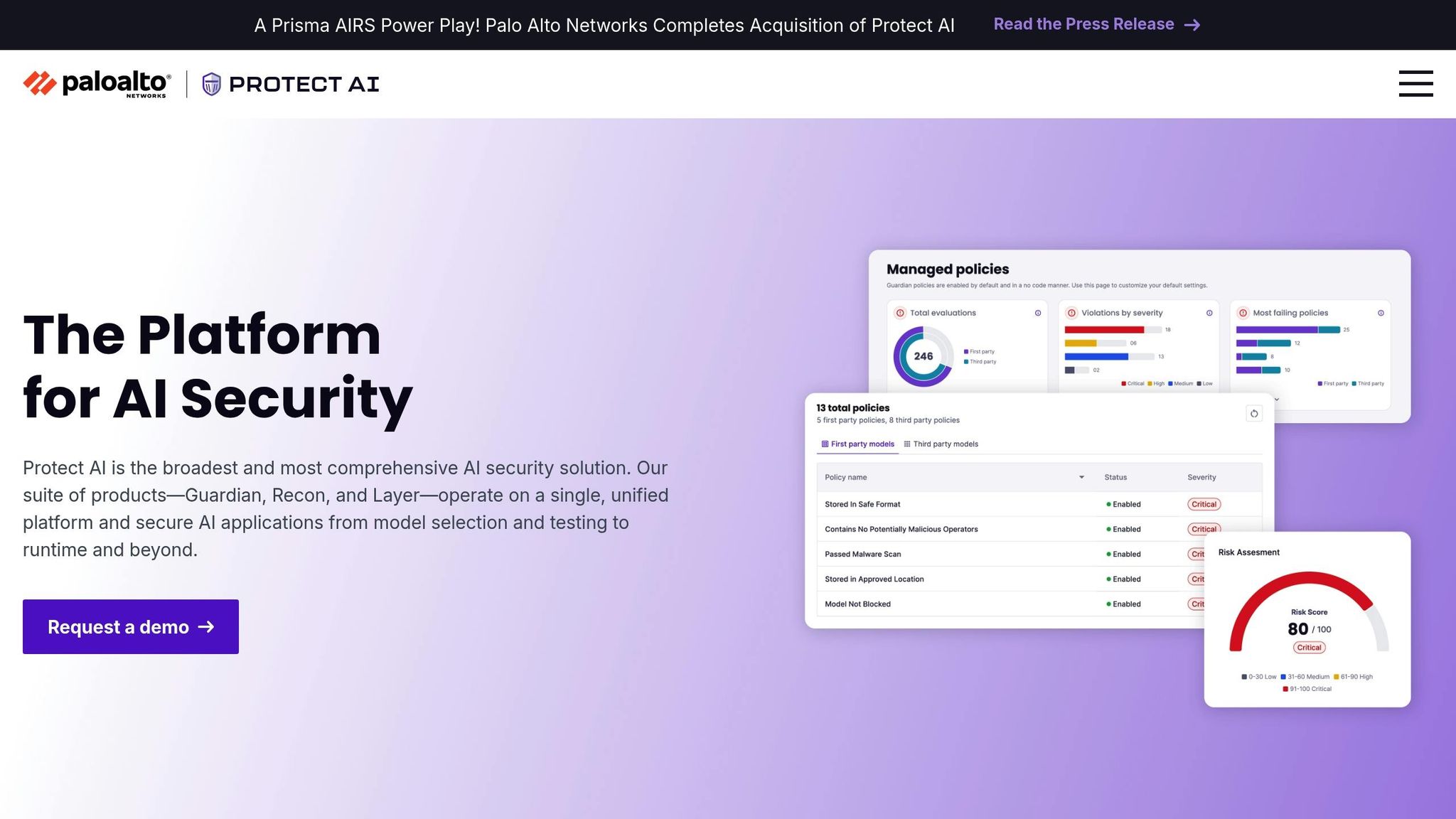
In the ever-changing world of AI security, Protect AI's Guardian platform stands out by focusing on safeguarding the integrity of AI models. Unlike traditional security tools that concentrate on infrastructure, Guardian zeroes in on the model files driving automated workflows. By April 2025, the platform had already scanned over 4 million models, including more than 1.5 million from the Hugging Face repository. This extensive scanning capability lays the groundwork for advanced AI threat detection.
Guardian supports over 35 model formats, such as PyTorch, TensorFlow, ONNX, Pickle, GGUF, and Safetensors, automatically scanning for vulnerabilities before models are deployed. It targets threats like deserialization attacks, architectural backdoors, and runtime vulnerabilities - issues that conventional tools often overlook. This robust detection is powered by huntr, a global network of over 17,000 security researchers who continuously identify and report AI-specific vulnerabilities, enriching Guardian’s scanning engine.
"Guardian offers the widest and deepest set of model scanners on the market - identifying deserialization, architectural backdoors, and runtime threats across all major model formats." - Protect AI
Through its collaboration with Hugging Face, Guardian ensures that open-source models are vetted and secure before organizations integrate them, effectively blocking compromised models from entering CI/CD pipelines.
Guardian allows organizations to establish customizable security policies for both first-party and third-party models. Security teams can define detailed rules around model metadata, approved formats, and trusted sources to ensure only authorized models are used in production. The platform also maintains a centralized audit trail, documenting every model evaluation to assist with regulatory compliance and internal audits.
By enforcing safe formats like Safetensors and restricting high-risk ones such as Pickle, Guardian mitigates the risk of deserialization attacks. These policies are flexible enough to accommodate varying risk levels across teams while maintaining consistent security practices, seamlessly integrating into existing workflows.
Guardian is designed to fit effortlessly into existing workflows, offering integration options via CLI, SDK, or a lightweight Docker container. It supports a wide range of model sources, including MLFlow, Amazon S3, Amazon SageMaker Model Registry, Artifactory, and Git repositories, allowing security teams to implement model scanning without disrupting current development processes or requiring major infrastructure changes.
"Guardian integrates seamlessly into existing AI pipelines, DevOps workflows, repositories, and research environments." - Protect AI
For organizations needing additional control, the Local Scanner can be deployed on-premises, enabling secure scanning of sensitive intellectual property. This setup provides immediate feedback during development, helping teams address vulnerabilities early rather than after deployment.

AI Security Platforms Comparison: Key Features and Capabilities
The analysis of AI security platforms highlights the importance of strong protections for workflow automation. With organizations managing an average of 4,500 alerts daily and facing data breach costs of about $4.88 million, having effective security measures is more critical than ever.
Here’s a breakdown of the key security features offered by Prompts.ai, showcasing how it safeguards AI-driven workflows across four critical areas: AI-driven threat detection, governance controls, integration capabilities, and compliance support.
AI-Driven Threat Detection
Prompts.ai carefully examines every GenAI prompt and response to detect and block threats like prompt injection attacks, data leakage, and inappropriate content. This level of prompt-specific security ensures potential risks are stopped before they can disrupt workflows or compromise sensitive data.
Governance Controls
The platform provides leadership teams with centralized visibility into all AI interactions within the organization. This transparency helps reduce shadow AI risks and ensures that AI usage aligns with established policies, keeping operations secure and accountable.
Integration Capabilities
Prompts.ai simplifies security management by unifying the monitoring of all GenAI prompts and responses into a single interface. This eliminates the need to juggle multiple tools or API keys, ensuring consistent security enforcement without interfering with existing workflows.
Compliance Support
Designed for enterprise needs, Prompts.ai offers features like detailed audit trails, real-time cost controls for regulatory reporting, and robust data handling measures. These tools help ensure that workflows remain within organizational and regulatory boundaries, making them audit-ready and compliant.
Ensuring secure AI-driven workflow automation requires integrating security measures at every stage of the AI lifecycle. This includes features like prompt-level filtering, behavioral monitoring, agentic governance, and incorporating human oversight. With the rapid expansion of AI usage, treating AI security as an afterthought is no longer an option for organizations.
When choosing a platform, focus on runtime protection rather than relying solely on posture management. Tools that block threats in real time - like those preventing prompt injections or data leaks - can stop issues before they escalate. Additionally, addressing shadow AI risks is critical, as highlighted by over one-third of enterprise leaders. Opt for solutions that offer centralized oversight of all AI activities and enforce governance without disrupting your current workflows.
Shadow mode testing is another vital strategy. It allows organizations to validate AI recommendations through human review before fully automating processes. As Sreeharsha Dugga, Cyber Defense Lead at Abnormal AI, explains:
"AI drafts the context, timelines, and suggestions. Humans decide on actions."
This collaborative approach cuts review times significantly - from 15–20 minutes to just 3–4 minutes - while ensuring accountability for critical decisions. By adopting such proactive measures, businesses can maintain operational integrity and protect themselves from major financial risks.
AI-driven workflow automation brings a host of security challenges, including data breaches, model manipulation, and system vulnerabilities. Data breaches may happen when sensitive information is accidentally exposed during automated processes, leaving confidential data vulnerable. Meanwhile, model manipulation - such as feeding adversarial inputs - can trick AI systems into making flawed decisions, potentially causing workflow disruptions.
System vulnerabilities, such as misconfigurations or insecure API integrations, can serve as gateways for malicious attacks. The intricate nature of AI systems makes them susceptible to threats like data poisoning or unauthorized access. To address these risks, organizations should implement strong security measures, such as encryption, identity management, anomaly detection, and continuous monitoring. These practices help ensure AI workflows remain both secure and dependable.
Prompts.ai brings together more than 35 AI models within a centralized platform, offering enterprise-grade security to meet your compliance and governance needs. Its standout features include real-time threat detection, data leak prevention, automated compliance checks, and comprehensive audit trails.
Designed to align with leading regulations such as GDPR, HIPAA, SOC 2, ISO 27001, and the EU AI Act, the platform helps businesses maintain security and compliance while streamlining their automated workflows.
Prompts.ai protects against prompt injection attacks by utilizing advanced AI models such as Anthropic Pro/Max and Opus 4.5. These models are specifically built to process natural language inputs with a focus on security and reliability.
To further enhance protection, Prompts.ai employs defense-in-depth strategies, layering multiple security measures to reduce risks in natural language processing. This combination of strong model design and proactive safeguards ensures that your automated workflows stay secure and resistant to potential threats.