Pay As You Go - AI Model Orchestration and Workflows Platform



AI workflows are transforming how businesses operate by integrating intelligence into processes, enabling smarter decisions and significant cost savings. With 66% of organizations prioritizing AI and workflows projected to power 25% of enterprise processes by 2025, choosing the right platform is critical. Companies like Prompts.ai, Orkes, and Make stand out by offering features such as multi-model integration, scalability, and enterprise-grade security.
Key Highlights:
Each platform caters to unique needs, from startups to large enterprises, ensuring businesses can enhance productivity, cut costs, and maintain control. Explore options to align with your goals and scale effectively.
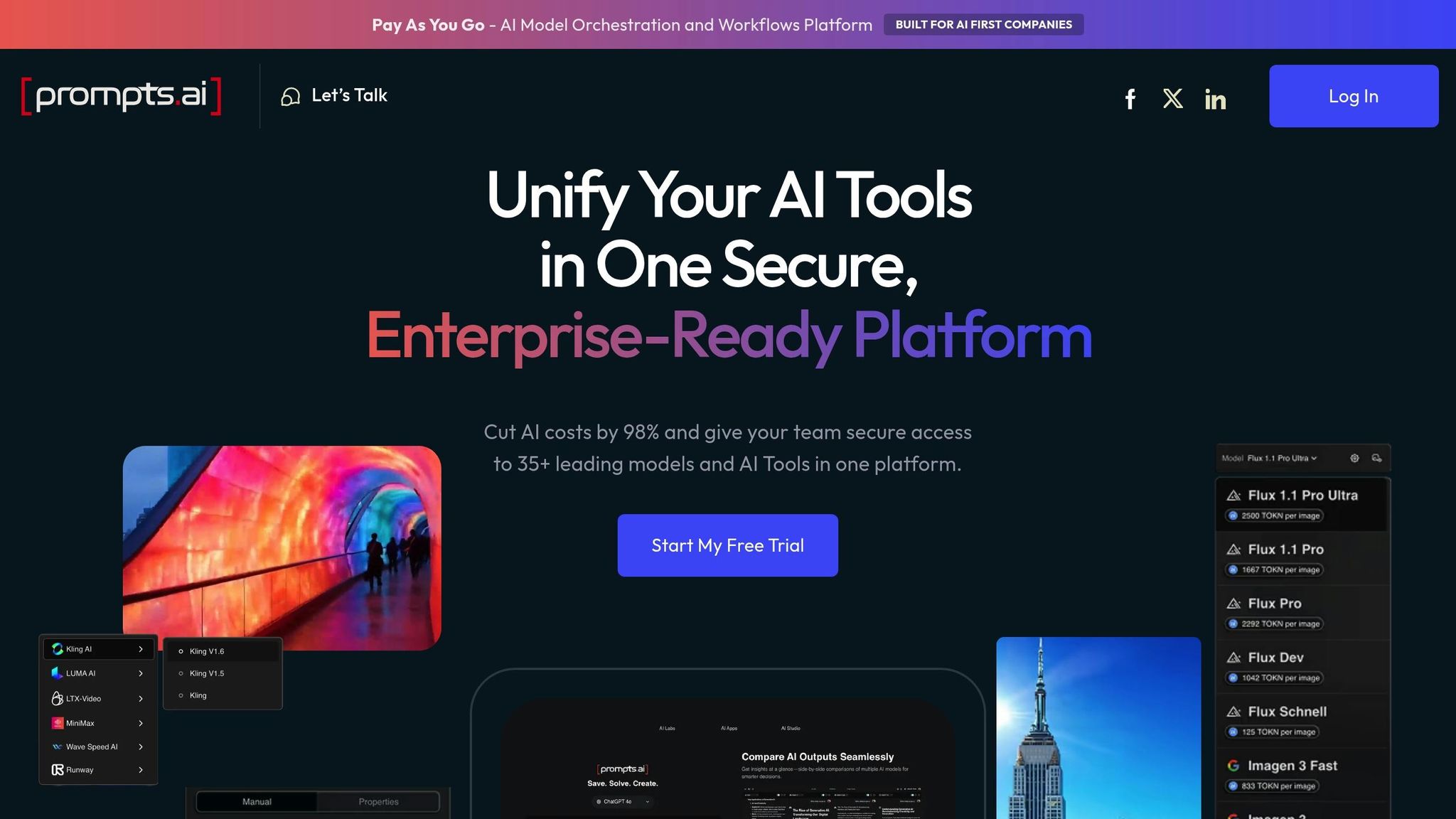
Prompts.ai tackles the common issue of managing multiple AI tools by offering access to over 35 top-tier language models - including GPT-5, Claude, LLaMA, Gemini, Grok-4, Flux Pro, and Kling - all within a single, unified platform. This streamlined approach can reduce AI software costs by as much as 98%, eliminating the need for separate subscriptions for each model.
By uniting these models, Prompts.ai simplifies the process of comparing and selecting the right tool for the task. Instead of juggling multiple accounts, billing systems, and learning curves, teams can easily switch between models. For example, use GPT-5 for complex reasoning, Claude for detailed content creation, or LLaMA for budget-conscious operations. This effortless model switching allows organizations to test and determine the most effective model for specific workflows before committing resources, removing the trial-and-error guesswork that often comes with adopting AI solutions.
Prompts.ai uses a pay-as-you-go TOKN credit system, offering flexibility compared to fixed monthly subscriptions. Each credit is tracked in real time through an integrated FinOps layer, ensuring spending is directly tied to measurable outcomes. This transparency eliminates unexpected charges and avoids paying for unused capacity. Business plans start at $99 per member per month for the Core tier, with the Elite tier available at $129 per member per month, tailored for creative professionals needing advanced model capabilities.
Prompts.ai builds enterprise-grade controls into every workflow. The platform ensures comprehensive audit trails for all AI interactions, enabling compliance teams to monitor which models were used, by whom, and for what purposes. Sensitive data remains securely within the organization, addressing concerns that have traditionally slowed AI adoption in regulated sectors like finance and healthcare.
Whether you're onboarding a small creative team or scaling up to a Fortune 500 enterprise, Prompts.ai makes growth simple. Adding new users, models, or use cases takes just minutes, not months. Its architecture supports seamless expansion, letting organizations begin with a few users testing workflows and scale up to thousands of employees across departments - all while maintaining centralized oversight and control. This flexibility ensures businesses can grow their AI capabilities without overhauling existing infrastructure.
Orkes takes AI agents from concept to production with its powerful orchestration engine, built on Netflix Conductor. Handling over 1 billion workflows daily with an availability SLA of up to 99.99%, the platform is designed for mission-critical tasks where downtime isn’t an option. This reliability forms the foundation for its advanced model integration features.
The MCP Gateway turns internal APIs into secure tools that AI agents and large language models (LLMs) can use instantly, breaking down integration hurdles. Orkes treats AI prompts with the same importance as traditional code, allowing teams to manage, version, and secure them effectively. With its Prompt to Workflow feature, users can describe a process in plain English, and the platform automatically generates a starter workflow that’s ready for editing and deployment. This feature makes it easier for teams, even those without extensive AI engineering skills, to move quickly from ideas to production.
"Prompt engineering is at the heart of agent behavior. The fact that Orkes Conductor treats prompts as first-class citizens shows us you're serious about building for real-world AI orchestration." - Mehdi Fassaie, AI Lead, Naveo Commerce
Orkes supports polyglot business logic, enabling microservice development in Python, Java, JavaScript, C#, or Go through open-source SDKs. This flexibility allows teams to build on their existing codebases without needing to overhaul their technology stack. The platform’s multi-agent coordination feature efficiently handles ordering, parallelism, and state management for multiple specialized agents within a single durable workflow. Trusted by over 1,200 companies and 10,000+ developers, with its open-source technology earning 24,000+ GitHub stars, Orkes seamlessly scales from small teams to enterprise-level operations.
Make simplifies AI orchestration with its intuitive visual workflow interface and Enterprise Grid, offering a centralized view of agents, applications, and workflows. This setup ensures businesses can stay in control as their AI operations grow and evolve.
Make aligns with modern AI orchestration needs by embedding advanced automation tools directly into existing workflows. Its AI-native task integration enables seamless incorporation of LLMs, prompt templates, and vector database connections - all without the need for custom coding. Additionally, the platform supports linking internal APIs to AI agents using standardized protocols. This allows teams to create sophisticated automations that merge traditional business logic with cutting-edge AI-driven decision-making. By doing so, organizations can enhance their existing data infrastructure while introducing smarter, more efficient processes.
Make ensures smooth operations with built-in error handling and replay features. If a workflow encounters an issue, teams can investigate the cause and restart processes from the failure point instead of starting over. For larger organizations, the Enterprise plan offers 24/7 support and priority execution for critical workflows, providing the reliability and support necessary for production-level deployments. These features create a dependable foundation for managing large-scale operations.
Designed for high-performance automation, Make uses a cloud-native, distributed Zeebe engine to scale horizontally and handle high-throughput tasks efficiently. Unlike traditional databases that can slow down under heavy loads, Make employs an event-driven, message-based system to maintain smooth performance. It also natively supports BPMN and DMN models, eliminating conversion delays and reducing errors, ensuring workflows run efficiently from start to finish.

AI Workflow Platforms Comparison: Features, Costs, and Capabilities
Each platform brings its own mix of control, integration options, and pricing models, making them suited to different needs. n8n is a go-to choice for developers who need full coding control. With JavaScript and Python code steps, it allows for custom logic without running into platform limits. Its execution-based pricing ensures predictable costs as you grow. However, for teams lacking coding expertise, the learning curve can be challenging compared to more visual, user-friendly tools. While n8n focuses on technical flexibility, other platforms prioritize broader integration and ease of use.
Zapier stands out with its massive integration library of over 8,000 apps. According to Marcus Saito, Head of IT and AI Automation at Remote:
"Zapier makes our team of three seem like a team of ten."
That said, its task-based pricing can become expensive as usage increases, and it doesn’t offer strong workflow testing features.
Vellum AI takes a different approach, catering to both technical and non-technical users with its prompt-first design and built-in evaluations that help avoid production issues. It’s particularly useful for teams iterating quickly on AI agents without needing to write code. For those focusing on error management and cost efficiency, Make offers scalable solutions, though its interface may take some time to master. Meanwhile, Workato provides enterprise-level governance with SOC 2 Type II compliance and guaranteed SLAs. However, its proprietary nature and high costs can make it less accessible for smaller teams.
Here’s a quick comparison of how these platforms stack up in areas like model integration, cost efficiency, governance, and scalability:
| Company | Model Integration | Cost Efficiency | Governance & Security | Scalability |
|---|---|---|---|---|
| Prompts.ai | High (35+ unified models) | High (98% cost reduction) | High (Enterprise audit trails) | High (Token-based scaling) |
| n8n | High (JS/Python code fallback) | High (Execution-based pricing) | Moderate (SOC 2, self-host option) | High (Self-hosted flexibility) |
| Zapier | Moderate (AI steps/Agents) | Low (Task costs climb with volume) | Moderate (SSO, basic RBAC) | Moderate (Limited by complexity) |
| Vellum AI | High (Prompt-first, multi-model) | Moderate (From $25/month) | High (VPC/On-prem, audit logs) | High (Production-grade AI) |
| Make | Moderate (AI modules) | High (Economical for volume) | Low (Limited RBAC/Secrets) | Moderate (Complex logic focus) |
Ultimately, the best platform depends on your priorities - whether it’s extensive integrations, cost control at scale, or meeting enterprise compliance standards. For technical teams, n8n often stands out for its flexibility, while non-technical users may prefer the accessibility of Vellum AI or Zapier for quick deployment.
Selecting the right AI workflow platform hinges on your organization's unique needs, budget, and technical expertise. Prompts.ai is a compelling choice for businesses looking to streamline access to over 35 leading AI models, backed by enterprise-level governance. Its token-based pricing model offers the potential to reduce AI costs by up to 98%, making it a strong contender for those prioritizing cost efficiency and transparency.
However, the landscape of AI platforms is diverse, with options tailored to various business requirements. Zapier excels in third-party integrations, while n8n offers the flexibility of self-hosting and execution-based pricing. For enterprises managing high-volume operations, Orkes handles over a billion workflows daily with ease. Companies needing BPMN standards-based modeling often turn to Camunda, and for industries like banking and healthcare, Opus addresses stringent regulatory demands. Teams focused on privacy and security may find solutions like Sprinto or OneTrust better suited to their compliance needs.
Ultimately, the best platform balances cost, functionality, and compliance while aligning with your team’s capabilities and future goals. Choose a solution that not only meets your current operational needs but also supports your strategic vision for growth.
Prompts.ai offers streamlined access to a robust suite of over 35 AI models, including advanced options like GPT-5 and Claude, all brought together in one centralized platform. This integration eliminates the hassle of juggling multiple tools, simplifying workflows and minimizing operational headaches for businesses.
The platform provides real-time cost tracking and a flexible, pay-as-you-go pricing structure, empowering organizations to manage budgets effectively while scaling their AI capabilities with ease. Designed with enterprise needs in mind, Prompts.ai emphasizes top-tier security, governance, and automation, making it a comprehensive solution for handling diverse AI workflows. It’s a game-changer for businesses looking to simplify and optimize their AI operations.
Prompts.ai enables businesses to cut costs with its flexible, pay-as-you-go pricing model. Instead of paying a fixed price, you’re charged only for the AI models and resources you actually use. This approach helps eliminate unnecessary expenses, making it easier to manage budgets and scale operations efficiently.
With access to more than 35 AI models, including well-known options like GPT-4 and Claude, Prompts.ai streamlines workflow orchestration, reducing operational complexities and associated costs. Its built-in governance tools and real-time cost tracking give businesses the ability to monitor spending closely, ensuring AI solutions are deployed securely and scaled effectively.
Prompts.ai places a strong emphasis on security, ensuring enterprise users can trust their AI workflows and sensitive data are well-protected. The platform incorporates essential safeguards like encryption, role-based access controls, and audit logging to maintain data integrity and confidentiality across all operations.
With industry-recognized certifications such as AIRTP+ for AI security, Prompts.ai demonstrates its dedication to upholding rigorous standards. These features empower enterprises to securely oversee AI models, regulate access, and meet compliance requirements, effectively minimizing risks like data breaches or unauthorized access.