Pay As You Go - AI Model Orchestration and Workflows Platform



AI integration is no longer optional for enterprises. 84% of CIOs equate its importance to the internet, yet many struggle to move beyond isolated tools. The key? Centralized platforms that unify workflows, ensure governance, and cut costs. Disconnected systems lead to inefficiency, with 80% of organizations seeing no measurable ROI from generative AI. To succeed, enterprises must adopt solutions that simplify orchestration and provide enterprise-wide context.
Highlights:
Takeaway: Centralized platforms like Prompts.ai streamline AI adoption, ensuring efficiency, compliance, and measurable ROI while reducing complexity and costs.
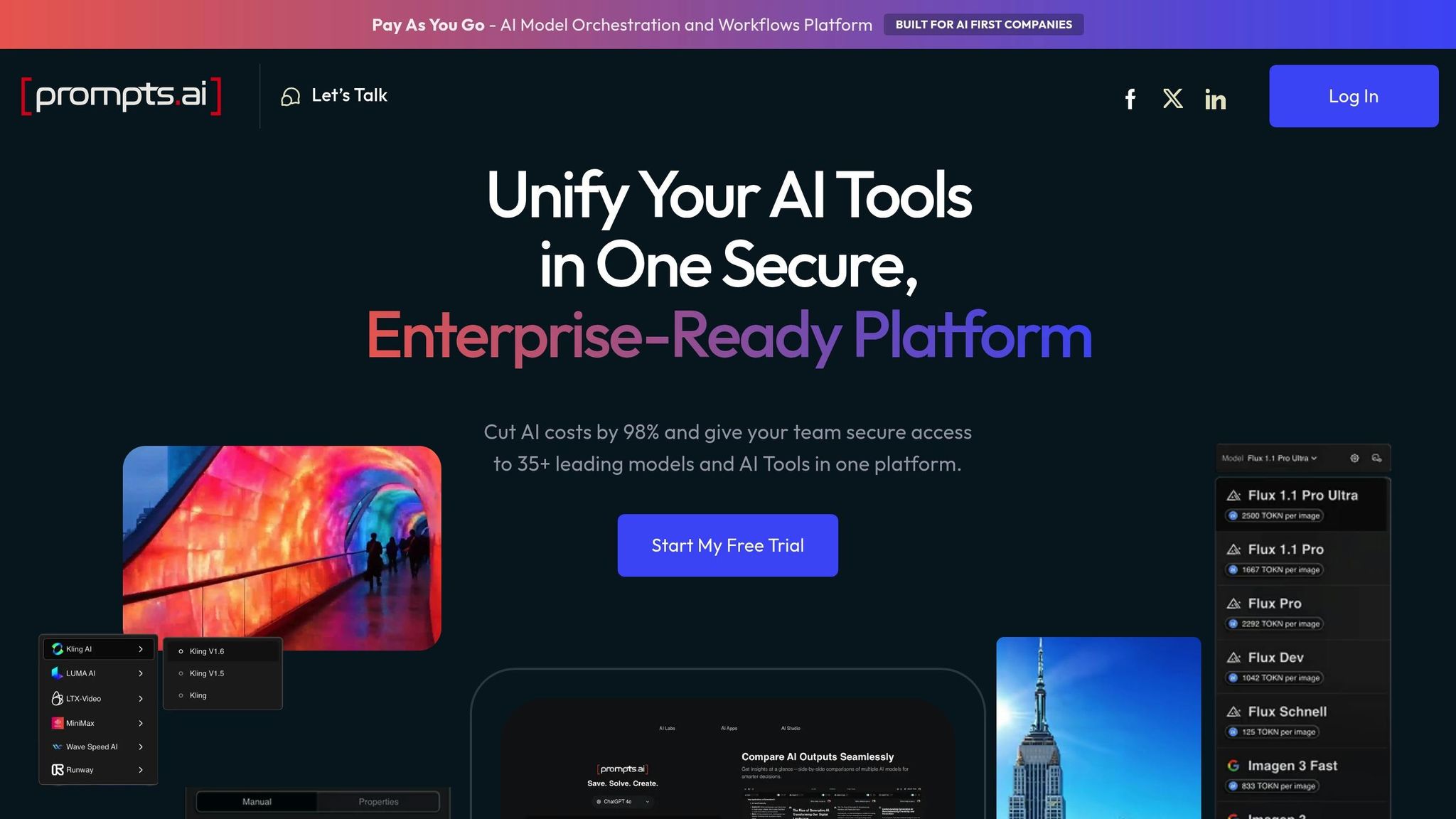
Prompts.ai brings together more than 35 top-tier LLMs - such as GPT-5, Claude, LLaMA, Gemini, Grok-4, Flux Pro, and Kling - into a unified, secure interface tailored for enterprise-scale use. Instead of juggling multiple vendor accounts and dashboards, teams can manage all models seamlessly through a single platform that includes unified governance controls.
Key features include role-based access control (RBAC), audit-ready logs, and robust data encryption, ensuring compliance with standards like GDPR and SOX. The platform also provides real-time FinOps tracking, allowing organizations to monitor token usage and spending across models and teams. This transparency eliminates hidden costs often associated with fragmented AI systems. Teams can compare model performance side-by-side, route tasks to the most cost-effective option, and maintain full oversight of every AI interaction - from the initial prompt to the final output.
Additionally, Prompts.ai supports prompt chaining and workflow orchestration, enabling the creation of advanced multi-step systems. Pre-built connectors integrate seamlessly with tools like CRM, ERP, ITSM, and HRIS, allowing AI models to access necessary context without requiring custom API development.
The platform’s open APIs and pre-built connectors facilitate smooth integration with enterprise systems, enabling collaboration among different AI models within comprehensive workflows. For example, a sales team might leverage an LLM-based lead scoring system that draws data from their CRM, while the marketing team utilizes RAG pipelines for content creation - all managed through the same platform under shared governance protocols.
This interoperability also spans cloud environments, including AWS, Azure, and GCP, ensuring deployment flexibility wherever enterprise data resides. Organizations can combine RAG pipelines, multi-agent systems, and legacy tools without needing custom integrations for every component. This approach supports scalable operations that adapt to business growth, avoiding the accumulation of technical debt with each new AI initiative. These capabilities not only streamline workflows but also deliver measurable cost efficiencies, as detailed in the next section.
Prompts.ai’s Pay-As-You-Go pricing model eliminates the burden of recurring subscription fees, charging only for actual token usage via TOKN credits. Real-time FinOps tracking provides detailed insights into AI spending, breaking it down by individual prompts and team members. The platform’s intelligent routing ensures tasks are assigned to the most cost-effective model, reducing unnecessary expenses from over-provisioning or defaulting to premium options.
Dynamic model selection and usage analytics further help enterprises minimize token consumption and eliminate redundant API calls, leading to savings of up to 98% in high-volume scenarios. This flexible approach allows organizations to explore new models and use cases without locking into costly annual contracts, aligning AI expenses directly with business outcomes rather than vendor-imposed commitments.
Building on a centralized platform for AI, these strategies streamline adoption and improve efficiency across teams.
Using Prompts.ai's centralized platform, teams can standardize workflows by creating a shared repository of approved prompts and templates that are accessible across departments. This ensures consistent, compliant workflows for tasks such as IT ticket triage, invoice processing, and document automation. Features like role-based access control (RBAC) and standardized templates make repeatable processes more efficient and reliable.
Performance and compliance dashboards provide real-time monitoring, helping reduce variability in AI outputs by up to 90% across departments like IT, finance, and operations. For instance, IT support teams can streamline ticket resolution workflows by integrating them with ITSM tools, while finance teams manage policy lookups and invoice processing through enterprise data - all within a unified governance framework.
These standardized workflows not only improve efficiency but also foster better collaboration across teams.
Prompts.ai's shared libraries and templates promote cross-departmental collaboration, breaking down silos and enabling teams to refine AI workflows together. For example, marketing and sales teams can co-develop prompts for personalized outreach, while HR and operations collaborate on resume screening workflows with built-in compliance filters. Shared workspaces also allow teams to work on AI agents and refine prompts through iterative feedback, improving accuracy by 40–60%.
The Prompt Engineer Certification program further supports collaboration by building internal expertise. Certified engineers can design advanced prompts, fine-tune models, and implement ethical AI practices, reducing the need for external consultants by 60%. These certified teams also deploy compliant workflows three times faster than uncertified counterparts, helping organizations achieve quicker results and a stronger return on investment.
Collaboration not only drives efficiency but also ensures compliance and security, which are crucial for scaling AI adoption.
Prompts.ai strengthens compliance and security with enterprise-grade features, ensuring sensitive data is protected throughout all AI workflows. Key tools include integrated audit trails, data encryption, and automated compliance checks, supporting standards like SOC 2, ISO 27001, and GDPR. By grounding workflows in enterprise permissions and enforcing zero-retention policies, organizations can prevent data leaks. Secure APIs further ensure safe integrations with other systems.
Additionally, model monitoring identifies biases or anomalies, reducing risks when handling sensitive data. Organizations using similar governance frameworks have reduced compliance risks by 95% in healthcare applications and cut compliance violations by 85% in large-scale deployments. These controls also enable secure RAG pipelines for tasks like document automation, ensuring personally identifiable information (PII) remains protected.
With these robust compliance and security measures in place, organizations can confidently scale AI adoption while minimizing risks.

Prompts.ai Pricing Plans Comparison: Personal vs Business Tiers
Prompts.ai provides two main pricing options: Personal Plans for individuals and families, and Business Plans for organizations.
Personal Plans begin with a free Pay-As-You-Go tier, which includes a limited number of TOKN credits. For more advanced needs, the Creator plan is available at $29/month (or $25/month when paid annually), offering 250,000 TOKN credits for individual projects. The Family Plan, priced at $99/month (or $89/month annually), supports up to five users and includes 500,000 TOKN credits - making it ideal for households.
Business Plans are designed to scale with enterprise needs and come in three tiers:
The primary distinction between Personal and Business Plans lies in their collaboration and governance capabilities. Personal Plans are limited to one workspace and a small number of users, while Business Plans provide unlimited workspaces and collaborators, enabling organizational growth. Business Plans also include advanced features such as compliance monitoring, governance controls, and interoperable workflows - tools that are absent in Personal Plans, which only offer basic analytics.
A unique benefit of all Business Plans is TOKN pooling, which allows organizations to share credits across teams rather than assigning fixed amounts to individuals. Additionally, annual payment options for Personal Plans include a 10% discount, making them more cost-effective for long-term use. The following table highlights the key features and differences across all plan tiers:
| Plan Tier | Monthly Cost | TOKN Credits | Workspaces | Collaborators | Features |
|---|---|---|---|---|---|
| Pay-As-You-Go | $0 | Limited | 1 | 1 | Basic access, 1GB storage |
| Creator | $29 ($25 yearly) | 250,000 | 1 | 1 | 5GB storage, workflow creation |
| Family | $99 ($89 yearly) | 500,000 | 1 | 5 | 10GB storage, workflow creation |
| Core | $99 per member/month | 250,000 | Unlimited | Unlimited | Governance tools, TOKN pooling, compliance monitoring, 10GB storage |
| Pro | $119 per member/month | 500,000 | Unlimited | Unlimited | Usage analytics, interoperable workflows, storage pooling |
| Elite | $129 per member/month | 1,000,000 | Unlimited | Unlimited | LoRA fine-tuning, enhanced governance administration |
Prompts.ai’s pricing structure is designed to align with user needs and scale efficiently. By consolidating over 35 AI tools in under 10 minutes, it significantly reduces enterprise AI expenses - cutting costs by up to 98% and keeping annual budgets for medium-sized operations handling 100,000 daily inquiries below $36 million.
Centralized orchestration lies at the heart of successful enterprise AI integration, driving both efficiency and long-term growth. By unifying over 35 leading AI models into a single platform, Prompts.ai tackles challenges like fragmented systems, governance issues, and unpredictable expenses. This approach eliminates time-consuming manual processes, speeding up solution deployment by up to 10 times compared to traditional methods. As a result, teams can shift their focus to strategies that deliver meaningful outcomes.
The potential for generative AI is staggering, with estimates suggesting it could add $2.6 trillion to $4.4 trillion in annual global economic value. Furthermore, 89% of organizations anticipate AI will enhance revenue and operational efficiency. However, without centralized control, these benefits often remain unattainable. Prompts.ai addresses this gap through robust governance tools, ensuring compliance with regulations like GDPR, HIPAA, and ISO standards, all while significantly cutting costs. This positions enterprises to scale AI adoption with confidence and clarity.
With these benefits in mind, enterprises must move beyond pilot programs and embrace scalable AI operations. Gartner forecasts that by 2027, one-third of enterprise AI implementations will incorporate autonomous agents to handle complex tasks. Already, 79% of senior executives report adopting AI agents within their organizations. Prompts.ai facilitates this transition through features like multi-agent orchestration, flexible TOKN credit pooling, and a model-agnostic design that avoids reliance on a single vendor.
To begin, decision-makers can try Prompts.ai's Pay-As-You-Go tier to experiment with workflows without commitment. From there, scaling into Business Plans unlocks advanced features such as unlimited workspaces, expanded collaboration tools, and comprehensive governance capabilities. The platform also offers hands-on onboarding, enterprise training, and a Prompt Engineer Certification program to speed up implementation and enhance internal expertise. Requesting a demo or consultation can help turn fragmented AI experiments into compliant, repeatable processes that deliver tangible results.
You can link AI to your CRM and ERP systems without the need for custom coding by utilizing low-code or no-code integration platforms. These platforms offer prebuilt connectors, automation tools, and intuitive interfaces to simplify the process. With features like AI bundles, universal connectors, and access to hundreds of prebuilt integrations, you can seamlessly integrate AI agents and workflows into your current systems, significantly reducing manual work.
Preventing the risks associated with Shadow AI and safeguarding sensitive data requires a combination of structured governance, strict access controls, and secure system designs. By utilizing unified platforms with a single control plane, organizations can efficiently oversee, manage, and secure AI agents and their integrations. These tools play a critical role in maintaining compliance and protecting vital information within enterprise workflows.
Predicting and managing AI expenses effectively calls for strong financial oversight and tools that provide clear visibility. Companies often struggle with scattered systems and a lack of transparency around expenses. Implementing AI cost management platforms can address these issues by enabling accurate spending forecasts, assigning costs based on usage, and identifying overages early. Regular monitoring and attributing usage to specific teams or projects promote accountability, help avoid surprise costs, and ensure that AI investments are scalable and aligned with organizational objectives.