Pay As You Go - AI Model Orchestration and Workflows Platform



Enterprise AI platforms simplify complex AI deployments by integrating advanced models with core business systems like CRM and ERP. They help organizations reduce costs, improve security, and scale operations efficiently. Here’s a quick breakdown of the top platforms:
| Platform | Models & Integration | Security & Governance | Scalability | Pricing & Cost Control |
|---|---|---|---|---|
| Prompts.ai | 35+ models, unified workflows | SOC 2 Type 2 audit, GDPR | Scales from pilots to enterprise | $99–$129/user/month, TOKN credits |
| Platform B | Model-agnostic, custom tools | Strong compliance tracking | Built for large enterprises | Custom pricing |
| Platform C | 250+ system integrations | Centralized governance | Rapid deployment at scale | Custom pricing |
Each platform suits different priorities - cost savings, governance, or ease of integration. Choose based on your business goals.

Enterprise AI Platform Comparison: Features, Pricing, and Capabilities
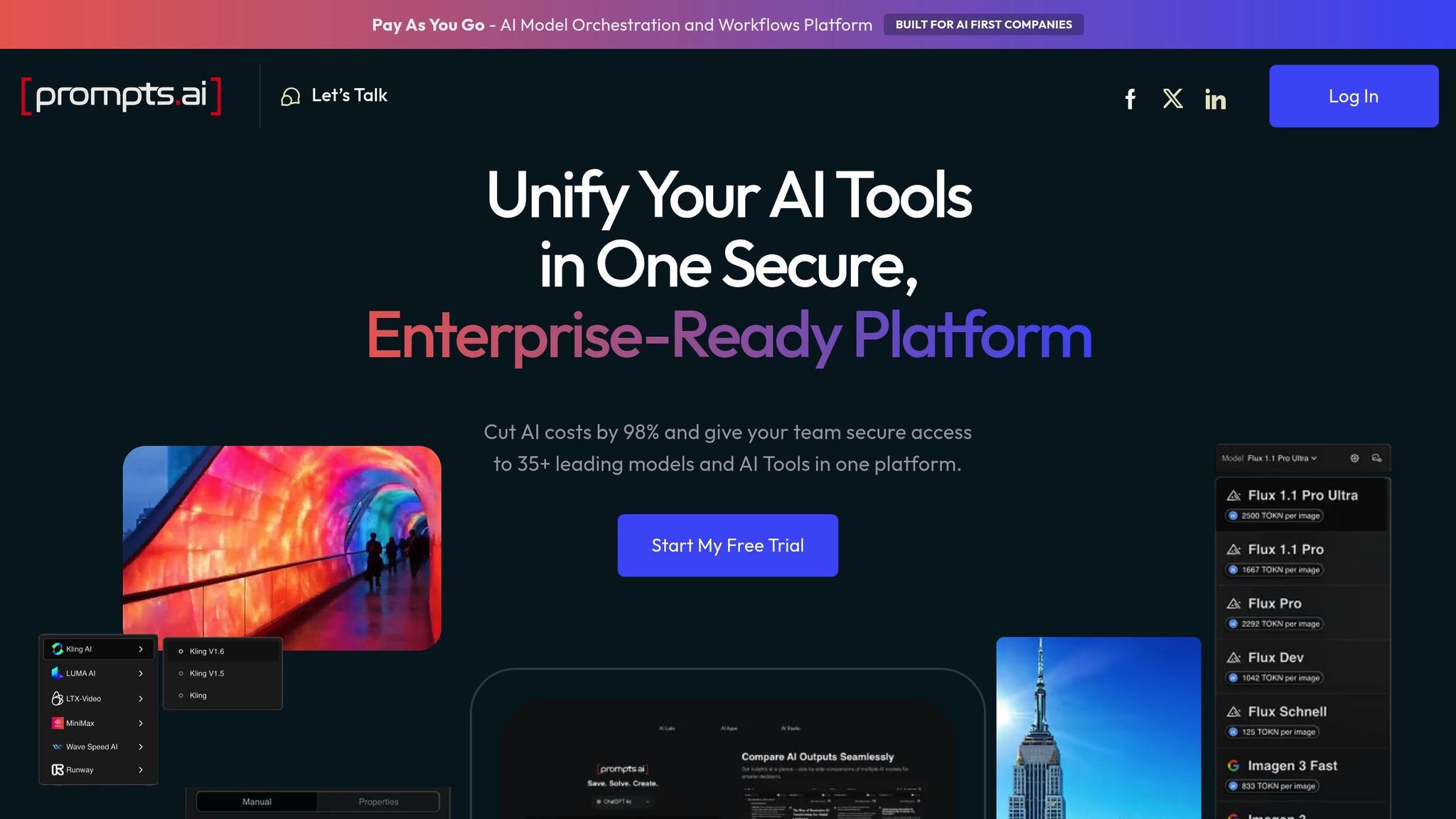
Prompts.ai brings together over 35 leading AI models - including GPT, Claude, LLaMA, and Gemini - into a single, easy-to-use platform. By consolidating these tools, it eliminates the inefficiencies caused by switching between platforms, helping teams maintain workflow consistency and save valuable time.
The platform seamlessly integrates with tools many enterprises already rely on, such as Slack, Gmail, and Trello. This allows teams to automate workflows without the need for custom development. One standout feature is the ability to compare large language models (LLMs) side by side using a single prompt. This makes it simple to evaluate and choose the best model for specific tasks. Additionally, the Interoperable Workflows feature, included in business-tier plans, turns ad-hoc tasks into repeatable, scalable processes - perfect for streamlining operations.
By combining these capabilities, Prompts.ai offers a cost-effective and secure way to manage AI-driven workflows.
Prompts.ai uses a flexible pay-as-you-go TOKN credit system, replacing traditional fixed-cost models with a usage-based approach. Pricing starts at $99 per member per month (250,000 TOKNs) and goes up to $129 per member per month (1,000,000 TOKNs). The platform claims it can reduce AI costs by as much as 98% by consolidating more than 35 separate tools into one subscription. Teams can also pool TOKNs, allowing resources to be shared efficiently and minimizing waste.
This cost-efficient setup is paired with strong security measures to ensure peace of mind.
Prompts.ai takes security seriously. As of June 19, 2025, the platform began a SOC 2 Type 2 audit and follows best practices outlined in HIPAA and GDPR frameworks. Continuous security monitoring is handled through Vanta, while detailed audit logs provide full visibility into every AI interaction. Business plans include advanced governance tools, such as compliance monitoring and centralized administration, giving IT teams the control they need to deploy AI responsibly - especially in regulated industries.
Prompts.ai is designed to grow with your organization. It allows businesses to add models, users, and teams without causing disruptions. Higher-tier plans support unlimited workflows, making it easy to scale from small pilot projects to full-scale enterprise deployments. The platform also optimizes resource distribution by pooling TOKNs and storage, ensuring smooth operations as workloads increase across expanding teams.
Platform B takes a model-agnostic approach to enterprise AI, enabling teams to handle generative, predictive, and agentic AI workloads on a single platform. This approach gives users the freedom to work with their favorite libraries and third-party tools without being tied to a single vendor's ecosystem.
At the heart of Platform B is a centralized Registry that manages model packages from diverse sources, including in-house and custom frameworks. Users can choose between a visual interface called the Workbench or a code-based environment, combining the best of both worlds to accommodate different workflows. This dual-mode setup ensures seamless collaboration between coding and visual tools.
To support this flexibility, the platform enforces a unified governance framework, ensuring security and efficient model management.
Platform B’s governance framework brings together data engineering, machine learning, and analytics into one cohesive workspace. Role-based access control (RBAC) provides strict security by managing permissions through a master catalog, covering all data assets and analytics reports. Additionally, the platform automatically tracks data lineage and versioning, simplifying compliance and audit processes - an essential feature for enterprises in regulated industries.
Built for global use, Platform B integrates natively with BigQuery to unify data and AI workloads. This design streamlines the journey from initial data analysis to full-scale production deployment. With dedicated training and prediction services, the platform reduces training time and simplifies model deployment on optimized AI infrastructure, making it easier to scale operations efficiently.
Platform C simplifies enterprise AI deployment by seamlessly coordinating multiple AI agents with existing systems. Instead of requiring businesses to overhaul their tech stack, it integrates AI agents directly into core systems.
The platform’s engine allows multiple AI agents to work together by sharing context and running tasks simultaneously. With 250 plug-and-play integrations, it connects effortlessly to systems like CRM, ITSM, HRIS, ERP, and data lakes. This connector ecosystem eliminates the need for time-consuming custom integrations, enabling teams to embed AI capabilities into their workflows with minimal technical effort. This integration framework ensures secure and compliant AI operations.
A centralized control plane handles security, visibility, and compliance. The governance dashboard offers a transparent view of agent decisions, actions, and performance, making it easy to track interactions and understand reasoning processes. Role-Based Access Control (RBAC) enforces organizational policies and manages permissions, ensuring that AI operations align with enterprise security standards.
Platform C is designed to scale effortlessly, transitioning from small pilot projects to full-scale deployments. Its model-driven design manages complex enterprise needs, including integration, data preparation, and lineage tracking, to support large-scale operations. By uniting data science, IT, and business teams on a single platform, it simplifies the journey from development to production. This approach ensures consistency and efficiency, even as data requirements grow across expanding AI initiatives.
The comparison table below highlights how each platform stacks up in terms of integration, security, scalability, and interoperability.
| Platform | Model Integration | Security & Governance | Scalability | Interoperability |
|---|---|---|---|---|
| Prompts.ai | ⭐⭐⭐⭐⭐ Unified access to 35+ top LLMs, including GPT-5, Claude, LLaMA, and Gemini, with side-by-side performance comparisons | ⭐⭐⭐⭐⭐ Enterprise-grade controls, real-time FinOps tracking, and complete audit trails for every AI interaction | ⭐⭐⭐⭐⭐ Pay-as-you-go TOKN credits remove recurring fees, scaling seamlessly from small teams to global enterprises | ⭐⭐⭐⭐⭐ A single secure interface unifies workflows, eliminating tool sprawl without requiring data handoffs |
| Platform B | ⭐⭐⭐⭐ Supports multiple models with robust management features | ⭐⭐⭐⭐ Strong governance framework with detailed monitoring and compliance for regulated industries | ⭐⭐⭐⭐ Built to handle large-scale enterprise deployments | ⭐⭐⭐⭐ Works with various systems, though integrating legacy setups may need extra effort |
| Platform C | ⭐⭐⭐⭐ Offers a wide range of pre-built integrations for major enterprise systems | ⭐⭐⭐⭐⭐ Centralized control with role-based access and a transparent governance dashboard | ⭐⭐⭐⭐⭐ Easily scales from pilot projects to full-scale deployments | ⭐⭐⭐⭐⭐ Embeds AI into core systems, reducing the need for custom integrations |
Each platform has its strengths, catering to different enterprise priorities, whether it’s cost savings, governance, or seamless integration.
Choosing the right platform depends on your specific enterprise goals and priorities, as each option brings unique capabilities to the table.
Prompts.ai stands out for its cost-effective approach and streamlined workflows. With pay-as-you-go TOKN credits and secure access to over 35 leading models, it offers a unified ecosystem that simplifies AI management. Its real-time FinOps tracking and enterprise-grade governance make it a strong choice for organizations looking to eliminate tool sprawl while maintaining full control.
Other platforms, however, bring their own advantages. Platform B excels in governance and large-scale deployments, making it a great fit for enterprises managing extensive data environments or operating in regulated industries where compliance and monitoring are critical.
For businesses that need speed and ease of integration, Platform C shines with its 250 pre-built connectors, enabling rapid embedding of AI into existing systems. While it prioritizes speed, it may not offer the same breadth of model selection as other platforms.
Ultimately, the right choice will depend on how well the platform aligns with your current systems and strategic objectives. Whether your focus is on cost savings, compliance, or quick integration, the platform you select should support scalable AI adoption and streamlined workflows.
Using an enterprise AI platform like Prompts.ai brings a range of benefits that can reshape how businesses deploy AI on a large scale. By integrating more than 35 AI models, including widely recognized ones like GPT-4 and Claude, into a secure, enterprise-focused system, the platform simplifies operations while cutting costs by up to 98%. This unified approach not only reduces expenses but also enhances governance and optimizes workflows, making AI integration smoother and more economical for large organizations.
Prompts.ai is designed to support scalable AI operations with centralized management and modular workflows. This setup allows enterprises to automate intricate processes, strengthen compliance, and maintain full control over their AI initiatives. Its adaptable framework lets businesses orchestrate multiple large language models (LLMs), such as GPT-5 and Gemini, ensuring smooth transitions between models, quicker deployment of AI solutions, and the ability to meet changing business demands. With a focus on secure infrastructure and governance, Prompts.ai helps organizations align their AI strategies with internal policies, minimizing risks while boosting overall efficiency. These capabilities position Prompts.ai as a powerful tool for deploying AI at scale with confidence and precision.
Prompts.ai places a strong emphasis on security and compliance, offering a unified platform to manage AI workflows. This setup empowers enterprises to maintain full control over their AI systems while meeting industry regulations and following established best practices.
In addition to safeguarding operations, the platform streamlines AI-related expenses and enforces governance protocols. This approach enables businesses to scale their AI solutions in a way that is both efficient and responsible. By combining these features, Prompts.ai ensures a smooth and secure integration of AI technologies, tailored specifically to the demands of enterprise environments.
When choosing an enterprise AI platform, it’s essential to evaluate a few key factors to ensure it aligns with your business goals. Scalability should be a top priority, as the platform must handle growing data volumes, expanding workloads, and increasing user demands without compromising performance. Equally important is security and compliance - the platform must safeguard sensitive data and adhere to relevant industry standards and regulations.
Another important aspect is how easily the platform integrates with your existing systems, workflows, and data sources. Seamless integration can simplify adoption across teams and reduce disruptions. Cost-efficiency is also a major consideration; the platform should offer tools tailored to specific business needs, helping to speed up implementation and deliver value more quickly. Lastly, an ideal platform should support the entire AI lifecycle, from development and deployment to monitoring and governance, ensuring smooth operations and long-term success.