Pay As You Go - AI Model Orchestration and Workflows Platform



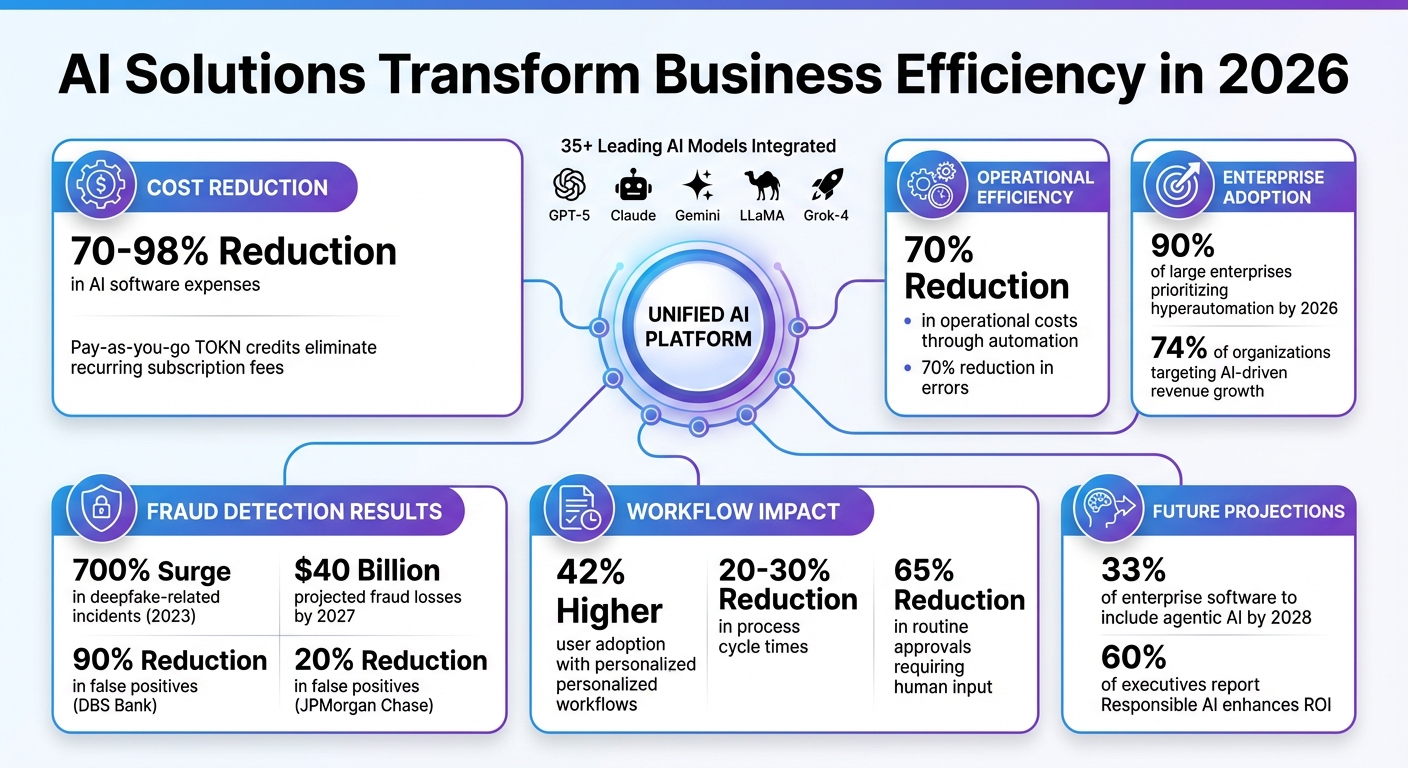
In 2026, AI has become a cornerstone for business operations, moving beyond basic tools to centralized platforms that streamline workflows, cut costs, and enhance productivity. Businesses are adopting unified AI systems like Prompts.ai, which integrates over 35 leading models (e.g., GPT-5, Claude, Gemini) into one interface, eliminating tool sprawl and inefficiency. Key highlights include:
Prompts.ai simplifies AI adoption by offering a single, secure platform that scales across teams, integrates seamlessly, and aligns costs with business outcomes. This approach transforms AI from a fragmented expense into a streamlined, results-driven investment.
AI Platform Cost Savings and Efficiency Gains in 2026
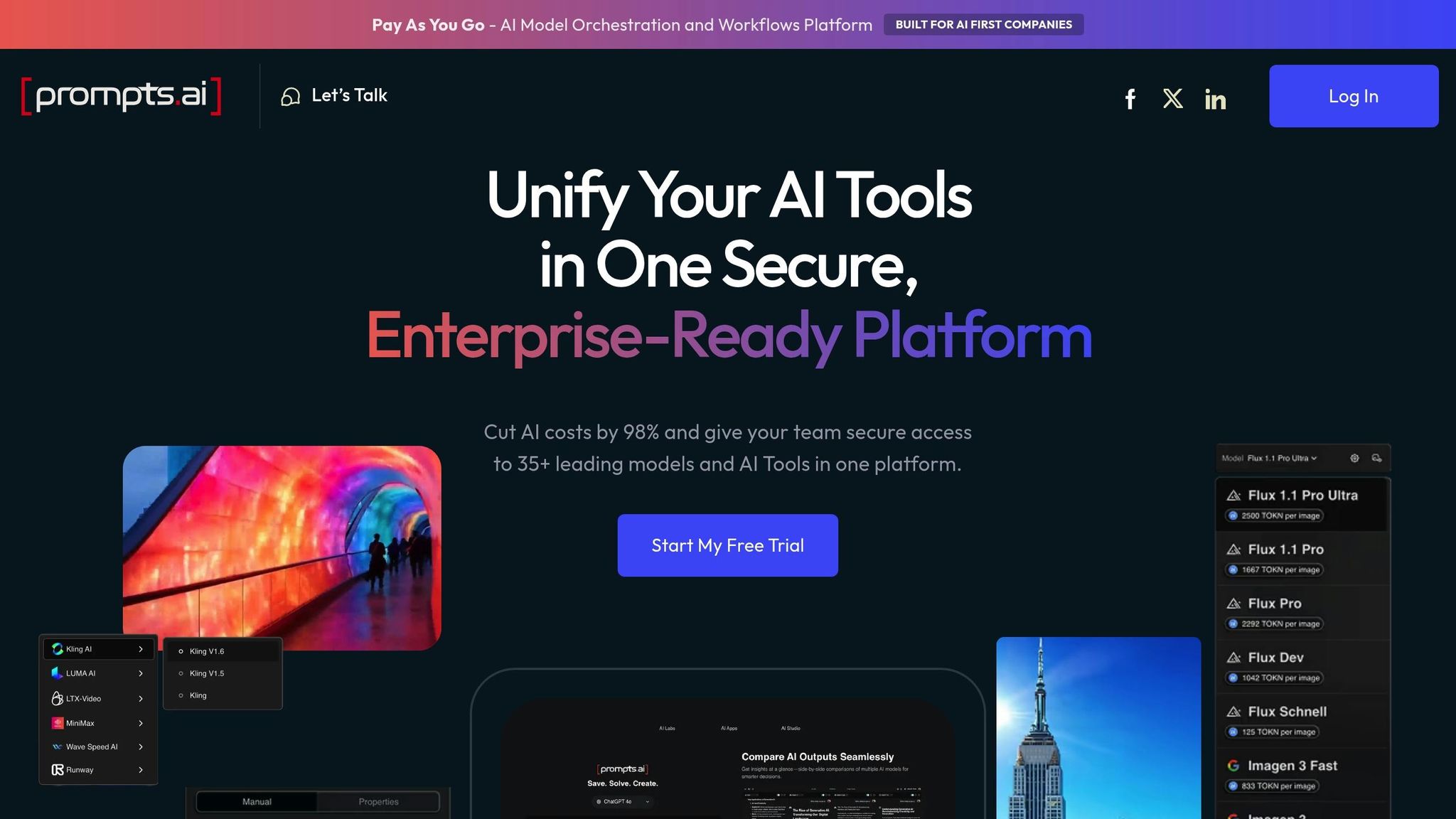
By 2026, businesses aren’t struggling to access AI - they’re struggling to manage the chaos that comes with it. Juggling multiple subscriptions for various AI tools creates inefficiencies and drives up operational costs. Prompts.ai tackles this issue by bringing together over 35 leading language models into one streamlined interface. Instead of navigating between different platforms, teams can access all the AI tools they need from a single dashboard.
This approach eliminates fragmented workflows by unifying model selection, prompt workflows, and real-time cost tracking. It also removes the hassle of setting up custom integrations whenever a new model is introduced. Teams can seamlessly switch between models, choosing cost-effective options for simpler tasks while reserving more advanced models for complex work. This flexibility eliminates the need to manage multiple vendor contracts or renegotiate terms, making operations smoother and more efficient.
Prompts.ai provides enterprise-level orchestration by integrating access to over 35 large language models, such as GPT-5, Grok-4, Claude, LLaMA, and Gemini, along with specialized models for images and videos. Teams can evaluate model performance side-by-side, ensuring they select the best option for each specific task - all without leaving the platform.
The platform’s prompt workflow management system allows organizations to create, version, and share optimized prompts across teams. Instead of having every team member start from scratch, businesses can build shared libraries of tested workflows, ensuring consistent and reliable outcomes. Real-time tracking adds another layer of efficiency, offering detailed insights into token usage and spending by team, project, or model. This FinOps functionality ties AI usage directly to business outcomes, helping teams identify which workflows deliver value and which are resource-intensive.
Prompts.ai also offers a Prompt Engineer Certification program and community features to help organizations build internal expertise. By training in-house AI specialists who understand both the technology and the company’s goals, businesses can reduce reliance on external consultants. This centralized approach not only simplifies operations but also enhances cost efficiency.
The financial advantages of consolidation are clear. Many organizations currently pay $20 to $200 per user per month for multiple AI tools, resulting in significant costs for separate subscriptions. By switching to Prompts.ai’s unified platform, businesses can eliminate these recurring fees. The pay-as-you-go TOKN credit system ensures companies only pay for what they use, avoiding unnecessary expenses.
For instance, a mid-sized agency paying thousands annually for individual subscriptions can cut costs by 70–98% with a token-based model. The real-time cost dashboard highlights resource consumption, helping teams optimize spending without compromising capabilities.
Beyond subscription savings, the platform offers tools to prevent budget overruns. Spending limits can be set by team or project, and managers receive alerts when budgets are close to being exceeded. This proactive approach allows businesses to adjust usage or reallocate resources as needed, ensuring spending aligns with priorities.
Cost savings alone aren’t enough for enterprise adoption - security and compliance are just as critical. Prompts.ai includes detailed activity logs that track every AI interaction, from who submitted a prompt to the model used, data accessed, and output generated. This level of oversight is vital in industries like healthcare and finance, where regulatory compliance is non-negotiable.
Role-based access controls ensure that sensitive workflows remain protected, meeting the strict requirements of industry regulations. Data is safeguarded through encryption during transit and at rest, with options for data residency to meet regional compliance standards.
As companies move toward agentic AI - where systems handle multi-step decisions autonomously - governance becomes even more essential. Prompts.ai includes approval workflows for high-risk applications, ensuring they’re reviewed before deployment. Centralized permission structures maintain accountability, even as AI systems take on more complex tasks. This “human-on-the-loop” approach ensures that while AI manages coordination and validation, humans remain responsible for critical decisions. Together, these governance and workflow features allow businesses to scale their AI operations securely and efficiently.
Building interoperable workflows takes the benefits of a centralized AI platform to the next level by seamlessly integrating AI tools and human efforts. To achieve this, start by creating a unified orchestration layer that connects all your AI models, applications, and data sources. This approach shifts the focus from automating individual tasks to orchestrating end-to-end processes. These processes coordinate, validate, and route work across your organization, ensuring a smoother, more efficient workflow.
This transition is essential because knowledge workers often spend too much time on "work about work" - tasks like updating statuses, tracking information, and managing handoffs - rather than focusing on strategic priorities. By 2026, it's expected that 90% of large enterprises will prioritize hyperautomation to streamline cross-department processes.
As noted by PwC, "Technology delivers only about 20% of an initiative's value. The other 80% comes from redesigning work." This highlights the importance of first analyzing your current processes, identifying key workflows that need improvement, and then introducing AI to manage coordination. Humans should remain responsible for strategic decisions while AI handles repetitive tasks. Start small by selecting a cross-department process that frequently causes delays. Map out the handoffs, and use AI agents to manage coordination and validation before automating decision-making.
Finding the right AI models for your needs means evaluating their performance against specific tasks, rather than simply opting for the most popular option. Prompts.ai offers tools to compare models like GPT-5, Claude, LLaMA, Gemini, and over 35 others. These tools let you test how each model performs on the same prompt, helping you determine which one best suits your use case. For routine tasks such as data formatting or simple customer service inquiries, more affordable models can handle the job. Reserve advanced models for tasks requiring deeper analysis, strategic thinking, or creative problem-solving.
In high-risk scenarios, consider using multi-model redundancy. This involves having models from different providers validate each other's work, reducing the chance of errors or biases slipping through. When assessing models, focus on factors like accuracy, speed, token efficiency, and compatibility with your existing systems. Real-time performance data can help you build a tailored portfolio of models for different stages of your workflows.
After selecting the right models, standardize how prompts are managed to ensure consistent results.
Developing repeatable prompt workflows saves time and ensures consistency. Prompts.ai's workflow management system allows you to create, version, and share optimized prompt libraries across your organization. By using tested libraries, you can rely on prompts that consistently produce reliable outcomes - an essential feature when deploying AI systems capable of understanding intent, learning from context, and taking proactive actions.
Your workflows should be flexible, focusing on intent rather than rigid execution. For instance, if a customer inquiry workflow encounters missing information, the AI system should decide whether to request clarification, escalate the issue to a human, or proceed with the available data based on the context. While AI can handle coordination tasks like status updates and data collection, humans should maintain final approval authority for critical decisions.
To complement model selection and workflow standardization, real-time cost tracking ensures your AI investments are both efficient and strategic. Prompts.ai's FinOps dashboard provides detailed insights into token usage at the team, project, or workflow level, linking AI expenses directly to business outcomes. By monitoring these metrics, you can identify high-value workflows, set spending limits, and receive alerts to prevent cost overruns.
The pay-as-you-go TOKN credit system allows you to pay only for what you use, cutting AI software costs by 70–98% compared to managing multiple vendor contracts. For better ROI and sustainability, consider carbon scheduling - approving high-token usage only when it adds significant value and scheduling intensive processing during periods when energy grids rely on cleaner energy sources. Metrics like cost per completed task, time saved per dollar spent, and error rates across models can help you refine workflows and maximize the profitability of your AI investments as your business scales.
These examples demonstrate how centralized AI workflows are transforming operations across various industries.
Financial institutions are turning to Prompts.ai to streamline fraud detection workflows. By analyzing transactions in real time and assigning risk scores on a 0–3 scale, the system flags high-risk cases for human review. This approach is crucial as AI-enabled fraud becomes more prevalent - deepfake-related incidents in the financial sector surged by 700% in 2023, and generative AI is expected to drive fraud losses in the U.S. to $40 billion by 2027.
Banks are also adopting autonomous auditing powered by agentic AI. These systems continuously monitor compliance, initiate workflows, request documentation, and escalate policy exceptions ahead of month-end reconciliations. Results have been impressive: DBS Bank reduced false positives by 90%, while JPMorgan Chase achieved a 20% reduction, improving customer experiences. Additionally, Prompts.ai ensures human-readable explanations for risk scores, meeting regulatory standards and fostering trust in AI-driven systems.
Marketing teams are using Prompts.ai to design personalized workflows that cater to individual user roles, histories, and preferences. By orchestrating CRMs, ERPs, and communication tools through a single trigger, the platform enables seamless coordination across the tech stack. Companies implementing these tailored digital experiences have seen 42% higher user adoption rates. Predictive analytics integrated into workflows also cut process cycle times by 20% to 30%, identifying bottlenecks before they escalate.
Creative teams are embracing Prompts.ai's agentic workflow coordination to simplify complex production processes. By managing roles like triage, analysis, drafting, and review within a unified system, teams can create and adjust workflows with plain language commands, such as "route premium customer complaints to senior support within 15 minutes." This eliminates the need for coding expertise. Organizations using these autonomous agents report a 65% reduction in routine approvals requiring human input. Looking ahead, 33% of enterprise software applications are expected to include agentic capabilities by 2028, with 60% of executives already noting that Responsible AI practices significantly enhance ROI and operational efficiency.
Expanding AI usage beyond a single pilot team requires infrastructure that can grow with your business. Prompts.ai's centralized platform simplifies this process by giving marketing, finance, HR, and operations teams access to 35+ leading models through a single interface. This eliminates the hassle of managing multiple vendor contracts and integrations. What sets successful enterprises apart is their ability to let teams deploy workflows independently. With plain-language prompt engineering, even non-technical staff can create and modify AI agents without relying on engineering teams. This shift transforms AI from a developer-centric tool into one that encourages collaboration across departments, making operations smoother and more adaptable.
Of course, scaling technology is only part of the equation - your workforce must also be equipped to use these tools effectively.
Investing in AI training for your workforce offers better returns than hiring a handful of specialists. In fact, 53% of top organizations prioritize educating their existing teams over bringing in external talent. Prompts.ai supports this approach with its Prompt Engineer Certification program, which helps employees build essential skills. Additionally, the platform's community shares expert-crafted "Time Savers" - reusable workflows designed to solve common business challenges. These templates allow teams to hit the ground running. Companies that establish clear AI usage guidelines see employee experimentation rates soar by nearly six times, turning hesitant users into confident innovators. This internal expertise not only boosts productivity but also supports smarter cost management.
Traditional subscription models often leave businesses paying for unused features or seats, which has contributed to 95% of generative AI pilots failing to reach production. Prompts.ai addresses this issue with its TOKN credits, which align costs directly with actual AI usage. You only pay when a model is executed, avoiding recurring fees. Real-time departmental tracking ensures that costs remain transparent and manageable as usage grows. With 74% of organizations aiming for AI-driven revenue growth by 2026, this flexible pricing model ensures costs grow only as activity increases.
"Governance is the difference between scaling successfully and stalling out." - Deloitte
Prompts.ai also integrates robust security features like Role-Based Access Control (RBAC), Single Sign-On (SSO), and detailed audit logs to maintain oversight as AI adoption expands. For businesses with strict compliance needs, on-premises or Virtual Private Cloud (VPC) deployments provide added control over sensitive data. This combination of adaptive pricing and enterprise-grade security allows businesses to transition from small-scale experiments to organization-wide AI operations without overhauling their infrastructure.
The shift to a unified AI platform encapsulates the transformative benefits businesses are seeking. Interoperable AI systems simplify operations and help manage costs effectively. By bringing together 35+ top models into a single interface, Prompts.ai turns scattered data into a cohesive intelligence layer, seamlessly connecting knowledge, workflows, and teams across departments.
Features like pay-as-you-go TOKN credits, real-time cost tracking, and governance tools such as Role-Based Access Control, Single Sign-On, and detailed audit logs ensure businesses can match spending to performance and compliance without sacrificing agility.
The real game-changer is making AI accessible to everyone in the organization. With tools like the Prompt Engineer Certification and community-driven Time Savers, employees at all levels can confidently integrate AI into their daily tasks. This approach transforms fragmented workflows into a streamlined enterprise intelligence system.
As AI systems grow more advanced, they are evolving from simple automation tools into dynamic partners capable of managing multi-step workflows and responding to unexpected challenges. These systems interpret context, make decisions, and coordinate across platforms, acting as true operational collaborators. For businesses ready to scale AI beyond initial trials, the combination of flexible pricing, enterprise-grade security, and broad accessibility provides a solid foundation for growth - aligning costs with measurable outcomes. This integrated strategy not only boosts efficiency today but also prepares businesses for the expanding role of AI in the years ahead.
To select the most suitable AI model, start by assessing the specific needs of your task - whether it involves writing, coding, research, customer support, or automation. Consider the level of risk involved and your available budget. For high-stakes tasks requiring precision and advanced reasoning, prioritize using more sophisticated models. For tasks with lower risk or tighter budget constraints, simpler models may suffice. Consistently evaluate models for accuracy and reliability to ensure they align with your operational objectives.
When working with AI workflows, it's essential to avoid including sensitive, proprietary, or personally identifiable information. Doing so reduces the risk of data breaches, misuse, or other security vulnerabilities. Prioritize safeguarding data that could potentially compromise privacy or violate established security protocols.
AI's return on investment (ROI) goes far beyond cutting costs. It’s about showing how AI accelerates the journey from insights to action, blends effortlessly into existing workflows, and relies on consistent, unified data. These strengths lead to smarter decisions, richer customer insights, and tangible business outcomes. By emphasizing these advantages, businesses can illustrate AI's broader value beyond just expense reduction.