Pay As You Go - AI Model Orchestration and Workflows Platform



Cut AI costs by up to 98% with smarter tools and strategies. In 2026, businesses face rising AI expenses, but solutions like unified platforms and multi-tool stacks are transforming cost management. Unified platforms like prompts.ai consolidate 35+ models into a single interface, offering pay-as-you-go pricing and intelligent task routing to maximize savings. On the other hand, multi-tool stacks combine specialized automation tools but require more effort to manage and integrate.
Key takeaways:
Choosing the right approach depends on your goals: centralized control or tailored flexibility. Both methods can drive efficiency, but unified platforms stand out for their scalability and predictable budgeting.
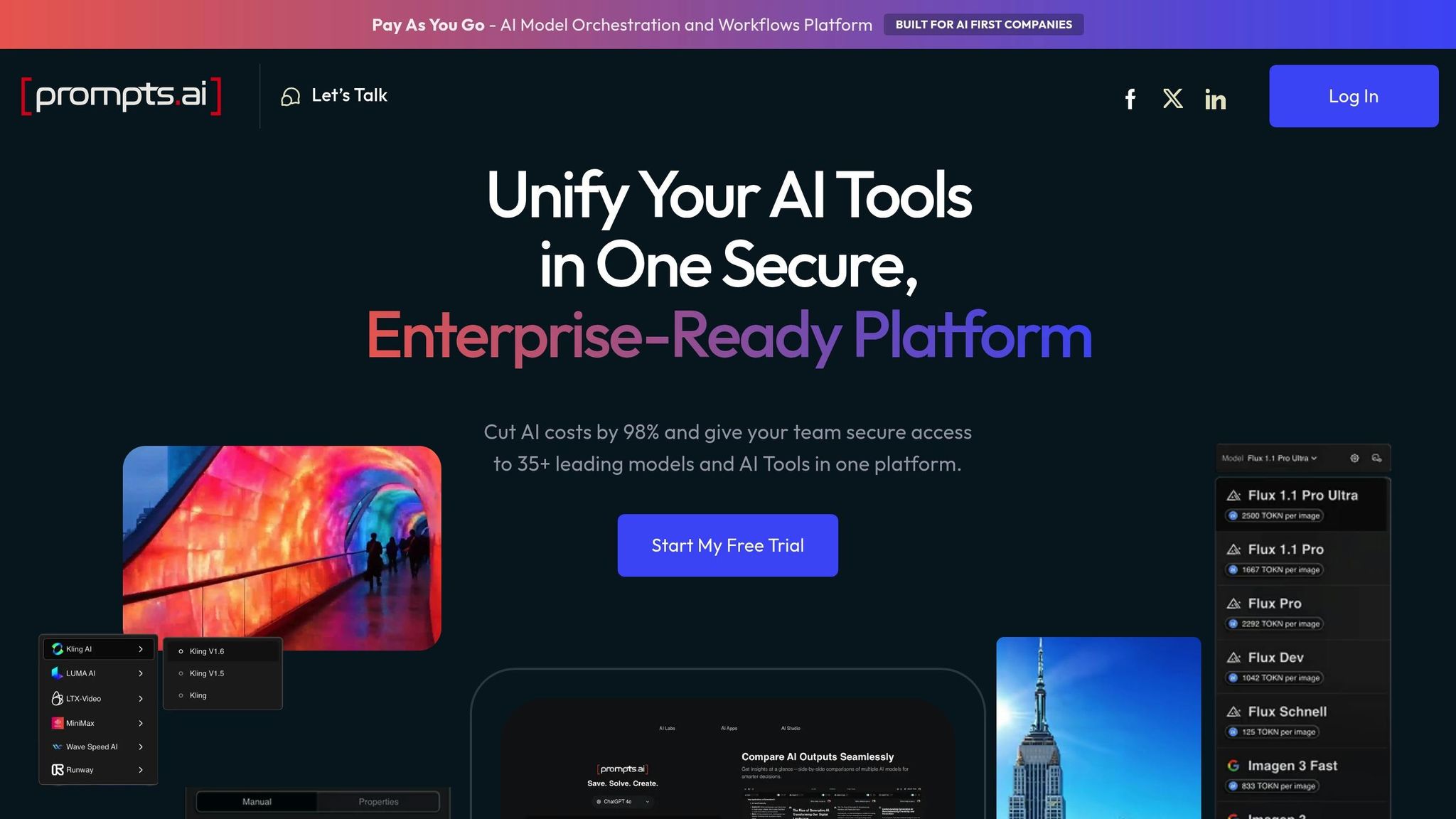
Prompts.ai simplifies AI cost management by bringing together over 35 top-performing models - including GPT-5, Claude, LLaMA, and Gemini - into one enterprise-ready platform. Instead of juggling multiple subscriptions, teams can access all these models through a single dashboard that tracks usage and automatically assigns tasks to the most cost-effective option.
The platform’s built-in FinOps tools make managing AI expenses straightforward. With transparent, usage-based pricing, you only pay for what you actually use. Its intelligent routing system ensures tasks are assigned to the right model, avoiding unnecessary costs like using advanced reasoning models for basic queries. This approach helps businesses control spending while keeping workflows efficient and effective.
Prompts.ai addresses the challenges of interoperability by serving as a coordination layer that connects various AI models, automation platforms, and productivity tools. Its automated workflows handle complex, multi-step tasks - like updating CRMs or qualifying leads - across your tech stack without requiring manual intervention. This smooth integration ensures systems work together effortlessly.
The platform prioritizes security and control, offering customizable approval processes and safeguards to ensure AI actions align with your business needs. By anchoring models in accurate, workspace-specific data, Prompts.ai reduces errors and ensures reliability for critical business tasks. Sensitive data stays protected within your workspace, reinforcing compliance and strong data governance practices.
Prompts.ai is built to grow with your needs, allowing you to add models and users quickly while keeping centralized control. Whether you’re a small team or a large enterprise, the platform supports expansion without compromising oversight. This combination of cost management and scalability makes it an ideal choice for businesses looking to optimize multi-tool AI ecosystems.
Creating a multi-tool stack involves combining automation platforms like Zapier, Make, or n8n with AI models to build tailored workflows. Unlike unified platforms, this approach requires you to connect separate services, manage different subscriptions, and handle the complexities of integration yourself. The upside? You get the freedom to choose tools that match your exact needs and swap them out as those needs evolve.
While multi-tool stacks offer flexibility, costs can add up quickly. For instance, Make provides 10,000 operations for $9/month, whereas Zapier's Pro plan starts at $19.99/month for just 750 tasks - about $0.025 per task. High-volume workflows may find n8n's self-hosted option appealing since it eliminates per-task fees, but it comes with added server and maintenance expenses. As Jan Oberhauser, founder of n8n, put it:
"When we used automation tools like Zapier at my previous job, we found that it became incredibly expensive very quickly."
The variety of billing models across platforms also makes expense tracking more challenging.
Beyond cost, ensuring smooth integration between tools is crucial. By 2026, the Model Context Protocol (MCP) has become a key standard, enabling AI models like Claude to orchestrate tools in your stack using natural language. Platforms offering native AI nodes simplify configurations, while fallback options like JavaScript or Python can handle more niche tasks. Zapier leads the pack with over 8,000 integrations, while n8n’s open-source flexibility and 170,000+ GitHub stars make it a favorite among developers. For tools lacking public APIs, browser-based automation can scrape data and carry out on-screen tasks directly.
With multiple platforms in play, managing security becomes more complex. Each service in your stack requires its own RBAC settings, and API keys often end up scattered across workflows rather than centralized. While leading stacks maintain SOC 2 Type II compliance, it's your responsibility to ensure every component in your setup meets security standards. Self-hosting through Docker or Kubernetes offers better control over sensitive data but demands skilled DevOps resources. Additionally, the absence of unified observability tools means troubleshooting often involves sifting through logs across multiple dashboards - a tedious process when workflows fail.
Multi-tool stacks can scale technically but grow harder to manage as they become more intricate. Adding new integrations is straightforward, but maintaining consistency requires detailed documentation. The shift from basic "if-then" workflows to autonomous agents capable of multi-step reasoning is reshaping automation in 2026. Searches for "AI automation tools" surged 900% year-over-year in 2025, reflecting growing interest. However, only 5% of enterprise AI pilots typically move into production. Companies leveraging low-code tools and external partnerships have doubled their success rates by reducing technical hurdles and streamlining deployment.
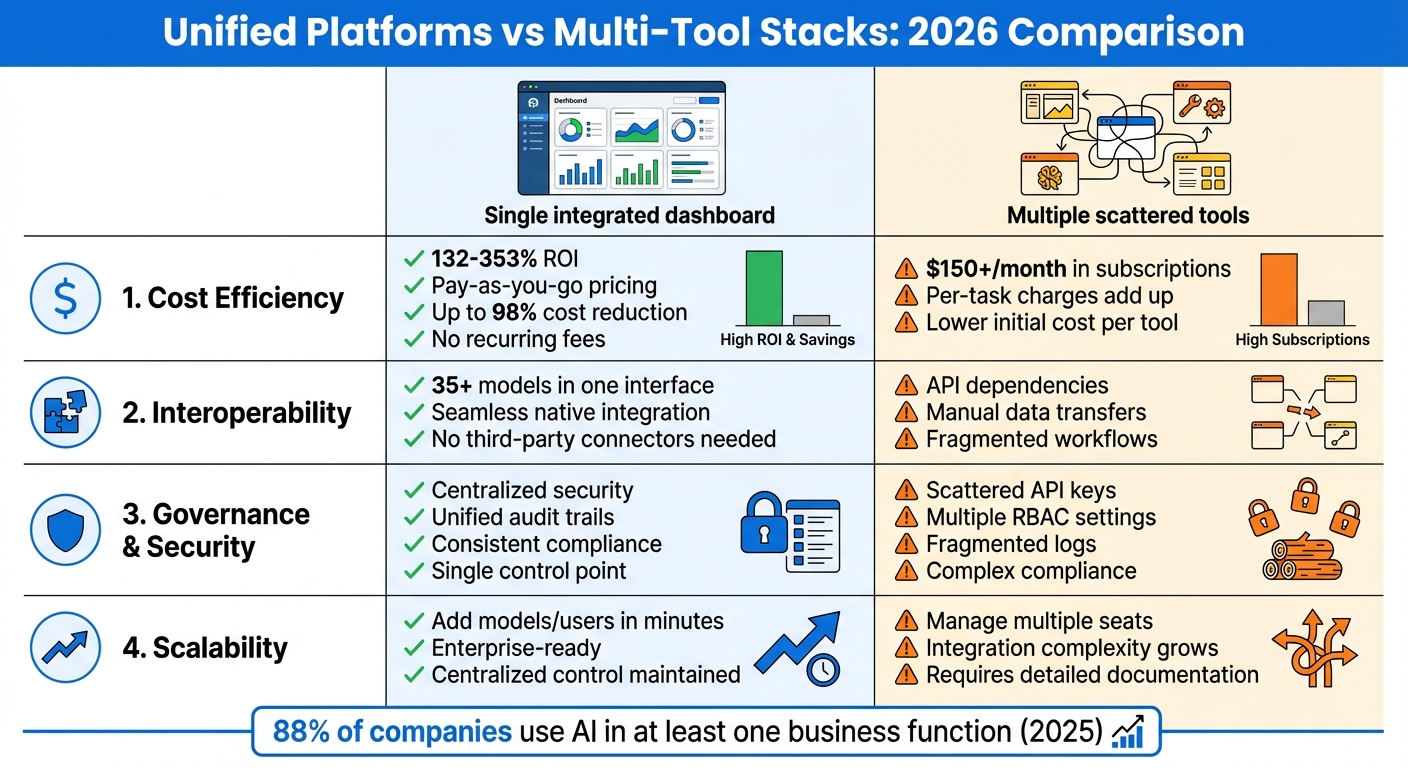
Unified AI Platforms vs Multi-Tool Stacks: Cost and Feature Comparison 2026
When considering cost-efficient AI workflows, it's essential to weigh the trade-offs between unified platforms and multi-tool stacks. Unified platforms, like prompts.ai, consolidate over 35 leading models into a single, streamlined interface with pay-as-you-go TOKN credits. On the other hand, multi-tool stacks offer specialized tools for tasks like content creation and imagery but often come with rising subscription fees and added complexity.
Unified platforms demonstrate impressive ROI, with returns ranging from 132% to 353% over three years. In contrast, multi-tool stacks can lead to scattered management of API keys, fragmented logs, and inconsistent access controls. As Laura Wade, a Presentation Design Expert, aptly points out:
"Nothing kills productivity faster than tools that don't integrate with anything else."
The table below highlights how these two approaches compare across four key dimensions critical for cost savings in 2026:
| Feature | Unified Platforms (e.g., prompts.ai) | Multi-Tool Stacks |
|---|---|---|
| Cost Efficiency | High ROI (132–353%); pay-as-you-go pricing eliminates recurring fees, cutting AI software costs by up to 98% | Lower initial cost per tool, but subscription fees can quickly add up (around $150+/mo), with extra charges for high task volumes |
| Interoperability | Seamless native integration ensures smooth data flow without third-party connectors | Often relies on APIs or manual data transfers, resulting in fragmented workflows |
| Governance | Centralized security, unified audit trails, and consistent brand voice guardrails | Enforcing consistent security and compliance across multiple vendors is more difficult |
| Scalability | Easily scales from small projects to enterprise-level operations, adding models and users in minutes | Scaling requires managing additional seats and integrations, increasing administrative complexity |
These comparisons highlight how each approach aligns with the goal of reducing AI operational costs. Unified platforms excel in governance and predictable expenses, making them ideal for enterprises prioritizing control and efficiency. In contrast, multi-tool stacks may appeal to teams that value specialized tools and are willing to manage the added complexity. By 2025, nearly 88% of companies reported using AI in at least one business function, with those focusing on operational control seeing the greatest rewards. The upcoming conclusion will translate these insights into actionable steps for maximizing AI cost savings.
A unified approach clearly outshines fragmented systems when it comes to managing AI tools. By consolidating access to over 35 leading models within a single interface and offering pay-as-you-go pricing, these platforms eliminate the headaches of juggling multiple subscriptions and scattered tools.
Such integrated systems can save teams between 4 and 20 hours each week by automating workflows and simplifying collaboration. With built-in cost controls, they help avoid budget overruns, while generous free-tier limits - like 100 notebooks and 500,000 words - allow users to experiment and grow without upfront financial commitments.
Strong governance features, including centralized security measures and unified audit trails, reduce risks like fines or the need for expensive rework caused by fragmented setups. Tools that offer workspace querying and compliance with industry standards ensure every AI interaction is secure and traceable, freeing teams to focus on meaningful projects instead of wrestling with integration issues.
As you evaluate AI platforms in 2026, look for solutions that combine cost management, enterprise-level security, and effortless scalability. These platforms not only simplify administration but also enable predictable budgeting, turning AI investments into measurable productivity gains. Small businesses can operate with the efficiency of larger enterprises, while larger organizations gain the control and visibility necessary for widespread AI adoption.
Consolidation is the key to aligning costs with usage, ensuring smooth integration, and boosting team productivity. In 2026, the smartest cost-saving strategy is choosing simplicity over complexity.
To select the best AI model in 2026, begin by clearly defining the task at hand - whether it's writing, coding, or conducting research. Match the task with a model specifically designed for that purpose. For simpler, low-stakes tasks like drafting, opt for faster and more budget-friendly models. Save the more advanced and resource-intensive models for tasks where precision and reliability are critical. When evaluating options, consider key factors such as accuracy, processing speed, and output consistency. Additionally, ensure proper data management practices are in place and strike a balance between the task's requirements and your available budget.
To keep AI budgets under control and prevent overspending, it's crucial to monitor token usage, which is a primary factor in costs. Utilize tools such as real-time token tracking, rules-based prompt routing, and automated workflows to streamline spending. Assign cost-effective models to handle routine tasks, saving the more expensive options for essential operations. Additionally, establish budget caps, activate alerts for irregular activity, and leverage automation to adjust workflows in real time without sacrificing efficiency.
To ensure the safety and accountability of AI workflows, it’s essential to adopt robust security practices and maintain comprehensive audit records. Start by implementing role-based access controls to limit permissions based on user roles. Encrypt all data, whether it’s stored or being transmitted, to safeguard sensitive information. Opt for platforms that come with established security certifications like SOC 2 Type II or HIPAA compliance for added peace of mind.
Regular audits are crucial to maintaining system integrity. Pair these with real-time cost monitoring and detailed activity logs to track usage and identify any unauthorized actions. These measures not only enhance security but also promote transparency, ensuring all team members can rely on secure, well-documented workflows.