Pay As You Go - AI Model Orchestration and Workflows Platform



AI governance platforms are becoming indispensable for organizations managing artificial intelligence systems. These tools centralize oversight, enforce policies, and automate compliance, making AI operations more efficient and secure. With AI now powering 90% of commercial applications, businesses face mounting pressure to address risks, comply with regulations like the EU AI Act (effective August 2, 2026), and reduce costs.
Key Takeaways:
Prompts.ai, a leading governance platform, integrates 35+ AI models (e.g., GPT-5, Claude, Gemini) into one secure system. It simplifies compliance, tracks costs, and offers tools like real-time dashboards and audit trails to ensure responsible scaling of AI systems. With penalties for mismanagement rising and shadow AI posing risks, governance platforms are no longer optional - they’re a business imperative.
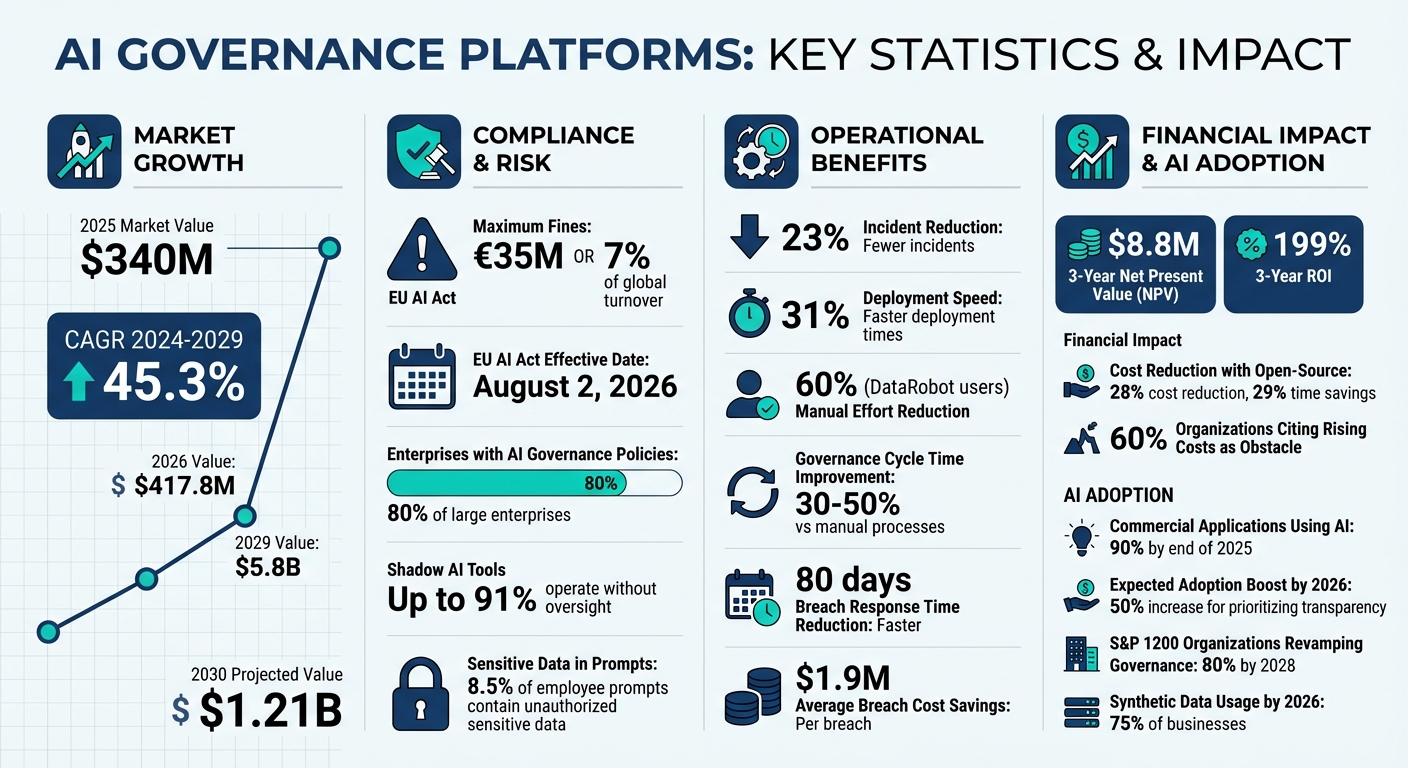
AI Governance Platforms: Market Growth, Cost Savings, and Compliance Impact 2025-2030
AI governance platforms are built around three key functions: centralized asset management, automated lifecycle monitoring, and compliance with FinOps. Together, these elements simplify governance, turning it from a manual challenge into an efficient, scalable process.
These platforms act as a single source of truth, automatically identifying and cataloging every AI model, dataset, and workflow - even capturing shadow AI. Each asset is meticulously documented using model cards, which store details like metrics, training data origins, and algorithmic specifics. This information supports end-to-end lineage tracking and clarifies ownership responsibilities. By benchmarking models across various architectures and vendors, organizations can select the most suitable option for their needs, eliminating the disarray caused by disconnected tools. Additionally, these platforms continuously monitor AI models to maintain compliance and performance over time.
Governance platforms provide constant oversight of deployed models, flagging issues like accuracy declines, fairness breaches, or performance drops below acceptable thresholds. Gated deployments ensure that models cannot go live without passing pre-defined risk checks. Using visual policy builders, teams can design rules without writing code, while runtime guardrails step in immediately to block issues like prompt injections, data leaks, and hallucinations. For instance, DataRobot users have reported a 60% reduction in manual effort, with governance cycle times improving by 30–50% compared to traditional manual reviews.
"DataRobot gives us reassurance that we are accessing generative AI through a well-governed and secure environment."
- Tim Reed, Head of Data Science & Analytics, NZ Post
In addition to these real-time safeguards, compliance controls ensure thorough financial oversight and maintain complete audit trails.
AI governance platforms simplify compliance by generating audit trails for every model version, dataset, and validation test. This reduces audit preparation time from weeks to mere minutes. Such functionality is crucial as regulations like the EU AI Act impose strict requirements on high-risk systems, with penalties reaching up to 7% of global annual turnover for violations. Financially, real-time dashboards track cost-per-request and token usage across all AI activities, helping identify underutilized GPU clusters and excessive resource allocations. With 60% of organizations citing rising operational costs as a major obstacle to scaling AI, these FinOps tools allow teams to directly connect expenses to business outcomes and enforce budget limits at the departmental level.
By centralizing management, monitoring lifecycles, and incorporating FinOps controls, AI governance platforms offer clear advantages in managing risks, cutting costs, and scaling operations effectively.
AI governance platforms transform lengthy manual compliance tasks into quick, automated workflows. Security teams using these tools have seen breach response times drop by 80 days and average breach costs decrease by $1.9 million. With the EU AI Act's strictest provisions taking effect on August 2, 2026 - carrying fines as high as 7% of global annual turnover - automated compliance tracking is no longer optional. These platforms generate tamper-proof audit trails, model cards, and AI Bills of Materials that meet standards like GDPR, HIPAA, the NIST AI Risk Management Framework, and ISO 42001, eliminating the need for legal teams to manually reconstruct project details.
"With OneTrust, our AI governance council has a technology-driven process to review projects, assess data needs, and uphold compliance." - Ren Nunes, Senior Manager, Data & AI Governance, Blackbaud
Real-time dashboards also highlight potential issues like bias, data leakage, and ethical risks before models reach production, minimizing reputational and financial damage. By 2026, organizations prioritizing AI transparency and trust are expected to see a 50% boost in adoption and user confidence.
AI governance platforms reveal hidden inefficiencies in AI spending, enabling substantial cost savings. Real-time FinOps dashboards expose underused GPU clusters and unnecessary resource consumption, leading to immediate savings and smoother scaling of operations. Organizations using these tools report governance cycle times shrinking by 30–50% compared to manual processes. Additionally, incorporating open-source software within a governance framework can reduce costs by 28% and save 29% in time.
These gains make it possible to scale AI across teams and departments without a corresponding rise in overhead. Centralized policy tools allow non-technical teams, like legal departments, to define compliance rules that are automatically enforced, removing bottlenecks that previously required data scientists' involvement. With AI projected to drive 90% of commercial applications by the end of 2025, scalable governance infrastructure will separate the organizations ready to expand their AI initiatives from those stuck in pilot phases. These cost efficiencies not only streamline internal processes but also enable industries to adopt AI with greater confidence.
The operational efficiencies provided by AI governance platforms make them valuable across a range of industries, from finance to healthcare. Fortune 500 companies use these platforms to manage intricate workflows in hybrid environments while ensuring regulatory compliance. For example, financial services firms use automated inventory systems to eliminate "shadow AI", ensuring every model undergoes proper risk assessments before handling sensitive customer data. Healthcare organizations rely on lineage tracking to document which datasets train diagnostic models, meeting HIPAA standards and enabling quick responses to data quality issues.
In manufacturing, risk-based triaging classifies AI systems by their impact, focusing oversight on critical predictive maintenance models while streamlining approvals for lower-risk applications. Retailers benefit from synthetic data generation to address privacy concerns, with 75% of businesses expected to use generative AI for creating synthetic customer data by 2026. Additionally, cross-functional collaboration features replace inefficient email chains and spreadsheets with shared workflows for approvals and risk assessments, bridging gaps between data science, legal, and IT teams for more structured and scalable processes.
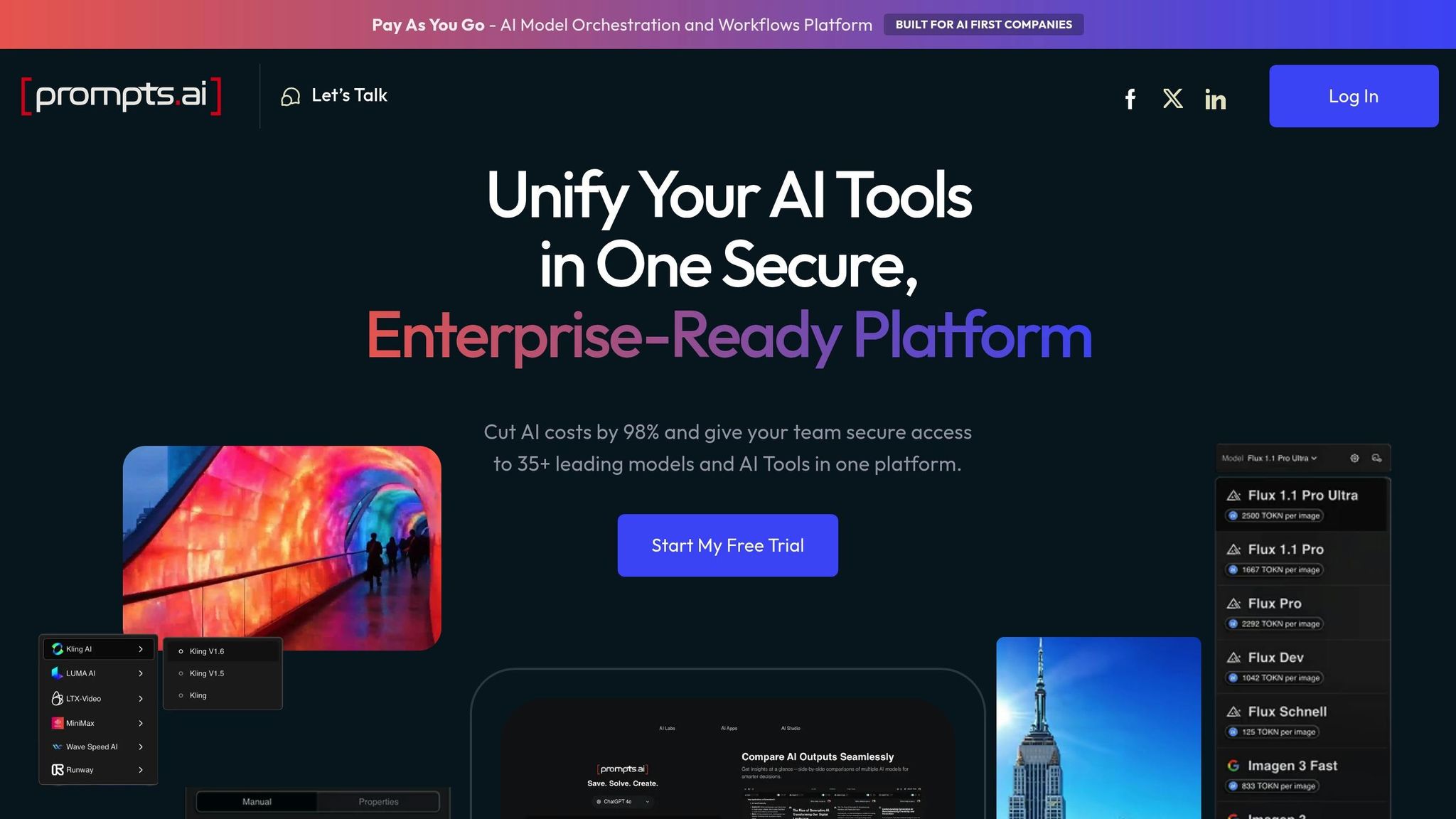
Prompts.ai provides centralized governance for deploying enterprise-scale AI across more than 35 leading LLMs, such as GPT-5, Claude, LLaMA, and Gemini. By uniting these diverse models within a single, secure platform, it ensures reliable and scalable oversight, addressing the growing demand for structured AI management. Teams can automate compliance, monitor token usage in real-time, and compare models side by side. This streamlined approach transforms scattered AI experiments into regulation-compliant workflows that align with global standards like the EU AI Act, NIST, and GDPR. The platform also reduces AI software costs by up to 98%, thanks to its flexible, pay-as-you-go TOKN credit system. From asset management to operational integration, Prompts.ai offers a complete solution for compliance and cost-efficiency.
Prompts.ai eliminates the inefficiency of juggling multiple tools by integrating GPT-5, Claude, LLaMA, Gemini, and over 30 other models into one cohesive interface. Administrators can establish policies once and apply them across all models, ensuring consistency and reducing manual effort. The platform allows side-by-side performance comparisons, helping teams identify the most effective and cost-efficient models for specific tasks. This reduces guesswork and ensures sensitive data remains secure within the organization’s environment. Adding new models, users, or teams takes just minutes, enabling seamless scaling without interruptions.
The platform’s centralized FinOps dashboard offers live insights into token usage and detailed audit trails, simplifying compliance with frameworks like the EU AI Act, NIST, and GDPR. Real-time tracking highlights underutilized resources and unnecessary spending, enabling immediate cost reductions. Automated policy enforcement ensures every AI interaction adheres to regulatory standards, with comprehensive logs available for audits. Enterprises leveraging similar governance tools have reported $8.8 million in net present value and a 199% ROI over three years, showcasing the financial benefits of structured AI oversight.
While Prompts.ai simplifies technical oversight, it also prioritizes user education and collaboration. The platform includes hands-on onboarding and a certification program to help teams quickly build expertise and adopt best practices as AI usage grows. Its unified interface minimizes the learning curve for managing multiple LLMs, and features like real-time dashboards and model comparisons serve as practical training tools. Users can also engage with community-driven resources, such as forums, shared prompt libraries, and collaborative governance dashboards, fostering collective problem-solving and knowledge sharing across both technical and non-technical teams.
As we look ahead to 2026, the importance of AI governance platforms has reached a new level. AI governance is no longer just an operational concern - it has become a business necessity. With 78% of enterprises integrating AI into essential systems that drive both revenue and operations, organizations must now balance innovation with strong safeguards and explainable processes. Yet, challenges remain: roughly 8.5% of employee prompts to AI tools involve sensitive data shared without proper authorization, highlighting the growing need for tighter oversight.
The regulatory landscape has become more demanding. The EU AI Act is now fully implemented, imposing fines as high as €35 million or 7% of global annual turnover for violations involving high-risk AI systems. At the same time, 80% of large enterprises have formalized internal policies for AI governance, marking a significant shift in how businesses approach AI management. Without effective governance platforms, companies face the daunting task of monitoring a growing number of AI systems while navigating increasingly complex regulatory requirements.
One of the most pressing issues is the rise of shadow AI - unauthorized AI tools operating without proper oversight. In some organizations, up to 91% of AI tools fall into this category, creating significant security and compliance vulnerabilities. The stakes are high: IBM's 2025 Cost of a Data Breach Report revealed that teams leveraging AI and automation reduced breach lifecycles by 80 days and saved $1.9 million on average per breach. This underscores how governance platforms not only address risks but also deliver measurable financial benefits.
"Governance isn't a restraint on innovation, it's a necessary companion." - Reggie Townsend, Vice President of the Data Ethics Practice, SAS
The AI governance market reflects this growing demand, with an anticipated CAGR of 45.3% from 2024 to 2029, projected to reach $5.8 billion in value. This rapid growth signals that businesses increasingly view governance platforms as essential infrastructure to mitigate risks while driving innovation forward.
AI governance platforms have become a must-have foundation for organizations aiming to scale AI responsibly. By bringing oversight under one roof, these platforms streamline operations, automate compliance with evolving regulations, and cut costs through real-time FinOps monitoring. For example, companies that implemented AI governance solutions reported $8.8 million in net present value and a 199% ROI over three years, highlighting the strategic edge governance provides.
As we look toward 2026, managing AI effectively demands unified and automated governance. With the AI governance market expected to hit $417.8 million by 2026 and Gartner forecasting that 80% of S&P 1200 organizations will revamp their governance programs by 2028, the need for robust solutions is clear. Enterprises must address a range of challenges, from bias detection and audit trails to cost management and multi-LLM coordination.
Prompts.ai rises to meet these challenges by offering centralized oversight for over 35 models - including GPT-4, Claude, and Gemini - through a single, secure platform. It blends technical governance with practical tools such as Prompt Engineer Certification programs and community resources. Its real-time FinOps feature tracks token usage, directly linking AI costs to business outcomes. Additionally, the platform’s detailed audit trails ensure transparency for regulatory purposes. The flexible TOKN credit system eliminates recurring subscription fees, allowing businesses to scale their AI investments based on actual usage rather than fixed costs.
Creating a solid framework for responsible AI practices starts with clear policies that emphasize safety, transparency, and alignment with both societal and organizational values. The focus should be on managing risks, ensuring compliance with regulations, and maintaining accountability throughout the AI lifecycle.
Key foundational steps include:
By addressing these areas early, organizations can create a scalable system that supports responsible AI development and usage.
An AI governance platform helps organizations tackle the issue of shadow AI by providing comprehensive visibility and control over all AI tools and applications in use. It tracks and monitors AI-enabled assets, including tools installed by employees without authorization, minimizing risks related to compliance, security, and ethical concerns.
These platforms ensure responsible AI usage by enforcing policies, automating risk management processes, and identifying unauthorized AI activities. This transforms shadow AI from an unseen risk into an element that can be effectively managed within the organization's broader strategy.
FinOps dashboards play a key role in cutting down Large Language Model (LLM) expenses by delivering real-time insights into token usage and associated costs. These tools help organizations spot inefficiencies, streamline operations, and apply strategies to save money. With detailed data at their fingertips, teams can take control of costs by setting budgets, enforcing usage limits, and fine-tuning model performance. This ensures AI deployments stay both effective and financially manageable.