Pay As You Go - AI Model Orchestration and Workflows Platform



AI governance platforms are transforming workflows by embedding compliance, improving efficiency, and reducing costs. Businesses report up to 30% ROI increases and 58% faster data clearance by automating processes like audit trails and resource management. These platforms also ensure adherence to global standards, such as GDPR, HIPAA, and the EU AI Act, while cutting AI costs by up to 98%. Here's a quick breakdown of the top platforms:
These platforms cater to diverse needs, from enterprise-grade compliance to cost-effective self-hosted solutions. Use this guide to choose the one that aligns with your organization's goals and regulatory requirements.

AI Governance Platforms Comparison: Features, Compliance, and Cost Controls
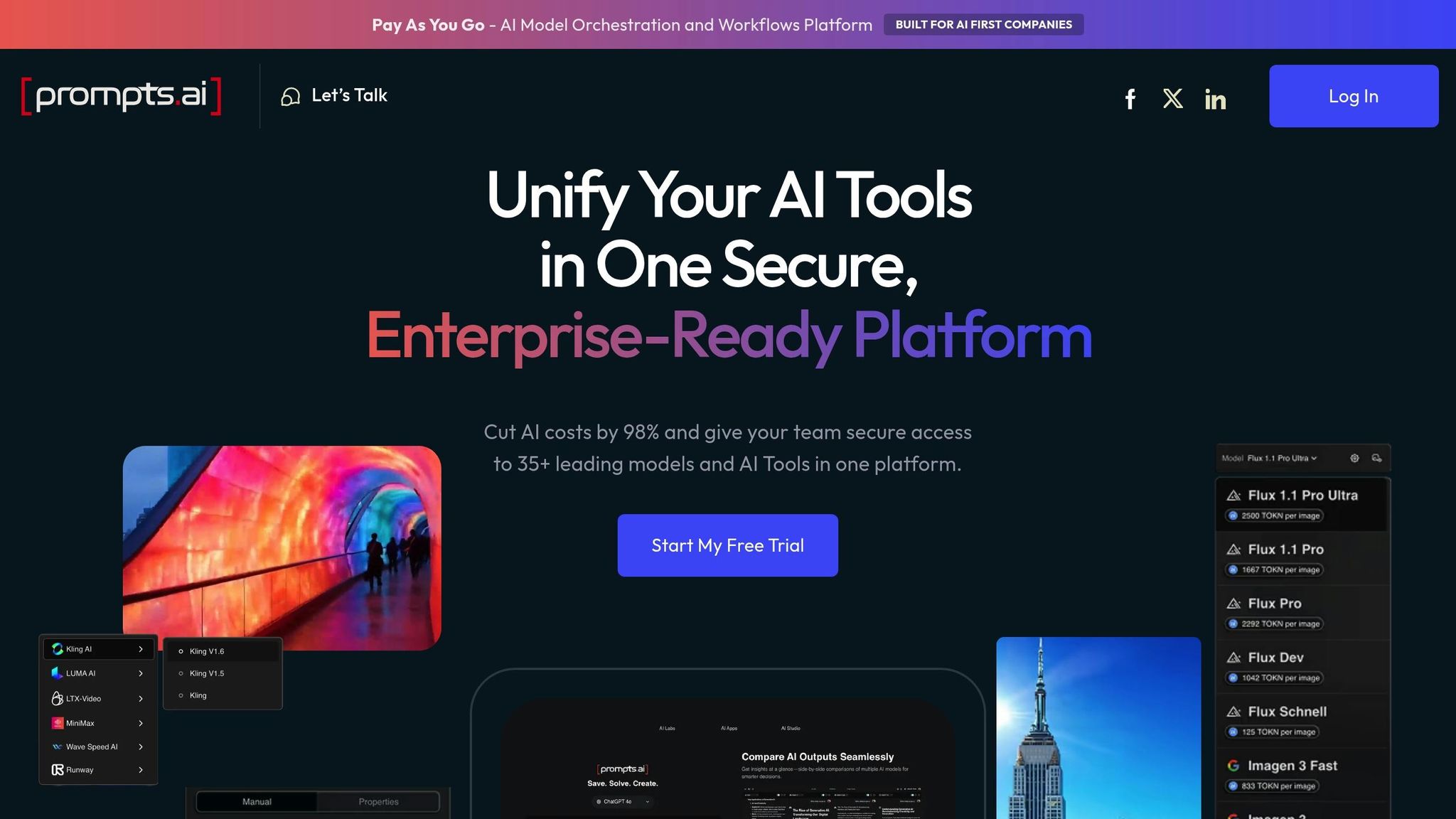
Prompts.ai brings together over 35 of the most powerful AI models - including GPT, Claude, LLaMA, and Gemini - into one streamlined platform designed for enterprise workflows. By offering a secure, compliance-ready interface, it eliminates the need for scattered subscriptions and unregulated AI usage. The platform began its SOC 2 Type 2 audit on June 19, 2025, and incorporates key practices from both HIPAA and GDPR standards, ensuring it meets regulatory demands across various industries. This combination of compliance and operational efficiency positions Prompts.ai as a leader in managing AI workflows.
Prompts.ai strengthens governance through role-based access control (RBAC) and flexible user management. Administrators can assign and manage user roles through a workspace structure tailored to specific subscription tiers. The Creator plan supports up to 5 users, the Problem Solver plan accommodates 99, and Business tiers provide unlimited users with centralized tools to manage permissions securely and in real time.
Every interaction with the platform is automatically logged, creating detailed, traceable records for compliance and internal oversight. These comprehensive logs provide full transparency into model usage, prompt execution, and workflow performance, saving teams from the hassle of manually compiling audit trails.
Prompts.ai reduces AI costs by up to 98% using TOKN credits and Storage Pooling, which allocate resources efficiently. Organizations can purchase TOKN credits on a pay-as-you-go basis, ensuring spending aligns with actual usage. Business plans start at $99 per user per month, with higher-tier options offering advanced analytics to monitor token consumption, flag cost anomalies, and manage budgets effectively in real time.
The platform integrates seamlessly with tools like Slack, Gmail, and Trello, enabling teams to automate workflows across multiple systems. Business-tier users gain access to Interoperable Workflows, which allow AI tasks to be automated across email, messaging, and project management platforms. This feature helps organizations reduce tool fragmentation while maintaining consistent governance policies across all integrated environments.
Workato is an enterprise automation platform designed to streamline AI agent integration with over 1,200 pre-built connectors. These connectors span modern SaaS applications, legacy systems like SAP, and major large language models (LLMs) such as OpenAI, Claude, and Llama. With a 99.9% uptime guarantee for mission-critical operations, Workato ensures reliability and efficiency. Recognized as a 2025 Gartner Visionary for Data Integration, the platform's Model Context Protocol (MCP) Gateway acts as the foundation for orchestrating automation. This gateway enables AI agents to collaborate seamlessly with both people and systems, all while maintaining strict governance controls - a vital factor for improving AI workflows.
Workato prioritizes secure and consistent user management through a robust Role-Based Access Control (RBAC) framework. Features like SCIM user management, SSO/SAML authentication, and Just-In-Time provisioning ensure streamlined access control. Administrators can centrally manage workspaces and define custom policies tailored to user roles. The Workspace Federation feature, available via AutomationHQ, extends these RBAC policies across multiple workspaces for consistency. Additionally, the MCP Gateway enforces runtime policies and authentication, addressing concerns like "shadow AI" by preventing unauthorized access to AI workflows.
Every action taken by an AI agent is meticulously recorded in detailed audit logs, ensuring full accountability. These logs can be streamed in real time to an organization's preferred SIEM platform, enabling centralized monitoring. This setup empowers security teams to quickly identify anomalies or unauthorized activities, bolstering compliance and operational transparency.
Workato meets rigorous compliance standards with certifications such as SOC 1/2 Type II, ISO 27001/27701, PCI-DSS Level 1, HIPAA, GDPR, and IRAP. These credentials demonstrate the platform's commitment to data privacy, secure handling of sensitive information, and operational transparency. To further safeguard data, Workato employs hourly encryption key rotation, offers Bring Your Own Key (BYOK) options, and integrates sensitive data masking alongside end-to-end encryption. These measures ensure that information processed by LLMs and AI agents remains secure while aligning with governance requirements.
Workato includes tools like Acumen, an AI data scientist agent, and Agent Insights, which provide actionable insights into ROI and monitor usage and performance metrics. These tools help organizations manage costs effectively by offering real-time diagnostics, optimizing workload scheduling, and ensuring resources are right-sized for their needs.
Workato's MCP serves as a secure governance layer, ensuring AI workflows remain safe, transparent, and compliant.
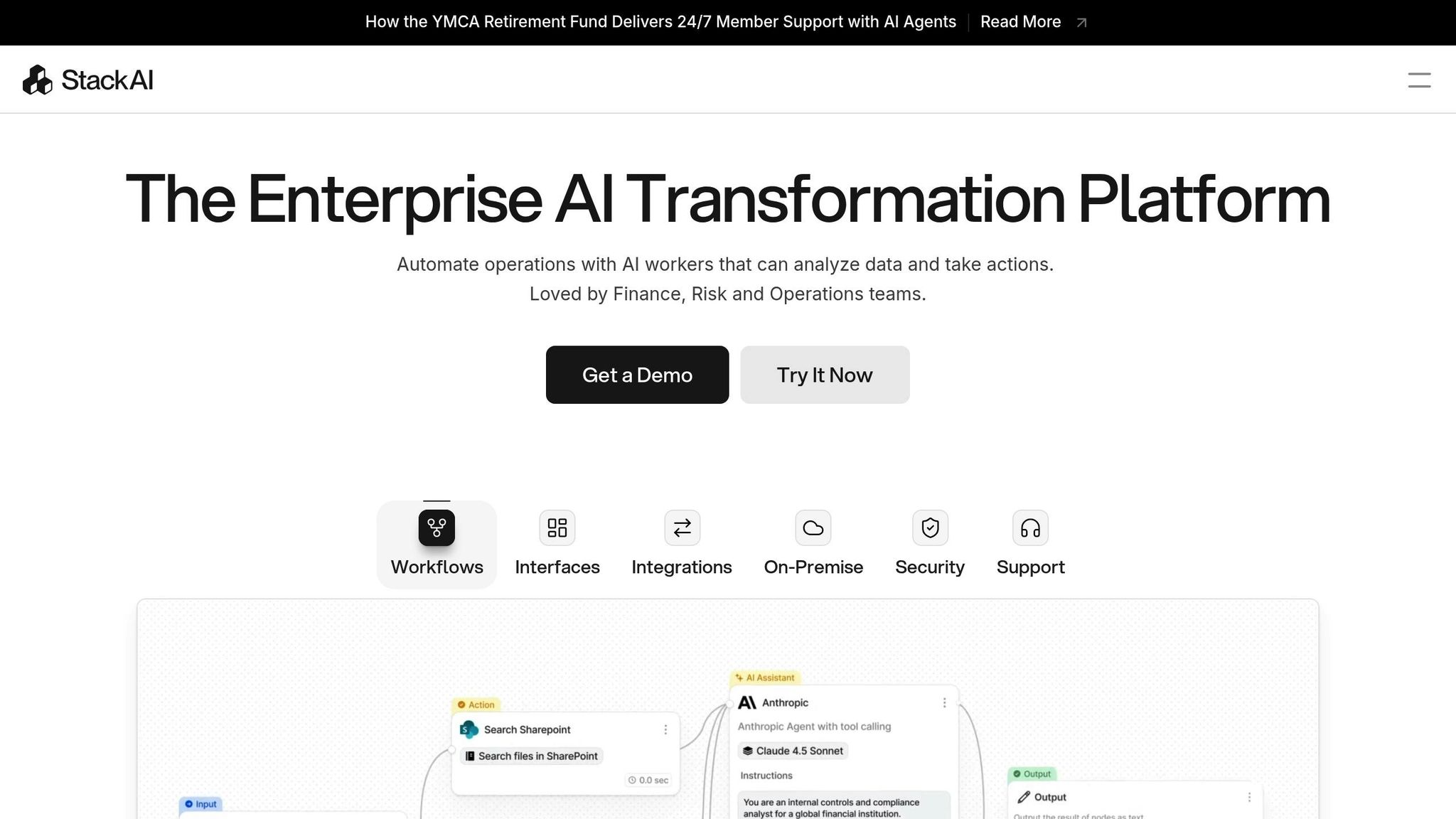
StackAI is a platform designed for enterprise AI governance, built around a robust 8-layer governance model that ranges from Role-Based Access Control (RBAC) to production analytics. It features a user-friendly drag-and-drop engine that uses "nodes" for data processing, seamlessly connecting legacy systems with modern SaaS platforms. Optimized to handle 90% of Retrieval Augmented Generation (RAG) use cases, StackAI simplifies workflow creation while ensuring strict governance measures. The platform meets compliance standards such as SOC 2 Type II, HIPAA, and GDPR, with ISO 27001 certification currently underway.
Here’s a closer look at the key features that ensure StackAI enforces governance at every level.
StackAI offers detailed access control through group-based permissions and workspace management. Administrators can create groups tailored to specific departments - like "Legal" or "HR" - and assign them to workspaces or folders with allowlists, ensuring only authorized users can access or modify sensitive content. Workflow creators can lock editing access to themselves, while administrators retain the ability to override these locks. To prevent unauthorized changes, publishing restrictions require admin approval before any updates are released into production. Additionally, access to specific data sources, such as SharePoint or Salesforce, can be restricted to designated users or groups. Administrators can also enforce global policies to block certain tools and connectors across the organization.
Every workflow execution is meticulously tracked with version control. The Analytics View provides downloadable project analytics, capturing user actions, token usage, latency, and detailed step-by-step traces. For organizations that require external security monitoring, StackAI supports scheduled exports and webhook posts, enabling integration with existing alerting systems. This versioning system allows administrators to review who made changes, what was altered, and when, offering the ability to roll back or approve modifications as needed.
StackAI includes built-in tools for managing costs, such as usage limits and token caps. Real-time analytics monitor token consumption for every workflow execution, giving administrators clear insights into AI-related expenses. These tools help avoid unexpected costs or resource overuse by setting strict usage limits before workflows are deployed to production.
In addition to its governance capabilities, StackAI excels in interoperability, allowing Large Language Models to connect with external systems through function calling. Workflows can be deployed across various channels, including Slack, WhatsApp, SMS, or integrated into existing applications via backend APIs. For industries with strict data sovereignty requirements, such as defense and finance, StackAI offers On-Premise deployment options to keep operations within private infrastructure. Identity management is streamlined with Single Sign-On (SSO) integration through Okta and Entra ID. The "Evaluator View" feature enables teams to test interoperability by uploading CSV files of batch inputs and using an LLM to evaluate agent performance against gold-standard answers before full deployment.
Tray.io offers a robust platform designed to bring enterprise-level governance to AI workflows. It connects over 700 pre-built connectors, covering systems like CRM, ERP, HR platforms, and data warehouses such as Snowflake and Redshift. By integrating directly with top Large Language Models (LLMs) like OpenAI and Amazon Bedrock, Tray.io ensures AI operations are tightly governed and secure. At the heart of this system is the Agent Gateway, a centralized hub for managing Model Context Protocol (MCP) servers. This feature enforces security policies across all AI tools within an organization.
The governance framework is built around Workspaces and Projects, which help teams organize automations by function, department, or team. IT administrators maintain full oversight, while individual teams can work at their own speed. Security is further tightened with mandatory single sign-on (SSO) and two-factor authentication (2FA), ensuring users access only the data relevant to their roles.
Below, we explore some of Tray.io's standout governance features.
Tray.io employs role-based access control (RBAC) to manage permissions at a detailed level. Administrators can assign workflows to specific workspaces - for instance, RevOps, HR, or Finance - allowing teams to operate independently while IT retains global visibility. When technical support is required, the platform provides time-limited access, which automatically logs all actions for compliance purposes. Every activity within the RBAC framework is recorded and can be streamed to external monitoring systems, ensuring continuous oversight and comprehensive audit tracking.
The platform keeps a detailed record of all actions across workflows, capturing agent activity and trigger sources. These logs can be streamed to external SIEM platforms, with retention periods adjustable between 24 and 30 days or disabled altogether if needed for compliance. The Tray Insights Hub offers dashboards that track usage trends and identify exceptions, enabling IT teams to address potential issues before they become critical.
Tray.io adheres to rigorous compliance standards, holding SOC 1 and SOC 2 Type 2 certifications, as well as meeting GDPR, HIPAA, and CCPA requirements. The platform provides signed Data Processing Agreements (DPAs) and maintains a transparent list of sub-processors. With regional hosting options across the US, EU, and APAC, organizations can meet specific data residency needs. Security is further bolstered by annual penetration tests and a bug bounty program.
Tray.io supports REST and GraphQL protocols, offering built-in features like authentication, schema handling, retries, and queuing. The Connector Development Kit (CDK) allows teams to create custom connectors using TypeScript or import them from OpenAPI specifications, making it easier to integrate legacy or niche systems. For secure connections to local databases and applications, an on-premises agent uses private IPs and proxy settings, eliminating the need to expose services to the internet. Additionally, any workflow or AI agent can be exposed as a REST API for triggering AI processes. To enhance AI-specific security, Tray Guardian enforces policies such as tokenization and redaction, safeguarding sensitive data before it reaches LLMs.
Microsoft Power Automate works seamlessly with Azure and the Power Platform, offering robust tools to manage AI workflows. With access to over 1,400 prebuilt, certified connectors, it links workflows to popular platforms like Dynamics 365, SAP, Salesforce, and Microsoft 365 apps (Teams, Excel, SharePoint). By combining API-based automation with RPA capabilities, it ensures compatibility with legacy systems. Businesses leveraging this platform have reported a 248% ROI over three years, driven by enhanced operational efficiency. For example, in 2024, Chad Aronson, Uber's Global Head of Intelligent Automation, spearheaded a Power Platform initiative that saved 3,400 hours annually and delivered $30 million in yearly cost savings.
The platform’s governance framework revolves around Managed Environments, which provide centralized oversight and control. Administrators can implement Data Loss Prevention (DLP) policies and use Azure Policies to regulate access to specific foundational models, safeguarding against unauthorized use of generative AI tools. Security is further enhanced with private endpoints and managed Virtual Networks (VNETs), protecting sensitive data and AI models from external exposure.
Let’s explore its key features, including RBAC, audit logging, compliance, and interoperability, which collectively strengthen AI governance.
Power Automate incorporates Role-Based Access Control (RBAC) to ensure precise management of permissions. Administrators can delegate ownership and editing rights to individuals or teams for specific workflows. For workflows requiring manual triggers, run-only permissions allow users to execute processes without editing access. Azure RBAC adds another layer of security by safeguarding data and APIs, while policy-based controls restrict access to unapproved AI models. This granular system empowers teams to work independently while IT retains overarching control.
Every action within Power Automate is meticulously logged, ensuring continuous compliance. From workflow triggers to user activities, all actions are recorded and can be streamed to external SIEM platforms for real-time monitoring. For example, in 2024, Rohan Tiwari, IT Automation Platforms Owner at Aon, used Power Automate to eliminate 20,000 redundant processes, achieving 8% cost savings through enhanced visibility and streamlined operations.
Power Automate integrates with Microsoft Purview and Microsoft Defender for Cloud, offering audit-ready compliance tools. A Responsible AI dashboard provides insights into model behavior, fairness, and error patterns. Compliance is further reinforced through Azure Policy, ensuring adherence to Microsoft's AI principles. DLP policies safeguard data across the organization, while Managed Environments provide centralized control, supporting the platform’s commitment to secure AI governance.
Power Automate’s extensive connector library is complemented by support for custom API connectors, allowing integration with virtually any cloud application. An on-premises data gateway ensures secure connectivity between cloud workflows and local systems, eliminating the need to expose internal infrastructure to the internet. The platform also integrates with Power BI for data-driven triggers and Power Apps for embedding automation into tailored business applications. In 2024, John Haisch, VP of AI and Automation at Nsure, used Power Automate alongside generative AI to streamline data validation processes, resulting in a 60% reduction in time and a 50% reduction in costs.
"It used to take over 100 people to validate and standardize data to and from carriers. With generative AI and Power Automate, this same process can be managed by just a few people." - John Haisch, VP of AI and Automation, Nsure
Power Automate Premium is priced at $15.00 per user/month (billed annually), and Process flows are available at $150.00 per bot/month. A 30-day free trial is also offered.
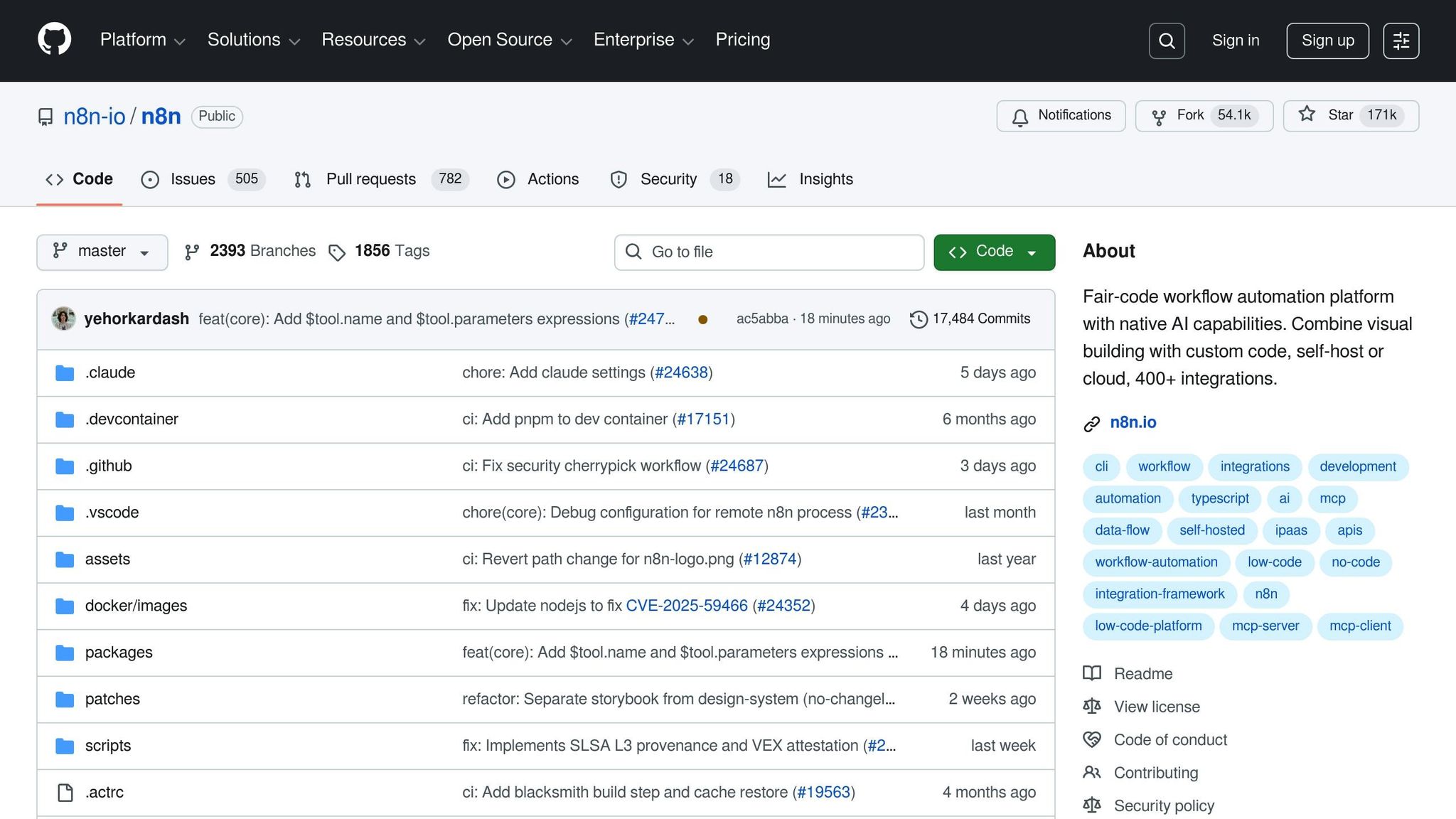
n8n is an open-source workflow automation platform that has gained widespread recognition, boasting 140,000 GitHub stars and a thriving community of over 200,000 users. Its fair-code license lets organizations self-host through Docker or npm, providing full control over both AI workflows and data. With over 500 native integrations and the ability to connect additional apps via its HTTP Request node, n8n ensures flexibility by supporting any Large Language Model (LLM) or vector store, eliminating vendor lock-in.
"We have seen drastic efficiency improvements since we started using n8n for user management. It's incredibly powerful, but also simple to use."
- Dennis Zahrt, Director of Global IT Service Delivery, Delivery Hero
n8n also prioritizes security and governance, with regular external penetration testing and support for secret managers like AWS Secrets Manager, Azure Key Vault, and HashiCorp Vault. Its performance is enterprise-ready, handling up to 220 workflow executions per second. Users have reported building workflows 3X faster compared to coding in Python for frameworks like LangChain, showcasing its ability to drive productivity. These features form the foundation of its robust governance framework.
n8n offers project-level Role-Based Access Control (RBAC) across all paid plans. This feature enables administrators to group workflows and credentials while assigning specific roles to users. A single user can hold different roles across multiple projects, allowing for precise permission management. When workflows or credentials are transferred between projects, previous sharing settings are automatically revoked to ensure security. Additionally, authentication can be added directly to AI Agent nodes, with system prompts defining access and behavior parameters.
To complement its RBAC capabilities, n8n provides detailed audit logs. These include inline logs and visual workflow inspection, making it easy to review each execution step. Token usage tracking helps monitor AI API consumption, allowing organizations to identify spending trends and control costs. Logs can be streamed to external aggregators for continuous monitoring, enabling integration with existing SIEM tools for enhanced security and performance analysis.
n8n meets SOC2 compliance standards and undergoes routine external penetration testing. Its self-hosting option is particularly valuable for organizations in regulated industries like finance, healthcare, and legal, ensuring complete data sovereignty. Features like SSO SAML, LDAP integration, and Git-based version control enhance security and support seamless transitions between development, staging, and production environments.
n8n includes several built-in tools designed to reduce AI-related expenses. Local data filtering compresses text before sending it to LLMs, minimizing token usage. The platform also supports reusing stored outputs to avoid redundant API calls, and filtering conditions prevent unnecessary requests. Additional safeguards like manual approval nodes and memory limits help prevent runaway loops and excessive spending.
"We've sped up our integration of marketplace data sources by 25X. It takes me 2 hours max to connect up APIs and transform the data we need. You can't do this that fast in code."
- Luka Pilic, Marketplace Tech Lead, StepStone
n8n's architecture is designed for seamless integration, supporting the Model Context Protocol (MCP) to enable workflows to communicate across AI systems. It offers over 1,700 pre-built templates, supports custom node development in JavaScript or Python, and allows projects to be exported as JSON. With webhook nodes for real-time integrations, the platform combines deterministic automation with AI capabilities, enabling human-in-the-loop approvals and advanced error-handling.
n8n provides a 14-day free trial for its Cloud version, along with self-hosting options via npm or Docker. RBAC features are included in all paid plans, while the free Community edition offers a more limited feature set.
To help you evaluate how various platforms address critical governance needs, the table below outlines their core features, focusing on compliance, cost management, and integration capabilities.
| Platform | RBAC Support | Audit Logs | Compliance Features | Cost Controls (FinOps) | Interoperability |
|---|---|---|---|---|---|
| Prompts.ai | Provides detailed access controls for teams and workflows. | Real-time audit trails track usage and performance. | Designed with enterprise-grade security and governance practices. | Real-time cost tracking with pay-as-you-go TOKN credits to optimize spending. | Unified interface connects with 35+ leading LLMs, including API and webhook support. |
| Workato | Enterprise-level access controls tailored for team management. | Comprehensive audit trails include execution history and error tracking. | Complies with industry standards like SOC2, ISO 27001, and GDPR. | Usage-based pricing with throttling features to manage costs. | Extensive library of pre-built connectors and REST API support. |
| StackAI | Offers granular user and team-level access controls with API key management. | Tracks prompt interactions and latency metrics through audit logs. | Actively improving its compliance framework to align with recognized standards. | Monitors token usage per workflow to optimize spending. | Enables multi-model integration via REST API and SDK options. |
| Tray.io | Advanced RBAC includes conditional access at project and workflow levels. | Provides detailed audit logs with visual debugging tools. | Complies with standards like SOC2 and ISO 27001. | Tracks execution costs and manages resources with allocation tools. | Broad integration options, including connectors and GraphQL support. |
| Microsoft Power Automate | Uses Azure AD for enterprise-grade access and security. | Logs flow run history and errors, integrated with Azure Monitor. | Meets standards like ISO 27001 and SOC2, with options for HIPAA and FedRAMP compliance. | Flexible licensing options (per-user or per-flow) with built-in usage analytics. | Extensive connectors for Microsoft and third-party services, plus custom connector support. |
| n8n | Offers project-level RBAC across paid plans for workflow access control. | Inline execution logs with visual workflow inspection and external streaming capabilities. | Focused on security with SOC2 compliance, penetration testing, and self-hosting options for data control. | Features local data filtering and manual approval nodes to manage token consumption. | Supports numerous native integrations and custom API connections through HTTP requests and code-driven nodes. |
This breakdown highlights the importance of selecting a platform that aligns with your specific governance, regulatory, and operational goals. Balancing these factors ensures seamless integration and effective cost management tailored to your needs.
Selecting the right AI governance platform depends on your organization's size, compliance requirements, and budget. Prompts.ai provides streamlined access to over 35 leading language models, along with real-time, pay-as-you-go cost tracking. This makes it a strong choice for consolidating tools while maintaining top-tier security.
For enterprise users, platforms like Workato, Tray.io, and Microsoft Power Automate offer centralized, integrated management to meet complex needs. Meanwhile, smaller organizations with tighter budgets can explore self-hosted or free-tier options like StackAI and n8n, which still deliver essential governance features. This variety ensures that businesses of all sizes can find a solution tailored to their operational and compliance demands.
Industries with strict regulations, such as banking and healthcare, should focus on platforms that align with critical regulatory standards like the EU AI Act, NIST AI RMF, ISO 42001, and HIPAA. Co-created AI portfolios have demonstrated measurable benefits, including a 30% boost in ROI and up to 150% improvements in operational efficiency[2].
Look for platforms that offer automated documentation, real-time monitoring, and seamless CI/CD integration. The ability to manage operations centrally, while supporting hybrid cloud, on-premises, or air-gapped environments, is equally important. Aligning governance, cost control, and interoperability is key to ensuring success.
The best governance platform combines strong compliance capabilities with effective cost management and smooth interoperability, enabling your AI workflows to remain secure, efficient, and scalable as your organization evolves.
AI governance platforms streamline workflows and ensure compliance by automating essential tasks such as policy enforcement, monitoring, and risk management. This approach reduces the need for manual oversight, cuts down on errors, and guarantees that AI systems consistently meet regulatory requirements. Platforms like Prompts.ai leverage policy-driven workflows to align AI operations with compliance standards, speeding up approval processes and improving efficiency.
These platforms also centralize the management of AI tools and models, providing better visibility, control, and security. By bringing operations into a unified environment, organizations can eliminate inefficiencies, uncover hidden costs, and maintain adherence to regulatory standards. Features such as audit-ready documentation and automated model tracking further promote transparency and accountability, empowering businesses to scale their AI initiatives responsibly while optimizing day-to-day workflows.
AI governance platforms are equipped with tools designed to help organizations effectively manage and cut costs tied to their AI workflows. A standout feature is real-time cost tracking, which sheds light on resource usage like token consumption and model calls. This visibility enables businesses to pinpoint inefficiencies and take corrective actions promptly.
Many platforms also incorporate budget controls and spending limits, helping organizations ensure their expenses remain within set boundaries. Another practical approach is the use of pay-as-you-go models, allowing companies to pay solely for the AI resources they utilize, avoiding fixed or surprise costs. By centralizing the management of multiple AI models and workflows, these platforms help reduce redundancies and streamline operations. Altogether, these features aim to balance cost optimization with operational efficiency.
AI governance platforms streamline the complex task of regulatory compliance by automating essential processes like policy enforcement and control mapping. Built to align seamlessly with global standards such as GDPR and HIPAA, these tools ensure that data privacy, security, and handling practices meet necessary legal benchmarks.
They also simplify the preparation for audits by producing documentation that’s ready for inspection, reducing the burden on businesses during compliance reviews. By embedding these features into AI workflows, organizations can stay productive while meeting crucial regulatory demands.