Pay As You Go - AI Model Orchestration and Workflows Platform



Generative AI is reshaping businesses in 2026, saving 60–70% of employee time and adding $2.6–$4.4 trillion annually to the global economy. Key sectors like customer operations, marketing, and R&D are seeing faster workflows and higher productivity. For instance, developers using GitHub Copilot completed tasks 56% faster in a 2023 study.
This guide compares Prompts.ai, OpenAI (ChatGPT for Business), and Google Cloud AI (Vertex AI) - three leading platforms helping businesses achieve 10–50% efficiency gains or create new business models. Each offers unique strengths in integration, security, cost savings, and scalability. Here's a quick breakdown:
These platforms simplify workflows, secure data, and reduce costs, but choosing the right one depends on your needs, infrastructure, and budget.
| Criteria | Prompts.ai | OpenAI (ChatGPT for Business) | Google Cloud AI (Vertex AI) |
|---|---|---|---|
| Model Access | 35+ models in one interface | GPT-5.2, Codex, Custom GPTs | 200+ models, including Gemini |
| Integration | Central hub for business systems | Google Drive, SharePoint, GitHub | BigQuery, Workspace, SAP |
| Security | Enterprise-grade, audit-ready | SOC 2, HIPAA, GDPR compliance | FedRAMP High, Model Armor |
| Cost | Pay-as-you-go TOKN credits | Tiered plans with API flexibility | Usage-based, $300–$350K startup credits |
| Scalability | Real-time tracking, rapid expansion | Bulk user management, SAML SSO | Serverless training, 2M token context |
Each tool supports businesses differently. Prompts.ai excels in cost control and multi-model flexibility. OpenAI focuses on privacy and enterprise tools. Vertex AI integrates deeply with Google’s ecosystem for large-scale operations. Select based on your goals and infrastructure to maximize efficiency and growth.

Comparison of Top 3 Generative AI Platforms for Business: Prompts.ai vs OpenAI vs Google Vertex AI
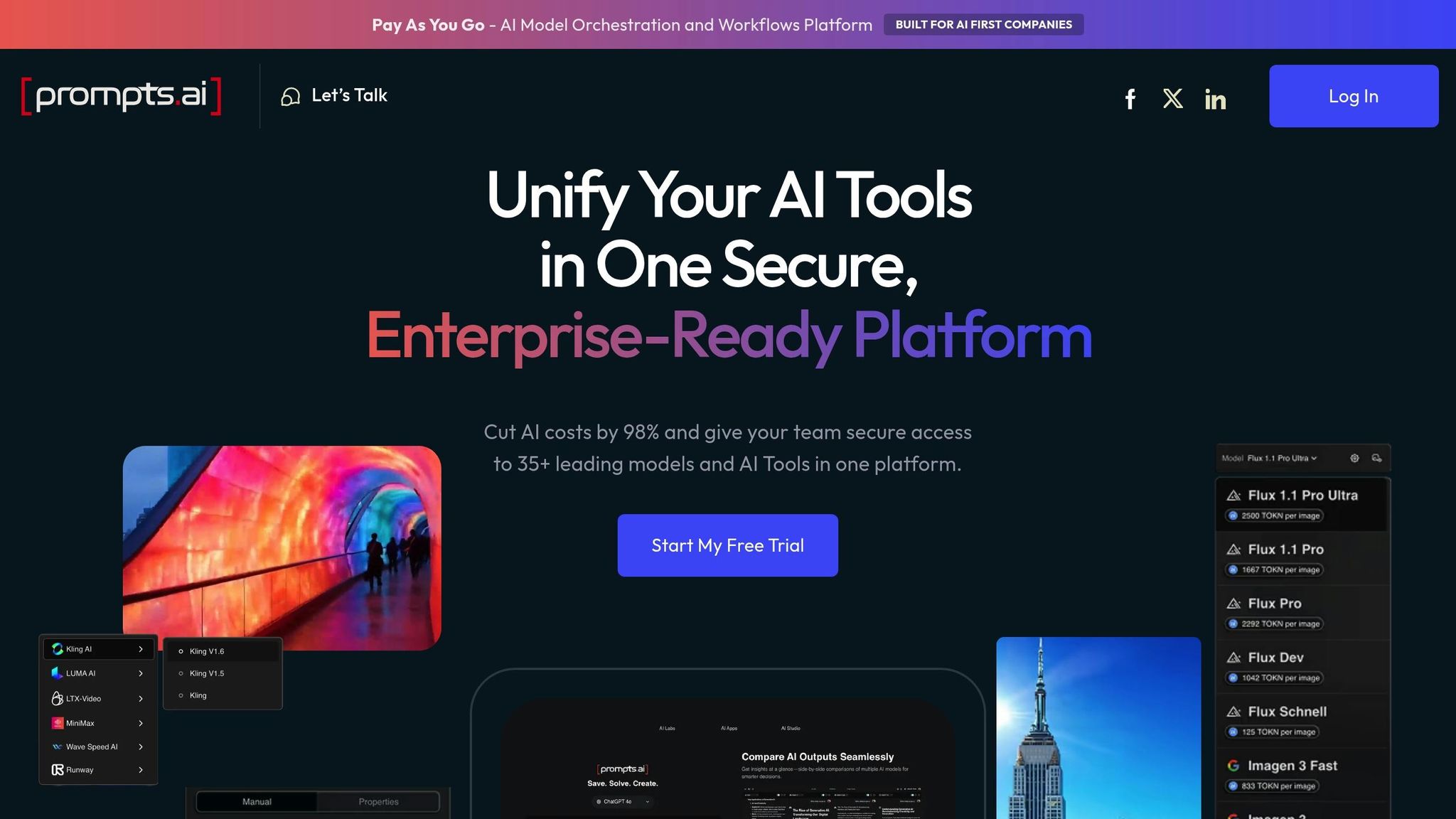
Prompts.ai serves as an AI orchestration platform, bringing together over 35 top-tier language models - such as GPT-5, Claude, LLaMA, Gemini, and Grok-4 - into one streamlined interface designed for enterprise use. Founded by Emmy Award-winning Creative Director Steven P. Simmons, the platform addresses challenges like tool sprawl, hidden costs, and governance issues that often arise when teams independently subscribe to multiple AI tools. By unifying these models, Prompts.ai offers a more efficient way to integrate, govern, and scale AI solutions across organizations.
Prompts.ai acts as a central hub, connecting various AI models to existing business systems and proprietary data. Instead of juggling multiple subscriptions, teams gain unified access through a single interface. Think of it as a "nervous system" that transforms APIs and Lambda functions into ready-to-use tools across frameworks. Teams can compare model performance side-by-side, seamlessly switch between models for different tasks, and adapt workflows without the need for reconfiguration.
The platform prioritizes enterprise-level security with adaptive prompt filtering and automated content moderation designed to identify and block manipulation attempts. Fine-grained access controls are tailored to specific AI functions and associated risks, integrating with existing identity providers for smooth authentication. For sensitive data and infrastructure, production environments enforce strict "no-human-access" policies, ensuring all activities are securely logged and auditable.
Prompts.ai uses a pay-as-you-go TOKN credit system, tracking usage across models to reduce software costs by up to 98%. Pricing begins at $0 for personal plans, with business tiers ranging from $99 to $129 per member monthly. This usage-based model eliminates waste by tying costs to actual usage rather than fixed licenses, making it especially effective for teams with varying AI needs.
The platform is designed for rapid growth, allowing organizations to add models, users, and teams in minutes without reconfiguring infrastructure. It includes a Prompt Engineer Certification program and a library of pre-built workflows called "Time Savers", which help departments quickly deploy solutions. This community-driven approach enables businesses to transition from isolated AI experiments to scalable, compliant processes. Whether starting with a small creative team or rolling out across a Fortune 500 company, Prompts.ai's architecture supports expansion while maintaining centralized oversight of usage, costs, and performance metrics.
OpenAI's ChatGPT for Business brings advanced AI capabilities to organizations with two main tiers: Business (starting at 2 users) and Enterprise (custom pricing for larger deployments). Trusted by over 5 million business users across various industries, the platform has proven its value. Companies have reported a 10x increase in speed when gathering product insights from R&D and a 6x improvement in AI fluency among employees. Impressively, 98% of employees opt for ChatGPT Enterprise, and 83% use it on a weekly basis.
ChatGPT for Business seamlessly integrates with enterprise systems like Google Drive, Microsoft SharePoint, GitHub, Dropbox, and Box, enabling context-aware responses tailored to company data. Organizations can create Custom GPTs to align with specific policies and templates or deploy specialized tools such as Codex, a secure cloud-based coding assistant, and ChatGPT Atlas, designed to automate complex, multi-step tasks via a browser interface. For proprietary systems, the Model Context Protocol (MCP) allows secure connection to internal data using custom MCP Servers, ensuring the AI operates with precise business context. These integrations can enhance CRMs, streamline financial reconciliations, and automate recurring reports, all while maintaining a secure and efficient workflow.
Security is a cornerstone of ChatGPT for Business. Both Business and Enterprise plans ensure customer data is excluded from training pipelines by default. The platform employs AES-256 encryption at rest and TLS 1.2+ for data in transit, and it holds certifications like SOC 2 Type 2 and compliance with ISO/IEC standards (27001, 27017, 27018, and 27701). Enterprise customers benefit from advanced security features, including SAML SSO, Multi-factor Authentication (MFA), and detailed role-based access controls. Healthcare organizations can execute Business Associate Agreements (BAAs) for HIPAA compliance, while industries with heightened security needs can use Enterprise Key Management (EKM) for customer-controlled encryption keys. Additionally, deleted conversations are removed from systems within 30 days, and Enterprise plans offer data residency options across 10 global regions, including the US, Europe, the UK, Japan, Canada, India, and the UAE.
The Business plan, billed annually per user, offers unlimited GPT-5.2 messages and a flexible credit system for high-compute tasks like GPT-5.2 Thinking and GPT-5.2 Pro. Enterprise pricing is tailored to organizational needs, offering volume discounts and expanded 128K context windows (compared to 32K for Business). Verified nonprofits can enjoy 20% off Business plans and 25% off Enterprise plans. For those using the API Platform, pay-as-you-go pricing is available across model tiers (GPT-5, GPT-5 mini, and GPT-5 nano), allowing companies to balance performance and cost based on their specific needs.
The platform is built to scale effortlessly, offering centralized admin tools, bulk user management, and SAML SSO integration. Enterprise customers gain access to SCIM provisioning, domain verification, and dedicated AI advisors who provide deployment resources and role-based training courses. ChatGPT Enterprise consistently earns high satisfaction scores, with organizations praising its adaptability. Companies can begin with small teams and expand to thousands of users while maintaining control through usage tracking, audit logs, and 24/7 priority support with SLAs for Enterprise accounts.
Vertex AI from Google Cloud is designed for seamless data integration and scalable AI workflows, offering a unified platform to build, deploy, and scale generative AI solutions. With access to over 200 models, including Google's Gemini, Anthropic's Claude, and open-source options like Llama, the platform is deeply tied to Google's robust data infrastructure. Companies like Kraft Heinz have seen dramatic results, cutting new product content development time from 8 weeks to just 8 hours by combining tools like BigQuery, Vertex AI, Gemini, Imagen, and Veo. Similarly, Snap Inc. boosted user engagement by 2.5x in the U.S. after incorporating Gemini's multimodal capabilities into their "My AI" chatbot.
Vertex AI seamlessly integrates with BigQuery through tools like Colab Enterprise and Workbench notebooks. It also offers Function Calling and an open-source Agent Development Kit (ADK) for integrating external APIs and building multi-agent systems. For instance, Major League Baseball (MLB) leverages Vertex AI and BigQuery to analyze live plays against the Statcast dataset in real time, delivering actionable player insights during broadcasts. The platform supports multiple programming languages, including Java, Python, Node.js, and Go, through its Gen AI SDKs. Gemini models enhance usability with a context window of up to 2 million tokens, making them ideal for processing complex business documents. This tight integration ensures robust security and performance.
Vertex AI prioritizes security with features like Model Armor, which defends against prompt injection and data breaches by assigning unique identities to AI agents for audit trails. Built-in safety filters and grounding capabilities link models to trusted enterprise data, reducing inaccuracies.
"The accuracy of Google Cloud's generative AI solution and practicality of the Vertex AI Platform gives us the confidence we needed to implement this cutting-edge technology into the heart of our business and achieve our long-term goal of a zero-minute response time."
This endorsement from GA Telesis CEO Abdol Moabery highlights the platform's dependability. Google Cloud's security suite, including Cloud Armor for DDoS protection and enterprise-grade controls for data residency and privacy, further solidifies its reliability in enterprise environments.
Vertex AI's pricing is usage-based, making it flexible for businesses of all sizes. Costs include $0.0001 per 1,000 characters for text/chat generation, $0.0001 per image, and $0.03 per pipeline run. New users receive $300 in credits, while startups can qualify for up to $350,000 in credits, allowing them to explore the platform without significant upfront investment. This structure enables businesses to choose models tailored to their specific needs from the extensive Model Garden catalog.
Vertex AI is built to scale effortlessly, whether for startups or large enterprises. Serverless training and dedicated clusters support a wide range of workloads. Python and machine learning tasks scale efficiently with Ray on Vertex AI, while the Agent Engine deploys AI agents at production scale. MLOps tools like Pipelines, Model Registry, and Model Monitoring streamline workflows, and GKE supports up to 15,000 nodes, ensuring the platform can handle even the most demanding tasks.
When selecting an AI platform, businesses must weigh factors like model integration, security, cost, and scalability. These elements can significantly impact how well a platform aligns with operational goals. Below is an analysis of the core strengths and trade-offs of three leading platforms, along with a comparison table for clarity.
Prompts.ai brings together over 35 top-tier models - including GPT-5, Claude, LLaMA, and Gemini - into one secure, centralized interface. It simplifies operations by reducing tool sprawl and enhancing compliance with comprehensive audit trails and strong governance features. Additionally, its built-in FinOps tracking ensures precise cost management.
OpenAI's ChatGPT for Business uses its Model Context Protocol (MCP) to link data through custom servers and integrates seamlessly with enterprise tools like Google Drive, SharePoint, GitHub, and Dropbox. Features such as AgentKit and the ChatGPT Atlas browser extension enable automation of complex tasks directly within the browser. While it meets high data privacy standards, including SOC 2 Type 2, CCPA, GDPR, and HIPAA compliance, it lacks the granular infrastructure controls seen in more enterprise-focused solutions.
Google Cloud's Vertex AI offers a robust platform that integrates deeply with Google Cloud services like BigQuery and Google Workspace, as well as enterprise systems such as SAP and Salesforce. Its Model Garden hosts over 200 curated models, and the Gemini context window supports up to 2 million tokens for handling large workloads. However, its pricing structure and tiered features may require careful consideration.
Here’s a side-by-side comparison of key criteria for each platform:
| Criteria | Prompts.ai | OpenAI (ChatGPT for Business) | Google Cloud AI (Vertex AI) |
|---|---|---|---|
| Model Integration | Over 35 models in one interface | MCP with connectors for Google Drive, SharePoint, etc. | Native integration with BigQuery, Workspace, and SAP |
| Governance & Security | Enterprise audit trails; data not used for training | SOC 2 Type 2, CCPA, GDPR, HIPAA compliance | Advanced controls like Model Armor and FedRAMP High |
| Cost Efficiency | Pay-as-you-go TOKN credits; up to 98% savings | Tiered plans with broad model access | Flexible pricing with advanced security features |
| Scalability | Real-time FinOps tracking; seamless expansion | Scalable API for high-volume applications | Serverless training and integrated MLOps pipelines |
Choosing the right platform depends on your organization's existing infrastructure and priorities. If cost transparency and multi-model flexibility are key, Prompts.ai offers a unified approach. For companies deeply embedded in the Google Cloud ecosystem, Vertex AI provides unmatched data integration. Meanwhile, those focused on robust data privacy and streamlined workflows might prefer OpenAI's ChatGPT for Business. These considerations help businesses identify the best fit for their needs and workflows.
Selecting the right generative AI platform depends on aligning it with your current setup and long-term objectives. Prompts.ai stands out for organizations seeking clarity in costs and flexibility across multiple models. Its unified interface reduces the chaos of managing multiple tools, while instant cost tracking helps prevent budget overruns. For businesses already operating within Google Cloud, Vertex AI offers seamless integration with BigQuery and Workspace, combined with powerful processing capabilities and a broad context window for handling intricate workloads. On the other hand, OpenAI's ChatGPT for Business is ideal for teams prioritizing data privacy and streamlined workflows across enterprise applications. These options cater to diverse needs, providing a strong foundation for your strategic decision-making.
Organizations leveraging these tools are already seeing tangible results. For instance, software developers report completing tasks 56% faster, while customer service teams resolve 14% more issues per hour. Such advancements are reshaping industries and driving efficiencies.
When deciding, consider your infrastructure, specific use cases, and budget. Small and mid-sized businesses often benefit from seat-based pricing with predictable monthly costs, while enterprises managing complex workflows might find pay-as-you-go token pricing more suitable. Evaluate whether you need deep integration with a particular cloud service, access to a variety of AI models, or specialized features like multimodal processing. By factoring in these elements, you can position your organization for immediate benefits and sustainable growth.
As AI evolves, agentic systems capable of reasoning, planning, and executing complex tasks will become increasingly valuable. With 78% of organizations already incorporating AI into their operations, staying competitive will hinge on how effectively you deploy and scale these tools across your teams. Matching your platform to your infrastructure, needs, and budget is key to driving efficiency and fueling ongoing innovation.
Prompts.ai empowers businesses to slash their AI expenses by up to 98%, offering seamless access to a robust lineup of over 35 large language models (LLMs). This all-in-one platform simplifies the complexities of managing AI workflows, eliminating the need for juggling multiple tools or resources.
By centralizing AI operations, Prompts.ai removes inefficiencies, trims overhead costs, and provides a scalable solution for expanding AI initiatives. All of this is achieved while ensuring top-tier performance and the flexibility companies need to stay competitive.
Prompts.ai prioritizes enterprise security with robust features designed to safeguard sensitive business data and support secure AI integration. Core protections likely include data encryption, strict access controls, and user authentication systems to block unauthorized access. Additionally, the platform aligns with industry standards to ensure compliance with regulatory requirements.
To strengthen security further, Prompts.ai may offer customizable security protocols, detailed audit logs, and governance tools. These features empower businesses to maintain full oversight of their AI operations, protect both operational and customer data, and minimize the risk of breaches - allowing enterprises to implement AI solutions with confidence.
Prompts.ai empowers businesses to grow efficiently with its flexible, pay-as-you-go platform designed specifically for AI-driven companies. By removing the burden of hefty upfront costs, it allows organizations to scale their AI capabilities as their requirements evolve. Whether it’s handling larger datasets, automating intricate workflows, or deploying AI solutions across various departments, the platform adjusts effortlessly to meet changing needs.
With seamless integration of multiple large language models (LLMs) and the capacity to automate tasks on a large scale, Prompts.ai simplifies operations, enhances decision-making, and drives productivity. From generating content to writing code and conducting research, the platform supports a diverse range of applications, enabling companies to innovate and remain competitive in today’s fast-paced market.