Pay As You Go - AI Model Orchestration and Workflows Platform



AI governance platforms are transforming how organizations manage machine learning (ML), generative AI (GenAI), and agentic systems. These tools centralize oversight, ensure compliance, and optimize workflows, helping businesses meet growing regulatory demands like the EU AI Act and NIST AI RMF. By automating governance, companies have achieved measurable results, such as a 150% boost in efficiency and 30% ROI gains at Infosys.
Here’s a quick overview of the top platforms for 2026:
These platforms streamline AI workflows, improve compliance, and cut costs, making them essential for enterprises navigating the complexities of AI in 2026.
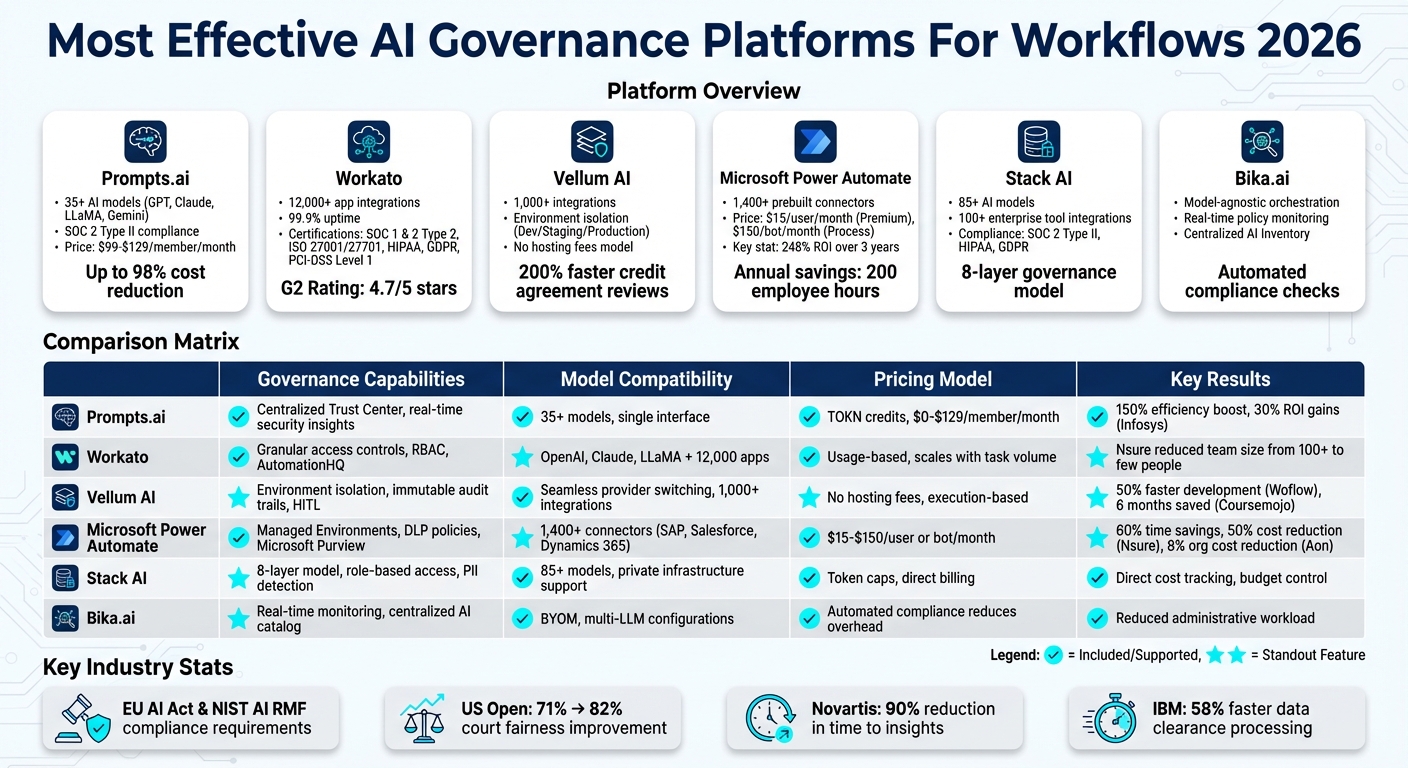
AI Governance Platforms 2026: Feature Comparison Chart
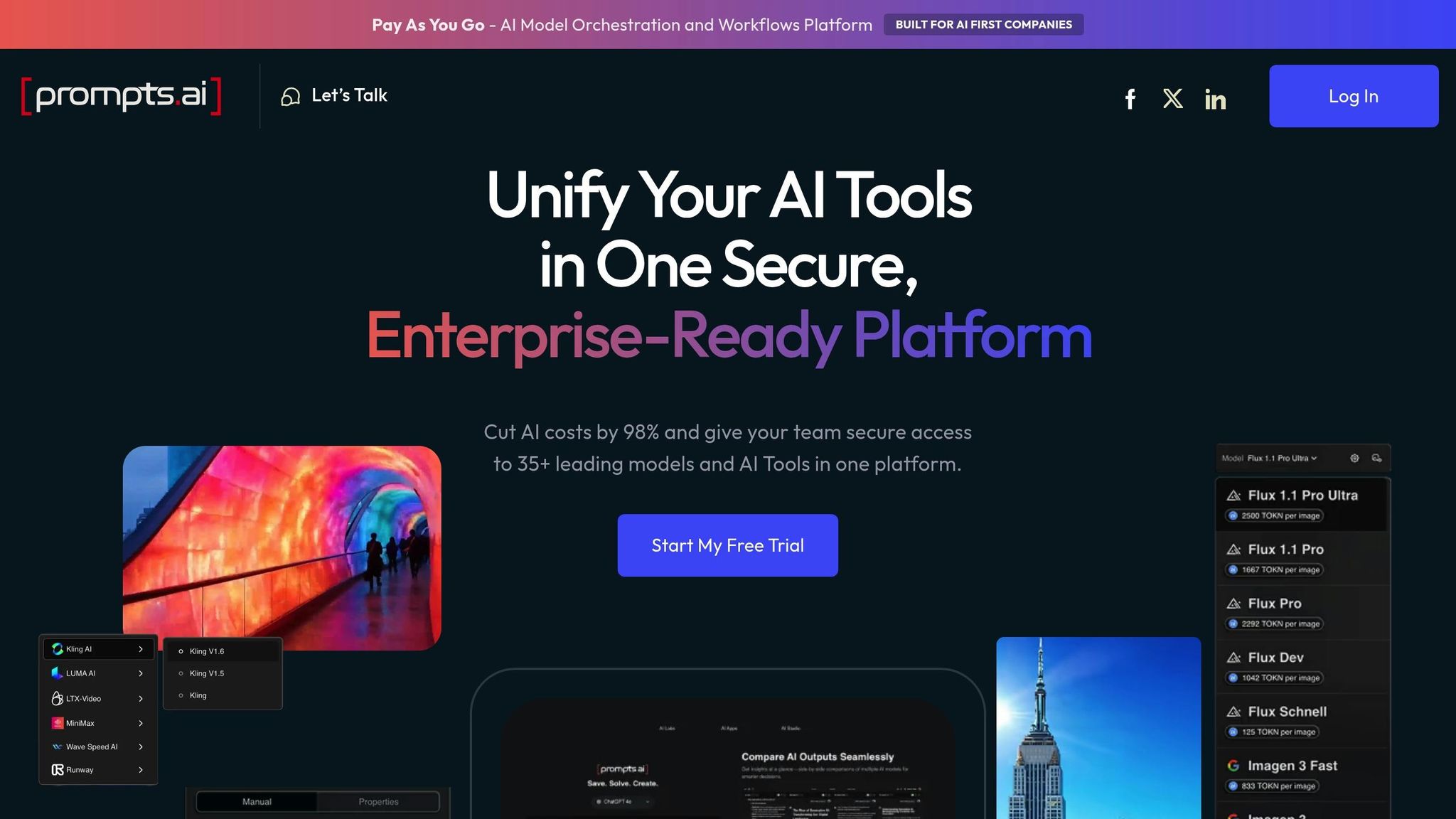
Prompts.ai stands out as a leader in AI governance, offering centralized oversight across 35 AI models, including GPT, Claude, LLaMA, and Gemini. The platform ensures transparency and accountability with comprehensive visibility and auditability for all AI interactions. On June 19, 2025, Prompts.ai took a significant step toward compliance by initiating its SOC 2 Type II audit process through Vanta.
The platform’s Trust Center provides real-time insights into security posture, policies, and controls, giving stakeholders instant access to audit evidence. For businesses and enterprises, governance tools and usage analytics are included to simplify compliance and enhance operational efficiency.
Prompts.ai serves as a unified layer for AI workflows, enabling side-by-side model comparisons that have reportedly increased productivity by up to 10×. The platform integrates seamlessly with popular workplace tools like Slack, Gmail, and Trello, allowing users to automate workflows in just seconds.
Prompts.ai turns one-off tasks into repeatable, scalable processes. Features like TOKN credits and storage pooling enable teams to efficiently manage and share AI resources. Recognized by GenAI.Works as the top platform for enterprise problem-solving and automation, Prompts.ai simplifies production workflows and enhances decision-making processes.
"With Prompts.ai's LoRAs and workflows, he now completes renders and proposals in a single day - no more waiting, no more stressing over hardware upgrades."
– Steven Simmons, CEO & Founder
By leveraging TOKN credits, Prompts.ai aligns costs with actual usage, eliminating the need for recurring subscription fees. Business plans are priced between $99 and $129 per member per month, offering a cost-effective alternative to managing multiple tools. The platform claims to cut AI expenses by up to 98%, consolidating over 35 disconnected tools into one streamlined solution.
Next, Workato builds on these capabilities with its own specialized governance tools.
Workato provides a secure and efficient way to manage AI workflows through its Model Context Protocol (MCP), a specialized orchestration layer designed for AI agents and tools. With an impressive 99.9% uptime and compatibility with over 12,000 applications, Workato ensures reliability and scalability. Ali Mannan Tirmizi, Senior DevOps Manager at Workato, highlights its effectiveness:
"Workato MCP... provides a secure governance layer that keeps AI workflows safe, transparent, and compliant - allowing organizations to truly reap AI's benefits."
Workato's governance model emphasizes granular access controls and thorough auditability. Features like advanced Role-Based Access Control (RBAC) and AutomationHQ simplify centralized policy management. The platform also supports environment separation, enabling organizations to test automation "recipes" in development and staging settings before rolling them out in production. This prevents unintended disruptions caused by rogue AI agents.
To enhance data security, Workato includes sensitive data masking, automated detection of confidential information, and end-to-end encryption with Bring Your Own Key (BYOK) capabilities. Real-time log streaming to SIEM platforms ensures immediate detection of policy violations, while audit trails provide comprehensive visibility. The platform meets rigorous compliance standards, holding certifications such as SOC 1 & 2 Type 2, ISO 27001/27701, HIPAA, GDPR, and PCI-DSS Level 1.
Workato's Workato AIRO™ serves as an AI-driven solution architect, offering real-time diagnostics and optimization for automation teams. The platform supports agentic orchestration, where AI agents, known as Genies, collaborate with humans, systems, and other agents to dynamically complete workflows. Its Agent Studio provides a low-code visual interface for designing, testing, and deploying enterprise-grade agents tailored to specific business needs.
The Enterprise MCP ensures that AI actions remain secure and predictable by requiring agents to authenticate with defined user identities and permissions at runtime. Organizations can establish trusted "Skills" using validated recipes, rather than granting agents unrestricted API access. This approach makes every AI action auditable and reversible. Workato also seamlessly integrates generative AI models like OpenAI, Claude, and Llama with SaaS tools, on-premises systems, and unstructured data sources, ensuring unified and compliant AI operations.
Workato's Acumen agent tracks automation ROI under a usage-based pricing model, which scales with task volume and helps reduce unnecessary development expenses. The platform’s serverless architecture ensures elastic performance, automatically adjusting to meet demand spikes without requiring additional DevOps resources. Additionally, the MCP Registry allows teams to convert proven AI capabilities into reusable assets, minimizing duplicate development efforts across the organization.
With a 4.7 out of 5-star rating on G2, Workato receives high praise for its extensive connector options and AI-assisted workflow setup. By combining integration, API management, and AI orchestration into a single platform, Workato significantly reduces the costs associated with maintaining multiple, isolated tools.
This robust combination of governance, workflow optimization, and cost management lays a strong foundation for Vellum AI’s specialized LLM production capabilities.
Vellum AI streamlines LLM production workflows by providing a centralized platform for managing prompts, orchestration, and model settings. With support for over 1,000 integrations, including Salesforce, HubSpot, Slack, Notion, and Google Drive, it ensures seamless connections between AI agents and existing business tools. This combination of performance and oversight makes it particularly well-suited for regulated industries.
Vellum enforces strict environment isolation across Development, Staging, and Production phases to safeguard sensitive deployment data. Each deployment is fully traceable with an immutable audit trail, enabling teams to roll back to earlier stable versions instantly - without needing to modify code. Its Human-in-the-Loop (HITL) functionality adds an extra layer of control, pausing workflows for external verification before continuing.
“Vellum accelerated our virtual assistant launch across 14 U.S. markets.” – Sebi Lozano, Senior Product Manager at Redfin
Vellum’s architecture allows teams to seamlessly switch between LLM providers without the hassle of rewriting workflows. Built-in fault tolerance ensures reliability by retrying failed LLM calls and automatically switching to backup models if third-party services encounter issues. Developers also have the flexibility to inspect and use workflow code locally, reducing reliance on a single vendor.
The platform records detailed execution data for every workflow, including inputs, outputs, model parameters, execution times, and raw logs. Using the Actuals API, teams can gather user feedback and quality scores to create datasets for refining prompts and fine-tuning models. Online evaluations monitor real-time performance, flagging any regressions immediately.
“We sped up AI development by 50 percent and decoupled updates from releases with Vellum. This allowed us to fix errors instantly without worrying about infrastructure uptime or costs.” – Jordan Nemrow, Co-Founder and CTO at Woflow
GravityStack, a legal tech firm, utilized Vellum’s AI capabilities to reduce credit agreement review times by 200% for a major financial institution. These improvements translate directly into tangible cost savings.
Vellum provides granular cost tracking for every workflow execution, offering teams clear insights into spending. Its "no hosting fees" model eliminates unexpected charges tied to execution frequency, making it easier for businesses to manage costs. By enabling domain experts to collaborate through its low-code interface, Vellum empowers business users to prototype independently. For instance, Coursemojo, an edTech company, saved over 6 months of engineering time by leveraging these tools.
Microsoft Power Automate blends low-code workflow automation with advanced governance tools, making it a versatile solution for both developers and business users. With access to over 1,400 prebuilt connectors, it integrates seamlessly with platforms like SAP, Salesforce, and Dynamics 365. Businesses have reported a 248% ROI over three years and an annual savings of 200 employee hours using this platform. Additionally, its governance capabilities and AI-driven optimization tools enhance compliance and operational efficiency.
Power Automate prioritizes secure and efficient automation with centralized oversight tools. Its Managed Environments offer live monitoring of automation activities across an organization, ensuring transparency and control. Administrators can implement Data Loss Prevention (DLP) policies to classify connectors as "Business", "Non-Business", or "Blocked", reducing the risk of sensitive data exposure. The Automation Kit supports teams in scaling automation efforts while adhering to Microsoft's best practices for lifecycle management. For added security, integration with Microsoft Purview and Microsoft Defender for Cloud protects against risks like prompt manipulation and unauthorized data access.
The platform's Copilot feature simplifies workflow creation using natural language, while task mining identifies inefficiencies and suggests improvements. A standout example comes from Nsure, where integrating Power Automate with generative AI drastically reduced the size of their data validation team while maintaining accuracy.
"It used to take over 100 people to validate and standardize data to and from carriers. With generative AI and Power Automate, this same process can be managed by just a few people." – John Haisch, VP of AI and Automation, Nsure
Power Automate offers flexible pricing to meet diverse business needs. The Premium plan, starting at $15.00 per user/month, includes cloud flows, attended desktop automation, and process mining. For enterprise-scale operations, the Process plan costs $150.00 per bot/month and supports unattended automation. Companies like Nsure achieved 60% time savings and 50% cost reductions in data validation processes, while Aon eliminated 20,000 redundant processes, leading to an 8% organizational cost reduction. By enabling business users to independently prototype solutions, the platform minimizes reliance on developers, speeding up implementation and delivering faster results.
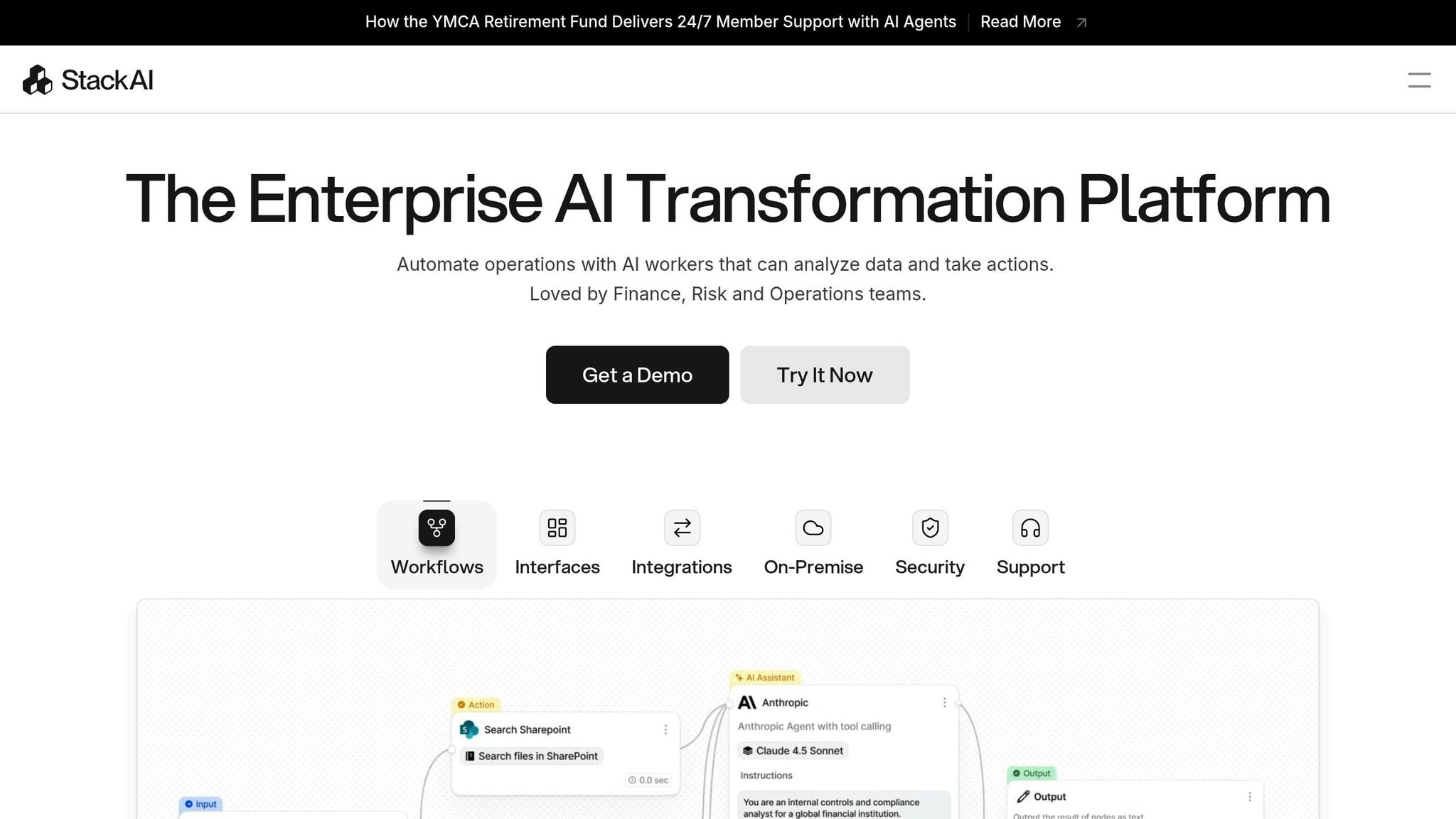
Stack AI builds on its strengths in governance and interoperability by implementing an eight-layer model that spans from role-based access control to production analytics. It supports more than 85 AI models from top providers such as OpenAI, Anthropic, Google, and Meta. To ensure compliance, the platform adheres to SOC 2 Type II, HIPAA, and GDPR standards. For sectors like defense and finance, where data security is paramount, Stack AI enables organizations to connect models hosted on private infrastructure, ensuring sensitive data remains within their control. This combination of compliance and local model integration bolsters the platform's ability to deliver comprehensive AI governance.
Stack AI's governance framework is designed to give administrators precise control over their AI ecosystem. It includes role-based access control (RBAC) with Single Sign-On (SSO) integration through providers like Okta and Entra ID. Administrators can secure projects by locking them, enforce approval workflows before publishing, and maintain a complete audit trail through version control. To safeguard sensitive information, the platform offers real-time PII detection and redaction. For added security, administrators can disable default API keys and replace them with organization-owned credentials, enhancing both auditability and billing transparency.
Stack AI offers robust local LLM support, allowing organizations to connect their private servers to the platform while leveraging its orchestration tools. Administrators can deactivate specific AI providers to ensure only pre-approved services are used, maintaining strict control over the organization's AI environment. Additionally, feature access policies allow admins to block specific tools - such as Notion - across the organization, reducing potential risks. This level of control ensures that the platform integrates seamlessly into secure and efficient workflows.
The platform simplifies complex AI workflows with a drag-and-drop canvas that includes nodes for tasks like data processing and document indexing. It offers a one-click RAG (Retrieval-Augmented Generation) setup, which indexes internal documents using pre-configured settings that suit most scenarios. The Evaluator View lets users batch-test agents with CSV inputs, grading outputs against a "gold standard" to ensure quality before scaling. Moreover, integration with over 100 enterprise tools - such as SharePoint, SAP, Salesforce, and Workday - eliminates data silos and streamlines operations.
Stack AI helps organizations manage costs effectively by allowing administrators to set token caps and usage limits, preventing budget overruns. A unified dashboard provides real-time metrics for precise cost tracking, while downloadable audit logs offer detailed insights into model usage. By enabling organizations to use their own API credentials instead of shared keys, the platform ensures that all usage is billed directly to the organization's accounts, avoiding unexpected charges. This level of cost transparency and control makes it a practical choice for managing AI expenses.
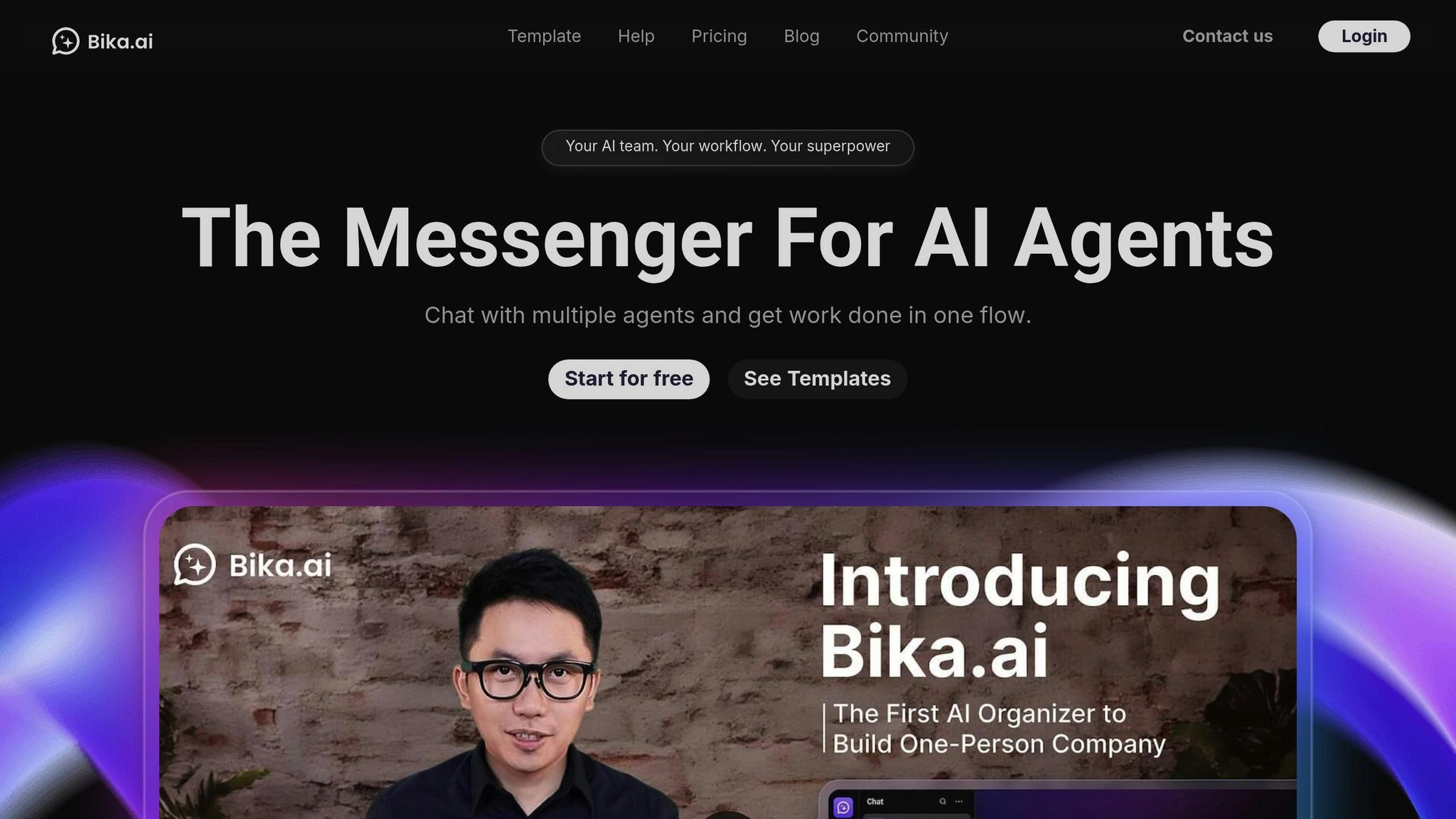
Bika.ai stands out as a platform designed to simplify compliance and governance in AI workflows. By incorporating automated oversight and centralized policy management, it tackles the challenges of AI governance projected for 2026. This automation reduces administrative workload while ensuring that AI-driven workflows adhere to strict governance standards.
Bika.ai offers real-time policy compliance, continuously monitoring for risks such as bias, data breaches, privacy violations, and security vulnerabilities. A key feature is its centralized AI Inventory or Catalog, which tracks all AI use cases, services, and agents across an organization. Through a single, intuitive dashboard, administrators can quickly detect compliance issues and enforce consistent policies.
The platform supports model-agnostic orchestration, accommodating Bring Your Own Model (BYOM) and multi-LLM setups. This flexibility ensures governance policies are applied uniformly, regardless of the model's developer or hosting environment. Bika.ai facilitates seamless collaboration between various systems, devices, and applications by enabling efficient data exchange and integration. Standardized integration hooks make it easy for organizations to connect their existing AI infrastructure without being tied to specific vendors or providers.
Beyond governance and interoperability, Bika.ai improves operational efficiency by automating compliance checks and policy enforcement. Its centralized catalog eliminates the need for manual tracking, saving administrators valuable time. This automation allows organizations to scale their AI operations more efficiently while ensuring every workflow complies with established policies and regulations.
This overview outlines the key strengths of six AI governance platforms, helping you make an informed choice based on compliance requirements, model compatibility, and pricing.
Each platform offers distinct approaches to governance. Prompts.ai stands out with its centralized Trust Center, providing real-time insights into security and audit evidence. Workato enforces granular access controls through its Model Context Protocol and boasts certifications like SOC 1 & 2 Type 2, ISO 27001/27701, HIPAA, GDPR, and PCI-DSS Level 1. Vellum AI ensures strict environment isolation across Development, Staging, and Production phases, backed by immutable audit trails. Microsoft Power Automate features Managed Environments with Data Loss Prevention policies and integrates with Microsoft Purview for added security. Stack AI employs an eight-layer governance model, covering everything from role-based access to production analytics, while meeting standards like SOC 2 Type II, HIPAA, and GDPR. Finally, Bika.ai automates compliance with real-time policy monitoring and a centralized AI Inventory to track organizational use cases.
Platforms vary in their integration capabilities. Prompts.ai simplifies access to over 35 models, including GPT, Claude, LLaMA, and Gemini, through a single interface, removing the hassle of managing multiple vendors. Workato connects generative AI models like OpenAI, Claude, and LLaMA with over 12,000 applications via its Enterprise MCP. Vellum AI allows seamless switching between LLM providers, offering fault tolerance and over 1,000 integrations, including Salesforce, HubSpot, and Slack. Microsoft Power Automate supports more than 1,400 prebuilt connectors for tools like SAP, Salesforce, and Dynamics 365. Stack AI integrates with over 85 AI models from providers such as OpenAI, Anthropic, Google, and Meta, while also supporting private infrastructure connections. Bika.ai takes a model-agnostic approach, enabling Bring Your Own Model setups and multi-LLM configurations.
Cost models are tailored to different business needs. Prompts.ai employs a pay-as-you-go TOKN credit system, starting at $0/month for exploration, with business plans ranging from $99 to $129 per member/month, avoiding recurring subscription fees. Workato uses a usage-based pricing model that scales with task volume through its Acumen agent. Vellum AI eliminates hosting fees and charges based on execution frequency. Microsoft Power Automate offers a Premium plan at $15.00 per user/month and a Process plan at $150.00 per bot/month for enterprise operations. Stack AI allows administrators to set token caps and usage limits, with direct billing to organization accounts. Bika.ai reduces costs by automating compliance checks, cutting down on administrative overhead.
These platforms deliver measurable results in workflow efficiency. For example, GravityStack reduced credit agreement review times by 200% using Vellum AI, while Coursemojo saved over 6 months of engineering time. Organizations leveraging Microsoft Power Automate reported a 248% ROI over three years and annual savings of 200 employee hours. Nsure achieved 60% time savings and 50% cost reductions in data validation, and Aon eliminated 20,000 redundant processes, leading to an 8% organizational cost reduction.
This comparison highlights how each platform addresses governance, interoperability, and cost efficiency, offering solutions tailored to enterprise needs as AI continues to evolve toward 2026.
Selecting the right AI governance platform begins with a clear understanding of your organization's workflow needs and compliance requirements. If your team manages a diverse range of AI models while needing strict oversight, focus on platforms that include a centralized model registry. This feature links every model version to its associated code, data, approvals, and risk assessments.
The best platforms combine automation with real-time monitoring to streamline governance. For instance, the US Open utilized governance tools to reduce bias in tournament data, boosting court fairness metrics from 71% to 82%. Similarly, Novartis achieved a 90% reduction in time to insights for GenAI use cases by implementing standardized governance practices. These examples demonstrate how automation in policy enforcement and auditing can lead to measurable improvements, far beyond just meeting compliance standards.
For those leveraging Generative AI or Agentic workflows, prioritize platforms equipped with real-time safeguards against issues like prompt injection, PII leakage, and hallucinations. By adopting centralized governance tools, IBM reduced data clearance request processing times by 58%, proving that effective governance not only ensures compliance but also accelerates AI deployment. As IBM aptly puts it:
Good governance isn't just about compliance; it's an accelerator to scaling AI.
Ensure that your chosen platform aligns with your risk level and regulatory environment. In highly regulated sectors such as finance or healthcare, tools with robust explainability features and pre-designed templates for frameworks like the EU AI Act, NIST AI RMF, or ISO 42001 are essential. For example, Standard Chartered Bank adopted a governed framework that enhanced AI solution development across various banking operations while maintaining scalable and controlled decision-making. These cases illustrate the importance of tailoring platform capabilities to meet both regulatory and risk-based demands.
The most effective governance platforms evolve alongside your organization's AI maturity. Look for solutions offering multi-cloud support, deep integration with existing tools, and transparent pricing that reflects actual usage. This guide has explored how different platforms address governance, interoperability, and optimization, ensuring your AI strategy remains flexible and compliant. Choose the platform that best aligns with your team's current needs and long-term objectives, balancing governance capabilities, model compatibility, and workflow efficiency.
AI governance platforms bring order to the often chaotic world of managing AI workflows by centralizing control over models and tasks. This streamlined approach eliminates inefficiencies, provides better operational transparency, and ensures that policies and security standards are consistently applied across the board.
Key features such as cost-management tools, audit logs, and automated policy enforcement empower organizations to keep regulatory compliance on track, avoid unexpected costs, and simplify day-to-day operations. These platforms also generate detailed reports, making audits and risk assessments less labor-intensive while strengthening accountability.
By leveraging these platforms, businesses can enhance operational efficiency, ensure regulatory compliance, increase visibility, and scale their AI initiatives with confidence in an increasingly AI-driven landscape.
AI governance platforms play a crucial role in ensuring adherence to regulations, such as the EU AI Act, by integrating regulatory requirements directly into every stage of the AI lifecycle. They align each AI use case with specific rules - like risk classification, transparency standards, and continuous monitoring - and implement these through automated approval workflows prior to deployment.
These platforms also serve as a centralized hub for documentation, securely storing versioned model details, audit trails, and compliance records. This makes retrieving information for audits straightforward and efficient. Furthermore, they streamline compliance by automating ongoing checks, identifying issues such as bias or data drift in real time, and initiating corrective actions when needed. By combining policy enforcement, audit-ready documentation, and real-time monitoring, these tools enable organizations to uphold compliance across the entire AI lifecycle.
To cut costs effectively, organizations should prioritize AI governance platforms equipped with real-time cost tracking and control. Tools like a built-in dashboard allow teams to monitor usage across models and workflows, making it easier to spot and address overspending. Features such as budget caps and automated alerts for approaching thresholds can also help avoid unexpected charges.
Platforms offering automated governance controls can further reduce expenses by streamlining operations. Automated approvals, policy-based model selection, and centralized compliance repositories simplify processes and lower manual labor costs. A unified catalog of AI models can eliminate inefficiencies tied to juggling multiple tools. On top of that, predictive cost forecasting and detailed audit trails enable teams to plan budgets with greater accuracy and secure better vendor agreements, ensuring consistent savings over time.