Pay As You Go - AI Model Orchestration and Workflows Platform



No-code AI workflow platforms are reshaping business operations by simplifying automation and integrating advanced AI tools without requiring coding expertise. These platforms empower teams to build workflows using drag-and-drop interfaces, saving time and reducing reliance on developers. By 2026, their integration with Large Language Models (LLMs) like GPT-5 and Claude enhances their ability to interpret unstructured data, automate decisions, and optimize processes.
Key insights include:
Top platforms for 2026:
These platforms are transforming how businesses automate tasks like CRM updates, invoice processing, and customer support, enabling faster, smarter, and more efficient workflows. Below is a quick comparison of their features and pricing.
| Platform | Key Features | Pricing (Starting) | AI Model Support | Best For |
|---|---|---|---|---|
| Prompts.ai | Access 35+ AI models, natural-language agent builder, cost transparency | $29/month | GPT-5, Claude, LLaMA, Gemini | Teams needing cost control and model flexibility |
| Zapier AI | 8,000+ app integrations, GPT-4o mini, visual Canvas | $19.99/month | GPT-4, Claude, Gemini | Broad app connectivity and workflow complexity |
| Make | 3,000+ apps, AI agents, visual debugging tools | $10.59/month | ChatGPT-5, Gemini, Claude | Visual workflow builders for teams |
| Parabola | Conversational AI, real-time data previews | $20/month | 50+ integrations | Non-technical users managing data-heavy tasks |
| Nanonets | Advanced OCR, multilingual models, document workflows | Custom pricing | Proprietary OCR, RAG | Enterprise document processing |
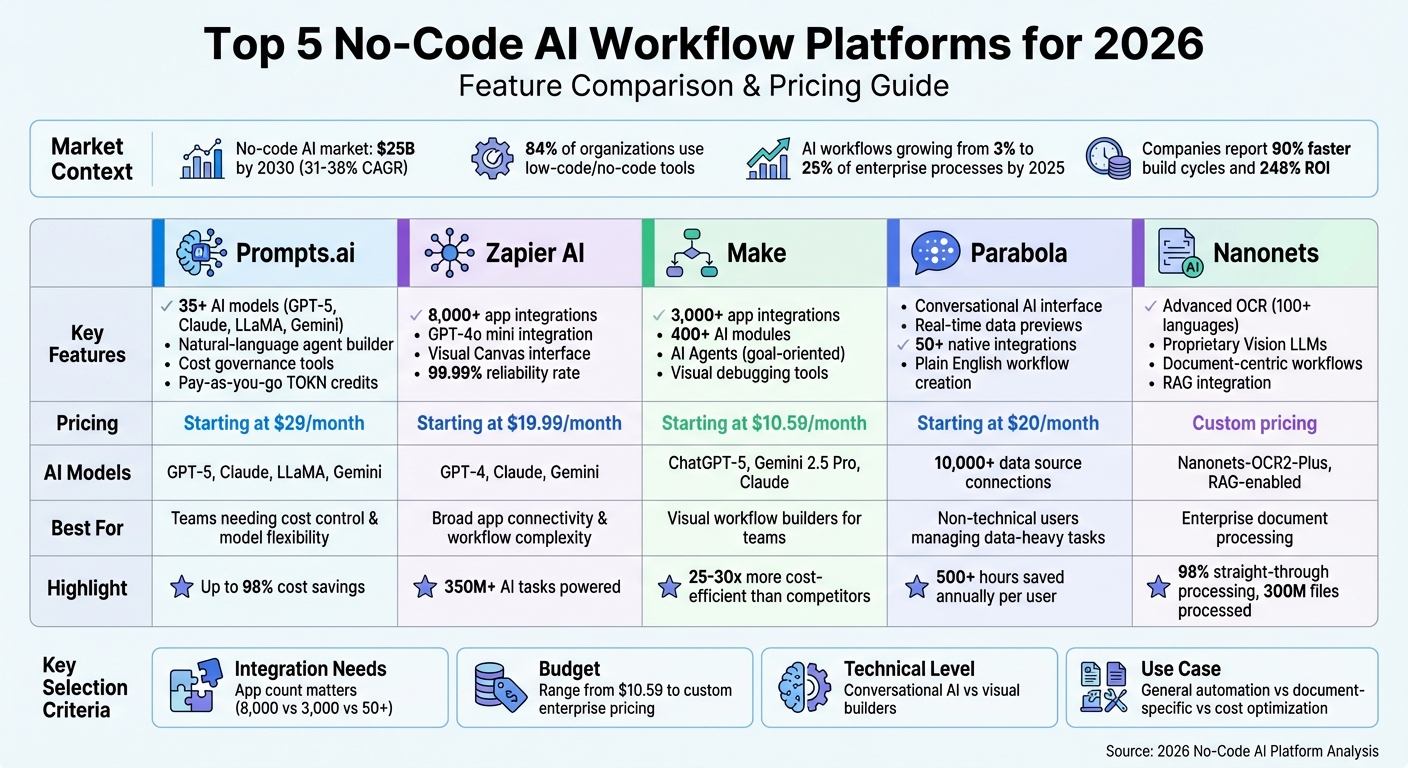
No-Code AI Workflow Platforms Comparison 2026: Features, Pricing & Best Use Cases
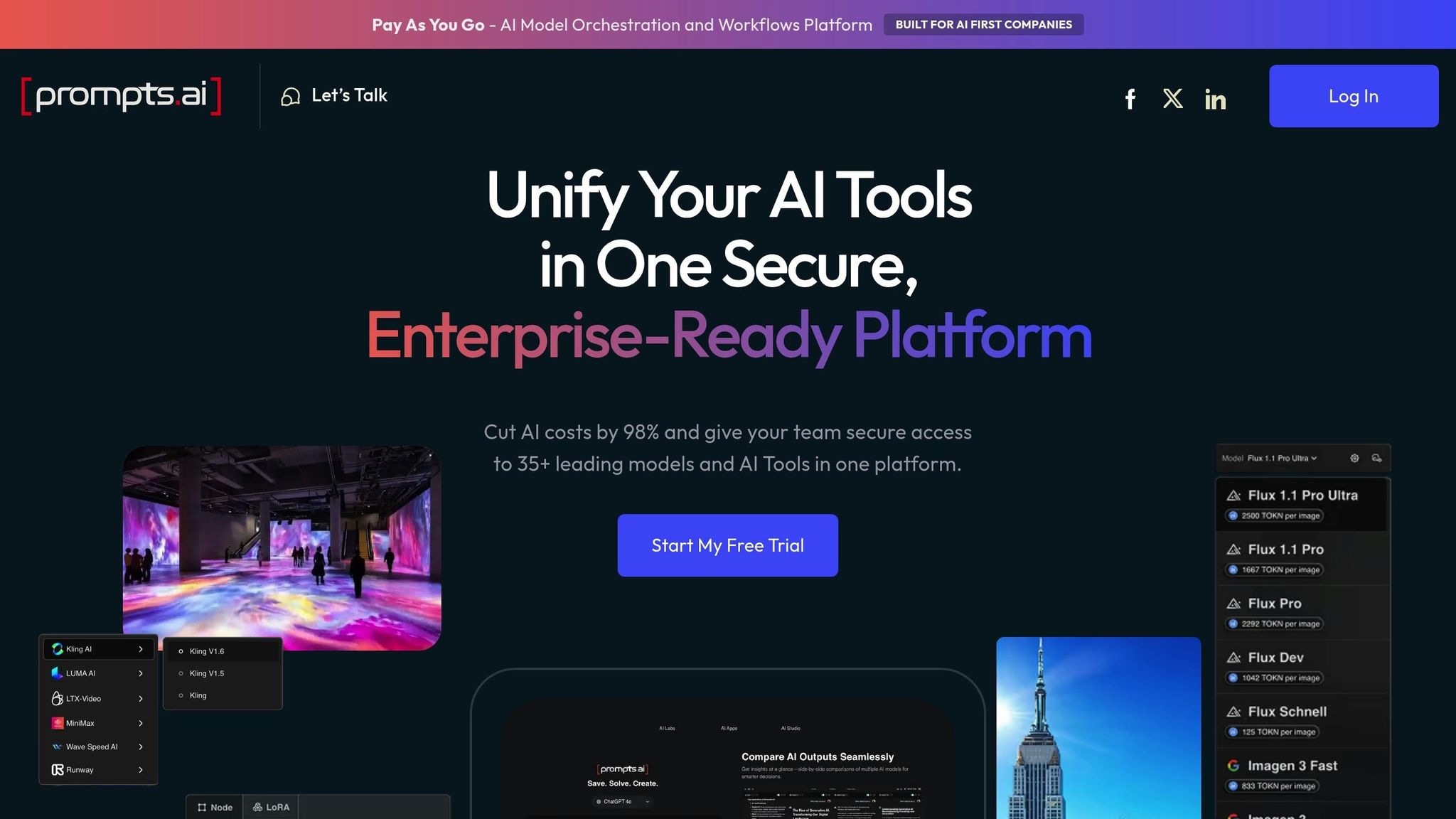
Prompts.ai is redefining how businesses and individuals approach AI by offering a streamlined, cost-efficient, and secure platform. With access to 35 leading AI models - including GPT‑5, Claude, LLaMA, and Gemini - all in one secure interface, it eliminates the hassle of managing multiple subscriptions and dashboards. The platform's governance tools and cost controls can cut AI software expenses by up to 98%.
Prompts.ai enables users to compare outputs from multiple AI models side by side, making it easy to decide whether GPT‑5, Claude, or another model works best for a specific task. Switching between models is seamless, allowing for optimization based on performance and cost. Features like built-in evaluations, versioning, and regression testing ensure workflows remain dependable even as models are updated or improved. These capabilities simplify the process of integrating AI into daily operations.
One standout feature is the natural-language Agent Builder, which lets users describe their workflow in plain English to automatically generate a complete AI agent. This eliminates reliance on IT teams, empowering departments such as marketing, operations, and HR to create advanced AI workflows independently and without delays.
Prompts.ai uses a flexible pay-as-you-go TOKN credit system, avoiding recurring subscription fees for the base tier. Personal plans start at $0 per month for exploration, $29 per month for individual creators, and $99 per month for family use. Business plans range from $99 to $129 per member per month. Real-time FinOps tracking provides visibility into token usage for each workflow, ensuring costs are directly tied to measurable business outcomes.
Security is a top priority for Prompts.ai, especially for enterprise users. The platform complies with SOC 2, GDPR, and HIPAA standards, offering features like role-based access control (RBAC), audit logging, and centralized secret management to maintain strict IT governance. Data is encrypted both at rest and in transit, providing peace of mind for running sensitive workflows without risking proprietary information.
Zapier AI connects with over 8,000 SaaS apps, making it the largest no-code integration library available. This platform allows teams to design advanced workflows without writing a single line of code. Supporting top-tier language models like ChatGPT, Claude, Gemini, Perplexity, and Jasper, Zapier AI can act as a step in intricate automations, manage tasks autonomously, or even interact with customers directly. Let’s explore its AI model integrations, customization capabilities, pricing details, and security measures.
Zapier AI uses the Model Context Protocol (MCP) and its built-in GPT-4o mini to seamlessly integrate models from OpenAI, Anthropic, Google, and Azure - no complex API setup required . Its Canvas interface offers a visual way to map out and automate complex AI processes, taking ideas from concept to execution. With over 1 million companies leveraging its AI features, Zapier has powered more than 350 million AI tasks, all while maintaining a 99.99% reliability rate for critical workflows.
These integrations make it easy to create tailored, automated workflows.
Zapier AI provides tools like if/then branching, conditional filters, and looping, enabling users to fine-tune their workflows. The Zapier Copilot feature takes automation to the next level by creating workflows, tables, and interfaces based on simple, plain-English instructions - no technical know-how required. The platform also supports agentic workflows, where AI agents can plan, conduct web research, and assess their actions to accomplish broader goals. For instance, in August 2025, Popl, a digital business card company, implemented over 100 Zapier workflows to streamline email categorization and lead routing based on region and company size. This saved them around $20,000 annually.
While functionality is key, Zapier also prioritizes affordability.
Zapier offers a free plan with 100 tasks per month. For more extensive needs, the Professional Plan starts at $19.99/month (billed annually) for 750 tasks, while the Team Plan costs $69/month and supports up to 25 users with shared app connections. Additional features include Agents Pro at $33.33/month for 1,500 activities and Chatbots Pro at $13.33/month for five chatbots and an expanded knowledge base. Businesses using Zapier AI tools report saving over three hours per week on manual tasks. For example, Remote’s three-person IT team used Zapier and ChatGPT to automate 28% of support tickets, saving more than 600 hours each month while supporting 1,800 employees.
Zapier takes data security seriously, holding SOC 2 (Type II) and SOC 3 certifications while complying with GDPR, GDPR UK, and CCPA regulations. Enterprise users are automatically excluded from having their data used to train third-party AI models, and other users can opt out manually. Data is safeguarded with AES-256 encryption at rest and TLS 1.2 (or higher) for data in transit. Additional security features include SAML-based single sign-on (SSO), SCIM for user provisioning, two-factor authentication, and detailed role-based access controls. Real-time audit logs provide IT teams with full transparency and oversight.
Make connects over 3,000 applications through a user-friendly, drag-and-drop interface. With over 250,000 active businesses relying on its platform, Make has earned a reputation as a reliable tool for teams seeking advanced automation without needing to code. Its visual canvas provides a clear view of how data moves between applications, simplifying both troubleshooting and workflow refinement.
Make integrates 400+ AI modules, connecting with platforms like OpenAI (ChatGPT-5, GPT-4.1), Google Gemini 2.5 Pro, Anthropic Claude, Perplexity AI, and Deepseek AI. One of its standout features is Make AI Agents - goal-oriented automations powered by large language models that intelligently determine the best tools and steps to accomplish tasks. For example, in March 2025, the organization #makeitfuture used Make to automate its support workflows, achieving a threefold increase in its support resolution rate. Additionally, Make provides a cloud-hosted Model Context Protocol (MCP) server, allowing seamless access to automation scenarios from various AI platforms without requiring users to manage their own infrastructure.
These integrations enhance Make's ability to deliver flexible and intelligent automation solutions.
Make’s visual builder, combined with its AI modules, includes tools like routers, filters, and error-handling modules to simplify even the most complex workflows. Its AI Content Extractor efficiently processes structured data from PDFs, images, and audio files up to 500MB, while also managing historical data for end-to-end automation. The Make Grid tool offers enterprises a real-time visualization of their automation landscape. For instance, ChargeGuru, which operates over 500 scenarios, used Make Grid to speed up debugging by 60%.
"Make drives unprecedented efficiency within our business in ways we never imagined. It's having an extra employee (or 10) for a fraction of the cost." - Cayden Phipps, COO, Shop Accelerator Martech
Make combines powerful features with cost efficiency. It uses a credits-based pricing system, starting with a free plan offering 1,000 credits per month. Paid plans begin at $10.59/month for 10,000 credits, $18.82/month for the Pro plan, and $34.12/month for Teams. Enterprise users enjoy custom pricing along with advanced features like SSO, SCIM, and dedicated support. With credit costs averaging ~$0.00106 per credit compared to ~$0.02665 per task, Make is 25–30 times more cost-efficient. Users can also save up to 40% on AI-heavy workflows by connecting their own OpenAI or Anthropic API keys. In December 2024, GoJob implemented Make to automate its operations, leading to a 50% increase in annual net revenue.
Make prioritizes security and compliance, meeting SOC 2 Type II and GDPR standards. Data is protected during transmission with TLS 1.2 and 1.3 protocols and stored securely using AES 256 encryption. Enterprise-grade security features include Single Sign-On (SSO), SCIM for user provisioning, Role-Based Access Control (RBAC), and IP whitelisting. The Human in the Loop feature allows users to manually review AI-generated outputs before they proceed in workflows. Advanced audit logs and an Analytics Dashboard offer full operational transparency. With ratings of 4.8 out of 5 on Capterra and 4.7 out of 5 on G2, users consistently highlight Make’s flexibility and visual debugging capabilities.
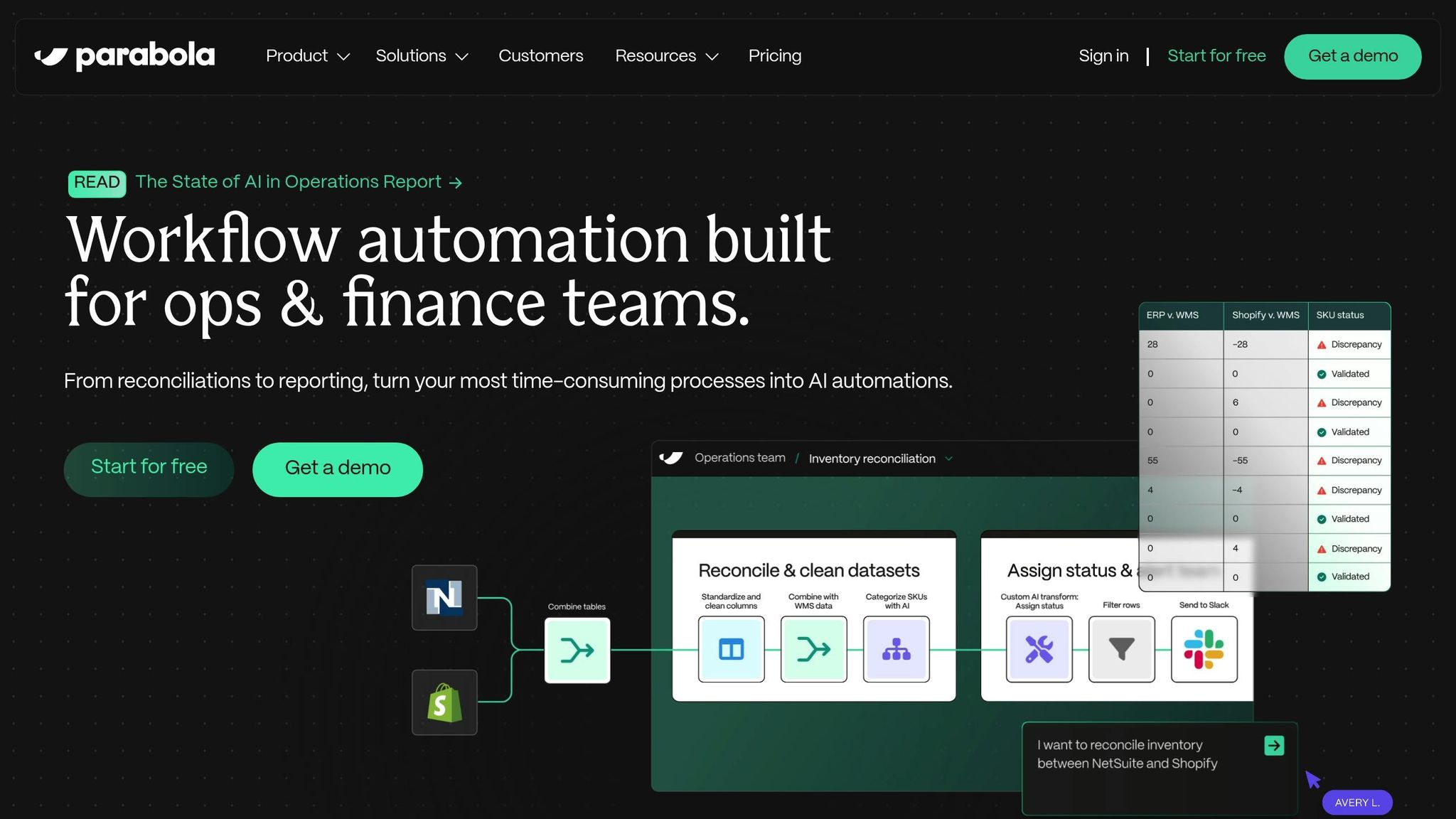
Parabola stands out in the AI workflow platform landscape with its conversational, user-friendly approach to automation.
Instead of requiring manual configurations, Parabola's AI-powered chat interface allows users to describe their desired outcomes in plain English. The platform’s natural language processing engine then translates these descriptions into automated workflows on a visual canvas. Its language models are adept at extracting specific data points - such as invoice numbers, line items, or SKUs - from unstructured sources like PDFs, handwritten receipts, and emails, converting them into structured tables for further use.
Parabola’s AI co-builder offers more than just automation - it provides documentation assistance, suggests next steps, and resolves workflow errors. It also explains the logic behind workflows, making team handoffs smoother. Users can refine AI-generated workflows with real-time data previews, enabling them to apply filters, joins, and complex business logic with ease. The platform connects to over 10,000 data sources and includes more than 50 native integrations, such as NetSuite, Shopify, Snowflake, and ShipStation, ensuring seamless data connectivity.
Parabola simplifies repetitive processes by allowing teams to group workflow steps into reusable cards and components that sync instantly. Over time, the platform learns and optimizes workflows based on usage patterns. Alastair Streitz, Senior Manager of Strategic Operations at Uber Freight, shared:
"As soon as we launched the first component of the automation, we saw an increase in our top-line compliance figure and immediately improved top-line compliance".
Users have reported saving more than 500 hours annually on operational tasks, with some workflows delivering up to $200,000 in yearly savings.
Parabola combines ease of use with a straightforward, consumption-based pricing model. Credits are only used when workflows run, not during building or editing. The Basic plan is free and includes 1,000 credits per month with limited AI functionality. The Explorer plan costs $20 per month, offering 1,500 credits and full AI features. The Collaborator plan, priced at $400 per month, supports up to three users with 30,000 credits. For larger teams, the Business plan offers custom pricing, unlimited users, and dedicated account management. With a 4.9-star rating across review platforms, Parabola is celebrated for making complex tasks manageable for non-technical users.
Parabola prioritizes security and compliance, adhering to industry standards. The platform holds SOC 2 Type II certification and complies with GDPR, providing Data Processing Agreements for all users. A specific agreement with OpenAI ensures that data processed through AI steps is not used for model training. Additionally, users can limit AI exposure by selecting specific columns for processing instead of sharing entire datasets. For enterprise clients, enhanced security features include Single Sign-On via Google, SAML, and OIDC, as well as granular user roles, audit logs, and IP whitelisting to secure database connections.
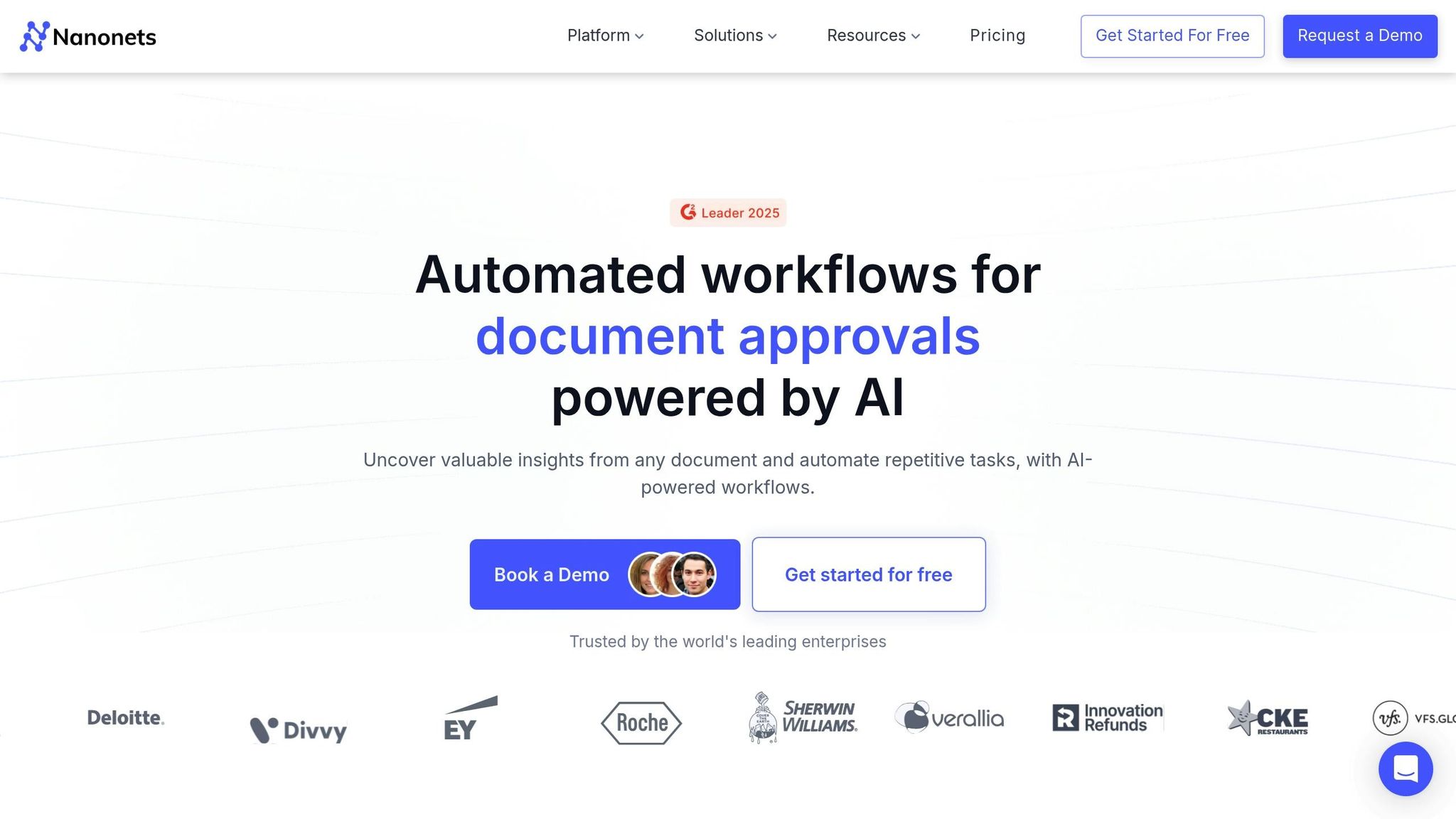
Nanonets stands out by focusing on document-centric workflows, offering advanced tools for enterprise-level document processing and automation. With a track record of processing 300 million files and saving users 3 million hours, the platform achieves an impressive 98% straight-through processing rate.
At its foundation are Nanonets' proprietary Vision Language Models, such as Nanonets-OCR2-Plus and Nanonets-OCR2-3B. These models handle complex document elements - checkboxes, watermarks, flowcharts, and multi-layered tables - across more than 100 languages. Outputs are converted into JSON or Markdown formats, making them immediately compatible with large language models and Retrieval-Augmented Generation (RAG) applications.
Nanonets enhances no-code capabilities, allowing users to integrate advanced document processing seamlessly. Its multilingual OCR goes beyond basic text extraction, enabling users to train custom large language models using their own data sources - like emails, support tickets, or customer databases - for tailored RAG workflows powered by natural language commands. For organizations with strict data policies, Nanonets offers on-premise deployment, ensuring data sovereignty while maintaining low-latency processing.
The platform integrates with major enterprise systems, including SAP. Catherine Gallagher from SaltPay's Accounts Payable team shared:
"Nanonets' direct integration with SAP helped SaltPay automate a crucial part of their Accounts Payable process".
Additionally, its APIs support enterprise-grade scalability and can be set up with just two lines of code.
Nanonets empowers users to design advanced workflows featuring conditional logic, automated decision-making, and intelligent document classification. Its "Classify and Split" feature automatically organizes multi-document files for streamlined data extraction. Human-in-the-loop stages allow teams to establish smart approval rules and backup approvers, automating up to 90% of manual tasks while maintaining oversight.
In 2024, Ken Christiansen, CEO of Augeo, implemented Nanonets to automate invoice processing for a financial services client. The shift from manually handling 3,000 invoices per month to processing 36,000 annually was transformative:
"Something that would earlier take us 4 hours per day will now be done in less than 30 mins. It's a huge saving in time".
Other success stories include ACM Services, which reduced the processing time for 300 invoices from a full day to just minutes using Nanonets' click-and-drag verification system - saving 90% of their time. In2 Project Management used the platform to build real-time dashboards from invoice data, uncovering insights that saved their client 700,000 AUD.
Nanonets offers a free trial with no commitment . Luke Faulkner, Product Manager at Tapi, highlighted the platform's impact:
"has been able to save 70% on invoicing costs, improve customer experience by turnaround of seconds from >6hrs and free up staff members from tedious work".
For enterprises, custom pricing plans include options like Role-Based Access Control and dedicated SLAs, tailored to specific business needs . Kale Flaspohler, a Financial Advisor at ProPartners Wealth, noted:
"We are seeing a major difference in accuracy, as Nanonets provides a >95% accuracy which has helped cut down our processing time by ~50%".
Nanonets prioritizes security and compliance, meeting SOC 2, GDPR, and HIPAA standards. Features include role-based access control, detailed audit trails for tracking workflow actions, and options for secure cloud storage or on-premise deployment to ensure complete data control . By 2024, over 34% of Fortune 500 companies were using Nanonets, with sandbox environments available for testing complex workflows before full deployment.
Prompts.ai understands that pricing plays a key role in making no-code AI workflows accessible, so it offers clear and flexible options tailored to different needs.
The platform uses a Pay-As-You-Go TOKN credit system, which eliminates recurring fees and ties costs directly to your usage. This token-based structure works seamlessly with the platform's ability to switch between multiple AI models, ensuring you only pay for what you actually use.
For individuals, Personal Plans begin with a free tier. The Creator Plan is priced at $29/month for solo projects, while the Family Plan costs $99/month, designed for collaborative use at home.
For teams and organizations, Business Plans start at $99 per member/month with the Core Plan, offering essential AI tools. The Pro Plan, at $119 per member/month, provides enhanced workflow integration. For $129 per member/month, the Elite Plan delivers full access to over 35 large language models and advanced capabilities.
All Business Plans come with enterprise-grade governance, real-time FinOps tracking, and a transparent token-based billing system that can slash AI software costs by up to 98%.
This pricing structure ensures that both individual creators and large enterprises can harness the power of AI without breaking the bank.
No-code AI workflow platforms are reshaping the way businesses function in 2026. These tools go beyond basic automation, enabling smarter decision-making that can interpret context, handle complex inputs, and manage exceptions that once required human oversight. With the no-code AI market projected to reach around $25 billion by 2030, growing at a robust CAGR of 31–38%, the momentum driving these platforms is impossible to ignore.
Companies adopting these platforms are seeing remarkable results. Build cycles are reported to be up to 90% faster compared to traditional development methods, while automation has enhanced process efficiency by as much as 95%. For example, Remote’s small IT team of three automated 28% of their 1,100 monthly support tickets, saving over 600 hours each month. Similarly, Cineplex achieved an annual savings of more than 30,000 hours across finance and guest services operations.
These platforms also enable businesses to scale efficiently. Teams can manage dramatic increases in workload - whether it’s customer support tickets, lead management, or document processing - without needing to significantly grow their workforce. By 2025, AI-enabled workflows are forecasted to rise from 3% to 25% of all enterprise processes, and 84% of enterprises plan to increase their investment in AI agents in 2026.
Automation is no longer confined to peripheral tasks; it’s becoming a central part of business infrastructure. By 2029, 85% of companies are expected to automate most of their core processes. Whether you’re an independent creator, part of a small team, or leading a large enterprise, exploring these platforms now can help you unlock efficiency, cut operational costs, and maintain a competitive edge in an increasingly AI-driven world.
The tools are here, the market is proven, and the potential for transformation in 2026 is undeniable. Start by identifying bottlenecks in your workflows, testing real-world scenarios, and scaling based on results. The opportunity to optimize and elevate your operations has never been more accessible.
No-code AI platforms simplify the connection to advanced language models like GPT-5 through intuitive visual tools and pre-configured integrations. With just a few clicks, users can drag and drop components, input a prompt, select a model (such as GPT-5), and set up actions like saving data, sending emails, or initiating other workflows.
These platforms take care of the technical complexities behind the scenes, including API calls, authentication, token management, and cost monitoring. This allows users to focus entirely on their objectives without needing to write any code. Many platforms also use adaptable protocols, making it seamless to switch between models without overhauling the setup. This streamlined approach enables businesses to incorporate AI into tasks like invoice processing or drafting responses quickly and effectively - all without touching a line of code.
No-code AI platforms provide businesses with a quick and budget-friendly way to adopt intelligent automation without needing advanced coding skills. By 2026, these tools will allow teams to roll out AI-powered workflows in just days rather than months, cutting down on both time and development expenses. With their user-friendly drag-and-drop interfaces, even non-technical users can design and customize solutions, enabling businesses to push forward without overburdening IT departments.
These platforms simplify operations by automating repetitive tasks, reducing manual errors, and accelerating decision-making. Companies can achieve greater efficiency, improved accuracy, and substantial cost reductions - sometimes slashing AI-related expenses by as much as 98%. Their ability to integrate seamlessly with existing systems ensures smooth data sharing, allowing AI to analyze information, predict outcomes, and initiate actions in real time. This frees up employees to concentrate on more strategic, high-value activities.
By 2026, no-code AI platforms will enable businesses to deploy AI solutions faster, cut costs, improve accuracy, and extend automation efforts organization-wide - all while being accessible to a wider range of users.
No-code AI workflow platforms place a strong emphasis on data security and compliance, integrating advanced safeguards directly into their systems. By implementing role-based permissions, they ensure that only authorized individuals can access, manage, or execute workflows. Every action is meticulously recorded in immutable audit trails, simplifying adherence to IT governance and reporting requirements.
These platforms align with rigorous compliance standards, including SOC 2 Type II, GDPR, CCPA, and HIPAA, showcasing their dedication to safeguarding sensitive data. Features like end-to-end encryption, data residency options, and compliance dashboards empower organizations to monitor and confirm their compliance with both federal and state regulations.
Through a combination of strict access controls, certified compliance measures, and secure data management, these tools enable businesses to automate workflows with confidence, maintaining privacy and security every step of the way.