Pay As You Go - AI Model Orchestration and Workflows Platform



AI workflow tools are transforming business operations, enabling faster, smarter, and more cost-effective processes. These platforms integrate with thousands of apps, automate tasks, and provide AI-driven orchestration to save time and reduce costs. Below is a quick summary of the top-rated AI workflow tools of 2026:
Choosing the right tool depends on your business size, integration needs, and budget. Start with free trials to test compatibility and ROI before scaling up.

AI Workflow Platform Comparison: Features, Pricing & Integrations 2026

Prompts.ai brings together over 35 AI models - including GPT-5, Claude, LLaMA, and Gemini - into one secure, centralized platform. By consolidating tools and improving efficiency, it reduces tool costs by up to 95% and cuts overall AI expenses by an impressive 98%. The platform also provides a unified system for governance and auditability, ensuring organizations have complete oversight of their AI activities. Additionally, it simplifies integration with widely-used productivity tools, making it a practical solution for businesses of all sizes.
Prompts.ai seamlessly connects with popular tools like Slack, Gmail, and Trello, turning scattered tasks into streamlined workflows. Its side-by-side model comparison feature allows users to test multiple AI models simultaneously, helping teams identify which model - whether GPT, Claude, or another - delivers the best results for their specific needs. This capability has been shown to increase team productivity by 10×, eliminating the hassle of switching between platforms.
Designed to grow with its users, Prompts.ai offers flexible pricing and robust security features suitable for everyone, from individual creators to multinational corporations. For smaller teams, the Creator plan costs $29 per month, providing 250,000 TOKN credits for up to five collaborators. Larger organizations can opt for the Business Elite plan, priced at $129 per member per month, which includes 1,000,000 TOKN credits and unlimited collaborators. The platform also supports shared credit usage through TOKN Pooling, ensuring efficient allocation across teams. To meet the security needs of regulated industries, Prompts.ai initiated its SOC 2 Type 2 audit process on June 19, 2025, delivering enterprise-grade protection. With a setup time of under 10 minutes, teams can start optimizing their workflows almost immediately.
Prompts.ai takes workflow automation to the next level with its curated library of tools and custom AI agents. Its Expert Prompt Library, crafted by certified prompt engineers, has earned a stellar 5.0/5 rating from users. Mohamed Sakr praised the platform’s Time Savers for automating critical functions like sales, marketing, and operations. Similarly, Emmy-winning Creative Director Steven Simmons highlighted how the Image Studio, featuring LoRA training, cut rendering and proposal times from weeks to just one day. These features empower teams to work smarter, faster, and more effectively.
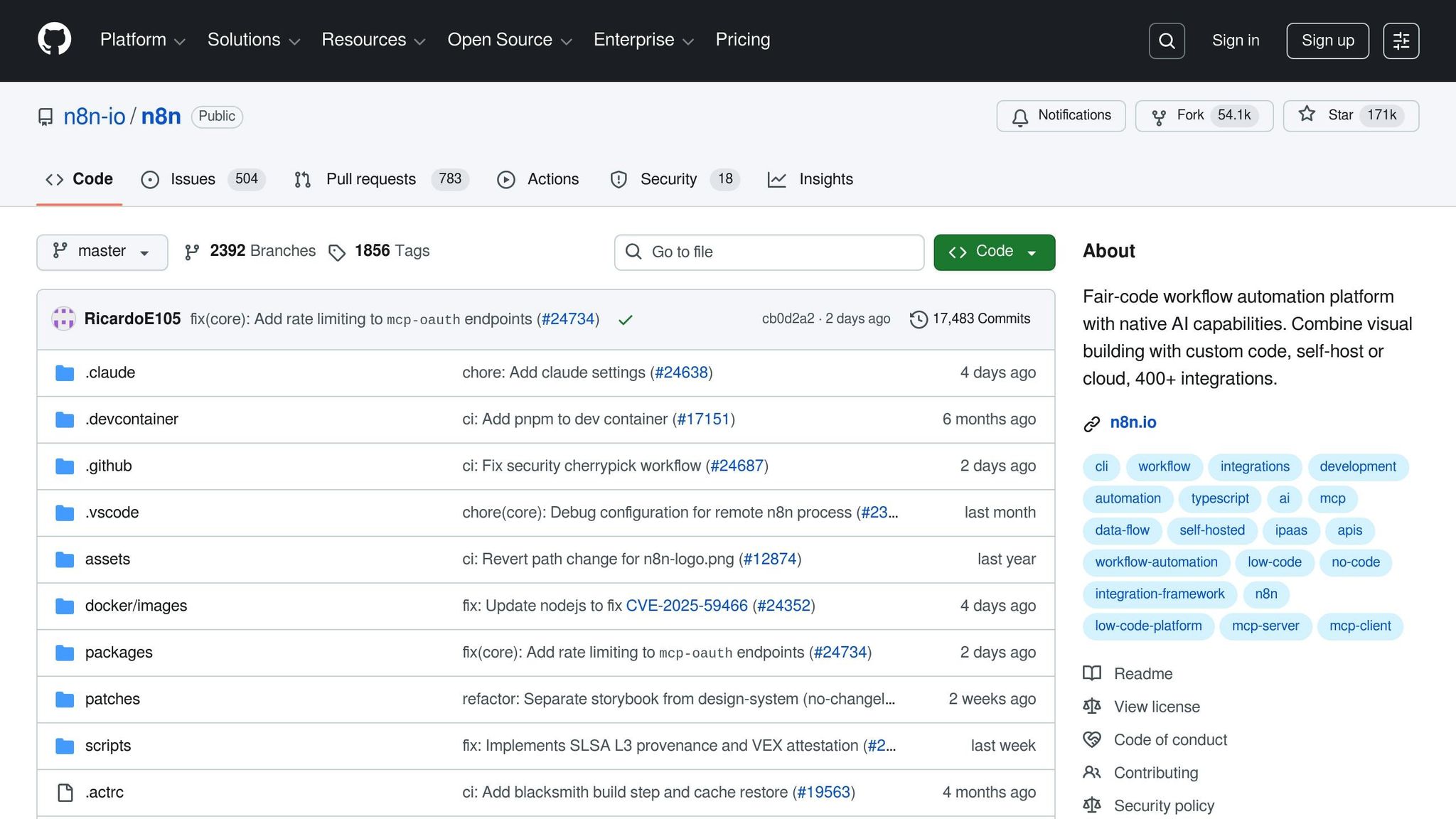
n8n is an open-source automation platform that connects over 400 integrations and 220+ app nodes, including popular tools like HubSpot, Salesforce, Slack, and Google Workspace. With its fair-code licensing and self-hosting options via Docker or Kubernetes, n8n gives users greater control and flexibility. It has earned more than 169,600 stars on GitHub, cementing its position as one of the most widely recognized automation projects. Capable of handling up to 220 workflow executions per second on a single instance, it’s designed to meet the demanding needs of enterprises. By combining a robust open-source framework with fast execution, n8n supports advanced AI-driven workflow automation, making it an excellent choice for organizations with high-volume automation requirements.
n8n’s flexibility shines through its integration capabilities, allowing developers to connect virtually any API. The HTTP Request node enables seamless connections to any service with a REST API, even allowing cURL commands to be imported directly into workflows. For more complex needs, developers can write custom logic using JavaScript or Python. The platform also features built-in nodes for LangChain, various LLMs, vector stores, and the Model Context Protocol (MCP), making it easy to integrate workflows with external AI systems.
StepStone’s Marketplace Tech Lead, Luka Pilic, shared how n8n revolutionized their data integration process, cutting the time required from two weeks of manual coding to just two hours - a 25X improvement.
"It takes me 2 hours max to connect up APIs and transform the data we need. You can't do this that fast in code." - Luka Pilic, Marketplace Tech Lead, StepStone
n8n is built to scale with growing demands. Its "Queue mode" and multi-main instance setups allow horizontal scaling, while governance features like fine-grained Role-Based Access Control (RBAC), SSO, SAML, and LDAP integration ensure enterprise-grade security. The platform is SOC 2 audited and supports external secret managers, including HashiCorp Vault and AWS Secrets Manager.
Real-world success stories highlight its impact: Vodafone automated threat intelligence processes with n8n, saving £2.2 million, while Delivery Hero’s IT team saved 200 hours monthly by automating user management workflows. Today, 25% of Fortune 500 companies rely on n8n for their critical AI workflows.
Unlike competitors that charge per step, n8n’s pricing model is based on complete workflow executions, offering a more predictable cost structure for complex automations.
n8n simplifies the creation of multi-agent AI systems with its visual interface and native LangChain support. Dedicated nodes include AI Agents, Chat Triggers, Memory for contextual conversations, and Document Loaders for handling PDFs and text files. To ensure safety, human-in-the-loop approval steps can be added before AI actions are implemented in production.
Nathaniel Gates, CEO of SanctifAI, explained how n8n enabled his team to build their first complex AI workflow in just 2 hours - 3X faster than using Python for LangChain - helping scale human-AI collaboration across 400+ workforces. The platform also includes a data replay feature for testing changes without resending API calls, and inline logs to visually troubleshoot issues in agent-driven systems.
Zapier connects over 8,000 applications through its automation platform, making it one of the most extensive integration ecosystems available. Trusted by more than 3.4 million companies globally, Zapier has powered over 350 million AI tasks while maintaining an impressive 99.99% uptime. With 87% of the Cloud 100 companies relying on its services, Zapier has proven its reliability for enterprises while remaining accessible to smaller teams.
Zapier uses "Zaps" to automate workflows by triggering actions in connected apps based on specific events. Its Model Context Protocol (MCP) bridges AI tools like ChatGPT and Claude with other apps, enabling AI to execute over 30,000 actions seamlessly.
The platform includes built-in logic tools such as Filters (to run workflows under specific conditions), Paths (if/then logic), and Formatter (for transforming data like dates, currency, or text). Webhooks allow integration with any API, and the low-code Platform UI simplifies API connections with a visual builder.
Arden Insurance Services, for instance, saves over $500,000 annually through automation with Zapier. Tyler Diogo, Operations Manager at Arden Insurance Services, highlighted its impact:
"Zapier contributes to an overhead savings of around $500,000+ on an annual basis."
These integrations are designed to scale with businesses of all sizes, ensuring efficiency and reliability.
Zapier’s scalability shines for both small teams and large enterprises. Remote.com’s three-person IT team supports over 1,700 employees by automating more than 11 million tasks in 2024. Using Zapier alongside ChatGPT and Notion, they built a multi-channel help desk that resolves 28% of tickets automatically, saving over 600 hours per month. Marcus Saito, Head of IT and AI Automation at Remote, described the results:
"Zapier multiplies our team of three into the productivity of ten."
For enterprise users, Zapier offers advanced features like role-based permissions, domain capture, and granular access controls. Security compliance includes SOC 2 Type II, SOC 3, GDPR, and CCPA, while SAML-based Single Sign-On (SSO) and SCIM streamline user management. Infrastructure options like VPC Peering provide secure data connections, and horizontal scalability ensures the platform grows with your automation needs.
Zapier offers a free tier for basic automation, with paid plans that scale based on task volume. Tasks performed within Zapier Tables don’t count toward monthly limits, adding extra value. Enterprise plans include features like consolidated billing, advanced governance, SSO, and SCIM provisioning.
ActiveCampaign tackled a 25% churn rate among new users by integrating Zapier into its onboarding process. By automating webinar registrations based on user language tags, they boosted webinar attendance by 440% and reduced churn by 15% within 90 days. Similarly, Popl’s sales team used Zapier to automate lead qualification and routing across HubSpot and Salesforce, layering in OpenAI to categorize emails and extract lead data. Jason Alvarez-Cohen, CEO of Popl, summed up the benefits:
"It's not just about doing more. It's about doing it better, faster, and with fewer resources."
AI by Zapier simplifies tasks like data extraction, classification, and summarization without requiring separate AI accounts or API keys. Pre-built models such as GPT-4o mini and Gemini 2.0 Flash are available for free, while users can also integrate models like GPT-4o, Claude, Gemini, Azure OpenAI, or their own APIs.
Zapier Agents act as AI-powered teammates, trained on company data to handle complex tasks across thousands of apps. These agents manage research-intensive and variable tasks, completing 23 million AI tasks monthly for over 1 million companies. Copilot, an AI-powered assistant, uses natural language prompts to build workflows, tables, and chatbots. Spencer Siviglia, Director of Operations at Toyota of Orlando, shared his experience:
"With Agents, I'm getting insights I didn't even know to look for. They flag when something's off, answer questions in plain language, and save me hours every week."
Additional AI features include a prompt strength indicator, automatic prompt optimization, and AI-powered troubleshooting that simplifies error explanations. Global Variables allow users to store and reuse data across Zaps, ensuring consistency and simplifying updates on a large scale.
Make supports over 350,000 customers globally with its intuitive visual drag-and-drop canvas and a library of more than 3,000 pre-built apps. This user-friendly interface simplifies even the most intricate multi-branch logic, making automation accessible to teams of all sizes. With impressive ratings of 4.8/5 on Capterra (404 reviews) and 4.7/5 on G2 (238 reviews), Make has established itself as a reliable choice for seamless integrations and workflow automation.
Make offers an extensive ecosystem of integrations, featuring over 400 AI-focused apps such as OpenAI, Anthropic Claude, Google Vertex AI, and Perplexity, alongside widely used business tools like HubSpot, Salesforce, Slack, and monday.com. With more than 30,000 actions available, plus real-time webhooks and "Watch" triggers, the platform ensures workflows are activated instantly when needed.
For those requiring custom solutions, the HTTP app allows users to connect any service with a public API using a no-code toolkit. Additionally, Make supports the Model Context Protocol (MCP), enabling centralized orchestration by linking internal and external services through MCP Server and Client.
Make Grid provides a dynamic, real-time map of all active agents, apps, and workflows, helping teams monitor and refine their expanding operations. Organizations have seen tangible benefits from adopting Make. In December 2024, GoJob reported a 50% increase in annual net revenue after integrating Make with AI. Similarly, in September 2025, FranklinCovey saved hundreds of thousands of dollars while freeing up significant staff hours. Philipp Weidenbach, Head of Operations at Teleclinic, shared his experience:
"Make really helped us to scale our operations, take the friction out of our processes, reduce costs, and relieved our support team."
The platform offers enterprise-grade features like role-based access control (RBAC), team-specific limits, and centralized admin dashboards. Its flexible API and custom extensibility options empower organizations to build AI agents that adapt to real-time data, enabling more agile and goal-oriented workflows.
Make’s free plan, which requires no credit card and has no time limit, provides an easy entry point for teams exploring automation. For larger organizations, enterprise plans include advanced security and dedicated support. Cayden Phipps, COO at Shop Accelerator Martech, highlighted its value:
"Make drives exceptional efficiency within our business. It's having an extra employee (or 10) for a fraction of the cost."
By simplifying development and eliminating the need for programming expertise, Make reduces training expenses and accelerates deployment. A notable example is #makeitfuture, which tripled its AI support resolution rate in March 2025 by leveraging Make-driven automations, showcasing the platform’s ability to deliver measurable returns.
Make integrates AI to enhance automation further, streamlining workflows for both technical and non-technical users. Maia by Make, an AI assistant, helps build, troubleshoot, and explain scenarios using natural language prompts, cutting down development time. Meanwhile, Fill by AI converts descriptions into formulas, auto-filling module fields with ease. The platform also offers pre-built, no-code modules for tasks like categorization, summarization, and data extraction.
One standout feature is Make AI Agents, which shift from static automation to goal-driven workflows. These agents use large language models to analyze tasks and select the best existing scenarios, adapting dynamically to real-time data. The Human in the Loop module adds an extra layer of quality control, allowing users to review AI-generated outputs before execution. Adoption of AI features within Make quadrupled in 2024, reflecting their growing popularity. Erkki Markus, Product Owner at Smaily, shared his enthusiasm:
"The simplicity, flexibility, and ability to build real complex automations without any knowledge of programming makes it the best thing since sliced bread."
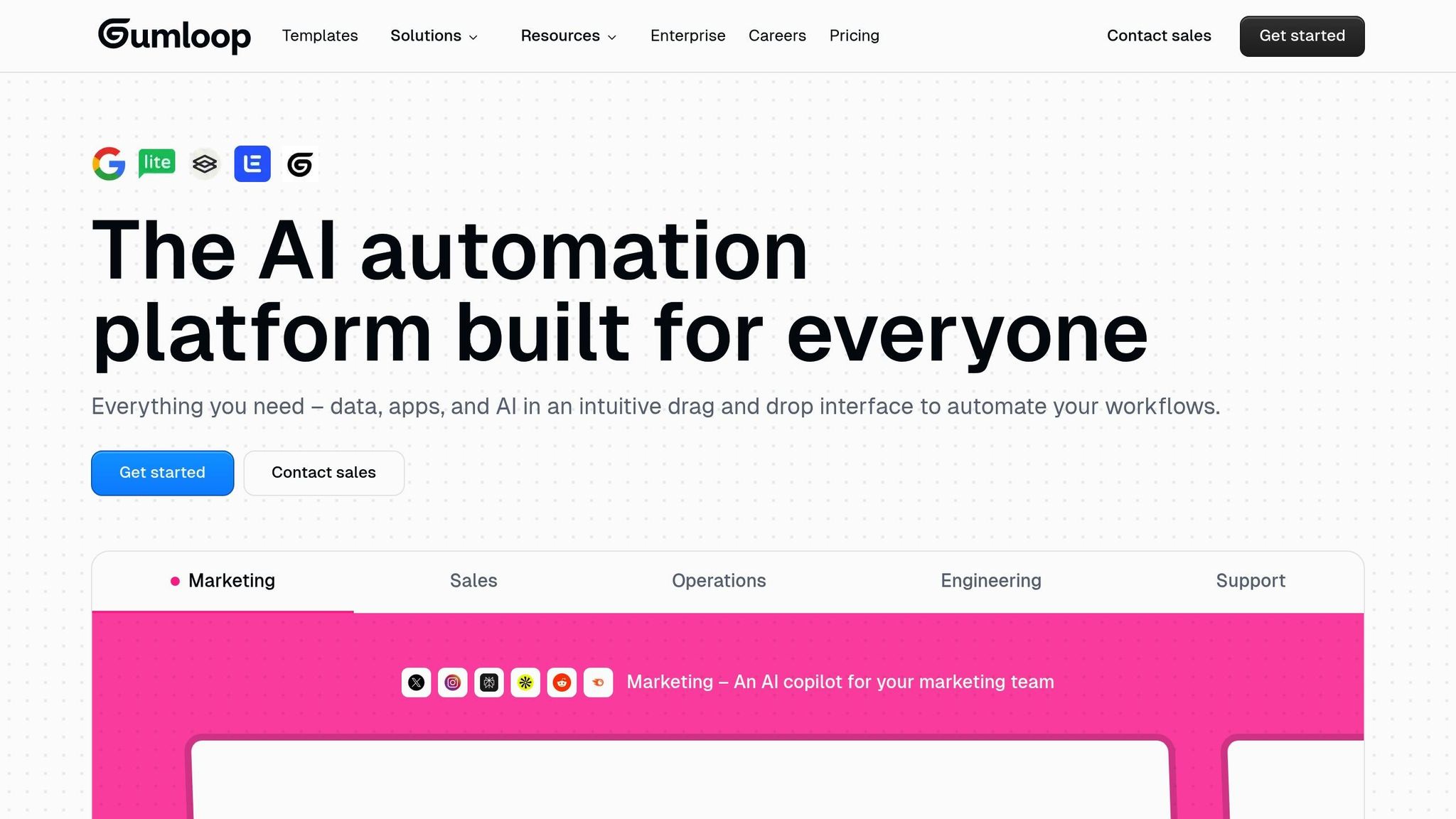
Gumloop has quickly risen as a standout in AI workflow automation since its launch in 2023. This platform takes a visual, no-code approach, streamlining over 400 million tasks to date. Its intuitive builder includes more than 120 native nodes, enabling seamless connections with essential business apps like Salesforce, HubSpot, Airtable, Slack, Google Workspace, and Zendesk. What truly sets Gumloop apart is its AI chatbot, Gummie, which creates workflows from natural language prompts, eliminating the need for manual configurations.
Gumloop’s integration capabilities are powered by MCP, allowing AI agents to directly connect with platforms like Gmail, Salesforce, and Notion, as well as custom internal APIs. It supports multiple large language models, including OpenAI (GPT-4o), Anthropic (Claude), Google (Gemini), Meta (Llama), and DeepSeek, giving users the flexibility to choose the best AI for their needs. The platform also features a Code Sandbox, offering a secure Python environment for data analysis and visualizations.
Key features like the AI Router dynamically guide workflows based on context, while Subflows break down complex automations into reusable components. Workflows can be triggered manually, on a schedule, or via webhooks and REST APIs, creating a robust framework for scalable performance. Fidji Simo, CEO of Instacart, praised the platform's impact:
"Gumloop has been critical in helping all teams at Instacart - including those without technical skills - adopt AI and automate their workflows, which has greatly improved our operational efficiency."
Gumloop is built for enterprise-level use, offering SOC 2 and GDPR compliance, Virtual Private Cloud (VPC) options, and auto-scaling compute to handle large workloads. For example, Instacart’s legal team cut 80% of the time spent sorting emails and paperwork by using Gumloop’s automations. The platform also provides advanced features like granular access controls, custom user roles, audit logging, and AI Model Governance, allowing organizations to manage compliance and costs effectively.
Privacy is a top priority with Gumloop’s Incognito Mode, which ensures sensitive workflows remain secure by wiping inputs, outputs, and intermediate steps in real time without storing data. Bryant Chou, Co-Founder of Webflow, highlighted the platform’s impact on productivity:
"Gumloop wins time back across an org. It puts the tools into the hands of people who understand a task and lets them completely automate it away."
Gumloop’s credit-based pricing model ensures flexibility and value. Basic workflows typically cost one credit, while more complex, AI-intensive tasks use up to 60 credits. New users are welcomed with 1,000 free credits to experiment with the platform. Subscription plans include Starter at $97/month, Pro at $297/month, and annual options ranging from $180/year to $480/year for enterprise users. With its "One Subscription For All" model, Gumloop eliminates per-model fees, letting users optimize costs by using budget-friendly models like GPT-4o Mini for simpler tasks and reserving advanced models like OpenAI o3 for more complex needs.
Gumloop’s AI Agents act as intelligent engines, orchestrating workflows and tools to handle open-ended tasks. Instead of rigid programming, these agents adapt to situations, making smart decisions about which tools to deploy. The platform also excels in document processing, offering features like extracting data from invoices, summarizing lengthy documents, and categorizing files automatically. The Human in the Loop feature ensures accuracy by allowing users to review AI outputs before final execution. David Phelps, VP of Academics at Albert, emphasized its accessibility:
"With Gumloop, any team member can now identify a manual process and turn it into an automated workflow without writing a single line of code."
Vellum AI is a dynamic platform designed to simplify the creation and deployment of AI workflows by seamlessly integrating large language models with autonomous agents. Its standout feature is two-way syncing, which bridges the gap between a visual editor and code environments like Python and TypeScript. This unique capability allows technical and non-technical teams to collaborate on the same workflow effortlessly. By enabling updates to be made independently of releases, Vellum AI has helped companies like Rentgrata and Woflow achieve a 50% boost in AI development speed. This approach of blending visual editing with coding paves the way for smoother collaboration across diverse teams.
Vellum AI’s architecture is built with collaboration and flexibility in mind. Its provider-agnostic design supports multiple LLM models within a single workflow, ensuring compatibility with various tools and systems. Key features include specialized nodes for HTTP requests, custom code execution (Python/TypeScript), and RAG pipelines. Once a workflow is finalized, deployment is as simple as a single click, with the system generating a production-grade API for seamless integration into existing applications. To ensure reliability, the platform incorporates Retry and Try node features, which gracefully handle third-party API errors, promoting fault-tolerant orchestration.
Whether for individual users or large enterprises, Vellum AI is designed to scale effortlessly while maintaining high standards of compliance and security. Small teams can start with a $25/month plan, while enterprise solutions offer advanced features such as VPC deployments, SOC 2 Type II compliance, HIPAA support, and RBAC. Redfin, for example, utilized Vellum AI to achieve a 10x reduction in AI optimization cycles, leading to a 15–30% improvement in business operations. This success gave them the confidence to roll out their virtual assistant across 14 U.S. markets. Sebi Lozano, Senior Product Manager at Redfin, shared:
"Vellum helped us quickly evaluate prompt designs and workflows, saving us hours of development. This gave us the confidence to launch our virtual assistant in 14 U.S. markets."
Vellum AI offers a range of features that streamline workflow management. The Agent Node automates schema management and tool-calling logic, while the Run From Node feature allows workflows to pick up from saved states, enhancing flexibility. Node Mocking minimizes expenses and speeds up testing by bypassing costly LLM calls. The platform also supports Human-in-the-Loop steps, enabling workflows to pause for external input when needed. These capabilities align with the industry’s push toward more integrated and user-friendly AI automation. Pratik Bhat, Senior Product Manager at Drata, highlighted the platform’s ease of use:
"Vellum made it so much easier to quickly validate AI ideas and focus on the ones that matter most. The product team can build POCs with little to no assistance within a week!"
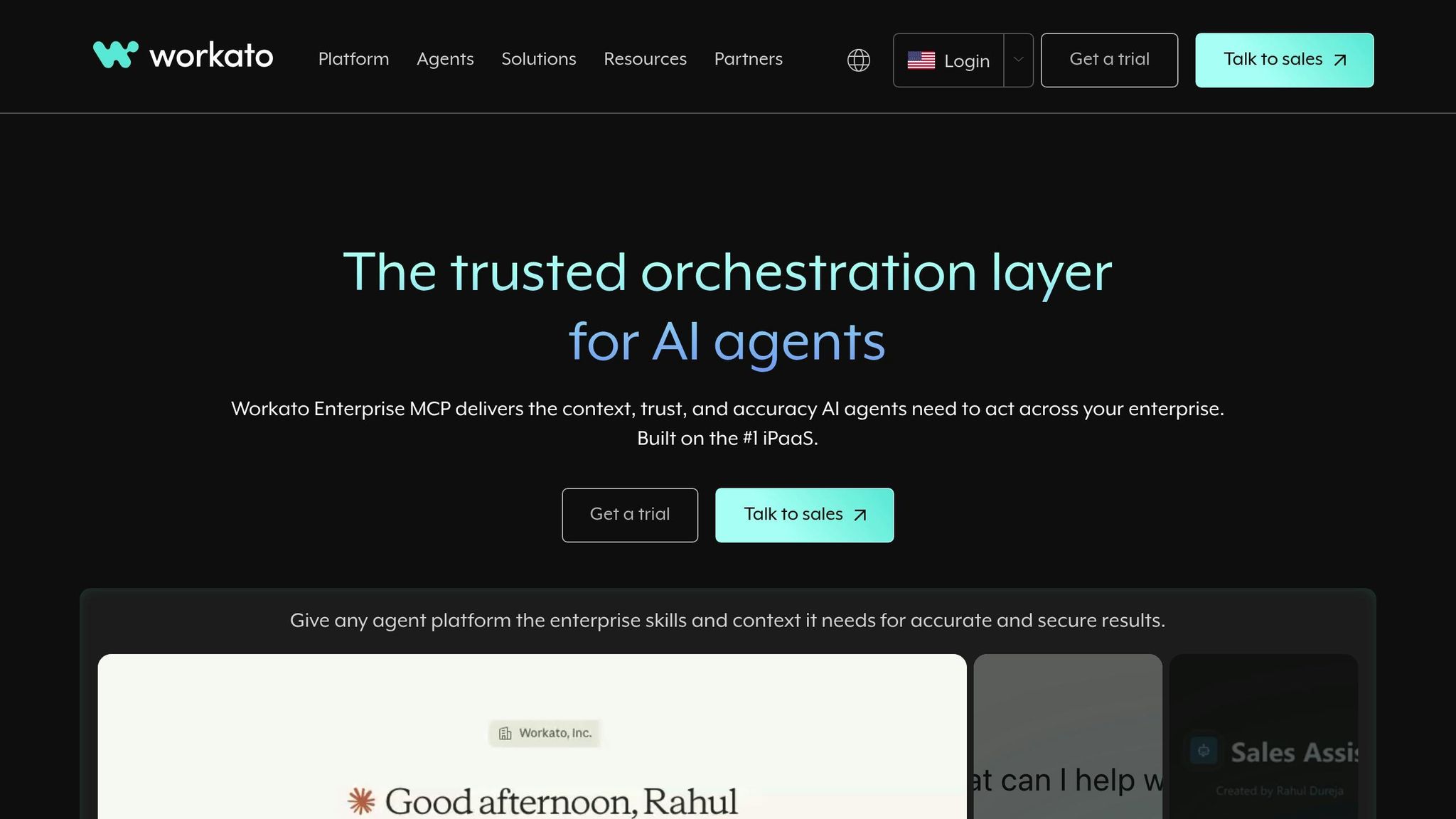
Workato serves as a robust enterprise-grade AI integration platform, seamlessly connecting modern SaaS applications and legacy systems through a single, unified solution. With over 1,200 pre-built connectors, it links tools like Salesforce and Workday to on-premises ERPs such as SAP, cloud data warehouses like Snowflake and BigQuery, and even SFTP servers. For systems lacking native connectors, Workato offers a Connector SDK and a configurable REST data connector, cutting down the need for extensive custom coding. Its integration with MCP ensures enterprise data is used effectively to drive business decisions, setting it apart in the realm of AI-powered operations.
Workato’s cloud-native, serverless architecture eliminates the need for managing infrastructure, allowing businesses to scale effortlessly. With a 99.9% uptime guarantee, it supports both technical and non-technical users through its intuitive low-code interface. For example, Atlassian completed an ERP transformation 40% faster than planned - wrapping up in just 9 months instead of 15 - by using Workato to tackle 1,000+ business requirements, 2,800 test cases, and over 73 new integrations. Similarly, ThredUp reported a 53% reduction in total cost of ownership and development speeds that were 5-6 times faster after adopting Workato. Darren Owsley, CTO at Gonzaga, shared:
"We have to do things with less people…We have way more people with their hands on the keyboard integrating [with Workato] than we would have ever had with another iPaaS platform."
Workato further boosts productivity with its advanced AI tools designed to streamline workflow creation. The Copilot Suite - featuring Recipe, Mapper, Formula, and Performance Copilots - supports users by generating automation logic, suggesting data mappings, performing complex data transformations, and analyzing workflows for cost, security, and efficiency. Additionally, Workato AIRO functions as an AI solution architect, offering real-time diagnostics and optimization advice. For rapid deployment, Workato Genies provide prebuilt AI agents tailored for tasks like HR onboarding, IT password resets, and sales lead research. These AI-powered capabilities not only enhance efficiency but also ensure compliance, delivering substantial improvements across enterprise operations. Recognized for its excellence, Workato has been named a Leader in the Gartner Magic Quadrant for iPaaS for seven consecutive years as of 2025.
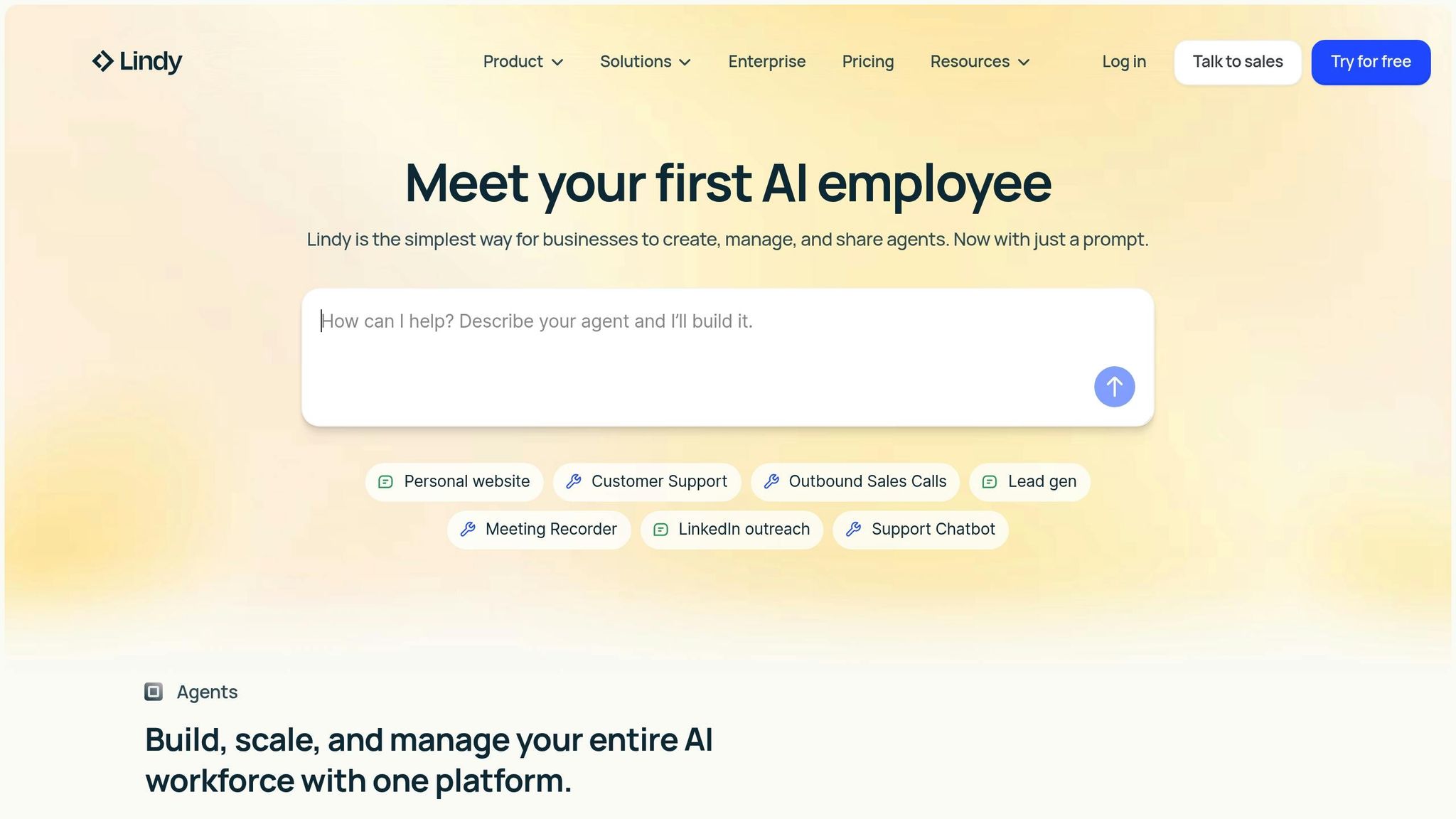
Lindy.ai introduces autonomous AI agents designed to think, adapt, and emulate human decision-making. Its standout "Vibe Coding" feature allows workflows to be created in plain English, eliminating the need for technical setup. This makes it especially useful for small teams looking to streamline operations by automating tasks often assigned to junior hires or virtual assistants. As Flo Crivello, CEO of Lindy, puts it:
"Lindy is an AI agent builder for small teams that need to run lean. You can deploy agents that handle the kind of work you'd usually give to a junior hire or VA."
Lindy.ai connects seamlessly to over 3,000 applications, including popular CRMs, email platforms, calendars, and business tools, using a simple triggers-and-actions framework. Its Autopilot feature takes automation a step further by allowing AI agents to interact directly with web applications via their own cloud-based computers, bypassing the limitations of standard API connections. This enables the agents to handle tasks on web interfaces just like a human, expanding automation possibilities. The platform also prioritizes security, meeting SOC 2 Type II, HIPAA, GDPR, and PIPEDA compliance standards, making it a dependable choice for businesses managing sensitive information.
Lindy.ai's multi-agent coordination allows teams to deploy specialized AI assistants that collaborate on intricate, multi-step processes. These agents are reportedly 10x faster and cost 1/10th of manual methods, significantly cutting down time spent on repetitive tasks like data entry and email management - by as much as 40%. For tasks requiring precision, the human-in-the-loop (HITL) feature lets users review and approve agent outputs before finalizing actions, ensuring accuracy in critical scenarios. Businesses using Lindy.ai can expect a 30–200% ROI within the first year, with automated workflows slashing processing times by up to 67%.
Lindy.ai offers a free plan with 400 credits per month, making it accessible for smaller teams. The Pro Plan costs $39.99 per month (billed annually) and includes 5,000 credits along with access to over 4,000 integrations. With a 4.9/5 star rating on G2 from 109 reviews, users highlight its efficiency in reducing administrative workloads. For larger teams, the Business Plan at $199.99 per month provides 20,000 credits, unlimited phone calls, and support for over 30 languages. Combining powerful autonomous agents with flexible pricing, Lindy.ai positions itself as a forward-thinking solution for next-generation AI workflows.
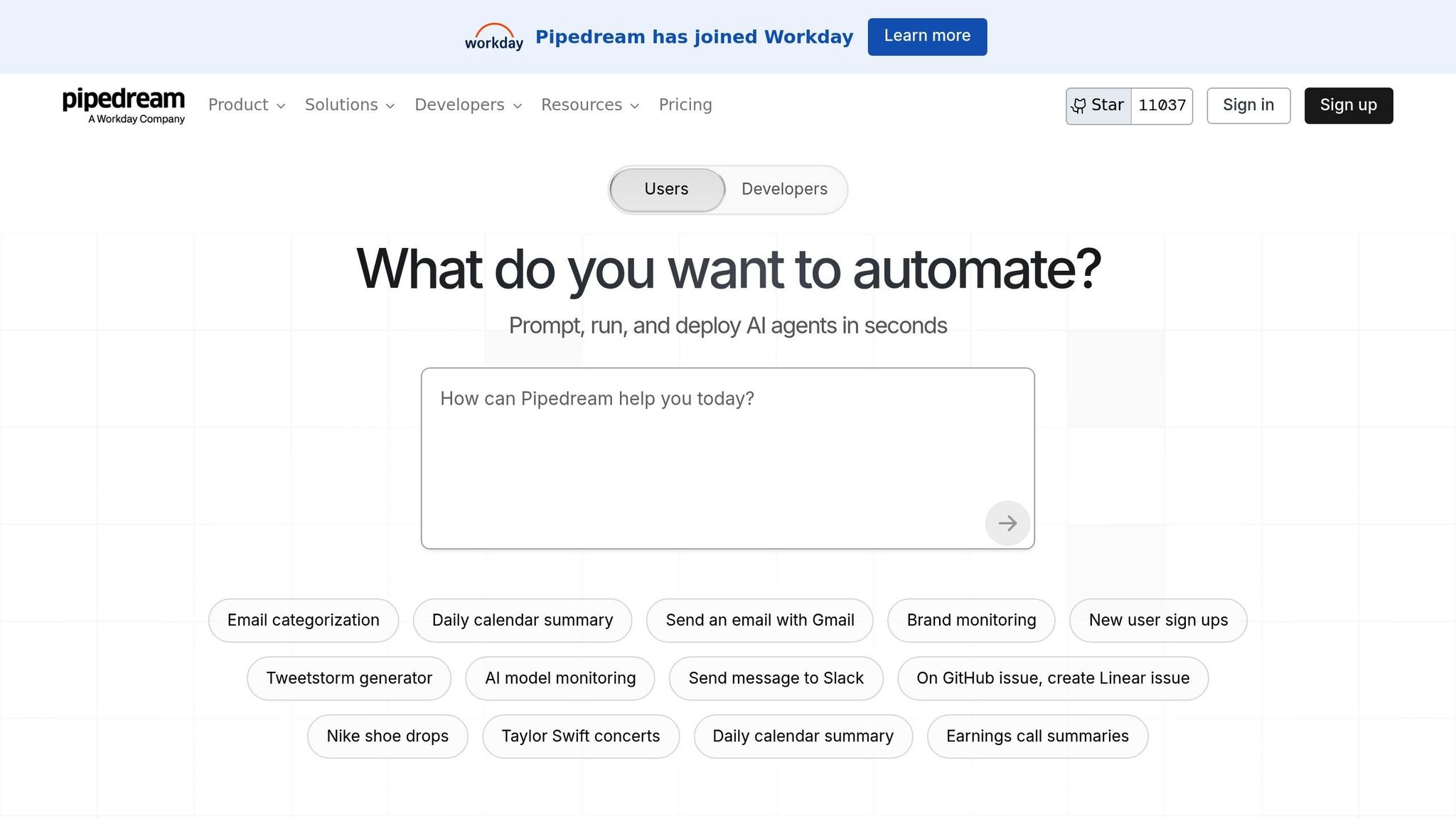
Pipedream offers a hybrid solution for workflow automation, blending the simplicity of no-code tools with the power of code-level customization. With over 1,000,000 developers relying on it - from startups to Fortune 500 companies - Pipedream is a go-to platform for managing both basic tasks and intricate technical workflows. Users can write and execute custom logic in Node.js v20, Python, Go, or Bash directly within their workflows, providing a solid and adaptable foundation for automation.
Pipedream connects to a vast ecosystem of over 2,700 apps and includes more than 10,000 prebuilt triggers and actions. The platform simplifies authentication by automating it for thousands of services, eliminating the hassle of manual OAuth configuration. With a single authentication setup, users can immediately integrate and automate processes across their tech stack. For organizations with stringent networking needs, Pipedream supports VPC peering and unique egress IPs, ensuring secure connections to databases and APIs.
Pipedream takes automation a step further with AI-powered tools. Its "Build with AI" assistant allows users to generate custom code steps using natural language prompts, removing the need for manual API coding and speeding up the creation of complex workflows. The platform also supports the Model Context Protocol (MCP), enabling AI models to interact directly with its network of integrated apps.
A real-world example of this innovation comes from October 2025, when Basha Coleman, Principal Content Strategy and Operations Program Manager at HubSpot, implemented a Pipedream workflow integrated with Windsurf. This setup automates daily SEO trend tracking, generating a spreadsheet at 9:15 am every morning that highlights new trends. The team uses this data to craft weekly content briefs, streamlining their workflow. For AI-driven automation, higher-tier plans include up to 50 million AI tokens per month.
Pipedream is designed to grow with its users, offering solutions that cater to both small teams and large enterprises while ensuring top-tier security and performance. The platform provides a Free tier with 100 credits and 3 active workflows, making it easy for smaller teams to get started. The Advanced plan, priced at $49 per month, includes unlimited workflows, connected accounts, and bi-directional GitHub Sync for managing version-controlled workflows in production. For larger organizations, the Business plan offers features like volume pricing, SOC 2 Type II, HIPAA, GDPR compliance, SSO, and dedicated Slack support.
Pipedream’s execution environments are built to handle demanding workloads, supporting up to 10 GB of RAM, 750-second durations, and high concurrency with 10,000+ events. In early 2026, Pipedream joined Workday, signaling potential advancements in its integration capabilities with enterprise HR and finance systems.
Kissflow combines no-code simplicity with enterprise-level automation, boasting 127,000 customer integrations and powering 49 million runs to date. With an impressive 94.7% customer satisfaction score and recognition as a Market Leader in the G2 Grid for 2024, it’s a trusted choice for businesses aiming to streamline complex workflows without relying heavily on IT teams. Its features open doors to AI-powered process innovations, as outlined below.
Kissflow’s AI-powered Process Builder simplifies workflow creation using natural language prompts, slashing development time by up to 70%. Oliver Umehara, IT Manager at SoftBank, highlighted the platform’s ease of use:
"The beauty of Kissflow is how quick and easy it is to create the apps I need. It's so user-friendly that I made exactly what I needed in 30 minutes."
The platform also includes intelligent routing, automatically assigning tasks based on team member expertise and availability, and employs Natural Language Processing (NLP) to pull data from unstructured documents like emails. Predictive analytics add another layer of efficiency, forecasting process completion times and pinpointing bottlenecks before they disrupt operations. This proactive approach gives teams greater control and visibility over their workflows.
Kissflow supports seamless integration with over 200 pre-built connectors, enabling connectivity with major enterprise systems like Salesforce, SAP, Microsoft Office 365, Google Workspace, and Workday. For additional flexibility, it allows HTTP, REST, and SOAP calls, as well as webhook catching from external systems. Its API-first architecture ensures compatibility with proprietary systems that adhere to standard protocols. The platform also includes over 40 internal event triggers and no-code triggers for external systems, making it easy to automate conditional processes across various tools. This robust integration capability ensures Kissflow meets the needs of enterprises with diverse tech stacks.
In 2024, SN Aboitiz Power Group, under the leadership of CIO Maria Theresa Cabigon, leveraged Kissflow to empower business users in creating custom applications and automating processes. The results were striking, with a reported 451% ROI and payback achieved in less than three months. Cabigon shared:
"Kissflow supports rapid application development by building a working application prototype in the shortest amount of time. It enables our business users or citizen developers to develop their own automated processes."
Kissflow facilitates collaboration between business users and IT teams, helping to reduce IT backlogs. Its secure, API-first framework aligns with industry best practices for AI workflow orchestration. For example, McDermott’s Senior Director of IT, Renee Villarreal, adopted Kissflow to handle complex internal workflows, processing 23,000 work items and managing 132 active workflows created by business teams. Users have reported up to an 80% reduction in manual tasks and a 40% decrease in operational costs, significantly improving IT efficiency and overall productivity.
Selecting the right AI workflow platform hinges on factors like team size, technical know-how, budget, and integration needs. To simplify your decision-making, the table below highlights ten platforms, comparing their pricing, integration capabilities, AI-driven features, and ideal use cases.
| Platform | Starting Price | Integration Options | AI-Powered Features | Best For |
|---|---|---|---|---|
| Prompts.ai | $0/month (Pay-As-You-Go) | 35+ LLMs (GPT-5, Claude, Gemini, LLaMA) unified interface | Multi-model orchestration, prompt workflows, real-time FinOps cost tracking | Enterprises reducing tool sprawl and cutting costs by up to 98% |
| n8n | Free (self-hosted) | 400+ integrations, custom HTTP requests | AI agent nodes, LLM chain building, custom code execution | Technical teams needing fully customizable workflows |
| Zapier | Free (limited tasks) | 8,000+ integrations, 300+ AI tools | AI orchestration, intelligent task routing, adaptive workflows | Small businesses automating lead management and support |
| Make | Free (1,000 operations) | 1,500+ apps and services | Visual AI scenario builder, data transformation, error handling | Visual learners creating complex multi-step automations |
| Gumloop | Contact for pricing | API-based connections, webhook support | AI workflow templates, natural language automation | Startups quickly prototyping AI-driven processes |
| Vellum AI | Contact for pricing | LLM provider integrations, REST APIs | Prompt engineering tools, A/B testing, version control | AI product teams optimizing model performance |
| Workato | Contact for pricing | 1,200+ pre-built connectors, enterprise systems | Recipe AI, intelligent data mapping, bot automation | Mid-to-large enterprises with complex tech stacks |
| Lindy.ai | $29/month | Email, calendar, CRM integrations | AI assistants, task delegation, context-aware responses | Knowledge workers automating administrative tasks |
| Pipedream | Free (limited invocations) | 2,000+ integrated apps, HTTP/webhook support | Event-driven workflows, serverless code execution | Developers building custom integrations quickly |
| Kissflow | Contact for pricing | 200+ pre-built connectors, API-first architecture | Natural language process builder, predictive analytics, intelligent routing | Business users creating apps without IT dependency |
This side-by-side breakdown offers a clear snapshot of each platform’s strengths, helping you match their capabilities to your business priorities. Pricing options range from free and pay-as-you-go models to custom enterprise solutions, ensuring flexibility for various budgets. Integration capabilities are expansive, with platforms supporting anywhere from hundreds to thousands of app connections, making them adaptable to diverse tech ecosystems.
What sets these platforms apart is their advanced AI-driven features, which streamline processes and improve decision-making. For instance, Prompts.ai simplifies operations by unifying 35+ LLMs under one interface, eliminating the hassle of managing multiple subscriptions. Meanwhile, tools like natural language process builders and intelligent task routing make workflow creation more intuitive. This comparison highlights how these platforms address unique business challenges while driving efficiency and productivity.
When choosing an AI workflow platform, focus on integration capabilities, scalability, and straightforward pricing. The platforms discussed support connectivity with anywhere from hundreds to over 8,000 apps, ensuring they can adapt to a wide range of tech stacks. With 78% of enterprises facing challenges in integrating AI into existing systems, taking advantage of free trials is essential. These trials allow you to test compatibility and avoid unexpected expenses.
Pricing structures differ significantly, with some platforms charging per full workflow execution and others billing for each action taken. To ensure a positive return on investment (ROI), start small and scale up once the platform proves its value. Scalability is just as important - look for features like enterprise-grade security (SOC 2 compliance), role-based permissions, and single sign-on (SSO). Human oversight remains critical to maintain quality at the speed of AI, while centralized monitoring tools simplify workflow audits and help identify new automation opportunities.
The shift from traditional automation to AI-driven workflows is gaining momentum. By the end of 2025, AI-enabled processes could account for 25% of enterprise workflows, up from just 3% today. Begin by mapping out current manual processes using visual tools, then explore platforms with pre-built templates for tasks like lead enrichment or IT support. For example, Vendasta saved 282 days of manual work annually and recovered $1 million in potential revenue by automating lead routing and enrichment.
As highlighted earlier, the integration range and AI features vary widely across platforms. Free trials are invaluable for testing ease of integration and assessing cost efficiency at your organization’s scale. The right platform can reduce tool sprawl, offer clear spending visibility, and empower both technical and non-technical teams to create automations that drive real business results. Use the comparison table provided to align platform capabilities with your specific business needs.
Prompts.ai slashes operational costs by as much as 98% by automating repetitive tasks and simplifying workflows. By allowing AI to manage complex processes, the platform reduces the need for manual efforts and lowers dependency on additional staff.
With smooth integration into existing systems, Prompts.ai enhances efficiency, sharpens decision-making, and minimizes errors or delays. This approach not only saves valuable time but also eliminates costs tied to human mistakes and process slowdowns. Businesses can expand their operations without facing steep increases in overhead, making Prompts.ai an essential solution for cutting expenses and boosting efficiency.
When choosing an AI workflow platform, it's essential to focus on a few key aspects to ensure it aligns with your business needs. Interoperability should be a top priority - the platform must work smoothly with your current systems and tools, making automation and data sharing more efficient. Equally important is scalability, as the platform should be capable of growing alongside your business and adapting to evolving workflows without requiring major overhauls.
Another factor to weigh is ease of use. Platforms that include no-code or low-code options allow non-technical team members to easily create and manage workflows, removing barriers to adoption. Additionally, robust security and compliance features are critical, especially for businesses in regulated industries, to safeguard sensitive data and meet required standards. By carefully considering these factors in line with your goals and budget, you can select a platform that boosts productivity and supports sustainable growth.
AI workflow tools provide small teams with a practical way to enhance productivity and eliminate repetitive tasks. By automating routine processes, team members can shift their attention to strategic and creative projects, achieving more even with limited resources.
These tools integrate effortlessly with existing platforms such as project management software, communication tools, and CRM systems. This seamless connection not only improves collaboration but also minimizes manual errors. Teams can design workflows that align perfectly with their unique requirements, leading to saved time, lower costs, and quicker project turnarounds.
By making advanced automation accessible, AI workflow tools empower small teams to scale their efforts efficiently and remain competitive, despite resource constraints.