Pay As You Go - AI Model Orchestration and Workflows Platform



In a fast-moving AI landscape, governance is no longer optional. The right tools can simplify compliance, reduce costs, and ensure your workflows meet global regulations like the EU AI Act and NIST AI RMF. This article reviews six leading platforms - Prompts.ai, DataRobot, Collibra, Alation, OneTrust, and Credo AI - each offering unique strengths for managing AI workflows securely and efficiently. Key features include real-time monitoring, automated documentation, and centralized compliance frameworks.
Highlights:
Quick Comparison (Markdown Table):
| Tool | Key Feature | Best For | Pricing Model |
|---|---|---|---|
| Prompts.ai | Unified access to 35+ models, cost tracking | Cost-conscious, multi-model users | Pay-as-you-go TOKN credits |
| DataRobot | Real-time monitoring, batch automation | Financial/healthcare industries | Subscription-based |
| Collibra | Lineage tracking, compliance templates | Enterprises needing traceability | Contract-based |
| Alation | Metadata-rich workflows, connectors | Data transparency-focused teams | Subscription-based |
| OneTrust | Global compliance alignment, automation | Privacy-centric, global organizations | Contract-based |
| Credo AI | Audit-ready compliance, policy automation | Regulated industries, large-scale AI | Custom contract pricing |
With only 18% of enterprises fully adopting governance frameworks, selecting the right tool is crucial - especially as the EU AI Act takes effect in August 2026. Whether you need cost savings, detailed traceability, or automated compliance, these platforms provide tailored solutions to scale AI responsibly.

AI Governance Compliance Tools Comparison: Features, Pricing, and Best Use Cases
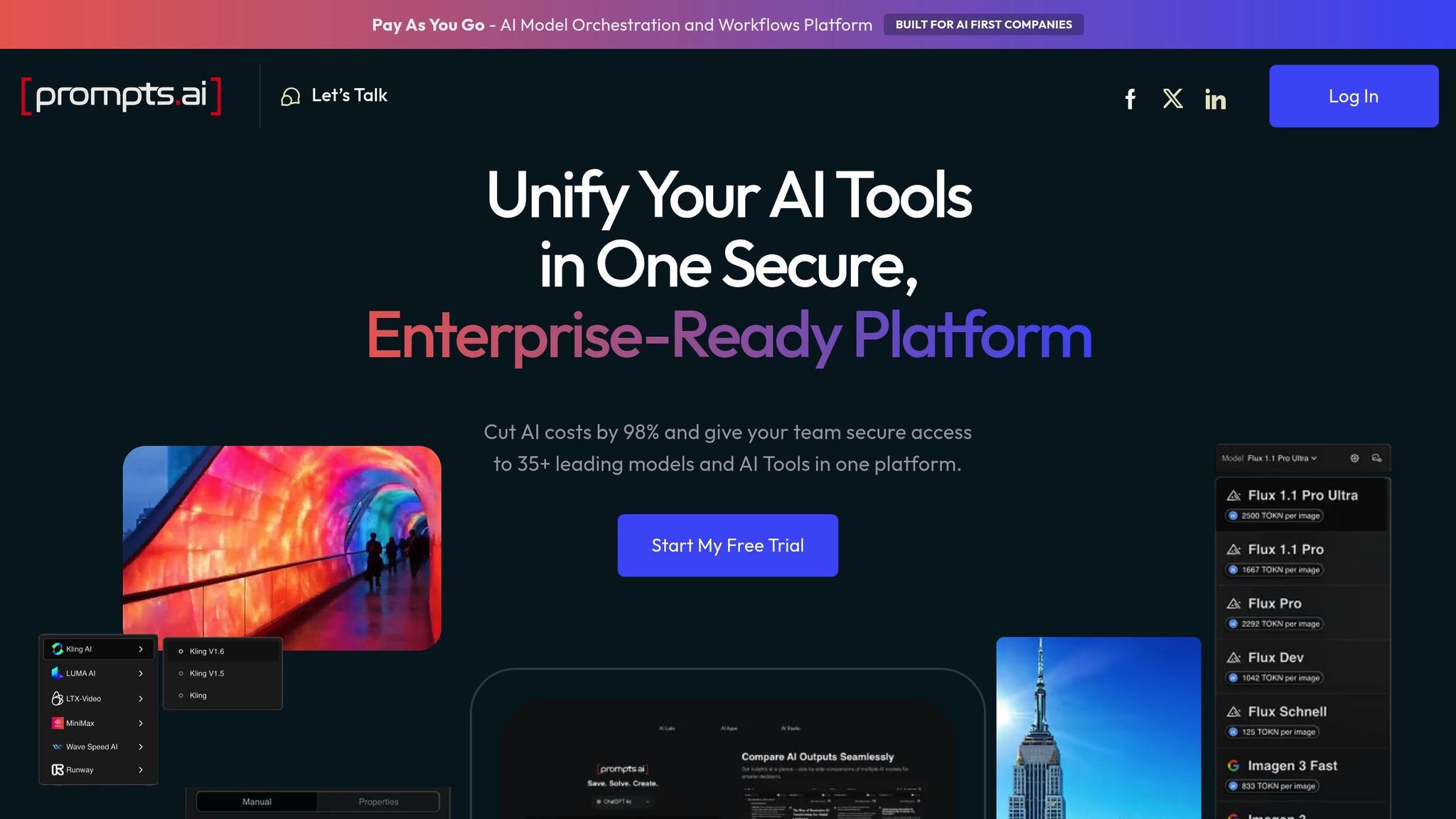
Prompts.ai stands out as an AI orchestration platform designed to simplify and unify access to over 35 large language models through a single, secure interface. It tackles a major challenge for organizations overwhelmed by managing multiple AI tools - eliminating the need for juggling numerous vendor contracts, logins, and compliance frameworks. By offering a centralized dashboard, the platform enables teams to streamline operations while maintaining full control over governance, including policy enforcement, audit trails, and regulatory compliance. This consolidation ensures smoother operations and stronger oversight.
Prompts.ai focuses on simplifying workflows by bringing disconnected processes together. Teams can utilize built-in workflows, known as "Time Savers", to create repeatable and compliant processes that align with best practices. Instead of letting employees experiment in silos, the platform standardizes interactions with language models, ensuring consistent results and minimizing the risk of non-compliant usage. Additionally, the system allows side-by-side comparisons of different models, enabling teams to evaluate and choose the best fit for specific tasks, all while maintaining strict governance protocols.
The platform prioritizes enterprise-level governance by seamlessly integrating with key compliance frameworks. It supports U.S. standards such as NIST AI RMF, HIPAA, and OCC SR 11-7, along with international regulations like ISO 42001 and the EU AI Act. Prompts.ai automatically logs all AI interactions, creating an auditable record that aligns with both internal policies and external regulatory requirements. This automation reduces the manual effort involved in compliance reporting and helps organizations demonstrate adherence during regulatory inspections or audits.
Prompts.ai offers real-time monitoring of AI interactions across the organization, tracking metrics such as usage patterns, model choices, and prompt histories. The platform enforces safeguards to protect sensitive data and identifies potential misuse. With its detailed tracking, organizations can trace any AI-generated output back to the user, model, and prompt responsible for creating it. This transparency is invaluable for meeting regulatory demands and maintaining internal accountability, ensuring a balance between governance and operational efficiency.
Adding to its operational strengths, Prompts.ai includes a FinOps layer that tracks token usage across all models, providing a clear link between AI expenses and outcomes. Instead of dealing with hidden fees or unpredictable bills, organizations gain full visibility into costs by team, project, or use case in real time. The platform offers pay-as-you-go TOKN credits starting at $0 for initial exploration, with business plans priced between $99 and $129 per member per month. By consolidating multiple vendor subscriptions into one system, Prompts.ai claims it can help organizations reduce AI software expenses by as much as 98%.
Balancing efficiency with compliance is crucial in AI governance, and DataRobot delivers on both fronts. Trusted by organizations like Freddie Mac and NZ Post, this end-to-end AI governance platform boasts an impressive 4.7/5 rating on Gartner Peer Insights, with 90% of users willing to recommend it. Designed to manage predictive, generative, and agentic AI, DataRobot helps organizations maintain control over their growing AI portfolios while meeting stringent regulatory standards in industries like financial services, healthcare, and the public sector. This robust approach simplifies workflow management and reinforces compliance.
DataRobot streamlines processes by integrating with tools like Apache Airflow, enabling teams to automate batch AI workflows without manual oversight. By connecting with MLflow, it consolidates metadata and benchmarks into a unified registry. For those already using platforms like Google Vertex, Databricks, or Microsoft Azure, DataRobot’s "bolt-on observability" feature enhances governance without disrupting existing setups.
Tom Thomas, Vice President of Data Strategy, Analytics & Business Intelligence at FordDirect, shared, "DataRobot helps us deploy AI solutions to market in half the time we used to do it before and easily manage the entire AI journey."
This seamless integration not only boosts efficiency but also simplifies compliance with regulatory requirements.
DataRobot automates adherence to key standards such as NIST AI RMF, SR-117, NYC Law No. 144, Colorado SB21-169, and California's AB-2013/SB-1047. It also aligns with EEOC AI Guidance and the DIU Responsible AI Guidelines. The platform’s one-click documentation feature generates audit-ready reports that directly link technical model behavior to specific legal requirements, saving countless hours of manual work. Financial institutions, for example, can utilize its templates tailored for the Federal Reserve's SR 11-7 guidance on Model Risk Management.
The platform offers real-time safeguards to detect and prevent issues like personally identifiable information leaks, prompt injection, hallucinations, and toxic outputs before they reach production. It maintains a thorough audit trail by tracking prompts, responses, and evaluation scores. Custom alerts can be configured to integrate with existing SIEM tools, providing instant notifications if models deviate from policy thresholds or exhibit drift.
Lakshmi Purushothaman, VP of Innovation in Data Science at Freddie Mac, remarked, "Our ability to leverage data science to help us identify disparities, remove barriers, and enable informed decisions... has been made much easier with DataRobot."
DataRobot supports deployment across a range of environments, including cloud, private cloud, hybrid, on-premise, and air-gapped setups, offering flexibility to meet diverse security needs. Its serverless compute environment optimizes resource allocation, allowing users to prioritize cost, latency, or availability as required. This architecture ensures that governance policies remain consistent, no matter where AI assets are developed or deployed.
Collibra takes on the challenge of fragmented AI governance with a unified platform approach. It has earned recognition as a Leader in the 2025 Gartner Magic Quadrant for Data and Analytics Governance Platforms and as a Strong Performer in The Forrester Wave for AI Governance Platforms (Q3 2025). As of December 2025, it holds impressive user ratings - 4.3/5 on Gartner Peer Insights and 4.5/5 on G2. This platform addresses a pressing industry issue: 43% of organizations have halted AI projects due to unreliable data or governance gaps, while only 4% have achieved scalable AI success.
Collibra simplifies AI governance by centralizing use case intake, documentation, and ownership into a shared system of record. This approach aligns data, AI, and risk teams from the very beginning of a project. It integrates effortlessly with leading cloud and AI platforms like AWS, Azure, Google, Databricks, and SAP. For example, its integration with Azure AI Foundry automates the stitching of datasets, models, and agents, providing complete lineage tracking. Custom environment users can also leverage the Developer Portal's Python tutorials to connect proprietary AI models. This streamlined workflow ensures that compliance controls are embedded from the start.
Collibra incorporates regulatory standards directly into AI workflows using pre-built assessment templates for frameworks such as the EU AI Act and NIST AI Risk Management Framework. This structured approach helps organizations avoid hefty fines, which can reach €35 million or 7% of global annual revenue for non-compliance with the EU AI Act. The platform assigns oversight responsibilities to Legal, Privacy, and Data Protection officers, ensuring thorough review. TELUS showcased Collibra's capabilities when Carine Botturi, Director of Data Strategy and Enablement, implemented its metadata management program, cutting the time spent searching for data assets by 83%. Upon completing assessments, automated workflows assign tasks to Business Stewards based on documented risks and business value.
Collibra maintains comprehensive Model and Agent Registries that track lifecycle stages, ownership, and compliance status. Every step of the workflow, from tasks to decisions, is meticulously logged, creating detailed audit trails for compliance reporting. During the approval process, the platform generates Assessment Review assets marked as "Under Review", prompting Business Stewards to conduct formal evaluations.
Thierry Martin, Head of Enterprise Data and Analytics at SAP, highlighted its benefits: "With Collibra AI Governance, we aim to visualize any data set, track its AI model usage, and identify its end consumers."
The platform ensures full lineage tracking from source data to deployment, making it audit-ready on a large scale.
Collibra’s platform-agnostic design governs AI across AWS, Azure, Google, Databricks, and SAP. Its policy-driven governance system assigns risk ratings and enforces data quality checks before deployment. Assessment templates can be customized to notify Owners and Assignees when tasks begin or are assigned, facilitating timely compliance reviews even across distributed teams. This ensures that organizations can scale their AI initiatives securely and efficiently.
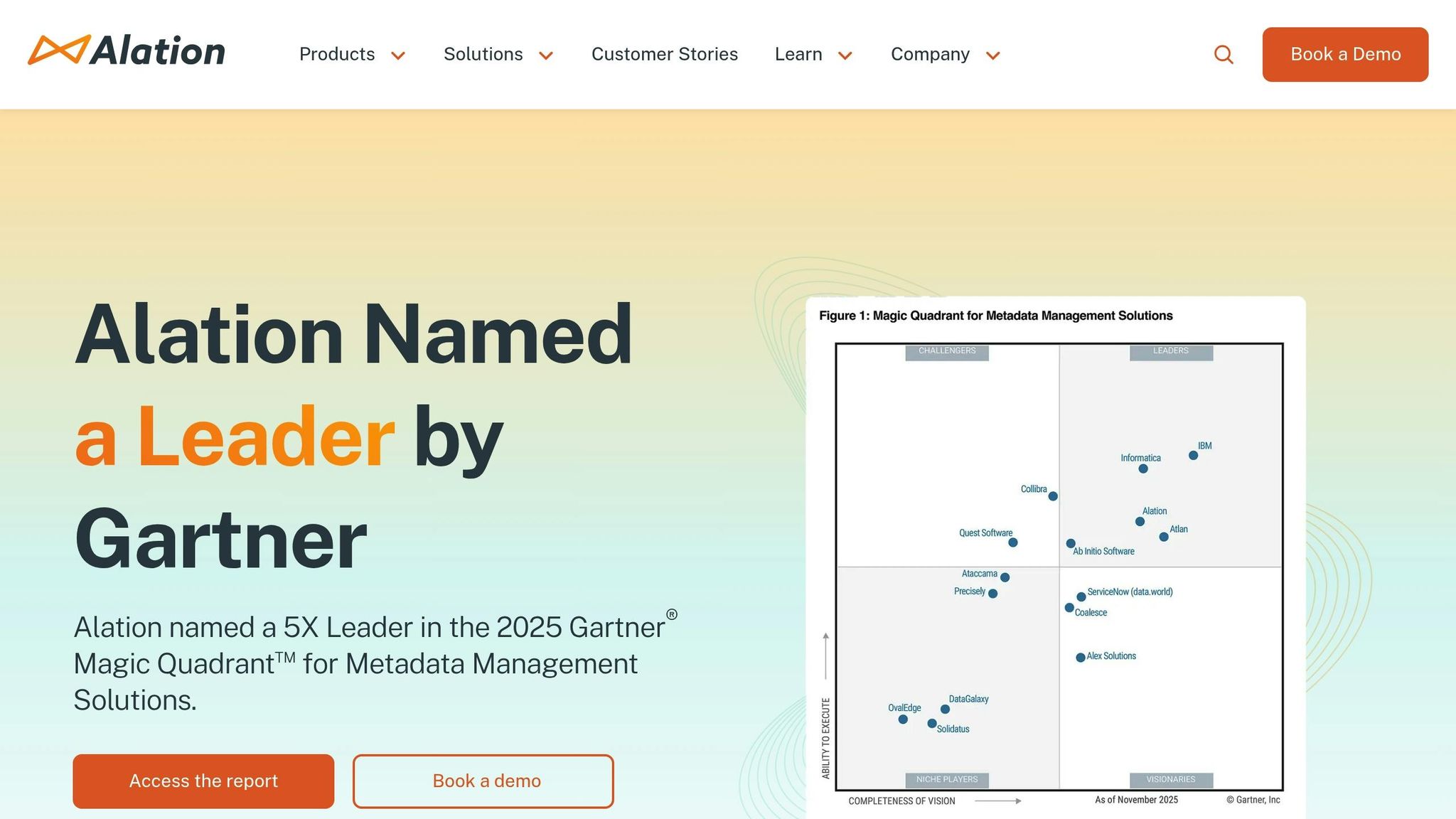
Alation tackles one of the toughest challenges in AI: scaling initiatives beyond proof-of-concept. With only 11% of such projects achieving success, governance and security gaps often stand in the way. Alation has earned recognition as a Visionary in the 2025 Gartner Magic Quadrant for Data & Analytics Governance Platforms and as a Leader in The Forrester Wave for Data Governance Solutions (Q3 2025).
Alation weaves governance seamlessly into daily operations using its Open Connector Framework, which includes over 120 pre-built connectors tailored for enterprise systems. It integrates effortlessly with popular tools like Slack, Microsoft Teams, Jira, and ServiceNow. The Workflow Center acts as a centralized hub, managing change requests and approvals for data objects. Suggested changes are routed to designated reviewers, ensuring updates are carefully vetted before being reflected in the catalog.
The platform's Agent Studio offers both an SDK and no-code templates to create governed AI agents. These agents automatically inherit access controls and organizational policies, streamlining tasks like metadata enrichment and policy implementation. A Forrester study highlights how Alation's tools can enhance data collaboration by up to 25%. Additionally, its CDE Manager reduces Critical Data Element governance costs by 70%, with automated agents saving an average of seven days per element during onboarding. By consolidating tools and processes, Alation lays the groundwork for strong compliance and audit capabilities.
Alation's strength in integration extends to major global compliance frameworks, including the EU AI Act, NIST AI Risk Management Framework, OECD AI Principles, GDPR, and CCPA. It maintains a centralized AI asset registry to catalog training datasets, LLM prompts, AI models, and API endpoints, ensuring comprehensive traceability across the AI landscape. Using model card templates, Alation standardizes AI documentation, offering stakeholders and auditors clarity on model types, training data, and adherence to ethical standards.
Sebastian Kaus, Head of Data Governance at Vattenfall, shared: "The GDPR requires us to know where our data sits and how it should be processed. Because we store that information in Alation, it becomes much easier for us to be compliant."
The platform's Policy Center centralizes all data policies and employs Trust Flags to guide users toward high-quality, compliant data while flagging non-compliant datasets. With Catalog Sets, Alation automatically classifies new data and applies relevant policies, keeping pace with the rapid influx of information.
Alation provides detailed, column-level lineage tracing from data sources to AI models, ensuring thorough auditability. The Workflow Center logs every change request and approval, creating comprehensive audit trails for compliance reporting.
In October 2024, Interac adopted Alation's AI Governance solution to establish a centralized model inventory. Ilya Gilin, Leader of Data and AI/ML Governance at Interac, noted:
"As we scale our AI initiatives, Alation delivers the transparency, traceability, and governance needed to build, document, and validate analytical models confidently."
The platform also leverages data quality flags and lineage tracking to ensure AI models remain accurate, up-to-date, and compliant with operational standards.
Alation’s vendor-neutral design supports multi-cloud, hybrid, and on-premises environments, even those outside the Microsoft ecosystem. It enforces row-level access controls and dynamic masking to safeguard sensitive data while ensuring authorized users can access information for AI development. The Alation Anywhere feature allows users to search and share governed data assets directly within tools like Microsoft Teams, Slack, and Excel, making collaboration seamless and secure.
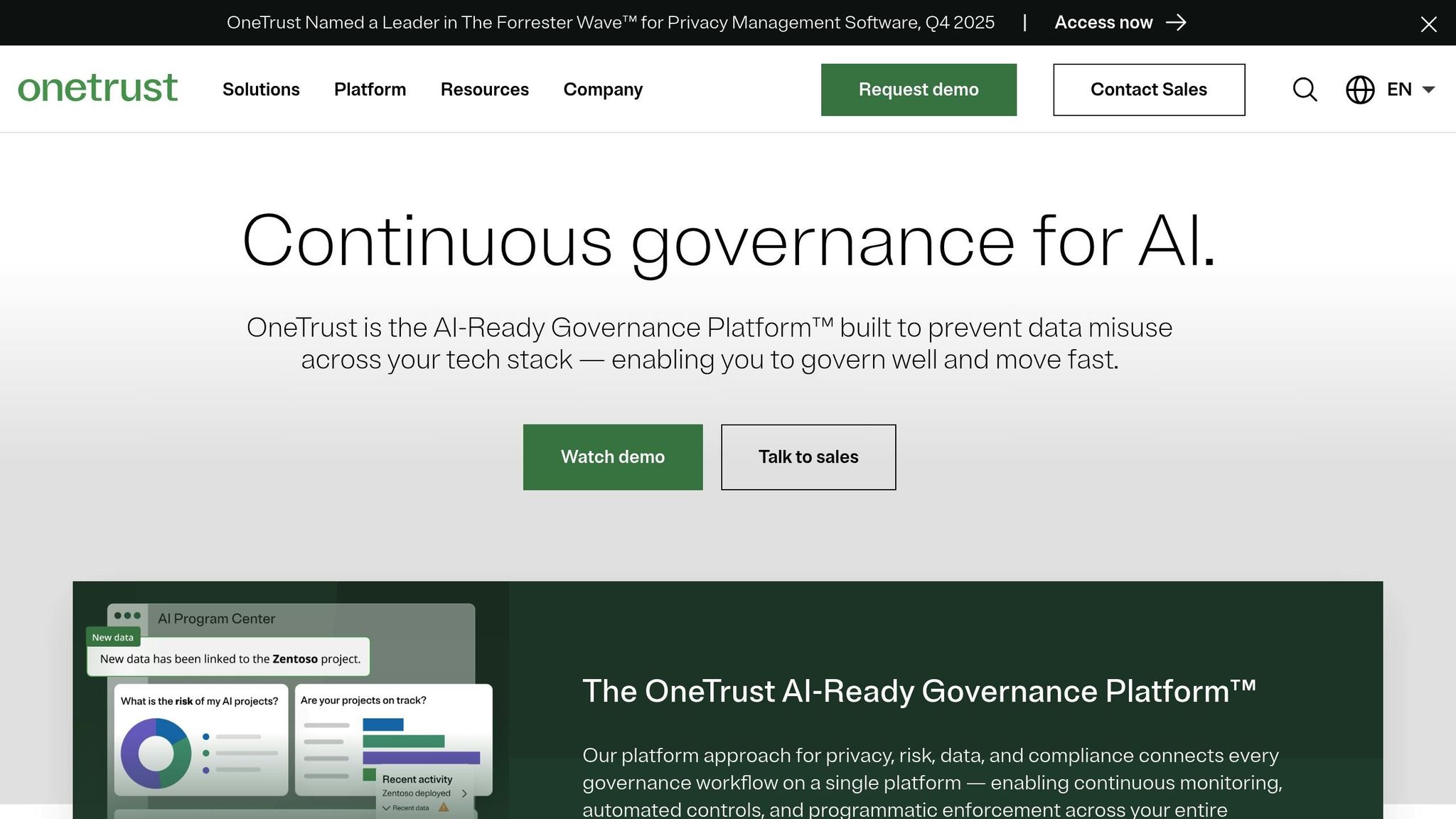
OneTrust, relied upon by over 14,000 customers, including half of the Global 2,000, stands out as a Leader in The Forrester Wave for Privacy Management Software (Q4 2025). Addressing a key challenge highlighted in a 2025 survey of 1,250 IT leaders, OneTrust tackles the growing inadequacy of legacy governance systems to keep up with AI advancements.
OneTrust seamlessly integrates with MLOps platforms like Databricks, allowing organizations to automatically discover and track AI agents, models, and datasets as they are created. By standardizing AI project intake with reusable workflows, the platform accelerates approvals while ensuring compliance remains intact.
Ren Nunes, Senior Manager of Data & AI Governance at Blackbaud, shared:
"With OneTrust, our AI governance council has a technology-driven process to review projects, assess data needs, and uphold compliance. Customizable workflows, platform integrations, and NIST AI Risk Management Framework alignment have expedited approvals."
OneTrust embeds governance checkpoints throughout the AI development process, setting alerts for critical issues such as data drift or model changes. This proactive approach eliminates last-minute compliance scrambles during audits. Organizations using the platform have reported a 75% boost in productivity through automated workflows and an 87% reduction in time-to-value by cutting manual bottlenecks. These streamlined processes not only enhance efficiency but also establish a strong foundation for compliance.
OneTrust supports a wide range of compliance standards, starting with major U.S. frameworks like the NIST AI Risk Management Framework, offering pre-built assessments and risk libraries tailored to its requirements. The platform also addresses emerging state-level regulations, such as California's AI transparency laws and Colorado's AI Bill (SB24-205), which prioritize consumer protection in AI applications. For federal compliance, OneTrust equips users to meet OMB Policy requirements for AI governance in federal agencies.
Globally, the platform aligns with regulations like the EU AI Act, ISO 42001, OECD AI Principles, GDPR, and South Korea's AI Basic Act. This comprehensive coverage enables multinational organizations to maintain consistent governance across jurisdictions. OneTrust also simplifies regulatory audits by automatically generating essential transparency documents, including model cards, AI Bills of Materials (BoM), and lineage reports - helping reduce compliance risks by up to 75%.
OneTrust provides a centralized AI inventory that tracks projects, models, and datasets, whether developed internally or sourced from third parties. The platform continuously monitors for issues such as data drift, bias, fairness, accuracy, and quality, sending instant alerts when problems are detected. This real-time oversight integrates with MLOps tools, ensuring AI model changes are automatically synced with the inventory.
Bryan McGowan, Global and US Trusted AI Leader at KPMG, highlighted the platform's impact:
"OneTrust AI Governance helps enable automation across the AI lifecycle, enhanced transparency, and control necessary for organizations to confidently operationalize Trusted AI at scale."
The platform also ensures comprehensive data traceability, tracking everything from data origins to deployment. This level of accountability supports "responsible AI by design", a growing expectation from both regulators and stakeholders.
OneTrust’s architecture is designed to scale, accommodating everything from small departmental pilots to enterprise-wide AI deployments across multiple divisions. By uniting privacy, risk, data, and compliance teams on a single interface, the platform facilitates automated controls and enforcement across the organization, breaking down silos that often hinder governance efforts.
Beyond its MLOps integrations, OneTrust connects with model registries and data platforms, bridging the gap between overarching policies and technical execution. Security remains a priority, with features like role-based access controls and automated policy monitoring throughout the AI deployment lifecycle. This ensures sensitive data stays protected, while authorized teams can work efficiently to advance AI initiatives.
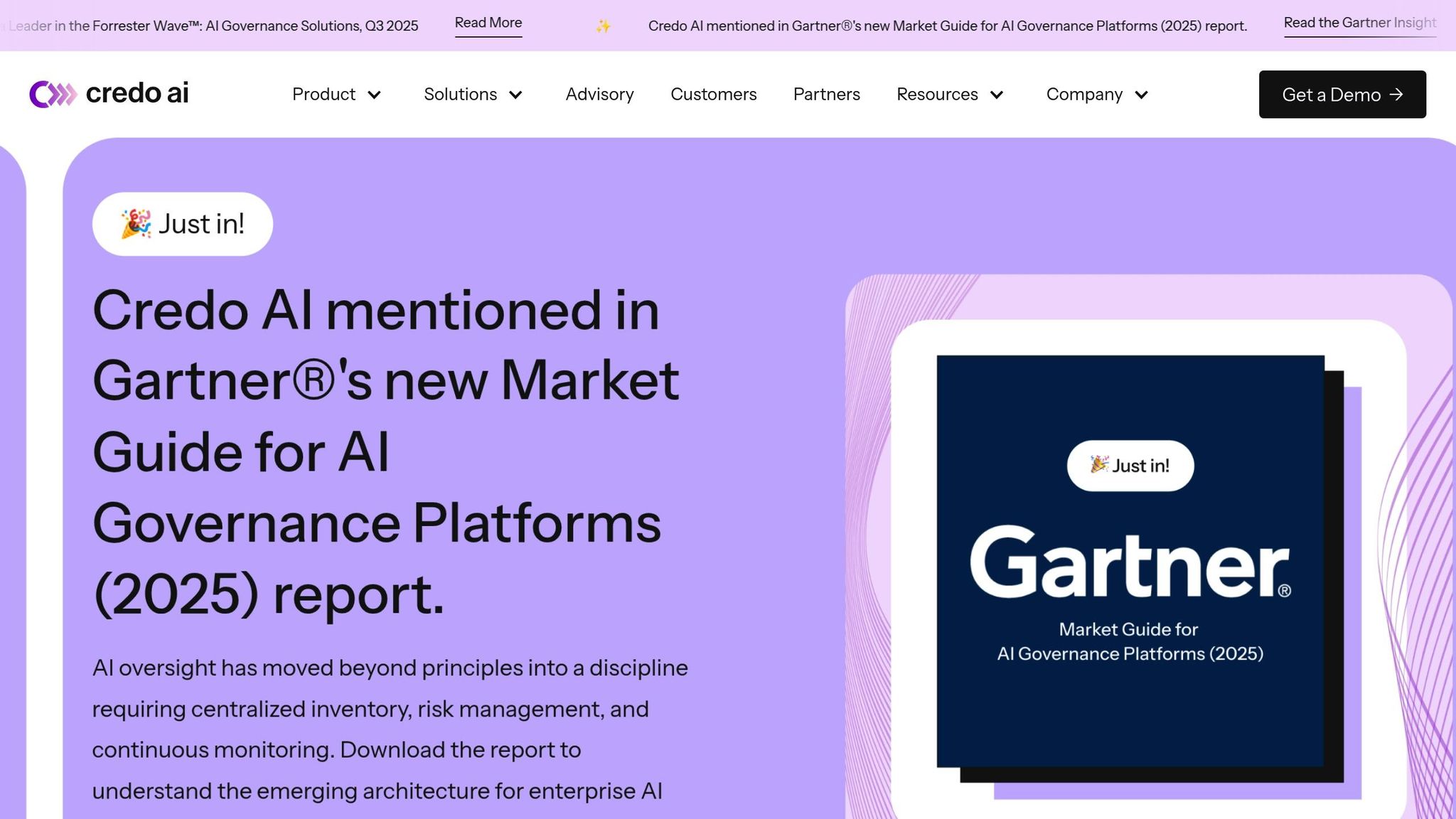
Credo AI has established itself as a leader in AI governance, recognized by Forrester as a top performer in AI policy management and innovation. The platform addresses the growing need to turn high-level AI principles into actionable processes, offering tools for centralized inventory, risk management, and ongoing monitoring. Companies using Credo AI have reported a 60% decrease in manual effort thanks to governance automation and have seen governance cycles shorten by 30–50%.
Credo AI simplifies governance while maintaining operational flexibility. It integrates seamlessly with tools like Snowflake, Databricks, and model stores to detect and register AI assets automatically. Its "Policy-to-Code" approach allows technical teams to pull evidence from existing assessment libraries and MLOps tools, ensuring compliance with governance standards for bias, performance, and robustness - without duplicating efforts.
The platform employs a three-step intake process - General Intake, Assessment Intake, and Governance - to streamline AI submissions and automate risk assessments across InfoSec, privacy, and procurement teams. This workflow assigns reviewers, monitors mitigation progress, and sends automated alerts when AI systems deviate from policies. Andrew Reiskind, Chief Data Officer at Mastercard, shared:
"Using the Credo AI Platform, Mastercard is able to manage AI risk and responsibly implement generative AI – with better speed and scale than ever before. Features like AI Registry and Vendor Registry have allowed us to maintain control of all AI use cases..."
Organizations using Credo AI have reported 50% faster workflow adoption and three times the engagement from legal, risk, and data teams. By providing a unified view of all AI assets, including generative AI and autonomous agents, the platform tracks lineage, metadata, and autonomy levels, laying the groundwork for efficient compliance and thorough auditing.
Credo AI supports key U.S. frameworks such as the NIST AI Risk Management Framework (RMF), operationalized through modular "Policy Packs." These packs translate regulatory requirements into actionable technical and process controls, eliminating manual mapping and enabling organizations to achieve compliance with frameworks like the EU AI Act up to 10x faster.
The platform also aligns with global standards like ISO/IEC 42001, the EU AI Act, and the OECD AI Principles, making it an ideal choice for multinational organizations. It includes tools for bias testing, fairness evaluations, and transparency, such as automated model cards and impact assessments. For third-party AI tools, its Vendor Portal extends governance by applying Policy Packs to external systems and collecting evidence from vendors, ensuring compliance at every checkpoint through automated audits.
Credo AI automatically logs every decision in the governance process, generating audit-ready trails that meet international standards. Its dashboards provide real-time insights into potential risks, data vulnerabilities, and ethical concerns - such as hallucinations or toxicity - both before and after deployment.
The AI Governance Workspace offers secure evidence storage, progress tracking, and reviewer assignment for specific AI use cases. For autonomous agents and models, the platform sends automated alerts when behaviors deviate from policies or compliance standards. Organizations using Credo AI have reported a 60% reduction in review times for legal, risk, and AI teams.
With standardized Policy Pack templates, users can generate model cards, impact assessments, and transparency reports in a single click. The platform integrates with MLOps tools to collect evidence on model performance, bias, robustness, and explainability. This approach also helps identify and manage "Shadow AI" by detecting AI systems that require governance oversight.
Credo AI offers deployment options tailored to different security needs, including Public Cloud, Private Cloud, and Self-Hosted (fully air-gapped) environments. This flexibility makes it a strong choice for industries with strict regulations, such as financial services, life sciences, and government agencies.
Its AI Agent Registry monitors risks associated with autonomous agents, such as emergent behaviors and autonomy levels. Credo AI has been recognized by Gartner as a "Cool Vendor" in AI Cybersecurity & Governance and was named one of Fast Company's "Next Big Things in Tech" for 2025. However, some users note that the platform’s steep learning curve may pose challenges for smaller teams or those new to AI governance. Pricing is contract-based and typically arranged through AWS Marketplace or direct vendor engagement, with custom quotes available for tailored solutions.
This section highlights the key advantages and challenges of the tools discussed earlier, offering a concise comparison to aid decision-making.
Each AI governance tool has its own strengths and trade-offs when it comes to managing workflows. Prompts.ai stands out by integrating 35+ leading models into one interface, reducing AI software costs by up to 98% through pay-as-you-go TOKN credits and real-time FinOps controls. Its primary advantage lies in eliminating tool sprawl while delivering enterprise-grade governance without requiring recurring subscription fees.
DataRobot is well-suited for its ecosystem, offering real-time monitoring for model drift and data quality alongside automated multi-level approvals. However, it lacks flexibility for complex regulatory scenarios, making it ideal for organizations already using DataRobot.
Collibra excels in traceability with its unified data and AI asset cataloging, offering accessible model registries for both technical and non-technical users. However, it does not provide native full lifecycle management and relies on third-party MLOps tools for integration.
Alation offers robust data cataloging and lineage tracking, making it an excellent choice for organizations focused on ensuring transparency across their data assets.
OneTrust is recognized for its global SaaS integration, enabling automated privacy workflows aligned with frameworks like GDPR and the EU AI Act. Despite its perfect 5/5 Gartner Peer Insights rating, its complexity and steep learning curve can pose challenges for new users.
Credo AI simplifies compliance by converting policies into machine-enforceable controls through its "Policy-to-Code" approach. It also delivers audit-ready artifacts, but its high implementation costs can be a barrier for smaller teams.
A broader industry challenge is evident: while 90% of enterprises use AI in daily operations, only 18% have fully implemented governance frameworks. Integration remains a significant hurdle, as connecting governance tools with systems like Identity and Access Management (IAM), Data Loss Prevention (DLP), and Security Information and Event Management (SIEM) often limits the efficiency of automated enforcement. To address this, organizations should prioritize tools capable of automated "shadow AI" discovery through scanning rather than relying on manual registration. This is especially critical given the potential non-compliance penalties under the EU AI Act, which can reach €35 million or 7% of global turnover.
Below is a summary of each tool's core attributes:
| Tool | Primary Strength | Main Weakness | Best For |
|---|---|---|---|
| Prompts.ai | Unified 35+ models; cost reduction; real-time FinOps | None identified | Teams seeking pay-as-you-go flexibility and reduced tool sprawl |
| DataRobot | Integrated MLOps & real-time monitoring | Limited customization for complex regulations | Organizations already in the DataRobot ecosystem |
| Collibra | Unified data & AI asset cataloging with strong lineage | No native AI lifecycle management; steep learning curve | Large enterprises needing detailed traceability |
| Alation | Strong data cataloging and lineage tracking | None identified | Companies prioritizing data transparency |
| OneTrust | Broad SaaS integration for global privacy | High complexity; steep learning curve | Large enterprises with multi-cloud environments |
| Credo AI | Policy automation; audit-ready compliance artifacts | High implementation and maintenance costs | Regulated industries scaling AI operations quickly |
Selecting the right AI governance compliance tool is critical for balancing the need for innovation with regulatory and ethical responsibilities. Prompts.ai stands out by simplifying AI management with unified access to over 35 models, flexible pay-as-you-go TOKN credits, and real-time FinOps controls. By cutting AI software costs by up to 98% - without the burden of recurring subscription fees - it’s an excellent choice for organizations scaling AI workflows while avoiding the hassle of juggling multiple vendor contracts.
Other platforms also cater to specific needs depending on your organization’s ecosystem. DataRobot offers seamless native integration and real-time monitoring, while platforms designed for hybrid cloud environments provide tailored solutions for companies with niche requirements. If data lineage and traceability are priorities, Collibra is a strong contender, though it does require third-party MLOps tools to manage the full lifecycle.
Regulatory pressures add urgency to these decisions. For example, OneTrust excels in handling complex global frameworks like GDPR and the EU AI Act, using automated discovery and mapping. It has earned a perfect 5/5 on Gartner Peer Insights, though some users find its learning curve steep. Meanwhile, Credo AI focuses on producing audit-ready materials, which is particularly valuable for industries like finance and healthcare, though its implementation costs may be challenging for smaller teams.
With the EU AI Act’s enforcement for high-risk systems set to begin in August 2026 - and penalties reaching as high as $35 million or 7% of global revenue - companies cannot afford to delay. Despite 90% of enterprises using AI daily, only 18% have fully adopted governance frameworks. Gal Nakash, Cofounder & CPO of Reco, highlights the importance of proactive governance:
"Governance works best when it evolves alongside AI adoption, embedding compliance into operations, not slowing them down."
To stay ahead, map out your AI use cases, select a tool that integrates with your IAM and SIEM systems, and establish tiered policies based on the criticality of your AI applications. The right governance tool should enhance your existing workflows, ensuring compliance without introducing unnecessary hurdles.
AI governance compliance tools bring a host of benefits, making it easier for organizations to manage AI-driven workflows with confidence and precision. A standout advantage is their ability to ensure regulatory compliance. By automating workflows, conducting thorough risk assessments, and enforcing policies aligned with global frameworks like the EU AI Act and NIST standards, these tools help organizations navigate complex regulations. This not only minimizes legal and reputational risks but also simplifies adherence to ethical and operational requirements.
Another key strength lies in promoting transparency and accountability across the entire AI lifecycle. These tools facilitate detailed documentation of models, track processes from start to finish, and produce audit-ready reports. Such features not only build trust but also ensure fairness in AI systems. Additionally, many tools are equipped to detect and address bias, enabling the creation of more dependable and equitable AI models.
Lastly, these tools help streamline operations by automating policy enforcement and maintaining ongoing oversight. This reduces the need for manual intervention, cuts operational costs, and accelerates the responsible integration of AI. As a result, organizations can scale their workflows effectively while maintaining ethical standards.
AI governance tools provide organizations with the means to meet regulatory requirements, such as those outlined in the EU AI Act. They do this by offering structured frameworks that address risk management, promote transparency, and uphold accountability throughout the entire AI lifecycle. Key features often include model traceability, automated compliance checks, and policy enforcement mechanisms, which help ensure that AI workflows adhere to ethical and regulatory standards.
These tools simplify critical tasks like documentation, monitoring, and reporting. By streamlining these processes, businesses can not only meet compliance obligations more efficiently but also improve operational workflows. This helps ensure that AI systems operate securely, ethically, and in line with global regulatory expectations.
When choosing an AI governance tool, it's crucial to focus on features that meet your organization's ethical, regulatory, and operational priorities. Seek tools that provide thorough oversight of AI models, including capabilities for monitoring, risk management, and compliance with frameworks like the EU AI Act or NIST guidelines. Features like end-to-end traceability - covering model documentation, lineage tracking, and audit readiness - are key to maintaining transparency and accountability.
It’s also wise to prioritize tools that can automate workflows, enforce policies, and handle compliance assessments, helping to minimize manual tasks and simplify AI deployment. Ensure the tool integrates smoothly with your current systems, whether they're on-premises or cloud-based, for a hassle-free setup. Lastly, look for solutions that support global compliance standards and offer insights into changing AI regulations, enabling your organization to stay ahead of legal requirements while fostering trust in your AI initiatives.