Pay As You Go - AI Model Orchestration and Workflows Platform



In today's AI-driven landscape, securing your systems against emerging threats like prompt injection, data breaches, and tool misuse is non-negotiable. With the average cost of a data breach hitting $4.88 million in 2024, and the AI security market projected to reach $8.2 billion by 2026, organizations must act now to safeguard their AI workflows. Below are five leading AI security tools designed to protect your systems while maintaining efficiency.
| Software | Focus Area | Top Feature | Best For |
|---|---|---|---|
| Prompts.ai | Prompt-level security | Redaction of sensitive data | Teams managing diverse LLM workflows |
| Check Point Infinity AI | Network and cloud security | Malware and phishing prevention | Enterprises needing broad protection across systems |
| Lasso Security | Behavioral threat detection | Intent-based anomaly monitoring | Organizations prioritizing real-time threat control |
| Palo Alto Prisma AIRS | Model and agent security | Adversarial simulations | Securing AI pipelines and hybrid setups |
| Microsoft Sentinel | Analytics and visibility | Cloud-native SIEM with AI analytics | Microsoft-based ecosystems needing scalability |
AI workflows demand specialized security solutions to address risks traditional tools overlook. Whether you're securing LLM interactions, preventing data leaks, or ensuring compliance, these five platforms offer tailored defenses that keep your systems safe without sacrificing performance or productivity.
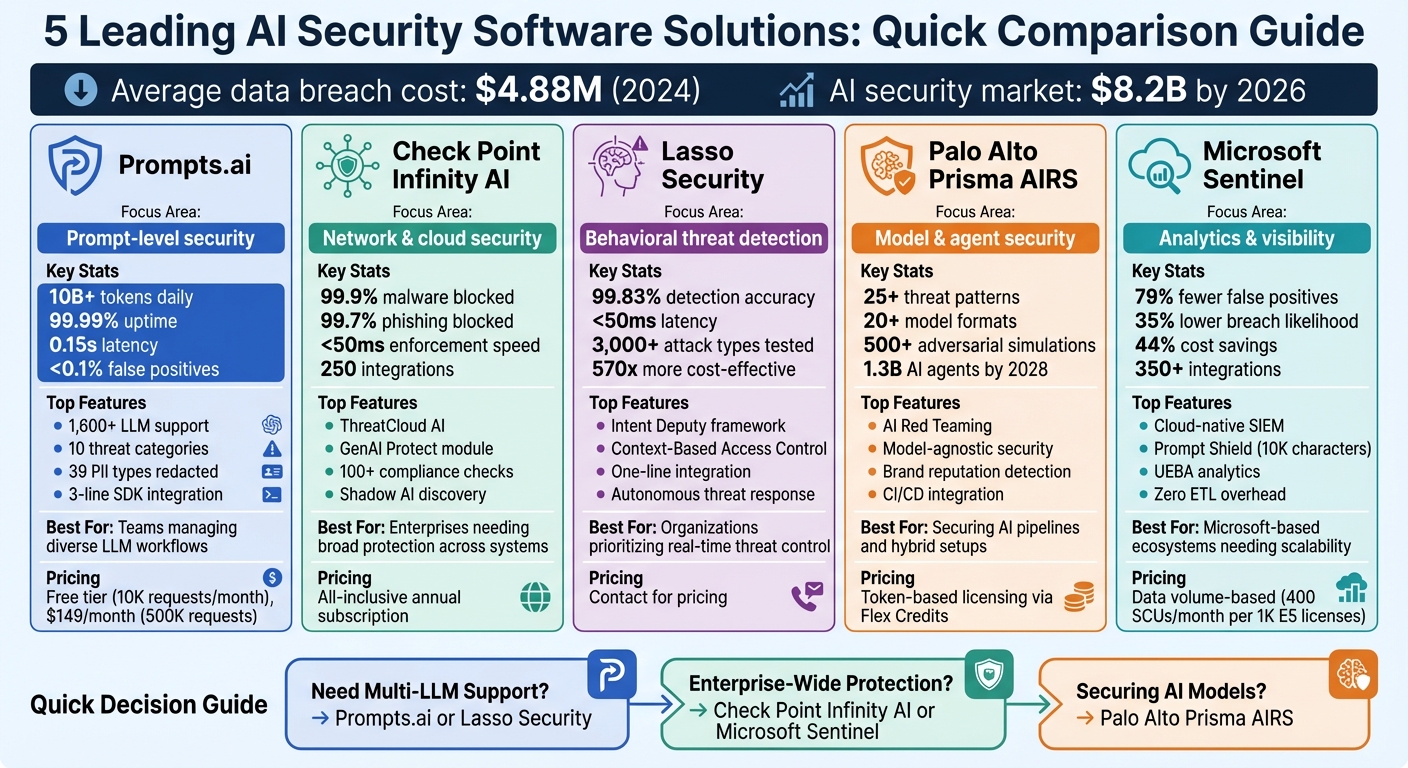
AI Security Software Comparison: Features, Strengths, and Best Use Cases
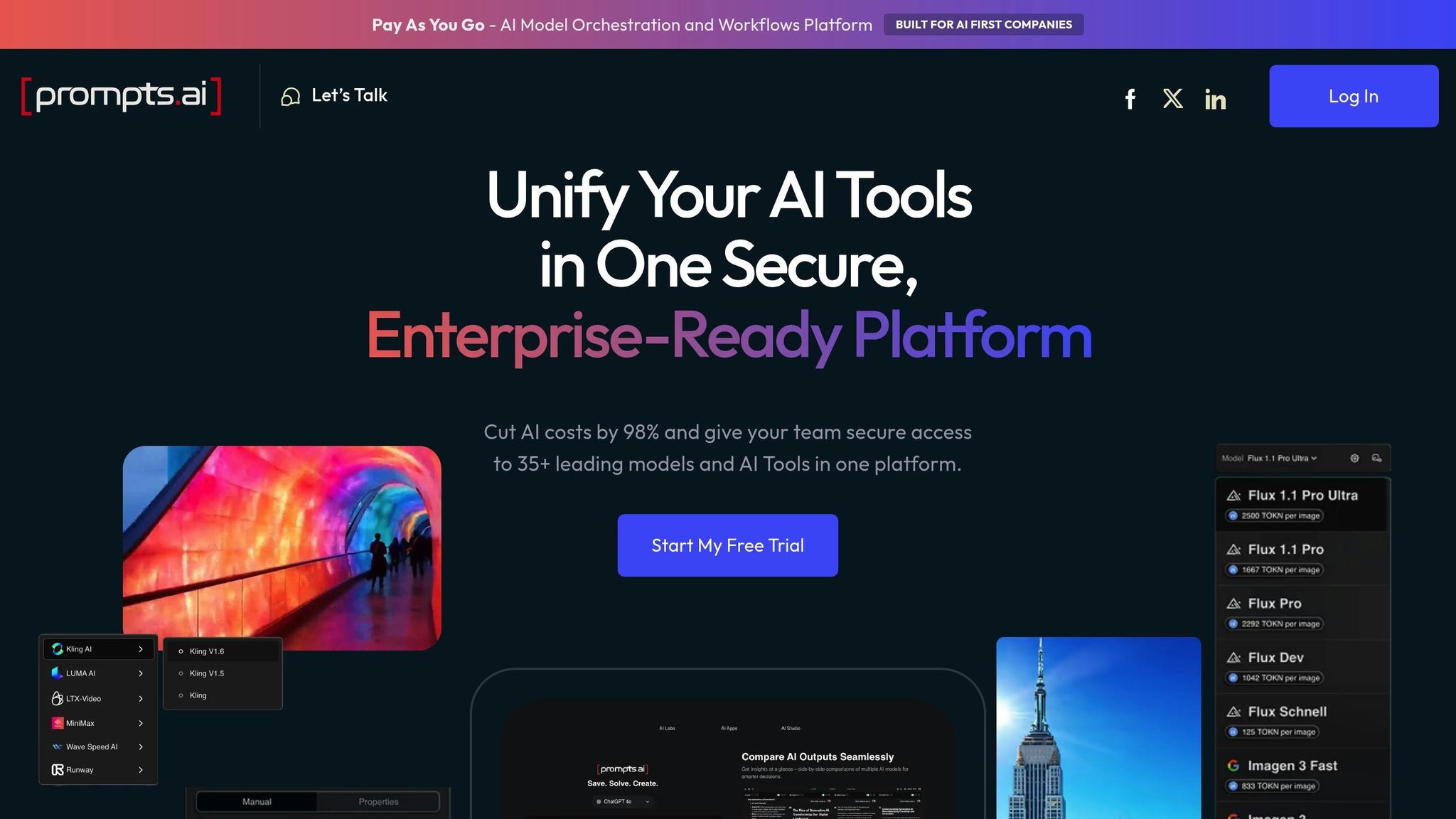
Prompts.ai acts as a security-first AI gateway, positioned between your applications and LLM providers to analyze and secure every request. The platform handles over 10 billion tokens daily while delivering a 99.99% uptime SLA and lightning-fast 0.15-second latency, ensuring a seamless user experience.
With support for over 1,600 LLMs via a single API, Prompts.ai connects to major providers like OpenAI, Anthropic, Google Gemini, Cohere, AWS Bedrock, and Mistral. This compatibility eliminates the hassle of managing multiple security tools or reworking policies for each provider, streamlining the integration of your AI infrastructure.
Integration is quick and simple - requiring just a three-line SDK update. By updating your LLM provider's base_url to the PromptGuard API endpoint, you can connect without modifying existing code. Features like semantic caching and automatic failover help cut LLM costs by approximately 40%, all while maintaining tight security. For environments with strict privacy needs, a zero retention mode processes requests without storing any prompt data.
The platform employs a combination of machine learning and LLM-driven detection to identify 10 categories of threats, such as prompt injection, jailbreaks, toxicity, data exfiltration, and tool injection. For AI agents, it validates tool calls, identifies privilege escalation attempts, and monitors behavioral anomalies. It also redacts over 39 types of PII, including financial and healthcare data, with the option to replace sensitive information using synthetic data. With a false positive rate of less than 0.1%, the system effectively blocks threats like role manipulation without interfering with legitimate activities. Additionally, a red teaming suite simulates 20+ attack vectors, delivering detailed vulnerability reports and security assessments. These features integrate smoothly with the platform's rapid setup process.
Prompts.ai provides comprehensive audit trails for all AI interactions, ensuring compliance with transparency regulations. A secure vault manages LLM API keys with virtual key rotation and revocation, removing the need to embed credentials in code. Administrators can configure security guardrails, routing rules, and content policies through a centralized dashboard, applying them organization-wide. The platform also includes tailored guardrails for Fintech (PCI-DSS), Healthcare (HIPAA), and legal sectors to meet specific compliance needs. A free tier supports 10,000 requests per month, while enterprise plans start at $149/month for 500,000 requests.
Check Point Infinity AI delivers dependable security for AI workflows through a unified platform designed to safeguard networks, cloud environments, and workspaces. Leveraging ThreatCloud AI, which integrates over 50 specialized engines and data from 150,000 networks globally, the system blocks 99.9% of malware and 99.7% of phishing attempts - a critical shield for enterprise operations.
The platform extends its protection to popular AI models such as ChatGPT, Claude, Gemini, and GPT-4 via the GenAI Protect module. This feature offers runtime protection directly through firewalls, eliminating the reliance on browser extensions. It also supports the Model Context Protocol (MCP), which secures API connections for tools like GitHub MCP and Figma MCP. With real-time monitoring across more than 100 languages, the system ensures enforcement speeds under 50ms, maintaining seamless performance.
With 250 integrations available, Check Point Infinity AI connects effortlessly with third-party tools like Microsoft Defender, Microsoft Entra ID, and CrowdStrike Falcon. Its Infinity Portal centralizes management, while Infinity Playblocks enables automated workflows across both Check Point and external products. The SmartConsole allows administrators to reuse policy objects and apply consistent controls across on-premises firewalls, cloud-native firewalls, and SASE environments. Additionally, the Infinity AI Copilot supports multilingual, chat-based interaction, reducing administrative tasks by 90%.
"With Infinity AI Copilot, we are ushering in a new era of cyber security where human-machine collaboration takes center stage." - Eyal Manor, VP of Product Management, Check Point Software Technologies
The GenAI Protect module addresses AI-specific risks like prompt injection, jailbreak attempts, and harmful outputs at the application edge. Features such as sensitive paste detection and real-time prompt inspection prevent data leaks via LLMs. The platform also tracks AI agent decisions, restricting unsafe runtime behavior by monitoring tool usage and privileges. Its Shadow AI Discovery function automatically identifies unauthorized AI tools within the workforce. Threat signals are shared globally in under 2 seconds, processing data from hundreds of millions of sensors to ensure rapid response.
The platform enhances security with automated auditing and over 100 compliance checks, supporting frameworks like PCI DSS, NIST, SOC 2, and HIPAA. GenAI Protect creates detailed audit trails and offers real-time data leakage prevention. Modules like Cloud Security Posture Management (CSPM) and SaaS Security Posture Management (SSPM) ensure compliance across more than 70 cloud-native services, guided by over 1,000 industry best practices. Check Point simplifies costs with an all-inclusive annual subscription model covering hardware, software, subscriptions, and support - ensuring transparency with no hidden fees.
Lasso Security strengthens AI workflows by focusing on behavior-based threat detection. Using its proprietary "Intent Deputy" framework, it achieves an impressive 99.83% threat detection accuracy by analyzing the purpose behind actions rather than just the content. This approach enables the system to identify harmful behavior even when prompts seem benign, all while operating with a latency of under 50ms to ensure a smooth user experience. This method allows for seamless integration and comprehensive support.
Lasso's behavioral security strategy extends protection across a variety of GenAI systems, including custom applications, third-party agents, and foundational models like Claude. It monitors the entire execution path of AI agents, comparing actions to established behavioral baselines to detect anomalies in real time. Lasso employs over 3,000 attack types and techniques through its offensive AI agents for continuous vulnerability testing. Additionally, its Shadow AI Discovery feature identifies unauthorized AI tools that employees may create or use, ensuring enterprise-wide security.
Lasso's integration process is designed to be simple and minimally disruptive. Organizations can deploy it via a Gateway, API, or SDK with just a one-line integration, and it supports identity providers like Okta for Single Sign-On using SAML, OIDC, and SWA, along with automated provisioning. Network-level security is enhanced through partnerships with Cloudflare (Gateway and Firewall) and Portkey (AI Gateway), enabling edge traffic inspection without the need for agents. The platform also supports the Model Context Protocol (MCP) through an open-source security gateway available on GitHub and integrates with Palo Alto Networks Next-Generation Firewalls to secure desktop AI agents. Its compatibility extends across the tech stack, connecting with SIEM, SOAR, ticketing systems, and messaging platforms for centralized logging and automated responses.
Lasso's behavioral analysis framework addresses AI-specific risks such as prompt injection, jailbreaking, goal hijacking, tool/API abuse, and sensitive data exfiltration. When a threat is detected, the system autonomously takes actions like blocking requests, masking sensitive data, or restricting tool access - no manual intervention required. Its Context-Based Access Control (CBAC) evaluates user role, data sensitivity, intent, and context to enforce policies far beyond traditional role-based permissions. The platform's 99.83% accuracy in detecting content, context, and intent is paired with being 570 times more cost-effective than traditional cloud-native solutions.
"Lasso's full security suite has been crucial in fortifying our GenAI applications. Their approach ensures our organization, customers, data, and employees stay protected from various attacks while allowing me full control over my environment." - Gil Ohayon, CIO
Lasso enforces compliance with standards like the EU AI Act, NIST AI Risk Management Framework (AI RMF), and ISO/IEC 42001 through real-time policy enforcement. The platform independently inspects AI interactions to ensure they meet safety and privacy requirements. Its 8-dimensional coordinate system provides clear, human-readable evidence for legal and risk teams, documenting the reasoning behind blocked or modified interactions. Organizations can use Lasso's pre-built policy library or custom policy generator to align AI usage with their internal rules as soon as the system is integrated.
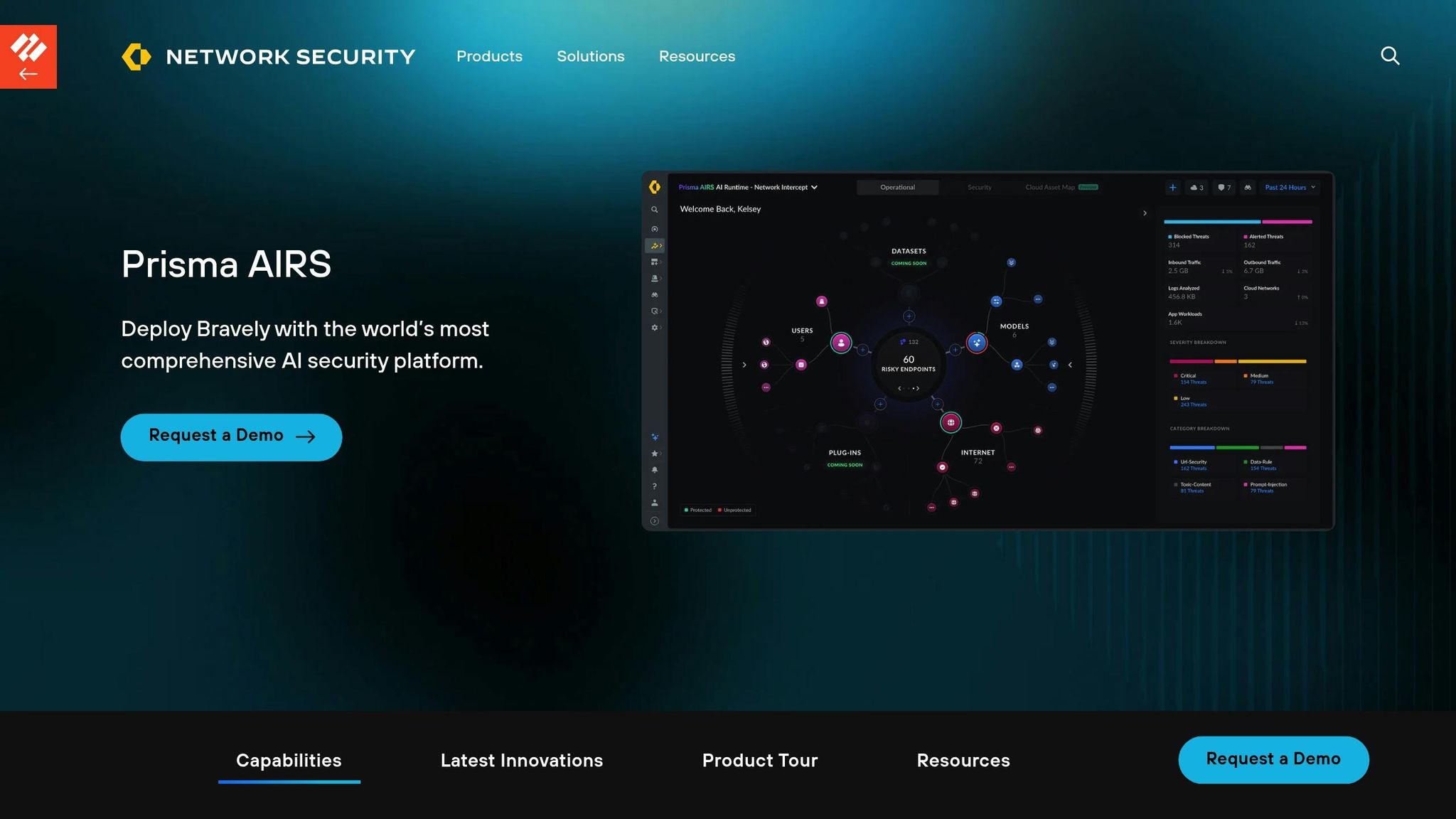
Palo Alto Prisma AIRS delivers AI security solutions by safeguarding models, runtime interactions, and autonomous agents within a single platform. It evaluates millions of models, identifying 25+ threat patterns across 20+ model formats, ensuring vulnerabilities are addressed before reaching production. The platform's AI Red Teaming feature conducts over 500 adversarial simulations, aligned with frameworks like NIST AI-RMF, OWASP, and MITRE, to provide continuous vulnerability assessments as models evolve.
Prisma AIRS offers model-agnostic security, covering thousands of models from providers such as OpenAI, Meta, Mistral, and DeepSeek. Its AI Model Security scans both third-party and open-source models for risks like tampering, malicious scripts, hidden backdoors, and unsafe serialization methods. The AI Agent Security feature protects autonomous agents from threats like identity impersonation, memory manipulation, tool misuse, and context poisoning. With AI agent production expected to reach 1.3 billion by 2028, this capability addresses critical emerging risks.
"What makes Palo Alto Networks AI Runtime stand out are three things. It has three functionalities - built-in data security, malware security and AI security." - Sunil Agrawal, CISO, Glean
Prisma AIRS integrates smoothly into existing AI development workflows, thanks to its API-first architecture. It connects directly to CI/CD and MLOps pipelines, offering Network Intercept for real-time protection and API Intercept via a Python SDK. In November 2025, the platform was integrated with Microsoft Foundry, enabling developers to scan prompts and responses in real-time during AI app development. Additionally, it supports a managed Model Context Protocol (MCP) server, allowing AI agents to embed threat detection using standardized protocols. Organizations can deploy the platform across public clouds like AWS, Azure, and GCP, as well as private clouds and Kubernetes clusters, all managed through Strata Cloud Manager or Panorama.
Prisma AIRS tackles AI-specific threats through five core components. AI Runtime Security safeguards against issues such as prompt injection, malicious code, toxic content, sensitive data exposure, resource overload, and hallucinations in real time. AI Posture Management provides visibility into the AI ecosystem, preventing excessive permissions, sensitive data leaks, and misconfigurations. A Brand Reputation Risk Detection feature, introduced in January 2026, scans AI outputs for potential risks to brand image. Local scanning ensures sensitive data remains under organizational control, protecting intellectual property during security evaluations. These features collectively strengthen the platform's ability to maintain the integrity of AI systems.
Prisma AIRS offers centralized oversight across all AI agents, including unsanctioned "Shadow AI", by maintaining a unified inventory of the AI ecosystem. It enforces least-privilege access for AI service identities and provides detailed audit trails to track usage, security events, and policy violations. The platform also documents model components, including architecture, training datasets, open-source licenses, and software dependencies, ensuring transparency. As of February 2026, Prisma AIRS 2.0 is available through Software NGFW Credits (Flex Credits), with token-based licensing for the AI Runtime API. A Credit Estimator tool helps organizations determine deployment needs.
"This is no longer about point solutions; it's about providing the full-lifecycle, 'secure-by-design' assurance and managed defense required for our clients to innovate with AI, confidently and at scale." - Harshul Joshi, Principal, Cyber, Data & Tech Risk, PwC US
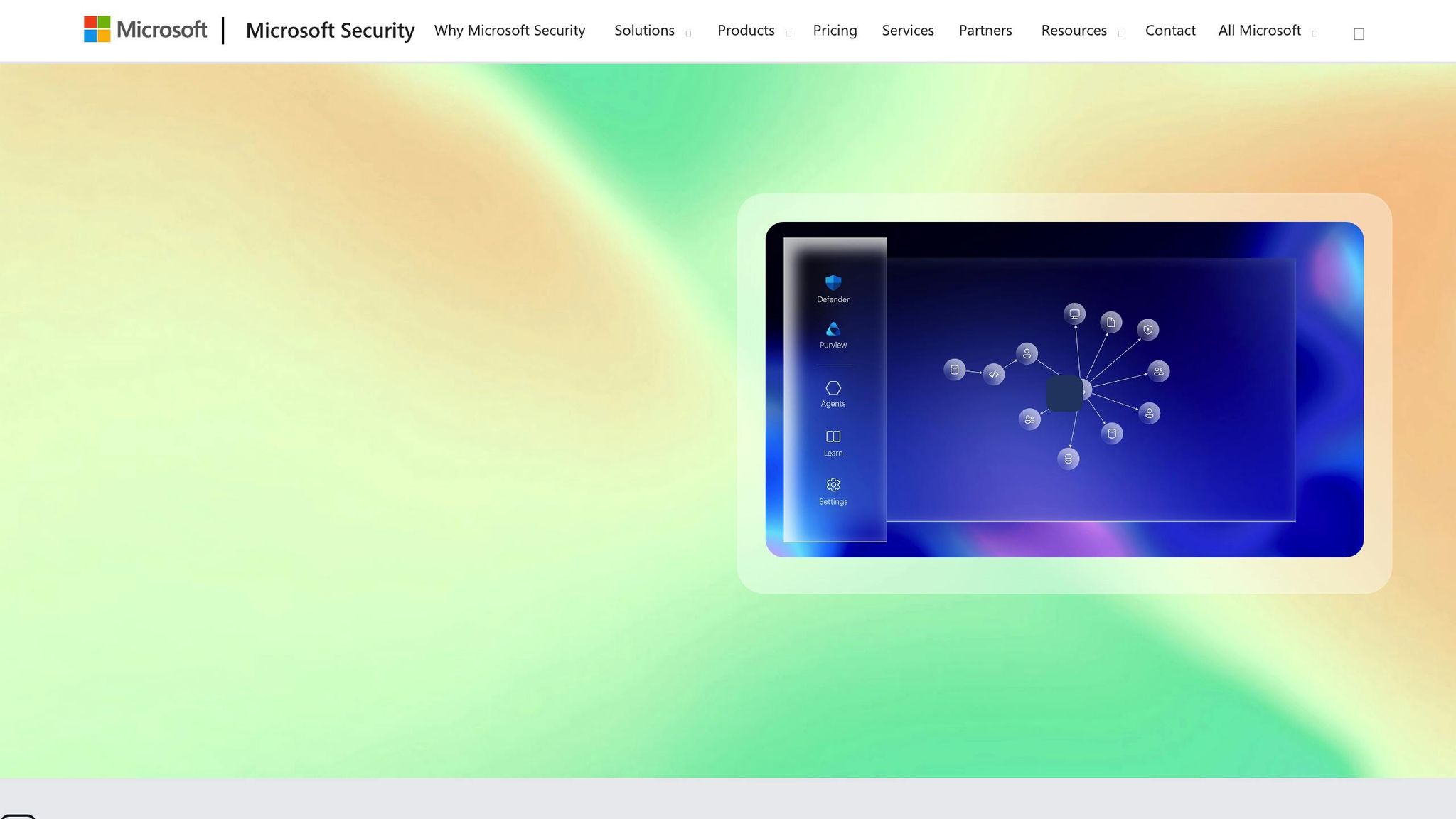
Microsoft Sentinel stands out as a cloud-native SIEM platform designed to streamline AI security operations. It consolidates security data from Microsoft 365, Azure, AWS, GCP, and over 350 third-party solutions into a single data lake. This setup allows AI agents to perform advanced analytics without the hassle of managing complex data pipelines. Organizations using Sentinel have reported impressive results, including a 79% reduction in false positives, a 35% lower likelihood of data breaches, and a 44% cost savings compared to older SIEM systems.
Sentinel’s MCP Server simplifies access to security data by enabling natural language queries, eliminating the need for custom connectors or manual coding. Its Sentinel Graph maps intricate connections between assets, identities, and threat intelligence, allowing AI agents to trace attack paths and analyze interconnected data effectively. The Microsoft Security Store provides security solutions from partners like Accenture, ServiceNow, and Zscaler. Additionally, integration with tools such as Visual Studio Code and Microsoft Copilot Studio lets security teams develop custom AI agents within familiar environments. Sentinel supports deployment across both public and private clouds, with zero ETL overhead for Azure AI workloads, ensuring seamless and efficient operations.
To counter emerging threats, Sentinel incorporates Prompt Shield, which defends against prompt injection and jailbreak attempts in real time. It supports prompts up to 10,000 characters across models like ChatGPT, Claude, Gemini, and Mistral. Security teams can utilize KQL analytics rules to identify GenAI-specific risks, including content safety violations, rate limit exploitation, and coordinated attacks triggered by identical prompts. UEBA (User and Entity Behavior Analytics) establishes baseline behaviors to detect anomalies like sudden model changes or unusual spikes in activity. For example, in late 2025, St. Luke's University Health Network adopted the Phishing Triage Agent, which now autonomously manages thousands of false positive alerts, saving the team nearly 200 hours each month, as noted by Associate CISO Krista Arndt.
Sentinel integrates seamlessly with Microsoft Purview and Entra Agent ID to ensure data security and visibility, preventing excessive data sharing in custom AI applications. Features like Azure AI Foundry Controls monitor agent tasks and enforce PII safeguards to protect sensitive information. Role-Based Access Control (RBAC) through Microsoft Entra further enhances security by assigning specific roles for AI-powered tools. For instance, TÜV SÜD implemented Security Copilot with Sentinel, enabling the organization to analyze security results 60% to 70% faster, according to CISO Norbert Vetter, significantly reducing global IT risks. Sentinel’s flexible pricing model is based on data volume, with Microsoft 365 E5 customers receiving 400 Security Compute Units (SCUs) per month for every 1,000 user licenses, supporting AI workloads efficiently. Together, these capabilities create a secure and compliant framework that enhances AI-driven security workflows.
Selecting the right AI security solution depends on your organization's goals, current setup, and security focus. The table below provides an overview of how different platforms stack up in terms of features, strengths, limitations, and ideal applications.
| Software | Key Features | Advantages | Limitations | Best For |
|---|---|---|---|---|
| Prompts.ai | Instant threat detection, prevention of prompt injection, AI-driven prompt hardening, automated red team testing with continuous attack library updates, output validation and filtering | Proactive threat prevention, continuous attack library updates, integrates with over 35 leading LLMs | Focused on prompt-level security rather than full infrastructure protection | Teams managing diverse AI workflows requiring specialized prompt security |
| Palo Alto Prisma AIRS | ModelScan for malicious code detection, Guardian for policy enforcement, ML supply chain security, continuous adversarial monitoring | Comprehensive coverage for networks, cloud, and security operations in a unified system | Best value requires full adoption of the Palo Alto ecosystem | Companies securing ML pipelines and deployments across hybrid setups |
| Microsoft Sentinel | Cloud-native SIEM with deep integration into Microsoft 365, Azure, and Defender, powered by AI threat analytics | Excellent integration for Microsoft users, globally scalable | Ecosystem dependency and variable consumption costs | Microsoft-focused organizations needing scalable, integrated security analytics |
This breakdown helps organizations match their security needs with the right platform, ensuring compatibility with their AI workflows and broader infrastructure.
Incorporating AI security software into your operations has shifted from being a choice to a critical requirement. With the AI security tools market projected to hit $8.2 billion by 2026, it's clear that businesses are increasingly aware of the unique risks traditional security systems fail to address. From tackling threats like prompt injection to managing unauthorized AI use within organizations, specialized platforms are essential for ensuring safe and scalable AI deployment. This underscores the pressing need for integrated security measures designed specifically to protect AI workflows.
Selecting the right security solution is key to reinforcing the strength of your AI infrastructure. For those deeply tied to a single cloud provider, native guardrails offer smooth integration. However, teams leveraging multiple LLMs across different platforms benefit from tools that combine seamless integration with strict policy enforcement. For organizations managing varied AI workflows, tools offering sub-10ms latency ensure real-time threat prevention without sacrificing performance.
"Guardrails and controls for secure and compliant AI innovation is crucial for enterprise success." - Ramy Houssaini, Chief Cyber & Technology Risk Officer
The benefits are evident: one financial services firm reported achieving 95% faster time-to-value, while AI-powered DLP systems resolved 80% of incidents. Considering the potential cost of a single data breach - over $115 million in healthcare alone - investing in automated, robust security measures delivers undeniable returns.
Start with PromptGuard, a tool specifically crafted to shield LLM applications from risks like prompt injection, data leaks, and AI-related vulnerabilities. It provides real-time visibility into potential threats and is simple to implement, making it an excellent solution for protecting your workflows.
These tools safeguard against prompt injection and data leaks by thoroughly scanning, validating, and logging every request. They can identify harmful inputs, recognize patterns linked to prompt injection, and flag any sensitive information. Any detected threats are blocked immediately, providing real-time protection for AI workflows.
To align AI security controls with HIPAA or PCI DSS requirements, start by confirming compliance with all necessary standards. Implement continuous monitoring to identify and address potential issues promptly. Leverage automated tools specifically designed to uphold these controls. Prioritize solutions that not only meet HIPAA and PCI DSS but also support other privacy regulations globally, ensuring strong security and consistent compliance.