Pay As You Go - AI Model Orchestration and Workflows Platform



AI workflows in 2026 are transforming how businesses operate by integrating multiple agents, improving collaboration, and ensuring better governance. Here's what you need to know:
| Feature | Key Tools/Platforms | Benefits |
|---|---|---|
| Visual Workspaces | Zapier, FREITAG tools | Faster collaboration, 50% cost savings |
| Open-Source Tools | CrewAI, n8n | 55% lower costs, 7× code accuracy |
| No-Code Platforms | Zapier, Make.com | Workflow creation without coding |
| Durable Execution | Temporal, LangGraph | Handles long-running workflows |
| Governance Systems | AccuKnox, IBM watsonx | Real-time security enforcement |
Key Takeaway: To maximize your AI investment, focus on platforms that streamline workflows, improve collaboration, and enforce governance. With 70–85% of AI projects failing without proper orchestration, adopting these tools can drive measurable value.
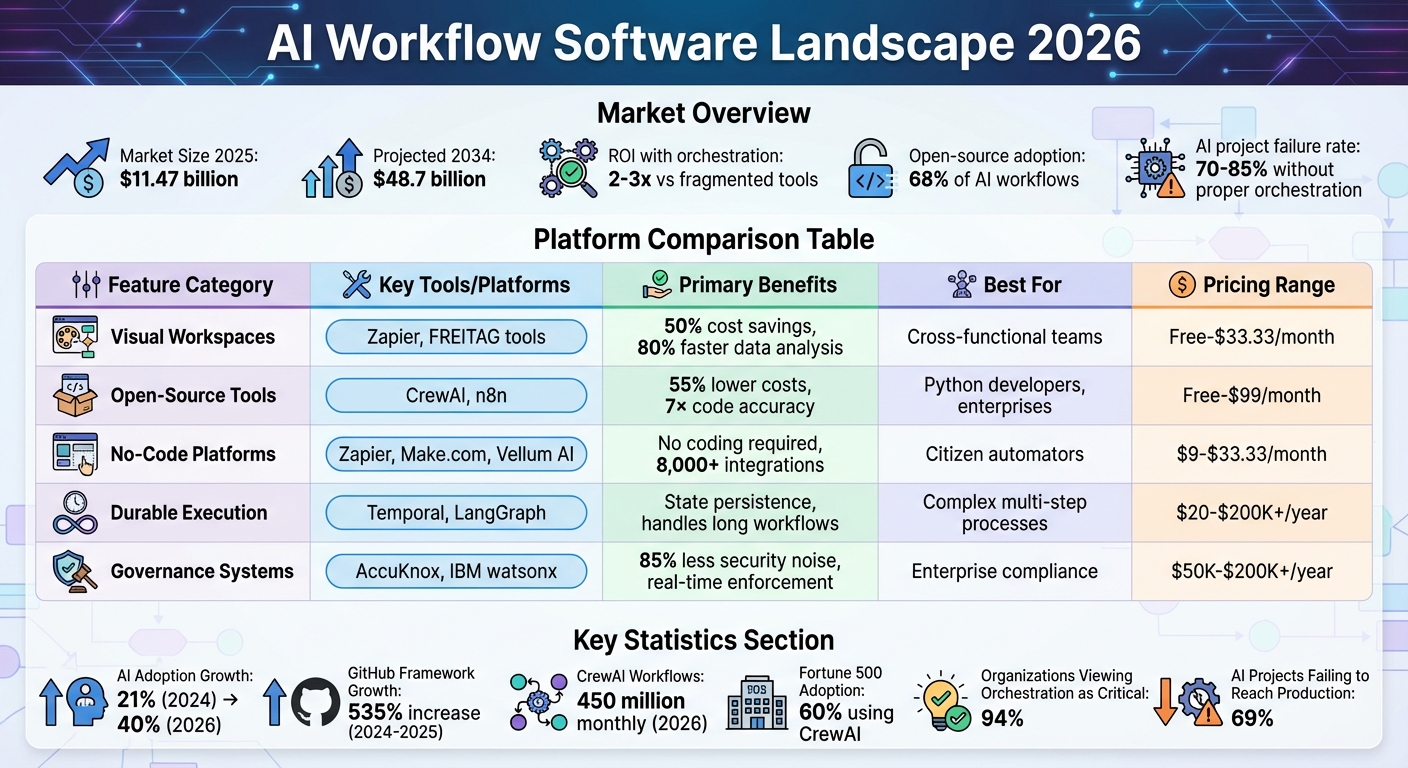
AI Workflow Software Platforms Comparison 2026: Features, Tools and Benefits
Shared Visual Workspaces Are Breaking Down Silos
In 2026, AI platforms are shifting from isolated, developer-centric tools to shared visual workspaces where technical and non-technical team members collaborate seamlessly. These platforms enable non-technical users to create AI agents with straightforward prompts, while engineers can fine-tune their functionality. By removing the bottleneck of waiting for engineering resources, this approach speeds up workflows and improves team productivity. It reflects a broader movement toward interoperable AI platforms that streamline collaboration across departments.
A practical example of this is the ERP replacement project undertaken by Swiss design company FREITAG in January 2026. Guided by Rainer Grau of Smart System Guild, the team used visual AI workflows to unite technical experts and business stakeholders on a single platform. This approach cut time and resource costs by 50% and improved data analysis speeds by 80%, reducing workshop evaluation timelines from weeks to just days.
"AI workflow building requires deep collaboration between non-technical teammates and engineers to make sophisticated workflows with stakeholder and SME level context." - Nicolas Zeeb, Author, Vellum AI
Despite the fact that 95% of generative AI pilots fail to reach production due to insufficient collaborative infrastructure, early adopters of these visual workflows are seeing measurable gains in efficiency. By integrating AI agents into familiar tools like Slack or project management platforms, teams can streamline task assignments and track progress without the delays caused by technical handoffs.
These platforms also include features like human-in-the-loop checkpoints for critical decisions, visual context processing that converts existing diagrams into actionable AI prompts, and transparent debugging tools. Together, these capabilities ensure that all team members, regardless of technical expertise, can contribute to and understand AI workflows effectively.
Self-Hosting and Data Control Redefine Enterprise AI
Open-source frameworks are reshaping enterprise AI by providing greater control and financial efficiency. This shift enables companies to self-host tools, ensuring sensitive data remains within their infrastructure - a critical need for industries like healthcare and finance that must meet GDPR compliance and other regulations.
By 2026, 68% of AI workflows rely on open-source frameworks. This trend isn’t just about cutting costs - it’s about ownership. Tools like n8n and CrewAI allow businesses to self-host, keeping customer data secure and reducing reliance on external SaaS platforms. The financial benefits are clear: enterprises using open-source orchestration tools report 55% lower per-agent costs compared to platform-only solutions, making it a practical choice for scaling AI operations.
Recent examples highlight the impact of open-source customization. In January 2026, PwC implemented CrewAI’s multi-agent framework, achieving a 7x boost in code generation accuracy for internal workflows. Similarly, General Assembly cut developer time by 90% for specific automation tasks using CrewAI’s role-based agents. These results showcase how open-source solutions can transform workflows by tailoring tools to unique business needs.
"Frameworks are where innovation happens. Platforms are where deployment happens. The best teams use both." - Harrison Chase, CEO, LangChain
The momentum behind open-source is undeniable. Between 2024 and 2025, GitHub repositories for agent frameworks with over 1,000 stars saw a 535% increase. CrewAI alone supports more than 450 million automated workflows monthly as of 2026, with 60% of Fortune 500 companies adopting its tools. Teams are embracing the flexibility to integrate custom JavaScript or Python logic into visual workflows, bridging the gap between business analysts and engineers while maintaining technical depth. Open-source isn’t just a tool - it’s becoming the foundation for enterprise AI innovation.
Plain English Interfaces Replace the Need for Technical Coding
No-code platforms are transforming how people interact with AI, making it possible for anyone to build workflows without needing technical skills. Take Make.com's "Maia" AI as an example - it can create a 15-module workflow graph from just one natural language prompt. Similarly, Zapier offers over 8,000 pre-built integrations and a conversational Copilot that builds workflows based on plain English instructions. These tools align with the broader trend of integrated and collaborative AI workflows.
By removing the need for coding expertise, these platforms open the door for professionals in fields like marketing, finance, and operations to actively contribute. Their unique insights bring valuable context to system design, ensuring workflows are practical and aligned with real-world needs.
No-code platforms also deliver measurable financial advantages. They cut down the time it takes to achieve results from months to mere minutes, bypassing traditional IT roadblocks. For instance, Zapier offers 400 free activities monthly, with Pro plans starting at $33.33 for 1,500 activities. Make's pricing begins at $9/month, while Vellum AI starts at $25/month - making enterprise-level AI tools accessible to a wider audience.
"The path forward in 2026 is making a huge leap from being a AI automation dev-only discipline to a team sport." - Nicolas Zeeb, Writer, Vellum AI
Between 2024 and 2026, AI adoption nearly doubled, climbing from 21% to 40%. Employees at companies with clear AI guidelines experimented six times more often. Tools like Zapier Canvas provide a "director's view" for mapping out complex AI processes, while role-based agent definitions allow users to assign objectives and backstories instead of writing code. This makes it easier to orchestrate collaborative AI behavior, empowering both technical and non-technical teams to work together seamlessly.
In 2026, platforms have stepped up to orchestrate all major AI models and handle increasingly intricate workflows, thanks to advancements in collaborative AI and no-code integration.
When managing AI processes with multiple decision points, prolonged execution timelines, and inter-agent communication, durable execution has become a must-have feature. Tools like Temporal ensure that AI agents can maintain their state over extended durations - even through server restarts. For example, an agent tasked with contract review can pause for days awaiting human approval and resume seamlessly without losing its context.
Graph-based orchestration is another game-changer, replacing traditional linear workflows with directed graphs that allow for cycles, loops, and parallel processing. LangGraph is a standout in this space, enabling agents to revisit earlier steps or explore multiple paths at the same time, making it ideal for complex decision-making scenarios.
To support these advanced workflows, observability tools are critical. They separate production-grade platforms from experimental ones by providing insights into an agent’s decision-making process. Features like time-travel debugging allow users to trace and understand every decision an agent makes, reducing errors and increasing reliability. The Model Context Protocol (MCP), supported by major tech companies, has standardized these tools, enabling smoother cross-platform operations. Businesses that embrace mature AI orchestration systems report capturing 2-3x more value from their AI agents compared to those that lack proper tooling.
"An orchestration platform is significantly less effective without a 'Debugger for AI Thoughts.'" - Digital Applied
Pricing for these platforms varies widely based on complexity and scale. For smaller setups, n8n offers free self-hosting with cloud plans starting at $20/month. CrewAI provides free open-source access with premium plans at $99/month. For larger enterprises, solutions like Domo and IBM watsonx come with price tags ranging from $50,000 to over $200,000 annually.
The rapid pace of advanced automation demands governance systems that can keep up.
Traditional methods of governance often fall short when managing AI agents executing complex, multi-step workflows. Manual reviews, or what some call "safety theater", simply can't match the speed and scale of modern AI operations. Instead, organizations are turning to policy-as-code frameworks that enforce rules in real time. This approach treats AI agents like workloads, applying runtime identity verification, least-privilege permissions, and strict egress controls to prevent unauthorized data access or leaks.
Consider this: 94% of organizations view process orchestration as crucial for deploying AI successfully, yet 69% of AI projects fail to move into operational use due to challenges with integration and orchestration. The missing piece often lies in the governance architecture. Platforms with unified governance capabilities can simplify tooling by 75% and cut down security alert noise by 85% through smarter, context-aware systems.
"The moment an agent is allowed to use tools, the blast radius stops looking like 'bad prompts' and starts looking like a compromised workload inside your environment." - Atharva Shah, AccuKnox
To address these risks, modern enterprise platforms now feature centralized governance gateways. These gateways provide a single control point for critical tasks like PII sanitization, prompt filtering, and usage monitoring across various LLM providers. Unlike traditional systems that monitor syntax after execution, these platforms enforce semantic security by evaluating an agent's intent and confidence levels before allowing actions. For organizations managing sensitive data, hybrid deployment models offer a balance: a cloud-based control plane for centralized oversight and a data plane within the company’s VPC to ensure data residency.
Audit trails are another cornerstone of effective governance. With 87% of developers expressing concerns about AI accuracy, detailed trace logs are not just about compliance - they're essential for diagnosing issues and improving operations. A strong audit trail transforms governance from a mere checkbox into a strategic advantage, offering clarity and accountability in AI-driven workflows.
Selecting the right platform for your team involves aligning it with your technical workflows and expertise. In 2026, collaborative AI workflow platforms have matured into three main categories, each catering to specific user roles and technical demands. Misalignment between your team’s needs and the platform’s capabilities can lead to inefficiencies and inflated costs.
For Python developers working on complex state machines, LangGraph (v1.0) stands out. Its graph-based execution offers precise control, pay-per-node pricing, and an open Agent Protocol that ensures seamless communication with agents created in frameworks like CrewAI or Microsoft Agent Framework. Technical power users and DevOps teams often turn to n8n, which features execution-based pricing - ideal for managing intricate AI loops - and supports up to 220 workflow executions per second on a single instance, thanks to its LangChain integration. Meanwhile, Zapier Agents is the go-to for citizen automators and business operations teams, providing no-code prototyping through its Model Context Protocol (MCP). It connects to over 8,000 apps and includes a free tier with 400 activities per month.
However, pricing models can influence your choice. Activity-based pricing, like that of Zapier Agents, may lead to higher costs when dealing with iterative loops. In contrast, execution-based pricing, as seen with n8n, offers more predictable costs per workflow run, making it a better option for complex processes.
"For financial services, healthcare, and government sectors, self-hosted orchestration shifts from 'nice to have' to 'mandatory infrastructure.'" - Likhon, AI Engineer
Observability tools further differentiate these platforms. Advanced debugging features are now standard in production-ready platforms. For instance, LangGraph Studio offers time-travel debugging to trace issues step by step, while n8n integrates with LangSmith for comprehensive error tracking, enabling developers to pinpoint failures with precision.
When workflows are mission-critical and require human-in-the-loop approvals, durable execution capabilities become indispensable. Temporal has emerged as the 2026 benchmark for state persistence, used by OpenAI for Codex in production to ensure agents continue operating even after server restarts. This distinction is crucial when comparing platforms designed for quick prototyping versus those built for enterprise deployment. Choosing an unsuitable orchestration foundation could lead to infrastructure costs exceeding $500,000 - a mistake no team wants to make.
Selecting the best AI workflow platform in 2026 requires aligning your technical setup with your team's skills and your business objectives. The difference between platforms that deliver 2–3x ROI and those that never move beyond pilot testing often comes down to proper alignment. For instance, the tools your Python developers need will differ greatly from those required by your business operations team. Forcing a one-size-fits-all solution can lead to inefficiencies and lost productivity.
To get started, focus on identifying your organization’s specific challenges. Companies that address these early tend to outperform those that take a broader, less targeted approach. While 88% of organizations now use AI in at least one area, many generative AI pilots fail due to poor orchestration. The main issue? A lack of attention to critical features like execution durability, observability, and governance - key aspects that separate scalable systems from prototypes.
"AI orchestration is no longer optional for organizations running complex AI systems." - Digital Applied
A well-structured pricing model is another essential factor. Choose one that aligns with your workflow complexity and offers predictable costs. Execution-based pricing, for example, can provide more stability than activity-based models, especially when iterative loops are involved. This is particularly important as AI agents take over about 30% of repetitive tasks today, with the aim of reaching 70%. Without proper orchestration infrastructure, between 70% and 85% of AI projects fail, making robust systems a necessity for achieving 2–3x higher value.
Interoperable workflows and strong governance are the foundation for scalable AI. To stay competitive, prioritize platforms that enable non-technical users to quickly deploy useful workflows. Look for features like clear usage policies to encourage experimentation, abstraction layers to adapt as frameworks evolve, and version control to recover from errors without losing progress. With only 2% of organizations deploying AI agents at scale, despite the $450 billion economic potential projected by 2028, there’s still a significant opportunity for teams that make smart, timely choices.
AI orchestration refers to the process of coordinating various AI tools, models, and workflows so they function smoothly as a unified system. It handles essential tasks such as routing, managing data flow, and overseeing system transitions. This approach is especially important in complex setups involving large language models (LLMs), as it helps boost efficiency, cut costs, and scale operations while ensuring governance and maintaining operational consistency.
To select the best workflow platform, focus on its capability to bring together AI models and tools for smooth management and less complexity. Look for features that support scalability, strong security, and compliance - especially when handling sensitive data. Tools that are easy to use, such as natural language builders and cost management options, are essential. Choose platforms with strong integration, governance, and simplicity to improve teamwork and keep up with changing AI needs.
In 2026, managing AI agents in production demands clear frameworks to prioritize safety, compliance, and reliability while encouraging progress. This involves implementing risk management strategies, robust security protocols, and operational oversight to avoid unintended consequences and maintain control over autonomous decision-making. Successful governance also requires tools for monitoring, ensuring transparency, and meeting regulatory standards. By balancing autonomy with accountability, organizations can ensure AI agents function ethically and securely in production settings.