Pay As You Go - AI Model Orchestration and Workflows Platform



AI command centers simplify how businesses manage, monitor, and automate AI workflows. They integrate tools across endpoints, networks, and cloud systems, helping teams handle massive alert volumes and reduce risks. With data breaches costing an average of $4.88 million (2024), these platforms are critical for cutting through alert fatigue and improving efficiency.
Here’s a quick overview of three top providers:
Each platform caters to different needs - model variety, security automation, or data integration. Below is a comparison to help you decide.
| Provider | Key Feature | Limitation | Best For |
|---|---|---|---|
| Prompts.ai | Access to 35+ LLMs; FinOps | Limited to LLM orchestration | Teams managing diverse AI tools |
| Provider X | AI security automation | Complex setup for governance | Security-focused organizations |
| Provider Y | 1,000+ data connectors | High scaling costs | Data-heavy enterprises |
Choose based on your priorities - cost efficiency, security automation, or seamless data integration.
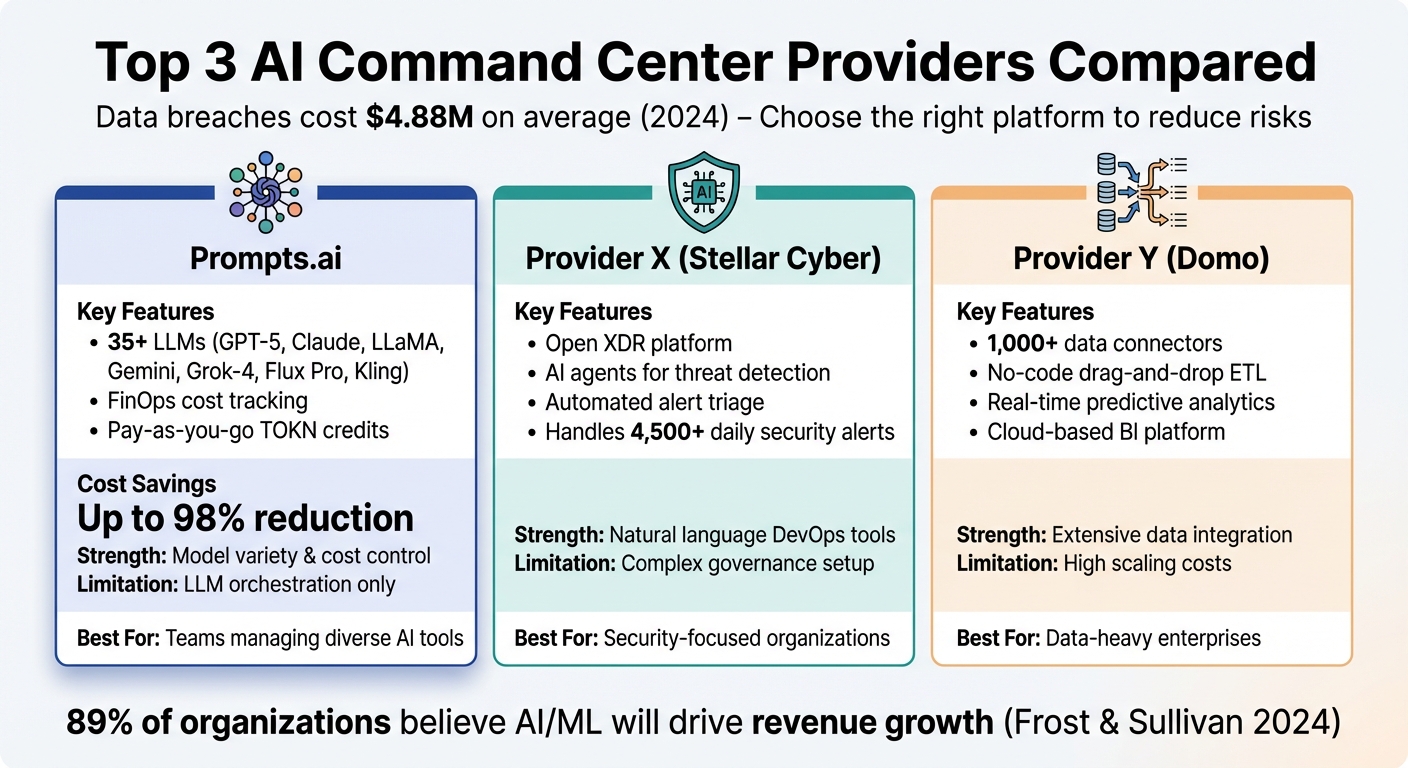
AI Command Center Providers Comparison: Features, Costs, and Best Use Cases
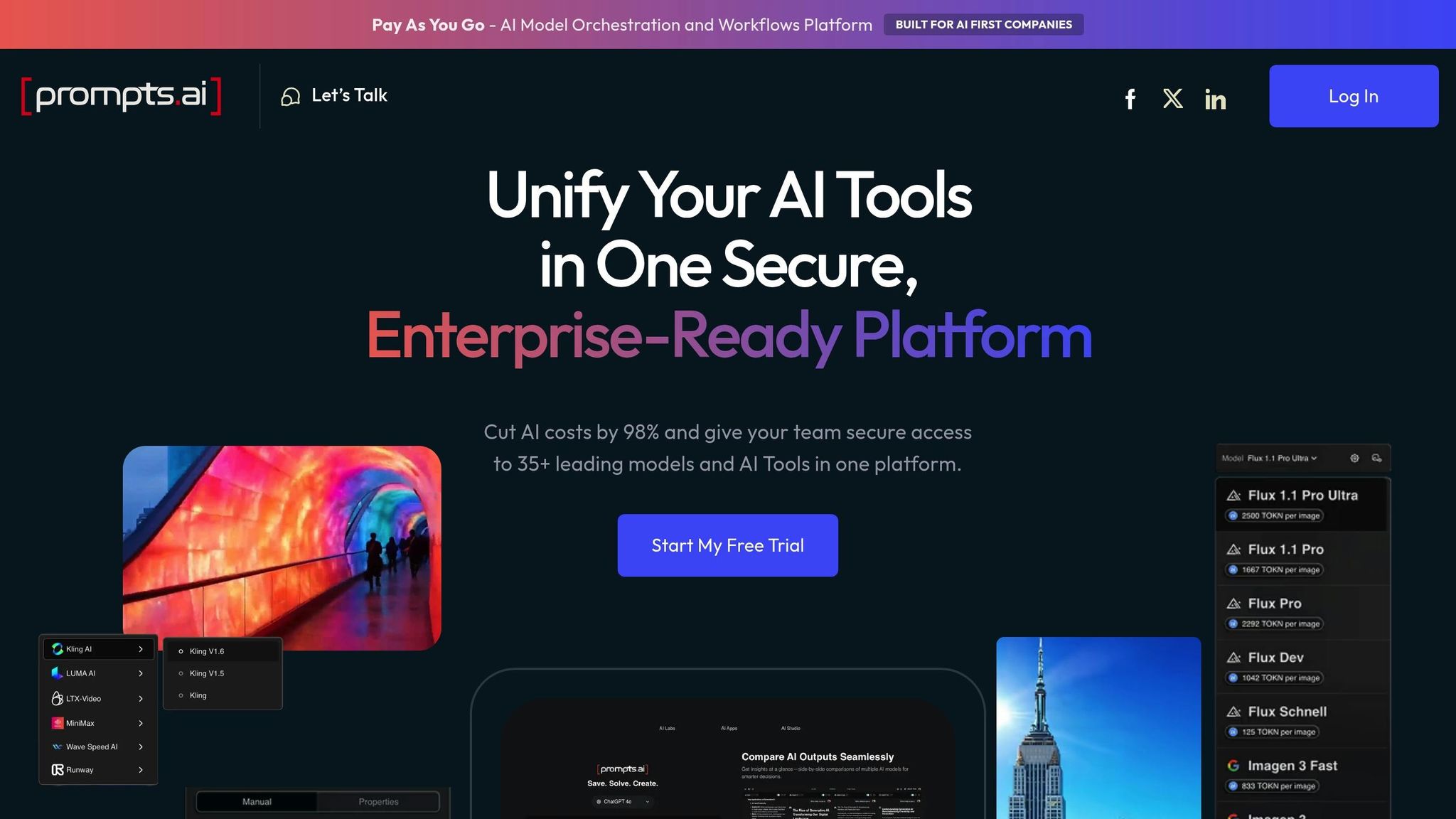
Prompts.ai is a powerful AI orchestration platform designed for enterprise use, bringing together over 35 leading large language models (LLMs) such as GPT-5, Claude, LLaMA, Gemini, Grok-4, Flux Pro, and Kling. Created by Emmy Award-winning creative leader Steven P. Simmons, the platform tackles the issue of managing scattered AI tools by offering what it calls "The Intelligence Layer for Institutional Knowledge."
Prompts.ai simplifies operations by combining access to the industry's top AI models in one secure interface. Instead of juggling multiple platforms or vendor contracts, organizations can seamlessly interact with any of the 35+ models. This setup allows teams to compare model performance side-by-side and choose the most effective tool for each task. By centralizing these capabilities, the platform enhances workflow efficiency and decision-making.
The platform's workflow engine transforms one-off experiments into structured, repeatable processes. Through standardized prompt workflows, teams can ensure compliance and consistency. Prompts.ai also offers a Prompt Engineer Certification program, equipping team members to create and share effective practices. With built-in usage tracking and audit trails, teams can monitor AI interactions and roll out new workflows in minutes while maintaining strict data oversight. This approach not only improves efficiency but also helps manage costs and ensures secure operations.
Prompts.ai can reduce AI software expenses by as much as 98% by eliminating unnecessary subscriptions and adopting a pay-as-you-go system with TOKN credits. The platform includes an integrated FinOps layer that tracks token usage, tying every expense directly to business results. Instead of paying fixed monthly fees, which often range between $29 and $129 per user for various tools, teams only pay for what they use. This transparency makes it easier to manage and optimize spending.
Security is a top priority for Prompts.ai, which incorporates enterprise-grade measures like role-based access controls, detailed audit trails, and customizable data residency options. These features ensure that sensitive data remains within approved boundaries. The platform also enforces compliance policies automatically, offering the control and visibility needed to meet regulatory demands while supporting rapid innovation.
Stellar Cyber functions as an Open XDR platform, designed to consolidate security tools and leverage AI-driven automation to handle intricate threat detection processes. It tackles a frequent issue in enterprise security - managing an overwhelming number of tools. By integrating with existing EDR, network security, and cloud security solutions, it serves as a centralized hub for security teams.
The platform employs AI agents capable of mimicking human analytical workflows but at machine speed and scale. These agents autonomously handle alert triage, threat investigation, context building, and the creation of actionable threat reports. This automation significantly reduces the workload for security teams, enabling them to concentrate on high-level strategic decisions instead of routine alerts. This efficient workflow aligns with the platform's mission to minimize manual effort and enhance decision-making.
Stellar Cyber's Open XDR framework seamlessly connects with existing EDR, network monitoring, and cloud security tools. It eliminates the need for additional solutions, allowing organizations to maintain their current systems while improving overall orchestration and functionality.
Domo is a cloud-based business intelligence platform that serves as an AI command center by seamlessly connecting real-time data streams with predictive analytics and automated workflows. It tackles a key challenge for enterprises: converting fragmented data into actionable insights while upholding rigorous security and governance standards. This combination of data integration and AI-powered automation reflects the growing demand for centralized and efficient AI management systems.
Domo provides secure connectors to popular data sources like Salesforce, SAP, BigQuery, and MySQL. Its drag-and-drop ETL interface allows users to prepare data without needing to write code. By removing technical hurdles, this feature empowers business teams to independently establish system connections, speeding up data integration efforts.
By combining real-time data with predictive analytics, Domo enables organizations to forecast outcomes and automate workflows. This functionality shifts businesses from reactive reporting to proactive decision-making, with automated responses triggered by predefined rules.
Domo incorporates robust security measures, including RBAC (role-based access control), encryption, and audit logs to monitor all activity. The platform provides centralized governance tools, complete with real-time alerts for data quality and potential risks. Designed to meet strict regulatory standards, Domo offers compliance certifications suitable for industries with demanding regulations. Its governance framework scales automatically to handle increasing data volumes and hybrid or multi-cloud environments, ensuring consistent security regardless of infrastructure complexity. This integrated approach highlights the industry's focus on streamlined and secure AI operations.
AI command center providers bring distinct strengths and challenges to the table, making it essential for businesses to align platform features with their operational goals and technical readiness. Below is a concise comparison of key providers to help you identify the best match for your needs.
Prompts.ai simplifies access to over 35 LLMs through a secure interface, integrating FinOps for real-time spending oversight. This reduces tool redundancy and can lower costs by as much as 98%. However, its specialization in LLM orchestration means businesses may need additional tools to address broader operational requirements.
Provider X excels in natural language-based infrastructure management, making it easier for teams to control systems without deep technical expertise. That said, configuring governance and security policies can be complex, particularly for organizations without dedicated DevOps teams, leading to potential hurdles during setup.
Provider Y stands out with its 1,000+ data connectors and user-friendly no-code interface, which simplifies integration tasks. Its drag-and-drop ETL tools are ideal for removing technical roadblocks. However, scaling the platform for larger deployments can become costly, which may be a concern for budget-conscious enterprises.
Here’s a quick look at the pros and cons:
| Provider | Key Strength | Primary Limitation | Best Suited For |
|---|---|---|---|
| Prompts.ai | 35+ LLMs; FinOps cost control | LLM orchestration only | Teams needing diverse AI model access |
| Provider X | Natural language DevOps tools | Complex governance setup | Organizations with infrastructure needs |
| Provider Y | 1,000+ connectors; no-code tools | High scaling costs | Enterprises focusing on data integration |
Choosing the right platform depends on your priorities. If model variety and cost efficiency are key, Prompts.ai is a strong contender. For infrastructure automation, Provider X may be the better fit, while Provider Y shines in scenarios requiring extensive data integration. Businesses with limited technical expertise should also consider potential onboarding challenges, such as the steep learning curve of Provider X or the scaling expenses of Provider Y.
Choosing the ideal AI command center requires aligning a platform's features with your organization's specific needs. Prompts.ai stands out for enterprises focusing on model variety and cost management. With access to over 35 top-tier LLMs and a built-in FinOps layer capable of reducing AI expenses by up to 98%, it offers a compelling solution for teams juggling multiple AI workflows - without the hassle of recurring subscription fees. This highlights the importance of matching platform capabilities with strategic goals in today’s era of autonomous AI workflows.
For businesses prioritizing security operations, autonomous systems that manage alert triage and threat investigation can dramatically cut response times and lower risk. Considering that organizations handle an average of 4,500 security alerts daily, automated workflows provide a practical solution for effective threat management.
Different platforms cater to varied priorities - some focus on cost efficiency and model diversity, while others emphasize infrastructure automation or seamless data integration. The rise of agentic AI, which refers to autonomous systems capable of executing multi-step workflows with minimal supervision, is transforming how businesses operate. According to Frost and Sullivan's Global State of AI Report 2024, 89% of organizations believe AI and machine learning will drive revenue growth, improve operational efficiency, and enhance customer experiences. As agentic AI continues to redefine workflows, selecting the right platform becomes essential to fully leverage these advancements.
Ultimately, your choice should reflect your organization’s technical requirements, team capabilities, and budget constraints.
An AI command center serves as a hub for managing and coordinating AI systems and workflows across an organization. It offers a single interface to oversee various AI tools, models, and agents, making operations more efficient while ensuring compliance and controlling costs. These platforms support real-time monitoring, automate workflows, and integrate seamlessly with existing systems, allowing businesses to streamline processes and maintain oversight of their AI initiatives on a larger scale.
To select the best AI command center, focus on how well it integrates with your existing systems and its ability to centralize control over various AI models and tools. Opt for platforms that accommodate a wide range of models, provide real-time monitoring, and include features for automation and governance. It’s also important to consider cost efficiency, scalability, and user-friendliness. Look for solutions that help cut costs, handle complex workflows seamlessly, and ensure transparency to drive both growth and operational efficiency.
When considering AI command centers, focus on platforms that offer integrated governance tools such as compliance management, security measures, and comprehensive audit trails. These features help maintain transparency, ensure accountability, and support regulatory requirements.
Strong audit capabilities should include tracking how models are used, monitoring data access, and logging decision-making processes. Seek centralized tools that provide real-time monitoring, cost management, and activity tracking to effectively mitigate risks and uphold compliance across intricate AI workflows.