Pay As You Go - AI Model Orchestration and Workflows Platform


AI orchestration platforms are solving the growing problem of platform sprawl, where businesses juggle disconnected tools and struggle to scale AI effectively. By centralizing workflows, data, and models, these platforms simplify management, cut costs, and ensure compliance. Despite 65% of companies starting AI pilots, only 11% achieve full deployment due to infrastructure gaps. Platforms like Prompts.ai, Stellar Cyber Open XDR, Palo Alto Cortex XSOAR, and C3 AI bridge this gap, offering tools to unify and scale AI while improving governance and transparency.
| Platform | Focus Area | Key Features | Cost Management | Governance Tools |
|---|---|---|---|---|
| Prompts.ai | AI Model Integration | Access 35+ LLMs, real-time comparisons, pre-built prompt orchestration | Pay-as-you-go TOKN credits | Role-based access, audit logs |
| Stellar Cyber Open XDR | Security Orchestration | Automates threat detection, integrates 400+ tools, aligns with MITRE ATT&CK | Unified license | Multi-tenancy, NIST alignment |
| Palo Alto Cortex XSOAR | Security Automation | AI agents, drag-and-drop workflow creation, 850+ integrations | Not specified | Audit trails, manual approvals |
| C3 AI | Enterprise AI Workflows | No-code workflow creation, 250+ connectors, self-evaluating agents | Auto-scaling services | Central model registry |
These platforms cater to different needs - Prompts.ai excels in cost efficiency and multi-model integration, while C3 AI delivers tailored solutions for specific industries. Choose based on your priorities: affordability and accessibility or advanced customization for enterprise use.

AI Orchestration Platforms 2026: Feature Comparison of Prompts.ai, Stellar Cyber, Palo Alto Cortex XSOAR, and C3 AI
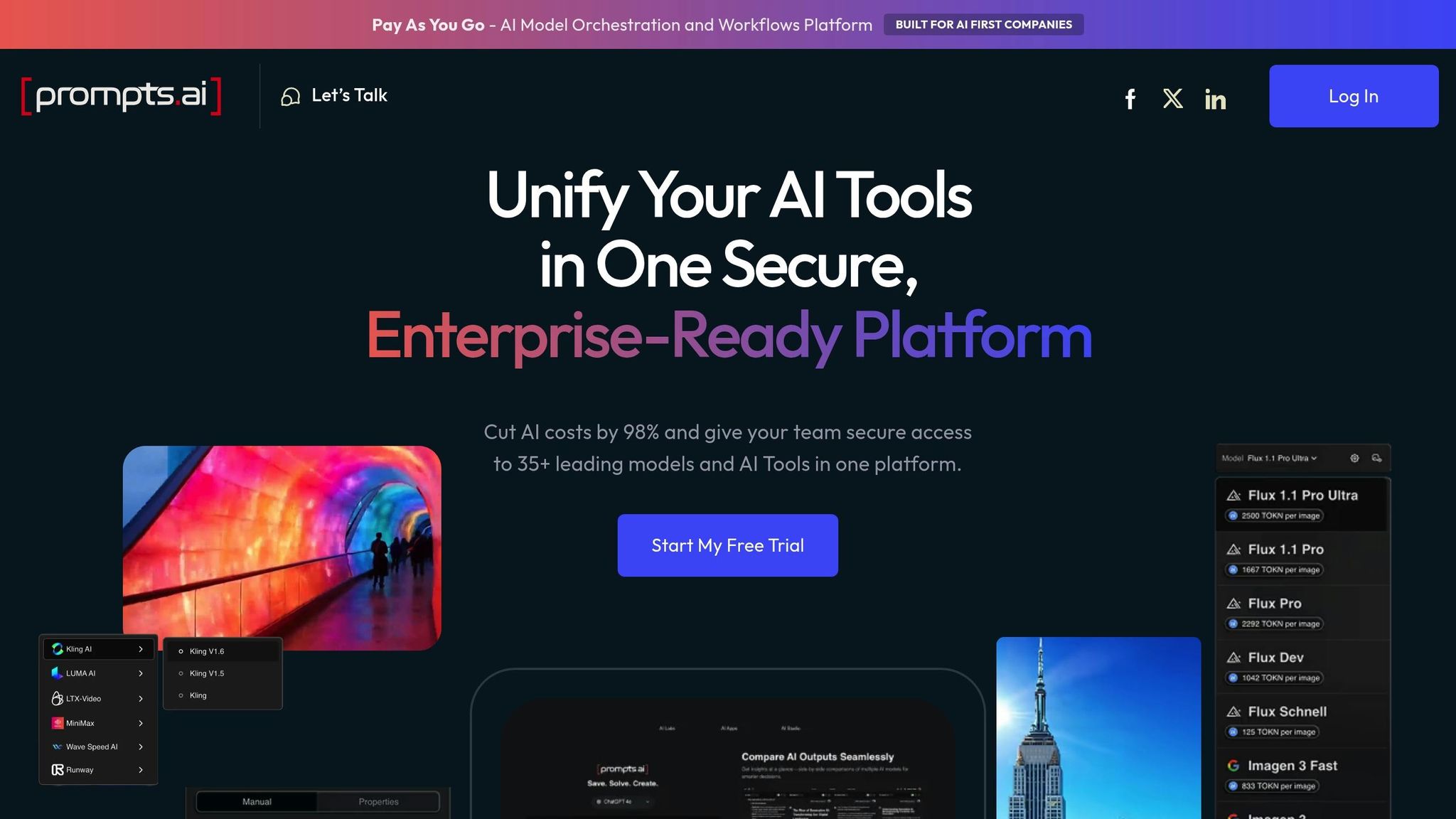
Prompts.ai tackles the issue of fragmented AI tools by bringing together 35+ large language models - such as GPT-5, Claude, LLaMA, Gemini, Grok-4, Flux Pro, and Kling - into a single, unified platform. This consolidation simplifies the AI adoption process by merging subscriptions, logins, and billing into one streamlined dashboard. From Fortune 500 companies to creative agencies, users can access all major models in one workspace, removing the typical barriers that slow down AI integration. This setup not only fosters easier adoption but also enables seamless model comparisons, automation, and strict oversight.
The platform’s architecture connects directly to various model providers without requiring individual API keys. Teams can switch between models instantly and compare their performance in real time to determine the best fit for specific tasks - whether it’s document analysis, code generation, or visual content creation. For example, a marketing team could test Claude for crafting compelling copy while the engineering team evaluates LLaMA for technical documentation, all within the same workspace. This flexibility ensures that each team can work efficiently without compromising on governance or oversight.
Prompts.ai enhances productivity with its prompt orchestration layer, which includes the "Time Savers" feature. This provides pre-built prompt sequences that are ready for immediate use. Teams can chain multiple models together to handle complex workflows - like using one model for data extraction, another for analysis, and a third for generating reports. This layered automation simplifies processes and boosts efficiency across departments.
To maintain control over these workflows, the platform offers enterprise-grade governance tools such as role-based access control (RBAC), audit logs, and data isolation. These features ensure sensitive information stays secure within organizational boundaries. Every user interaction is logged, creating a transparent audit trail that meets regulatory requirements. This level of oversight gives IT leaders the confidence to manage AI-driven actions across different departments while maintaining compliance.
Prompts.ai’s cost tracking layer provides real-time monitoring of token usage, linking every dollar spent to specific teams, projects, or tasks. Organizations report up to 98% savings on AI costs by consolidating their subscriptions through the platform. With the pay-as-you-go TOKN credit system, users are only charged for what they actually use, avoiding the need for fixed monthly fees. This flexible pricing model ensures that expenses align with actual business needs, eliminating wasteful spending on underutilized tools.
Stellar Cyber Open XDR tackles the problem of fragmented security tools by acting as a central orchestrator, seamlessly integrating with existing systems without the need for replacements. In January 2026, version 6.3 introduced the Model Context Protocol (MCP), which allows organizations to incorporate third-party AI agents and bots directly into their security workflows. With API-based connectors, the platform integrates with over 400 third-party tools - ranging from EDR systems and firewalls to identity providers and cloud platforms - offering centralized visibility and paving the way for advanced automation.
Leveraging its unified architecture, the platform's Agentic AI processes security signals automatically, prioritizing risks and providing detailed incident explanations. Through graph-based correlation, it consolidates alerts into unified "Cases", aligning them with the MITRE ATT&CK framework, which eliminates the need for manual data aggregation. Organizations using Stellar Cyber report an 8x improvement in Mean Time to Detect (MTTD) and a 20x improvement in Mean Time to Respond (MTTR) compared to traditional SIEM solutions. The AI-generated case summaries clearly explain the "what, why, and how" of each incident. As Aimei Wei, Chief Technology Officer at Stellar Cyber, puts it:
"With Agentic AI at the core of our platform, we're transforming raw telemetry into clear decisions and automated actions - so security teams can move at machine speed without losing human trust."
The platform also emphasizes governance, offering multi-tenancy capabilities that allow MSSPs and large enterprises to manage multiple business units within a single instance while maintaining logical separation. The Query Manager feature lets teams export and share proven detection logic across tenants, ensuring consistent security practices throughout the organization. Every workflow is aligned with NIST SP 800-207 Zero Trust principles, providing continuous identity and context evaluation to meet regulatory requirements.
Stellar Cyber combines AI-driven SIEM, NDR/OT, UEBA, ITDR, and Open XDR into a single unified license, eliminating the need for multiple standalone solutions. This approach boosts analyst productivity by 80% and reduces false positives by over 90%, enabling lean security teams to focus on real threats instead of alert noise. Erwin Eimers, CISO at Sumitomo Chemical, shares:
"Stellar Cyber is the most cost-effective way to adopt AI and XDR."
Users on Gartner Peer Insights have praised the platform as delivering "Sportscar Performance XDR for a Family Sedan Budget", emphasizing its ability to provide enterprise-grade capabilities at a budget-friendly price.
Palo Alto Cortex XSOAR takes security orchestration to a new level with autonomous AI operations. The 2026 introduction of Cortex AgentiX allows organizations to deploy AI agents capable of independently handling security challenges. These agents, trained on 1.2 billion operational executions, operate within a controlled framework that ensures both governance and auditability. This development aligns with the industry's shift toward unified and intelligent orchestration. Francis Odum, Founder and Software Analyst at Cyber Research (SACR), highlights:
"Cortex AgentiX stands apart by leveraging a decade of SOAR maturity to ensure agents operate within a fully governed automation framework."
The platform seamlessly connects with over 850 third-party products using APIs and webhooks. With the Cortex MCP Server, the Model Context Protocol (MCP) enables natural language interactions between large language models (LLMs) and security tools. Integration outputs are stored in a centralized JSON format, making data sharing straightforward. For proprietary systems, users can leverage the Bring Your Own Integration (BYOI) feature to create custom connections. This robust integration framework supports the growing demand for interoperable and efficient AI workflows.
The Visual Playbook Editor simplifies workflow creation with its drag-and-drop interface, allowing users to build complex processes that include conditional paths and manual approvals. For example, North Dakota Information Technology (NDIT) implemented 196 playbooks that now automatically resolve 60% of incidents, achieving the equivalent of adding eight to 10 full-time SOC analysts. Similarly, the Oneida Nation reduced their median time to resolution (MTTR) to just 43 seconds by utilizing the platform’s advanced automation tools. Additionally, built-in machine learning models, like DBot for indicator analysis, enhance operations by learning from historical analyst actions.
The platform ensures transparency and accountability through several governance tools. Every investigation is documented in the War Room, a chronological record that serves as a complete audit trail. For critical decisions, manual approvals are required, maintaining human oversight. Cortex XSOAR also verifies all third-party content in its marketplace for safety. Teams can test automation scripts in the Playground environment without affecting live operations. These governance features underscore the platform’s commitment to secure, enterprise-level automation. As the Head of Cyber Security Prevention and Transformation at BNL shares:
"Cortex XSOAR allowed us to orchestrate all the activities we used to perform manually, resulting in the optimization of all the processes."
C3 AI delivers enterprise-level orchestration through its Agentic AI Platform, which introduced Agentic Process Automation (APA) in September 2025. This solution goes beyond traditional RPA by combining fixed business rules with adaptable AI agents. Stephen Ehikian, CEO of C3 AI, describes it as:
"C3 AI Agentic Process Automation is a breakthrough that will mark a decisive shift in the very nature of work."
This unified approach reflects the broader move in the industry toward centralized orchestration, aligning with trends seen across other leading platforms.
C3 AI integrates seamlessly with major large language models such as Azure OpenAI, Anthropic Claude, and Google Gemini, while also supporting established machine learning frameworks like TensorFlow, XGBoost, and Transformers. The platform offers over 250 connectors, enabling integration with structured, unstructured, batch, and streaming data from various enterprise systems. Its Data Fusion capability creates virtual, unified data images without duplicating data, protecting prior investments and enabling smooth orchestration across existing systems.
C3 AI empowers business users to design workflows through a no-code, natural language interface, using pre-built templates for tasks like invoice processing and equipment troubleshooting. Ansh Guglani, Senior Product Manager at C3 AI, highlights:
"If you understand your business problem, you can author a workflow in natural language without getting into the weeds of what's happening in the background."
Unlike static scripts, C3 AI agents can evaluate their own outputs, retry failed steps, and adaptively choose the best next action based on real-time conditions. Workflows can operate on fixed schedules or be triggered instantly.
Transparency is a key focus for C3 AI, achieved through a central model registry that supports version control and auditability for all AI models. The platform includes tools for data lineage and profiling, ensuring every AI action is fully traceable. It meets stringent compliance standards such as SOC2, NIST, and HIPAA, while role-based access controls restrict data access to authorized users. Additionally, human-in-the-loop capabilities allow users to define conditions requiring manual review before workflows proceed.
C3 AI optimizes costs with auto-scaling inference services that adjust resources based on demand, ensuring efficient computational use. Its advanced time-series capabilities manage storage tiers intelligently, balancing performance and cost for large-scale deployments. With over 200 data transformations - including anomaly detection and text manipulation - the platform reduces development time and expenses, enabling organizations to implement AI workflows quickly without needing custom-built solutions.
AI orchestration platforms in 2026 bring distinct advantages and compromises, catering to different organizational needs.
Prompts.ai brings together over 35 large language models in a single, secure dashboard. Its standout features include real-time FinOps controls for cost management and direct performance comparisons, enabling organizations to reduce AI expenses and simplify tool usage. The platform's pay-as-you-go TOKN credit model removes fixed fees, making it a flexible option. It also prioritizes governance and efficient workflows, making it suitable for teams with varying technical expertise. On the other hand, C3 AI delivers a more focused, industry-specific solution.
C3 AI employs a model-driven architecture to quickly deploy reusable AI applications and workflows tailored to specific industries. While this allows for scalable and customized automation, its enterprise-centric approach often requires a larger upfront investment compared to more streamlined platforms like Prompts.ai.
The right platform depends on what your organization prioritizes. If seamless access to multiple models, transparent cost management, and quick deployment are essential, Prompts.ai may be the better fit. However, for businesses seeking highly customized, industry-specific solutions, C3 AI might align more closely with their goals. Both platforms reflect the ongoing push to simplify AI integration while addressing cost, adaptability, and oversight.
Choose an AI orchestration platform that aligns with your team’s technical skills and operational goals. For those aiming to quickly deploy and access more than 35 leading models, Prompts.ai offers a streamlined solution with clear cost management. Its pay-as-you-go TOKN credit system and real-time FinOps dashboard help eliminate financial uncertainty.
While Prompts.ai focuses on rapid deployment and affordability, platforms like C3 AI cater to organizations requiring highly tailored, industry-specific workflows. These solutions offer deeper customization but often come with longer implementation timelines and higher upfront costs.
This comparison highlights the trade-off between immediate usability and specialized functionality. Your decision should hinge on whether cost efficiency, flexibility across multiple models, and quick deployment take precedence over a customized, sector-specific approach. Together, these considerations reflect the broader goal of unifying fragmented AI tools into scalable, efficient solutions.
AI orchestration platforms bring several key benefits that simplify and improve the management of AI operations for businesses. By centralizing workflows, these platforms make it easier for organizations to oversee multiple AI models and processes, cutting through complexity and boosting productivity.
They also help control costs more effectively through real-time monitoring and centralized expense management, enabling businesses to reduce operational spending. On top of that, they strengthen governance and compliance by automating oversight and applying consistent policies, which is crucial for scaling AI responsibly.
With features that automate complex tasks, support scalability, and maintain oversight of AI deployments, these platforms have become indispensable for enterprises aiming to get the most out of their AI investments.
Prompts.ai offers businesses a 'Pay As You Go' pricing model, allowing you to pay only for the AI resources you utilize. This flexible approach can cut AI-related expenses by as much as 98%, making it an effective way to manage budgets efficiently.
The platform also provides centralized tools for managing costs, including real-time tracking of AI usage and spending through TOKN credits. These features give businesses the ability to monitor workflows closely and adjust them as needed, ensuring scalable AI integration without overspending.
Effective AI orchestration platforms need to incorporate essential governance features like audit trails, security controls, and compliance management. These capabilities are crucial for keeping workflows on track, ensuring regulatory requirements are met, and minimizing the risk of errors.
Equally important are tools such as real-time cost tracking and budget controls, which allow organizations to monitor expenses and allocate resources effectively, particularly in large-scale operations. By automating oversight tasks, these platforms not only improve reliability and transparency but also ensure processes remain aligned with established standards, making them vital for managing AI initiatives with precision and efficiency.