Pay As You Go - AI Model Orchestration and Workflows Platform



AI chaos is costing businesses both time and money. 74% of enterprise AI initiatives fail to deliver results due to disconnected tools, hidden usage, and siloed teams. The solution? Collaborative AI workflows - integrated systems that streamline tools, align teams, and enforce governance.
Key Takeaways:
How It Works:
Prompts.ai unifies 35+ AI models (e.g., GPT-5, Claude, LLaMA) into one secure platform. Teams share prompt libraries, monitor workflows, and optimize costs with TOKN credits. By centralizing resources and tracking performance, organizations can scale AI usage while maintaining control.
Collaborative workflows are transforming AI from isolated experiments into scalable, team-driven solutions.

Key Benefits of Collaborative AI Workflows: ROI, Cost Savings & Productivity Stats
Shifting from isolated AI experiments to organized workflows promotes faster teamwork, reduces costs, and improves compliance. These advantages directly contribute to measurable productivity gains and more effective cost management.
Collaborative workflows tackle inefficiencies caused by juggling multiple AI tools or manually moving data between systems. With access to a shared prompt library on a unified platform, teams can bypass repetitive trial-and-error processes. Instead of starting from scratch for every task, they can rely on proven prompts, saving time and increasing efficiency.
Speed isn't the only factor - financial oversight is just as critical. Without clear visibility into token usage, AI spending can spiral out of control. Prompts.ai addresses this by tracking usage in real time and applying model right-sizing. For example, simpler tasks are routed to cost-effective models like Phi-3 or LLaMA-3, avoiding the expense of high-reasoning models when they aren't necessary. This smart routing can slash costs by up to 85%.
Additionally, optimizing prompts - such as instructing models to "be concise" - can reduce token usage by 15–25% on average. A recent case study highlighted a 14% cost reduction simply by adjusting workload configurations, with no performance loss. The gap between unoptimized and optimized AI deployments can range from 30× to 200× in cost, underscoring the importance of tools like Prompts.ai. Its pay-as-you-go TOKN credits and monitoring system have been shown to cut AI expenses by as much as 98%.
Unregulated use of AI tools can lead to audit issues and security vulnerabilities. Collaborative workflows mitigate these risks by incorporating role-based access control, detailed audit trails, and compliance monitoring directly into the platform. Every prompt, model call, and output is logged with timestamps and user attribution, allowing teams to tag and track AI usage across departments or features. This level of transparency not only prevents unexpected costs but also ensures accountability, turning AI operations into secure, auditable processes. Such governance measures reinforce the platform's ability to deliver structured, accountable workflows that align with an organization's broader AI strategy.
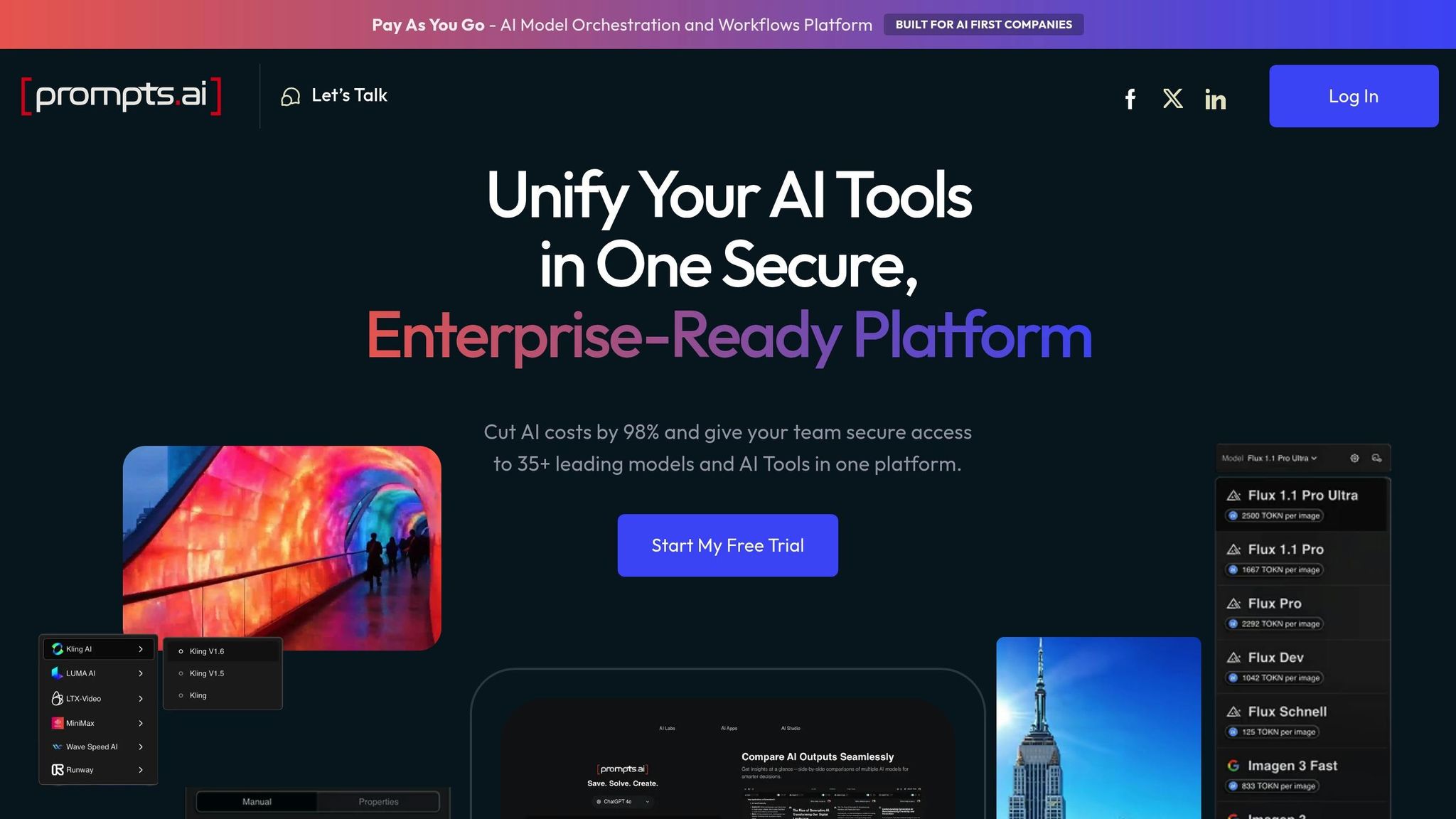
Prompts.ai brings together essential tools and features into a single, streamlined platform. By focusing on collaboration and governance, it simplifies workflows and enhances team efficiency.
With Prompts.ai, users gain access to over 35 top-tier language models, including GPT-5, Claude, LLaMA, Gemini, and Grok-4, all within a unified workspace. This setup allows teams to choose the most suitable model for each specific task without switching platforms. The result? Faster onboarding, reduced friction, and a consistent experience for everyone involved.
Prompts.ai goes beyond just providing access to models - it fosters collaboration through shared resources. Recreating prompts across departments wastes time and effort, so Prompts.ai offers a shared prompt library where teams can distribute and refine effective prompts. Additionally, the Prompt Engineer Certification program helps organizations train internal experts who can create standardized workflows for recurring tasks. For instance, a content generation prompt developed by one team can be tagged and shared across departments, turning individual successes into scalable organizational knowledge.
Keeping a close eye on AI operations is vital for success. Prompts.ai’s real-time analytics give teams the ability to monitor usage and performance metrics as they happen. Managers can quickly spot bottlenecks, link AI activities to business outcomes, and identify areas for improvement. This level of transparency not only supports better decision-making but also ensures that AI investments align with measurable business goals. These tracking tools work hand-in-hand with governance measures, providing a clear connection between AI efforts and tangible results.
Together, these features demonstrate how seamless workflows can lead to scalable and consistent AI-driven success.
To achieve scalability, start by standardizing your most critical tasks. Pinpoint processes that are time-consuming or prone to frequent errors, as these are ripe for improvement. Automating tasks like lead qualification or ticket triaging can free up valuable time for more complex operations. Research indicates that refining workflows can boost business efficiency by 5% to 15%, highlighting the importance of prioritizing the right processes.
Design workflows with modularity in mind. This approach allows for seamless growth as new departments or team members come on board, avoiding the need for complete overhauls. Flexibility ensures that scaling up doesn’t mean starting from scratch.
Leverage established methodologies to guide your efforts. For example, Lean focuses on eliminating waste, Six Sigma identifies and addresses inefficiencies, and Agile promotes visual collaboration and adaptability. Choose a framework that aligns with your organization’s goals and remain consistent in its application.
Once processes are standardized, the focus shifts to empowering your team to take ownership of these initiatives.
Select and train AI champions within your organization to lead adoption efforts and set best practices. These individuals can experiment with tools, refine prompts, and guide their colleagues through AI workflows. Programs like Prompts.ai's Prompt Engineer Certification provide structured training, transforming these champions into experts capable of maintaining and updating internal resources.
Develop a team AI playbook to document usage standards, safety protocols, and approved prompts. This evolving resource serves as a go-to guide for onboarding new team members and maintaining consistency. Certified champions should oversee this playbook, ensuring it stays up to date as workflows and use cases evolve.
"AI tools are most powerful when developers use them collaboratively by sharing prompts, refining outputs together, and adopting common usage standards across the team." - INSPYR Solutions
With internal champions in place, the next step is to use analytics to refine and expand workflows.
Leverage analytics to measure workflow performance and identify areas for improvement. Metrics like cycle time, error rates, and resource usage can reveal which processes are delivering the best results and which need adjustments. Tools like Prompts.ai's analytics dashboard provide insights to help prioritize scaling efforts and refine workflows before expanding them further.
Regularly reviewing metrics ensures that your AI strategy evolves alongside business needs. Early successes can highlight tangible benefits, building momentum for broader automation efforts. For example, when Nike implemented standardized just-in-time production workflows in the 1940s, they increased production by 20% and cut lead times by 40% (Source: The Digital Project Manager, 2024). This demonstrates how systematic scaling can drive measurable results.
Keep automation simple. If a workflow requires constant troubleshooting, it may be more trouble than it’s worth. Focus on processes that integrate smoothly with tools like CRMs or project management platforms. This reduces the learning curve, speeds up adoption, and reinforces the importance of interoperability and collaboration across teams.
Collaborative AI workflows are reshaping how teams operate, driving measurable gains in productivity and cost efficiency. Yet, many organizations find it challenging to fully capitalize on their AI investments. Fragmented tools, untracked usage, and a lack of cohesive strategies often limit the potential of these technologies, leaving AI experiments isolated and underutilized. This highlights the importance of developing integrated, team-wide AI approaches.
Prompts.ai tackles these issues head-on by offering a unified platform that orchestrates and governs over 35 leading AI models. With features like centralized prompt libraries, workflow tracking, and real-time FinOps controls, the platform addresses the common "closet innovation" problem. This occurs when hidden AI usage not only fragments value but also introduces unmanaged security risks. By turning individual prompt expertise into shared, institutional knowledge, Prompts.ai ensures continuity and scalability as team dynamics evolve. The result is a collaborative environment where diverse AI models and centralized governance work together seamlessly to support modern AI strategies.
Consider the example of a Fortune 500 pharmaceutical company that, in June 2025, reported a 92% reduction in time spent on competitor analysis tasks. This dramatic improvement was made possible through integrated workflows, which replaced siloed and unstructured AI experiments with cohesive processes that deliver clear results.
The ability to transform individual AI expertise into scalable, shared processes is key to unlocking long-term competitive advantage.
"True value is unlocked when effective prompts are codified into team-based prompt libraries, when their impact is measured through workflow telemetry, and when insights are shared through tracked learning cycles." – Organizational Dynamics
The top priority in any AI workflow is creating a standardized foundation to maintain consistency and ensure interoperability. Start by unifying the management of AI models, such as GPT-4, alongside data sources to minimize inefficiencies and control costs. It's equally important to define clear protocols for data formats, model interfaces, and governance policies. These standards help streamline integration, support scalable workflows, and promote smooth collaboration across various tools and teams.
To keep AI token costs in check, implement real-time tracking alongside centralized workflow management. By closely monitoring token usage, you can pinpoint and eliminate unnecessary interactions, helping to control expenses effectively.
Bringing multiple AI models together on a single platform and automating workflows further reduces token waste. This approach simplifies operations and improves efficiency, ensuring stable costs without compromising AI performance or scalability.
Effective AI governance is about ensuring organizations use AI responsibly, securely, and in compliance with regulations. To achieve this, it’s important to establish clear policies addressing risk management, regulatory adherence, and data handling practices. Teams should focus on defining the scope of AI use, managing access controls, setting up protective measures, and performing regular monitoring and audits. By creating centralized workflows and structured frameworks, organizations can maintain consistency, reduce risks, and deploy AI responsibly while meeting both operational and legal demands.