Pay As You Go - AI Model Orchestration and Workflows Platform


AI is now a core part of enterprise operations, driving measurable results like 20% faster support handling, 5× quicker policy creation, and 95% on-time compliance rates. To achieve these outcomes, companies are turning to AI workflow orchestration platforms that connect multiple large language models (LLMs) like GPT-5, Claude, and Gemini. These platforms allow enterprises to switch between models, automate tasks, and optimize costs while maintaining strict governance.
Here’s a quick look at six leading platforms transforming enterprise AI workflows in 2026:
These platforms balance integration, governance, and cost optimization, helping enterprises streamline operations and improve efficiency. Below, we explore their standout features, pricing, and governance tools.
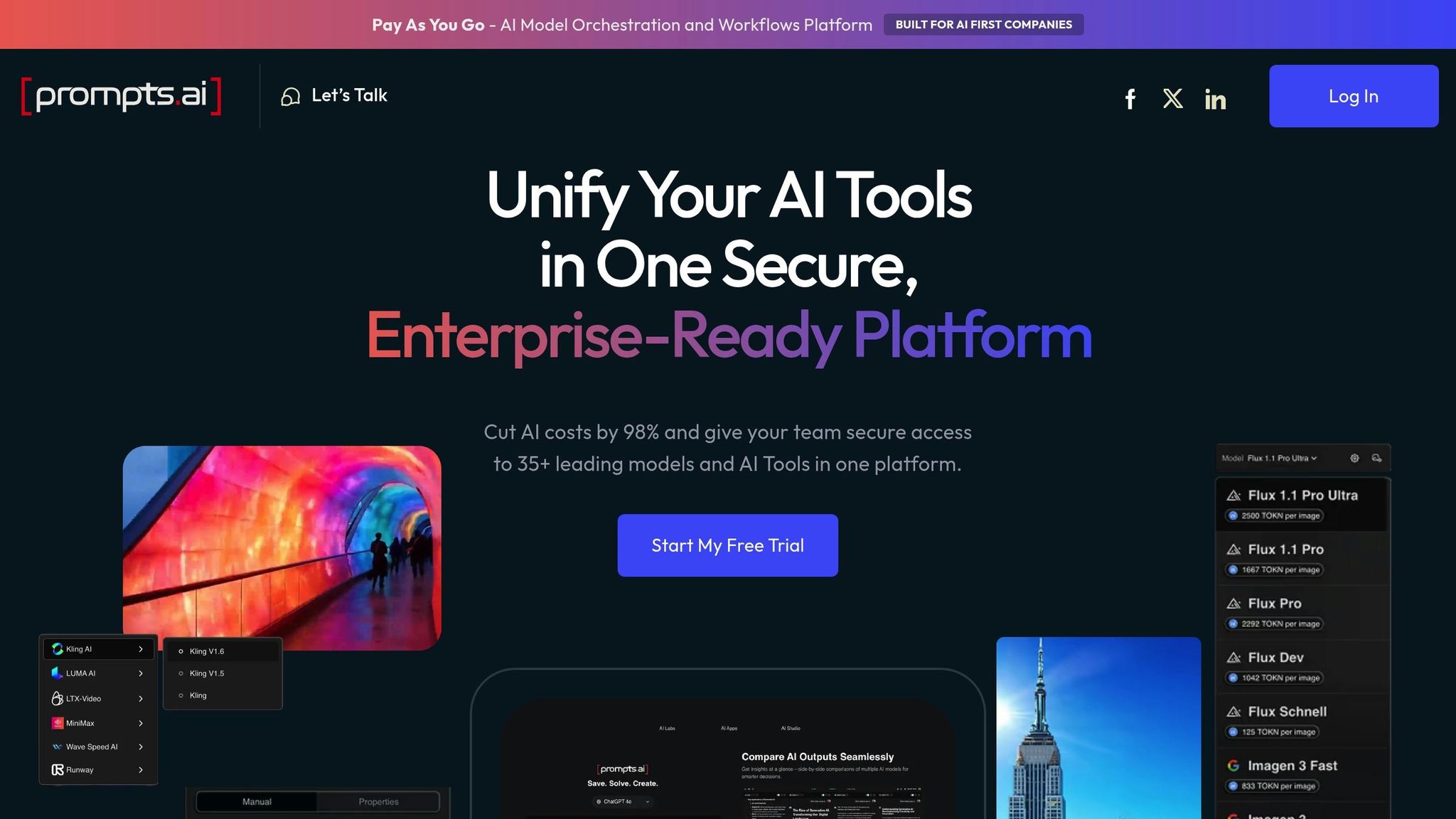
Prompts.ai serves as an enterprise-level AI orchestration platform, providing access to over 35 top-tier large language models (LLMs) like GPT-5, Claude, LLaMA, and Gemini - all through a single, secure interface. Founded by Steven P. Simmons, the platform is designed for organizations aiming to simplify AI management while maintaining strict governance. Its emphasis on integration, scalability, and governance distinguishes it in the AI orchestration space.
Prompts.ai seamlessly connects with widely used enterprise tools such as Slack, Gmail, and Trello. This integration allows teams to create AI-powered workflows that leverage more than 35 language models within a unified interface, effectively eliminating the chaos of juggling multiple tools. With a setup process that takes less than 10 minutes, IT departments can quickly onboard entire teams and streamline operations.
The platform is built to handle growth effortlessly. Features like TOKN Pooling and Storage Pooling enable organizations to share and optimize resources like credits and data across teams. Adding new models, users, or departments is straightforward, ensuring smooth expansion without creating silos as AI adoption scales. For larger organizations, higher-tier plans support unlimited workflow creation, making it ideal for high-volume automation needs.
"With Prompts.ai's LoRAs and workflows, he now completes renders and proposals in a single day - no more waiting, no more stressing over hardware upgrades".
Prompts.ai prioritizes security and regulatory compliance, offering centralized governance with full visibility into all AI interactions. This ensures workflows remain both secure and efficient. The platform incorporates compliance standards from SOC 2 Type II, HIPAA, and GDPR, with its SOC 2 Type II audit officially initiated on June 19, 2025. Features like role-based access controls and immutable audit logs provide robust tracking, ensuring data security as teams grow.
By operating on a pay-as-you-go TOKN credit system instead of traditional subscriptions, Prompts.ai helps organizations save significantly. Pricing ranges from $99 to $129 per member per month, with annual plans offering a 10% discount. The platform consolidates over 35 AI tools, cutting AI costs by up to 98% and reducing overall expenses by as much as 95%. Additionally, its side-by-side LLM comparison feature enhances productivity by up to tenfold.
The Microsoft Power Platform brings together Power Automate, Power Apps, and AI Builder, creating a comprehensive automation ecosystem for enterprises. By integrating with Azure AI Foundry and Copilot Studio, it utilizes large language models (LLMs) like GPT-4o, GPT-4, and Llama to process unstructured business data. This integration ensures seamless functionality across diverse enterprise systems.
The platform offers over 1,400 prebuilt, certified connectors for enterprise tools such as SAP, Salesforce, and Dynamics 365. For older systems, Power Automate uses RPA desktop flows to automate legacy user interfaces. It also features an on-premises data gateway, enabling secure connections between cloud-based AI workflows and local data sources. Additionally, its native integration with Microsoft 365 allows users to automate tasks directly within Excel, Teams, and SharePoint, eliminating the need to switch between applications.
Microsoft’s RPA infrastructure automatically adjusts to handle peak workloads. In 2024, Uber’s Global Head of Intelligent Automation, Chad Aronson, implemented Power Automate, Power Apps, and Power BI, achieving 3,400 hours saved annually and an estimated $30 million in yearly cost savings. The platform’s Automation Center centralizes workflow monitoring for high-volume operations, while its Managed Environments enable IT teams to oversee low-code assets organization-wide. These features make scaling automation across enterprises straightforward and effective.
"With Power Automate, we get the benefits of a Power Platform ecosystem that aligns with our future plans, including what we see as leading generative AI and process mining capabilities." - Chad Aronson, Global Head of Intelligent Automation, Uber
The Power Platform incorporates Data Loss Prevention (DLP) policies to control connector usage, safeguarding sensitive data. For example, in 2024, PG&E’s Principal Product Owner, Eric Soria, used the Power Platform Center of Excellence to govern 4,200 Power Automate flows and 2,000 Power Apps, ensuring data security while enabling scalable development. Enterprise Data Protection encrypts all Copilot data, whether at rest or in transit, and aligns with the same contractual protections as Exchange and SharePoint data.
Power Automate Premium is priced at $15.00 per user/month (billed annually), while Power Automate Process costs $150.00 per bot/month for unattended automation. Enterprises adopting the platform have reported a 248% ROI over three years. Professional developers experienced a 20% reduction in time spent on automated workflows, and companies like Nsure achieved 60% time savings and 50% cost savings. At Nsure, John Haisch, VP of AI and Automation, revolutionized data validation tasks - previously requiring over 100 employees - by leveraging generative AI and Power Automate.
The Salesforce Einstein Automation Stack, powered by Agentforce, moves beyond traditional rule-based workflows, introducing autonomous AI agents capable of reasoning, retrieving data, and executing multi-step tasks. At its core, the Atlas Reasoning Engine breaks down complex prompts into actionable steps, enabling enterprises to manage intricate workflows seamlessly across their business operations.
Salesforce's Open Model Ecosystem offers businesses the flexibility to use pre-built LLMs or integrate their own models via the LLM Open Connector. The Model Builder effortlessly connects to leading LLMs, including those from OpenAI, Azure OpenAI, Google, and Amazon. Meanwhile, MuleSoft Agent Fabric orchestrates workflows across systems and APIs, ensuring governance is built in. By leveraging Data Cloud, the platform unifies structured and unstructured data from external sources, delivering real-time context to AI agents. This integration is critical, especially since enterprises manage an average of 991 different applications, making streamlined connectivity essential for operational efficiency.
"Our strategy is integrated with the Einstein Trust layer, a secure AI architecture that makes sure AI-generated outputs are reliable and safe, and ensures data privacy and integrity through advanced security measures." - Daryl Martis, Director of Product Management, Einstein, Salesforce
The platform's scalability is evident through its enterprise deployments. By late 2025, Salesforce processed over 1 million support requests using its Agentforce platform. Earlier that year, global payments marketplace Zota implemented a merchant FAQ agent in just five weeks using Salesforce Platform and Data Cloud. This AI agent now handles 180,000 inquiries annually with 24/7 availability, enabling a team of 140 to operate with the efficiency of 800 employees. Additionally, early adopters like Indeed have reported creating AI agents up to 16x faster than with traditional methods. Linda West, VP of Business Systems at Indeed, highlighted how the platform has allowed them to build customer relationships in ways that were previously unattainable. This streamlined approach underscores the platform's ability to scale while maintaining robust governance.
The Einstein Trust Layer ensures AI outputs are safe and reliable by incorporating features like data masking, toxicity detection, and comprehensive audit trails. These tools protect sensitive information, ensuring PII is redacted and compliance requirements are met. Additionally, Agent Script combines deterministic logic with LLM reasoning to deliver consistent and predictable results in regulated environments. Salesforce also enforces zero data retention agreements with partners such as OpenAI, AWS, and Google, ensuring customer data is not stored or used for external model training. This hybrid reasoning model allows companies to harness AI's adaptability while staying compliant with regulatory standards.
Salesforce provides flexible pricing options through Flex Credits, consumption-based models, and Salesforce Foundations, which offers free access for basic use cases. For larger enterprises, Platform Login Licenses provide on-demand access at a fraction of the cost of full-time licenses. By consolidating multiple point solutions into a single platform, Salesforce reduces the total cost of ownership while expanding AI capabilities across organizations. This unified approach ensures businesses can scale efficiently without overspending.
ServiceNow positions itself as the AI operating system of the 21st century, built on a unified platform rather than pieced together through acquisitions. Trusted by 85% of the Fortune 500, it handles tasks ranging from IT operations to HR workflows, powered by AI agents capable of reasoning, coordinating, and autonomously executing tasks across departments.
The Workflow Data Fabric ensures seamless connections to external data sources in real time, aligning them with ServiceNow's unified data model. This allows AI agents to access the most current information from any integrated system. The AI Agent Fabric facilitates communication between AI agents across platforms like Microsoft, NVIDIA, Google, and Oracle. With its model-neutral architecture, ServiceNow supports native, customer-owned, or third-party AI models, avoiding vendor lock-in. Additionally, the Integration Hub provides real-time, native connections to external systems, streamlining operations.
This integration framework lays the groundwork for scalable enterprise solutions.
ServiceNow's standardized data models and centralized governance, managed through the AI Control Tower, eliminate silos as workflows expand across IT, HR, and customer service functions. The introduction of RaptorDB accelerates AI workflows by 27 times compared to earlier database versions.
"We are the only ones who can orchestrate AI, data, and workflows on a single platform. Now is the moment to unlock tomorrow's opportunities with ServiceNow as the AI operating system of the 21st century." - Bill McDermott, Chairman and CEO, ServiceNow
ServiceNow's agent-driven workflows deliver impressive results, increasing gross margins by 55% compared to 22%. In one example, the NHL built a mobile app in just 10 weeks using ServiceNow's Field Service Management to streamline game-day operations across 32 arenas, covering areas like staffing and puck management.
ServiceNow embeds robust security and compliance tools directly into its platform, offering a strategic advantage in AI orchestration. Tools like Now Assist Guardian and the AI Control Tower secure large language model (LLM) interactions and integrate risk policies into workflows, ensuring adherence to industry-specific regulations. The Integrated Risk Management feature automates compliance tracking and risk assessments, reducing the time spent preparing for audits.
For instance, Zoom utilized ServiceNow's compliance tools to meet FedRAMP standards while centralizing IT and HR support for over 8,000 employees. Similarly, Visa announced plans in May 2025 to implement a Disputes Management system driven by AI agents, embedding governance into financial resolution workflows. Wells Fargo adopted the platform alongside RaptorDB to automate complex workflows while adhering to the strict oversight required in banking.
ServiceNow's unified platform not only scales operations but also drives cost efficiency. By consolidating point solutions, it reduces the total cost of ownership. The Integration Hub can lower integration expenses by up to 70% compared to third-party iPaaS solutions. Zero-copy access to external sources like Snowflake or Databricks further reduces integration costs. Additionally, low-code and no-code tools empower non-technical teams to create AI workflows, reducing reliance on IT departments and speeding up deployment timelines.
Workato has evolved into an Enterprise Orchestration Platform (EOP), designed to seamlessly coordinate humans, systems, AI agents, and robots within a unified environment. Trusted by 50% of the Fortune 500, the platform boasts over 1,200 pre-built connectors for popular SaaS tools like Salesforce and Workday, on-premise ERPs such as SAP, databases like Oracle and MySQL, and even legacy systems like mainframes. For systems without pre-built connectors, enterprises can leverage a low-code SDK to create custom integrations.
Workato’s Enterprise Model Context Protocol (MCP) framework bridges the gap between AI agents and business systems, enabling secure interaction with over 12,000 applications. The platform integrates directly with major large language models (LLMs) such as OpenAI, Claude, and Llama. Instead of granting unrestricted API access, Workato uses "trusted skills" - pre-approved, auditable actions that ensure AI agents operate within defined boundaries. Acting as a secure "translator" between systems, this framework enables AI agents to perform meaningful, actionable tasks across an enterprise’s tech ecosystem.
Built on a cloud-native, serverless architecture, Workato dynamically scales to handle increasing transaction volumes and complex workflows. With a 99.9% uptime guarantee and zero-downtime upgrades, the platform ensures uninterrupted operations. In 2024, Atlassian utilized Workato to complete an ERP transformation 40% faster than anticipated - wrapping up in just 9 months instead of the projected 15 - while deploying 73+ new integrations. Additionally, the platform’s vibrant community, consisting of 70,000+ members, has shared over 400,000 recipes, streamlining deployment processes.
Workato prioritizes security and compliance, addressing critical concerns for IT leaders about safely deploying AI agents in production environments. The platform offers enterprise-grade role-based access control (RBAC), immutable audit trails for tracking every interaction, and certifications such as SOC 2 Type II, ISO 27001, PCI DSS, and GDPR. Its Skills framework ensures AI agents are restricted to admin-approved actions, eliminating the risks associated with open API access. For example, digital ad agency Monks successfully deployed a Workato "Genie" (AI agent) to maintain visibility across systems following 34 global mergers, all while upholding strict security and compliance standards. Organizations can also validate agent behavior in a dedicated Sandbox environment before moving to production.
Workato’s platform not only integrates seamlessly but also delivers tangible cost savings. ThredUp reported a 53% reduction in Total Cost of Ownership (TCO) and accelerated development speeds by 5–6× compared to their previous integration platform. The low-code approach empowers more team members to actively participate in automation. Darren Owsley, CTO at Gonzaga, highlighted:
"More staff can now directly engage in integrations than with previous iPaaS platforms".
Workato’s AIRO agent offers real-time diagnostics and automation logic, while Acumen provides operational insights to measure ROI. Customers have rated the platform an impressive 4.9/5 for its capabilities, with 100% recommending it.
Vellum is designed to help enterprises transition from basic AI pilots to managing intricate, multi-step AI operations. With 78% of organizations using AI in at least one business function as of 2025, the platform meets the rising demand for tools that can handle complex AI workflows while ensuring enterprise-level security.
Here’s a closer look at how Vellum combines advanced workflow capabilities, seamless integration, strict governance, and cost management to address enterprise needs.
Vellum supports sophisticated execution patterns, including loops with state snapshotting, recursion, and parallel branch execution - key for autonomous AI agents handling multi-step tasks. Its dual interface bridges a visual UI with code-based tools (Python/TypeScript SDKs), enabling both technical and non-technical teams to collaborate effectively. In 2025, Sebastian Lozano, Senior Product Manager II at Redfin, used Vellum to cut AI optimization cycles by 10× and deploy a virtual assistant across 14 U.S. markets, improving operations by 15–30%.
The platform’s "Agent Builder" simplifies workflow creation by allowing teams to use natural language prompts, making AI development accessible even to non-technical staff. Jordan Nemrow, Co-Founder and CTO of Woflow, highlighted how Vellum accelerated AI development by 50%, thanks to its ability to separate AI updates from application releases. This feature enabled instant fixes without causing infrastructure downtime.
Vellum’s provider-agnostic architecture supports a variety of foundation models, including those from OpenAI, Anthropic, and Google, along with "Bring Your Own Model" (BYOM) functionality. The platform includes native connectors for CRM, ERP, ITSM, and data warehouses, while open APIs, webhooks, and SDKs allow developers to add custom logic as needed. It also supports custom-defined nodes and Docker images, making it compatible with legacy systems and specialized dependencies. Additionally, Vellum integrates with existing MLOps stacks and vector databases, enabling Retrieval-Augmented Generation (RAG) pipelines.
Vellum ensures secure integrations with rigorous controls. It holds SOC 2 Type II certification and offers HIPAA compliance with Business Associate Agreement (BAA) support. Security measures include AES-256 GCM encryption for data at rest, TLS for data in transit, Role-Based Access Control (RBAC), Single Sign-On (SSO/SAML), and SCIM for automated user provisioning. Immutable audit logs provide full traceability by recording every prompt, tool call, and output. Deployment options include cloud, private VPC, and air-gapped on-premise setups to meet stringent data residency needs. Built-in approval gates and human-in-the-loop processes add an extra layer of oversight for sensitive automations.
Vellum helps manage costs with features like per-run cost visibility, token caching, and usage alerts to avoid budget overruns during scaling. A free tier is available for initial testing, while paid plans start at $25 per month, with custom pricing for large-scale deployments requiring VPC or on-premise setups. The platform also includes evaluation tools to quantitatively assess workflow quality, cost, and latency before moving to production.
"Vellum has been a force multiplier for our AI efforts; their test-driven approach helps us catch regressions early and iterate quickly." – Lior Solomon, VP of Engineering

AI Workflow Platform Comparison: Features, Pricing & Governance for Enterprises 2026
When it comes to scaling AI in large enterprises, each platform brings its own set of advantages and challenges. The table below highlights key features, pricing structures, and governance approaches, providing a snapshot of how these platforms stack up.
| Platform | Pros | Cons |
|---|---|---|
| Prompts.ai | Combines 35+ models (like GPT-5, Claude, LLaMA, Gemini) into one interface; real-time FinOps cuts AI costs by up to 98%; pay-as-you-go TOKN credits eliminate recurring fees; enterprise-grade governance with audit trails; includes a Prompt Engineer Certification program. | Newer to market compared to established enterprise vendors; requires organizations to shift towards centralized AI orchestration. |
| Microsoft Power Platform | Works seamlessly with Microsoft 365 and Azure; offers a wide range of prebuilt connectors; supports role-based access control and data loss prevention policies. | Limited flexibility for non-Microsoft models; costs can escalate rapidly at scale. |
| Salesforce Einstein Automation Stack | Fully integrated into Salesforce CRM; provides predictive analytics tailored for sales and marketing; designed for ease of use by non-technical staff. | Scalability is largely limited to the Salesforce ecosystem; less effective for workflows spanning multiple platforms. |
| ServiceNow AI Powered Workflow Platform | Features a unified data model that eliminates silos; widely adopted by 85% of Fortune 500 companies; integrates with legacy systems without requiring a full overhaul. | Pricing based on demos can lack transparency; its IT service management focus may not suit all enterprise needs. |
| Vellum AI Workflow Automation Platform | Supports cloud, VPC, and on-premise deployment; includes immutable audit logs and compliance with SOC 2 and HIPAA. | Advanced features require significant onboarding to unlock full potential; smaller market presence compared to legacy providers. |
Cost Models:
Prompts.ai stands out with its pay-as-you-go TOKN credit system, directly aligning expenses with usage. In contrast, IBM watsonx Orchestrate offers a 30-day trial to demonstrate ROI, while platforms like ServiceNow and Salesforce rely on demo-based or seat-based pricing, which can obscure the total cost until full deployment. DataRobot, meanwhile, claims its unified framework reduces solution deployment time by 50%, significantly accelerating time-to-value.
Integration Depth:
Integration isn’t just about the number of connectors - it’s about how seamlessly data flows across systems. ServiceNow excels here with its single data model, enabling smooth information exchange across HR, IT, and finance without the need for custom middleware. For example, FordDirect’s VP of Data Strategy, Tom Thomas, noted that "DataRobot deploys AI solutions in half the time and simplifies management". Similarly, IBM’s watsonx Orchestrate allowed its HR team to instantly resolve 94% of 10 million annual requests, freeing employees to focus on strategic initiatives.
Governance:
Strong governance is the backbone of successful AI deployment. Platforms like Prompts.ai and Vellum offer robust features, including immutable audit logs, role-based controls, and single sign-on capabilities. Microsoft Power Platform leverages Azure’s compliance frameworks to ensure enterprise data security. IBM watsonx Orchestrate has also proven its governance capabilities, helping Dun & Bradstreet cut procurement task times by 20% through AI-driven supplier risk evaluation.
"Our investment in AppliedAI is a decisive step towards reimagining enterprise operations from the ground up … enabling us to create intelligent, secure automation for the most complex, regulated sectors".
- Dr. Sanjiv Goenka, Chairman of RPSG Group and Firstsource
These comparisons reveal how each platform addresses enterprise needs differently, balancing cost, integration capabilities, and governance to meet diverse operational demands.
Selecting the ideal AI workflow platform in 2026 requires careful consideration of current enterprise operations, governance requirements, and budget constraints.
For organizations deeply aligned with the Microsoft ecosystem, Microsoft Power Platform stands out due to its seamless integration with existing identity, security, and data frameworks. A notable example is KPMG International, which implemented Microsoft Power Platform for 95,000 auditors across 140 countries. They emphasized its strong governance and observability features, which are particularly critical in regulated industries.
On the other hand, enterprises seeking vendor flexibility and avoiding lock-in may prefer platforms with an open architecture. These platforms connect effortlessly with various AI agents, workflows, and data sources, ensuring interoperability while reducing dependency on a single vendor. This adaptability enables improvements such as supplier risk assessments and automated procurement processes, driving measurable efficiency gains.
For industries like banking, healthcare, and insurance - where regulatory compliance is paramount - platforms must offer governance capabilities, real-time monitoring, and compliance-focused tools to support mission-critical workflows.
Cost management becomes a defining factor as organizations scale their AI initiatives. Pay-as-you-go pricing models provide clarity by aligning costs with actual usage, whereas seat-based models can obscure expenses until deployment is complete. Transparent pricing is particularly relevant, given that 88% of U.S. executives plan to increase their AI investments in the coming year. Platforms that combine clear pricing with powerful integration and governance capabilities are well-positioned to lead.
The best platforms strike a balance between interoperability, governance, and cost transparency without requiring a complete overhaul of existing technology. Whether enhancing current investments, managing multi-vendor AI tools, or simplifying compliance-heavy workflows, the right solution should streamline deployment and reduce complexity. Ultimately, the focus should remain on addressing the three critical pillars: integration, governance, and cost clarity.
AI workflow orchestration platforms provide large enterprises with a unified way to manage AI-driven processes, addressing inefficiencies caused by scattered tools and disconnected data pipelines. By bringing workflows together, these platforms can automatically match tasks with the most appropriate AI models, enforce governance rules, and offer real-time financial tracking. This not only helps businesses cut costs but also ensures better use of their resources.
These platforms also streamline operations by automating repetitive tasks, keeping an eye on resource usage, and managing errors with features like automatic retries and alerts. This boosts system reliability and speeds up issue resolution. Their ability to scale and adapt means enterprises can adjust workflows to meet shifting business demands, integrate new AI models effortlessly, and maintain compliance while expanding operations across the globe.
AI platforms integrate compliance-by-design principles directly into their workflows, helping organizations adhere to regulatory standards. Features such as consent tracking, purpose limitation, and the right-to-be-forgotten ensure alignment with GDPR requirements. On top of that, tools like role-based access controls, end-to-end encryption, and comprehensive audit logs provide security teams with clear, traceable records of data and model usage - key elements for meeting SOC 2 audit criteria.
These platforms also offer regional data residency settings, allowing sensitive information to be stored in approved locations. Many come with pre-certified compliance attestations, such as GDPR, SOC 2, and ISO 27001, simplifying the process of meeting regulatory obligations. By consolidating AI operations into a single control system, these tools make governance more manageable, reduce operational complexity, and ensure compliance is maintained consistently across all workflows.
AI platforms empower businesses to save money by automating repetitive tasks and building workflows that can be used repeatedly. These tools allow companies to adapt their existing AI models instead of investing in costly custom solutions or being locked into specific vendors. This flexibility helps avoid expensive system overhauls and speeds up the time it takes to see a return on investment.
Another way enterprises cut costs is by consolidating AI, data, and workflows onto a single cloud-based platform. Centralizing operations reduces licensing fees and operational costs, while scalable, pay-as-you-go pricing ensures businesses only pay for what they use. These approaches not only trim expenses but also improve efficiency and simplify enterprise processes.