Pay As You Go - AI Model Orchestration and Workflows Platform



AI platforms are transforming enterprise operations in 2026. With 75% of knowledge workers now using AI daily and global productivity increasing by 1.5% annually, businesses are turning to scalable, secure, and cost-efficient solutions to meet their operational needs. This guide reviews three top platforms - Prompts.ai, Workato, and Vellum AI - evaluating their strengths in scalability, interoperability, workflow automation, and governance.
| Platform | Scalability | Interoperability | Workflow Automation | Governance & FinOps |
|---|---|---|---|---|
| Prompts.ai | Supports 35+ LLMs, integrates with cloud services | API-first, seamless model orchestration | Agentic automation with cost tracking | Pay-as-you-go TOKN credits, 98% cost reduction |
| Workato | Cloud-native, handles 12,000+ apps | 1,200+ connectors, community recipes | Low-code AIRO™ for agent orchestration | Role-based access, ROI tracking tools |
| Vellum AI | Flexible deployment (cloud, on-prem) | Multi-model orchestration, BYOM | No-code tools + SDK for custom workflows | Detailed cost tracking, fine-grained RBAC |
Each platform addresses unique enterprise challenges, from reducing costs to scaling AI operations. Your choice depends on whether financial efficiency, system integration, or development speed is your top priority.

Enterprise AI Platforms Comparison: Prompts.ai vs Workato vs Vellum AI
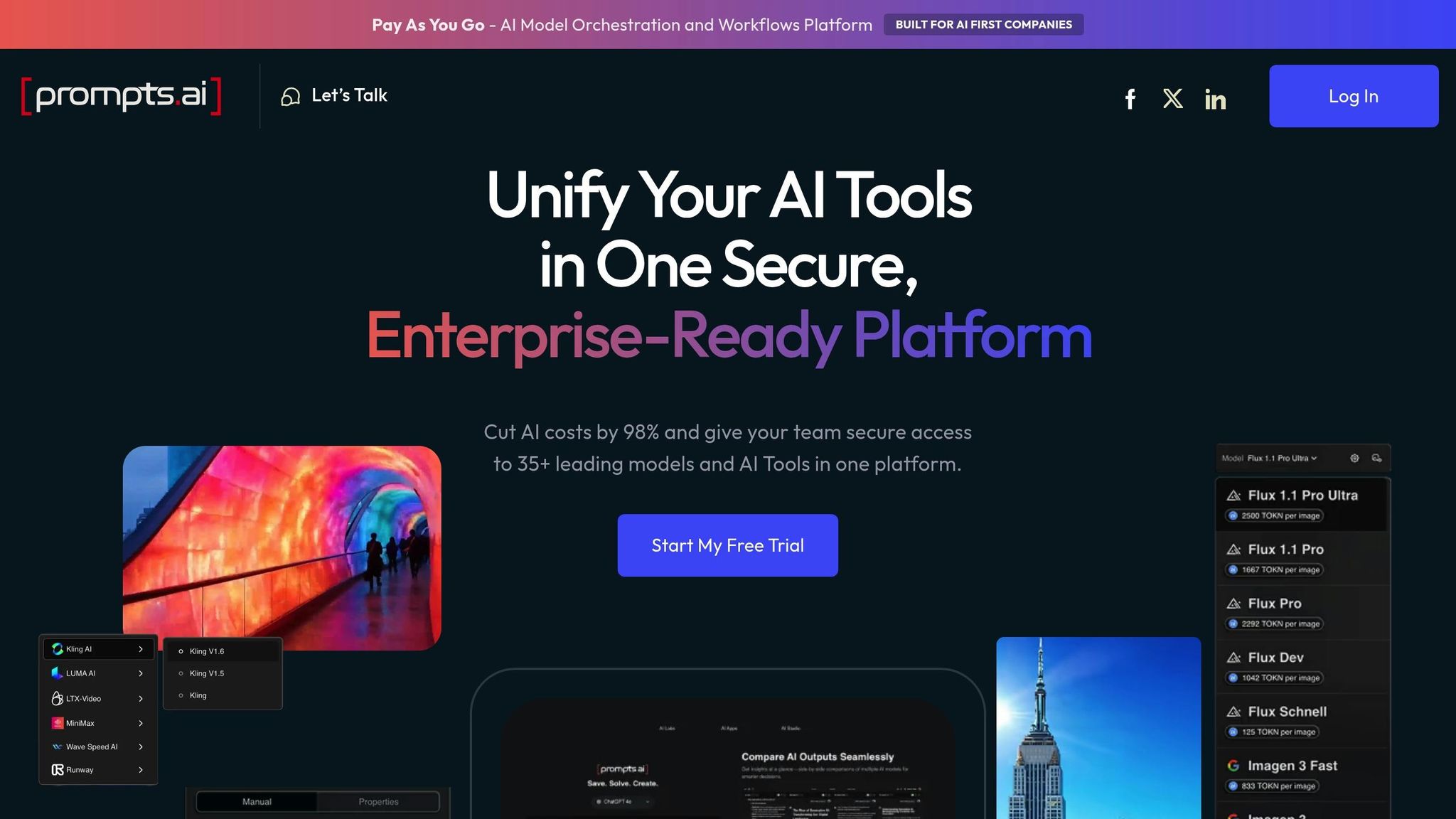
Prompts.ai brings together over 35 top-tier large language models - such as GPT-5, Claude, LLaMA, and Gemini - into one secure and unified platform. Designed to meet the demanding needs of large enterprises, it addresses challenges like tool sprawl, governance, and high AI software costs, delivering savings of up to 98%. Founded by Emmy Award-winning Creative Director Steven P. Simmons, the platform is ideal for a wide range of organizations, from Fortune 500 companies to creative agencies, offering centralized control without compromising on flexibility or security. Its strengths lie in scalability, seamless integration, and workflow automation.
Prompts.ai empowers enterprises to scale their operations effortlessly by integrating deeply with cloud services like Azure, AWS, and Google Cloud. It also connects smoothly with CRM, ERP, ITSM, HRIS, and data warehouses. By supporting agentic RAG (Retrieval-Augmented Generation) patterns, it enables companies to transition from experimental AI models to fully functional solutions capable of managing vast data volumes.
The platform’s advanced integration frameworks allow businesses to deploy AI solutions across their existing systems without requiring costly infrastructure changes.
Prompts.ai focuses on agentic automation, streamlining manual workflows with minimal human input. With expert-designed prompt workflows that incorporate best practices, organizations can significantly enhance productivity.
Prompts.ai goes beyond operational efficiency by embedding a real-time FinOps layer that provides detailed tracking of token usage, generates actionable insights, and ties AI expenses directly to business outcomes. This ensures full visibility into AI interactions, supported by comprehensive audit trails. Instead of traditional subscription fees, the platform uses a pay-as-you-go TOKN credit system, aligning costs with actual usage and preventing overspending. Pricing starts at $99 per member per month for the Core tier, with the Elite tier - tailored for creative teams - available at $129 per member per month.
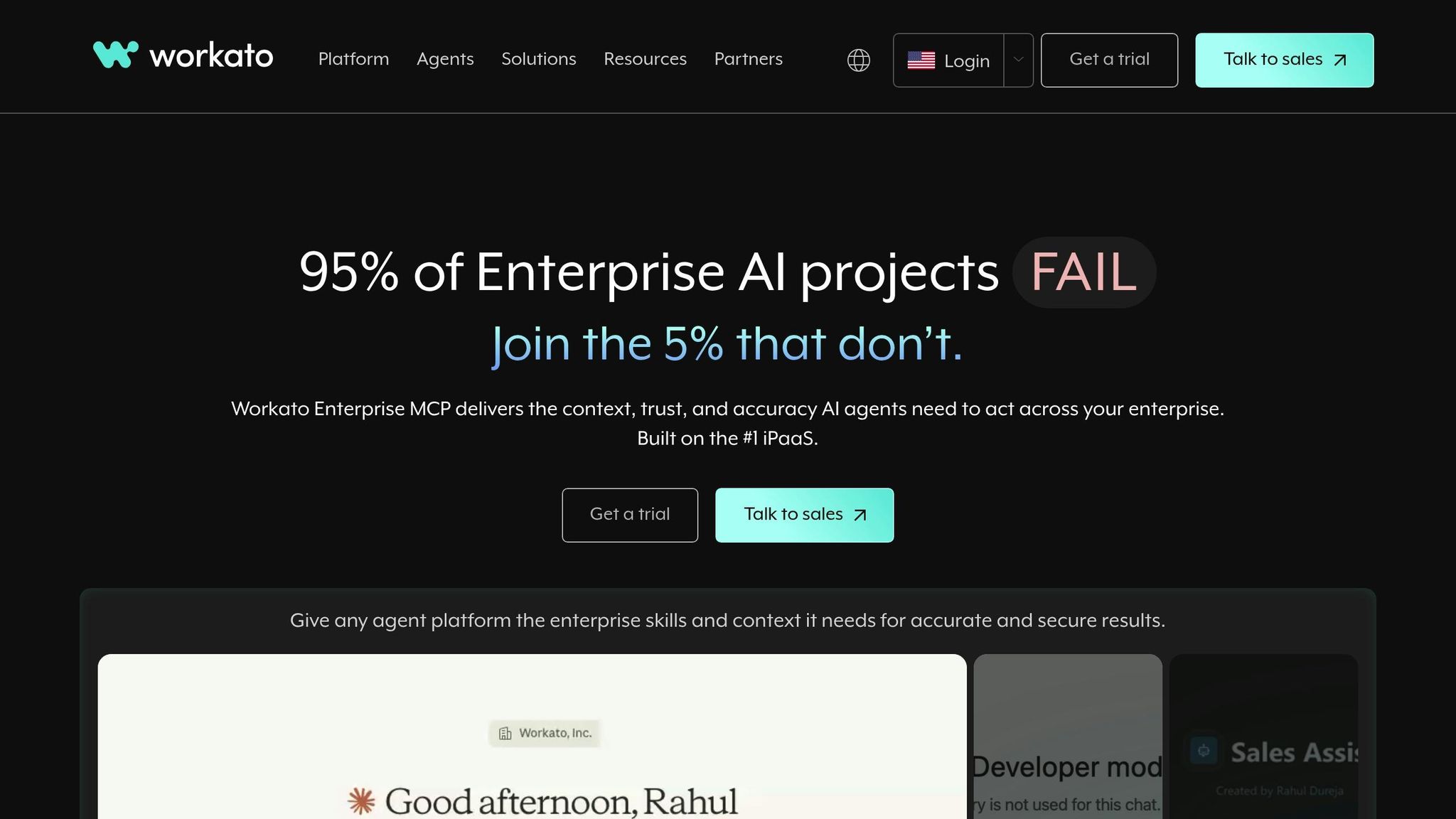
Workato has been recognized as a Gartner Magic Quadrant Leader for iPaaS for seven consecutive years. By 2026, it continues to define the gold standard for enterprise AI workflow orchestration. Serving half of the Fortune 500, the platform holds an impressive 4.9/5 rating on Gartner Peer Insights, with customers consistently praising its platform capabilities, pricing, and collaborative approach. Transitioning from a traditional integration platform to a robust Enterprise Orchestration Platform (EOP), Workato enables seamless, real-time coordination between humans, AI agents, and systems.
Workato’s cloud-native serverless architecture ensures automatic scaling of its containerized runtimes. A prime example of this scalability is Atlassian’s ERP transformation, which wrapped up in just nine months - 40% faster than the anticipated 15 months. This project tackled over 1,000 business requirements, 2,800 ERP test cases, and 73+ new integrations. The platform’s Enterprise MCP (Model Context Protocol) framework connects large language models to more than 12,000 applications via hundreds of managed, high-availability MCP servers. This setup allows organizations to deploy AI agents at scale without compromising performance. With a 99.9% uptime guarantee and 775 updates rolled out in a single year, Workato remains deeply committed to its AI-native roadmap. Such scalability ensures smooth interoperability across even the most complex system landscapes.
Workato excels in universal connectivity with its 1,200+ pre-built connectors and a vast community library of 400,000+ recipes, enabling effortless integration across modern SaaS tools like Salesforce and Workday, on-premises ERPs such as SAP, legacy mainframes, and data lakes including Snowflake and Redshift. This extensive library is actively utilized by over 70,000 members. Its Agent Orchestrator manages a diverse mix of agents, including those from SaaS vendors, major platforms like Google and Microsoft, and custom-built agents created with tools like LangChain. For applications lacking native support, Workato offers a Connector SDK to build tailored integrations. For instance, ThredUp leveraged this flexibility to reduce its Total Cost of Ownership (TCO) by 53% while accelerating development speed by 5–6 times compared to its previous solution.
Workato’s Workato AIRO™ (AI-driven, Intent-based, Real-time Orchestrator) empowers users to design, test, and deploy intricate multi-app workflows using natural language. This innovation moves beyond traditional static data pipelines to what Workato terms "agentic orchestration" - where AI agents, people, and systems collaborate to address complex, non-linear workflows. The Agent Studio provides a low-code interface for creating enterprise-grade agents, equipped with specific business logic and knowledge bases. Users also gain access to over 635,000 "Enterprise Skills" contributed by the Workato community. Additionally, prebuilt AI agents, known as "Genies," are available for tasks like HR onboarding and Sales CPQ, delivering rapid returns on investment. These advancements drive greater agility and transparency in enterprise operations.
Workato prioritizes governance and cost control to meet the demanding compliance and financial needs of enterprises. The Agent Trust framework ensures robust governance with patented role-based access control (Agent Auth™), automated policy enforcement, and adherence to standards like SOC 2 Type II, ISO 27001, PCI DSS, and GDPR. The MCP Gateway further enforces policies, authentication, and runtime observability, effectively mitigating risks of "shadow AI" while maintaining compliance. For financial oversight, Workato integrates AI-driven ROI tracking tools. The Acumen agent analyzes automation ROI and provides actionable insights to optimize costs. Meanwhile, the Agent Insights tool offers real-time data on agent performance, usage, and ROI, ensuring enterprises have complete visibility into their AI investments. Darren Owsley, CTO at Gonzaga, highlights the platform’s accessibility:
We have way more people with their hands on the keyboard integrating [with Workato] than we would have ever had with another iPaaS platform.
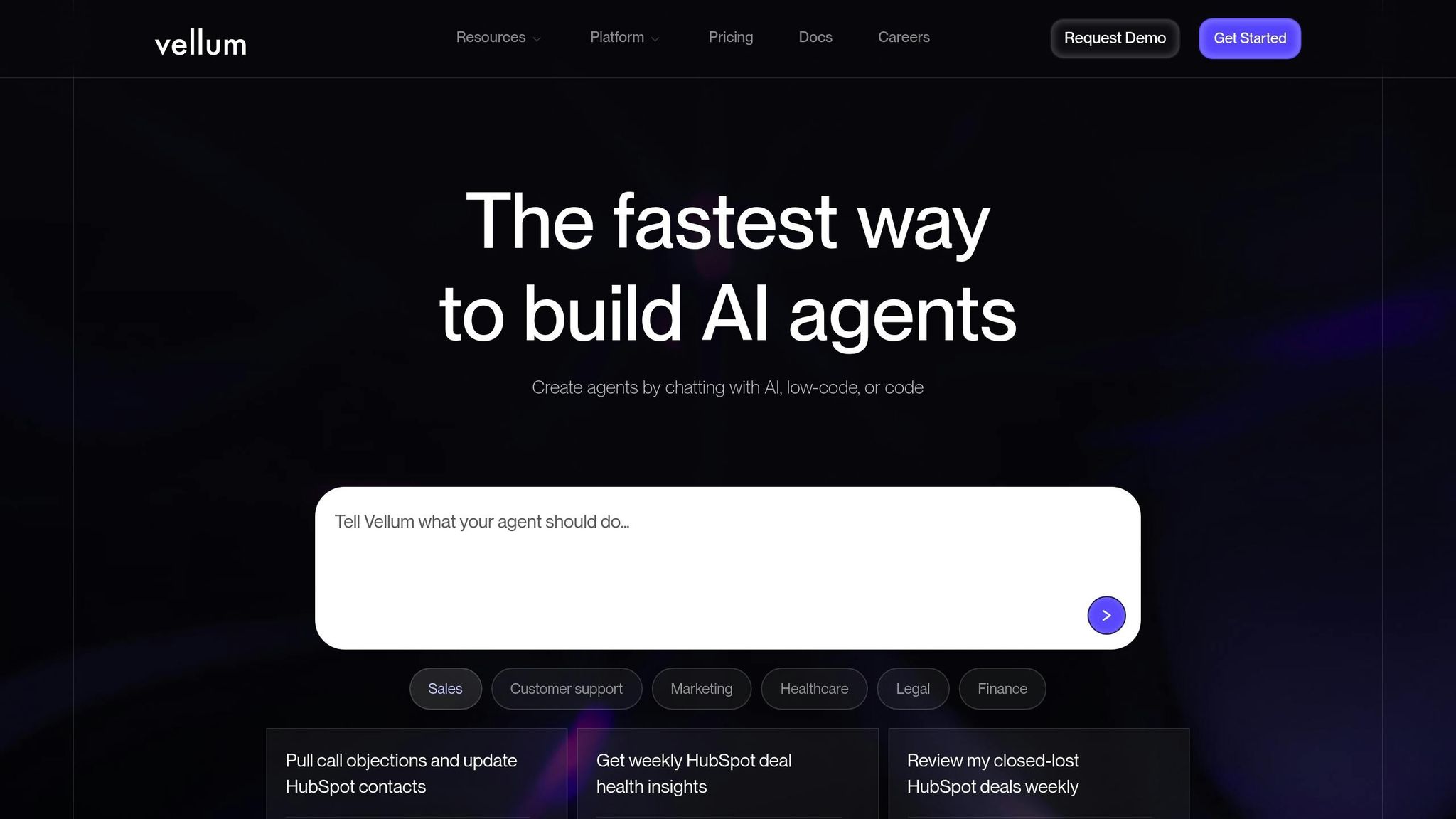
Vellum AI builds on Workato’s orchestration capabilities with a hybrid development approach that combines the simplicity of no-code tools with the flexibility of SDKs. Designed for enterprises needing scalable and agile AI agent deployment, Vellum blends a visual no-code interface with Python and TypeScript SDKs. This allows technical teams to extend functionality while business users retain control and refine prompts as needed. This approach has enabled customers to accelerate AI development cycles by 50%.
Vellum addresses enterprise needs with deployment options tailored to diverse security and residency requirements. Whether it’s cloud, private VPC, or on-premises (including hardened, air-gapped environments), the platform ensures compliance with strict security standards. Its high-availability infrastructure includes regional isolation, disaster recovery, and defined SLAs for global reliability. The decoupled AI lifecycle further enhances flexibility, allowing teams to fix errors or optimize models without affecting infrastructure uptime or requiring core code redeployments. Jordan Nemrow, Co-Founder & CTO at Woflow, highlighted this benefit, noting that Vellum’s approach helped his team achieve a 50% increase in AI development speed.
Vellum’s multi-model orchestration supports top providers like OpenAI, Anthropic, and Google, while also offering a "Bring Your Own Model" (BYOM) option to avoid vendor lock-in. Native connectors integrate seamlessly with enterprise systems like CRM, ERP, ITSM, and data warehouses, while the two-way sync feature bridges the gap between visual interfaces and code, enabling collaboration between engineers and non-technical stakeholders. Sebi Lozano, Senior Product Manager II at Redfin, shared how Vellum streamlined prompt evaluation and workflows, leading to a 10x reduction in optimization cycles. This efficiency allowed Redfin to roll out a virtual assistant across 14 U.S. markets, boosting business operations by 15–30%. Such seamless integration paves the way for effective workflow automation.
With Vellum’s Agent Builder, teams can create workflow automations in minutes using natural language prompts. The platform’s built-in "Evals" evaluate AI agent performance - measuring quality, cost, latency, and reliability - before production deployment. Additionally, its agentic tooling supports advanced workflows with features like state snapshotting and forking, ensuring reproducibility for even the most complex processes. Lior Solomon, VP of Engineering, praised Vellum’s impact:
Vellum has been a force multiplier for our AI efforts; their test-driven approach helps us catch regressions early and iterate quickly. In a space where accuracy and security assurance are critical, Vellum gives us the infrastructure to move fast without compromising performance.
Vellum AI strengthens enterprise operations by combining innovation with stringent governance and cost management. The platform offers fine-grained Role-Based Access Control (RBAC), SSO/SAML support, and immutable audit logs for complete traceability. It complies with SOC 2 Type II, HIPAA, and GDPR standards to meet enterprise security requirements. For financial oversight, Vellum provides detailed cost tracking with per-run and per-agent visibility, budget caps, and usage alerts to prevent overages during scaling. Organizations using Vellum have reported a 20–40% reduction in total AI costs thanks to its optimized orchestration capabilities. Pricing starts at $25/month for paid plans, with custom options available for large-scale deployments needing VPC, HIPAA compliance, and dedicated support.
When assessed on scalability, interoperability, workflow automation, and governance & FinOps, each platform brings distinct advantages and trade-offs to the table. These differences give enterprise decision-makers the flexibility to choose a solution that aligns with their specific needs.
Prompts.ai stands out for its cost-saving capabilities and centralized model management. By offering up to 98% savings on AI software costs, it provides a compelling option for organizations focused on financial control. Its pay-as-you-go TOKN credit system eliminates recurring subscription fees, making it an attractive choice for businesses looking to optimize spending. Additionally, Prompts.ai excels at unifying leading language models while delivering real-time cost insights.
Workato shines in enterprise interoperability, thanks to its extensive library of pre-built connectors. These connectors seamlessly integrate AI workflows with major enterprise systems like CRM, ERP, and ITSM, enabling rapid deployment. This makes Workato a strong choice for businesses seeking efficient integration with existing infrastructure. However, organizations with highly specialized AI needs may find its customization capabilities somewhat limited compared to code-first platforms.
Vellum AI bridges the gap between developer flexibility and business user accessibility. It combines intuitive no-code tools with SDK support, allowing teams to tailor solutions while maintaining ease of use. Its decoupled AI lifecycle ensures that models can be optimized without causing infrastructure disruptions. Built-in evaluation tools further enhance quality control before production. While Vellum AI is designed for mid-market deployments, enterprises with stringent security requirements may need to consider additional configuration options.
Below is a summary of the key strengths and limitations of each platform:
| Platform | Scalability | Interoperability | Workflow Automation | Governance & FinOps |
|---|---|---|---|---|
| Prompts.ai | Unifies over 35 language models in a secure, serverless setup. | API-first integration with streamlined model orchestration. | Supports multi-model orchestration with real-time cost tracking. | Offers token-level visibility with up to 98% cost reduction. |
| Workato | Highly scalable via cloud and hybrid deployment options. | Broad portfolio of pre-built connectors for major enterprise systems. | Features a low-code automation builder for rapid deployment. | Delivers robust governance via role-based access controls. |
| Vellum AI | Flexible deployment options, including cloud and on-premises. | Supports multiple AI models with options for bespoke integrations. | Combines intuitive no-code tools with SDK support for tailored automation. | Enables fine-grained access management alongside cost controls. |
The comparison highlights that each platform excels in specific areas. Prompts.ai leads in cost efficiency and model variety, making it ideal for organizations prioritizing financial oversight. Workato is unmatched in enterprise system integration, catering to businesses with complex infrastructure needs. Vellum AI offers a balanced approach, blending technical flexibility with user-friendly automation tools. Ultimately, the right choice will depend on an organization’s top priorities - whether that's reducing AI expenses, integrating with existing systems, or enabling seamless collaboration across teams.
Choosing the right AI platform comes down to aligning with the specific priorities of your organization. If financial clarity and control are top of mind, Prompts.ai offers a compelling solution with its pay-as-you-go TOKN pricing model. By delivering token-level visibility, it equips finance teams to monitor and fine-tune spending across departments, ensuring smarter budget allocation. This approach places a strong emphasis on financial efficiency, setting it apart from platforms that lean more toward system integration or development agility.
Other platforms may prioritize seamless integration or strike a balance between technical adaptability and ease of use. The variety of features available highlights the importance of a thoughtful, customized decision-making process.
When evaluating options, it’s essential to weigh factors like scalability, interoperability, workflow automation, and governance. Leaders must also address challenges such as managing costs, maintaining oversight of multiple models, and ensuring compliance to identify the platform that best meets their needs.
When choosing an AI platform in 2026, large enterprises should focus on scalability. The platform must be capable of managing production-grade workloads while supporting both cloud and on-premises deployments. This dual capability is crucial for handling latency-sensitive operations or working with regulated data environments.
Equally important are security and compliance features. The platform should meet industry standards such as HIPAA or GDPR and include essential tools like access controls, audit trails, and mechanisms to mitigate bias. These features ensure AI is used responsibly and securely.
Lastly, evaluate the platform's integration capabilities and cost-efficiency. Solutions offering unified tools for data pipelines, model management, and seamless DevOps workflows simplify operations and accelerate deployment. Assessing the total cost of ownership - including predictable cloud and licensing expenses - can help align the platform with your organization's financial and operational goals.
Prompts.ai helps enterprises slash AI software costs by up to 98% through centralized model orchestration and real-time financial operations (FinOps) insights. By uniting over 35 large-language models - such as GPT-4 and Claude - into a single, streamlined platform, businesses can eliminate the hassle of juggling multiple vendor contracts and paying for redundant subscriptions.
The platform features a live FinOps dashboard that tracks usage and expenses in real time, automatically directing tasks to the most cost-effective model that still meets performance requirements. This ensures companies only pay for the compute power they actually use. On top of that, Prompts.ai’s orchestration layer simplifies workflows by cutting out unnecessary processing steps, reducing overhead, and boosting efficiency. These combined tools offer a scalable and budget-friendly solution designed specifically for large organizations.
Prompts.ai serves as a comprehensive AI orchestration hub, allowing enterprises to seamlessly integrate more than 35 large-language models through a single, pay-as-you-go platform. Its standout features include a powerful automation engine designed for multi-model orchestration, real-time cost tracking using TOKN credits, and granular governance tools like usage limits, audit logs, and role-based access. These capabilities aim to reduce the need for extensive engineering efforts.
Workato is centered on app integration and automation, offering a variety of pre-built connectors to link SaaS tools and on-premise systems. While it can trigger AI services, its primary purpose lies in facilitating data movement between applications. This often involves technical expertise and custom scripting to create workflows tailored to specific needs.
Vellum AI caters to enterprise AI engineering, focusing on the secure development, versioning, and deployment of AI agents. Its automation tools prioritize compliance with standards like SOC 2 and GDPR, and it provides features for governing and comparing AI models. However, its emphasis is more on secure model management than on multi-model orchestration or extensive app integration.
Prompts.ai stands out with its model-centric, unified workflow engine that emphasizes governance and cost management. In contrast, Workato excels in data integration automation, while Vellum AI is geared toward secure AI agent development and deployment for enterprise-scale operations.