Pay As You Go - AI Model Orchestration and Workflows Platform



AI workflows in 2026 face growing security threats like prompt injection, data poisoning, and model tampering. Traditional tools struggle to keep up, leaving organizations exposed. The solution? AI-powered security platforms designed to monitor, block, and enforce controls in real time. Here's a quick look at five leading options:
Each platform brings unique strengths in threat detection, workflow integration, and compliance automation. Below, we dive into their features and help you decide which fits your needs.

AI Security Platform Comparison: Features, Detection Rates, and Pricing Models for 2026
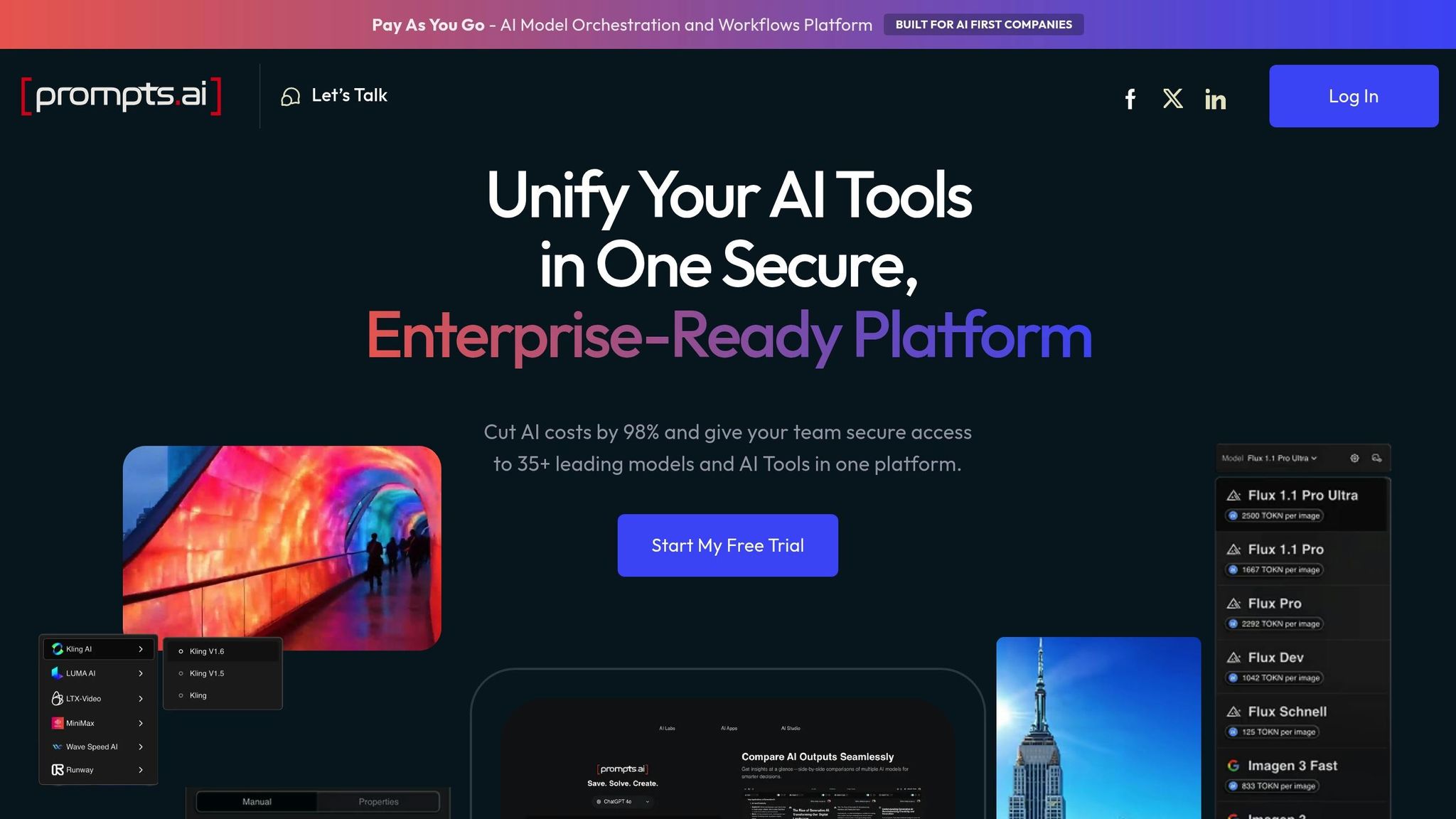
Prompts.ai offers advanced security measures tailored for enterprise AI workflows. Acting as a real-time firewall, it monitors and filters prompts and responses before they interact with your systems.
The platform continuously scans prompts and outputs, blocking harmful inputs like prompt injection attacks and safeguarding sensitive data. This real-time monitoring ensures smooth and secure integration across various AI models.
Prompts.ai works effortlessly with more than 35 top AI models, including GPT-5, Claude, LLaMA, and Gemini, creating a centralized security checkpoint. It also provides complete audit trails for all AI transactions, ensuring compliance requirements are met.
Comprehensive governance controls allow businesses to perform compliance reviews and follow industry standards with ease.
With its flexible pay-as-you-go TOKN credit system, there are no recurring fees. Organizations can quickly scale by adding models, users, or security policies in just minutes. The integrated FinOps layer directly links security spending to measurable business results.
GenAI Protect secures AI workflows using a dual-layer machine learning architecture. The first layer employs a supervised engine trained on millions of malicious prompts to block injections and jailbreak attempts. The second layer relies on an unsupervised engine that adapts to your application environment, detecting real-time anomalies. This system achieves a 99.8% malware catch rate while maintaining latency under 50ms.
The platform's semantic detection engine analyzes context in over 100 languages, identifying hidden attacks that use metaphors or idioms to bypass traditional security tools. Following the Lakera acquisition, GenAI Protect now includes advanced defenses to counter inputs designed to exploit LLM safety filters.
It also provides specialized AI agent guardrails to prevent issues like tool misuse, unsafe autonomy, and "looping" risks, where agents may repeat unintended actions. Monitoring over 300 GenAI services, the system flags unauthorized Shadow AI tools automatically. Its context-aware DLP detects sensitive data in unstructured GenAI conversations, such as code, PII, and copyrighted material, which conventional tools often miss. Notably, 55% of data loss incidents are linked to GenAI, with about 1 in 80 prompts exposing sensitive information to potential threats.
This robust detection framework integrates seamlessly across platforms, ensuring comprehensive protection.
GenAI Protect employs an open-garden architecture, allowing integration with multivendor environments like identity providers, DLP, CASB, and network security stacks from vendors such as Palo Alto Networks, Zscaler, Netskope, and Fortinet. It supports modern workflow protocols and offers various deployment options, including:
"Check Point's open-garden approach becomes essential. Rather than locking customers into a closed ecosystem, Check Point supports integration, data sharing, and policy coordination across multivendor environments." - Brian Crouch, Practice Manager, WWT
GenAI Protect also exports risk scores, prompt logs, and policy events to major SIEM platforms such as Splunk, Microsoft Sentinel, IBM QRadar, and Elastic, streamlining incident response workflows. After acquiring Cyata in February 2026, the platform added specialized governance for autonomous AI agents, monitoring their actions and restricting unsafe tool usage before risks escalate.
With its risk reporting and SIEM integration, GenAI Protect supports unified governance across your AI operations.
The platform delivers full visibility into Shadow AI usage within your organization, detecting unauthorized generative AI tools and assessing their risks. It tracks user interactions across more than 300 AI services, maintaining unified audit trails that log all activities. With support for over 700 predefined and custom data types, including OCR for images, it classifies conversational data in prompts, distinguishing sensitive business information from low-risk personal content.
Granular role-based access ensures that only authorized users manage sensitive AI interactions, reinforcing enterprise security. The AI Security Posture Management (AI-SPM) framework oversees your entire AI ecosystem, identifying policy violations and ensuring compliance with GDPR, CCPA, and HIPAA standards.
"Through AI and automation, Check Point's new GenAI security capabilities enable enterprises to safely adopt generative AI tools by discovering how GenAI apps are being used, analyze the data being shared, apply a security policy that prevents data loss in real time, and enable visibility and reporting for compliance." - Frank Dickson, Group Vice President, Security & Trust, IDC
Prisma AIRS 2.0 offers end-to-end AI agent protection, from deployment to runtime. It actively monitors agent behavior in real time, blocking threats like prompt injections, memory manipulation, and privilege escalation during interactions. The system scans millions of models across 20+ formats, identifying 25+ distinct threat patterns, such as architectural backdoors and risks of arbitrary code execution. Together, these features provide a robust defense tailored to the ever-changing landscape of AI threats.
The platform's AI Red Teaming feature runs 500 customized adversarial simulations to uncover vulnerabilities before they can be exploited. In February 2026, Prisma AIRS introduced multi-turn attack detection, which identifies threats that evolve over multiple conversational exchanges.
Prisma AIRS also blocks unauthorized activities like schema extraction, direct function invocation, and memory tampering. It prevents LLM-generated malicious code, toxic content, and unsafe URLs that lead to phishing sites. The Huntr threat research community, with its 18,000 members, enhances the platform's threat intelligence with constant updates.
These advanced detection capabilities integrate seamlessly into workflows, ensuring security without disrupting operations.
Prisma AIRS uses an API Intercept pattern to embed real-time checkpoints for secret redaction and permission validation directly into workflows, maintaining developer efficiency. For instance, Glean integrated Prisma AIRS to protect against prompt injections, enabling administrators to activate safeguards with just three clicks by pasting an API key into the Glean console. Similarly, in January 2026, Factory incorporated Prisma AIRS into its "Droid Shield Plus", securing autonomous software development agents by inspecting LLM interactions and blocking secrets before they reach developers.
"Microsoft is committed to helping organizations innovate with AI in a secure and trusted way. By collaborating with Palo Alto Networks, we're strengthening agent security in Microsoft Copilot Studio, delivering real-time protection and visibility so customers can confidently bring AI into their business." - Shay Gurman, Vice President, Microsoft Copilot Studio
Prisma AIRS integrates effortlessly with platforms like Microsoft Copilot Studio, Salesforce Agentforce, ServiceNow AI Platform, Google Gemini Enterprise, and Glean. It also supports low-code and no-code solutions built with AWS Agent Builder, GCP Agent Builder, and Azure AI Agent Builder.
Prisma AIRS goes beyond threat detection with strong governance controls. It maps agent data connections and permissions in real time, enforcing least-privilege access to prevent over-privileged agents from causing data breaches or lateral movement. The system generates detailed audit trails, including API scan logs, threat logs, and AI security logs, which are essential for meeting regulatory requirements.
"Without least-privilege governance, innovation quietly expands the attack surface." - Chandan Agarwal and Jane Leung, Palo Alto Networks
The platform provides a comprehensive inventory of all AI agents, listing their descriptions, instructions, LLMs, and authorized tools. It integrates with Enterprise DLP to prevent sensitive data leaks and supports regional storage for DLP evidence to comply with data residency rules. In January 2026, Prisma AIRS achieved FedRAMP Authorization for its Device Security components, meeting high-security standards for U.S. government-related entities.
Prisma AIRS 2.0 uses Software NGFW Credits (Flex Credits), which can be purchased through the Palo Alto Networks Customer Service Portal. To offer more flexibility, a token-based licensing model was introduced in February 2026, specifically for the AI Runtime API. A credit estimator tool helps customers plan their credit needs for deployments.
The platform supports synchronous scan requests up to 2 MB and asynchronous requests up to 5 MB, with asynchronous batching allowing 25 requests and 100 URLs per request. This setup ensures scalability across public clouds (AWS, Azure, GCP), private clouds, and containerized environments like Kubernetes, all while maintaining high performance.
Lasso Security introduces Intent Deputy, a behavioral framework designed to analyze the intent behind AI actions. This system achieves an impressive 99.83% threat detection accuracy rate, processing classifications in under 50ms without disrupting workflow efficiency. By monitoring the entire execution path - from input processing to reasoning and tool invocation - it identifies threats like prompt injection, jailbreaks, agent goal hijacking, and tool/API misuse. This approach lays the groundwork for better integration and compliance within AI workflows.
Lasso Security redefines AI security, as highlighted by CEO Elad Schulman:
"Intent Security represents the breakthrough security paradigm this rapidly evolving market demands... It equips security teams with precise behavioral baselines to identify and stop agent deviations."
Unlike traditional methods relying on regex or keyword scanning, Lasso creates behavioral "fingerprints" for both human users and AI agents, enabling real-time detection of anomalies. To reinforce system resilience, Lasso's offensive AI agents simulate over 3,000 attack vectors.
The platform also enhances data protection by automatically identifying and masking sensitive information such as PII (Personally Identifiable Information) and PCI (Payment Card Information) in prompts or file uploads. Additionally, it provides centralized tracking of "Shadow AI", uncovering unauthorized AI tools used in departments like HR or Marketing. This feature is critical, given that over 50% of employees use GenAI tools without security team approval.
Lasso supports the Model Context Protocol (MCP), acting as a governance layer to monitor traffic between large language models and servers. This prevents issues like cross-tool data leaks and unauthorized capability usage. The platform is deployable via Gateway, API, or SDK, offering seamless integration with existing security systems such as SIEM and SOAR platforms, as well as tools like Jira and Slack.
"Lasso's security suite has been crucial in fortifying our GenAI applications. Their approach ensures our organization, customers, data, and employees stay protected from various attacks while allowing me full control over my environment."
- Gil Ohayon, CIO
Lasso enhances security workflows with strict governance measures. Using Context-Based Access Control (CBAC), the platform evaluates user identity, request context, data sensitivity, and intended actions in real time. It logs all user, model, and agent activities along with decision rationales, ensuring compliance with regulations such as the EU AI Act, GDPR, NIST AI RMF, and ISO/IEC 42001. Post-deployment monitoring and human oversight mechanisms further strengthen compliance.
By treating all outputs as untrusted, the platform enforces measures like redaction or confidence adjustments after generation. As Ophir Dror, CPO at Lasso Security, explains:
"Legacy tools only look at content: what the user asked or the AI output. Intent Deputy asks the real question: Is this action aligned with the agent's authorized purpose?"
Lasso is 570 times more cost-efficient compared to similar cloud-native solutions, all while maintaining its sub-50ms processing speed. This cost advantage makes it feasible to scale AI security across large enterprise datasets without budget concerns. The platform supports both inline prevention and out-of-band detection, ensuring robust security with minimal latency across various deployment scenarios.
The SentinelOne Singularity platform delivers end-to-end AI lifecycle protection, covering everything from data ingestion to runtime security. Using autonomous behavioral AI, it actively blocks adversarial attacks, data poisoning, and prompt injection in real time. A standout feature is its ability to oversee autonomous AI agents - such as OpenClaw, Moltbot, and Clawdbot - by tracking process execution and network activity (e.g., port 18789). This capability addresses the growing need, as of 2026, to manage autonomous agents capable of executing code and accessing sensitive data with user-level privileges, moving beyond simple chatbot oversight.
The platform has consistently delivered 100% detection accuracy with zero delays in MITRE ATT&CK evaluations for five consecutive years, while generating 88% fewer false alerts compared to the median competitor. Its Purple AI feature automates threat hunting, identifying subtle anomalies that traditional tools often overlook. Additionally, an offensive security engine simulates attacks on cloud infrastructure to reveal exploitable vulnerabilities, minimizing false positives and reducing validation time.
With the rapidly evolving threat landscape, SentinelOne’s focus on securing autonomous AI agents is critical. Gregor Stewart, Chief AI Officer at SentinelOne, highlights this approach:
"AI security is not a point problem. It is a lifecycle problem. Data security is the first mile, but true protection requires securing everything AI is built on, from data and infrastructure to runtime behavior."
The platform also tackles a significant operational challenge: security teams often lack the capacity to investigate 43% of daily alerts. By incorporating verified exploit paths and automated response workflows, SentinelOne reduces manual workloads while ensuring robust protection.
These advanced threat detection capabilities integrate seamlessly into diverse operational setups, enhancing security without adding complexity.
The platform’s Singularity Hyperautomation feature offers a no-code canvas for creating, testing, and deploying intricate workflows. With over 100 pre-built integrations, it connects effortlessly to major SaaS applications and security tools via the Singularity Marketplace. Its unified data lake acts as a "safe-to-train" checkpoint, blocking high-risk data from entering AI pipelines. Meanwhile, CI/CD pipeline security incorporates policy-as-code gates using OPA/Rego rules and cryptographic signing of model artifacts. SentinelOne also safeguards AI coding assistants like GitHub Copilot and Cursor by scanning for vulnerabilities and preventing sensitive information from being exposed in prompts.
In September 2024, SentinelOne earned FedRAMP High Authorization from the FedRAMP Program Management Office, enabling it to secure sensitive unclassified data for U.S. Federal, Defense Industrial Base, and Critical Infrastructure sectors. Michael Loefflad, Senior Director of Federal Sales Engineering, emphasized:
"SentinelOne's authorization at the FedRAMP High Impact Level is a significant milestone in our journey to secure the nation's most critical assets."
The platform complies with NIST SP 800-53 Rev 5 security controls and meets federal logging requirements under OMB M-21-31 by providing 12 months of hot data storage and 18 months of cold storage. Its AI Security Posture Management (AI-SPM) feature offers a unified inventory of training jobs, development notebooks, and inference endpoints, while ensuring compliance with global regulations like the EU AI Act. SentinelOne is also listed on CISA’s Continuous Diagnostics and Mitigation Approved Product List, with subscriptions starting at approximately $45.00 per year. Trusted by four Fortune 10 companies, the platform holds a 4.8/5 rating, with 96% of users recommending it for endpoint protection.
Protecting AI-driven workflows demands platforms that are strong in threat detection, seamless integration, governance, and cost management. The table below highlights how key features compare across leading solutions.
| Feature | Prompts.ai Enterprise Security Orchestration | GenAI Protect (Check Point) | Prisma AIRS (Palo Alto Networks) | Lasso Security Platform | SentinelOne Singularity Platform |
|---|---|---|---|---|---|
| Threat Detection | OWASP Top 10 compliance; MCP agent gateway | 50+ AI engines; ThreatCloud AI from 150,000 networks | Runtime protection with red teaming; agent monitoring | Real-time prompt review; LLM gateway protection | Behavioral AI; zero-day and ransomware detection |
| Workflow Integration | LLM-agnostic; 35+ model support | Browser extension; rapid deployment | Palo Alto ecosystem integration | API-based gateway; browser and app integration | Single lightweight agent for endpoint and cloud |
| Governance & Compliance | Data anonymization; policy enforcement with audit trails | Granular policy controls; risk assessment dashboards | Contextual data policies; shadow AI visibility; SOC 2 and ISO 27001 | Shadow AI discovery; autonomous monitoring | Automated remediation; audit logs |
| Cost Efficiency | Pay-as-you-go TOKN credit system | Quote-based; unified management reduces tool sprawl | Enterprise pricing; complex setup may increase labor costs | Custom quote; focused on GenAI ROI via AWS and Azure marketplaces | Quote-based; complex licensing for smaller organizations |
Check Point’s solution stands out for its rapid deployment through a browser extension, backed by threat intelligence from 150,000 networks. Prompts.ai and Lasso focus on intercepting LLM API calls to prevent prompt injection and data leaks. Prisma AIRS integrates compliance tools within Palo Alto’s ecosystem, while SentinelOne ensures endpoint and cloud security with a single, lightweight agent.
All five platforms are highly rated within the industry. Prompts.ai and SentinelOne both hold a 4.8/5.0 rating on Gartner, while Palo Alto scores 4.7/5.0. Check Point has been recognized for its "industry-leading catch rates" in Miercom testing. Choosing the right solution depends on factors like deployment speed, LLM protection, lifecycle security needs, and compliance goals.
AI security tools in 2026 bring three major advantages: runtime protection to close gaps left by isolated solutions, real-time enforcement to stop threats as they happen rather than after damage is done, and operational efficiency that simplifies tools and can cut complexity by up to 75%. With the average data breach costing $4.88 million and AI-related security incidents soaring 56.4% in 2024, manual reviews are no longer sufficient for managing autonomous AI workflows.
It's crucial to select solutions that fit the specific needs of your environment. Runtime enforcement is critical for autonomous agents operating at machine speed, where manual oversight simply can’t keep up. Compliance automation is increasingly necessary to meet regulations like the EU AI Act. Additionally, cost control through unified platforms can replace multiple specialized tools, reducing both licensing costs and the overwhelming flood of alerts that bog down security teams.
To tackle these challenges, effective security platforms provide integrated controls across all layers. This approach directly addresses the growing risks tied to AI operations.
"The moment an agent is allowed to use tools, the blast radius stops looking like 'bad prompts' and starts looking like a compromised workload inside your environment." - Atharva Shah
Applying zero trust principles, such as explicit identities and least-privilege access, is essential to safeguarding AI agents. As voluntary guidelines give way to mandatory governance, automating audit trails and evidence becomes key for seamless compliance. By consolidating security layers, organizations can reduce incident response times by up to 95% and cut alert noise by 85%, enabling teams to focus on innovation rather than constantly putting out fires.
The biggest challenges to AI workflows in 2026 stem from weaknesses in the broader workflow ecosystem rather than the models themselves. Major risks include data exfiltration via third-party tools, prompt injections, data leaks, adversarial inputs, and supply chain vulnerabilities. To safeguard sensitive operations and data, it’s essential to secure the entire workflow, not just individual components.
To ensure the safety of autonomous AI agents using tools, implement real-time guardrails, ongoing red teaming, and active monitoring to address potential vulnerabilities. Focus on protecting against risks like prompt injection, misuse of tools, and planning-based exploits by securing every interaction point. Employ runtime security platforms for live threat detection, control access to external tools with care, and routinely test your defenses to block any attempts at manipulation or exploitation.
To maintain robust oversight of AI systems, it's essential to log critical data points. This includes details on data access, transfers, threat detection events, model usage, security incidents, and compliance actions. These records provide a solid foundation for conducting thorough security and compliance audits, ensuring all activities are effectively monitored and evaluated.