Artificial intelligence is reshaping industries, but managing its risks requires robust governance. Companies deploying AI face challenges like compliance, bias monitoring, and operational oversight. This article evaluates five leading AI governance platforms - Credo AI, IBM Watsonx.governance, Microsoft Azure Machine Learning, DataRobot, and Prompts.ai - to help you find the best fit for your needs. Here's what each offers:
Each platform addresses compliance, bias detection, integration, and scalability, but they differ in focus and strengths. Whether you're managing a single ecosystem or juggling multiple AI models, the right choice depends on your operational needs, regulatory requirements, and budget priorities.


Credo AI is a platform designed to simplify the governance, compliance, and monitoring of AI systems. By translating complex regulatory requirements into actionable workflows, it helps organizations deploy AI responsibly and effectively. Key features include compliance alignment, bias monitoring, integration flexibility, and scalability.
Navigating regulatory challenges can be daunting, but Credo AI makes it manageable with its compliance engine. This tool maps AI systems to major regulatory frameworks like the EU AI Act, NIST AI Risk Management Framework, and industry-specific standards in sectors such as healthcare and finance. Instead of relying on manual interpretation of regulations, teams can use pre-built assessment templates tailored to these frameworks. This ensures that organizations document their AI practices in a format that auditors and regulators expect, saving time and effort during compliance reviews.
For companies operating across multiple jurisdictions, Credo AI offers an automated regulatory library that stays up to date. It flags models impacted by new rules and guides teams through the necessary documentation process. This is particularly crucial for industries where non-compliance can lead to hefty financial penalties.
Credo AI goes beyond surface-level bias checks by evaluating models against fairness metrics like equal opportunity, predictive parity, and disparate impact. Users can set specific bias thresholds, and the platform provides alerts when models exceed these limits.
What sets Credo AI apart is its continuous monitoring approach. As models interact with new data in production, the platform tracks performance across demographic groups and use cases. This helps identify bias that may emerge over time due to factors like data drift or shifting user populations. Detailed reports highlight exactly where fairness issues occur, making it easier to trace problems back to their source - whether it’s the training data, feature selection, or model design.
Credo AI seamlessly integrates with existing MLOps toolchains, eliminating the need for organizations to overhaul their infrastructure. It connects with popular model registries, data pipelines, and deployment platforms using APIs and pre-built connectors. This allows data scientists to continue working with their preferred tools while governance processes run in the background.
The platform pulls in key information such as model metadata, training data lineage, and performance metrics directly into its workflows. By avoiding duplication of documentation and manual data transfers, Credo AI minimizes friction and ensures that governance practices are followed without being seen as a bureaucratic burden.
As AI portfolios grow, Credo AI helps maintain order by organizing models into structured governance layers based on factors like business unit, risk level, or regulatory requirements. This prevents oversight from becoming unmanageable.
With role-based access controls, compliance officers can focus on audits and regulatory mappings, while data scientists concentrate on technical performance. This division of responsibilities ensures that governance can scale efficiently across large, distributed teams without causing bottlenecks or delays.

IBM Watsonx.governance enforces AI governance policies seamlessly across both IBM and third-party systems in multi-cloud setups. It supports IBM's own models and those hosted on AWS or Microsoft platforms, ensuring smooth integration. The system automates compliance workflows and maintains transparency throughout the AI lifecycle. With generative AI capabilities, it simplifies risk assessments and audit summaries, offering a robust foundation for managing compliance, integration, and scalability.
IBM Watsonx.governance provides direct access to global compliance frameworks such as the EU AI Act, NIST AI Risk Management Framework (AI RMF), and ISO 42001. Its built-in regulatory library eliminates the need for manual interpretation of complex regulatory documents. Leveraging machine learning, the platform delivers intelligent recommendations, aligning emerging trends with specific regulatory requirements and suggesting actionable steps. This approach accelerates compliance efforts while reducing manual workloads.
Understanding the need for flexibility in multi-vendor environments, Watsonx.governance ensures consistent policy enforcement across platforms, including IBM, AWS, and Microsoft Azure. It automatically applies governance policies, allowing data scientists to continue using their preferred tools without interruptions. By separating governance from development, the platform ensures compliance processes do not hinder innovation or creativity.
To meet the growing demands of organizations deploying numerous AI models, IBM Watsonx.governance extends its monitoring and security capabilities to include Generative AI agents. This ensures comprehensive oversight for both autonomous and traditional models. With automated workflows and smart recommendations, the platform helps teams manage complex operations while providing the transparency and documentation required by regulators.
Microsoft Azure Machine Learning provides a solid foundation for managing the entire AI lifecycle, combining powerful infrastructure with integrated governance tools. Its Responsible AI Dashboard acts as a central hub where teams can assess model behavior, spot potential issues, and document compliance efforts. This setup ensures organizations maintain control over their AI systems while scaling operations across diverse teams and environments. Below is a closer look at how Azure supports compliance, bias monitoring, cost management, integration, and scalability within its governance framework.
Azure Machine Learning simplifies regulatory compliance by offering templates that align with frameworks like GDPR, HIPAA, and emerging AI-focused regulations. The platform automatically creates detailed audit trails, capturing key elements such as model iterations, training data, and deployment decisions - helping teams meet documentation requirements with ease.
A model registry tracks the lineage of data, showing how it flows through pipelines and noting any transformations applied along the way. This transparency enables organizations to respond swiftly to regulatory inquiries, providing a clear view into the development process. Additionally, compliance reports can be exported in standardized formats, significantly cutting down the time needed to prepare for audits.
The Responsible AI Dashboard includes tools for assessing fairness across different demographic groups. These tools measure disparities in outcomes and pinpoint scenarios where predictions may unfairly disadvantage certain populations. The platform supports a variety of fairness metrics, allowing for in-depth evaluations tailored to specific needs.
Azure's Error Analysis tool dives deeper into model performance, breaking it down by subgroup to uncover patterns that broader metrics might overlook. This level of detail helps teams identify where models may underperform and which groups are affected. Interactive charts make these findings easier to share with non-technical stakeholders, ensuring transparency across the board.
To maintain fairness, organizations can set thresholds that trigger alerts when models exceed acceptable bias levels. These automated checks continuously monitor model behavior, adapting as data distributions shift over time. Notifications are sent when intervention is necessary, preventing biased predictions from reaching production environments.
Azure Machine Learning offers comprehensive cost tracking, giving teams a clear view of spending across experiments, models, and workspaces. This unified dashboard highlights patterns in compute usage, storage, and API calls, helping organizations allocate budgets wisely. Budget alerts notify administrators when spending nears predefined limits, avoiding unexpected overages.
The platform also supports automated resource scaling, adjusting capacity based on workload demands. For cost efficiency, training jobs can use spot instances, which are significantly cheaper than dedicated compute options. If spot capacity becomes unavailable, the system automatically switches to standard instances, ensuring reliability. These cost-saving measures integrate seamlessly into workflows, balancing efficiency with operational needs.
Azure Machine Learning integrates governance into everyday workflows, supporting popular frameworks like TensorFlow, PyTorch, scikit-learn, and XGBoost. It also provides SDKs for Python, R, and CLI interfaces. The platform works seamlessly with Azure DevOps, GitHub Actions, and REST APIs, enabling automated CI/CD pipelines that include governance reviews before models are deployed.
This flexibility extends to hybrid architectures, allowing some components to run on Azure while others operate on-premises or in other cloud environments. Regardless of where models are deployed, consistent governance policies are maintained, ensuring smooth and secure operations.
Azure Machine Learning is built to handle everything from small experiments to large-scale deployments involving thousands of models. This scalability ensures that even extensive AI portfolios remain under strict governance, addressing concerns like model version control and risk management.
The platform’s distributed training capabilities split large jobs across multiple nodes, speeding up the training process for complex models. Resources are allocated dynamically based on job requirements, ensuring efficiency.
For deployment, managed endpoints automatically scale to handle traffic spikes and large batch inferences, removing the need for manual infrastructure management. Batch inference pipelines can process millions of predictions while maintaining audit trails, dynamically adjusting compute resources to balance speed and cost as workloads evolve.

DataRobot provides a robust platform for managing AI governance at an enterprise level. It simplifies compliance, monitors model performance, and documents the entire AI lifecycle. By tackling key governance challenges, it ensures transparency in how models operate in production while meeting regulatory and ethical standards. Designed for both technical experts and business professionals, the platform minimizes the challenges often linked to maintaining responsible AI practices. Below is a closer look at how DataRobot handles compliance, bias, integration, and scalability in AI governance.
DataRobot keeps detailed audit trails that document every step in the model development process. From training data sources to deployment settings, every decision is logged automatically, making regulatory reviews quicker and more efficient.
The platform offers pre-built compliance templates tailored to specific industries and regulations. For example, financial services teams can use templates aligned with SR 11-7 guidelines from the Federal Reserve, while healthcare organizations benefit from frameworks designed for HIPAA compliance. These templates simplify the process of translating regulatory requirements into actionable technical tasks.
With its model cards, DataRobot provides a centralized resource for legal, compliance, and technical teams. These cards consolidate all governance-related information, ensuring stakeholders can generate comprehensive reports for auditors without manually pulling data from multiple systems.
The platform also enforces compliance through automated rules. Organizations can set criteria such as minimum accuracy levels, maximum allowable bias, or required documentation. Models that fail to meet these standards are flagged automatically, preventing non-compliant models from entering production and ensuring consistent governance across projects.
DataRobot includes fairness assessment tools that evaluate models for potential bias across protected attributes. During model validation, the platform automatically calculates fairness metrics like disparate impact, comparing outcomes across demographic groups to identify potential issues. Teams can customize these metrics to align with their specific use cases and compliance needs.
The platform features interactive visualizations that make it easy to analyze model performance across different subgroups. Charts showing prediction distributions, error rates, and decision boundaries help teams identify patterns that could indicate bias. These tools are accessible to non-technical stakeholders, enabling meaningful discussions about fairness across various departments.
Continuous monitoring ensures that any shifts in fairness metrics are detected as data distributions evolve. Alerts can be configured to notify teams via email, Slack, or incident management tools, ensuring timely responses to emerging issues.
To address detected bias, DataRobot offers built-in mitigation strategies. Teams can test techniques like reweighting training data, adjusting decision thresholds, or applying post-processing corrections directly within the platform. By comparing the tradeoffs between fairness and accuracy, teams can choose the most effective solution for their specific needs. These features highlight DataRobot's commitment to making AI governance both rigorous and user-friendly.
DataRobot is designed to integrate seamlessly with a wide range of tools and systems. It works natively with Snowflake, Databricks, Amazon Redshift, Google BigQuery, and other SQL databases, enabling teams to use data directly where it resides. Deployment options include REST APIs for real-time predictions, batch scoring for large datasets, and embedded prediction servers. The platform also integrates with development tools like Jenkins, GitLab CI/CD, and Azure DevOps, embedding governance checks directly into the development workflow.
For data scientists, DataRobot offers SDKs for Python, R, and Java, allowing them to interact with the platform using their preferred programming languages. These SDKs retain full governance capabilities, ensuring consistent oversight for models developed through code or the platform's visual interface.
DataRobot is built to handle portfolios ranging from a handful of models to thousands, without compromising governance. Its architecture efficiently distributes workloads, scaling automatically to meet increased demands. This allows organizations to monitor hundreds of production models simultaneously, with each model receiving continuous oversight.
The platform's model registry acts as a central hub, organizing models by project, business unit, or use case. This structure is invaluable as portfolios grow, enabling teams to quickly locate specific models and understand their connections to other components. Version control is built-in, making it easy to revert to earlier iterations if needed.
Batch predictions are optimized for scale, distributing workloads and caching data to maintain audit trails while ensuring efficient job completion. Organizations running large-scale daily scoring jobs, such as on customer databases, benefit significantly from these capabilities.
DataRobot also supports multi-tenancy, allowing different teams or business units to operate in isolated workspaces with their own governance policies. This ensures that models developed for distinct purposes or under different regulatory environments remain separate. Administrators retain organization-wide visibility while individual teams maintain control over their specific projects.

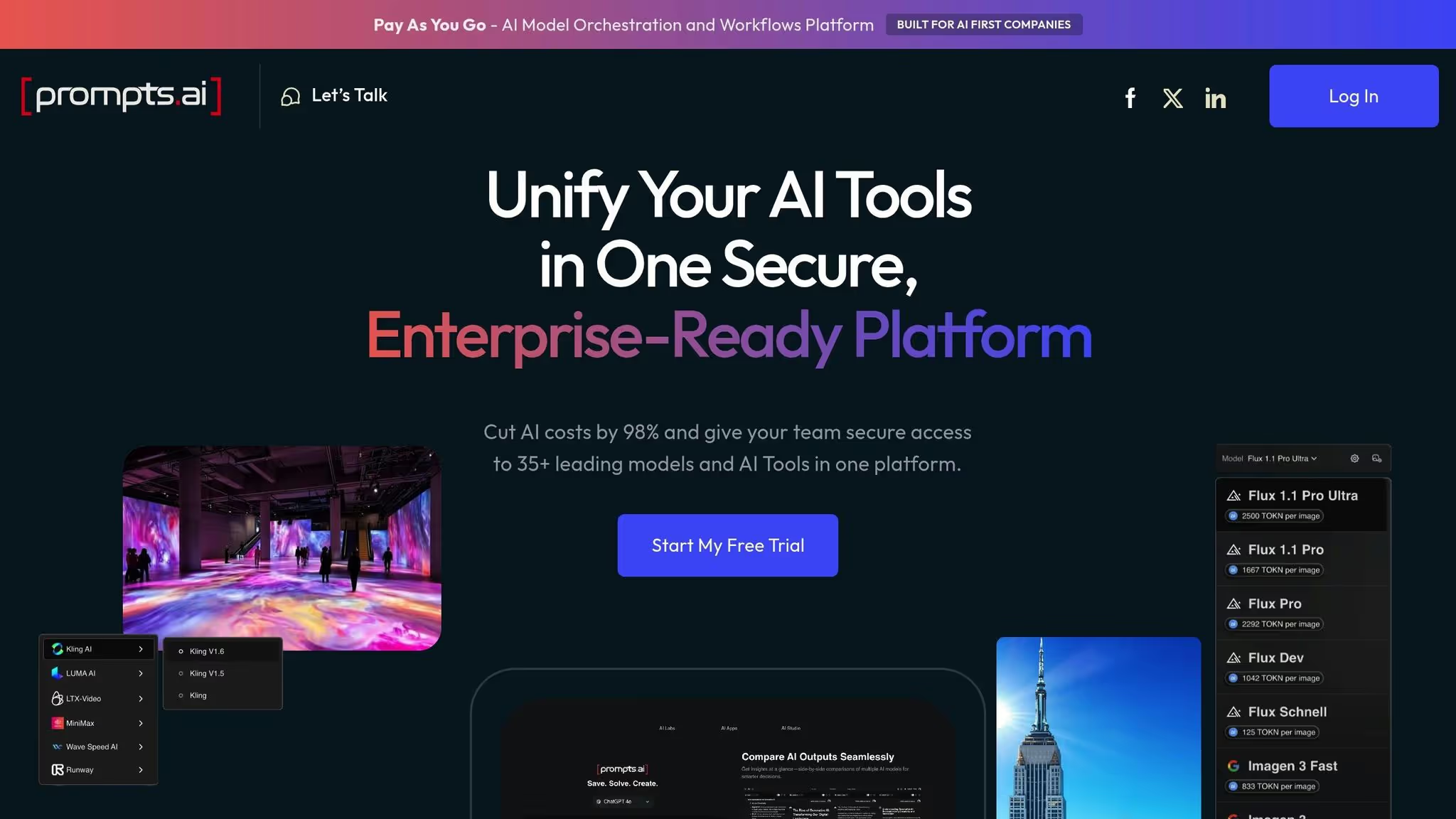
Prompts.ai offers a fresh approach to managing AI models, focusing on the orchestration layer where organizations interact with over 35 leading large language models. Instead of dealing with the complexities of a single model's lifecycle, the platform tackles the governance challenges that arise when multiple AI models are deployed across various use cases. By providing unified access to models like GPT-5, Claude, LLaMA, and Gemini, Prompts.ai bridges governance gaps, tracks interactions, manages costs, and ensures compliance is consistent. This approach eliminates the need for separate subscriptions, access controls, and audit trails for each model provider, giving organizations a single, streamlined point of oversight. This unified system sets the stage for discussions on critical areas like compliance, bias, cost management, integration, and scalability.
Prompts.ai integrates compliance into its core, following best practices outlined in SOC 2 Type II, HIPAA, and GDPR frameworks. The platform initiated its SOC 2 Type 2 audit process on June 19, 2025, demonstrating enterprise-level security. Through the Trust Center at https://trust.prompts.ai/, organizations can monitor their compliance status in real time, accessing insights into security policies, controls, and progress.
Detailed audit trails capture every AI interaction, documenting the models used, prompts submitted, and outputs generated. This level of transparency is particularly valuable for industries like financial services and healthcare, where proving responsible AI use is often a regulatory requirement.
Both Personal and Business plans include compliance monitoring features, ensuring accessibility for organizations of all sizes. The system works seamlessly with Vanta for continuous control monitoring, keeping security measures effective as the platform evolves. This automated oversight reduces the need for manual intervention, helping businesses maintain their compliance posture effortlessly.
For customer-facing AI applications, Prompts.ai minimizes regulatory risks by monitoring prompts for sensitive information such as personally identifiable information (PII), credentials, and proprietary data. This pre-submission filtering acts as a safeguard, preventing data exposure that could lead to GDPR or HIPAA violations.
Prompts.ai actively tracks input and output data to detect and address bias in AI responses. By analyzing how different prompts generate varied outputs across demographics, the platform helps teams identify inconsistencies or discriminatory tendencies in AI behavior. This capability is especially important for applications like customer service or hiring, where biased outputs could result in legal or reputational risks.
Teams can review historical data to pinpoint whether specific phrasing leads to problematic responses. For instance, if a customer support query generates less helpful replies based on how it’s worded, teams can adjust templates to ensure consistent service quality. This proactive approach allows organizations to address bias before it escalates into larger issues.
Real-time dashboards provide visibility into bias metrics, enabling compliance officers and data science teams to intervene quickly. Alerts notify designated team members when responses show inconsistent treatment based on protected characteristics, ensuring timely action to mitigate bias in production environments.
Managing expenses is a key challenge in multi-model AI deployments, and Prompts.ai excels at controlling costs across providers with different pricing structures. The FinOps layer tracks token usage across 35+ models, attributing costs to specific teams and projects for accurate budgeting.
The platform’s Pay-As-You-Go TOKN credit system replaces traditional monthly fees, cutting costs by up to 98%. This usage-based model ensures organizations only pay for what they use, making AI deployments more efficient.
Prompts.ai identifies inefficiencies, such as overly long prompts that inflate costs unnecessarily. It flags these patterns and suggests optimizations, like using shorter prompts or switching to less expensive models for certain tasks. These small adjustments can lead to significant savings, especially for organizations with high daily AI interactions.
Budget alerts help prevent unexpected expenses by notifying administrators when spending nears set thresholds. Teams can set limits at various levels - organization, department, or project - ensuring experimental initiatives don’t drain resources intended for critical applications.
Prompts.ai integrates seamlessly with major cloud providers like AWS, Google Cloud Platform, and Microsoft Azure, allowing organizations to maintain their existing infrastructure while adding centralized AI governance. Its API-first architecture supports custom integrations with proprietary systems, ensuring governance workflows align with established IT processes.
For developers, Python SDKs provide programmatic access to governance features, enabling compliance checks, cost tracking, and bias monitoring directly in their code. This ensures governance oversight doesn’t hinder technical teams working on custom AI applications.
The platform also connects with enterprise SIEM (Security Information and Event Management) systems, centralizing security monitoring. Security teams can correlate AI governance events with broader security data, quickly identifying potential threats. For example, suspicious prompt patterns can be flagged alongside other security indicators, enabling faster responses.
Prompts.ai supports multiple LLM providers, including OpenAI and Anthropic, with a single governance framework. This eliminates the need to create separate policies for each provider, simplifying compliance management and reducing administrative burdens.
Prompts.ai is designed to scale alongside growing AI initiatives, providing complete visibility and auditability of every interaction. Its architecture supports increasing volumes of users and prompts without compromising performance, making it suitable for mid-sized businesses and large enterprises alike.
Role-based access controls ensure team members interact with governance features relevant to their roles. Data scientists can access metrics and cost data for their projects, compliance officers can monitor organization-wide adherence, and business users can focus on results without navigating technical details. Administrators maintain oversight of the entire system, ensuring smooth operations.
The centralized model registry organizes governance policies by department, use case, or regulatory requirement. Teams operating under different compliance frameworks can work in isolated environments with their own rules, while administrators retain the ability to monitor all activities. This setup prevents conflicts between policies across business units.
As new teams adopt AI models, administrators can quickly provision access and apply governance policies, enabling rapid onboarding. This streamlined process supports organizations aiming to expand AI usage while maintaining centralized control over compliance, security, and costs. By scaling horizontally, Prompts.ai ensures governance remains effective, no matter how extensive the organization’s AI adoption becomes.
AI governance platforms each bring their own advantages and limitations, catering to different organizational needs. The table below summarizes an in-depth analysis of five critical evaluation criteria.
| Platform | Compliance Alignment | Bias Monitoring | Cost Management | Integration Flexibility | Scalability |
|---|---|---|---|---|---|
| Credo AI | Strength: Tailored governance frameworks align with EU AI Act and NIST standards. Weakness: Customizing compliance frameworks for specific industries can be time-intensive. |
Strength: Provides detailed fairness assessments with statistical testing. Weakness: Focuses on retrospective analysis, delaying real-time bias detection. |
Strength: Transparent pricing for governance features. Weakness: Does not optimize operational AI costs, focusing instead on governance overhead. |
Strength: API-first design supports custom integrations with machine learning pipelines. Weakness: Limited built-in connectors require additional engineering efforts. |
Strength: Supports enterprise-scale deployments with centralized policy management. Weakness: Onboarding new teams requires manual configuration for each use case. |
| IBM Watsonx.governance | Strength: Strong audit trail capabilities through integration with IBM’s compliance tools and Watson ecosystem. Weakness: Optimized for IBM’s AI services, with third-party model governance requiring extra configuration. |
Strength: Automatically detects fairness metric drift. Weakness: Bias tools are most effective with structured data, struggling with unstructured outputs. |
Strength: Offers consolidated billing for IBM Cloud users. Weakness: Costs can rise quickly with multi-cloud setups, lacking granular project-level cost attribution. |
Strength: Integrates seamlessly with IBM Cloud Pak and Red Hat OpenShift. Weakness: Non-IBM users face a steeper learning curve and integration challenges. |
Strength: Enterprise-grade infrastructure efficiently supports large-scale deployments. Weakness: Scaling across multiple units may require additional licenses or modules. |
| Microsoft Azure Machine Learning & Responsible AI Dashboard | Strength: Built-in compliance features for Azure-hosted models, backed by Microsoft's security certifications. Weakness: Governance tools are spread across various Azure services, requiring manual coordination. |
Strength: Offers visual insights into model fairness across demographic groups via the Responsible AI Dashboard. Weakness: Limited to Azure ML-deployed models, excluding external API calls. |
Strength: Azure Cost Management provides detailed expense breakdowns for ML compute and storage. Weakness: Does not provide automated cost optimization, leaving teams to identify inefficiencies. |
Strength: Integrates smoothly with Microsoft’s enterprise tools like Power BI and Dynamics 365. Weakness: Cross-cloud governance is challenging for organizations using non-Azure platforms. |
Strength: Global infrastructure supports massive scaling with automated resource provisioning. Weakness: Policies must be manually replicated for new workspaces. |
| DataRobot | Strength: Automates compliance documentation throughout the AI model lifecycle, with version control. Weakness: Compliance tools are closely tied to DataRobot’s AutoML platform, limiting flexibility for custom models. |
Strength: Continuously monitors prediction drift and fairness metrics in production. Weakness: Focused on tabular data, with limited support for generative AI outputs. |
Strength: Includes ROI calculators and cost–benefit analyses for deployment decisions. Weakness: High licensing costs without usage-based pricing for variable workloads. |
Strength: Pre-built connectors enable integration with major data warehouses and BI tools. Weakness: Custom integrations often require professional services due to limited self-service API documentation. |
Strength: Multi-tenant deployments with effective role-based access controls. Weakness: Adding new model types or frameworks depends on platform updates, reducing agility. |
| Prompts.ai | Strength: Initiated SOC 2 Type 2 audit on June 19, 2025, offering real-time compliance visibility through its Trust Center and a unified governance framework for over 35 major language models. Weakness: As a newer platform, some formal compliance certifications are still in progress. |
Strength: Standardized prompt workflows encourage responsible AI practices and consistent governance. Weakness: More detailed bias analytics and monitoring metrics are areas for future growth. |
Strength: TOKN credit system aligns costs with actual AI usage, potentially reducing expenses by up to 98%. Weakness: Cost savings are most impactful for organizations using multiple models; smaller deployments may see less impact. |
Strength: Simplifies integration by consolidating access to various language models in one platform. Weakness: Advanced custom integrations for specialized needs may require additional support. |
Strength: Built for rapid scalability, allowing quick addition of models, users, and teams while maintaining governance. Weakness: Highly specialized use cases may require further customization. |
This comparison highlights the importance of balancing strengths and limitations based on specific organizational needs. Platforms like IBM Watsonx.governance and Microsoft Azure Machine Learning deliver seamless integration within their ecosystems, while Credo AI and DataRobot focus on specialized governance capabilities.
Prompts.ai offers a distinct solution by unifying operations across over 35 language models, reducing the fragmentation often seen with multiple services. Its usage-based pricing model and streamlined integration make it especially valuable for organizations managing diverse AI workflows.
When evaluating these platforms, consider your operational setup. Teams already deeply integrated with a single cloud provider may benefit most from native tools, while those managing multiple AI models could find Prompts.ai’s unified platform reduces administrative complexity and enhances flexibility. By weighing these factors, organizations can implement governance strategies that align with their goals and operational demands.
Selecting the right AI model governance service is crucial to meeting your organization's unique needs. Options like IBM Watsonx.governance and Microsoft Azure Machine Learning offer seamless integration into their ecosystems, while platforms such as Credo AI and DataRobot cater to specific compliance and documentation requirements.
Budget considerations play a significant role in this decision. Fixed pricing models are ideal for predictable workloads, whereas usage-based plans are better suited for organizations with fluctuating demands or operations spanning multiple departments. These financial factors highlight the importance of unified solutions, especially when managing numerous models across various teams.
For organizations handling diverse AI workflows, juggling multiple governance frameworks can lead to unnecessary complexity and administrative strain. Prompts.ai simplifies this by providing access to over 35 leading language models within a single governance system. Its pay-as-you-go TOKN credit structure ensures costs align directly with usage while maintaining enterprise-level security and compliance.
Industries with strict regulations require governance solutions that deliver detailed audit trails and enforce rigorous compliance. Conversely, fast-paced sectors need tools that support rapid model iteration without introducing delays. Depending on your priorities, you may require extensive bias monitoring for customer-facing applications or place greater emphasis on version control and risk management.
As technology and industry needs continue to evolve, focus on platforms that address current challenges while allowing room for future growth. Whether you choose native ecosystem tools, specialized governance platforms, or unified orchestration solutions, your decision should support compliance requirements and operational efficiency. A strong governance framework not only mitigates risk but also enables confident AI deployment and paves the way for sustainable progress.
Prompts.ai follows top-tier standards such as SOC 2 Type II, HIPAA, and GDPR to provide strong data protection and meet regulatory requirements. These frameworks are in place to safeguard sensitive information while promoting transparency in AI operations.
To strengthen trust and accountability, Prompts.ai collaborates with Vanta for ongoing control monitoring and officially began its SOC 2 Type II audit process on June 19, 2025. This forward-thinking strategy ensures Prompts.ai stays in step with changing compliance needs while delivering responsible AI solutions.
Prompts.ai enables organizations to dramatically cut expenses by merging more than 35 AI tools into a single, efficient platform, slashing costs by as much as 95%. With its integrated FinOps layer, you gain real-time insights into usage, spending, and ROI, ensuring every interaction is tracked and optimized. This level of transparency makes it simple to manage budgets while getting the most out of your AI workflows.
Prompts.ai takes an active role in identifying and reducing bias in AI models to promote fairness and ethical decision-making. Using advanced algorithms and ongoing evaluation methods, the platform carefully examines datasets, model predictions, and decision-making workflows to pinpoint potential biases.
To combat these challenges, Prompts.ai employs methods such as balancing datasets, deploying bias detection tools, and providing transparency through detailed reporting. These measures help ensure that AI models meet ethical guidelines while producing accurate and fair outcomes across a wide range of uses.