Pay As You Go - AI Model Orchestration and Workflows Platform



AI command centers are transforming enterprise operations by integrating advanced models, workflows, and governance tools into a single interface. The 2026 leaders in this space are solving challenges like tool sprawl, siloed AI systems, and high costs, while enabling businesses to scale AI effectively. Here's what you need to know:
| Company | Key Features | Cost Savings | Integration Ease | Governance Focus |
|---|---|---|---|---|
| Prompts.ai | 35+ models, FinOps tools | 98% | Unified platform | Strong compliance tools |
| Microsoft Azure | Copilot, Power Platform integration | Moderate | Native ecosystem | Enterprise-grade |
| Google Cloud | Gemini AI, no-code agent creation | High | Open protocols (MCP) | Secure, compliant |
| AWS Bedrock | Scalable AI, custom chips | 10× | Broad cloud services | Regional compliance |
| IBM watsonx | Hybrid cloud, z17 mainframes | Moderate | Enterprise data sources | Strong security |
| Salesforce | CRM-focused AI tools | Moderate | CRM ecosystem | Ethical AI practices |
| ServiceNow | AI Control Tower, MCP protocols | Moderate | Seamless governance | Compliance leader |
| Appian | Low-code automation | Moderate | Pre-built connectors | Data sovereignty |
| Pega | Multi-agent workflows | Moderate | Legacy system support | Regulated industries |
| Kore.ai | 100+ pre-built connectors, real-time tools | High | Flexible integrations | Role-based controls |
These platforms address enterprise challenges by reducing costs, improving integration, and ensuring strong governance. Choose based on your priorities: cost efficiency (Prompts.ai), seamless integration (Google Cloud), or governance (ServiceNow).

Top 10 AI Command Centers 2026: Feature Comparison and Cost Savings
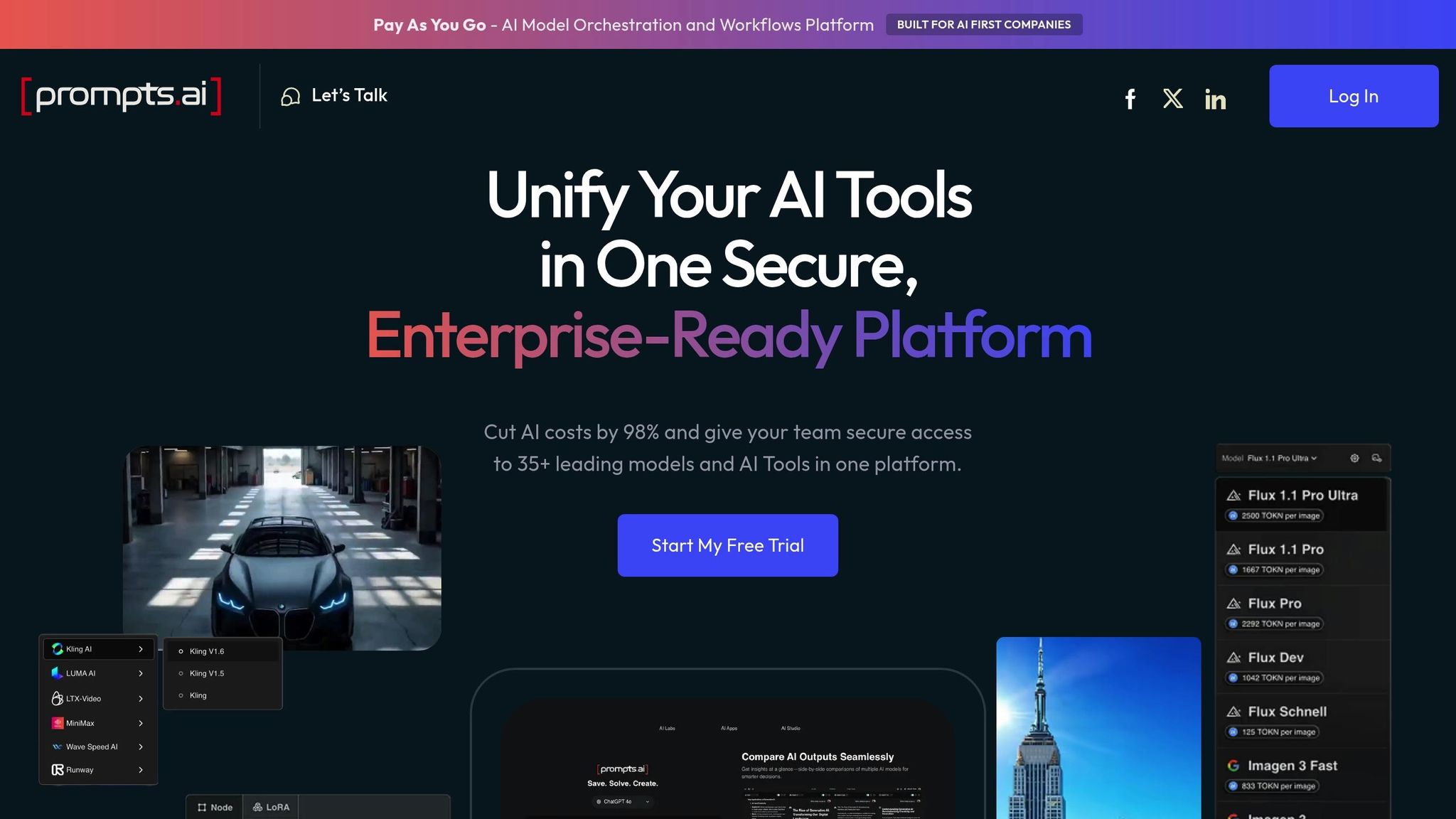
Prompts.ai brings together over 35 of the top language models - including GPT, Claude, LLaMA, and Gemini - into a single, streamlined platform. This central hub allows organizations to manage their entire AI ecosystem efficiently, cutting down on tool clutter and reducing AI costs by as much as 98%.
One of the platform’s standout features is its Interoperable Workflows, included in the Business and Enterprise plans. This functionality allows teams to execute tasks across multiple models simultaneously, compare outputs in real time, and maintain consistency in experiments. With integrations into tools like Slack, Gmail, and Trello, automation can seamlessly extend across departments, simplifying operations. Alongside these integrations, the platform emphasizes strong governance to ensure smooth and reliable performance.
Prompts.ai takes security and compliance seriously. On June 19, 2025, the platform began its SOC 2 Type 2 audit process, reinforcing its commitment to enterprise-level security. It follows best practices outlined by SOC 2 Type II, HIPAA, and GDPR frameworks, with continuous monitoring handled by Vanta. A real-time Trust Center offers transparency into policies, controls, and compliance progress. Administrators can enforce policies at scale using centralized governance tools, ensuring full auditability for all AI interactions.
The platform’s Business plans include advanced usage analytics, offering insights into team productivity, model performance, and token consumption organization-wide. Comprehensive audit logs document every AI interaction, while a side-by-side LLM comparison feature allows for real-time troubleshooting. These tools give organizations a clear picture of how AI resources are being used, helping identify areas for improvement. Paired with these operational insights, the platform also delivers substantial cost-saving opportunities.
Prompts.ai optimizes resource allocation through TOKN Pooling and Storage Pooling, ensuring efficient use of AI resources across teams. Business Elite plans provide 1,000,000 TOKN credits per member each month, with pricing starting at $99 per member for the Core tier. The platform claims that by consolidating disconnected AI tools, organizations can achieve a 95% cost reduction in under 10 minutes. This level of control allows enterprises to align AI spending directly with business goals, maximizing both efficiency and value.
Microsoft has established its AI command centers as a blend of enterprise-scale infrastructure and centralized oversight. By September 2025, the company's Copilot suite had surpassed 150 million monthly active users, underscoring its widespread adoption across enterprises. To meet this growing demand, Microsoft is set to double its global data center footprint between late 2025 and 2027. It is also collaborating with partners such as Marvell to develop custom 3nm ASICs, aiming to enhance performance and improve thermal efficiency.
The Power Platform acts as Microsoft's low-code orchestration layer, empowering non-technical users to create AI-driven agents that seamlessly integrate with tools like Word, Excel, Teams, and Windows. Beyond Microsoft's own models, third-party options like Anthropic's Claude are also incorporated into the Microsoft 365 Copilot environment. This gives organizations the flexibility to leverage various reasoning capabilities tailored to specific tasks. The ability to blend in-house and external models enhances productivity while maintaining a smooth and cohesive workflow, paving the way for stronger governance structures.
Microsoft's centralized workflows are bolstered by a robust approach to governance, security, and compliance. In 2026, the company partnered with ServiceNow's AI Control Tower to establish a unified governance hub for managing risks and ensuring compliance across its distributed AI systems. Azure AI's infrastructure also includes advanced tools like document intelligence, OCR, and proprietary data extraction capabilities. These features are designed with regulated industries in mind, ensuring that AI models remain secure and compliant even at scale.
Microsoft's seamless integration of workflows and centralized governance demonstrates its capability to handle critical enterprise applications. In September 2025, JPMorgan Chase utilized Azure's LLM Suite to generate a five-page investment banking deck in just 30 seconds - a task that previously required hours of effort from junior banking teams. This tool supported 250,000 employees, with 125,000 daily users relying on it for their tasks.
Google Cloud's Vertex AI Agent Builder is designed as a no-code platform that simplifies enterprise AI deployment. By utilizing Gemini multimodal AI models, it allows non-technical teams to create tailored solutions for tasks like research, coding, and administrative workflows. This unified platform ensures seamless coordination across various enterprise operations.
The Vertex AI Agent Builder excels in creating interconnected workflows through its use of the Model Context Protocol (MCP). Acting as a universal bridge, MCP enables AI agents to integrate with enterprise tools and databases, including platforms like Slack. This setup ensures that AI outputs are accurate and grounded in an organization’s internal data. Additionally, its integration with Chrome Enterprise allows businesses to automate tasks across a variety of applications, combining cloud-based management with AI-driven solutions.
To protect sensitive business data, the platform enforces strict security measures throughout the orchestration process. It employs a retrieval-augmented generation approach, ensuring that AI responses are based on internal data for accuracy and compliance. Key security features include identity management, resource protection, and integrated backup and disaster recovery systems, all of which reinforce the platform’s reliability and trustworthiness.
Vertex AI includes advanced analytics tools that help teams monitor performance, manage costs, and fine-tune services. Its no-code workbench provides full visibility into the lifecycle of agent creation, deployment, and management. Backing these capabilities, Google has made significant investments in its AI infrastructure, such as a $15 billion project in Vishakapatnam, India, which includes a gigawatt-scale facility, and a $5 billion commitment to enhance AI infrastructure in Belgium over two years. These investments ensure the computing power needed to support enterprise-scale operations, enabling businesses to streamline command-center activities with top-tier tools and practices.
AWS Bedrock serves as a centralized platform designed to scale generative AI by seamlessly combining foundational models, data storage, and computing resources. By embedding AI directly into business workflows, it eliminates the need for organizations to juggle multiple systems, streamlining the management of intricate AI-driven tasks across enterprise operations.
With its agent-oriented design, AWS Bedrock leverages the Model Context Protocol (MCP) to link AI agents with enterprise tools, databases, and communication platforms. This approach ensures smooth collaboration between systems while maintaining efficiency. AWS also employs custom ASICs, developed in partnership with companies like Marvell, to enhance power efficiency and reduce costs for high-speed AI networking. Operating on a global scale, the platform ensures localized content delivery and compliance with regional regulations, enabling efficient and secure operations no matter the location.
AWS Bedrock prioritizes governance and security as part of its orchestration framework. Core security services are integrated throughout the platform, covering resource protection, identity management, and compliance monitoring. By processing and storing data in regional data centers, AWS aligns with local privacy laws and regulations. The platform also offers enterprise-grade reliability through built-in backup systems, disaster recovery capabilities, and robust encryption protocols, ensuring that sensitive business data remains protected at all times.
AWS is committed to scaling its infrastructure to meet the growing demands of AI operations. The company recently secured a 1.9 GW energy agreement and has projects underway to add 1 GW of capacity by 2026. These large-scale facilities are designed to support the high-density compute needs essential for agent-oriented orchestration. AWS also enhances flexibility through modular construction and custom server rack designs, working with partners like Celestica to bypass traditional OEM constraints. This approach accelerates the deployment of AI infrastructure, ensuring AWS Bedrock is optimized for both integration and large-scale enterprise use.
AWS Bedrock is built to meet the demands of enterprise environments. Amazon’s operational scale is evident in its use of AI-powered robotics, which handle the majority of its order fulfillment. To further its enterprise AI initiatives, AWS has doubled its investment in the Generative AI Innovation Center, adding an additional $100 million. The platform offers a comprehensive suite of tools, including Amazon SageMaker for model training and Amazon Comprehend for natural language processing, empowering businesses to deploy AI agents across varied workflows. With 94% of IT leaders planning to incorporate AI into their technology stacks by the end of 2025, AWS Bedrock’s infrastructure positions it as a key player for organizations looking to scale their AI operations effectively.
IBM watsonx Orchestrate serves as a powerful AI command center, blending advanced software intelligence with specialized hardware on a hybrid cloud platform. It combines watsonx.ai for deploying models and watsonx.data for managing enterprise data through a lakehouse architecture. This creates a cohesive system for managing complex AI workflows across various systems and locations.
Built on its hybrid cloud foundation, watsonx Orchestrate simplifies operational workflows. It offers access to a library of over 500 automation agents, designed to handle a wide range of enterprise tasks. These agents ensure smooth operations, whether workloads are running on-premises, in the cloud, or across multiple infrastructures. With the support of IBM's z17 mainframes and LinuxONE 5 systems, the platform processes billions of AI inference operations daily, showcasing its immense computational power.
The platform integrates autonomous security AI within its hardware and software to detect and address threats in real time. IBM's z17 mainframes provide enterprise-grade reliability while meeting rigorous regulatory standards. IBM’s leadership in AI innovation is evident, with over 1,200 AI utility patents and nearly $400 million in annual revenue from AI patent licensing. This highlights IBM’s dedication to protecting its technology and ensuring customer data security.
By uniting watsonx.ai, watsonx.data, and its autonomous security systems, the platform enables real-time decision-making. Its lakehouse architecture provides a clear view of all orchestrated workflows, allowing IT teams to monitor agent performance and address issues proactively before they disrupt operations.
IBM watsonx Orchestrate is built to meet the needs of AI-driven enterprises, where autonomous agents play a central role in business operations. Its ability to handle billions of inferences daily, paired with robust security features, makes it ideal for large-scale deployments. As a recognized hyperscaler alongside AWS, Google Cloud, Microsoft Azure, and Oracle Cloud, IBM leverages decades of experience to support enterprises requiring hybrid cloud flexibility and mainframe-level security.
Salesforce presents Einstein and Agentforce as a comprehensive AI hub, combining strategy, governance, and risk management into one cohesive platform. It streamlines workflow management and ensures compliance by offering real-time insights that help reduce risks and meet regulatory requirements. The platform reinforces best practices to protect data, manage processes effectively, and promote ethical AI usage throughout enterprise operations. This integrated system reflects the evolving trend of centralized AI command centers shaping enterprise AI solutions across industries.
The AI Agent Fabric from ServiceNow acts as a central communication hub, seamlessly connecting AI agents across an enterprise. This framework allows agents to share information, coordinate tasks, and perform actions without disruption. By leveraging standardized protocols like the Model Context Protocol (MCP) and Agent2Agent Protocol (A2A), the platform ensures smooth interaction between AI systems from different vendors. ServiceNow has deployed thousands of AI agents optimized for tasks such as IT support, operations, asset management, and security. These agents are designed to handle challenges autonomously, featuring self-healing and self-defending capabilities that enable systems to resolve problems and recover from disruptions faster. Dorit Zilbershot, Group Vice President of AI Experiences and Innovation at ServiceNow, highlighted the platform's strength, stating, "We're allowing our customers to govern and manage their AI assets across the enterprise to make sure that they have full control on everything that they do." This interconnected framework provides a foundation for centralized management and oversight.
The AI Control Tower serves as the central hub for managing AI assets. In late 2025, Microsoft selected this platform to oversee governance for both its native and third-party AI agents, showcasing its ability to handle diverse integrations. ServiceNow also provides tools like AI Discovery and Inventory, which use a specialized data model to link AI assets directly to business services. With built-in compatibility for frameworks such as the NIST AI Risk Management Framework (RMF) and the EU AI Act, the platform offers pre-configured workflows to help organizations stay compliant with regulations. By 2028, enterprises utilizing AI governance platforms are expected to experience a 30% boost in customer trust ratings and a 25% improvement in regulatory compliance scores.
The AI Control Tower provides real-time dashboards designed to measure AI performance against specific business goals and productivity metrics. Through integration with CMDB and CSDM, the platform embeds AI governance into core business technology services, offering end-to-end visibility into the AI lifecycle. This setup allows IT teams to monitor every stage of their AI assets - from deployment and performance to eventual retirement - all from one reliable source of truth.
Appian offers a low-code automation platform that simplifies process automation and supports smarter decision-making. As we look toward 2026, top AI platforms are integrating governance tools to oversee every stage of AI and data workload management - spanning training, tuning, and deployment. Appian prioritizes data sovereignty, helping organizations retain control over sensitive information while adhering to regulatory standards. Notably, Appian is among the top-performing AI stocks in 2026. This comprehensive strategy ensures a smooth path to large-scale enterprise adoption.
Appian's low-code framework is built for large organizations, fostering collaboration between business teams and IT departments. This approach accelerates the creation and implementation of automation solutions while maintaining a strong focus on security and compliance.
Pega bridges workflows across various departments, ensuring smooth collaboration between customer service, back-office teams, and field operations. It integrates effortlessly with existing systems, offering a streamlined approach to oversight and compliance.
Pega employs a governance framework tailored for industries with strict regulations, featuring automated lifecycle management. Its advanced AI command centers include "human-in-the-loop" oversight, real-time risk monitoring, and transparent reporting. These features are critical for maintaining safe and compliant operations in sectors like finance and government.
Designed for large-scale deployments, Pega's command center ensures reliability and adherence to regulations. The platform efficiently handles multiple workflows simultaneously, maintaining detailed audit trails and performance metrics essential for operational continuity and compliance.
Kore.ai facilitates seamless collaboration among AI agents through its Supervisor Agents and Inter-Agent Protocols. This system allows agents to share memory and manage intricate decision-making processes across various departments. The platform connects to over 100 enterprise applications using pre-built connectors, integrating both structured data sources like Salesforce, SAP, and Epic, as well as unstructured ones such as SharePoint, Slack, and Google Drive. A notable example is Pfizer, which deployed 60 AI agents globally across R&D, medical, commercial, and manufacturing divisions. Vik Kapoor, Head of GenAI Platforms & Products at Pfizer, shared:
"We needed a scalable platform, and these agents will only continue to become more intelligent."
This level of orchestration provides a strong foundation for monitoring and optimizing AI performance.
Kore.ai takes its orchestration a step further by offering real-time insights into agent interactions through tracing, audits, and event monitoring. Its unified command center gives enterprises a clear view of their "AI workforce automation layer", making it easier to track agent decisions, interactions, and identify bottlenecks. For instance, Eli Lilly leveraged this visibility to transform its Tech@Lilly service desk. AI agents now handle 70% of service requests, allowing human employees to focus on more strategic tasks.
Kore.ai’s Model Hub supports integration with any AI model, whether it’s commercial, open-source, or proprietary. The platform’s Model Context Protocol (MCP) integrations, combined with no-code tools for quick deployment and pro-code options for advanced customization, make it highly adaptable. Autodoc exemplifies this flexibility, using Kore.ai to enhance its existing infrastructure. The result? A 74% first-call resolution rate and noticeable operational savings.
Kore.ai has been recognized by Gartner's Magic Quadrant and rated highly in the Forrester Wave, underscoring its enterprise-grade capabilities. With features like Role-Based Access Control (RBAC) and compliance frameworks, the platform supports operations across diverse regulatory environments. Puneet Chandok, President of India and South Asia at Microsoft, remarked:
"By integrating Kore.ai's advanced conversational and GenAI capabilities with Microsoft's robust cloud and AI services, we are enabling enterprises to adopt AI at scale and with enterprise-grade security."
The table below provides a concise comparison of the strengths, limitations, ease of integration, and ROI for various AI command centers. This snapshot highlights how each platform tackles challenges related to integration, cost, and security.
| Company | Key Strengths | Primary Limitations | Integration Ease | ROI Track Record |
|---|---|---|---|---|
| Prompts.ai | Centralized access to 35+ models; reduces tool sprawl; real-time FinOps cost controls; up to 98% cost savings | Relatively new player building its market presence | Secure, unified interface; pay-as-you-go TOKN credits | Cuts AI software costs by up to 98%; boosts productivity 10× |
| Microsoft Azure & Power Platform | Seamless integration with Microsoft 365 and Copilot; enterprise-grade security | Complexity in connecting fragmented AI tools | Native Microsoft ecosystem compatibility | Widely adopted by Fortune 500 enterprises |
| Google Cloud Vertex AI | Comprehensive AI-optimized platform; supports open protocols (MCP, A2A) | Early struggles with AI "silo" issues | Integrates with Workspace, M365, Salesforce, SAP | Delivered 500% ROI for Mercari; enabled 50% order growth for Klarna |
| AWS Bedrock | Custom ASIC projects for efficiency; leading infrastructure provider | High compute costs (over 80% of startup budgets); energy consumption concerns | Broad cloud service integration | Annual cost reductions of 10× |
| IBM watsonx Orchestrate | Over 1,200 AI patents; advanced orchestration capabilities | Challenges in integrating hybrid cloud and mainframe systems | Connects to enterprise data sources | Trusted in highly regulated industries |
| Salesforce Einstein & Agentforce | Deep integration with CRM data; supports AP2 protocol | Limited ability to handle historical data due to context window constraints | Fully integrated within Salesforce ecosystem | Offers personalized agent context using CRM insights |
| ServiceNow Now Platform | Centralized AI governance with AI Control Tower; supports MCP and A2A protocols | Difficulties managing the growing volume of AI assets | Seamlessly governs ServiceNow and third-party agents | Provides real-time ROI insights and validates business outcomes |
| Appian | Low-code workflow automation; fast implementation | Struggles with multi-step reasoning for complex tasks | Pre-built connectors for enterprises | Improves process automation efficiency |
| Pega | Strong in decision and case management | Coordination issues in multi-agent systems | Integrates well with legacy systems | Enhances claims processing efficiency |
| Kore.ai | Offers 100+ pre-built connectors; supports Model Context Protocol | Limited by fixed context windows for historical data | Structured integration with tools like Salesforce and SAP | - |
The evolution from generative AI to agentic AI introduces a recurring hurdle: siloed systems hinder seamless orchestration across large-scale organizational workflows. Thomas Kurian, CEO of Google Cloud, highlighted this issue:
"The first wave of AI, while promising, has been stuck in silos, unable to orchestrate complex work across an entire organization."
Additionally, hyperscale data centers - defined as those exceeding 50 MW and often reliant on liquid cooling - face physical limitations even as AI operational costs drop by 10× annually, and hardware efficiency improves by 30–40% each year. While these trends reduce long-term expenses, the initial infrastructure investment remains steep. Projections estimate that supporting AI growth will require $7 trillion in global data center capital by 2030.
Governance and security are becoming ever more critical in this landscape. Dorit Zilbershot, Group VP of AI Experiences at ServiceNow, emphasized the importance of maintaining control:
"We're allowing our customers to govern and manage their AI assets across the enterprise to make sure that they have full control on everything that they do."
Centralized control systems and standardized protocols like MCP and A2A are proving effective in managing the complexities of multi-vendor environments.
To succeed, AI command centers must strike a balance between seamless integration, cost efficiency, and robust governance. Organizations should carefully evaluate these factors alongside their workflow needs, regulatory requirements, and long-term AI goals when deciding on a platform.
As we look toward 2026, the AI command center landscape highlights standout leaders across three key areas. ServiceNow takes the lead in governance with its AI Control Tower, offering centralized oversight for both its own and third-party AI agents. This capability is projected to boost customer trust ratings by 30% and improve regulatory compliance scores by 25% by 2028. Such advancements are particularly critical for sectors like banking and healthcare, where regulatory compliance is non-negotiable.
On the interoperability front, Google Cloud emerges as a frontrunner with its Agent2Agent (A2A) and Agent Payments (AP2) protocols, in addition to its support for the Model Context Protocol (MCP). Addressing the challenges of siloed AI systems, Google Cloud CEO Thomas Kurian remarked:
"The first wave of AI, while promising, has been stuck in silos, unable to orchestrate complex work across an entire organization".
Google’s approach provides a solution for enterprises aiming to streamline operations across diverse systems, ensuring seamless coordination.
When it comes to cost management, fragmented AI tools often lead to inefficiencies and budget overruns. Prompts.ai offers a solution by consolidating tools, enabling up to 98% cost savings. With access to 35+ models through a single pay-as-you-go interface and real-time FinOps controls, Prompts.ai simplifies operations while cutting costs dramatically.
Ultimately, the right platform depends on your organization’s priorities. For those focused on regulatory compliance, platforms like ServiceNow or Microsoft Azure are strong contenders. If interoperability and system integration are top concerns, Google Cloud provides a clear advantage. For businesses grappling with high AI software costs and operational complexity, Prompts.ai offers a streamlined, cost-effective alternative.
As AI model costs continue to drop - falling tenfold annually - and hardware efficiency improves by 30–40% each year, success will hinge on choosing platforms built for this fast-paced, cost-efficient environment. Companies that embrace these forward-looking architectures will be best positioned to thrive in the evolving AI landscape.
AI command centers provide businesses with a centralized hub to simplify operations, improve decision-making, and cut costs. By offering real-time monitoring and optimization, these centers help ensure processes run smoothly and challenges are addressed quickly.
They also make it easier to scale operations by connecting platforms that work seamlessly together, enabling businesses to handle increasing demands effectively. Beyond that, they open doors to new possibilities by using AI insights to identify opportunities and drive better performance across the board.
Prompts.ai enables businesses to cut up to 98% of AI operational costs by bringing together more than 35 leading AI models and tools into one secure, unified platform. This integration removes the hassle of juggling multiple standalone tools, minimizing inefficiencies and simplifying workflows.
With streamlined AI management and optimized resource usage, Prompts.ai allows businesses to channel their energy into driving innovation, all while keeping operational costs in check.
Governance and compliance play a key role in AI command centers, serving to protect data security, safeguard sensitive information, and ensure alignment with crucial U.S. regulations such as HIPAA and SOX. These practices are fundamental to establishing trust, promoting accountability, and adhering to industry standards.
Focusing on governance and compliance allows organizations to uphold operational integrity, minimize legal risks, and build a framework for ethical and transparent AI practices. This commitment not only meets regulatory requirements but also paves the way for responsible advancements in AI.