Pay As You Go - AI Model Orchestration and Workflows Platform



Machine learning workflows can be complex, but the right platform can simplify processes, save costs, and improve results. Here's a breakdown of four leading platforms designed to streamline AI workflows:
| Platform | Key Features | Ideal For | Challenges |
|---|---|---|---|
| Prompts.ai | Unified LLM access, cost optimization, governance | Teams using multiple LLMs | Subscription-based pricing |
| TFX | TensorFlow integration, metadata tracking | TensorFlow-focused teams | High infrastructure complexity |
| MLflow | Multi-framework support, model registry | Experiment tracking & deployments | Requires engineering resources |
| Kubeflow | Kubernetes-native, distributed training | Large-scale AI/ML applications | Steep learning curve |
Each platform addresses different needs, from simplifying LLM workflows to managing large-scale pipelines. Choose based on your team's goals, technical expertise, and scalability requirements.

Machine Learning Workflow Platforms Comparison: Features, Strengths and Ideal Use Cases
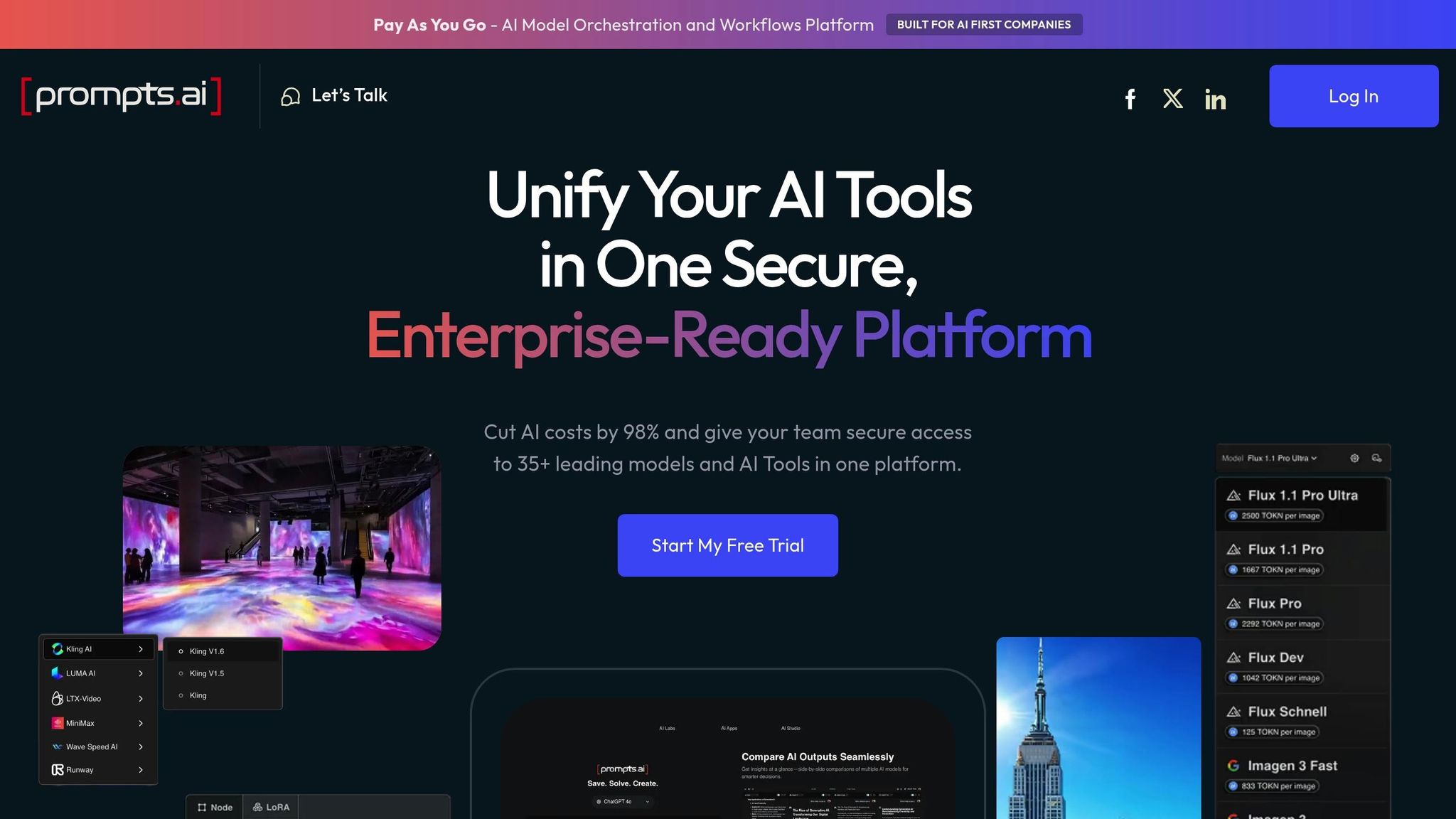
Prompts.ai is an AI orchestration platform designed to simplify and unify access to over 35 top-tier large language models (LLMs). These include well-known names like GPT-5, Claude, LLaMA, Gemini, Grok-4, Flux Pro, and Kling. Instead of juggling multiple subscriptions and tools, teams can direct workflows to the most suitable model for a task, all from a single, secure interface. This eliminates the inefficiencies of managing numerous tools, streamlining machine learning operations.
At the heart of Prompts.ai is its unified model access layer, which makes working with various LLMs straightforward and efficient. Users can compare model performance, switch between providers with ease, and assign prompts to the best-performing model for their needs. There's no need to deal with multiple API keys, authentication systems, or billing setups. This streamlined approach allows organizations to explore and incorporate new models into their workflows in a matter of minutes, not weeks, ensuring operations stay efficient and adaptable.
Prompts.ai incorporates a real-time FinOps layer to monitor token usage across all models and teams. Instead of fixed monthly fees, the platform uses a pay-as-you-go system with TOKN credits, ensuring costs align with actual usage. By eliminating unnecessary subscriptions and optimizing model selection based on cost and performance, organizations can reportedly cut AI software expenses by up to 98%. This approach ties spending directly to measurable outcomes, ensuring every dollar spent delivers value.
For enterprises, especially those in regulated industries, robust governance is essential. Prompts.ai includes built-in audit trails, access controls, and compliance tools. These features track model usage, executed prompts, and the flow of sensitive data through workflows, providing full visibility and accountability. By keeping all data within the organization's security perimeter, the platform minimizes reliance on external third-party services, enhancing security and compliance.
Whether you're a small agency or a Fortune 500 company, Prompts.ai is built to scale effortlessly. Adding new models, users, or teams doesn’t require complex infrastructure changes. Pricing tiers start at $99 per member per month for the Core plan, with Pro and Elite plans offering expanded features at $119 and $129, respectively. This scalability ensures that organizations of all sizes can maintain efficient and streamlined AI workflows as their needs grow.
TensorFlow Extended (TFX) is Google’s robust platform designed to manage the entire lifecycle of machine learning projects. Built on TensorFlow, it supports everything from data validation to model deployment and monitoring, making it a go-to solution for production-scale ML pipelines.
TFX emphasizes reproducibility and transparency through its use of ML Metadata (MLMD), which meticulously tracks component runs, artifacts, and configurations. Tools like TensorFlow Data Validation (TFDV) automatically generate data schemas and flag anomalies, ensuring data quality. TensorFlow Model Analysis (TFMA) assesses model performance before deployment, validating results against predefined metrics. Once models are deployed, TFDV continues to monitor inference requests for drift and anomalies. Additionally, the InfraValidator component performs canary deployments in isolated environments, safeguarding production systems from potentially flawed models. These governance measures make TFX a reliable choice for managing complex ML workflows.
TFX is built to handle the demands of large-scale machine learning operations. It integrates seamlessly with orchestration tools like Apache Airflow and Kubeflow Pipelines, enabling distributed workflows. Kubeflow, in particular, supports portable and distributed training on Kubernetes, enhancing flexibility. The modular architecture of TFX allows teams to scale specific components of their workflows independently, ensuring adaptability to changing computational needs. This modularity and integration capability make TFX an essential tool for managing scalable ML workflows.
Expanding on the ideas of orchestration and scalability discussed earlier, MLflow provides a cohesive framework tailored to managing the entire lifecycle of machine learning projects, with a particular focus on generative AI.
MLflow is a widely-used open-source platform across various industries. It supports every stage of the machine learning process, from initial experimentation to full-scale production deployment.
MLflow now integrates seamlessly with generative AI through its AI Gateway and GenAI capabilities. The AI Gateway acts as a unified interface for deploying and managing multiple large language model (LLM) providers, such as OpenAI, Anthropic, Azure OpenAI, Gemini, and AWS Bedrock, all through one secure endpoint. This setup allows teams to switch between providers effortlessly without needing to alter application code. Additionally, its prompt management system supports template versioning and logs execution details, improving GenAI workflow transparency and observability. MLflow also works with frameworks like LangChain, offering APIs for logging and tracking models.
The AI Gateway helps organizations reduce expenses by routing requests to the most efficient models available. This centralized approach not only optimizes costs but also ensures flexibility in managing AI infrastructure.
MLflow places a strong emphasis on reproducibility and collaborative model management. Its Model Registry acts as a centralized repository for the entire lifecycle of models, including versioning, stage transitions (e.g., development, staging, production, and archiving), and annotations. Security is enhanced through the AI Gateway, which securely stores API keys and logs request/response data for comprehensive audit trails. Its observability features capture detailed execution data for GenAI workflows, aiding both compliance and debugging efforts.
Designed for large-scale enterprise operations, MLflow supports distributed training on clusters like Apache Spark and integrates with distributed storage solutions such as AWS S3 and DBFS. It packages models for deployment across a variety of environments, including Docker-based REST servers, cloud platforms, and Apache Spark UDFs. For scalable Kubernetes deployments, MLflow integrates with MLServer, leveraging tools like KServe and Seldon Core. The predict_stream method (introduced in version 2.12.2+) further enhances its ability to handle large or continuous data streams efficiently. These features make MLflow a powerful tool within the broader machine learning workflow ecosystem, setting the stage for evaluating the strengths and limitations of different platforms.
Kubeflow brings a Kubernetes-native approach to managing large-scale machine learning workflows, making it a powerful tool for enterprises. Designed to handle distributed AI/ML workloads, it seamlessly operates across cloud environments and on-premises data centers.
Kubeflow supports the entire AI lifecycle, with specialized workflows for large language models (LLMs). Through the Kubeflow Trainer, it offers advanced fine-tuning capabilities, enabling distributed training across frameworks such as PyTorch, HuggingFace, DeepSpeed, MLX, JAX, and XGBoost. For handling generative AI tasks, KServe provides a robust inference platform tailored to scalable use cases. Features like intelligent routing and "Scale to Zero" on GPUs help optimize resource usage. This modular setup allows teams to integrate LLM functionalities without requiring major infrastructure changes.
Kubeflow enhances workflow management with multi-user isolation, giving administrators precise control over access and operations across different teams. The platform's Model Registry stores critical ML metadata and artifacts, ensuring clear tracking of model lineage throughout its lifecycle. Kubeflow Pipelines further supports saving machine learning artifacts in compliant registries, aiding organizations in meeting regulatory standards. Built-in versioning and collaboration tools make experiments and models both auditable and reproducible. These governance features align with Kubeflow's distributed architecture, offering a structured yet flexible solution.
Kubeflow’s design is geared toward large-scale operations, making it an ideal choice for managing complex AI/ML applications. Rafay's MLOps platform, for example, uses Kubeflow to oversee fleets of AI/ML applications across AWS, Azure, GCP, on-premises systems, and even edge environments. It supports operational scalability by enabling teams to manage hundreds of clusters and applications in organized, software-defined groups. Kubeflow Pipelines orchestrates portable, containerized workflows that can scale independently. Additionally, the Kubeflow Spark Operator simplifies running Spark applications on Kubernetes, streamlining data preparation and feature engineering for large-scale projects. This flexible ecosystem allows organizations to deploy only the components they need or utilize the full platform, depending on their goals.
Following the detailed exploration of platform profiles, let’s dive into the key advantages and drawbacks, shedding light on the trade-offs each platform presents.
Each platform balances cost, complexity, and capabilities differently, helping teams match their technical requirements with operational realities.
Open-source platforms such as TFX, MLflow, and Kubeflow eliminate licensing fees but demand significant engineering resources. These solutions require investments in infrastructure - covering compute, storage, and networking - alongside ongoing engineering support. For instance, TFX is tailored for production-scale needs, but it relies on orchestration tools like Apache Airflow and an ML Metadata backend. Kubeflow, built on a Kubernetes foundation, offers unparalleled scalability but comes with a steep learning curve, requiring advanced DevOps expertise to manage and troubleshoot effectively. Meanwhile, MLflow stands out for its flexibility, integrating seamlessly with over 40 frameworks - including PyTorch, OpenAI, HuggingFace, and TensorFlow. However, deploying MLflow in production settings often necessitates dedicated engineering resources.
Interoperability and collaboration are also key differentiators among these platforms. MLflow simplifies deployment by standardizing model packaging into multiple "flavors", enabling integration with environments like Docker-based REST servers, Azure ML, AWS SageMaker, and Apache Spark. Its Registry serves as a centralized model store, complete with APIs and a user-friendly interface for managing the entire model lifecycle, fostering collaboration across teams. On the other hand, Kubeflow’s modular and Kubernetes-native design allows teams to deploy components independently or as a complete platform in any Kubernetes environment. Similarly, TFX pipelines work seamlessly with external orchestration systems and utilize an ML Metadata backend, ensuring traceability for experiment tracking and reproducibility.
The resource demands of these platforms vary widely. Open-source solutions cater to teams with robust engineering capabilities, while managed services are better suited for those prioritizing quick deployment. Although open-source platforms come without licensing fees, their total cost of ownership can be substantial when factoring in the engineering hours needed for maintenance and customization. Managed MLflow hosting, described by its creators as "free and fully managed", simplifies setup but may have compatibility constraints or favor native alternatives for specific features.
Here’s a quick comparison of the platforms:
| Platform | Key Strengths | Primary Weaknesses |
|---|---|---|
| Prompts.ai | Unified interface for 35+ LLMs; real-time FinOps cost controls; enterprise governance; minimal setup time | None significant |
| TFX | Production-grade reliability; strong TensorFlow integration; comprehensive ML Metadata tracking | High infrastructure complexity; requires orchestration systems; steep learning curve |
| MLflow | Versatility with 40+ framework integrations; excellent collaboration tools; self-hosted or managed options | Production deployments need dedicated engineering; managed versions may face compatibility limitations |
| Kubeflow | Exceptional scalability; Kubernetes-native portability; modular architecture; multi-framework support | Requires advanced DevOps expertise; complex troubleshooting; high operational demands |
This comparison highlights how each platform’s unique design aligns with different operational and technical priorities, helping teams make informed decisions.
Choose the platform that best fits your organization's goals and priorities.
While effective MLOps can cut deployment time by 60–70% and significantly improve production success rates, only 20% of AI projects make it to production. This highlights the importance of selecting a platform that aligns with your specific needs. A thoughtful evaluation of each platform's capabilities is essential to ensure success.
Prompts.ai simplifies AI workflows by offering unified access to over 35 models, complete with built-in governance and real-time cost management, cutting AI expenses by up to 98%. TFX provides robust, production-grade reliability for TensorFlow-focused teams, though it requires extensive orchestration. MLflow stands out for its strengths in experiment tracking, version control, and reproducibility, along with flexible deployment options. Kubeflow caters to teams with advanced DevOps expertise, enabling scalable, Kubernetes-native workflow orchestration. Each platform uniquely addresses the key priorities of interoperability, cost efficiency, and scalability discussed throughout this article.
When selecting a machine learning workflow platform, it's essential to consider how well it aligns with your project requirements and existing tools. Start by prioritizing compatibility - the platform should seamlessly integrate with your current libraries, frameworks, and deployment infrastructure. This ensures a smoother workflow and reduces the need for extensive reconfiguration.
Another critical feature to look for is experiment tracking. Platforms that automatically log code versions, parameters, and datasets make it easier to reproduce results and maintain consistency across projects. If you're working with large models or running multiple experiments, scalability becomes a key factor. Opt for platforms that offer distributed training and efficient resource management to handle growing computational demands.
Pay close attention to deployment options as well. Whether your target environment is the cloud, edge devices, or serverless endpoints, the platform should support your deployment needs without unnecessary complexity. For team collaboration, features like an intuitive user interface, role-based access control, and metadata tracking can significantly enhance productivity, especially in industries with strict regulations.
Lastly, consider the trade-offs between open-source tools and paid platforms. Open-source options often come with active community support, while paid platforms may provide dedicated customer service and enterprise-grade features. By carefully weighing these factors - technical fit, budget constraints, and compliance requirements - you can choose a platform that effectively supports your machine learning initiatives.
Prompts.ai is designed to simplify AI workflows, making them more efficient and easier to scale. By automating repetitive tasks and integrating effortlessly with large language models, the platform minimizes wasted resources and streamlines operations. Its focus on collaboration further enhances productivity, helping teams work smarter, not harder.
The platform also supports solutions that grow with your needs, handling increasing data and processing demands without compromising efficiency. This blend of automation and scalability allows you to manage budgets effectively while delivering top-tier performance on your projects.
Open-source platforms like TensorFlow Extended (TFX) and Kubeflow provide powerful tools for managing complete machine learning workflows. However, they come with their own set of challenges. Both require substantial infrastructure setup - TFX is deeply tied to TensorFlow, while Kubeflow depends on Kubernetes, which necessitates a solid grasp of containerization, cluster management, and resource allocation. For teams unfamiliar with these technologies, the learning curve can be daunting.
On top of that, maintaining these platforms demands considerable resources. For example, Kubeflow incurs ongoing expenses for compute power, storage, and GPUs, alongside the need for frequent updates, monitoring, and issue resolution. Since these tools are primarily community-driven, enterprise-level support is limited. This often forces organizations to rely on in-house expertise or community forums, which can slow down implementation and hinder scalability.