Pay As You Go - AI Model Orchestration and Workflows Platform



Generative AI in 2026 is all about unified platforms that simplify workflows, reduce costs, and ensure secure enterprise integration. Businesses now demand tools that connect seamlessly with existing systems like Google Workspace and Salesforce, while offering automation and governance at scale. Here’s a quick look at the top platforms shaping this landscape:
Each platform addresses unique enterprise needs, from cost savings to advanced reasoning and collaboration. Below is a quick comparison to help you identify the right solution for your business.
| Feature | Prompts.ai | GPT-5 Orchestrator | Claude Enterprise Suite |
|---|---|---|---|
| Primary Strength | Multi-model access | Advanced reasoning | Team collaboration |
| Cost Savings | Up to 98% | 50–80% token reduction | Batch processing available |
| Context Window | Variable | 400K tokens | 200K–1M tokens |
| Best For | Automation & flexibility | Complex problem-solving | Secure, long-form workflows |
Generative AI is no longer experimental - it’s a core driver of productivity and efficiency. Whether you need cost-effective automation, cutting-edge reasoning, or secure collaboration, these platforms are leading the charge into 2026.
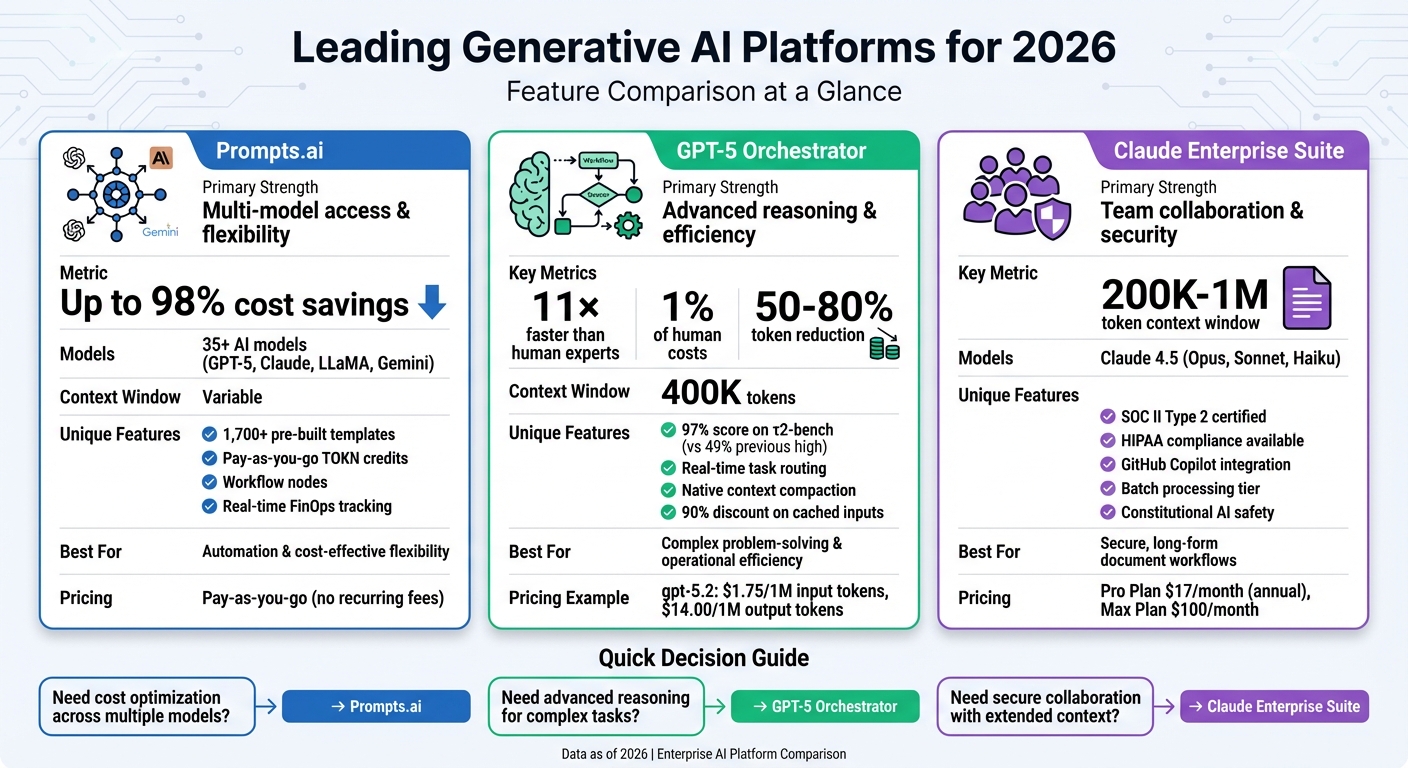
2026 Generative AI Platform Comparison: Prompts.ai vs GPT-5 Orchestrator vs Claude Enterprise Suite
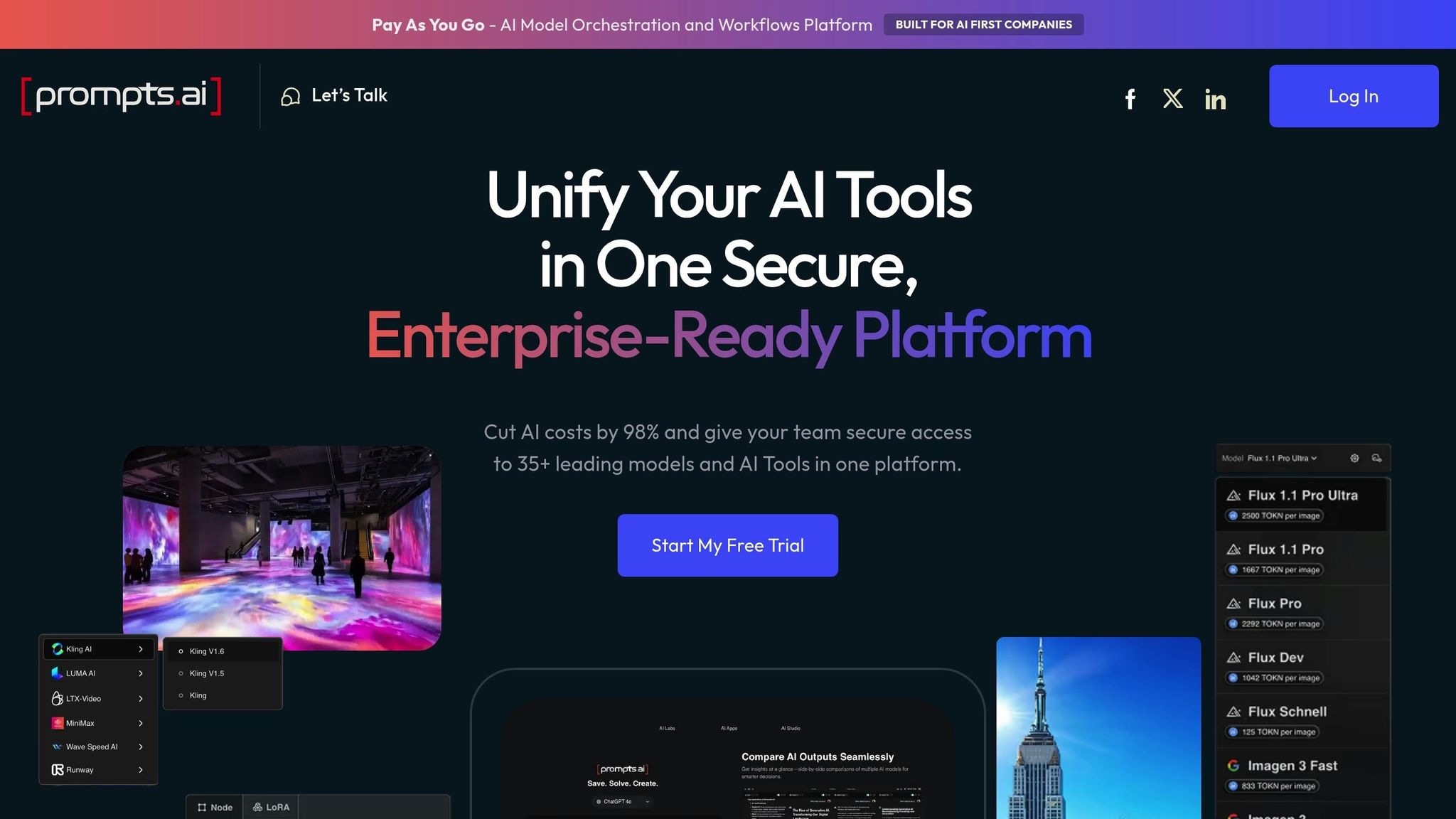
Prompts.ai takes the complexity out of managing AI tools by bringing together over 35 top-tier large language models like GPT-5, Claude, LLaMA, and Gemini. With its secure and unified platform, it simplifies AI integration and dramatically reduces software costs - by as much as 98% - using a flexible pay-as-you-go TOKN credit system.
At its core, Prompts.ai uses Azure Foundry-powered generative AI models to perform tasks through natural language instructions. Users can create, test, and save prompts that are reusable across agents, workflows, or applications. The platform also supports dynamic inputs during runtime, seamlessly combining user-provided variables with organizational knowledge to deliver precise results.
Prompts.ai introduces "workflow nodes", a feature that integrates AI-powered actions directly into automation processes. This allows teams to handle unstructured data effortlessly, eliminating the need for manual input. By bridging the gap between rigid automation systems and the flexibility required for complex business needs, the platform enables organizations to automate intricate, multi-step tasks that once relied on human judgment.
The platform’s Control Plane Framework ensures smooth management of context, agent orchestration, and institutional memory, creating a solid foundation for production-ready AI infrastructure. Built-in guardrails automatically flag outputs for human review based on specific, policy-driven criteria. Additionally, Role-Based Access Control (RBAC) allows precise control over permissions, ensuring compliance agents have access to necessary data while safeguarding sensitive information. This governance structure transforms AI into a secure, auditable solution that meets enterprise-level security requirements.
Prompts.ai operates on a pay-as-you-go basis, aligning costs directly with token usage and eliminating recurring fees. Its built-in FinOps layer tracks token consumption in real time, giving enterprises a clear view of their AI spending. This transparency helps prevent budget overruns and enables accurate cost attribution, making it an ideal choice for organizations managing multiple teams and diverse projects.
Next, we’ll dive into GPT-5 Orchestrator and its role in advancing AI workflow automation.
The GPT-5 Orchestrator is designed to streamline complex workflows, addressing the need for seamless and unified AI solutions. Instead of juggling fragmented systems, it acts as a centralized command hub, automatically routing tasks between fast-response models and deep-reasoning engines based on the complexity of the task. Its real-time routing system continuously improves by learning from accuracy feedback, eliminating the need for manual adjustments.
The platform excels at connecting and coordinating tools to complete tasks, whether sequentially or in parallel. It achieved an impressive 97% score on the τ2-bench telecom tool-use benchmark, far surpassing the previous high of 49%. GPT-5 integrates with a range of professional tools like Notion, Box, Shopify, Zoom, and Databricks, enabling smooth workflows across enterprise systems.
In August 2025, the AI platform Manus adopted GPT-5 to handle intricate tasks. Co-Founder Yichao 'Peak' Ji highlighted how the model's refined preambles and enhanced tool control brought a "significant leap in stability", allowing agents to outperform internal benchmarks without requiring custom prompts. By enabling tools to execute commands in plaintext, GPT-5 minimizes escaping errors, further enhancing operational reliability.
These capabilities naturally extend into advanced workflow automation, simplifying operations for businesses.
In December 2025, AJ Orbach, CEO of Triple Whale, shared how GPT-5.2 transformed their operations by consolidating a multi-agent system into a single, streamlined mega-agent. This model, equipped with over 20 integrated tools, drastically reduced maintenance complexity and latency. Tasks that once required sprawling instructions were now executed seamlessly with simple one-line prompts.
"GPT-5.2 unlocked a complete architecture shift for us. We collapsed a fragile, multi-agent system into a single mega-agent with 20+ tools. The best part is, it just works." - AJ Orbach, CEO, Triple Whale
Additionally, GPT-5.2-Codex is tailored for automation within Windows environments and complex terminal workflows, making it a versatile solution for technical tasks.
The GPT-5 Orchestrator prioritizes safety and compliance through a Preparedness Framework, which applies "High" capability safeguards in sensitive domains like biology and chemistry. These protections activate specific measures to ensure responsible use. Its "safe-completions" feature represents the latest advancements in AI safety, designed to prevent the generation of restricted content.
In December 2025, Andrew MacPherson, a principal security engineer at Privy (a Stripe company), used GPT-5.1-Codex-Max to identify vulnerabilities in React. By guiding the model through defensive tasks such as setting up local testing and fuzzing environments, MacPherson uncovered issues that were responsibly disclosed to the React team within a week. This effort contributed to OpenAI's Trusted Access Pilot, an invite-only program that ensures high-capability models are used exclusively for defensive purposes.
GPT-5.2 delivers professional-grade results at 11× the speed and 1% of the cost of human experts. It achieves superior performance while using 50–80% fewer tokens, significantly reducing the expense of complex reasoning tasks. Its native context compaction ensures coherence over extended tasks, maintaining nearly 100% accuracy on long-context retrieval tests up to 256,000 tokens. Additionally, a 90% discount on cached inputs in the API further lowers costs for repetitive or long-context workflows.
| Model | Input per 1M tokens | Cached Input per 1M tokens | Output per 1M tokens |
|---|---|---|---|
| gpt-5.2 / gpt-5.2-chat-latest | $1.75 | $0.175 | $14.00 |
| gpt-5.2-pro | $21.00 | - | $168.00 |
| gpt-5 / gpt-5-chat-latest | $1.25 | - | $10.00 |
| gpt-5-mini | $0.25 | - | $2.00 |
| gpt-5-nano | $0.05 | - | $0.40 |
"We are seeing promising early results from deploying GPT-5 across workflows at Amgen including increased accuracy and reliability, higher quality outputs and faster speeds compared to prior models." - Sean Bruich, Senior Vice President of AI & Data at Amgen
On average, ChatGPT Enterprise users save 40–60 minutes daily, with heavy users reclaiming over 10 hours of productivity each week.
Next, we'll take a closer look at the Claude Enterprise Suite and its approach to enterprise AI deployment.
The Claude Enterprise Suite is powered by Claude 4.5 and offers three tailored versions: Opus for handling intensive tasks, Sonnet for balanced performance, and Haiku for speed-focused operations. It seamlessly integrates with major cloud platforms like Amazon Bedrock and Google Cloud Vertex AI, allowing businesses to incorporate AI into their existing systems without disruption.
In December 2025, GitHub rolled out Claude Opus 4.5 across its Copilot platform, making it available to Enterprise and Business subscribers. Developers can access Claude through GitHub.com, Visual Studio Code, JetBrains, and Xcode via the Model Context Protocol (MCP), which connects to external data sources and tools.
The suite also integrates deeply with productivity and collaboration platforms, streamlining workflows for enterprise teams. Anthropic's Agent Skills further enhance task management by enabling complex task orchestration. High-tier plans include Claude Code, a specialized tool for debugging and in-line code generation within complex codebases.
"Gumloop has been critical in helping all teams at Instacart - including those without technical skills - adopt AI and automate their workflows." - Fidji Simo, CEO @ Instacart
Instacart has leveraged Claude's AI tools to empower non-technical teams to automate repetitive tasks, significantly improving efficiency. Similarly, Webflow's Co-Founder Bryant Chou implemented Claude's automation tools, explaining: "It puts the tools into the hands of people who understand a task and lets them completely automate it away".
Claude's function calling capabilities allow interaction with external tools using API calls, producing structured outputs for custom workflows. The suite supports a 200,000-token context window for enterprise operations, with plans to expand this to 1,000,000 tokens. Additionally, in the Claude Apps ecosystem, API usage for shared applications is billed to the user’s subscription, lowering scaling costs for developers.
The suite prioritizes secure and compliant deployment, holding SOC II Type 2 certification and offering HIPAA compliance options for API integrations. Enterprise-grade data protection ensures user data is never used to train models. Administrators can control model access through policy settings, and GitHub Copilot users must opt-in to enable Claude Opus 4.5 organization-wide.
Anthropic has implemented Inoculation Prompting, which has reduced harmful generalizations during training by 75–90%. The suite also includes copyright indemnity for commercial use and features robust safeguards against jailbreaks and misuse. The Model Context Protocol supports Enterprise SSO with Identity Assertion Authorization Grants and strict redirect URI validation.
The suite offers cost-saving features like prompt caching and detailed API cost reporting, which help reduce expenses for high-context, repetitive queries. The Administrative API provides organizations with detailed cost reports, categorized by workspace, model, or task, enabling precise budgeting across departments.
For non-time-sensitive tasks, a batch processing tier is available at a lower cost. Claude's use of Constitutional AI embeds safety and compliance into the model itself, reducing the need for external moderation and cutting operational complexity. Pricing starts at $17 per month with an annual subscription for the Pro Plan (or $20 monthly), while the Max Plan begins at $100 per month, offering significantly higher usage limits.
These features position Claude Enterprise Suite as a versatile solution, balancing advanced capabilities with cost-conscious options for businesses of all sizes.
When evaluating unified platforms for enterprise AI workflows, it's essential to weigh their strengths alongside any potential limitations. Each platform brings distinct features tailored to specific needs, but these come with trade-offs that should not be overlooked.
Prompts.ai offers access to over 35 models under a single subscription, reducing costs to roughly 30% compared to standalone models. It also provides more than 1,700 pre-built templates, making it highly versatile. However, relying on third-party orchestration can introduce challenges related to data dependency and auditability.
The GPT-5 Orchestrator, on the other hand, excels in advanced reasoning and operational efficiency. Its Orchestrator-8B model achieves 37.1% accuracy on the Humanity's Last Exam benchmark, surpassing the standard GPT-5's 35.1%, while being 2.5× more efficient. The Responses API enhances performance by enabling chain-of-thought processing, which reduces latency and improves cache hit rates. Additionally, it supports freeform inputs like SQL or shell commands through context-free grammars. However, parameters such as temperature and top_p are only functional when reasoning levels are set to "none", and higher reasoning efforts can lead to increased latency.
Meanwhile, the Claude Enterprise Suite is designed for collaborative document workflows and prioritizes security. It offers a 200,000-token context window, with plans to expand up to 1,000,000 tokens. Its seamless integration with GitHub Copilot across major development environments makes it particularly appealing for developer teams. The suite also includes advanced role-based access controls, Git integration, and isolated environments for multi-user projects. This focus on predictability and safety contrasts with GPT-5's more flexible, tool-driven approach.
The table below highlights the key strengths and limitations of these platforms, emphasizing their strategic differences:
| Feature | Prompts.ai | GPT-5 Orchestrator | Claude Enterprise Suite |
|---|---|---|---|
| Primary Strength | Multi-model access & cost savings | Advanced reasoning & operational efficiency | Team collaboration & extended context |
| Interoperability | 1,700+ templates | Custom tools with context-free grammars | GitHub Copilot integration |
| Efficiency | Optimized model routing | 2.5× more efficient than standard GPT-5 | Predictable and reliable |
| Context Window | Variable | 400K tokens | 200K–1M tokens |
| Best For | General business automation | Complex problem solving | Document synthesis & secure workflows |
For teams seeking cost-efficient flexibility, Prompts.ai is an excellent choice, especially for avoiding vendor lock-in. Those needing advanced reasoning capabilities will benefit from the specialized models of the GPT-5 Orchestrator. Enterprises focused on secure, long-form document processing and developer collaboration will find the Claude Enterprise Suite's extended context windows and GitHub Copilot integration particularly advantageous.
As generative AI continues to advance toward 2026, businesses need platforms that combine workflow automation, scalability, and cost efficiency without sacrificing security or control. The comparison highlights three distinct options: GPT-5 Orchestrator, known for its strength in complex reasoning tasks; Claude Enterprise Suite, ideal for collaborative workflows; and Prompts.ai, which emerges as a robust solution for organizations aiming to automate business processes on a large scale. This analysis sets the stage for a closer look at what makes Prompts.ai stand out.
Prompts.ai distinguishes itself with an AI-first design that seamlessly integrates tools like Slack, Google Sheets, and Notion with large language model reasoning. This capability transforms unstructured data into actionable insights, streamlining processes for businesses. Its no-code prompt-building features and dynamic CRM data integration empower organizations to achieve operational efficiency across departments without requiring technical expertise.
One of Prompts.ai's standout features is its reusable prompt templates with dynamic placeholders, which enable businesses to personalize content generation and service responses at scale. Marissa Scalercio, VP of Sales Operations at Carnegie Learning, shared:
"Prompt Builder allows our team at Carnegie Learning to bring our CRM data into our prompts easily with no code! This helps us augment our business processes to cut down on service rep response, email outreach, and content generation time".
This accessibility allows non-technical teams to seamlessly incorporate AI into their workflows, driving adoption across departments and accelerating productivity. Such tools are paving the way for enterprises to refine and execute their AI strategies effectively.
For organizations evaluating their AI strategy in 2026, the choice often depends on specific needs. Teams prioritizing complex reasoning might lean toward GPT-5 Orchestrator, while those focused on collaborative tasks may find Claude Enterprise Suite more suitable. However, businesses seeking a unified platform that offers workflow automation, flexibility across multiple models, and cost optimization will likely find Prompts.ai to be the ideal solution. Its enterprise-grade security, reinforced by dedicated trust layers, ensures sensitive data remains secure, while autonomous AI agents provide round-the-clock support.
The rise of autonomous agents and accessible AI tools signals a new era in enterprise productivity. With its no-code approach, real-time data integration, and seamless compatibility with everyday tools, Prompts.ai positions itself as a practical choice for businesses ready to scale beyond experimentation into fully operational AI workflows.
Prompts.ai offers a powerful way to cut software expenses by simplifying workflows and automating tasks through advanced generative AI. By working effortlessly with large language models, it replaces the need for multiple tools and reduces manual labor, helping businesses save both time and money.
Its scalable approach allows companies to slash costs by as much as 98%, reducing dependence on costly traditional software while enhancing productivity and operational efficiency. For businesses aiming to maximize their budgets without sacrificing results, Prompts.ai stands out as a smart, effective solution.
Prompts.ai offers enterprise-grade security, giving businesses complete oversight and control over their generative AI operations. The platform tracks AI interactions in real time, monitoring who accesses models, the prompts they submit, and the data exchanged. This enables security teams to audit activity instantly and ensure adherence to company policies.
The platform's built-in policy enforcement ensures that unauthorized model access is blocked automatically, protects against prompt-injection attacks, and keeps sensitive data secure. Features like role-based access controls and comprehensive audit trails enhance protection, helping organizations comply with standards such as SOC 2, ISO 27001, and GDPR. These robust measures empower enterprises to innovate securely while safeguarding critical information.
Prompts.ai serves as a robust AI workflow platform, bringing together over 35 large-language models, such as GPT-5, Claude, and Gemini, within a secure and scalable dashboard. With its emphasis on no-code workflows and API-driven integrations, it seamlessly connects with a variety of business tools.
Although direct integration with Google Workspace apps like Gmail, Docs, or Meet isn't explicitly detailed, the platform's interoperability and API capabilities open the door for potential connections with SaaS platforms, including Google Workspace. This adaptability empowers businesses to simplify processes and boost productivity with AI-powered solutions.