Pay As You Go - AI Model Orchestration and Workflows Platform



AI prompt engineering is transforming how businesses leverage advanced models like GPT-5, Claude, and Gemini. It’s the bridge between raw AI capabilities and tailored enterprise solutions, driving efficiency, compliance, and automation across industries.
Here’s how organizations approach it:
Choosing the right approach depends on your size, budget, and compliance needs. For small teams, platforms like prompts.ai are affordable and user-friendly, starting at just $29/month. Larger enterprises often combine in-house teams with consultants for tailored, scalable workflows.
| Approach | Cost | Scalability | Compliance |
|---|---|---|---|
| prompts.ai | $29–$99/month | High: Instant scaling | Built-in governance |
| In-house Teams | High fixed costs | Moderate: Time-intensive | Custom frameworks |
| Consulting Firms | $25–$99/hour | Moderate: Project-based | Strong external guidance |
Key takeaway: Platforms like prompts.ai are ideal for SMBs, while enterprises benefit from hybrid models. Start with the solution that aligns with your goals and resources.
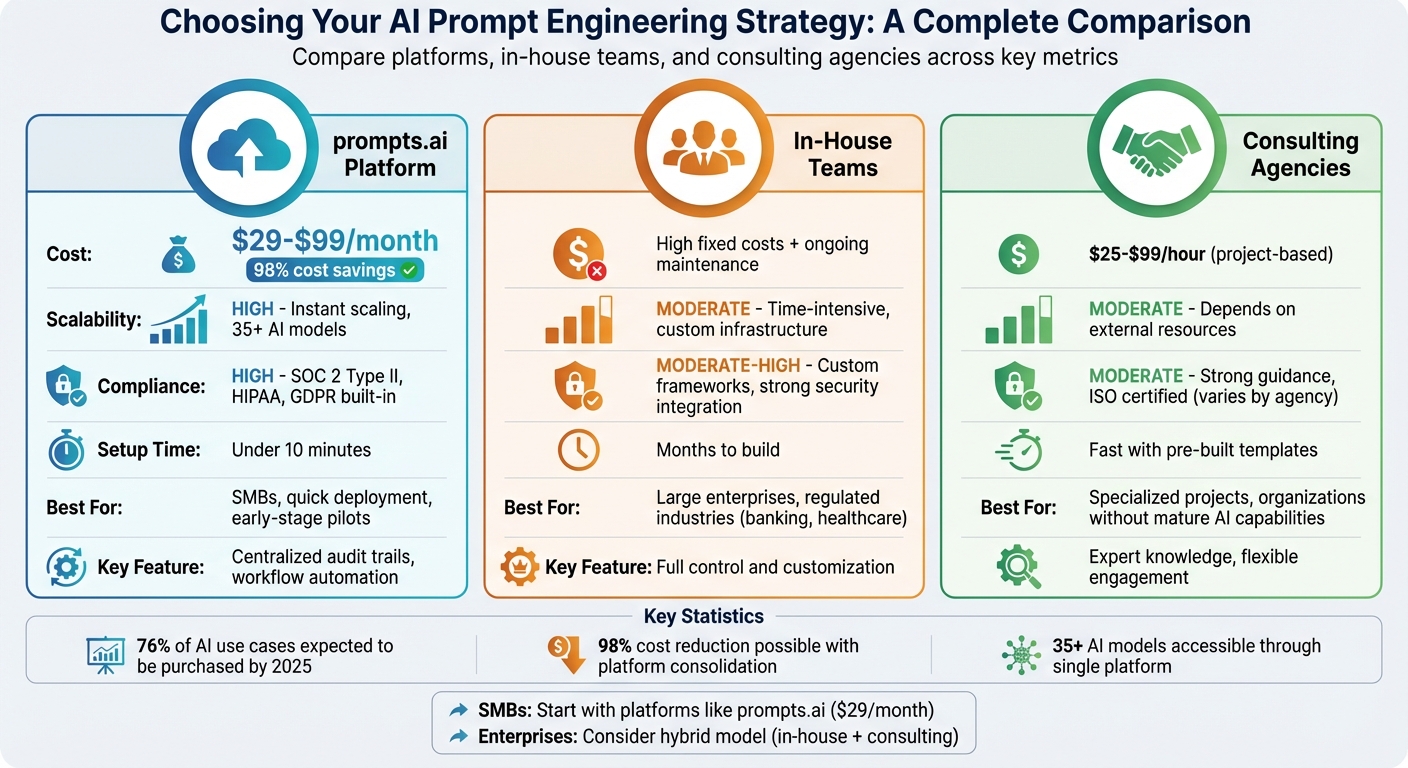
AI Prompt Engineering Approaches: Cost, Scalability & Compliance Comparison
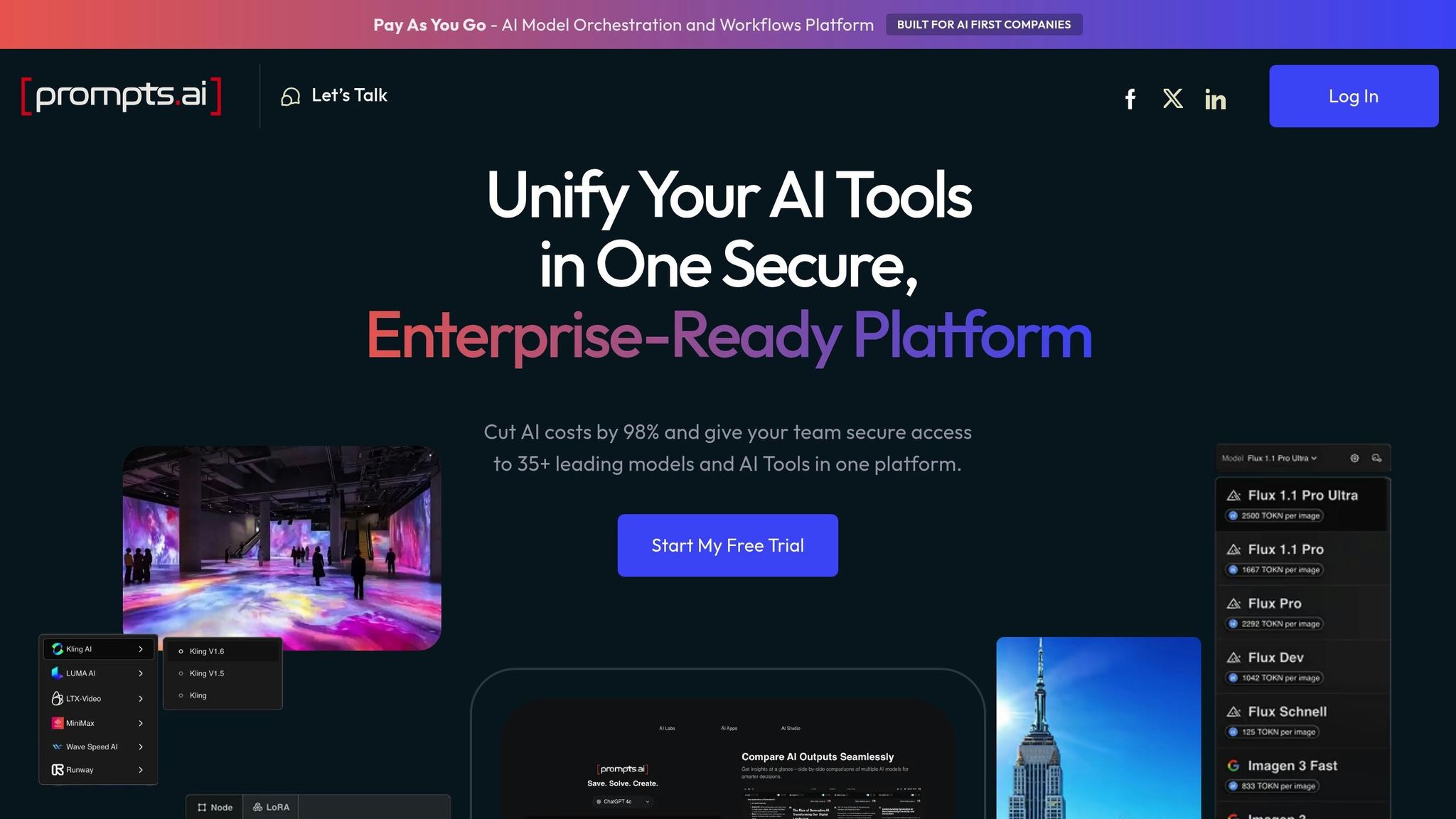
Prompts.ai is a robust AI orchestration platform tailored for enterprise use, offering seamless access to over 35 top AI models - including GPT-5, Claude, LLaMA, and Gemini - all through a single, secure interface. Say goodbye to juggling multiple subscriptions and tools; with prompts.ai, you can manage all your AI workflows from one centralized dashboard. Designed to meet the needs of organizations ranging from creative agencies to Fortune 500 companies, this platform simplifies operations and eliminates the inefficiencies of scattered tools. Its scalable design ensures it adapts effortlessly to the shifting demands of any organization.
Prompts.ai’s intuitive interface is built to scale, whether you’re conducting small experiments or deploying AI solutions across an entire enterprise. Adding models, users, or teams is seamless, making it easy to grow alongside your business. The platform offers three pricing tiers to suit varying needs:
This flexible pricing structure allows small teams to start affordably while offering the capacity to scale AI solutions across departments. It transforms one-off tasks into efficient, automated workflows that grow with your organization.
Prompts.ai claims it can reduce AI costs by up to 98% by consolidating more than 35 fragmented AI tools into one system - all in under 10 minutes. Instead of managing multiple subscriptions, the platform uses a pay-as-you-go TOKN credit system, ensuring costs align with actual usage. Steven Simmons, CEO & Founder, shares his experience:
"I used to spend weeks rendering in 3D Studio and a month writing business proposals. With Prompts.ai's LoRAs and workflows, I now complete renders and proposals in a single day - eliminating waiting times and hardware concerns."
This approach transforms fixed infrastructure and labor costs into a scalable, on-demand model. Smaller teams can now compete effectively without the financial strain of maintaining in-house AI infrastructure.
For organizations navigating strict regulatory landscapes, prompts.ai offers centralized governance and full visibility into all AI interactions. Every prompt, model call, and workflow execution is meticulously tracked and auditable, ensuring compliance with U.S. audit, security, and regulatory standards. Real-time FinOps controls provide precise monitoring of token usage and spending, linking AI costs directly to business outcomes. This helps teams avoid budget overruns while maintaining transparency and accountability.
Prompts.ai goes beyond basic functionality by supporting the entire prompt lifecycle, enabling continuous improvement and optimization. Users can leverage an expert prompt library, compare outputs from different LLMs side-by-side, and even train custom LoRAs. Collaborative tools and automation turn one-time prompts into scalable, repeatable processes. This means prompts can be fine-tuned over time, ensuring they stay aligned with evolving business needs and deliver impactful results.
Building an in-house prompt engineering team provides direct control, but trends show a shift: by 2025, 76% of AI use cases are expected to be purchased, offering faster deployment and immediate production benefits.
As AI models advance, the need for dedicated in-house prompt engineering roles is decreasing. Instead, these responsibilities are being absorbed into broader roles like software developers and data scientists. This approach allows organizations to scale more effectively by integrating prompt engineering into existing workflows, avoiding the need for large, specialized teams. Additionally, automated prompt optimization - where AI systems refine and improve prompts independently - further enhances efficiency without requiring a corresponding increase in staffing.
Maintaining in-house teams often comes with significant overhead costs beyond just salaries. The growing preference for purchasing AI solutions reflects the cost advantages of flexible engagement models, which often outperform the expense of building and maintaining internal infrastructure.
In-house teams can play a critical role in ensuring governance and compliance, particularly for organizations operating under strict regulatory frameworks. This setup allows companies to create tailored frameworks that align with industry standards like GDPR and HIPAA. Effective prompt engineering can reduce issues like hallucinations and improve the reliability of AI outputs, directly supporting compliance and building trust. However, maintaining these standards requires constant monitoring as AI evolves. For some organizations, these challenges make AI consulting agencies an attractive alternative for managing prompt engineering needs.
Many organizations are now turning to specialized AI consulting agencies to handle prompt engineering, offering a flexible and expert alternative to building in-house teams.
These agencies bring deep expertise in designing, refining, and scaling prompts for various business functions, such as customer service and finance. For instance, PwC integrates prompt engineering into its digital transformation projects, ensuring accurate and compliant outputs, particularly in regulated industries.
AI consulting agencies excel in creating scalable workflows that remove operational hurdles. They develop prompt strategies tailored to enterprise applications, ensuring these solutions can grow and adapt alongside evolving business needs. This approach allows organizations to quickly implement advanced AI capabilities without the delays and costs associated with assembling internal teams. In contrast, in-house setups often demand significant time and resources to reach the same level of efficiency.
With flexible engagement options - ranging from time-and-material contracts to dedicated teams or outstaffing - consulting agencies provide cost-effective solutions that align with different project scopes and budgets. This adaptability often results in a stronger return on investment, especially for businesses seeking expertise for specific projects rather than maintaining a full-time team. These models also complement in-house efforts and platform-based solutions.
Ensuring compliance and security is a key focus for AI consulting agencies. Companies like Computools and vsynergize, for example, hold ISO certifications and adhere to GDPR and HIPAA standards. PwC emphasizes responsible AI practices, incorporating governance and risk management into their services. As frameworks for ethical and bias-free AI continue to develop, this dedication to compliance becomes even more crucial.
Each method of AI prompt engineering comes with its own set of pros and cons.
Platforms like prompts.ai are designed for quick setup and cost management. They provide access to over 35 language models through a single interface, complete with governance frameworks that meet SOC 2 Type II, HIPAA, and GDPR standards. Additionally, they offer centralized audit trails for all AI interactions, creating a secure and scalable solution. However, using a third-party platform can lead to vendor dependency and may come with functional limitations.
In-house prompt engineering teams offer unparalleled control and customization, allowing organizations to design evaluation pipelines that align with their specific needs and integrate seamlessly with existing security systems. This option is especially appealing for industries like banking or healthcare, where regulatory compliance is critical. On the downside, building internal tools can take months, delaying time-to-value. Furthermore, hiring and retaining specialized engineers, along with the ongoing maintenance needed as APIs evolve, can result in significant fixed costs.
AI consulting agencies bring specialized expertise to the table, speeding up implementation with pre-built templates and best-practice frameworks. They excel at aligning technical controls with compliance requirements and are particularly useful for organizations without mature AI capabilities. However, their services come with a price tag of $25–$99 per hour, and there’s a risk of over-relying on external teams for critical expertise.
Here’s a comparison of the trade-offs:
| Approach | Scalability | Cost Efficiency | Governance & Compliance | Prompt Lifecycle Support |
|---|---|---|---|---|
| prompts.ai Platform | High: Instantly scale models, users, and teams | High: Plans start at $29/month, consolidating costs | High: Built-in compliance (SOC 2 Type II, HIPAA, GDPR) with centralized audit trails | High: Includes LLM comparisons, workflow automation, LoRA training, and AI agent features |
| In-house Teams | Moderate to High: Custom infrastructure tailored to needs, though scaling may take time | Low to Moderate: High fixed costs with ongoing maintenance | Moderate to High: Strong internal security integration but requires significant effort | High: Full control over development, testing, and iterative improvements |
| Consulting Agencies | Moderate: Scalability depends on external resources and project scope | Moderate to Low: Costs range from $25–$99/hour, leading to potentially high fees | Moderate: Strong compliance guidance, but practices vary across agencies | Moderate: Project-specific support; ongoing lifecycle management may be limited |
This breakdown helps U.S.-based teams match their needs to the right approach. Smaller teams or those running early-stage pilots may benefit from the affordability and ease of a SaaS platform like prompts.ai. Larger enterprises often find success by combining an in-house team for domain control with consulting agencies for specialized expertise and complex integrations, striking a balance between independence and external guidance.
Selecting the right AI prompt engineering strategy hinges on your organization's size, budget, and compliance needs. For small to medium-sized businesses (SMBs), platforms like prompts.ai offer a practical solution. Starting at just $29 per month, this platform can slash AI costs by up to 98% while granting access to over 35 leading models. For companies just embarking on their AI journey, a unified platform eliminates the need for multiple disconnected tools. With built-in compliance features - such as SOC 2 Type II, HIPAA, and GDPR - what once required months of effort can now be accomplished in a single day. A great example is Emmy-winning creative director Steven Simmons, who, in 2025, used prompts.ai workflows to complete renders and business proposals in just one day - a task that previously took weeks for renders and an entire month for proposals.
Larger enterprises, particularly those in heavily regulated industries, might find a hybrid model more suitable. This approach blends in-house teams with external consulting agencies, which typically charge between $25 and $99 per hour. This combination provides the flexibility to maintain control while leveraging expert insights.
When deciding on an approach, focus on time-to-value. While in-house development can delay deployment and consulting services may create dependency, SaaS platforms offer predictable costs and quick scalability. Take stock of your compliance requirements, team size, and budget. Generally, smaller organizations achieve the highest return on investment with a platform-based solution, while larger enterprises can benefit from a hybrid model after validating initial use cases. Choosing the right strategy not only enhances operational efficiency but also strengthens your competitive position in today’s rapidly evolving AI landscape.
When selecting an AI prompt engineering solution, focus on companies that excel in research and development and have a history of delivering scalable, efficient results for enterprise applications. Ensure they prioritize security and adhere to industry regulations, keeping your data safe.
It's also important to evaluate their industry reputation and ability to customize solutions to meet your specific objectives. The right provider should streamline workflows while ensuring precision and adaptability to support future growth.
Prompts.ai cuts AI expenses by up to 98% by uniting more than 35 leading AI models and tools within a single, secure platform. This approach eliminates the hassle of juggling multiple subscriptions, reduces inefficiencies, and simplifies workflows.
With centralized access and smarter resource management, Prompts.ai empowers businesses to do more with less, delivering cost savings and time efficiency without compromising the quality of AI-powered operations.
Using a hybrid approach for AI prompt engineering brings together data-driven analysis and logical reasoning, creating a well-rounded foundation for making smarter, more balanced choices. This combination helps improve clarity and explainability, which plays a key role in fostering trust in AI systems.
Hybrid models also stand out for their versatility, making them suitable for various industries and applications. This makes them particularly appealing to large organizations aiming to streamline AI-powered workflows across multiple scenarios.