Pay As You Go - AI Model Orchestration and Workflows Platform


Machine learning workflows often face inefficiencies due to scattered tools and manual processes. This article evaluates eight top-tier tools designed to simplify, automate, and optimize machine learning pipelines. Each tool is assessed for integration, scalability, governance, and cost management, catering to diverse needs from enterprise-grade solutions to open-source platforms. Key takeaways include:
| Tool | Best For | Key Features | Limitations |
|---|---|---|---|
| Prompts.ai | Enterprise AI orchestration | 35+ LLMs, FinOps, compliance-ready | Focused on prompt workflows |
| n8n | Flexible open-source workflows | Customizable, free tier, visual UI | Limited ML-specific features |
| LangChain | LLM-powered applications | Modular, integrates with ML frameworks | Complex for large-scale setups |
| AutoGen | Automated ML task management | Role-based agents, A/B testing | Use-case specific |
| LlamaIndex | Data integration for ML | Prepares unstructured data for models | Focused on data indexing |
| Flowise | No-code ML workflows | 400+ integrations, easy interface | Not ideal for advanced tasks |
| Metaflow | Large-scale data workflows | Open-source, Netflix-tested | Requires technical expertise |
| VectorShift | Interoperability | API-first, integrates existing tools | Needs other tools for full ML |
Each tool offers distinct strengths based on team expertise, project scale, and budget. Whether you're automating workflows, integrating LLMs, or managing large datasets, selecting the right tool can save time, reduce costs, and improve outcomes.

Prompts.ai is an enterprise-level AI orchestration platform designed to simplify and enhance prompt-based workflows. It connects users to over 35 leading AI models - such as GPT-4, Claude, LLaMA, and Gemini - through a single, streamlined interface, eliminating the hassle of juggling multiple AI tools.
The platform emphasizes visual workflow design and enterprise-ready functionality. Its user-friendly drag-and-drop interface is perfect for both technical experts and non-technical users, enabling the creation of advanced AI workflows that can easily move from testing to full-scale production. Below, we’ll explore its standout features in integration, scalability, compliance, and cost management.
Prompts.ai stands out for its ability to unify various AI systems through seamless integration. It supports multi-provider large language model (LLM) connections, allowing teams to effortlessly combine models from providers like OpenAI, Anthropic, and Hugging Face into a cohesive workflow. Beyond AI models, the platform integrates with popular tools like Slack, Gmail, and Trello, and offers APIs and connectors to link with existing data sources. This integration capability effectively solves the problem of tool overload, creating a more streamlined and efficient workflow.
Leveraging its cloud-native infrastructure, Prompts.ai adapts to a wide range of needs - from simple prompt chains to intricate, multi-step automations. The platform handles concurrent tasks and large data volumes with ease, making it suitable for small teams as well as enterprise-scale operations. In June 2025, GenAI.Works recognized Prompts.ai as a top-tier platform for enterprise automation and problem-solving, highlighting its reliability in managing growing workloads. This scalability also aligns with the platform’s strong focus on compliance and auditability.
Prompts.ai meets rigorous enterprise governance standards by adhering to best practices from frameworks like SOC 2 Type II, HIPAA, and GDPR. In partnership with Vanta, the platform launched SOC 2 Type II audits in June 2025, reinforcing its commitment to security and compliance. Features such as user access controls, detailed audit logs, and prompt versioning ensure that every interaction is traceable and meets regulatory requirements.
Prompts.ai helps organizations reduce expenses by centralizing access to multiple AI models. Enterprises can cut AI costs by up to 98% thanks to its intelligent resource management, usage analytics, and tools for refining workflows. The platform’s real-time FinOps capabilities monitor token usage, ensuring spending aligns with actual needs. Its pay-as-you-go TOKN credit system ties costs directly to usage, making it especially practical for businesses with fluctuating AI demands. By centralizing resource management and providing actionable insights, Prompts.ai sets the standard for efficient machine learning workflows.
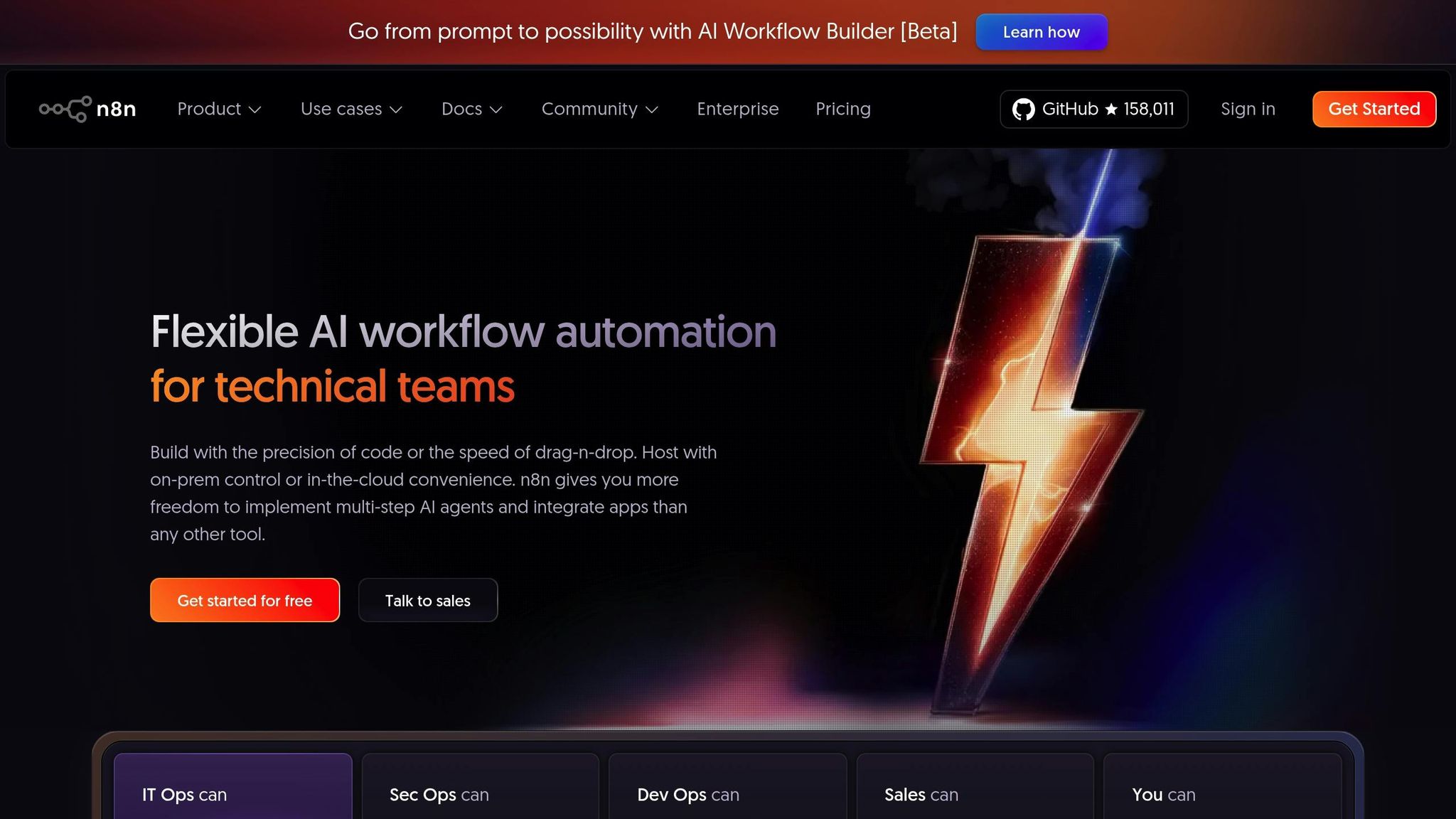
Unlike platforms designed with a strong focus on enterprise users, n8n stands out with its open-source model that prioritizes flexibility and cost-effectiveness. This workflow automation platform allows organizations to design, customize, and deploy machine learning (ML) workflows without being tied to a specific vendor. Its visual interface makes it accessible to both technical experts and non-technical team members, bridging the gap between different skill sets.
n8n offers a free version with core features for individual users, alongside an enterprise edition for those with more advanced needs. This makes it an appealing choice for teams aiming to implement sophisticated ML workflows without incurring hefty licensing fees.
"n8n empowers teams to automate their workflows without the constraints of traditional software, allowing for greater innovation and efficiency." - Jan Oberhauser, Co-founder of n8n
n8n’s open-source foundation supports seamless connections between diverse systems, making it an ideal tool for integrating complex environments. With over 200 pre-built integrations, it easily connects popular databases, APIs, cloud services, and tools critical for machine learning workflows. This versatility allows teams to unify CRM systems, inventory platforms, analytics tools, and ML model endpoints into a single, streamlined workflow.
For added customization, users can inject JavaScript or Python code directly into workflows, enabling data scientists to incorporate proprietary algorithms and tailor data transformations to their specific needs.
In 2025, a mid-sized e-commerce company showcased n8n’s integration power by linking their CRM, inventory management system, and analytics tools into one cohesive workflow. This approach reduced data processing time by 40% and enhanced the accuracy of their ML models by ensuring consistent, real-time data flow.
n8n’s self-hosting option gives organizations the freedom to scale their infrastructure as projects grow. By leveraging self-hosted installations, teams can manage unlimited workflows and handle large data volumes, with scalability limited only by their hardware resources.
The platform is capable of managing intricate, multi-step workflows, making it well-suited for large-scale ML initiatives. With n8n’s visual interface, teams can orchestrate entire ML pipelines, from data ingestion and preprocessing to model training and deployment.
In 2025, a financial services company adopted n8n to automate its data processing workflows. By integrating various ML models and APIs, they achieved a 40% reduction in processing time across their data pipelines, enabling faster decision-making and boosting operational efficiency.
n8n’s open-source design and self-hosting capabilities eliminate the need for per-flow fees and ongoing cloud expenses. This cost-effective approach is further supported by a robust community of over 70,000 GitHub stars, offering pre-built templates and resources that significantly reduce development time.
"n8n allows you to automate workflows quickly and efficiently, reducing the need for custom development and associated costs." - Shakudo Blog
The platform’s extensive library of pre-built integrations also saves teams from investing in custom API development. By leveraging existing connectors, organizations can streamline their automation efforts while keeping costs under control.
LangChain and LangGraph are tools designed to integrate large language models (LLMs) into machine learning workflows. While LangChain provides the foundational framework to develop LLM-powered applications, LangGraph takes it a step further by enabling complex workflows that can handle stateful and intricate decision-making processes.
The frameworks’ modular architecture is particularly useful for teams looking to incorporate LLMs into their existing machine learning pipelines without needing to overhaul their infrastructure. Both tools are open-source, licensed under MIT and Apache 2.0, making them accessible to organizations of all sizes without requiring significant upfront investment. This modularity ensures smooth integration across various machine learning components.
"LangChain has become the de facto standard for building LLM-powered applications, providing unparalleled flexibility for experimental workflows." - Vinod Chugani, Machine Learning Expert
One of LangChain’s key strengths is its ability to connect diverse components within machine learning ecosystems. The framework includes templates and libraries that simplify integration with popular ML frameworks, data sources, and model servers. This modular design allows developers to link different systems without the need for extensive custom development.
LangChain supports a variety of LLMs, including models from OpenAI and Hugging Face, giving teams the flexibility to select the best model for their specific needs. Through its extensive connector library, developers can seamlessly integrate these models with databases, APIs, and analytics tools.
LangGraph brings additional capabilities by managing workflows that maintain context across multiple interactions. This is especially useful for applications that need to coordinate between various ML models and external systems while preserving workflow states. This ability to handle complex workflows makes it easier to deploy scalable and adaptable solutions.
LangChain’s modular design is built for incremental scalability, allowing teams to grow their applications without being tied to a rigid architecture. It efficiently handles large datasets and complex queries, making it a strong choice for enterprise-level projects.
For instance, in 2025, a financial services company implemented LangChain to power a chatbot that managed 100,000 daily queries. The integration, led by their AI Development Team, connected LangChain to existing CRM systems, resulting in faster response times and improved customer satisfaction.
"LangChain's modular architecture allows for seamless scaling and integration, making it an ideal choice for large-scale machine learning projects." - Eryk Lewinson, Data Scientist, Towards AI
Another advantage is the framework’s compatibility with multiple LLM providers. Teams can begin with smaller models for initial development and testing, then transition to more powerful models as their applications expand in complexity and user base.
As applications grow, ensuring proper governance becomes critical. LangChain and LangGraph include features designed to meet industry standards, especially in highly regulated fields like finance and healthcare. Both frameworks support role-based access control (RBAC), enabling organizations to assign permissions based on user roles and protect sensitive data from unauthorized access.
The platforms also include audit logs to track user actions and system changes, a feature that is crucial for meeting regulatory requirements. These logs provide transparency and accountability, which are essential for compliance in industries that demand data lineage and strict access controls.
Additionally, the frameworks integrate easily with existing compliance tools, allowing organizations to maintain their current governance processes while adopting new LLM technologies. This reduces the complexity of staying compliant while exploring advanced machine learning workflows.
The open-source nature of LangChain and LangGraph eliminates licensing fees, cutting costs for organizations adopting LLM-powered workflows. Without subscription costs, expenses are primarily focused on infrastructure and development.
The frameworks also include an extensive library of pre-built components, which reduces the time and cost associated with development. Teams can use existing templates and integrations to accelerate deployment, avoiding the need to build custom solutions from scratch.
LangChain’s support for multiple LLM providers further enhances cost management. Teams can select models that align with their performance needs and budget, switching providers as necessary without requiring significant architectural changes. This flexibility ensures organizations can control expenses while optimizing performance.
AutoGen is a framework designed to create collaborative systems where multiple AI agents work together to tackle complex machine learning (ML) tasks. Unlike traditional automation tools that rely on rigid if-then rules, AutoGen introduces dynamic decision-making, making it well-suited for evolving ML projects that demand flexibility.
The framework uses a role-based architecture, which reflects how ML teams typically operate. Each agent specializes in specific tasks, such as data preprocessing, model training, evaluation, or deployment. This approach ensures tasks are clearly defined and distributed efficiently, helping teams maintain structured workflows while managing workloads effectively.
AutoGen shines in handling intricate experimental workflows. It supports automated designs like A/B testing, enabling agents to oversee multiple experimental conditions at once. This eliminates the need for constant manual oversight, making it easier to test various models and configurations. This capability directly supports operations that need to scale efficiently.
AutoGen is built to scale ML workflows without requiring a proportional increase in resources. As project requirements expand, additional agents can be deployed to manage specific tasks, creating a flexible and adaptive scaling approach. By dividing responsibilities among specialized agents, teams can streamline their workflows while optimizing resource use.
Beyond scalability, AutoGen helps teams cut costs by optimizing resource allocation. Instead of relying on large, continuously running systems, the agent-based model allows teams to deploy agents on demand for specific tasks, minimizing unnecessary resource consumption. Additionally, by automating experiments, AutoGen saves both time and labor costs, making it a practical solution for resource-conscious ML operations.
LlamaIndex serves as a powerful data framework that bridges large language models (LLMs) with external data sources, simplifying the process of integrating and managing data. By connecting raw data to AI systems, it enables teams to build smarter, context-aware machine learning (ML) applications.
What makes LlamaIndex stand out is its ability to transform unstructured data into formats ready for machine learning. This capability streamlines knowledge management and minimizes the need for manual data preparation, making model training far more efficient. Its intelligent data pipelines can analyze and understand the context and relationships within datasets, turning previously complex processes into smooth, repeatable workflows. These features make LlamaIndex a key tool for improving integration, scalability, and cost management.
LlamaIndex integrates effortlessly with LLMs and other data processing tools, creating a unified workflow environment. Its design allows teams to incorporate it into existing systems without requiring major infrastructure changes.
For example, in June 2025, a tech company's data science team used LlamaIndex to connect their existing ML models with a new LLM framework. This integration streamlined data retrieval, cutting model training time by 25% and improving prediction accuracy. Data Scientist John Doe, who led the project, remarked, "LlamaIndex's ability to connect with various tools made our workflow significantly more efficient."
"LlamaIndex's interoperability with other machine learning tools is a game-changer for teams looking to optimize their workflows."
- Jane Smith, AI Solutions Architect, DataTech Inc.
LlamaIndex is built to handle large-scale computing needs, supporting distributed systems for parallel data processing and model training. It integrates seamlessly with cloud services, enabling dynamic resource allocation to match workload requirements.
The framework is capable of managing datasets as large as terabytes, making it ideal for enterprises with significant data demands. Its architecture adjusts automatically to varying data sizes and workloads, ensuring both adaptability and efficient use of resources. Compared to traditional ML frameworks, LlamaIndex offers a more streamlined and resource-conscious approach to scaling.
"LlamaIndex is built to handle the complexities of large-scale machine learning projects, ensuring that teams can focus on model development rather than infrastructure challenges."
- Authoritative Source
By unifying data preparation and model training, LlamaIndex significantly reduces operational costs. Its streamlined processes eliminate the need for multiple point solutions, cutting licensing fees and simplifying system maintenance.
Organizations that adopt strong MLOps practices, including tools like LlamaIndex, can experience a 60–70% reduction in model deployment time. This translates to lower operational expenses and improved resource efficiency, enabling faster deployment and more frequent model iterations. The result? Leaner workflows and enhanced automation.
"Organizations that implement robust MLOps practices typically see a 60–70% reduction in model deployment time and a substantial increase in the number of models successfully making it to production."
- Sam Austin, MLOps Expert
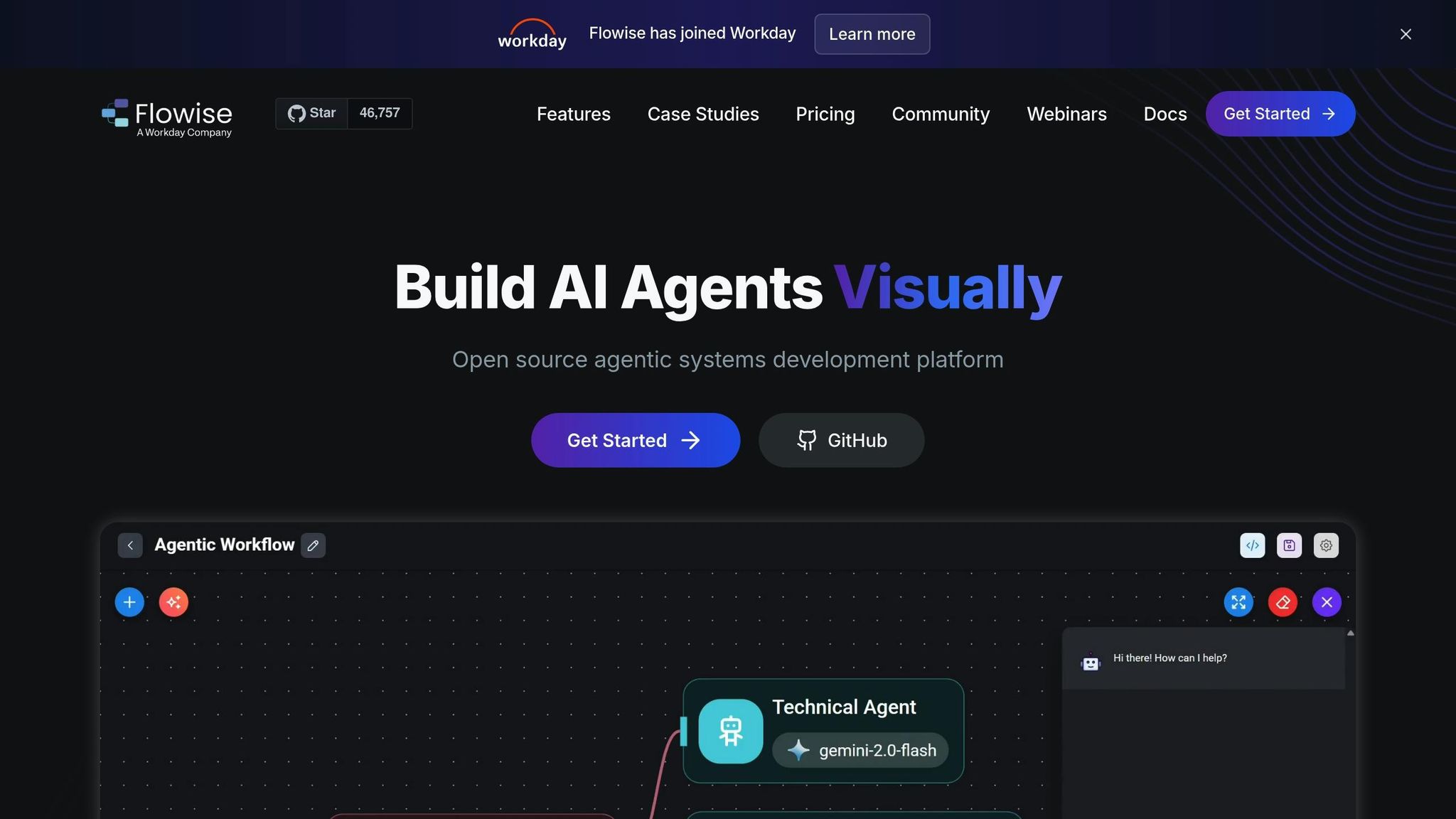
Flowise is a platform designed to simplify the creation and management of machine learning workflows, all without requiring coding expertise. This no-code solution allows both technical and non-technical team members to develop AI applications through an easy-to-use interface. Its primary goal is to make machine learning workflows accessible to everyone while maintaining the robust capabilities needed for enterprise-level tasks. With Flowise, teams can swiftly prototype, test, and deploy AI workflows, sidestepping the typical technical hurdles. The platform also emphasizes integration, scalability, compliance, and cost-effectiveness.
Flowise stands out for its ability to connect various machine learning tools and platforms seamlessly. It offers extensive integration options, supporting numerous APIs and connectors, which makes it simple to incorporate existing data and machine learning frameworks. With over 400 pre-built integrations, organizations can build interconnected ML pipelines while maximizing their current technology investments.
"AI workflow platforms close that gap by embedding intelligence directly into the rhythms of your business." - Domo
Its visual interface simplifies the task of mapping data flows across different systems, cutting down on the complexity usually associated with managing multiple tools.
Built for handling complex workflows and large-scale data operations, Flowise supports horizontal scaling across multiple nodes. This capability ensures it can manage thousands of tasks and process high volumes of data efficiently, making it an ideal choice for enterprise-level needs. Its real-time data processing features provide immediate insights, which are critical for time-sensitive business operations. Additionally, the platform’s dynamic resource allocation optimizes performance during peak demand periods while keeping costs in check during less intensive usage.
Flowise integrates compliance management directly into its workflows, helping organizations meet regulatory requirements - especially important for industries with strict oversight. Users can set and enforce compliance rules within workflows, ensuring data handling aligns with necessary standards. For example, in 2025, a financial services company utilized Flowise to automate its compliance reporting, cutting the time spent on checks by 50% while enabling real-time monitoring of regulatory adherence.
"Flowise empowers teams to build compliant workflows without needing extensive coding knowledge." - John Smith, Product Manager at Flowise
The platform’s no-code design is particularly advantageous for compliance, as it allows teams to quickly adapt workflows to changing regulations without requiring significant reprogramming.
By eliminating the need for specialized programming skills, Flowise reduces costs while accelerating deployment timelines. Teams can create and adjust workflows without deep technical expertise, which lowers labor expenses and speeds up the time-to-market for machine learning projects. Additionally, the platform’s pre-built integrations minimize the need for custom development to link disparate systems, cutting down on both upfront implementation costs and ongoing maintenance expenses.
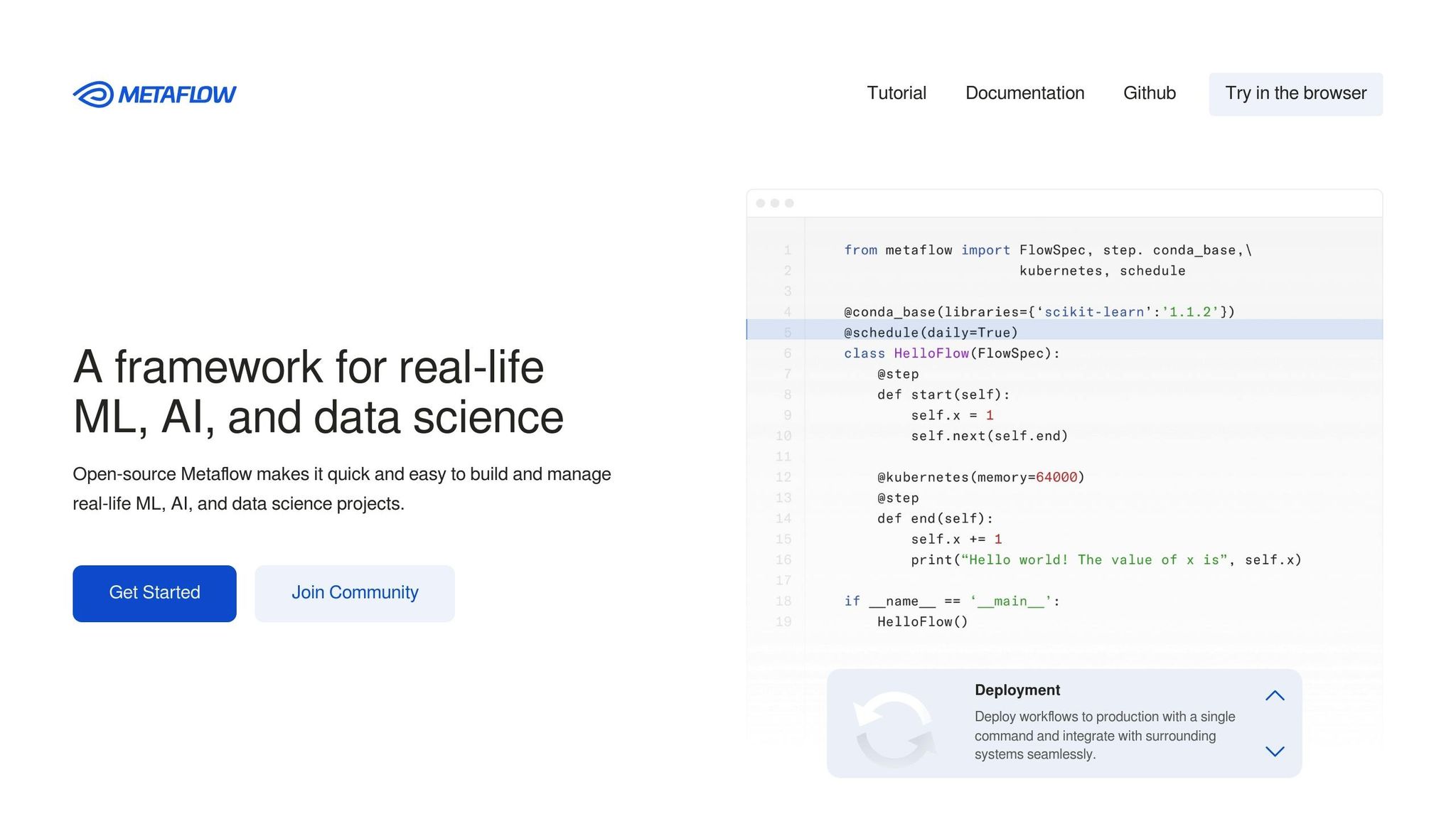
Metaflow, an open-source workflow management platform created by Netflix, simplifies machine learning operations by allowing data scientists to concentrate on building models. It automatically tracks metadata and restarts failed steps, making collaboration easier for teams working on shared workflows.
"Metaflow helps data scientists focus on building models instead of worrying about MLOps engineering." - Anaconda Team, MLOps Tools Overview
Metaflow stands out for its ability to integrate seamlessly into existing machine learning ecosystems. It works well with widely-used libraries like TensorFlow and Scikit-learn, offering a straightforward Python API that simplifies defining workflows. This ease of integration ensures that teams can connect Metaflow with their preferred tools without hassle.
The platform supports deployment across multiple cloud providers, including AWS, Google Cloud Platform, and Microsoft Azure, giving organizations the flexibility to run workflows in their chosen environments. This multi-cloud compatibility ensures consistency across different infrastructure setups. Teams can start with small-scale projects to test how Metaflow fits within their existing workflows before expanding to larger implementations. This adaptability makes it easier to scale operations to meet production needs.
Proven in Netflix's demanding environment, Metaflow has shown it can handle large-scale machine learning workflows efficiently. In 2023, Netflix used it to process millions of data points, achieving better model performance and faster deployment times.
"Metaflow allows data scientists to focus on their models while providing the necessary tools to scale and manage workflows effectively." - Netflix Engineering Team
The platform’s ability to scale across various cloud environments makes it a solid choice for organizations managing extensive datasets and complex models. Its automatic tracking and versioning of experiments ensure reproducibility, which is critical as projects grow in size and complexity.
Metaflow includes built-in governance features designed to ensure secure and compliant workflows, making it especially useful for industries with strict regulations. The platform automatically tracks and versions data and experiments, creating a transparent audit trail that supports compliance with standards like GDPR and HIPAA.
In 2023, Netflix's data science team reported improved compliance with internal governance policies after adopting Metaflow. They also noted faster model deployment and reduced time spent managing experiments, highlighting the platform’s value in regulated environments.
For organizations navigating evolving regulatory landscapes, Metaflow's governance features provide a reliable way to maintain compliance without sacrificing operational efficiency.
Metaflow delivers cost savings through its open-source nature and Python-focused design. By eliminating licensing fees, it allows organizations to implement a powerful workflow management solution without significant upfront expenses. While there may be costs associated with cloud infrastructure, the platform’s efficient resource use helps minimize these operational expenses.
Its Python-based approach reduces the need for specialized MLOps expertise, cutting labor costs and speeding up deployment. Additionally, Metaflow’s compatibility with existing cloud infrastructure enables organizations to make the most of their current technology investments. With a user-friendly interface, it shortens the learning curve for data science teams, reducing training costs and accelerating adoption across the organization.
VectorShift simplifies machine learning workflows by effortlessly connecting with existing tools and systems. It bridges the gap between disconnected platforms, enabling streamlined and efficient workflows.
"Interoperability is key for organizations looking to streamline their machine learning operations." - Industry Expert, MLOps Insights
This focus on integration lays the groundwork for scalability and cost-effective solutions.
VectorShift stands out for its ability to integrate seamlessly with existing machine learning infrastructures through robust API support and pre-built connectors. Instead of requiring a complete system overhaul, it works alongside current tools, allowing teams to continue using their preferred frameworks with minimal disruption.
The platform offers connectors for widely-used data science tools, significantly reducing the time and effort needed for integration. Its flexible architecture caters to diverse organizational needs, letting users tailor workflows to fit their infrastructure without extensive adjustments.
By 2025, over 70% of enterprises are expected to prioritize integration when choosing MLOps tools. VectorShift meets this growing demand with ready-to-use connectivity options that lower technical barriers, making adoption smoother and faster.
VectorShift is built to grow with your machine learning operations. Its API-first design ensures that workflows can expand alongside organizational needs without running into integration challenges.
This design allows teams to create custom integrations tailored to their environments while maintaining scalability. Organizations can begin with a smaller setup and expand their use of VectorShift as their machine learning initiatives grow, ensuring a scalable and future-ready solution.
By focusing on interoperability, VectorShift helps organizations save money. Its ability to integrate with existing tools eliminates the need for costly replacements or overhauls. The platform's connector strategy also reduces the need for custom development, cutting down on additional expenses.
For companies that have already invested heavily in specific machine learning frameworks or data tools, VectorShift maximizes these investments. Instead of starting from scratch, organizations can enhance their workflows by connecting existing systems, creating more cohesive and efficient operations.
To make the most of VectorShift, organizations should assess their current toolsets and explore how its API capabilities can unify disconnected systems. By leveraging this platform, teams can improve data flow and operational efficiency across the entire machine learning pipeline, reinforcing the importance of efficient and interconnected MLOps solutions.
This section distills the key strengths and limitations of each tool, offering a clear overview of their impact on project outcomes. Each tool brings distinct capabilities and challenges, which can significantly influence your workflow decisions.
| Tool | Key Advantages | Main Disadvantages |
|---|---|---|
| Prompts.ai | Enterprise-grade security with access to over 35 leading LLMs; up to 98% cost savings through FinOps controls; unified governance for AI workflows | Primarily geared toward prompt engineering and model orchestration, rather than traditional ML workflows |
| n8n | User-friendly visual workflow builder for non-developers; open-source with extensive customization; free tier with paid plans starting at $20/month | Limited machine learning-specific features; requires additional tools for advanced ML operations |
| LangChain/LangGraph | Highly flexible for language model applications; strong integration capabilities; tailored for LLM workflows | Steep learning curve for beginners; can become complex for large-scale implementations |
| AutoGen | Automates code and workflow generation; reduces manual development effort; simplifies repetitive tasks | Limited to specific use cases; manual configuration may be needed for complex scenarios |
| LlamaIndex | Streamlines data indexing and retrieval; enhances model performance with structured data access | Primarily focused on data indexing; requires integration with other tools for comprehensive workflows |
| Flowise | Low-code platform ideal for non-technical users; enables quick deployment of ML workflows | Lacks advanced features for complex enterprise needs; pricing often requires custom quotes |
| Metaflow | Proven scalability (used by Netflix); free to use; excellent for intricate data science projects | Cloud service costs can add up; requires technical expertise for optimal use |
| VectorShift | API-first design for seamless interoperability; cost-effective integration | Specialized in vector operations; requires supplemental tools for broader functionality |
These comparisons shed light on the practical trade-offs of each tool. For instance, Netflix's success with Metaflow highlights its ability to automate data versioning and tracking, leading to tangible efficiency gains.
"Metaflow allows our data scientists to focus on building models rather than managing infrastructure." - Data Science Lead, Netflix
Choosing the right tool depends on your team's expertise, budget, integration needs, and scalability goals. Tools like n8n and Flowise empower non-technical users to create workflows, while platforms such as LangChain offer advanced flexibility but demand technical proficiency. Organizations that adopt robust MLOps practices report a 60–70% reduction in model deployment time, emphasizing the importance of selecting the right tool from the outset.
"The right MLOps tools can dramatically reduce the time and cost associated with deploying machine learning models." - Sam Austin, MLOps Expert
These insights reinforce the earlier evaluations, emphasizing the importance of aligning your tool choice with both technical needs and organizational priorities.
Selecting the right workflow tools requires balancing technical needs, team expertise, and organizational goals. The key to success lies in aligning a tool's capabilities with your unique requirements.
Prompts.ai is a standout choice for organizations focused on enterprise-level AI management. It provides access to over 35 top-tier large language models and delivers up to 98% cost savings through its FinOps controls. Its unified governance system is particularly suited for teams handling complex workflows across multiple models and departments.
For teams prioritizing ease of use, platforms like n8n and Flowise offer intuitive visual workflow builders, making them accessible to non-technical users. However, these tools may require additional integrations to handle advanced machine learning tasks. On the other hand, LangChain/LangGraph excels in flexibility for language model workflows but comes with a steep learning curve, demanding significant expertise. Similarly, Metaflow is an excellent option for managing data-heavy projects, though it may incur higher cloud service costs.
Budget planning is another critical factor. Open-source tools like n8n often provide free tiers, while enterprise solutions typically come with higher price points. It's essential to assess the total cost of ownership, factoring in infrastructure, training, and maintenance expenses.
Start with tools that align with your current capabilities and scale up as your needs evolve. As your team gains expertise, you can transition to more advanced platforms or integrate multiple tools to expand functionality.
With AI-enabled workflows expected to grow from 3% to 25% of enterprise processes by the end of 2025, selecting tools that offer strong community support, consistent updates, and seamless integration options is crucial. These factors will ensure your investment remains effective and adaptable in this rapidly advancing field.
To choose the right machine learning workflow tool, it's essential to begin by identifying your project's specific needs. Factors like the complexity of your data, the size of your team, and deployment requirements should guide your decision. Look for tools that provide interoperability, scalability, and are straightforward to use, ensuring they meet both your immediate objectives and long-term plans.
Evaluate how well the tool facilitates collaboration, streamlines automation, and integrates with your existing systems. Running a small-scale project or pilot can offer valuable insights into whether the platform aligns with your organization's goals. Focus on options that boost productivity and simplify processes for your team.
To maintain compliance and proper governance when incorporating machine learning workflow tools, enterprises should focus on version control for all related artifacts, including models, datasets, and code. This approach ensures transparency and makes it easier to track changes throughout the development process.
Automating the machine learning pipeline is another key step. It not only promotes consistency but also minimizes the risk of human error. Equally important is establishing thorough data validation processes to uphold data quality and integrity, which are vital for producing reliable and unbiased model results.
By addressing these critical areas, organizations can improve accountability, simplify workflows, and confidently meet regulatory standards.
Open-source tools like n8n and Metaflow offer a cost-effective way to manage machine learning workflows by eliminating hefty licensing fees. They provide teams with the flexibility to customize and automate processes without the high costs of proprietary platforms. This makes them an appealing option for startups and small businesses operating on tight budgets.
That said, these tools often come with some trade-offs. They may lack advanced features, struggle with scalability, or offer limited dedicated support. While they work well for smaller or less complex projects, scaling them to handle enterprise-level needs might require extra effort, such as custom development or infrastructure upgrades. It’s important to weigh your project’s complexity and future growth needs before opting for an open-source solution.