Pay As You Go - AI Model Orchestration and Workflows Platform



Managing large-scale machine learning workflows requires specialized orchestration tools that ensure smooth operations, cost control, and compliance. Whether you're dealing with terabytes of data, running distributed training on Kubernetes, or navigating multi-cloud environments, choosing the right platform is critical. Here’s a quick overview of six leading options:
Each tool is evaluated based on scalability, integration, lifecycle coverage, governance, and cost efficiency. For teams prioritizing traditional ML workflows, tools like Airflow, Kubeflow, or Flyte may fit best. For those focused on AI orchestration and LLMs, Prompts.ai offers unmatched governance and cost transparency.
| Tool | Scalability | Integration | ML Lifecycle Coverage | Governance | Cost Efficiency |
|---|---|---|---|---|---|
| Apache Airflow | High | Extensive (Hadoop, Spark) | Moderate | Basic (audit logs) | Moderate (open-source) |
| Kubeflow | High (Kubernetes) | Strong (cloud-native) | Full | Moderate (RBAC) | Moderate (requires setup) |
| Prefect | High | Good (simpler setup) | Full | Moderate (collaboration) | High (low setup costs) |
| Flyte | High (Kubernetes) | Strong | Full | Good (versioning) | Moderate (open-source) |
| MLRun | High (serverless) | Strong (data lakes, stores) | Full | Good (experiment tracking) | Moderate (free, infra req.) |
| Prompts.ai | High (LLM-focused) | Strong (35+ LLMs) | Moderate | Strong (SOC 2, HIPAA) | High (pay-as-you-go) |
The right choice depends on your infrastructure, team expertise, and business goals. Dive deeper into each tool to find the best fit for your needs.
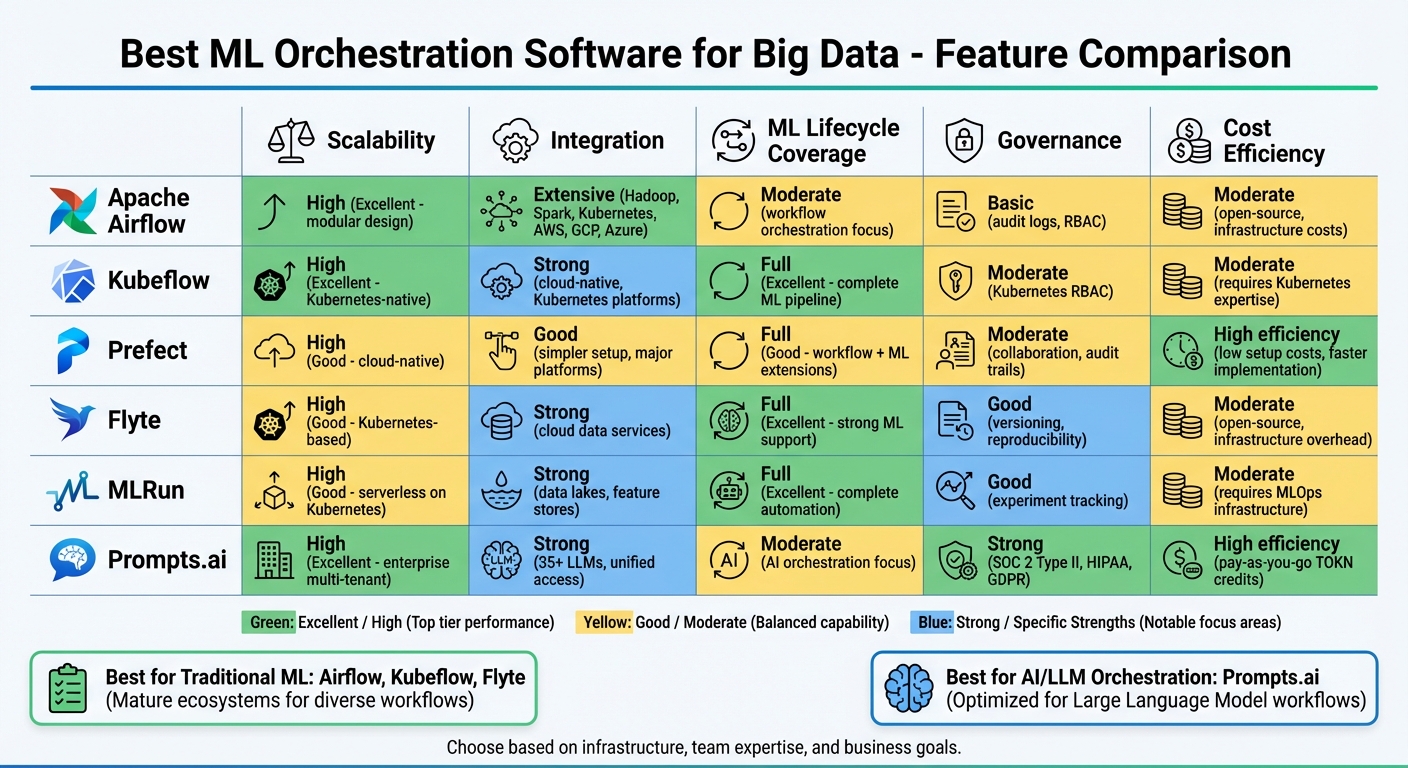
ML Orchestration Tools Comparison: Features, Scalability, and Cost Analysis
Apache Airflow is an open-source orchestration platform built on Python, designed to manage workflows through Directed Acyclic Graphs (DAGs). Initially created at Airbnb and now maintained by the Apache Software Foundation, it has gained widespread adoption, particularly among data engineering teams. While not specifically tailored for machine learning (ML), its flexibility makes it a practical option for handling ML workflows in large-scale data environments, especially for teams already proficient with the tool. It provides a reliable framework for organizing and managing workflows, even in complex big data settings.
Airflow’s modular design enables it to scale effectively. By distributing tasks across workers while adhering to specified dependencies, it ensures workflows can expand as data processing demands grow. For instance, Netflix relies on Airflow to manage and schedule thousands of tasks in its data pipelines, maintaining seamless operations. That said, Airflow excels in environments with relatively stable workflows and may not perform as efficiently in highly dynamic setups.
Airflow stands out for its ability to integrate with various big data systems, making it a versatile tool for diverse ecosystems. It offers numerous operators that connect with platforms like Hadoop, Spark, and Kubernetes. For example, Wise, a financial technology company, leverages Airflow to retrain ML workflows on Amazon SageMaker, aiding in real-time transaction monitoring and Know Your Customer (KYC) processes. Additionally, managed services such as Google Cloud Composer and Astronomer simplify scaling and transitioning from on-premises to cloud-based environments.
Airflow’s Python-based programmatic approach allows teams to orchestrate multiple stages of the ML lifecycle, from data preprocessing to model training and deployment. Its ability to dynamically generate pipelines lets users create and schedule intricate workflows based on specific parameters. However, setting up Airflow can introduce moderate DevOps challenges, and it may lack some ML-specific capabilities found in platforms designed exclusively for machine learning.
Airflow includes a user-friendly web interface for monitoring pipeline progress and resolving issues. Its DAG structure not only organizes workflows but also tracks versions, facilitating collaboration and maintaining audit trails. This feature is particularly valuable for industries like finance and healthcare, where regulatory compliance and clear data lineage are critical for managing ML workflows in big data environments.
As an open-source platform, Apache Airflow requires users to cover only the infrastructure costs, whether deployed on-premises or in the cloud. While managed services like Cloud Composer and Astronomer come with additional expenses, they also reduce the burden of maintenance, scaling, and updates. For teams already experienced with Airflow through data engineering projects, the learning curve is minimal, further lowering indirect costs.
Kubeflow is an open-source toolkit designed to simplify the deployment, monitoring, and management of machine learning workflows on Kubernetes. Tailored for teams leveraging Kubernetes to handle large-scale machine learning operations, Kubeflow stands apart from general-purpose orchestration tools by focusing exclusively on the unique needs of the ML lifecycle. This specialized approach makes it ideal for optimizing workflows in environments dealing with massive datasets.
Built on Kubernetes' native scalability, Kubeflow efficiently handles machine learning workloads across distributed systems. Its containerized framework allows teams to deploy pipelines that dynamically adjust resources based on processing demands, a critical feature when training models on extensive datasets. Kubeflow also integrates seamlessly with major cloud providers like AWS, Google Cloud Platform, and Microsoft Azure. This multi-cloud compatibility offers enterprises the ability to manage large-scale data operations with flexible resource allocation, making it a powerful tool for hybrid or multi-cloud setups.
Kubeflow's integration with Kubernetes enables it to fit smoothly into existing data engineering ecosystems. For instance, it works alongside popular workflow systems like Airflow, allowing organizations to enhance their ML orchestration capabilities without overhauling their infrastructure. Its cloud-native design ensures portability, making it adaptable to different environments while maintaining efficiency.
Kubeflow covers every stage of the machine learning lifecycle, from training and testing to deployment, model versioning, and hyperparameter tuning. The platform provides pre-configured containers, offering a standardized way to deploy ML pipelines within Kubernetes. As Domo notes:
By standardizing how ML pipelines are deployed and served, Kubeflow ensures that teams can innovate quickly without reinventing the wheel.
Moreover, Kubeflow democratizes access to advanced machine learning tools, empowering engineers and scientists across teams to build, run, and experiment with models, fostering collaboration and innovation.
While Kubeflow itself is free, it requires a solid understanding of Kubernetes to use effectively. For teams already operating Kubernetes clusters, the additional costs are minimal. However, those new to Kubernetes may encounter a steep learning curve and integration challenges, which could lead to higher initial expenses.
Prefect is a modern workflow management system designed to handle today's complex data environments and infrastructures. Unlike older orchestration tools, Prefect prioritizes ease of use and resilience, making it a popular choice for teams managing unpredictable big data workloads. Monte Carlo Data has even dubbed it "Airflow, but nicer" due to its intuitive interface, simplified setup process, and reduced complexity.
Prefect stands out for its ability to scale seamlessly. It can handle millions of workflow runs, offering a level of scalability suitable for enterprise needs. The platform is available in two versions: Prefect Core, an open-source option, and Prefect Cloud, a fully hosted solution. This flexibility allows teams to start small and expand as their data requirements grow. Prefect Cloud provides additional features like performance enhancements and agent monitoring, essential for managing workflows that process large datasets across distributed systems. Its hybrid execution model further strengthens its adaptability by enabling tasks to run securely across on-premises, cloud, or hybrid environments - perfect for big data and machine learning workflows.
Prefect enhances data pipelines by incorporating critical features such as retries, logging, dynamic mapping, caching, and failure alerts. Dynamic mapping, in particular, is invaluable for handling fluctuating data volumes and enabling parallel processing. The platform also integrates seamlessly with tools like lakeFS, enabling data versioning by wrapping API calls in PythonOperators or custom tasks. This functionality ensures efficient version control for large-scale datasets.
Prefect goes beyond traditional data pipeline management to support the entire machine learning lifecycle. The introduction of Marvin AI - a framework for building AI models, classifiers, and applications using natural language interfaces - expands its capabilities significantly. Additionally, its automatic retry feature safeguards workflow integrity, ensuring smooth operations throughout the ML lifecycle.
Prefect Core is free and open-source, making it an accessible option for developers working with big data workflows. For teams seeking enhanced capabilities, Prefect Cloud offers a paid, fully hosted backend with features like permissions, team management, and service-level agreements (SLAs). Pricing for Prefect Cloud varies based on usage. With its straightforward setup and user-friendly design, Prefect is an excellent choice for teams looking to save time and resources while implementing orchestration tools.
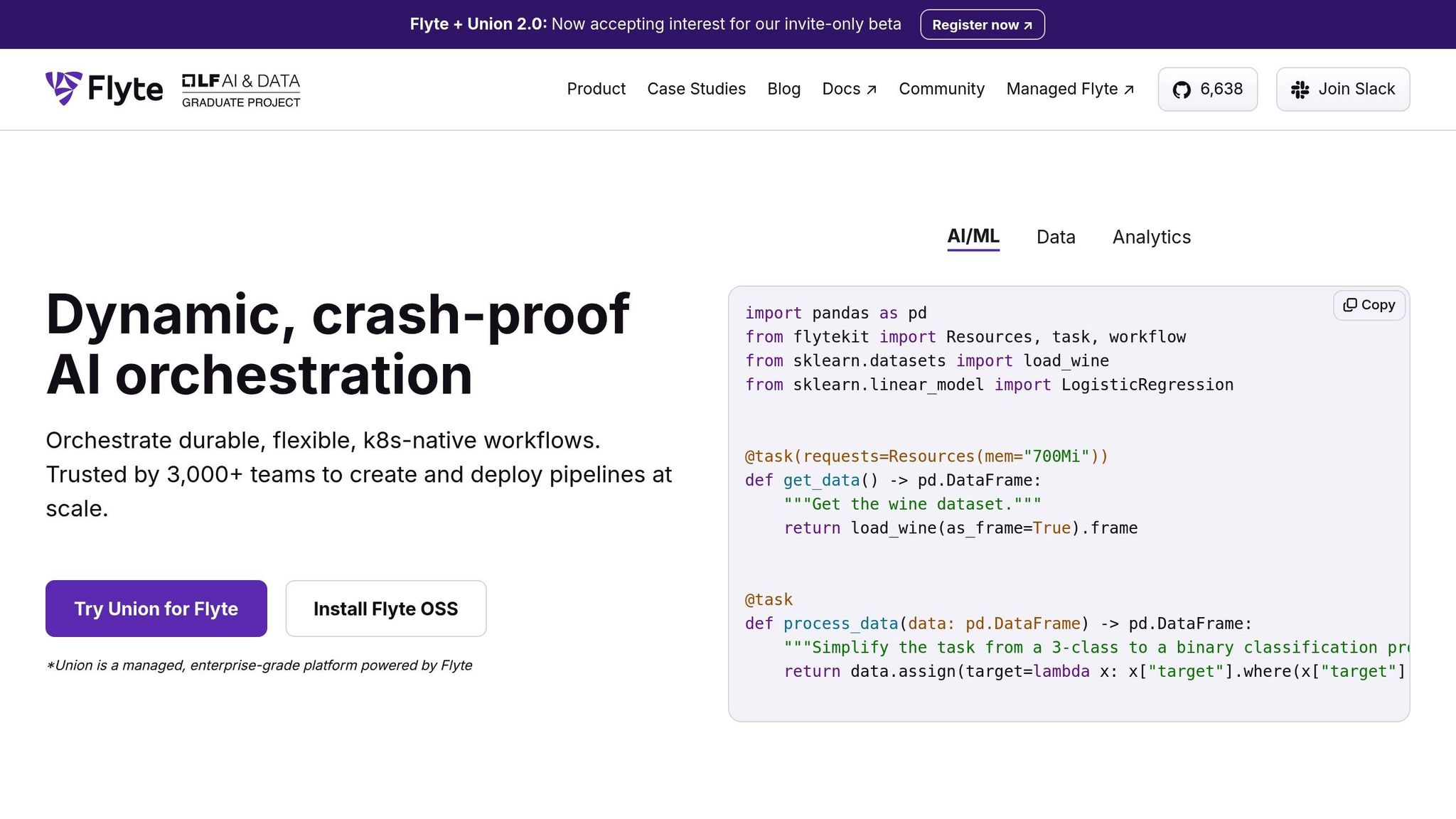
Flyte is a Kubernetes-native orchestration platform initially developed by Lyft to manage large-scale machine learning workloads in production. Today, it powers workflows for over 3,000 teams and is trusted by major companies like Google and Airbnb to scale machine learning models across data centers.
Flyte’s design allows for dynamic scaling, eliminating idle costs by adjusting resources on demand. It supports both horizontal and vertical scaling, enabling resource adjustments directly from your code during runtime. With built-in features like automatic retries, checkpointing, and failure recovery, Flyte ensures reliability and reduces the need for manual fixes. This scalable framework also integrates seamlessly with big data systems.
Flyte’s architecture is optimized for highly concurrent and maintainable workflows, making it ideal for machine learning and data processing tasks. Teams can deploy separate repositories without disrupting the platform’s functionality. This setup prevents tool fragmentation across data, ML, and analytics stacks, while centralizing workflow management at scale.
Flyte provides comprehensive workflow management for developing, deploying, and refining AI/ML systems on a single platform. Its Python SDK supports data preprocessing for ETL workflows. For model training, Flyte facilitates distributed workflows and integrates seamlessly with frameworks like TensorFlow and PyTorch.
Flyte’s open-source version is free, making it accessible to teams of all sizes. For those needing advanced features, Union Enterprise offers a managed version of Flyte with customized pricing options. Jeev Balakrishnan from Freenome describes Flyte as "a workhorse", highlighting its reliability and effectiveness. This cost flexibility strengthens Flyte’s position as a dependable solution for large-scale, production-ready ML workflows.
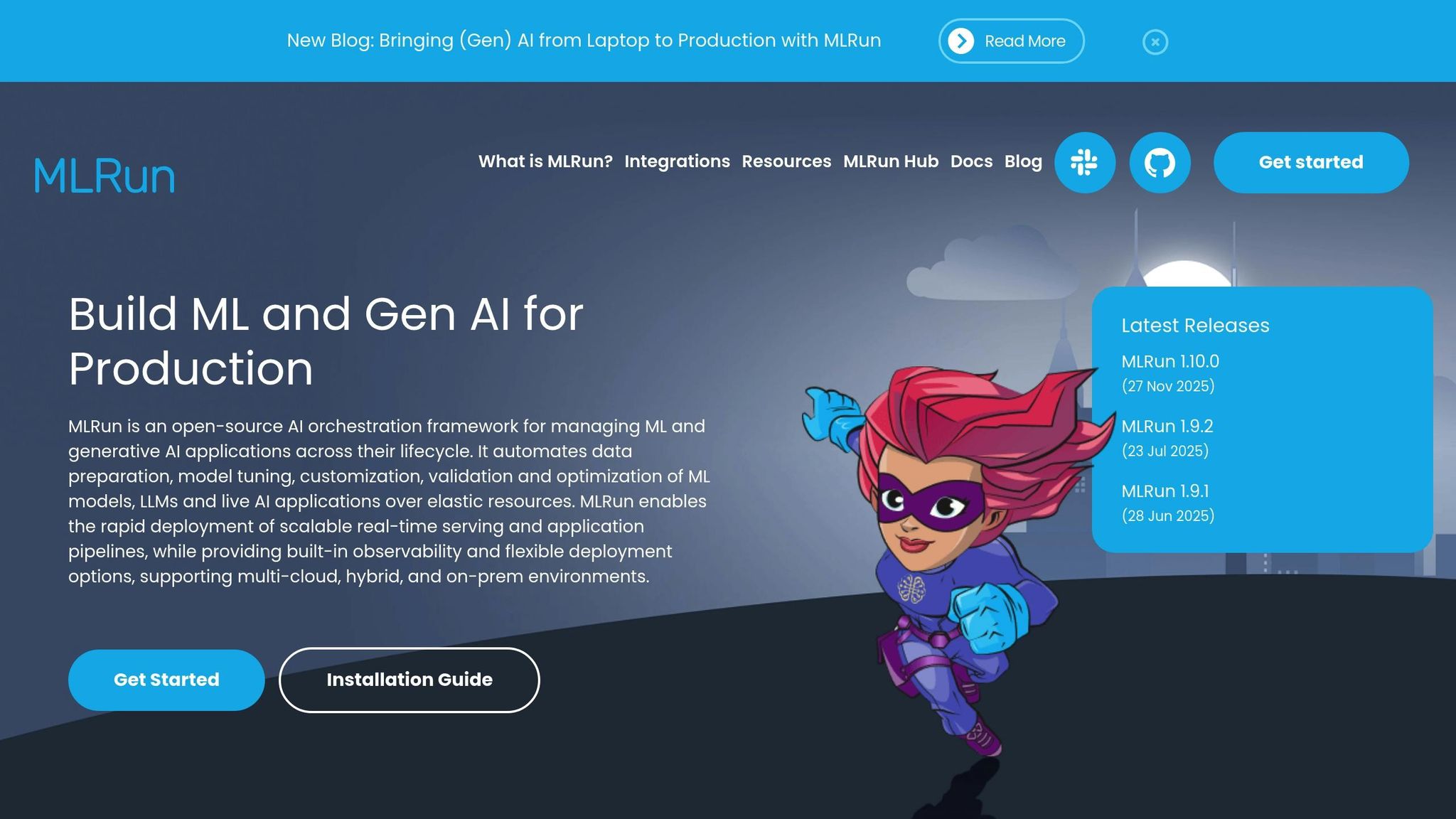
MLRun is an open-source platform designed to manage the entire machine learning lifecycle at scale. Its serverless, elastic architecture makes it especially useful for teams working with large-scale data operations.
With its ability to support millions of runs, MLRun eliminates the need for manual infrastructure management through elastic scaling. This serverless design allows teams to focus on developing models while the platform transforms their code into production-ready workflows.
MLRun’s framework integrates effortlessly with various data systems, making it a strong choice for handling big data. It includes a feature and artifact store to manage data ingestion, processing, metadata, and storage across multiple repositories and technologies. This centralization is critical for big data operations. The platform supports a variety of storage systems, including S3, Artifactory, Alibaba Cloud OSS, HTTP, Git, and GCS, offering flexibility in infrastructure choices. Additionally, its abstraction layer connects seamlessly with a wide array of machine learning tools and plugins, ensuring compatibility with established big data frameworks.
MLRun goes beyond scalability and integration by covering the entire machine learning pipeline, from initial development to deployment. It streamlines processes such as automated experiments, model training, testing, and real-time pipeline deployments, maintaining consistency across every stage of the machine learning lifecycle.
As an open-source platform, MLRun is free to use, making it an economical option for organizations of all sizes. This cost structure allows teams to allocate more resources to infrastructure and talent rather than expensive licensing fees, which is especially beneficial for startups and research-focused groups.
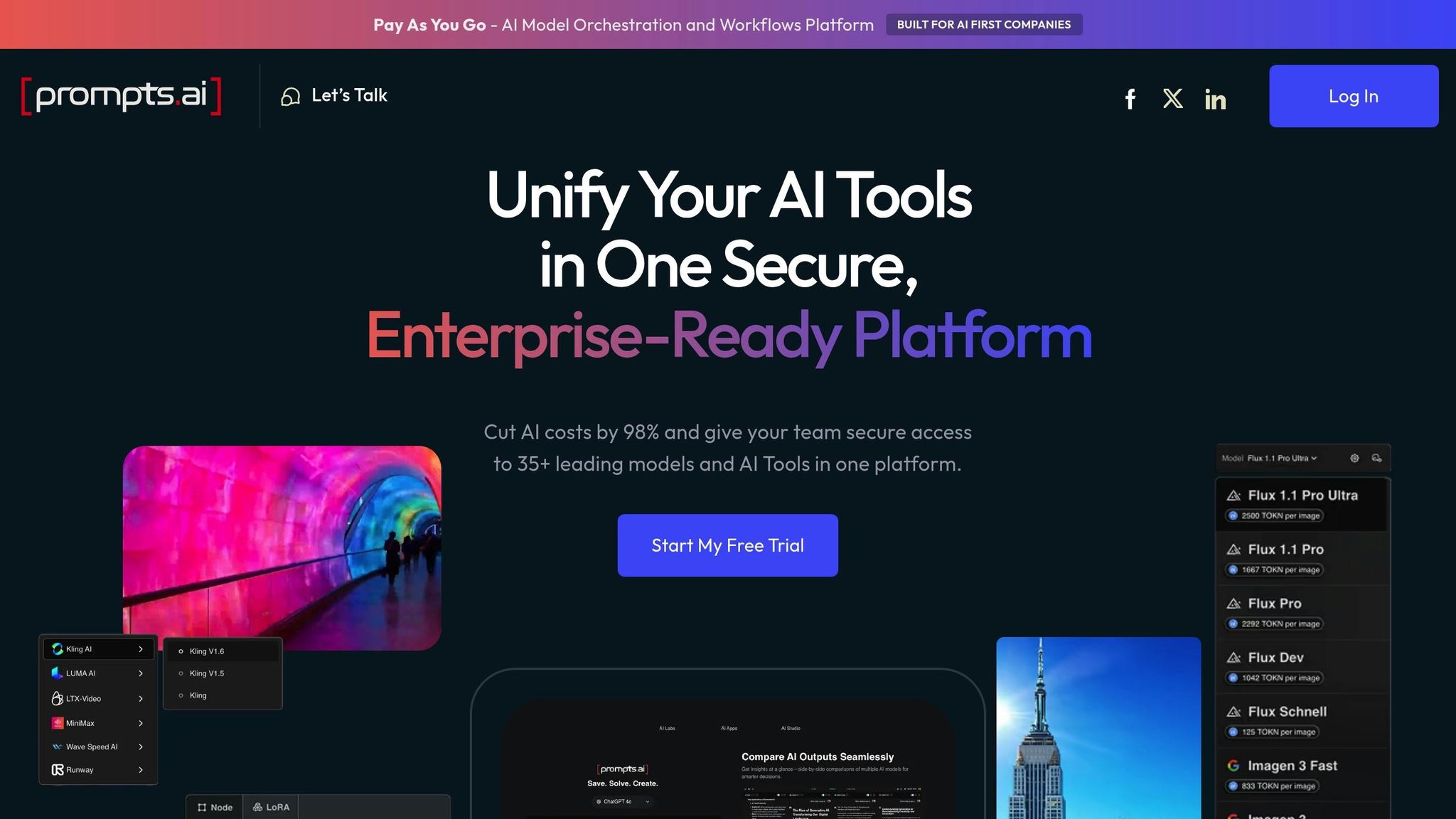
Prompts.ai is a powerful enterprise platform designed to streamline AI orchestration. It brings together access to over 35 leading large language models, such as GPT-5, Claude, LLaMA, and Gemini, all within a single and secure interface. Unlike other tools, Prompts.ai emphasizes strong governance, precise cost management, and seamless access to modern AI models, making it a reliable choice for managing machine learning workflows at scale. Its features cater to scalability, integration, governance, and cost management, ensuring businesses can operate efficiently.
Prompts.ai is built to grow alongside your needs. Its dynamic workspaces and collaborative tools allow teams to pool resources effectively, supported by a flexible pay-as-you-go TOKN credit system. With its multi-tenant architecture, data science teams, ML engineers, and analytics professionals can run simultaneous experiments and pipelines across large datasets without performance slowdowns.
The platform integrates seamlessly with existing data infrastructures, supporting RAG workflows and vector database configurations to enable end-to-end machine learning pipelines. By bridging traditional ML processes with modern large language model capabilities, Prompts.ai empowers teams to handle vast amounts of data while maintaining secure connections to their existing systems. This approach ensures that diverse data environments can be managed efficiently.
Security and compliance are at the heart of Prompts.ai. It aligns with industry standards like SOC 2 Type II, HIPAA, and GDPR to safeguard sensitive data, making it especially valuable for industries such as healthcare and finance. The platform began its SOC 2 Type II audit process on June 19, 2025, and offers a public Trust Center at https://trust.prompts.ai/ where users can access real-time updates on its security and compliance status. Features such as compliance monitoring and governance tools are included in its Business plans, ensuring comprehensive oversight.
Prompts.ai introduces a pay-as-you-go TOKN credit system, moving away from traditional per-seat licensing. Its pricing options include a $0 exploratory tier and business plans ranging from $99 to $129 per member per month. With real-time FinOps tools, users can monitor token usage and optimize spending, ensuring AI costs align with business objectives. This transparency helps businesses reduce overall expenses while maximizing value.
Each tool brings its own strengths and challenges when it comes to scalability, integration with big data and AI systems, ML lifecycle management, governance, and cost efficiency. Let’s break down the key highlights:
Apache Airflow stands out for its scalability, thanks to its modular design and efficient scheduler that can handle thousands of concurrent tasks in production environments. It integrates seamlessly with distributed systems like Hadoop, Spark, and Kubernetes, along with major cloud platforms such as AWS, GCP, and Azure. However, its steep learning curve and complex setup might slow adoption, particularly for smaller teams.
Kubeflow takes advantage of its Kubernetes-native framework to deliver cloud-native scalability. However, to unlock its full potential, teams need prior experience with Kubernetes and the necessary infrastructure to support it.
Prefect simplifies deployment with its Python-first, modern approach, allowing teams to achieve faster results with less complexity. This makes it a popular choice for rapidly growing teams looking for quicker implementation.
Flyte and MLRun focus on reproducibility across the ML lifecycle. While both tools excel in this area, their ecosystems are not as extensive as Apache Airflow’s, which has a more established user base.
Prompts.ai takes a different approach by centering on AI orchestration rather than traditional ML pipelines. It offers unified access to over 35 leading large language models through a secure interface and includes built-in FinOps controls for cost management. Its pay-as-you-go TOKN system eliminates per-seat fees, and its compliance with SOC 2 Type II, HIPAA, and GDPR ensures it meets the governance needs of regulated industries.
Here’s a quick comparison of these tools based on key metrics:
| Tool | Scalability | Big Data / AI Integration | ML Lifecycle Coverage | Governance | Cost Efficiency |
|---|---|---|---|---|---|
| Apache Airflow | Excellent – modular design with distributed workers | Strong – supports Hadoop, Spark, Kubernetes, and major clouds | Moderate – workflow orchestration focus | Basic – audit logs and role-based access | Moderate – open-source but requires infrastructure investment |
| Kubeflow | Excellent – Kubernetes-native and cloud-friendly | Strong – integrates with Kubernetes and cloud platforms | Excellent – full ML pipeline management | Moderate – uses Kubernetes RBAC | Moderate – open-source but needs Kubernetes expertise |
| Prefect | Good – cloud-native with easy scaling | Good – supports major platforms with simpler setup | Good – workflow-focused with ML extensions | Moderate – includes collaboration and audit trails | Good – lower setup costs and faster implementation |
| Flyte | Good – Kubernetes-based with reproducible workflows | Good – connects with cloud data services | Excellent – strong ML lifecycle support | Good – versioning and reproducibility controls | Moderate – open-source with some infrastructure overhead |
| MLRun | Good – serverless scaling on Kubernetes | Good – works with data lakes and feature stores | Excellent – full ML lifecycle automation | Good – includes experiment tracking and governance | Moderate – requires dedicated MLOps infrastructure |
| Prompts.ai | Excellent – enterprise-grade, multi-tenant design | Strong – unified access to 35+ LLMs and workflows | Moderate – focuses on AI orchestration | Excellent – SOC 2 Type II, HIPAA, and GDPR compliance | Excellent – pay-as-you-go TOKN credits for cost transparency |
The right tool depends heavily on your team’s existing infrastructure, expertise, and specific needs. Teams with strong Kubernetes skills might find Kubeflow or Flyte more suitable, while those looking for simplicity and faster deployment may lean toward Prefect. For enterprises prioritizing governance, cost management, and unified AI model access, Prompts.ai offers a standout solution with its compliance-driven design and transparent cost structure.
Choosing the right ML orchestration software hinges on aligning it with your team's expertise, existing infrastructure, and business priorities. Apache Airflow remains a strong contender for general workflow orchestration, offering proven scalability across platforms like Hadoop, Spark, and major cloud providers. Its modular architecture efficiently manages thousands of tasks simultaneously, though it does require a significant setup effort.
Governance and compliance also play a pivotal role, especially in regulated industries. Features like role-based access controls, audit logging, and data lineage tracking are essential for meeting standards like GDPR and HIPAA. However, implementing these capabilities often demands considerable infrastructure investments and continuous maintenance.
For U.S.-based companies leveraging Kubernetes-based infrastructure, tools like Kubeflow and Flyte provide robust, cloud-native scalability with strong support for ML lifecycle management. While both integrate seamlessly with container orchestration, they require a solid understanding of Kubernetes. For teams lacking this expertise, Prefect offers a more straightforward deployment process.
For enterprises focusing on LLM-driven projects and AI orchestration, Prompts.ai stands out. It simplifies access to over 35 language models while addressing governance challenges with SOC 2 Type II, HIPAA, and GDPR compliance. The pay-as-you-go TOKN credit system ensures cost transparency, eliminating per-seat licensing fees - a clear benefit for U.S. companies looking to balance scalability with budget constraints.
Ultimately, your decision depends on whether your priorities lie with traditional ML workflows or modern AI orchestration. By weighing your needs against key criteria - scalability, integration, lifecycle coverage, governance, and cost efficiency - you can make an informed choice. Established ML pipelines align well with traditional orchestration tools, while Prompts.ai is an excellent fit for unified, LLM-focused AI operations.
When choosing an ML orchestration tool for big data, it's crucial to prioritize compatibility with your current tech stack. A tool that integrates smoothly with your existing systems can save both time and resources, reducing unnecessary complications.
Think about the tool's scalability - can it handle increasing data volumes and more intricate workflows as your needs grow? It's equally important to consider the ease of use for your team. A user-friendly tool that matches your team’s skill level can significantly reduce the time spent on training and onboarding.
Additionally, robust monitoring and automation features are essential for simplifying workflow management and ensuring dependable performance. Lastly, evaluate whether the tool aligns with your organization's long-term plans, such as adopting new technologies or transitioning to the cloud.
Governance and compliance play a key role in selecting machine learning orchestration software, as they ensure your workflows align with both legal requirements and internal standards. Tools offering data lineage, audit trails, and strong security controls help protect the integrity of your data while maintaining regulatory compliance.
In the context of big data workflows, compliance ensures that sensitive information is managed responsibly and with transparency. Effective governance minimizes risks and fosters confidence in your machine learning processes, paving the way for seamless scaling while adhering to industry guidelines.
The expense of utilizing machine learning orchestration software is influenced by several key factors, including infrastructure demands, operation scale, and support requirements. For instance, platforms like Kubeflow and Metaflow often lead to higher infrastructure costs due to their intricate deployment processes. On the other hand, open-source solutions such as Apache Airflow and Prefect can help cut down on licensing expenses but may necessitate additional internal resources for setup and ongoing upkeep.
Ultimately, the total cost will depend on your specific needs. Variables such as the size of your data workflows, the degree of automation you aim to achieve, and whether you require enterprise-level support or tailored integrations play a significant role in determining the overall expense.