Pay As You Go - AI Model Orchestration and Workflows Platform


Machine learning platforms simplify automation by managing the entire AI lifecycle - from data preparation to deployment. Here's a breakdown of three top platforms to help you choose the right one for your business:
| Platform | Model Integration | Automation Features | Pricing | Scalability |
|---|---|---|---|---|
| Prompts.ai | 35+ models; multi-vendor support | No-code workflows, AI agents | $99–$129/month per user | Scales from small to large teams |
| AWS SageMaker | AWS ecosystem integration | AutoML, CI/CD, SageMaker Pipelines | Pay-as-you-go; free tier available | Enterprise-grade, AWS-focused |
| Google Vertex AI | Google Cloud integration | AutoML, Vertex Pipelines | $0.19/hour for training | Google Cloud-dependent |
Choose Prompts.ai for flexibility, SageMaker for AWS-heavy setups, or Vertex AI for Google Cloud users. Each platform supports scaling and automation, but your choice depends on your existing infrastructure and goals.
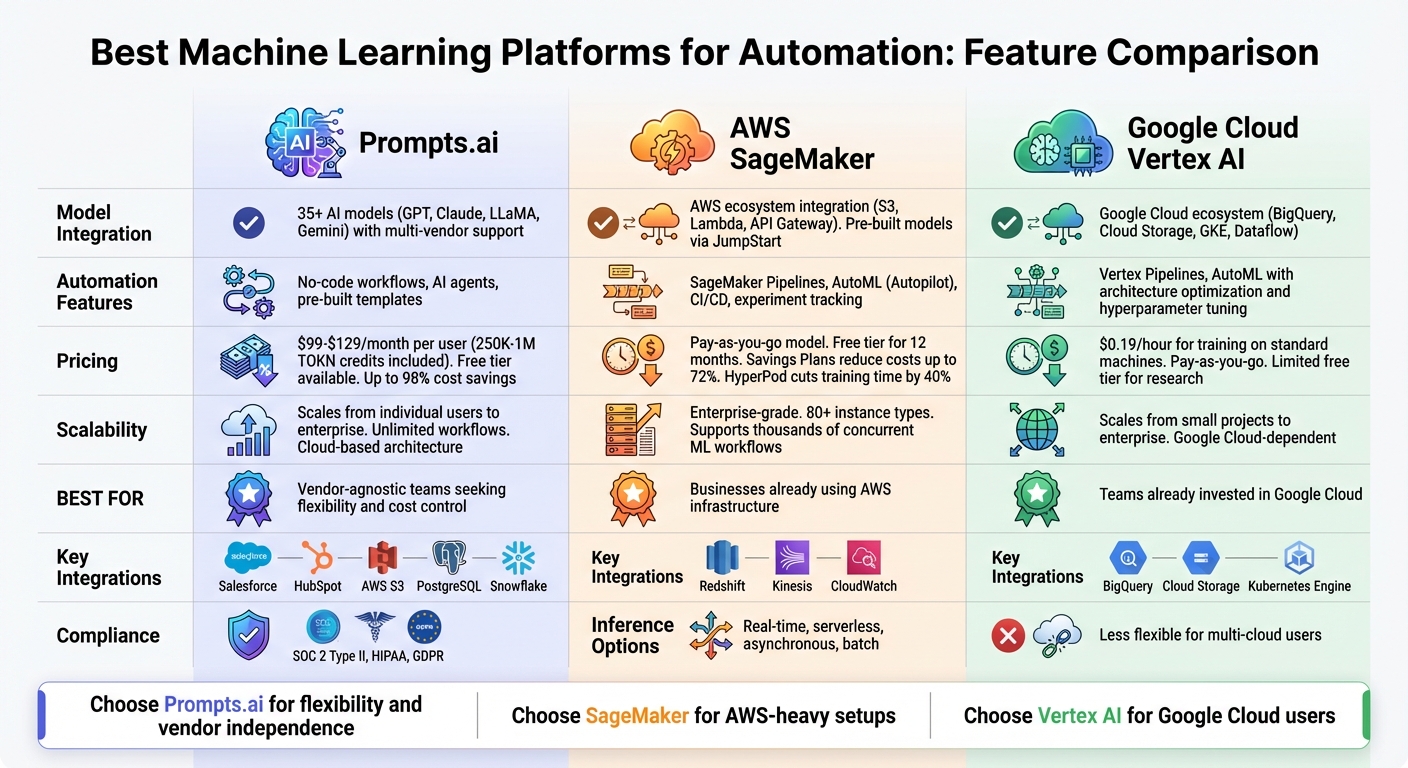
Machine Learning Platforms Comparison: Prompts.ai vs AWS SageMaker vs Google Vertex AI
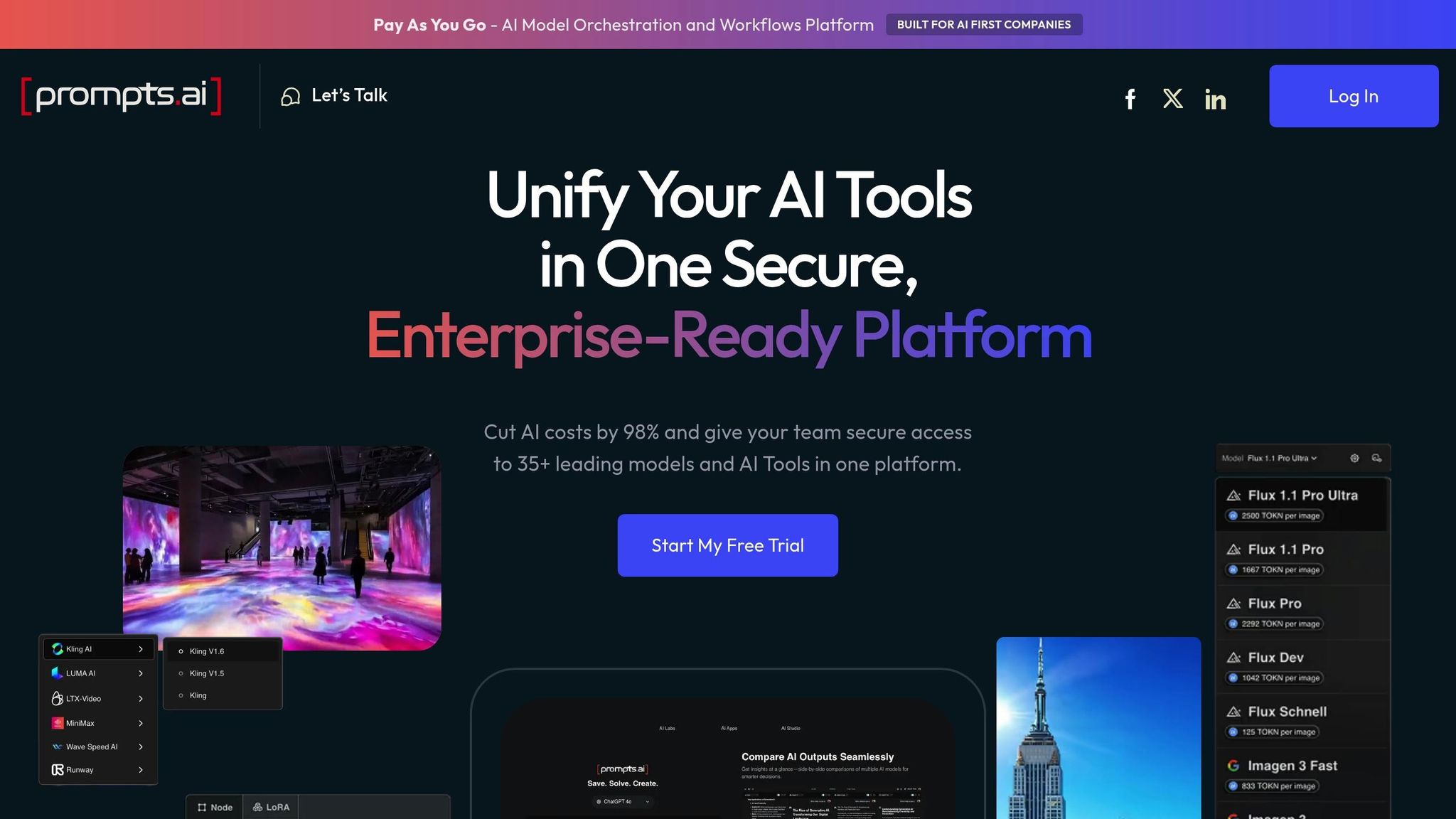
Prompts.ai simplifies AI management by consolidating access to over 35 models, including GPT, Claude, LLaMA, and Gemini, into one platform. This eliminates the need to juggle multiple vendor accounts, API keys, or billing systems. It connects seamlessly with external LLM providers through standard APIs and SDKs, while also integrating tools like Salesforce, HubSpot, AWS S3, PostgreSQL, and Snowflake using OAuth or API keys. Data syncs automatically, streamlining both training and inference workflows. For instance, a US-based retail company could link its e-commerce database to the platform to generate real-time product descriptions and personalized email campaigns effortlessly. This integration framework lays the groundwork for efficient, automated workflows.
Prompts.ai features a no-code/low-code workflow builder that allows users to automate processes like data ingestion, preprocessing, model calls, and post-processing. Workflows can be triggered on a schedule or by specific events. For example, the platform can automatically pull daily sales data, clean it, generate demand forecasts, update BI tools, and notify stakeholders via Slack - all without manual effort. Additionally, AI agents can be configured with specific roles, tools, and instructions to handle ongoing tasks, such as monitoring emails or updating CRMs. Pre-built templates for areas like sales, marketing, support, and operations further speed up deployment, offering tailored solutions for diverse business needs.
Prompts.ai offers flexible pricing in US dollars ($), starting with free exploratory plans and scaling to business tiers priced between $99 and $129 per member per month. These plans include 250,000 to 1,000,000 TOKN credits. Costs are influenced by factors like inference volume, storage, and compute time. Built-in dashboards provide transparency by tracking AI expenses for each workflow and model. Teams can allocate premium models to high-priority tasks and opt for more economical choices for routine operations. Features like rate limits, batching requests, and autoscaling policies help further control costs. For example, a mid-sized company handling 500,000 automated prompts monthly can monitor token usage in real time and adjust settings to stay within budget.
Prompts.ai’s cloud-based architecture is designed to scale effortlessly, handling increased workloads like large outbound campaigns without any manual adjustments. It supports distributed processing and high-throughput API calls to ensure consistent performance, even during peak demand. Regional hosting in US data centers ensures low latency and compliance with local regulations. Whether managing a single workflow or scaling to millions of monthly requests, the platform’s multi-tenant design, role-based access controls, and audit logs make it a powerful tool for data scientists, engineers, and business teams alike.
AWS SageMaker streamlines the process of building, training, and deploying machine learning (ML) models by seamlessly connecting with Amazon S3, AWS Lambda, and Amazon API Gateway. With SageMaker Studio, users gain access to a unified development environment where they can create ML pipelines and monitor performance using CloudWatch. For businesses already utilizing AWS, this integration simplifies operations by eliminating the challenges of connecting separate systems. Additionally, SageMaker JumpStart offers pre-built models that can be deployed quickly, reducing time-to-value.
SageMaker Pipelines brings automation to ML workflows, incorporating features like experiment tracking, CI/CD, and AutoML through SageMaker Autopilot, minimizing manual effort. This serverless orchestration service is designed to handle tens of thousands of concurrent ML workflows in production environments. With support for a variety of algorithms and prebuilt model templates, SageMaker accelerates the development process. Its integration with services like Redshift and Kinesis ensures smooth data movement across the AWS ecosystem. These automation features align perfectly with SageMaker's comprehensive integration and resource management capabilities.
SageMaker operates on a pay-as-you-go pricing model in U.S. dollars, ensuring users only pay for the resources they use. A free tier is available for 12 months, allowing users to explore the platform within defined limits. Cost-saving measures like Savings Plans can reduce expenses by up to 72%, while HyperPod technology cuts training time by 40%. Elastic training further optimizes costs by automatically scaling jobs based on demand.
SageMaker’s robust infrastructure supports scaling from small projects to enterprise-level workloads. Leveraging AWS's global, high-performance network, the platform can manage large-scale models and datasets effortlessly. It supports deployment across more than 80 instance types and offers options for real-time, serverless, asynchronous, and batch inference. For enhanced performance, specialized hardware like Inferentia chips delivers efficient inference and optimized training. This scalability ensures SageMaker is equipped to handle everything from experimental projects to full-scale enterprise applications.
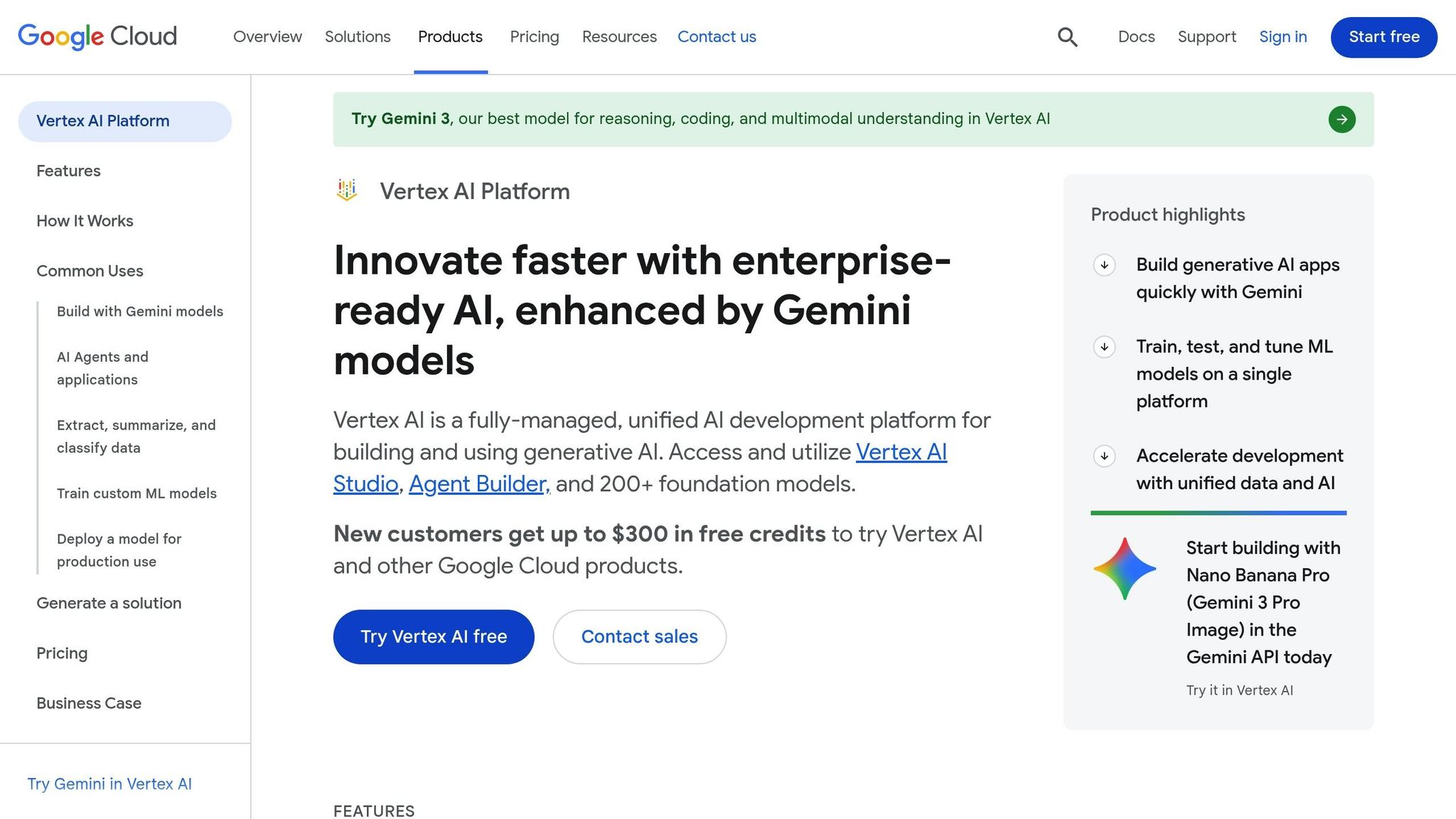
Google Cloud Vertex AI serves as a unified platform seamlessly connecting with the broader Google Cloud ecosystem, including tools like BigQuery, Cloud Storage, Google Kubernetes Engine, and Dataflow. This interconnected setup allows organizations to handle data processing, model training, and deployment all within a single workspace. By offering a streamlined interface for tasks like training, validation, and prediction, Vertex AI simplifies the machine learning process, especially for teams already invested in Google Cloud.
Vertex AI shines with its automation features, particularly through Vertex Pipelines, which oversee the entire machine learning workflow. Its AutoML tools take care of tasks such as model selection, architecture optimization, and hyperparameter tuning, significantly cutting down the manual effort required to create precise models. This automation empowers teams to train custom machine learning models quickly, often with minimal coding involved.
Vertex AI follows a pay-as-you-go pricing model, starting at $0.19 per hour for training models on standard machines. While the pricing is attractive for smaller-scale or entry-level projects, costs can climb as additional services or larger workloads are added. Google Cloud AutoML, a key feature of Vertex AI, includes a limited free tier for research purposes, with commercial usage requiring payment. Organizations should carefully monitor their service usage, as more complex deployments or larger datasets can lead to higher expenses. This pricing structure, however, remains flexible enough to accommodate scaling needs.
Vertex AI is designed to grow with your needs, offering scalability from small experimental projects to full-scale enterprise deployments. Its tight integration with other Google Cloud services ensures efficient data flow as workloads expand. However, this reliance on Google’s ecosystem could pose challenges for teams looking for more cloud-agnostic solutions.
After diving into the features of each platform, let’s break down their strengths and potential limitations to help you make an informed choice.
prompts.ai provides access to over 35 AI models through a single secure interface, complete with SOC 2 Type II, HIPAA, and GDPR compliance to ensure high standards in security and privacy. It simplifies workflows and offers flexible pricing options, ranging from a free, pay-as-you-go model to enterprise plans starting at $99 per member per month. This setup can reduce AI costs by as much as 98%. However, for teams deeply embedded in a specific cloud ecosystem, prompts.ai might not integrate as seamlessly as cloud-native alternatives.
AWS SageMaker brings a robust suite of machine learning tools, emphasizing automation through managed services. Its tight integration with the AWS ecosystem makes it a natural choice for businesses already running workloads on Amazon Web Services. That said, organizations operating in multi-cloud environments may face challenges when it comes to integration.
Google Cloud Vertex AI offers a full range of managed services, including AutoML features that reduce the need for extensive manual coding. Its deep integration with Google Cloud services is a major advantage for existing users, but for companies seeking cloud-agnostic solutions, this tight coupling might present some constraints.
Here’s a side-by-side comparison to help visualize the key differences:
| Platform | Model Integration | Automation Capabilities | Cost Efficiency | Scalability |
|---|---|---|---|---|
| prompts.ai | 35+ models; popular integrations | Workflow automation; AI agent interoperability | Free pay-as-you-go; enterprise plans from $99/month; up to 98% savings | Scales from individual users to enterprise; unlimited workflows |
| AWS SageMaker | Fully managed within AWS | Automated model building and deployment | Pay-as-you-go; cost-effective for AWS users | Enterprise-grade scalability within AWS ecosystem |
| Google Cloud Vertex AI | Unified with Google Cloud services | AutoML; Vertex Pipelines for streamlined workflows | Affordable for smaller projects | Scales with Google Cloud; limited flexibility outside ecosystem |
Choosing the right platform depends on your specific needs. If you're looking for centralized AI access and vendor independence, prompts.ai stands out. On the other hand, businesses already invested in AWS or Google Cloud may find their respective platforms better suited to their existing infrastructure and workflows.
When deciding on the right machine learning (ML) platform, it ultimately comes down to aligning your technical requirements with your organization's broader goals. The best choice will depend on your unique priorities and infrastructure.
Prompts.ai stands out for its vendor-neutral approach, offering access to over 35 AI models through a single, unified interface. Its flexible pay-as-you-go pricing and enterprise plans starting at $99 make it an attractive option for teams looking to leverage advanced AI without overspending. On the other hand, AWS SageMaker integrates seamlessly into existing AWS setups, providing managed services that simplify model creation and deployment. For teams already embedded in Google Cloud, Vertex AI offers AutoML tools that minimize manual coding and streamline workflows with Vertex Pipelines. While its design fits well within Google’s ecosystem, this focus may feel limiting for organizations seeking broader flexibility.
For businesses that need comprehensive ML lifecycle support and integration across diverse systems, avoiding vendor lock-in could be a critical factor. The ideal platform should not only meet your current technical demands but also offer the scalability to grow alongside your automation needs. As ML technology continues to evolve, your platform should be ready to adapt, ensuring your workflows remain efficient and future-ready.
When selecting a machine learning platform for automation, prioritize key features that align with your business needs. Look for platforms that integrate seamlessly with your current systems, offer scalability to accommodate growth, and include intuitive tools to streamline workflows. Ensuring security and compliance is equally crucial to safeguard sensitive data and adhere to industry standards.
It's also wise to evaluate the platform's cost-efficiency relative to your budget while assessing its ability to meet your specific automation goals. Dependable customer support and regular updates play a vital role in ensuring a smooth setup and continued success over time.
Prompts.ai empowers businesses to cut costs and grow efficiently with a pay-as-you-go pricing model that can slash AI expenses by up to 98%. The platform offers secure access to more than 35 top-tier AI tools and models, all seamlessly integrated into one enterprise-ready system.
Built with scalability in mind, Prompts.ai caters to organizations of all sizes - from startups to large corporations - delivering efficient automation and customized workflows to meet your unique requirements.
These platforms make managing AI workflows easier by automating complex processes. They handle tasks like data preprocessing, feature engineering, algorithm selection, and hyperparameter tuning, cutting down on the need for hands-on work.
They also offer advanced features such as model ensembling, comparison, and interpretability, ensuring results are both precise and easy to understand. Beyond that, they simplify deployment and provide tools for continuous monitoring, helping users maintain and fine-tune AI models over time. Designed for efficiency, these tools deliver comprehensive automation with minimal effort required.