Pay As You Go - AI Model Orchestration and Workflows Platform



Generative AI is transforming how businesses operate by reducing costs, increasing productivity, and enabling secure, efficient workflows. Choosing the right platform depends on your goals, whether it’s model variety, compliance, cost management, or integration with existing tools. Here’s a quick summary of the top platforms:
| Platform | Key Features | Best For | Limitations |
|---|---|---|---|
| Prompts.ai | 35+ models, SOC 2 compliance, TOKN credits | Cost savings, multi-model tasks | Newer to market, steep learning curve |
| ChatGPT Enterprise | Data privacy, SSO, usage analytics | Secure workflows, compliance | Vendor lock-in, high cost at scale |
| Moveworks | IT automation, cross-system integration | Streamlining enterprise tasks | Limited customization, resource-heavy |
| Glean | Advanced search, real-time indexing | Knowledge management, scaling | Custom pricing, moderate flexibility |
Each platform offers distinct advantages depending on your needs. Start small with pilot projects to test scalability and ROI before committing to large-scale deployment.

Prompts.ai serves as a powerful enterprise-grade platform designed to simplify and unify access to over 35 leading generative AI models through a single, secure interface. By integrating top-tier language models like GPT-5, Claude, LLaMA, and Gemini, it consolidates AI tools to streamline workflows, enhance governance, and significantly reduce unforeseen costs.
With extensive model support, Prompts.ai allows teams to compare and choose the best AI model for specific tasks quickly. For instance, marketing teams might use one model for crafting content, while technical teams could rely on another for code analysis. Its interoperable workflows enable seamless switching between models without requiring process overhauls.
This streamlined access to multiple models is paired with robust compliance features to ensure secure and efficient operations.
Prompts.ai simplifies enterprise AI governance with built-in tools for compliance monitoring and administration. It incorporates best practices from frameworks such as SOC 2 Type 2, HIPAA, and GDPR to protect sensitive data during AI interactions.
On June 19, 2025, the platform initiated its SOC 2 Type 2 audit process, reaffirming its dedication to meeting strict enterprise security standards. By offering full visibility and auditability of AI activities, organizations can track everything from model usage and data processing to results, effectively addressing potential governance challenges.
For real-time updates on security policies, controls, and compliance measures, the Trust Center at https://trust.prompts.ai/ provides enterprise security teams with essential insights to assess and manage risks effectively.
These governance measures not only ensure compliance but also create a foundation for better cost management and seamless integrations.
Managing AI deployments across enterprises often leads to unpredictable expenses and wasted resources. Prompts.ai tackles this issue with a FinOps-driven approach, potentially cutting AI costs by up to 98% compared to using multiple standalone tools. Its token-based pricing system, powered by TOKN credits, ensures companies pay only for the AI processing they use, eliminating inefficiencies like unused features or licenses. Real-time budget tracking further aids finance teams in controlling costs and avoiding overruns.
Prompts.ai also addresses the common challenges of enterprise AI adoption, such as workflow disruptions, which contribute to a high failure rate of AI projects (up to 95%). The platform integrates effortlessly with widely-used tools like Slack, Gmail, and Trello, enabling automation across departments without requiring teams to abandon their existing processes.
One client, for example, managed to complete complex 3D renders and proposals within a single day using Prompts.ai workflows. By streamlining operations, these integrations not only simplify tasks but also boost overall productivity.
"Get your teams working together more closely, even if they're far apart. Centralize project-related communications in one place, brainstorm ideas with Whiteboards, and draft plans together with collaborative Docs."
- Heanri Dokanai, UI Design
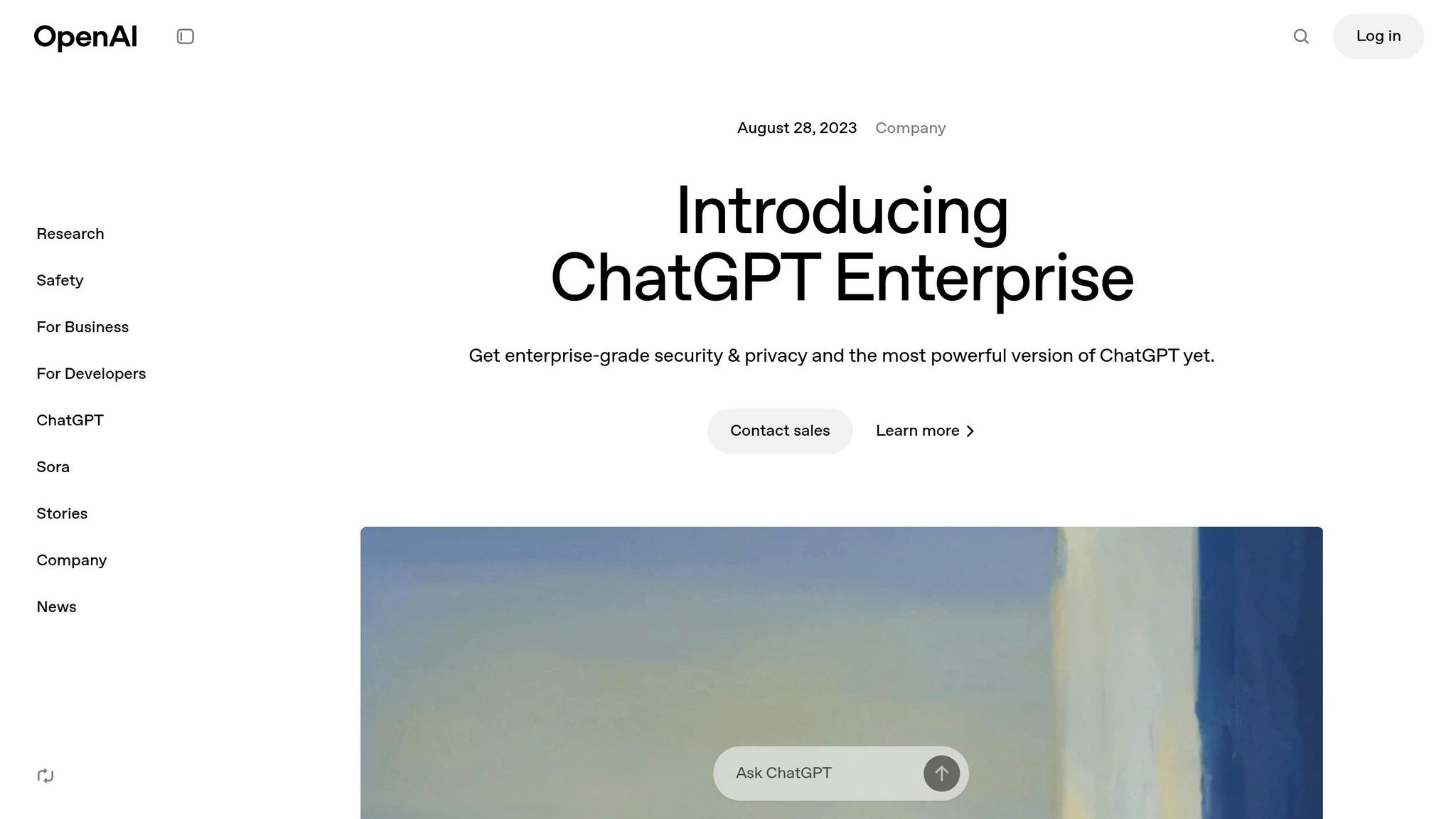
ChatGPT Enterprise offers businesses a secure, enterprise-level version of OpenAI's conversational AI model, tailored to meet the demands of organizations prioritizing data protection and administrative control. By focusing on security and compliance, the platform provides a reliable foundation for effective governance and smooth integration into business operations.
One of the key challenges in adopting AI for enterprise use is ensuring data privacy and security. ChatGPT Enterprise directly addresses this by guaranteeing that customer data is not used for model training. Its integrated administrative console supports IT and compliance needs with features like single sign-on (SSO), domain verification, detailed usage analytics, and data isolation options. For businesses dealing with sensitive information, the ability to keep data compartmentalized across departments or projects ensures an added layer of protection.
ChatGPT Enterprise is designed to integrate effortlessly into existing workflows while adhering to industry data protection standards. The platform’s administrative console offers usage insights, equipping IT teams with the tools to monitor AI interactions and refine deployment strategies. With its focus on safeguarding data and maintaining compliance, ChatGPT Enterprise is an excellent choice for organizations with rigorous data security requirements.
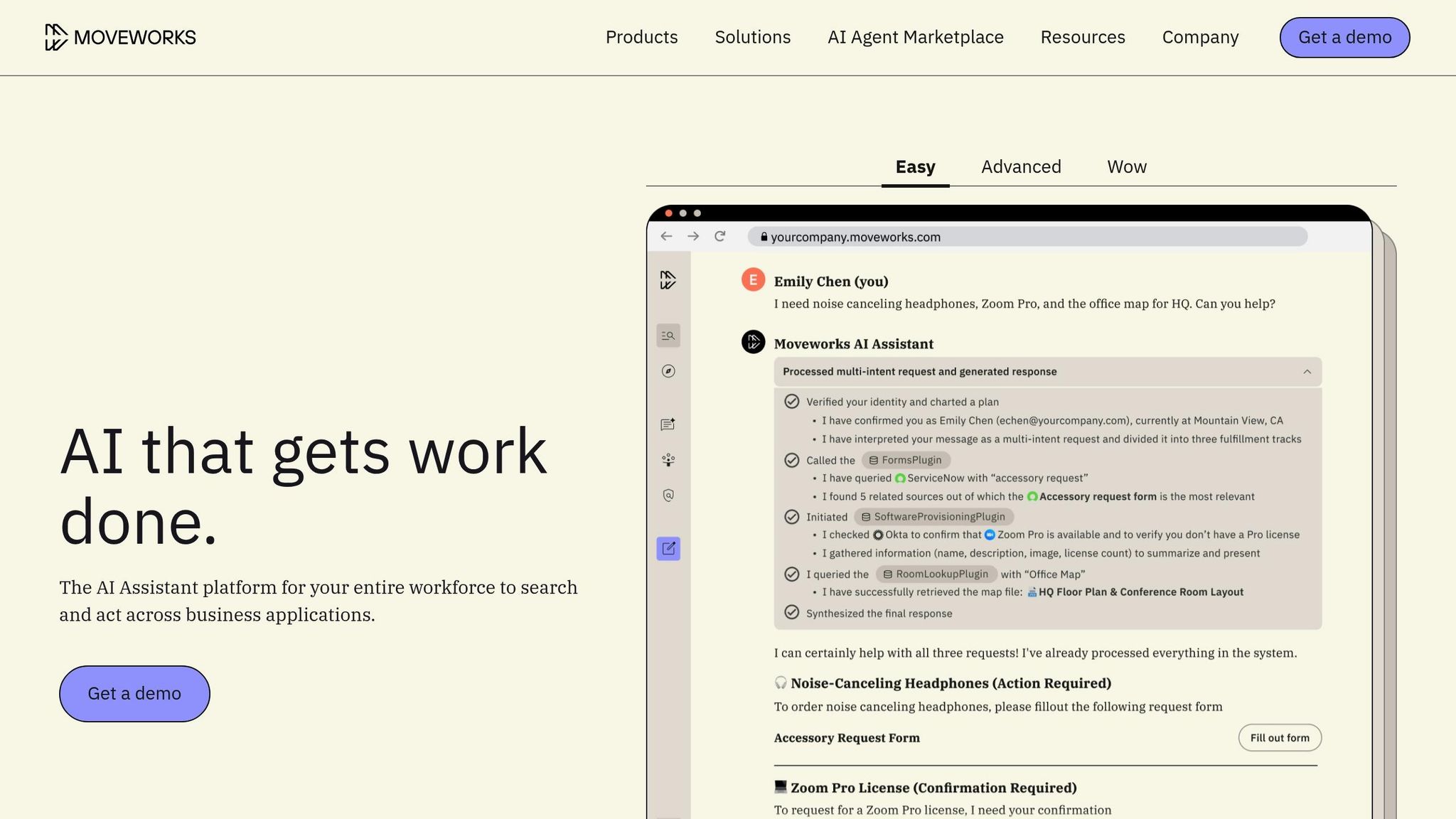
Building on the strengths of governance and integration seen in other platforms, Moveworks takes enterprise support to the next level with its advanced AI-driven solutions.
Moveworks is a highly regarded enterprise search platform that uses generative AI to bring together various business systems. This allows for seamless information retrieval and automation of tasks, making internal processes more efficient.
Moveworks shines in its ability to consolidate all business systems into one intelligent interface. It integrates seamlessly with key enterprise tools, including ITSM (IT Service Management), HRIS (Human Resources Information System), ERP (Enterprise Resource Planning), CRM (Customer Relationship Management), and identity management systems, through both native and custom integrations. Powered by its Reasoning Engine, the platform’s AI understands complex queries, maps out multi-step processes, and performs tasks across different applications. This unified setup simplifies workflows, reduces reliance on IT teams, and strengthens the concept of enterprise-wide AI workflows.

Glean is an AI-driven platform designed to revolutionize how businesses access and use their organizational knowledge. By connecting to over 100 applications and services, Glean quickly indexes intranets, cloud storage, and other data repositories to provide precise chatbot responses. This centralized system helps tackle the issue of information silos that often exist across departments.
Glean’s strength lies in its ability to seamlessly integrate with existing workflows and tools, ensuring businesses can maintain their current tech setups. Its real-time indexing keeps information up to date, making it easier to manage updates and policy reviews. Additionally, the platform includes an AI builder that allows companies to create custom automation workflows, such as generative AI applications, agents, and assistants, simplifying routine tasks.
By combining integration and automation, Glean delivers meaningful operational savings. Automating tasks like report generation and notifications reduces labor costs and improves efficiency. The platform’s advanced search capabilities cut down the time employees spend searching for information, driving productivity gains across the organization. Built to support rapid scaling, Glean enables process expansion without requiring a matching increase in administrative resources.
With a custom pricing model and a 4.5 out of 5-star rating from 122 Gartner reviews, Glean has also been recognized as a "Top Trending Product" for companies with revenues between $50 million and $1 billion. This recognition underscores its value for enterprises aiming to enhance efficiency while managing costs effectively.
Understanding the strengths and weaknesses of different platforms can guide smarter AI investment decisions. A striking statistic reveals that 65% of organizations have abandoned AI projects due to a lack of in-house expertise. This underscores the importance of assessing platforms with real-world implementation challenges in mind.
Here’s a quick comparison of the strengths and limitations of key platforms:
| Platform | Key Strengths | Primary Limitations |
|---|---|---|
| Prompts.ai | Access to 35+ AI models in one place; up to 98% cost savings; transparent FinOps controls; enterprise-grade governance | Newer to the market, requiring validation; steep learning curve for advanced orchestration features |
| ChatGPT Enterprise | Excellent natural language processing; user-friendly interface; strong API ecosystem | Lack of transparency in proprietary models; risk of vendor lock-in; expensive at scale |
| Moveworks | Pre-built IT automation workflows; proven success in enterprise environments; strong customer support | Limited customization options; high resource demands for advanced implementations |
Beyond individual platform features, broader challenges continue to impact AI adoption. For instance, opaque deep-learning models can erode trust and accountability, making it harder for enterprises to ensure transparency in decision-making. This highlights the need for platforms that prioritize integrated, transparent solutions.
Data governance and privacy remain universal concerns. Cloud-based AI often introduces privacy risks, especially in regulated sectors. Poor data quality can further compromise AI outputs, leading to potentially flawed and unfair business decisions.
The talent shortage in AI is another significant barrier. Recruiting and retaining skilled professionals is increasingly difficult and expensive. Platforms offering low-code or no-code tools can help address this gap, making AI development more accessible.
Cost structures also vary widely, often straining budgets. While AI adoption has reached 97%, only half of enterprise leaders report seeing widespread benefits, pointing to difficulties in scaling these solutions.
Integration with existing systems is another hurdle. Many enterprises struggle to connect AI platforms with their current workflows and legacy technologies. Seamless integration is critical for enterprise-grade tools, but achieving it remains a challenge.
The rapid pace of AI innovation also raises concerns about long-term compatibility. Rigid architectures can quickly become outdated, forcing costly system overhauls. Platforms designed with flexibility and modularity offer better protection against obsolescence.
Finally, ROI uncertainty complicates decision-making. Demonstrating clear financial value from AI investments remains a challenge, making it difficult to gain stakeholder support. Notably, 85% of executives report feeling decision stress, with three-quarters saying their daily decision-making workload has increased.
To navigate these obstacles, organizations can start small by launching pilot projects, empowering internal AI advocates, and incorporating human-in-the-loop orchestration for greater transparency.
Selecting the right generative AI platform hinges on your organization’s unique priorities and constraints. Each platform offers distinct strengths tailored to different enterprise needs.
For organizations focused on cost efficiency, Prompts.ai stands out with its pay-as-you-go TOKN credit system, offering up to 98% in cost savings by eliminating recurring subscription fees.
For enterprises aiming for quick deployment, ChatGPT Enterprise provides a user-friendly interface and a robust API ecosystem. However, it’s essential to evaluate long-term costs and potential vendor lock-in as usage scales.
Moveworks shines in delivering pre-built automation workflows. Companies such as Broadcom and GitHub have successfully used Moveworks to streamline IT support and enhance employee productivity by integrating seamlessly with their existing HRIS and ERP systems.
Integration remains a critical factor across all platforms. With 65% of enterprises already using AI in production, ensuring smooth workflow integration is key. Platforms with strong APIs and third-party compatibility not only enhance developer productivity but also foster collaboration across teams. These integration capabilities should align with budget and governance considerations to shape a cohesive AI strategy.
As Daniel Dultsin aptly puts it:
"The right enterprise AI platform doesn't just slot into a tech stack - it reshapes how decisions get made, how teams operate, and how value is delivered."
Budget transparency is another critical factor. Prompts.ai’s credit-based system offers clear cost predictability, which can be a deciding factor for many organizations.
For regulated industries, platforms with robust audit trails, stringent data privacy controls, and comprehensive compliance frameworks are essential to meet industry standards and maintain trust.
A practical starting point for any organization is to launch pilot projects in areas with high potential impact. For example, Klarna’s January 2024 deployment of generative AI to manage the workload of 700 support agents across 23 markets highlights the value of focusing on customer support, an area where 49% of AI projects are currently concentrated. These pilot initiatives can pave the way for scalable, long-term AI investments.
Ultimately, the best platform balances immediate operational needs with future scalability, ensuring your AI investment delivers measurable returns while maintaining the flexibility to evolve alongside emerging technologies.
Prompts.ai introduces a token-based pricing system powered by TOKN credits, its internal currency. This pay-as-you-go model allows businesses to purchase TOKN credits and allocate them toward AI tools and services as needed. The result? You only pay for what you use, helping to eliminate unnecessary expenses.
For enterprises, this approach translates into measurable savings, as costs scale directly with usage. Whether you're streamlining workflows or creating content, the token-based system offers clear pricing and cost control, making it an effective solution for businesses across the board.
When choosing an enterprise AI platform, certain factors should take center stage to ensure both security and compliance. A strong emphasis on data governance is non-negotiable - it’s vital to safeguard sensitive information and adhere to regulatory standards. Opt for platforms that highlight trust and transparency, providing clear insights into AI models and implementing measures to prevent misuse.
Another key consideration is scalability. The platform should be able to adapt as your business grows and integrate smoothly with your current workflows. By focusing on these priorities, your organization can operate securely, stay compliant, and maintain efficiency.
Integration matters because it ensures AI tools can smoothly connect with the systems, processes, and data your business already relies on. Without the right integration, companies risk running into problems like isolated data, inefficiencies, and limited functionality of their AI solutions.
When systems work together seamlessly, AI technologies can boost productivity, automate tasks, and grow alongside your business. This alignment ensures the AI tools meet your organization's unique requirements and deliver real, measurable outcomes.