Pay As You Go - AI Model Orchestration and Workflows Platform



AI tools are no longer reserved for big corporations. Today, businesses of all sizes can use affordable platforms to automate tasks, boost productivity, and save costs. This article highlights five standout platforms - Prompts.ai, Zapier, Make, n8n, and Lindy AI - offering features like workflow automation, app integrations, and secure governance. Here's what you need to know:
Each platform balances cost, performance, and security, catering to different business needs. Whether you're managing small tasks or complex processes, these tools can simplify workflows and reduce overhead.
| Platform | Starting Price | Key Features | Best For |
|---|---|---|---|
| Prompts.ai | $0/month | 35+ AI models, pay-as-you-go pricing | Teams needing AI model variety |
| Zapier | $0/month | 8,000+ app integrations | Simple app connections |
| Make | $9/month | Visual workflow builder | Visual, no-code automations |
| n8n | $20/month | Customizable workflows, coding options | Developers, technical teams |
| Lindy AI | $0/month | AI agents for multi-step tasks | Small businesses, lean operations |
These platforms provide flexible options for businesses to automate tasks, save time, and focus on impactful work. Choose based on your team’s specific needs and budget.
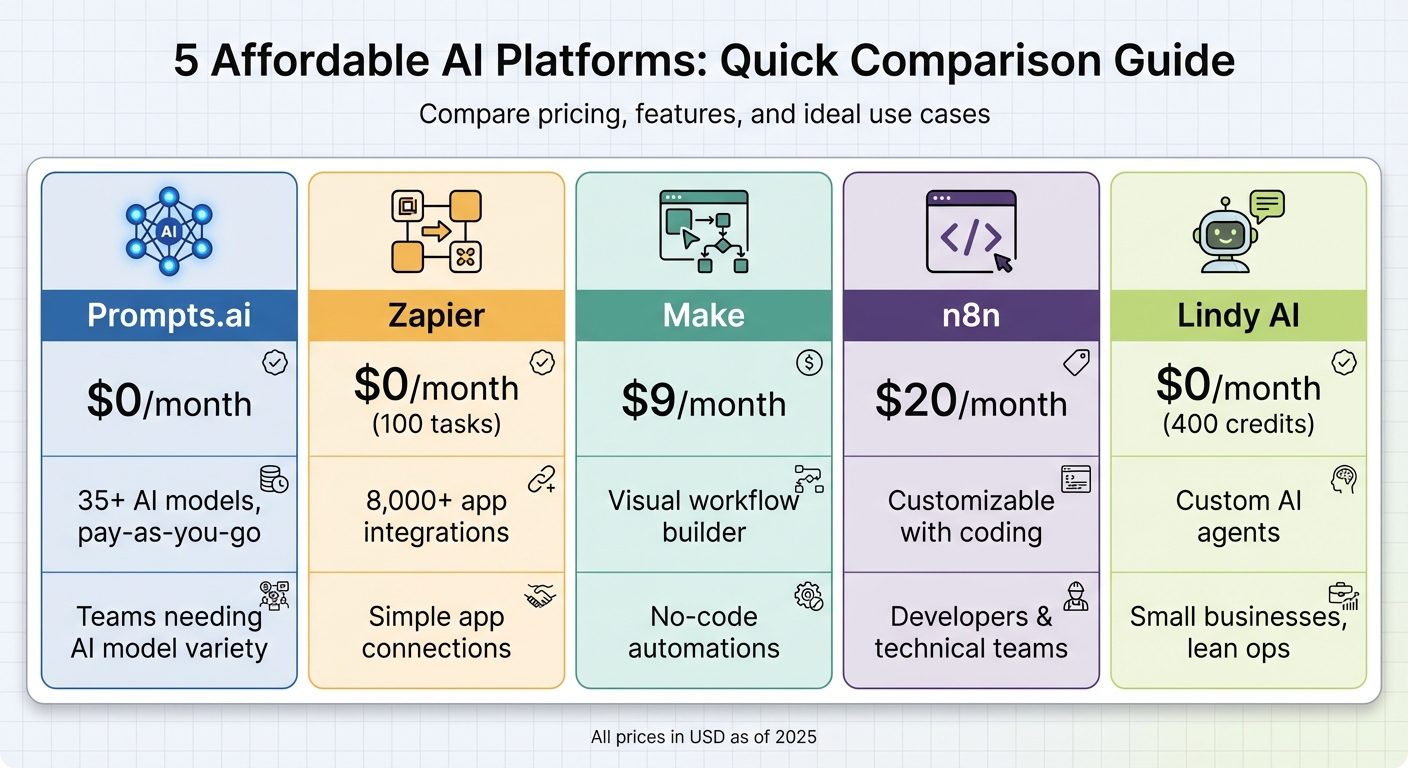
AI Platform Pricing and Features Comparison Chart 2025

Prompts.ai brings together over 35 leading language models, including GPT-5, Claude, LLaMA, Gemini, and Grok-4, within a single, secure dashboard. Instead of managing multiple subscriptions and logins, you can access these tools seamlessly from one platform. According to the company, this approach can slash AI-related costs by up to 98% and reduce expenses tied to tool sprawl by 95%.
Prompts.ai offers a straightforward pricing structure based on its TOKN credit system, making it scalable for various needs. The platform has three main tiers:
This flexible pricing model shifts fixed software costs into a pay-as-you-go format, ensuring users only pay for what they use as their needs grow.
Prompts.ai simplifies the creation of automated workflows across various departments like sales, marketing, and operations. Users can compare language models side-by-side to find the best fit for specific tasks, then link multiple AI steps into cohesive workflows. The platform integrates with popular tools such as Slack, Gmail, and Trello, embedding AI directly into existing systems for seamless functionality.
Steven Simmons, CEO & Founder, shares: "With Prompts.ai's LoRAs and workflows, he now completes renders and proposals in a single day - no more waiting, no more stressing over hardware upgrades."
Architect June Chow uses the platform's side-by-side model comparison to accelerate complex projects. Similarly, Frank Buscemi, CEO & CCO, highlights its impact on his team:
"Prompts.ai streamlines content creation, automates strategy workflows, and frees up his team to focus on big-picture thinking - while still keeping his creative edge sharp."
The platform claims to enhance productivity by up to tenfold, eliminating the inefficiencies of switching between tools and managing multiple accounts. With an average user rating of 4.8 out of 5, Prompts.ai helps businesses of all sizes deliver projects faster and reduce overhead.
For organizations where data security is critical, Prompts.ai adheres to SOC 2 Type 2, HIPAA, and GDPR standards. The platform began its SOC 2 Type 2 audit on June 19, 2025, and ensures continuous monitoring through Vanta. This system provides full visibility into AI interactions, tracking every prompt, model choice, and team action for centralized governance.
The Trust Center at https://trust.prompts.ai/ offers real-time updates on security measures, policies, and compliance progress. These features are particularly valuable for U.S. companies working with sensitive data or operating in regulated industries, solidifying Prompts.ai as a reliable choice for secure AI workflows.
Zapier connects over 8,000 apps through automated workflows, known as "Zaps", positioning itself as a top automation platform for businesses in the United States. With a 4.5 out of 5 rating on G2 from 1,397+ reviews and 4.7 out of 5 on Capterra from over 3,023 reviews, its user-friendly design and vast integration options stand out.
Zapier follows a task-based pricing model, which can become expensive as workflows grow. The Free plan includes 100 tasks per month, unlimited Zaps, and basic two-step workflows. For more advanced needs, the Professional plan costs $19.99/month (annual billing) or $29.99/month (monthly billing) and provides 750 tasks per month, multi-step Zaps, and webhooks. The Team plan, at $103.50/month, supports up to 25 users with shared Zaps and SAML SSO. For larger organizations, Enterprise plans offer custom pricing, unlimited users, and enhanced administrative features. While the entry-level options are affordable, businesses with high-volume workflows may face unpredictable costs due to the task-based billing system.
Zapier empowers users to automate repetitive tasks with multi-step workflows that trigger specific actions, such as sending notifications or updating databases. Its no-code, trigger-based interface makes it easy to set up Zaps that activate when certain events occur, streamlining processes and saving time.
Zapier goes beyond automation by prioritizing security and compliance. The platform holds SOC 2 Type II and SOC 3 certifications, demonstrating its commitment to stringent security practices. It complies with CCPA and GDPR regulations, encrypts data in transit using TLS 1.2, and secures data at rest with AES-256 encryption. All data is hosted on AWS servers within the United States. Connor Sheffield, Head of Marketing Ops and Automation at Zonos, highlights this focus:
"Customers trust us to keep their data secure and safe."
For enterprise users, Zapier offers advanced features like role-based permissions, detailed audit logs, granular access controls, and SSO via SAML. These tools enable organizations to manage team access to specific integrations, restrict certain app connections, and implement custom data retention policies. This ensures compliance across automated workflows while maintaining data security.
Make simplifies workflow automation with its intuitive drag-and-drop builder, connecting over 1,500 apps like Google Sheets, Salesforce, Slack, and Mailchimp to trigger smooth, automated actions. The platform also provides transparent pricing options that cater to businesses of all sizes.
Make’s pricing model is based on operations, starting with a Free plan that includes 1,000 operations per month - perfect for testing workflows. The Core plan, priced at $9/month (billed annually), offers 10,000 operations, while the Pro plan provides 20,000 operations for $16/month. For larger teams or businesses with higher needs, the Teams and Enterprise plans offer custom pricing tailored to high-volume operations. This straightforward pricing structure helps U.S. companies manage expenses as they grow.
Make empowers users to automate even the most complex workflows with ease. Its visual interface allows for designing processes using multi-branch logic and advanced data transformation tools. Features like routers, iterators, and detailed data mapping enable businesses to build sophisticated workflows without requiring developer expertise. Real-time processing and robust error-handling capabilities ensure seamless conditional routing between connected apps.
By automating repetitive tasks, Make helps teams reclaim time for more strategic work. For instance, one team used Make to overhaul their content distribution process - automating tasks like pulling blog data, drafting social media posts, updating the content calendar, and notifying the marketing team. This saved them around 3–4 hours of manual work each week, giving them more time to focus on strategic, high-impact initiatives.
n8n is an automation platform designed to give technical teams complete control over their workflows. It combines flexibility with cost-effective solutions, making it a smart choice for developers and IT teams. What sets n8n apart is its free self-hosted option, enabling teams managing their own infrastructure to save on costs while maintaining full autonomy over their tools. Below, we’ll break down its pricing model and automation features, showing how it supports both technical needs and budget-conscious users.
n8n’s pricing is simple and transparent. Cloud plans start at $20/month (billed annually) for up to 2,500 workflow executions with unlimited steps. If you prefer monthly billing, the Starter plan is available for $24/month with the same execution limit. For teams with higher demands, the Pro plan offers 10,000 executions at $60/month, while Enterprise customers can request custom pricing tailored to their needs. Unlike tools that charge per step, n8n charges per workflow execution, ensuring that costs remain predictable even for complex automations.
n8n offers a versatile platform for building automations. Teams can use its visual drag-and-drop interface for quick setups or dive deeper with custom JavaScript and Python code. The platform supports integrations with npm and Python libraries, cURL requests, and even allows merging workflow branches for advanced logic. This combination of pre-built nodes and coding flexibility lets users balance speed and customization. Additionally, its source-available licensing provides transparency that proprietary systems often lack.
By automating repetitive tasks, n8n helps teams reclaim valuable time. For instance, one user set up a daily automation to back up an internal SQL database to a Google Sheet at 6:00 AM, allowing team members to focus on more impactful work. With a 4.8 out of 5 star rating on G2 (based on 131+ reviews) and a 4.6 rating on Capterra, users frequently commend n8n for its reliability and adaptability.
Lindy AI takes a fresh approach to automation, allowing users to create custom AI agents, known as "Lindies", for handling complex workflows - no technical expertise required. Designed for businesses aiming to streamline repetitive tasks while maintaining a lean operation, Lindy AI offers transparent, usage-based pricing, along with a free tier to help teams get started. It’s an appealing option for budget-conscious businesses across the U.S., bringing advanced automation within reach.
Lindy AI keeps its pricing simple and scalable to suit different business needs. The free plan includes 400 credits per month, providing a no-cost way to explore the platform. For growing teams, the Pro plan is priced at $49.99/month and offers 5,000 credits. For companies requiring advanced tools and priority support, the Business and Enterprise tiers are available, with pricing provided upon request. Additionally, voice calling features are available at $0.19 per minute for GPT-4o agents, offering flexibility for teams managing phone-based workflows.
Lindy AI makes automation straightforward with prebuilt templates and customizable agents. For instance, in July 2025, a user utilized the platform’s Lead Generator template to create a 10-person lead list in less than 20 minutes - an effort that would have taken hours of manual research. The automation seamlessly generated a Google Sheet with detailed lead information, showcasing how Lindy AI can save significant time on tedious tasks.
By automating tasks like lead generation, data entry, and workflow coordination, Lindy AI helps small and mid-sized businesses focus on higher-value activities without the need to grow their workforce. Its combination of affordable pricing and practical automation tools makes it a smart choice for U.S. teams looking to improve efficiency and streamline operations without compromising on quality.
Selecting the right AI platform depends on factors like pricing, automation features, and how much control you need over your workflows. Each of the five platforms offers its own approach to solving automation challenges. Here's a closer look at how they compare in terms of pricing, automation capabilities, and governance.
Prompts.ai offers a standout pricing model with access to 35+ AI models through a pay-as-you-go TOKN credit system, avoiding recurring subscription fees. Personal plans start at $0/month for exploration, $29/month for individual creators, and business plans begin at $99/month, all with enterprise-grade governance included. Lindy AI uses a credit-based system, providing 400 free credits monthly and scaling to $49.99/month for 5,000 credits in its Pro plan. n8n adopts an execution-based pricing structure, starting at $20/month for 2,500 executions on the Starter plan, with the Pro tier at $60/month offering enhanced administrative tools.
For automation capabilities, Prompts.ai provides real-time FinOps cost controls, side-by-side comparisons of model performance, and pre-designed prompt workflows ready for immediate use by teams. Lindy AI focuses on building custom AI agents capable of handling complex, multi-step tasks like lead generation, CRM updates, and meeting summaries - all without requiring coding skills. Both Zapier and Make specialize in connecting apps via visual automation builders, while n8n combines a drag-and-drop node system with the flexibility to integrate custom functions.
Governance is a key concern for U.S. businesses, especially those with strict compliance needs. On the topic of governance and compliance, Prompts.ai delivers enterprise-grade audit trails, robust data security, and team-wide visibility for all AI interactions. These features are particularly valuable for organizations managing sensitive data or operating under regulatory scrutiny. Lindy AI and n8n also offer Business and Enterprise plans with advanced administrative controls and priority support, though the specifics of governance features differ depending on the plan. This variety ensures that businesses with high security demands have several options to choose from.
In terms of performance and efficiency, Prompts.ai is designed to cut AI software costs by up to 98% while boosting team productivity by as much as 10× through centralized model access and streamlined workflows. Additionally, n8n simplifies routine tasks, such as automating daily SQL backups to Google Sheets, saving teams significant time. These capabilities demonstrate each platform’s ability to enhance workflows while maintaining high performance standards.
Choosing the right AI platform is all about balancing cost and performance while addressing your team’s specific needs. Each of the five platforms discussed offers a unique way to tackle workflow challenges. For example, Prompts.ai provides unified access to over 35 models with flexible pay-as-you-go pricing, while Lindy AI focuses on building custom agents. Meanwhile, tools like Zapier, Make, and n8n excel in visual automation. The challenge lies in aligning these capabilities with your goals to find the best fit.
When comparing options, focus on tools that deliver clear and measurable ROI and integrate smoothly into your existing workflows. Experts recommend AI tools that save at least twice their monthly cost in time or produce noticeable business value. A good practice is to set a 30-day checkpoint after subscribing. If the tool hasn’t delivered time savings or quality improvements worth at least double the subscription fee, it might be worth reevaluating.
With 56% of small businesses already leveraging AI for daily operations and the global AI market expected to surpass $300 billion by 2027, making the right choice now can set the stage for long-term growth. Be sure to account for the total cost - not just the subscription fee, but also the time spent on training and adapting workflows.
To choose the right AI platform for your business, begin by pinpointing your specific needs - whether it's content creation, streamlining workflows, or analyzing data. Focus on platforms that align with these goals and offer features designed for your priorities. Make sure to assess how easily the platform integrates with your current systems, its scalability, and how simple it is for your team to use.
Budget is another critical factor. Compare pricing options to ensure the platform delivers strong performance without straining your finances. Additionally, prioritize solutions that provide strong data security and compliance measures to safeguard your business information. By carefully matching your needs with a platform's capabilities, you can select a tool that enhances your operations efficiently.
Pay-as-you-go pricing works by charging you based on what you actually use - whether it’s the number of tokens processed or the minutes of audio analyzed. This approach gives you flexibility, but your costs can vary depending on how much you use the platform.
In contrast, credit-based pricing gives you a fixed number of credits over a specific time frame, often with extra features included. This setup helps keep expenses steady and easier to plan for, particularly if your usage tends to stay consistent.
AI platforms offer small businesses a way to streamline operations, save money, and reclaim valuable time. By automating repetitive tasks and enhancing workflows, these tools allow business owners to focus on what truly matters. For example, AI-powered chatbots can handle customer inquiries around the clock, eliminating the need for large support teams and lowering operational costs.
Beyond customer service, automation platforms can connect various apps, analyze data, and oversee processes, giving employees the freedom to tackle more critical responsibilities. Embracing AI not only increases productivity but also helps reduce labor expenses and enables small businesses to scale efficiently - all without compromising on quality.