Pay As You Go - AI Model Orchestration and Workflows Platform


AI workflow tools simplify complex processes, save time, and reduce costs. With options like Prompts.ai, Zapier AI, and Make, you can automate tasks, integrate apps, and manage workflows efficiently. Here's a quick breakdown:
| Tool | Key Features | Starting Price | Key Benefit |
|---|---|---|---|
| Prompts.ai | 35+ AI models, cost tracking | $29/month | Cost-effective for high-volume AI tasks |
| Zapier AI | 8,000+ app integrations, AI Agents | $19.99/month | Simplifies workflows for non-technical teams |
| Make | Visual builder, 3,000+ integrations | $9/month | Affordable for detailed automation |
These tools cater to different needs, from advanced AI orchestration to simple app connections. Choose based on your team’s goals, technical expertise, and budget.

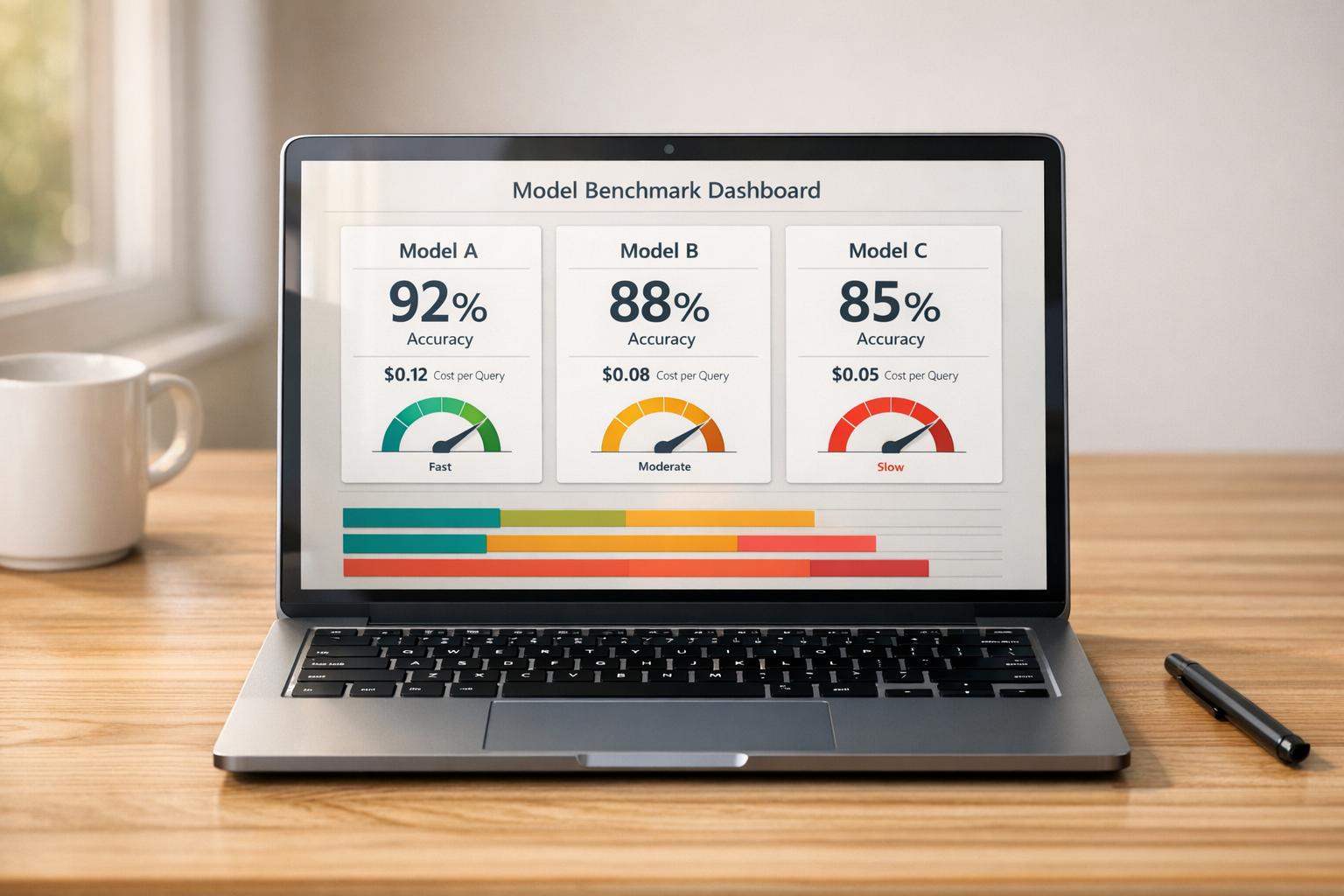
AI Workflow Tools Comparison: Prompts.ai vs Zapier AI vs Make - Features, Pricing & Benefits
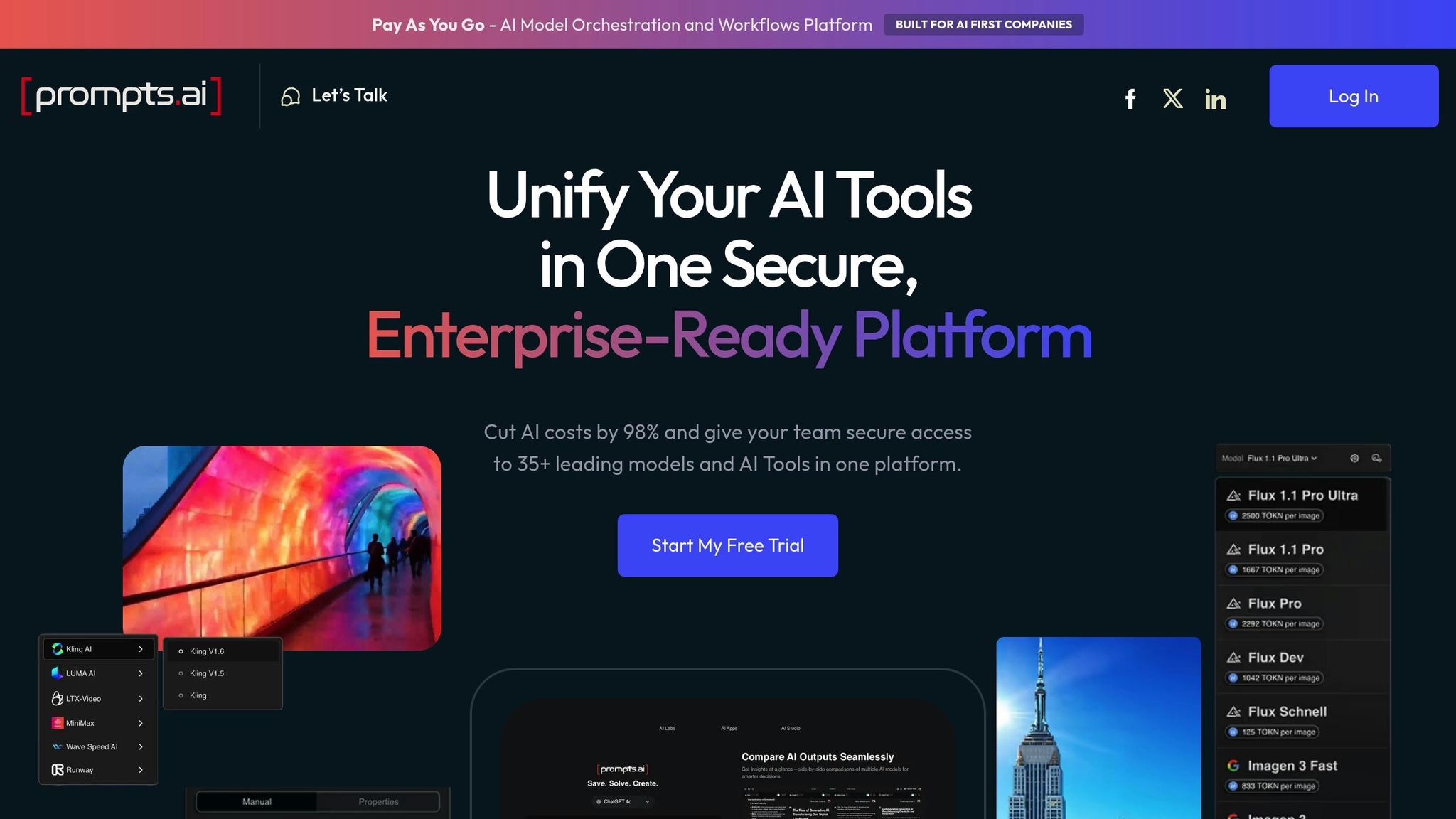
Prompts.ai is an enterprise-grade AI orchestration platform that brings together over 35 top-performing large language models - including GPT-5, Claude, LLaMA, and Gemini - into one secure and unified interface. By consolidating these models, businesses can slash AI software costs by up to 98%, all while maintaining strict governance and compliance standards.
One of the platform’s standout features is its side-by-side model comparison capability. This allows teams to test prompts across multiple LLMs simultaneously, providing instant comparative insights before moving to production. By removing the guesswork, teams can confidently select the most cost-efficient model tailored to each task. The platform doesn’t stop at text-generation models; it also supports specialized tools like Flux Pro for image generation and Kling for video creation. This versatility eliminates the need for multiple vendor relationships, streamlining AI workflows and enabling seamless automation.
Prompts.ai simplifies workflow creation with its natural language-driven approach. Users can design AI automations by simply describing their needs, making it accessible even for those without technical expertise. For more advanced users, engineers can leverage TypeScript and Python SDKs for deeper customization. The visual canvas fosters collaboration, allowing product managers, subject matter experts, and developers to work together through commenting and version control.
The platform includes AI-native building blocks such as semantic routing for intent-based decisions, tool calling, and retrieval-augmented generation (RAG). Human-in-the-loop approval steps are seamlessly integrated, ensuring oversight for sensitive tasks. Additionally, the platform offers complete observability, with features like node traces, searchable logs, and real-time tracking of costs and latency - key for scaling projects from pilot phases to full production.
Prompts.ai goes beyond integrations and automation by offering robust scalability and top-tier security. Deployment options include cloud, Virtual Private Cloud (VPC), and on-premise setups, ensuring sensitive data remains within your control. Compliance is bolstered through features like Role-Based Access Control (RBAC), Single Sign-On (SSO), and detailed audit logs. Separate environments for development, staging, and production allow for safe testing with rollback options, minimizing risks. The platform has earned high user ratings, with 5/5 on G2 (11 reviews) and 4.8/5 on Capterra (8 reviews), with users highlighting its ability to connect technical and non-technical teams effectively.
Prompts.ai offers a $0 pay-as-you-go personal plan, with paid options starting at $29/month. Business plans range from $99 to $129 per member monthly. The platform’s TOKN credit system ensures you only pay for what you use, making it a practical solution for teams. This approach addresses a major challenge, as 46% of product teams cite poor tool integration as a barrier to AI adoption. High user ratings further emphasize the platform’s ability to balance technical depth with ease of use, making it a valuable tool for teams of all skill levels.
Zapier AI is an automation powerhouse, seamlessly connecting more than 8,000 apps with advanced AI functionality. It supports leading models like GPT (OpenAI), Claude (Anthropic), Gemini (Google), and Azure OpenAI. Users can either bring their own API keys or take advantage of the built-in "AI by Zapier" tool, which includes models such as GPT-4o mini and Gemini 2.0 Flash. This integration lays the groundwork for how Zapier AI delivers measurable impact across industries.
Zapier AI introduces AI Agents, autonomous tools that act like digital teammates. These agents can search the web, make decisions based on natural language commands, and execute complex, multi-step tasks across thousands of apps. Spencer Siviglia, Director of Operations at Toyota of Orlando, shared:
"With Agents, I'm getting insights I didn't even know to look for. They flag when something's off, answer questions, and save me hours every week."
A compelling example comes from Vendasta, where Marketing Operations Specialist Jacob Sirrs developed an AI-driven lead enrichment system in April 2025. By automating data collection and analysis, Vendasta reclaimed 282 working days annually and unlocked $1 million in potential revenue. Sirrs explained:
"Because of automation, we've seen about a $1 million increase in potential revenue. Our reps can now focus purely on closing deals - not admin."
Key tools like Canvas for visual workflow mapping, Tables for structured data storage, and human-in-the-loop approval steps enhance the platform's capabilities. Additionally, the Model Context Protocol (MCP) connector enables users to trigger over 30,000 Zapier actions directly from AI interfaces like ChatGPT or Claude, empowering AI to seamlessly interact with your software ecosystem.
Beyond its advanced workflows, Zapier AI emphasizes enterprise-level security. The platform adheres to strict compliance standards and offers features like SAML-based SSO, SCIM provisioning, and detailed audit logs. With a 99.99% uptime guarantee under its Enterprise SLA, Zapier ensures reliability. In 2025, Marcus Saito, part of a three-person IT team at Remote.com, implemented an AI-powered helpdesk using Zapier. This system resolved 28% of 1,100 monthly support tickets, saving the company $500,000 in hiring costs. Saito remarked:
"Zapier makes our team of three feel like a team of ten."
Zapier AI offers flexible pricing to meet various business needs. The $0 free plan supports basic two-step workflows, while the Professional plan starts at $19.99/month (billed annually). Team plans begin at $69/month, and Enterprise pricing is tailored to specific requirements. AI Agents are included for free with 400 monthly activities or can be upgraded to $33.33/month for 1,500 activities. By late 2025, Zapier had processed over 350 million AI tasks, with users automating more than 23 million tasks every month. This efficiency translates into significant cost savings and streamlined operations, making it a valuable tool for businesses aiming to optimize their workflows.
Make offers a visually intuitive way to manage workflow automation through its drag-and-drop canvas, which provides real-time insights into data flow. This approach helps users quickly identify bottlenecks and better understand complex automation setups. With over 3,000 app integrations and 400+ AI connections, the platform supports more than 350,000 customers worldwide and boasts an impressive 4.8/5 rating on Capterra from 404 reviews.
Make integrates seamlessly with leading AI models, including OpenAI (GPT-4, DALL-E 3, Whisper), Anthropic Claude, Google Gemini, Perplexity AI, DeepSeek AI, Mistral AI, and Hugging Face. The platform also features Maia, an AI assistant designed to simplify building and troubleshooting workflows using natural language commands. Maia supports dynamic, cross-workflow AI agents, making automation even more accessible. Additionally, the Model Context Protocol (MCP) enables users to access scenarios from any AI interface without the need to handle server management. These integrations create a versatile and efficient automation environment.
The platform's visual canvas is equipped with advanced tools like routers, filters, iterators, and aggregators, allowing for precise data handling. For example, in December 2024, GoJob reported a 50% increase in annual net revenue, while FranklinCovey achieved notable cost savings and reduced staff hours by automating internal processes. Cayden Phipps, COO at Shop Accelerator Martech, shared:
"Make drives unprecedented efficiency within our business in ways we never imagined. It's having an extra employee (or 10) for a fraction of the cost."
Make also offers the Make Grid feature, which automatically generates a live map of your automation landscape. This helps teams manage intricate systems as they grow. However, the platform does have a steeper learning curve compared to simpler tools, often requiring users to understand API structures or complete Make Academy training for custom workflows.
As a cloud-based platform, Make scales automatically and delivers approximately 99.9% uptime. Data security is a priority, with TLS 1.2/1.3 encryption for data in transit and AES-256 encryption for data stored on AWS volumes. Enterprise-grade security features include Single Sign-On (SSO), Two-Factor Authentication (2FA), and Role-Based Access Control (RBAC). Additionally, Make complies with GDPR and SOC 2 Type II standards, ensuring European customer data remains within EU-based AWS infrastructure.
Make operates on a credit-based pricing model, where most operations use one credit, though AI-related tasks may consume multiple credits. The free plan includes 1,000 credits per month and allows for 2 active scenarios, while paid plans start at $9/month (Core), $16/month (Pro with priority execution), and $29/month (Teams). Enterprise pricing is tailored to specific needs. Students with a valid .edu email can enjoy a 30% discount.
However, users should be mindful that every workflow step - whether internal logic, polling triggers, or failed runs - counts toward the credit budget, potentially increasing costs if not carefully managed. Despite this, the platform’s efficiency and scalability make it a top choice for automation, as reflected in its high user ratings.
Every tool comes with its own set of strengths and limitations. By understanding these nuances, you can select the platform that aligns with your goals and technical expertise. Here's a closer look at the key benefits and challenges of each option.
Prompts.ai shines in AI orchestration, offering access to over 35 top-tier large language models, native tools for side-by-side performance comparisons, and detailed tracking of interactions, including costs, latency, and traces. Its integrated FinOps controls can cut AI expenses by up to 98% through a pay-as-you-go structure, making it a great choice for high-volume tasks. However, its prompt-based agent-building method might feel unfamiliar to teams accustomed to drag-and-drop interfaces. Additionally, frequent updates may require teams to adjust workflows periodically.
Zapier AI is known for its extensive integration library of over 8,000 apps and an intuitive interface that makes it easy for non-technical teams to get started. A robust collection of community templates further simplifies the setup of common workflows. That said, it lacks native tools for model versioning and evaluations, which can make tracking the impact of prompt adjustments difficult. Costs can rise significantly with higher usage, and setting up API keys for individual workflows may pose challenges for enterprise-level security protocols.
Make offers advanced features like multi-branch logic and data transformation, along with a visual debugger that simplifies managing intricate automation flows. Its credit-based pricing starts at just $9 per month, making it budget-friendly for high-throughput operations. However, its interface can feel overwhelming, leading to a steep learning curve for new users. Additionally, the absence of integrated AI testing and versioning tools limits its ability to fine-tune and optimize prompt performance systematically.
The table below provides a quick comparison of these tools:
| Tool | Pros | Cons |
|---|---|---|
| Prompts.ai | Access to 35+ LLMs; side-by-side testing; detailed tracking; up to 98% cost savings | Prompt-based interface may be unfamiliar; frequent updates may disrupt workflows |
| Zapier AI | 8,000+ app integrations; user-friendly for non-technical teams; community templates | Lacks model versioning; costs increase with volume; configuring API keys is complex |
| Make | Advanced logic tools; visual debugger; affordable pricing ($9/month starting) | Steep learning curve; cluttered interface; lacks AI testing and versioning features |
Selecting the right AI workflow tool boils down to your team's priorities. For those managing high-volume AI operations and requiring detailed oversight of model performance and expenses, Prompts.ai stands out. With its extensive access to large language models (LLMs) and real-time cost tracking, it can reduce expenses by up to 98%. As discussed, Prompts.ai excels in orchestrating complex workflows and optimizing costs, making it ideal for teams ready to embrace a more advanced orchestration platform.
On the other hand, Zapier AI offers simplicity and accessibility. With over 8,000 integrations and an intuitive interface, it's a great choice for teams prioritizing ease of use. However, scaling with Zapier AI can lead to higher costs, and it lacks built-in tools for evaluating AI performance.
For a balance between complexity and affordability, Make provides a strong alternative. Its visual builder simplifies complex automations while keeping costs low. That said, its steeper learning curve and absence of built-in AI evaluation tools may require more technical expertise.
Ultimately, the decision comes down to your team’s specific needs, technical capabilities, and budget. If your focus is on AI-driven operations, platforms like Prompts.ai, designed for large language model orchestration, might be the best fit. For teams looking to enhance existing business processes, more general automation tools like Zapier AI or Make could be the right choice.
Prompts.ai sets itself apart by focusing on cost savings and advanced model management. With unified access to over 35 large language models, including GPT-4 and Claude, it enables businesses to reduce AI-related costs by as much as 98%. This makes it an excellent option for companies seeking to expand their AI capabilities without breaking the budget.
While many tools concentrate on app integration or simple automation, Prompts.ai goes further with features like multi-model orchestration, cost tracking, and compliance management. These tools not only simplify workflows but also deliver measurable savings, offering businesses a resource-efficient way to scale operations while maintaining performance and flexibility.
Businesses, regardless of their size, can tap into the advantages of Zapier AI's automation tools, especially those aiming to boost efficiency and simplify workflows. From small and medium-sized businesses (SMBs) to large enterprises, these tools help cut down on manual tasks, improve accuracy, and drive productivity across various departments, including sales, marketing, customer support, IT, and operations.
Zapier AI shines when it comes to making automation user-friendly, even for those without technical expertise. Teams can easily design and manage workflows without needing to write a single line of code. For organizations looking to expand AI-driven processes across multiple functions and applications, Zapier AI offers the perfect solution for managing complex workflows effortlessly. By integrating these tools, businesses can save valuable time, spark creativity, and create a more nimble, AI-enhanced workplace.
Users frequently encounter hurdles when leveraging Make for workflow automation, particularly when it comes to juggling numerous integrations, keeping costs under control, and maintaining governance. While Make’s flexibility and API-driven customization offer robust capabilities, these strengths can sometimes result in tool sprawl, making it harder to maintain clear oversight as workflows become increasingly intricate.
Efficiently scaling workflows presents another challenge, especially without well-defined governance frameworks. This is a common concern for organizations striving to optimize AI-driven processes while balancing cost efficiency and adhering to both internal policies and external compliance standards.