Pay As You Go - AI Model Orchestration and Workflows Platform



AI workflow platforms are reshaping enterprise operations, but scaling AI effectively remains a challenge. With 95% of generative AI pilots failing to reach production, organizations need tools that simplify orchestration, reduce costs, and ensure governance. Platforms like Prompts.ai consolidate over 35 advanced models (e.g., GPT-5, Claude, Gemini) into one system, offering cost control, security, and scalability. Here's what you should know:
Choosing the right platform depends on your goals - whether it's cost savings, compliance, or handling complex tasks. Start by identifying bottlenecks like repetitive tasks or scaling needs.
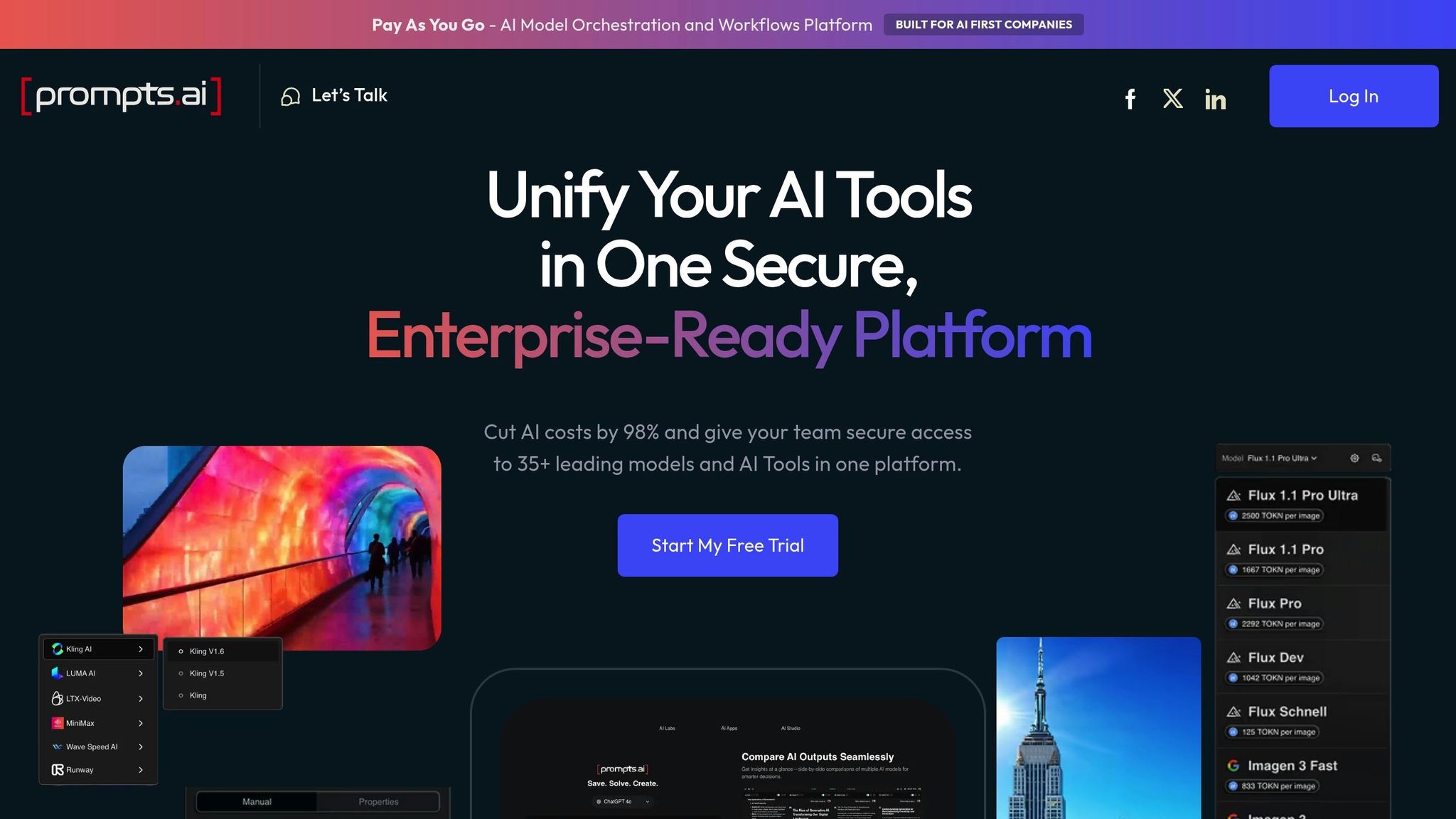
Prompts.ai brings together over 35 leading large language models - including GPT-5, Claude, LLaMA, Gemini, Grok-4, and Flux Pro - into a single, secure platform. By consolidating these tools, it simplifies AI interactions while offering transparency and control. Founded by Emmy Award-winning Creative Director Steven P. Simmons, Prompts.ai eliminates the inefficiencies of disconnected systems, giving organizations a unified view of their AI operations. This integration lays the groundwork for advanced model management, as outlined below.
Prompts.ai leverages Automated Prompt Engineering (APE) to replace manual prompt crafting with intelligent, adaptive algorithms. These algorithms dynamically generate and refine prompts by analyzing semantic similarities and applying reinforcement learning based on output feedback. This ensures optimal performance for large language models across a variety of tasks. By automating this process, teams can scale AI workflows effectively and focus on delivering results.
The platform offers a powerful way to reduce AI software costs by up to 98%. Its FinOps layer tracks token usage and optimizes spending, allowing organizations to pay only for what they use through a pay-as-you-go TOKN credit system. This eliminates the burden of recurring subscription fees. Additionally, real-time cost controls and side-by-side comparisons of model performance empower teams to choose the most cost-effective solutions for their specific needs.
Prompts.ai prioritizes governance and security with continuous monitoring and risk assessment throughout the AI lifecycle. Features like automated sensitive-data redaction, real-time data sanitization, and robust content moderation ensure that outputs align with organizational policies. Comprehensive audit trails further support compliance, addressing the challenges many organizations face when transitioning AI pilots into full-scale production.
Prompts.ai supports a global network of prompt engineers through its Prompt Engineer Certification program and expert-designed "Time Savers", which encapsulate best practices. The platform also offers tailored onboarding and enterprise training to help teams transform experimental approaches into consistent, compliant workflows. By making expert-built prompt workflows accessible, Prompts.ai enables organizations of all sizes - from Fortune 500 companies to research labs - to achieve faster, more reliable outcomes through collaboration.
Prompts.ai simplifies AI operations with its unified approach, but other platforms focus on specific aspects like governance and cost management. The AI workflow ecosystem is diverse, with each platform offering unique features tailored to different organizational needs. This diversity is especially important when evaluating governance and security measures.
The way platforms handle governance and security can vary widely. For example, Reco identifies AI features embedded in SaaS tools, mapping data flows, permissions, and agents to minimize shadow AI risks. This approach acknowledges that many organizations now interact with AI through their existing software subscriptions instead of standalone tools. On the other hand, Credo AI and ModelOp Center focus on creating registries for AI systems, producing audit-ready documentation like model cards and impact assessments to meet compliance requirements.
Other platforms emphasize monitoring and risk detection. Arthur AI and Fiddler AI specialize in tracking model performance, identifying bias, and detecting anomalies early. Meanwhile, Snyk integrates security into developer workflows through tools like IDEs and CLIs, ensuring secure practices from the ground up. High-profile breaches, such as those at Equifax and Marriott, highlight the importance of robust security measures.
"Governance works best when it evolves alongside AI adoption, embedding compliance into operations, not slowing them down." - Gal Nakash, Cofounder & CPO, Reco
Pricing models are another key differentiator among platforms. Many platforms offer either usage-based or subscription pricing structures. For instance, IBM watsonx.governance charges $0.60 per resource unit, while Arthur AI includes a free tier alongside premium and enterprise plans. Reco uses a quote-based model that adjusts based on the number of users and integrations. These pricing strategies aim to balance costs with the level of security and governance features provided.
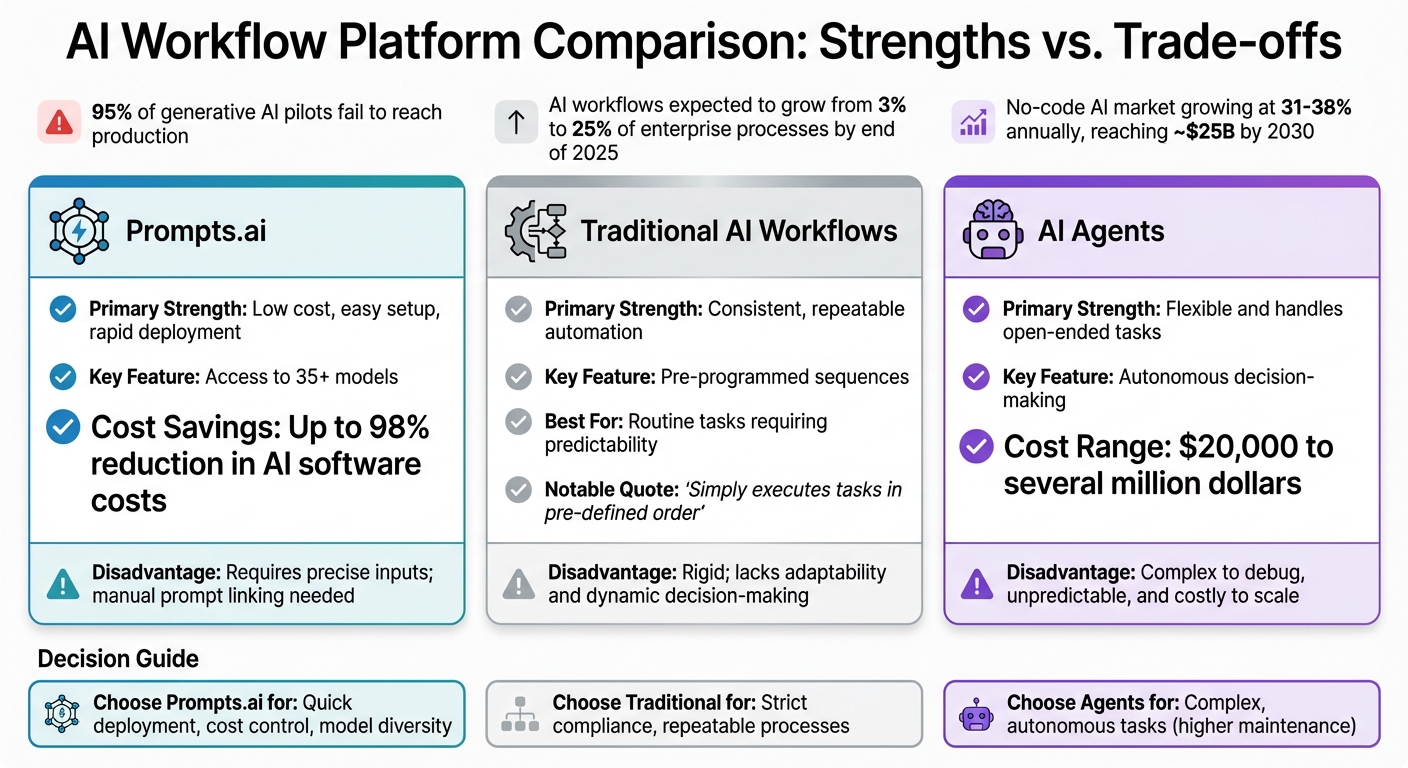
AI Workflow Platform Comparison: Prompts.ai vs Traditional Workflows vs AI Agents
Each AI workflow approach comes with its own set of trade-offs, influencing how teams operate and achieve their goals. Prompts.ai stands out for its low-cost, easy setup, and quick deployment, making it a great fit for organizations needing fast access to over 35 leading models. Its unified interface helps reduce tool sprawl, streamlining operations. However, its effectiveness depends heavily on clear and precise input. Ambiguous instructions can lead to inconsistent outputs and necessitate manual linking between prompts. This highlights the trade-off between speed and precision that comes with different AI workflow strategies.
On the other hand, traditional workflow platforms offer consistent and repeatable automation by following pre-programmed sequences. These are excellent for routine tasks where predictability is key. However, this rigidity becomes a limitation when unexpected inputs arise. As Confluent explains, "The AI doesn't make decisions or iterate; it simply executes tasks in a pre-defined order." This lack of adaptability means human intervention is often required to update processes as conditions change.
Agentic platforms, while highly flexible and capable of managing open-ended tasks, introduce additional complexity. Debugging and testing these systems can be particularly challenging due to what Confluent describes as "the stochastic nature of [agent] outputs." Scaling these platforms further complicates matters, adding dependencies and reliability issues, with costs ranging from $20,000 to several million dollars.
| Platform Type | Primary Strength | Significant Disadvantage |
|---|---|---|
| Prompts.ai | Low cost, easy setup, rapid deployment | Requires precise inputs; manual prompt linking needed |
| AI Workflows | Consistent, repeatable automation | Rigid; lacks adaptability and dynamic decision-making |
| AI Agents | Flexible and handles open-ended tasks | Complex to debug, unpredictable, and costly to scale |
The best choice for your organization depends on its specific needs. If agility and quick access to multiple models with clear cost controls are priorities, Prompts.ai provides an excellent solution. Traditional workflow platforms are better suited for environments requiring strict compliance and repeatable processes. Meanwhile, agentic systems are ideal for handling complex, unpredictable tasks, though they come with a higher maintenance burden and cost. Balancing these factors is key to selecting the platform that aligns with your goals.
Choosing the right AI workflow platform means aligning its capabilities with your organization’s specific needs. If your focus is on quick deployment, access to over 35 top-tier models, and straightforward cost controls, Prompts.ai offers a streamlined solution. It cuts down on tool sprawl and reduces AI software costs by up to 98%. With its pay-as-you-go structure and strong governance features, it’s a great option for teams looking to stay agile without compromising on security or overspending.
Traditional platforms are better suited for environments that require strict compliance and repeatable processes. These systems excel in handling tasks like regulatory reporting or standardized data workflows, where rigid, pre-defined sequences are essential. However, their inflexibility can lead to challenges when unexpected scenarios arise, often requiring manual intervention.
Agentic platforms, on the other hand, shine in managing complex, autonomous tasks but come with higher demands for debugging and scalability. They’re ideal for use cases such as vendor onboarding or managing product feedback loops. However, their unpredictable outputs can make maintenance more challenging.
To make an informed decision, start by identifying bottlenecks - such as repetitive, high-volume tasks like customer request triage or drafting support responses. Many organizations find that starting with AI augmentation, where AI works alongside humans instead of completely automating processes, minimizes risks and builds trust. Ensuring your data is centralized in one operational system also enhances AI performance.
The no-code AI market is expanding rapidly, growing at an annual rate of 31–38% and projected to reach around $25 billion by 2030. By the end of 2025, AI-enabled workflows are expected to increase from 3% to 25% of enterprise processes[1]. This shift signals a move away from rigid "If X, then Y" rules toward AI systems capable of understanding context and making informed decisions. Whether your priority is speed and model diversity with Prompts.ai, compliance with traditional platforms, or the autonomy of agentic systems, your success will depend on aligning the platform’s strengths with your team’s skills, budget, and security needs.
To bring AI into production effectively, your team needs well-structured workflows that address every stage, including input validation, preprocessing, AI processing, and error handling. Testing these workflows against real-world edge cases is crucial to ensure they perform reliably under varying conditions. Utilize AI orchestration platforms to streamline model management, monitor expenses, and maintain governance standards. Additionally, ensure your team is well-versed in deployment practices and has the necessary infrastructure to handle large-scale AI operations seamlessly.
To get started, prioritize automating workflows that tackle your biggest challenges or offer immediate benefits. Target repetitive tasks such as data entry, report creation, or routine communications - areas where automation can quickly save time and effort. By addressing these tasks first, you can achieve fast results and redirect resources toward more strategic initiatives.
Start small by using no-code or low-code tools, which allow you to experiment and fine-tune processes without requiring extensive technical expertise. Once you’ve streamlined these initial workflows and gained confidence, you can gradually expand to more complex automation projects.
To keep AI expenses in check when working with multiple models, consider platforms that bring model access under one roof, track token usage, and streamline workflows. Effective approaches include real-time cost tracking, pay-as-you-go pricing, and automation tools like semantic caching and prompt optimization. Consistently monitoring usage and opting for scalable platforms with built-in governance tools can help cut costs while ensuring smooth operations.