Pay As You Go - AI Model Orchestration and Workflows Platform



Generative AI is transforming startups in 2026, enabling small teams to achieve massive efficiency gains while cutting costs. With over 65% of organizations leveraging generative AI for core operations, startups can now scale faster, streamline workflows, and boost revenue like never before.
Here’s what you’ll learn in this guide:
Startups using the right AI stack are halving their time-to-market and driving measurable results. For example, LunaBill automated over 50,000 billing calls and secured $764,000 in recurring revenue within six months.
The generative AI market has developed into distinct categories, each designed to address specific challenges that startups face. Choosing the right tool requires a clear understanding of these categories to effectively tackle your team’s operational bottlenecks. Let’s break down the key types of solutions and their applications.
AI Automation and Integration Platforms have advanced far beyond basic "if-then" logic. These platforms now interpret context and adapt workflows dynamically. Interest in these tools has skyrocketed, with search queries for "AI automation tools" increasing by 900% in 2025. Zapier leads the pack with over 7,000 app integrations, while n8n has gained popularity among developers, boasting over 170,000 GitHub stars. Unlike traditional automation, these platforms excel at handling unstructured data such as emails, voice notes, and PDFs.
Generative Writing and Content Creation Tools focus on producing brand-safe, SEO-optimized content while simplifying complex workflows. These tools can streamline processes from research to final drafts. Marketers using such solutions report a 7% improvement in customer satisfaction, and organizations implementing them have reduced documentation time by as much as 60%. For instance, in January 2026, a healthcare organization with 5,000 employees used BuzzClan's HIPAA-compliant tool to cut clinical documentation time from three hours to just one hour per session.
Conversational AI and Customer Interaction Solutions have evolved from basic chatbots to advanced "AI employees" capable of delivering contextually aware support across both voice and text channels. These systems can perform deep knowledge searches and handle complex tasks like appointment scheduling. Front’s platform starts at $35 per user per month, while Kore.ai caters to high-volume contact centers with enterprise-grade solutions. A key trend in this category is the ability to maintain conversation history and context over time, enhancing the customer experience.
AI Orchestration and Model Management Platforms act as the coordination hub for multi-agent systems. These platforms manage state persistence, inter-agent communication, and "Durable Agent Execution", enabling tasks to span days or include human checkpoints. Startups can integrate proprietary APIs like GPT-4o with open-source models such as Llama 4, achieving a balance between cost and privacy. This orchestration approach can boost developer efficiency by up to 30% and is projected to generate trillions of dollars in economic value by 2028. For startups scaling multiple AI models, this layer is essential for maintaining efficiency and control.

How to Evaluate Generative AI Solutions: 3-Step Framework for Startups
Selecting the right generative AI solution goes beyond comparing features. With 69% of AI projects failing to reach operational deployment due to integration challenges, having a solid evaluation framework is crucial. The gap between pilot programs and production often stems from not asking the right questions early on. A well-chosen AI solution can simplify operations and help startups scale quickly and efficiently.
Your AI platform must integrate seamlessly with your current tech stack and scale as your business grows. Start by assessing connectivity options - does the platform support APIs, webhooks, and SDKs? This ensures you can integrate it with your existing infrastructure without overhauling everything.
The platform should also maintain context across workflows, even during interruptions. Using tools like Temporal for durable agent execution ensures continuity, which is vital for startups managing multiple AI models.
Observability tools are equally important. Solutions like LangGraph Studio or LangSmith allow you to trace issues within workflows, acting as a "Debugger for AI Thoughts." Without this level of insight, troubleshooting becomes guesswork. Additionally, prioritize platforms offering Human-in-the-Loop (HITL) functionality for high-stakes decisions, where AI pauses for human approval before proceeding.
"An orchestration platform is significantly less effective without a 'Debugger for AI Thoughts.'" - Digital Applied
Consider latency requirements based on your use case. For real-time applications like voice AI, latency over 300ms disrupts interactions, while document processing can tolerate more delay. Many startups begin with local tools like Ollama for development and later shift to high-throughput engines such as vLLM for production, balancing speed and cost.
After ensuring integration and scalability, the next step is to evaluate the solution's cost structure and return on investment (ROI).
AI pricing often involves more than just subscription fees. For example, data preparation can account for 30% to 60% of your total project budget, a cost many startups overlook. This is especially relevant if you're working with unstructured data.
Your choice of model heavily impacts long-term costs. Hosted APIs offer lower upfront costs but higher variable expenses, while fine-tuned or custom-trained models require more initial investment but provide greater control or accuracy. Implement LLM routing to optimize costs - use fast, inexpensive models like GPT-4o Mini ($0.15 per 1M input tokens) for simple tasks and reserve pricier models like Claude 3.5 Opus ($15.00 per 1M input tokens) for complex queries.
Cost-saving measures like context caching can cut input token expenses by up to 90%, especially for agents with extensive instruction sets. This can make the difference between a profitable SaaS and one that burns through capital. Also, plan for ongoing expenses, as annual operational costs (monitoring, retraining, infrastructure) typically range from 15% to 30% of the initial build cost.
Start with phased investments by testing small pilots ($20,000–$60,000) to prove ROI before scaling to larger applications ($60,000–$250,000+). Instead of focusing solely on features, measure value in terms of dollars saved per hour or per automated decision. For execution-heavy workflows, platforms like n8n, which offer execution-based pricing, may be more cost-effective than activity-based models like Zapier.
Once you've accounted for integration and costs, turn your attention to security and governance.
Security should be a top priority when evaluating AI solutions. By 2028, 25% of enterprise breaches are expected to stem from AI agent misuse, making a strong security framework essential. Start by ensuring Zero Data Retention (ZDR) - your data should not be stored on provider systems. This is particularly critical for sensitive information like protected health information (PHI), personally identifiable information (PII), or trade secrets.
"We don't train on your data ≠ We never keep your data." - Damon Segal, CEO, Audio Native
Check that your Master Service Agreement (MSA) explicitly includes ZDR and Data Processing Addendums (DPA). For providers like OpenAI or Azure OpenAI, ZDR is often a configurable option rather than a default, so confirm this during setup. Consumer-grade tools often train on inputs by default, posing significant security risks.
Administrative governance features like admin consoles, audit logs, and usage insights are essential. Integration with SSO (SAML/OIDC) and granular Role-Based Access Control (RBAC) ensures tight security. Non-compliance with regulations like the EU AI Act can result in penalties of up to €35 million or 7% of global annual revenue, making compliance a critical consideration for startups targeting European markets.
Seek certifications relevant to your industry, such as SOC 2 Type 2 for data security, ISO 27001 for information management, HIPAA BAA for U.S. healthcare data, and GDPR/CCPA compliance for privacy requirements. Implement a tiered usage policy to classify data into levels (Public, Internal, Regulated) and mandate specific tools and configurations for each. For highly regulated workflows, self-hosting open-source models like Llama or Mistral can eliminate third-party data processing risks altogether.
The AI market saw explosive growth in 2025, expanding by nearly 50% to reach an estimated $1.5 trillion. For startups, this rapid evolution brings both opportunities and challenges. The task of choosing AI solutions that deliver measurable returns without adding operational complexity has become more critical than ever. The rise of autonomous "AI coworkers" is reshaping workflows, allowing automation of complex, multi-step processes rather than just simple tasks.
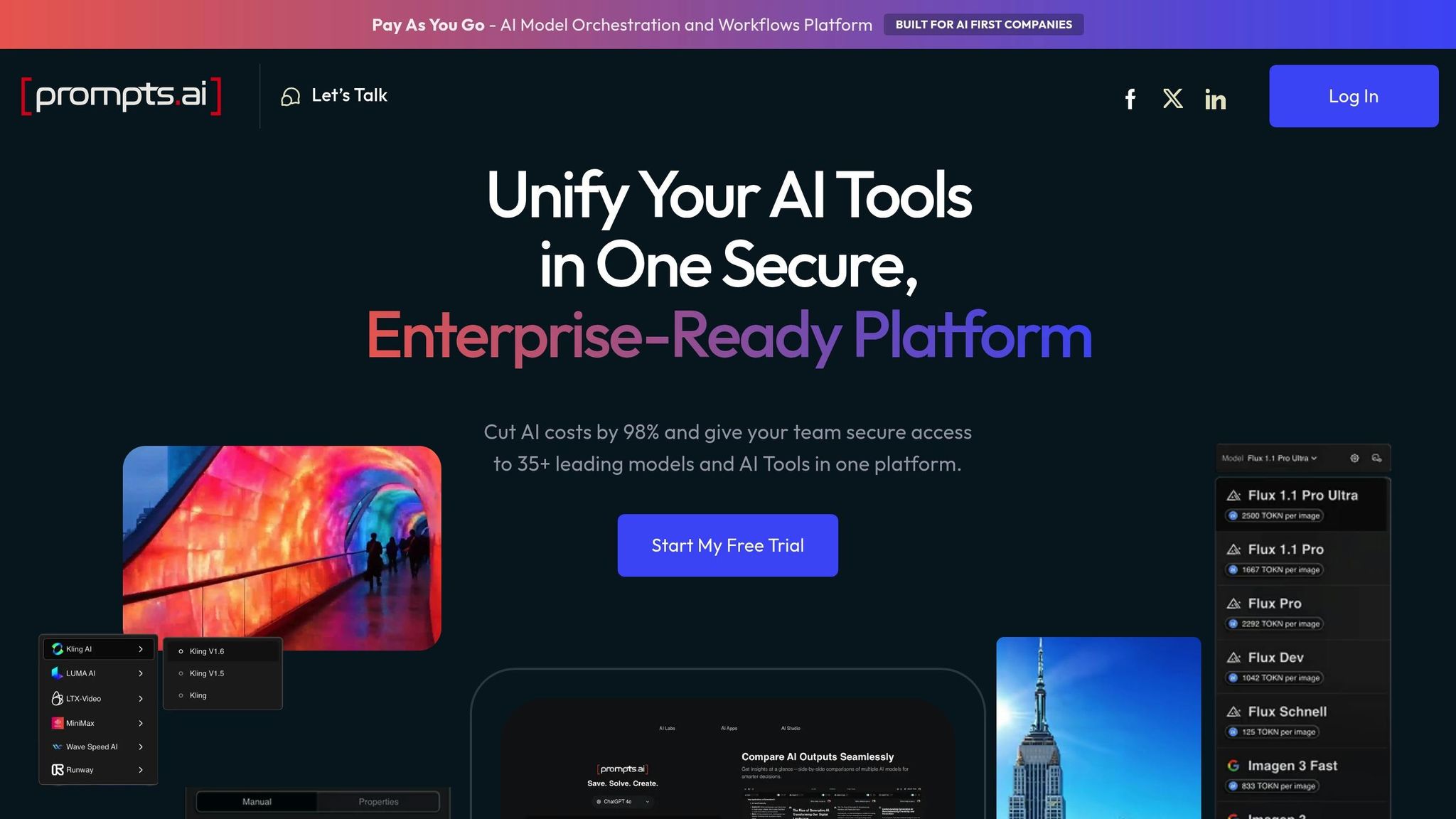
Prompts.ai stands out as a solution that combines efficiency, integration, and cost management. It provides centralized access to over 35 leading language models - including GPT-5, Claude, LLaMA, Gemini, Grok-4, Flux Pro, and Kling - through a single secure platform. For startups, this means streamlined workflows without the hassle of juggling multiple subscriptions.
The platform is designed to cut AI software costs by up to 98%, thanks to real-time FinOps tracking and Pay-As-You-Go TOKN credits. This flexibility allows startups to align costs with actual usage, such as deploying cost-effective models for routine tasks and reserving premium models for more complex needs. Additional features like side-by-side model comparisons, enterprise training programs, and Prompt Engineer Certification courses enable teams to build internal AI expertise and adopt best practices.
Security and compliance are also a priority, with features like full audit trails, single sign-on integration, and granular role-based access controls. These capabilities, typically associated with large enterprises, are now accessible to startups from day one, ensuring they can scale with confidence.
Marketing is undergoing a transformation with the advent of "Agentic Commerce", where AI takes charge of the entire funnel, from discovery to conversion. The emerging practice of Generative Engine Optimization (GEO) is helping brands improve visibility in AI-driven search engines like Perplexity and ChatGPT, marking a significant shift in digital marketing strategies.
A compelling example of this evolution came in late 2025 when the startup Absurd produced a video ad for Kalshi, titled "Election Day." Using a multi-agent orchestration layer, they completed the project in just 72 hours, achieving over 1 million views. This demonstrated how generative platforms can now handle intricate creative tasks that previously required weeks and large teams.
"AI is revolutionizing digital marketing. Startups now use generative tools to produce content, ad copy, and visuals in seconds, personalizing B2B marketing campaigns for every audience segment." - eLearning Industry
Sales teams are also benefiting from AI advancements, with tools like AI voice callers handling tasks such as lead qualification and document collection. These innovations free up sales professionals to focus on building meaningful, high-value relationships, while AI handles the heavy lifting in the background.
AI-powered customer interaction platforms are tackling long-standing challenges like data silos, which often lead to inconsistent and uninformed responses. A standout example is DevRev, which launched its AI-native platform in 2025. By integrating customer, product, and engineering data from tools like Salesforce and Zendesk into a unified knowledge graph, their "Computer" assistant automated manual tasks and bridged gaps that previously frustrated both customers and support teams.
Voice automation tools have also proven to enhance efficiency significantly. These platforms connect directly to internal data sources - such as CRMs, knowledge bases, and document repositories - ensuring AI-generated responses are tailored to the company’s specific context. The result? Faster resolutions, consistent customer experiences, and the ability to scale support operations without needing to proportionally increase staff.
Transitioning from isolated AI experiments to a reliable, scalable system requires creating a vendor-agnostic framework that prioritizes governance, data management, and structured teams. Many organizations - over 70% - have only implemented a fraction of their planned GenAI projects. This gap often stems from a lack of infrastructure to sustain model operations over time. Companies that overcome this hurdle focus less on individual tools and more on building systems that offer oversight and adaptability. This shift lays the groundwork for the more detailed steps discussed in the next sections.
"Building an AI system is only the first half of the work. Operating it - reliably, safely, and economically over months and years - is the second half that determines whether the system becomes a durable capability or an expensive prototype." - Umbrex AI Primer
Start with small, focused pilot projects overseen by humans to catch and address errors early. This method allows you to test integration points and security requirements before expanding further. Within the first 30 days, identify 2–3 high-impact use cases and appoint an AI Compliance Officer. From there, scale successful pilots and establish an AI Center of Excellence. This centralized hub consolidates infrastructure expertise while embedding specialists into product teams to drive adoption.
Expect to budget 2–3 times your initial estimates to cover data preparation, iterations, and unexpected challenges. Companies that follow structured adoption frameworks are three times more likely to achieve significant productivity improvements compared to those using ad-hoc approaches. Internal programs, such as Prompt Engineer Certification courses, can help upskill employees, turning them into advocates who drive adoption across departments.
To maintain flexibility, use abstraction layers to separate vendor APIs from your application logic. Store raw data, labels, and embeddings in your own systems rather than relying on vendor-specific storage. This approach, often called "data gravity", makes it easier to switch models as technology evolves without requiring a complete system overhaul. Platforms like Prompts.ai support this strategy by offering centralized access to over 35 leading models, enabling side-by-side comparisons of options like GPT-5, Claude, and Gemini. This setup allows you to pivot between models based on performance or cost without disrupting workflows.
Keep prompts in a centralized registry that’s independent of any specific vendor. Document workflows in a way that allows seamless migration to new models. With 33% of enterprises identifying vendor lock-in as a significant risk, this approach safeguards your system’s adaptability and long-term competitiveness.
Beyond infrastructure, tapping into community knowledge can accelerate your AI progress. Engage in forums and explore vendor resources that explain how to transition from outdated APIs to modern infrastructure capable of advanced reasoning. Prompts.ai’s community of prompt engineers regularly shares workflows that you can implement immediately.
Reassess "failed" use cases every six months. Rapid advancements in AI capabilities mean that what didn’t work yesterday might succeed today. Staying active in communities that monitor emerging techniques and regulatory changes - such as the EU AI Act, which becomes enforceable on August 2, 2026 - helps ensure your strategy remains both compliant and competitive.
Choosing generative AI solutions in 2026 requires systems that are scalable and adaptable to different models. Startups seeing 3–10x higher revenue per employee are prioritizing architectures that let them switch models in hours instead of months. Platforms with abstraction layers and access to multiple models can help you avoid being locked into a single vendor.
Cost-efficiency begins with understanding your unit economics before scaling up. Instead of relying on a single demo, evaluate AI platforms against 20 real-world business tasks. Use observability tools to track every decision your AI makes, and apply intelligent routing to assign simple tasks to cost-effective models while reserving advanced models for complex reasoning. Monitoring your Cost Per Successful Inference (CPSI) from the start ensures you don’t waste resources on features that fail to deliver measurable ROI. Alongside cost management, maintaining compliance is equally important to safeguard your operations.
"Defensibility in 2026 is found in the 'last mile' of execution, not the 'first mile' of generation." - We Are Presta
While keeping costs under control is crucial, compliance and governance must be embedded in your infrastructure from the outset. Look for platforms with built-in audit logs, role-based access controls, and data retention policies. For industries like healthcare or finance, prioritize solutions that offer deterministic fallbacks and human-in-the-loop checkpoints when AI confidence falls below acceptable thresholds.
To start, focus on high-impact use cases where AI outperforms traditional methods. Begin with a single-agent workflow to demonstrate value, then refine and expand your initiatives. By combining scalable systems, cost control, and robust governance, you can amplify your team’s capabilities without replacing human judgment - allowing your startup to thrive in an AI-driven economy. With these strategies, generative AI can become a powerful tool for growth and innovation.
Startups can simplify the integration of generative AI by opting for platforms designed with connectivity, security, and scalability in mind. AI orchestration tools are particularly helpful, as they can link various systems, automate workflows, and reduce operational complexity, ensuring smooth alignment with existing processes.
When selecting tools, prioritize those offering strong API integrations, prebuilt templates, and adherence to compliance standards like SOC 2 Type II or HIPAA. These features not only ease deployment but also help maintain data security and minimize potential disruptions. By choosing flexible, compliance-focused solutions, startups can seamlessly incorporate AI into their operations while ensuring compatibility with their current technology infrastructure.
Startups looking to cut expenses on generative AI can adopt smart cost-saving strategies that maintain quality while optimizing efficiency. One such approach is model routing, which assigns simpler tasks to less expensive AI models, reserving high-cost models for only the most complex jobs. This targeted use of resources can lead to significant savings.
Another effective tactic is prompt caching. By reusing commonly used prompts or instructions, startups can avoid unnecessary processing and potentially slash costs by up to 90%. Additional measures include limiting output length to reduce token usage, batching tasks to decrease per-request expenses, and exploring open-source AI tools to steer clear of hefty subscription fees.
By integrating these strategies, startups can cut AI-related costs by as much as 70%, all while retaining access to advanced generative AI capabilities.
Startups can protect their data and stay compliant by tackling AI-specific challenges like data leakage, model misuse, and unauthorized access. Key strategies include implementing input and output validation, enforcing minimal permissions, and using data encryption to safeguard sensitive information without disrupting operations.
Opting for secure deployment methods, such as hybrid models, enables startups to keep critical data within their own infrastructure while managing metadata externally. Embracing privacy-by-design principles, conducting routine audits, and limiting the amount of data collected are additional steps to ensure compliance with regulations. Leveraging tools with features like regional hosting and robust access controls adds another layer of security while helping meet industry standards.