Pay As You Go - AI Model Orchestration and Workflows Platform


Generative AI platforms are transforming workflows across industries, offering tools to save time, reduce costs, and improve productivity. From managing large-scale document analysis to creating cinematic-quality videos, these platforms cater to diverse needs. Below are the top options to explore in 2026, each tailored for specific tasks and audiences:
| Platform | Primary Use Case | Key Feature | Pricing (Starting) | Best For |
|---|---|---|---|---|
| Prompts.ai | AI orchestration & workflows | Side-by-side LLM comparison | $29/month | Creative teams, enterprises |
| Gemini | Multimodal & Workspace tasks | Google integration, 2M-token context | $14/user/month | Google Workspace users |
| GPT-5.2 | Knowledge work & coding | Advanced reasoning, 400K-token context | $1.75/1M tokens | Developers, enterprises |
| Claude 4.5 | Long-context workflows | Adjustable reasoning effort | $20/month | Researchers, legal teams |
| Grok 4 | Real-time web insights | Social data integration | $30/month | Social analysts, researchers |
| Runway ML | Video production | Node-based video editing | $12/user/month | Video creators, agencies |
| Qwen3-Max | Multilingual tasks | Open-source, hybrid reasoning | $1.20/1M tokens | Privacy-conscious users |
| Kimi K2 | Math & debugging | Transparent reasoning | $4.99/month | Academics, researchers |
| DeepSeek | Coding & mathematics | Sparse architecture for cost efficiency | $0.28/1M tokens | Startups, developers |
| Perplexity | Real-time research | Fact-checked answers with citations | Free/$20/month | Analysts, researchers |
Each platform is designed to address specific challenges, from reducing inefficiencies to improving productivity. Whether you're looking for multimodal capabilities, cost-effective coding tools, or advanced reasoning, these options deliver measurable outcomes. Dive deeper to find the right fit for your needs.

Generative AI Platforms Comparison: Features, Pricing, and Best Use Cases 2026

Prompts.ai serves as a centralized AI orchestration platform, offering seamless access to over 35 top-tier language models, including GPT-5, Claude, Gemini, LLaMA, and Grok 4, all through a single interface. It excels in text generation, workflow automation, and prompt engineering, allowing users to compare outputs from multiple models side-by-side and select the most effective result for their tasks. Beyond text, its Image Studio and MediaGen Models enable visual content creation. The platform also integrates with tools like Slack, Gmail, and Trello, turning scattered requests into streamlined automated workflows.
Prompts.ai operates as a commercial SaaS platform, utilizing a TOKNs credit system rather than traditional subscriptions. Personal plans start at a free tier (with limited credits) and go up to $29/month for the Creator tier, which includes 250,000 TOKNs. Business plans begin at $99 per member monthly for the Core tier. The platform is browser-based, requiring no installation, and offers enterprise-grade security with SOC 2 Type II, HIPAA, and GDPR compliance as of June 19, 2025.
A standout feature of Prompts.ai is its side-by-side LLM comparison, which eliminates the need for lengthy trial-and-error processes by enabling simultaneous prompt testing. Coupled with real-time FinOps cost tracking, this feature can reduce AI software expenses by as much as 98%, consolidating multiple subscriptions into one. Emmy-winning Creative Director Steven Simmons highlights the platform’s efficiency:
"With Prompts.ai's LoRAs and workflows, he now completes renders and proposals in a single day - no more waiting, no more stressing over hardware upgrades."
Prompts.ai’s capabilities are tailored to meet the needs of a wide range of professionals.
The platform is particularly well-suited for enterprises needing secure AI oversight, creative teams handling large-scale production, and organizations looking to consolidate AI tools. Architect June Chow shares:
"Comparing different LLM side by side on prompts.ai, allows her to bring complex projects to life while exploring innovative, dreamlike concepts."
Additionally, Mohamed Sakr, Founder of The AI Business, uses Prompts.ai to automate sales and marketing workflows, giving it a perfect 5/5 rating.
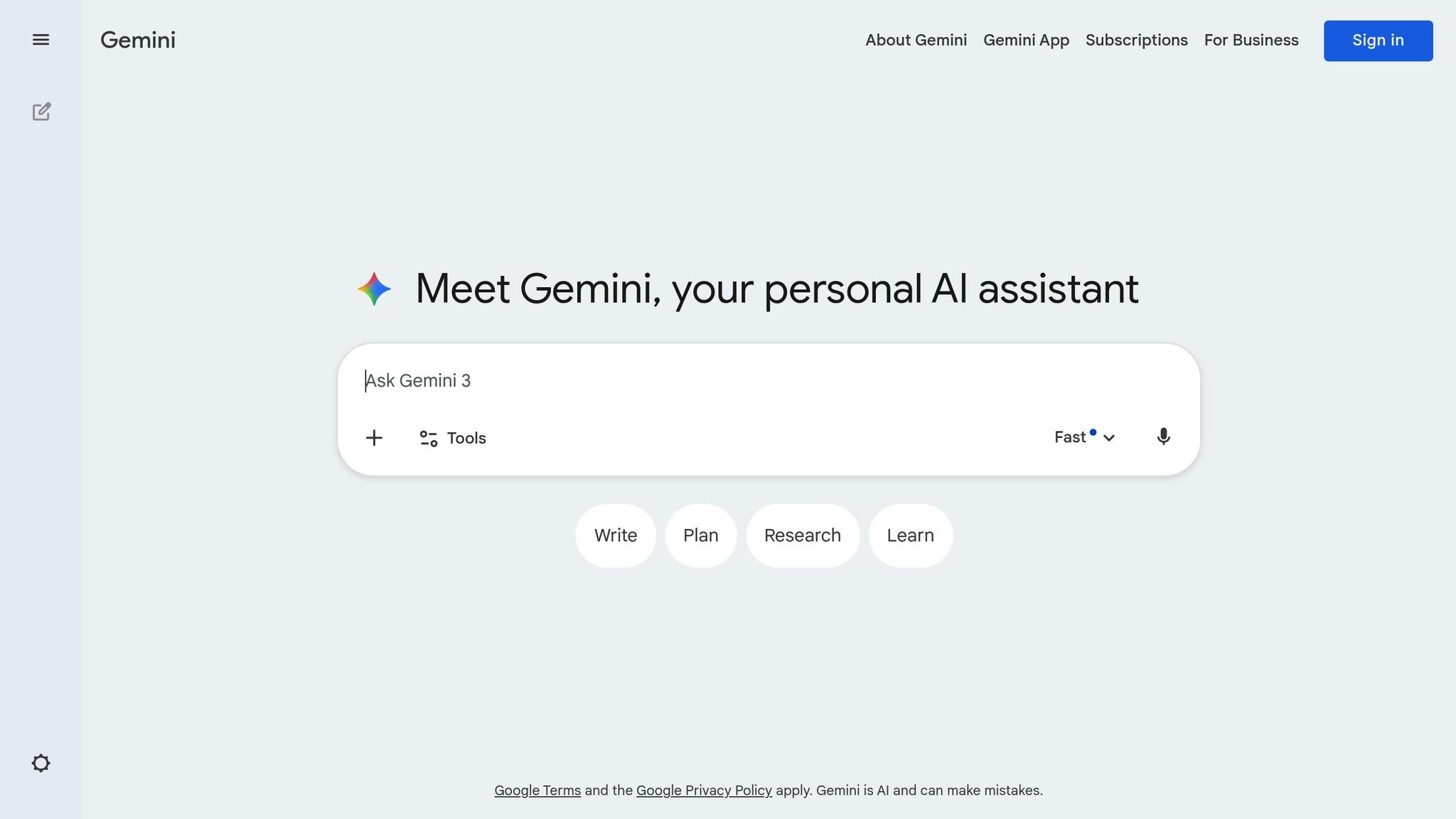
Gemini acts as a multimodal AI assistant, seamlessly integrated across the Google ecosystem. It handles tasks like text generation, image and video creation, coding, and data analysis. Through direct integration with Google Workspace tools like Docs, Slides, and Videos, users can create campaigns, collateral, and training materials without switching platforms. Developers benefit from rapid prototyping for interactive tools and 3D visualizations, while enterprises can deploy AI agents that connect to business data for full process automation. Notably, Gemini 3 Pro Thinking achieved 100% accuracy on the AIME 2025 mathematics benchmark (with code execution enabled) and showed 35% higher accuracy in solving software engineering tasks compared to its predecessor. These advancements support its flexible pricing structure, detailed below.
Gemini is available through a commercial SaaS model with tiered pricing. Google Workspace AI starts at $14 per user per month, while Gemini Enterprise is priced at $21 per user per month. For developers, API pricing is set at $2.00 per 1 million input tokens and $12.00 per 1 million output tokens for Gemini 3 Pro. The faster Gemini 3 Flash is offered at $0.50 and $3.00 for input and output tokens, respectively. New users also receive $300 in free credits to test proof-of-concept projects. Google ensures that customer data from Enterprise and Workspace versions is not used to train global models or shared with third parties.
Gemini’s standout feature is its ability to process text, images, video, audio, and code within a single system, supported by massive context windows. This design enables iterative development and scientific workflows. Its "Grounding with Google Search" feature connects responses to real-time internet data, reducing inaccuracies and enhancing enterprise workflows. Ben Kus, CTO of Box, highlights its impact:
"Gemini 3 Pro brings a new level of multimodal understanding, planning, and tool-calling that transforms how Box AI interprets and applies your institutional knowledge."
Gemini is a great fit for enterprises needing close integration with Google Cloud services like BigQuery, Looker, and Security Command Center. Creative teams can generate content directly within Workspace tools, while developers can accelerate their work using Gemini Code Assist in VS Code and JetBrains. For example, Wayfair used Gemini 3 Pro to turn partner support procedures into clear infographics, enhancing information retention. With support for 100+ languages and a 93.4% score on the Global PIQA benchmark, Gemini is also ideal for multinational organizations.
Building on the success of Gemini's multimodal capabilities, GPT-5.2 focuses on professional knowledge work and autonomous coding for high-stakes tasks. It excels in handling complex, multi-step processes requiring sustained reasoning. This model is adept at creating functional outputs like financial models, workforce planning frameworks, and sales presentations. It also manages customer support workflows and executes complete software engineering patches.
Performance benchmarks highlight its capabilities:
GPT-5.2 operates as a commercial SaaS platform, available through ChatGPT (Plus, Pro, Team, and Enterprise plans) and the OpenAI API. Pricing details are as follows:
The Responses API enhances functionality by allowing developers to pass "Chain of Thought" between conversation turns. This reduces the need for re-reasoning, cutting latency. The model supports a 400,000-token context window, with up to 128,000 output tokens, and has a knowledge cutoff date of August 31, 2025.
One of GPT-5.2's standout features is its "compaction" technology, which compresses prior conversation states. This allows workflows to exceed the standard context window, enabling long-running tasks. Users can adjust its reasoning level from none (for quick, low-latency tasks) to xhigh (for maximum accuracy on complex problems).
The model also includes the apply_patch tool, which emits structured diffs for coding tasks, reducing failure rates by 35% compared to standard JSON edits. Triple Whale CEO AJ Orbach remarked in December 2025 that GPT-5.2 replaced a multi-agent system with a single "mega-agent", cutting latency and simplifying maintenance by a factor of 100.
GPT-5.2 is ideal for enterprises seeking reliable AI agents, advanced software engineering tools, and automated financial analysis. Windsurf CEO Jeff Wang implemented GPT-5.2 as the default model for core Devin workloads in December 2025, calling it the "biggest leap for GPT models in agentic coding since GPT-5." Its 30% reduction in response-level errors compared to GPT-5.1 and its 93.9% factuality rate make it a top choice for professional tasks where precision and dependability are critical.
Claude Opus 4.5 is tailored for high-end software engineering, autonomous AI agents, and enterprise workflows like financial modeling and legal analysis. Its strength lies in long-context storytelling, capable of producing 10–15 page chapters with consistent structure and organization. Designed as a collaborative partner, it handles multi-step workflows, integrates with various tools, and manages subagents effectively. One of its standout features is the ability to navigate desktop environments and browse the web with human-like precision, enabling automated web QA and workflow automation. The model scored 80.9% on the SWE-bench Verified benchmark and 66.3% on the OSWorld benchmark for autonomous computer navigation. These capabilities make it an excellent fit for advanced AI workflows.
Claude Opus 4.5 is offered as a commercial SaaS platform, accessible via the Anthropic API and major cloud platforms like Amazon Bedrock, Google Cloud Vertex AI, and Microsoft Foundry. Pricing is set at $5.00 per million input tokens and $25.00 per million output tokens. Individual users can opt for the Pro plan at $20 per month (or $17 per month if billed annually), while the Max plan starts at $100 per month, offering 5–20× more usage capacity. For non-urgent, high-volume tasks, batch processing provides 50% savings. The model supports a 200,000-token context window and a 64,000-token maximum output, which is four times larger than many competitors. With a knowledge cutoff date of March 2025, it operates under the ASL-3 (AI Safety Level 3) standard and boasts a 99.78% harmless response rate.
What sets Claude Opus 4.5 apart is its "Effort Parameter", allowing users to adjust the depth of reasoning. Users can choose "Low" for faster, more cost-efficient outputs or "High" for tackling complex problems. Using the "Medium" effort level has shown a 76% reduction in output tokens for specific tasks. Additionally, the model includes a Memory Tool (currently in beta) that stores and retrieves information across sessions, effectively bypassing the constraints of standard context windows.
"Having Claude's advanced reasoning alongside GPT models in one platform gives us flexibility to build scalable, enterprise-grade workflows that move far beyond prototypes."
This insight comes from Michele Catasta, President of Replit. Notably, the model has demonstrated a 20% improvement in accuracy for Excel automation and financial modeling over its predecessors.
Claude Opus 4.5 is a strong choice for software engineering teams working on large-scale code migration and refactoring, financial and legal professionals who need precise modeling, and cybersecurity teams handling automated incident response.
"Manus deeply utilizes Anthropic's Claude models because of their strong capabilities in coding and long-horizon task planning, together with their prowess to handle agentic tasks."
Tao Zhang, Co-founder and Chief Product Officer at Manus AI, highlighted this. Developers using prompt caching for repeated contexts or lengthy documents can save up to 90% on costs.
Grok 4 builds on earlier advancements to provide real-time, multi-agent orchestration for complex tasks across industries like coding, finance, healthcare, and law. With its "DeepSearch" technology, it retrieves and analyzes live web data and social conversations from X, delivering up-to-date insights. The model has achieved impressive benchmarks, scoring 100% on the AIME math test and 87% on the GPQA PhD-level science benchmark. For tasks requiring deeper reasoning, the "Think Mode" toggle enables the model to apply first-principles logic, refining its answers. Notably, it scored 44.4% on "Humanity's Last Exam" (HLE) when using tools, showcasing its ability to handle multi-step problem-solving.
Grok 4 is offered as a commercial SaaS platform, accessible through grok.com, X integration, and mobile apps for iOS and Android. Enterprise users can also deploy it via Oracle Cloud Infrastructure (OCI) in Ashburn, Chicago, and Phoenix, or through Azure AI Foundry. Pricing includes $3.00 per million input tokens, $15.00 per million output tokens, and $0.75 per million tokens for cached input. Subscription plans include:
The platform supports a 1-million-token context window on the app and 256,000 tokens via API - far exceeding the capacity of most models in 2026. A specialized "Grok 4 Fast" variant, available for free with usage limits, supports up to 2 million tokens.
Grok 4’s standout feature is its ability to orchestrate up to 32 parallel models that collaborate to refine answers, improving accuracy and reducing errors. Its training, conducted on the Colossus supercomputer with 200,000 Nvidia GPUs and 10× more compute than its predecessor, ensures exceptional performance. The platform also supports native tool use, such as executing Python code and conducting internet searches. In voice mode, responses are delivered in just 250 milliseconds. For developers, the "Grok 4 Code" variant integrates with IDEs, supports live file editing, and works with over 20 programming languages, making it a powerful tool for high-demand enterprise applications.
Grok 4 is ideal for enterprises extracting data from SEC filings or legal contracts, researchers monitoring breaking news and sentiment, and developers managing large codebases. Its extensive context window enables processing of entire software repositories or lengthy documents in one session. Financial analysts benefit from real-time X integration for tracking news and social sentiment, while legal professionals can use it to summarize complex technical documents. With a knowledge cutoff of June 2025 and continuous real-time web access, Grok 4 ensures users have access to the most current information available.
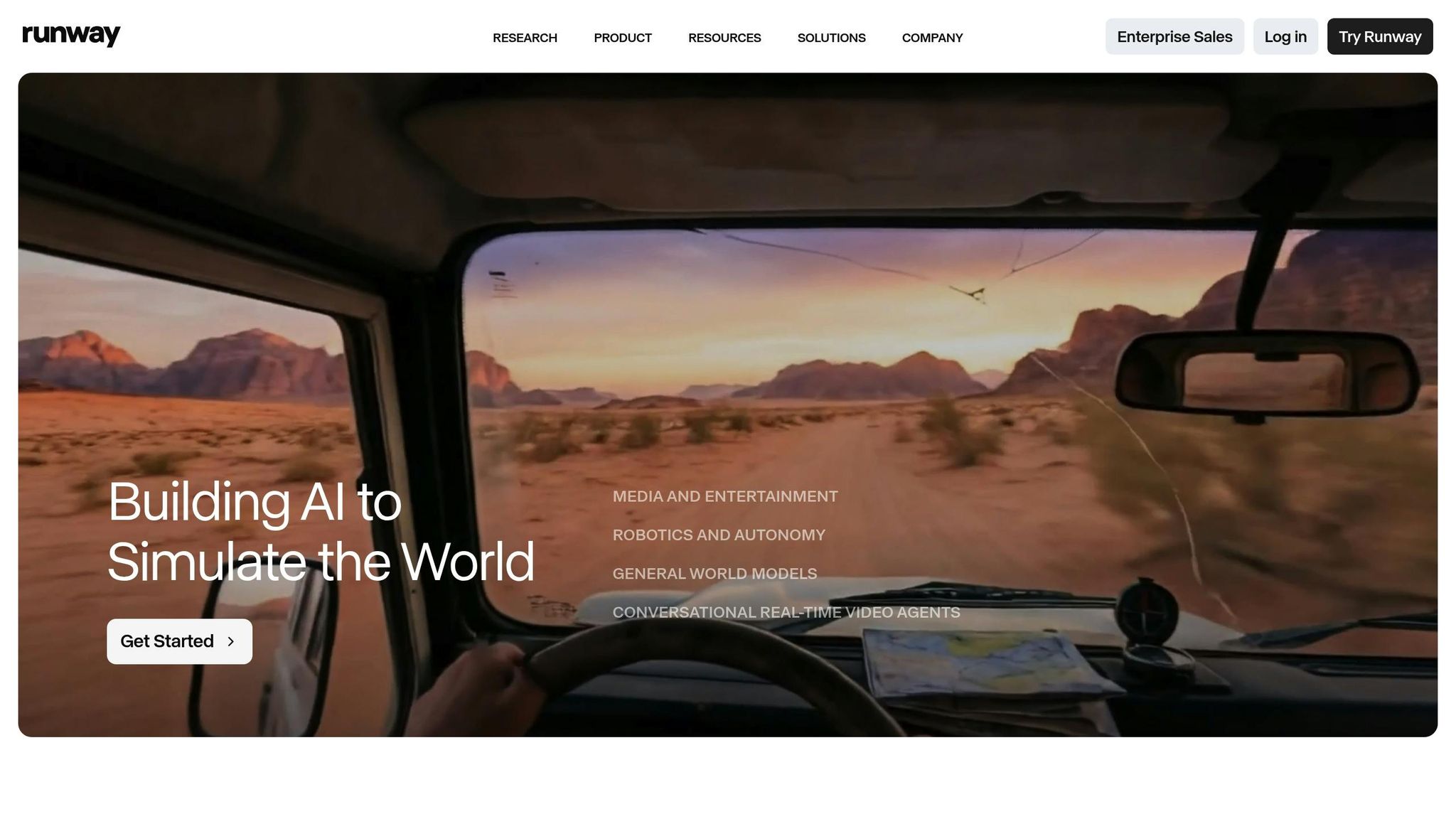
Runway ML focuses on generative video production and editing tailored for professional workflows. Its Gen-4.5 model delivers cinematic motion quality and introduces General World Models (GWM) to simulate real-world dynamics. The platform features tools like video-to-video transformation, character performance control through the Act-Two model, and production-ready options for upscaling, background removal, scene relighting, and dialogue addition. These functions are backed by a deployment model designed for flexibility and accessibility.
Runway functions as a commercial SaaS platform available via web browsers, iOS apps, and a REST API for developer integration. It provides a Free tier with 125 one-time credits for exploration, while paid plans start at $12 per user per month (Standard) and go up to $76 per user per month (Unlimited) when billed annually. Enterprise plans offer custom pricing and include features like Single Sign-On, advanced security, and SOC 2 Type 2 compliance. In February 2026, Runway secured $315 million in Series E funding, nearly doubling its valuation to $5.3 billion.
Runway's Custom Workflows stand out as a key feature - a node-based, no-code environment allowing users to link AI models for precise creative control. This ensures visual consistency across camera angles, lighting, and movement by anchoring elements with text prompts and image references. LLM nodes further refine basic prompts into detailed instructions. In 2024, Amazon Prime's "House of David" production team reported 80% cost savings compared to traditional VFX pipelines by leveraging Runway's tools.
"With Runway, we were able to do in a few hours what would previously have taken a month." - Geoff Marshall, Creative Director, Eggplant Picture & Sound
Runway is ideal for professional film studios, architecture firms, and creative agencies that need production-ready video generation and VFX solutions. Major players like Lionsgate (partnered in September 2024), Under Armour (used it for a TV commercial), and KPF architecture firm (enhanced rendering workflows) have integrated Runway into their projects. Its 4.5/5 star rating on the Apple App Store from 7,800 reviews highlights strong user satisfaction. For teams looking to prototype visual concepts quickly or create high-quality videos on tight budgets, Runway offers an appealing mix of speed, quality, and collaborative tools.
Qwen3-Max is designed for advanced tasks like autonomous agents, complex STEM reasoning, and enterprise-level Retrieval-Augmented Generation (RAG). It shines in nuanced dialogue, creative writing, and instruction-following across 119 languages. A standout feature is its Hybrid Reasoning Engine, which allows users to switch between "Thinking Mode" for detailed, step-by-step logic and "Non-Thinking Mode" for quicker, low-latency responses. This adaptability makes it suitable for a wide range of tasks, from solving mathematical proofs to handling real-time customer service.
The Qwen 3 family also includes multi-modal and open-source versions for broader applications. At the top of the line, Qwen3-Max employs a Mixture-of-Experts (MoE) architecture with over 1 trillion parameters. It has achieved leading scores in benchmark math competitions and ranks first on the Humanity's Last Exam (HLE) leaderboard with a score of 58.3, showcasing its exceptional reasoning capabilities. The model is available with flexible API access and pricing tiers to accommodate different scales of use.
Qwen3-Max is a proprietary, closed-source model accessible exclusively via API through Alibaba Cloud DashScope. Pricing is as follows:
The model natively supports a 256K-token context window, which can be extended to handle up to 1 million tokens.
In contrast, other Qwen 3 models, like the Qwen3-235B variant, are open-source under the Apache 2.0 license. This allows free commercial use, modification, and self-hosting. The open-source version has been downloaded more than 40 million times across platforms like Hugging Face and ModelScope. For high-volume usage exceeding 100,000 requests daily, self-hosting can be significantly more cost-effective, with estimated monthly costs of $150–$300 for running a 70B model on a cloud A100 instance.
Qwen3-Max's Hybrid Reasoning Engine sets it apart. Users can toggle between modes depending on the task:
enable_thinking parameter unlocks full chain-of-thought capabilities.Additionally, the Qwen3-235B variant features 235 billion total parameters but activates only 22 billion per token, reducing inference costs by approximately 6× compared to dense models of similar size.
In 2025, AstraZeneca China leveraged Qwen models to automate adverse-event analysis, boosting document processing speed by 300% while maintaining 95% accuracy.
"Qwen turbo-charged our pharmacovigilance workflow - an industry first." - Xin Zhong, IT Head, AstraZeneca China
The automotive company NIO also adopted Qwen's unified LLM stack for its "smart cockpit", powering in-car AI assistants and voice interactions. These capabilities make Qwen3-Max a compelling choice for industries that demand high performance and strict data control.
Qwen3-Max is particularly well-suited for enterprises that prioritize data privacy, customization, and regulatory compliance. Self-hosting ensures sensitive information remains within your infrastructure, making it a strong option for sectors like healthcare, finance, and law. The open-source variants also enable fine-tuning with techniques such as LoRA or QLoRA on proprietary datasets, offering a level of control that commercial SaaS platforms often lack. While local deployment requires high-performance GPUs, quantization methods like GGUF or AWQ can cut hardware needs by 70–80%, making it feasible for consumer-grade setups.
Kimi K2 Thinking, developed by Moonshot AI and launched in November 2025, is designed for deep, multi-step reasoning. It excels in areas like mathematical proofs, research synthesis, and precise debugging. The model has demonstrated 100% accuracy on AIME25 (American Invitational Mathematics Examination) problems when paired with Python tools and achieved a 51.0 score on Humanity’s Last Exam (HLE) in heavy mode, surpassing GPT-5 High’s 42.0. A standout feature is its transparent reasoning process, which includes a reasoning field that outlines its step-by-step logic before providing the final answer. This makes it particularly valuable for educational purposes and critical applications requiring verifiable logic.
In addition, the model is optimized for long-horizon agentic workflows, maintaining consistent performance across 200–300 sequential tool calls. This makes it highly effective for autonomous agents tasked with navigating the web, verifying information, and executing complex API orchestrations. In software engineering, it scored 71.3% on SWE-Bench Verified, showcasing its ability to address real-world GitHub issues. Its 256K token context window allows it to process extensive research papers or large codebases, handling up to 200,000 words in a single prompt.
These capabilities make Kimi K2 Thinking a versatile tool for a wide range of demanding applications.
Kimi K2 Thinking can be deployed in two ways. The commercial SaaS option offers API access through platforms like Together.ai, priced at $1.20 per 1M input tokens and $4.00 per 1M output tokens. Subscription plans cater to different needs, starting with a Starter tier at $4.99/month (500 credits) and going up to a Premium plan at $129.99/month, which includes unlimited usage and IDE integration.
For organizations requiring more control, the model weights are available for self-hosting under a Modified MIT License. However, the hardware demands are steep, requiring at least 80GB GPU memory (A100 or H100), 256GB system RAM, and 2TB SSD storage. Infrastructure costs for enterprise-grade setups range between $50,000 and $200,000.
At the heart of Kimi K2 Thinking lies its trillion-parameter Mixture-of-Experts (MoE) architecture. While the model boasts a total of 1 trillion parameters spread across 384 specialized experts, only 32 billion parameters per token are activated during processing. This design achieves a balance between computational efficiency and intelligence. Additionally, the model incorporates INT4 quantization through Quantization-Aware Training (QAT), providing a 2× speed boost without compromising accuracy. Trained on 15.5 trillion tokens of high-quality data, it also scored 60.2 on BrowseComp for agentic web searches, far exceeding Claude 4.5’s score of 24.1.
"Kimi K2 Thinking doesn't just generate answers - it reasons through problems step by step, showing its work like a human expert." - Moonshot AI
Kimi K2 Thinking is ideal for enterprises in legal, finance, and software development. Legal teams can process extensive contracts in a single pass using its 256K context window, while financial analysts benefit from its agentic search capabilities to synthesize real-time market data. Research institutions and academics can automate literature reviews, analyzing hundreds of sources to uncover patterns and produce detailed syntheses. To maximize efficiency, it’s best to reserve Kimi K2 Thinking for complex, high-value problems. For simpler tasks like basic classification, standard models are more cost-effective and faster. When working with inputs exceeding 100K tokens, including a concise executive summary can help maintain speed and focus.
DeepSeek v3.2 is designed as a reliable daily tool for tasks like text generation, coding support, and advanced mathematical problem-solving. It stands out with a 96.0% score on the AIME 2025 benchmark, outperforming GPT-5 High's 94.6%, and an impressive 99.2% on the Harvard-MIT Mathematics Tournament (HMMT) 2025. The Speciale variant excels in high-compute reasoning and tool integration, earning top honors in global competitions such as the International Mathematical Olympiad (IMO) and the International Olympiad in Informatics (IOI). With its 128,000-token context window powered by DeepSeek Sparse Attention, it reduces costs for long-context tasks by 50%, making it a practical choice for handling complex workflows with efficiency.
DeepSeek v3.2 is offered through a flexible hybrid deployment model. Users can access it as a commercial SaaS via the official web interface, mobile app, or paid API, with pricing set at $0.28 per 1 million input tokens and $0.42 per 1 million output tokens. For organizations prioritizing data sovereignty, the model weights are freely available on Hugging Face under the permissive MIT License, enabling self-hosting and on-premises deployment. The Speciale variant, tailored for more demanding tasks, is priced at $0.40 per 1 million input tokens and $0.50 per 1 million output tokens.
The standout feature of DeepSeek v3.2 is its 671-billion-parameter Mixture-of-Experts (MoE) architecture, which activates just 37 billion parameters per token during processing. This sparse approach achieves high performance while keeping inference costs significantly lower. The entire DeepSeek V3 series was trained for approximately $5.5 million, a fraction of the training costs for comparable flagship models, showcasing how algorithmic advancements can replace sheer computational expense.
DeepSeek v3.2 is a perfect fit for cost-conscious startups, STEM-focused research institutions, and enterprises needing strict data control. Its reasoning-first design and extensive agentic task synthesis pipeline - spanning 1,800 environments and over 85,000 complex instructions - make it a valuable tool for agent developers. Legal and medical organizations can self-host the model to maintain control over sensitive information, while high-volume API users benefit from discounted cached input pricing at $0.028 per 1 million tokens for repetitive tasks. For everyday production needs like coding and analysis, the standard v3.2 is a solid choice, while the Speciale variant is better suited for intricate reasoning tasks that require tool integration.
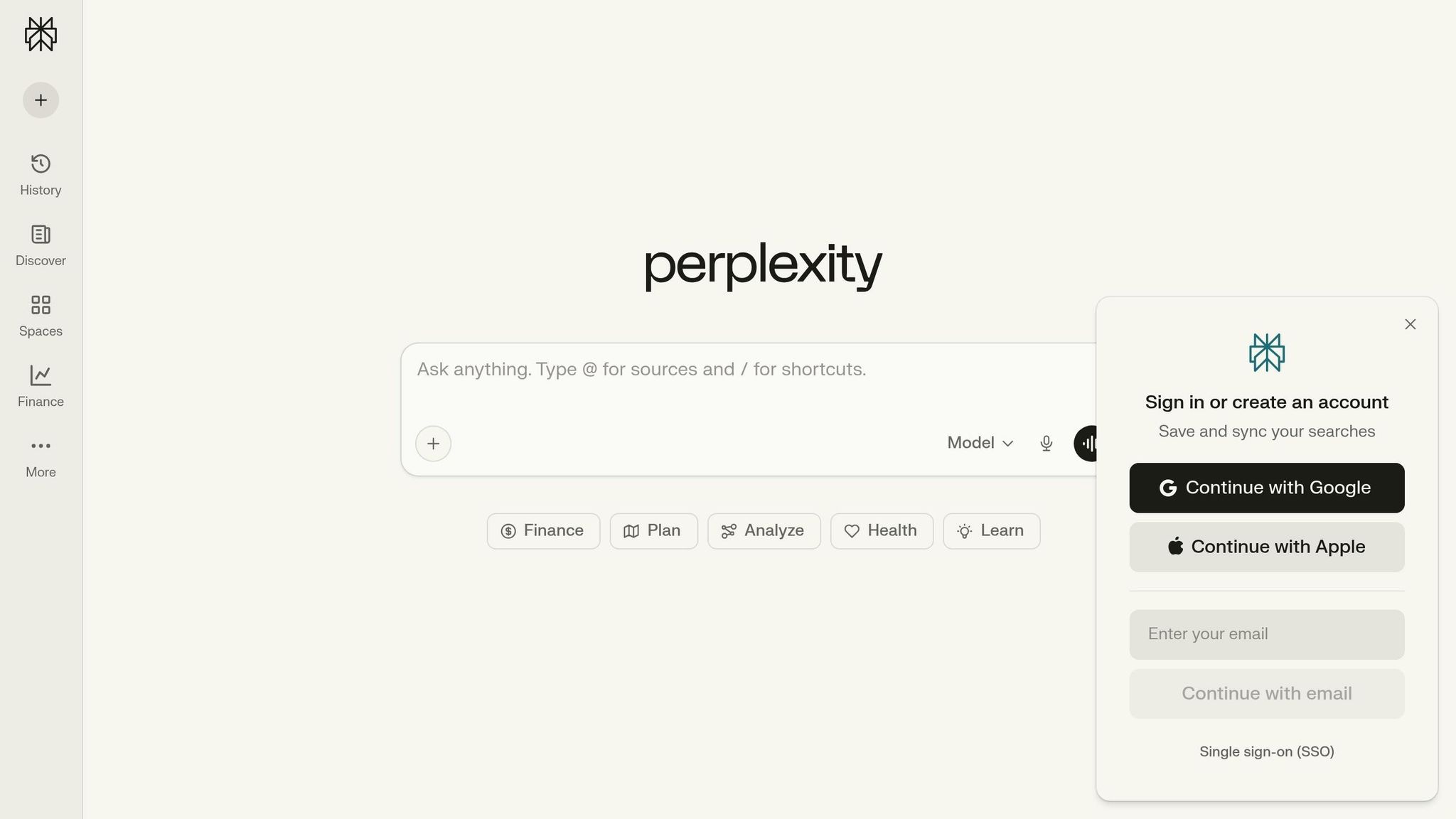
Perplexity is a conversational search engine designed to deliver concise, fact-checked answers with numbered footnotes and hyperlinks for easy verification. Unlike static language models limited by outdated training data, it retrieves real-time information from the web, covering everything from breaking news and academic studies to live sports updates and election results. The platform's "Spaces" feature allows users to organize related threads, upload files, and collaborate with teams, while "Pages" turns research into shareable, professional-looking articles. For complex queries, the "Pro Search" mode enhances results through multi-step reasoning, asking follow-up questions to refine answers. These features make it a powerful tool for users who need precise, up-to-date information.
Perplexity is offered as a commercial SaaS platform with a tiered pricing model:
Perplexity stands out with its search-first approach, prioritizing factual accuracy and web-based research. Users can switch between models like GPT-5.2, Claude 4.5, and Gemini 3 Pro to optimize their research. Its Sonar Pro model achieved an impressive F-score of 0.858 on the SimpleQA benchmark in 2025, surpassing the standard Sonar model's 0.773. The platform's rapid growth is evident in its $20 billion valuation by 2025, following a successful $25.6 million Series A funding round. These capabilities make Perplexity a reliable and efficient choice for users across various industries.
Perplexity is ideal for researchers, enterprises, and content creators who need accurate, real-time information. It has been used for tasks like creating course syllabi (Iolani School), conducting rapid policy research (United States Anti-Doping Agency), and analyzing extensive datasets, such as Tripadvisor's database of over 1 billion reviews and 300,000 travel experiences. Developers benefit from tools like Claude Sonnet 4.5 for technical reasoning and real-time code generation, while marketing teams leverage it for competitive analysis and data-driven insights.
Finding the right generative AI platform depends on your workflow, budget, and technical needs. Consumer platforms typically operate as cloud-based SaaS, with premium tiers averaging around $20/month. In contrast, open-source solutions like Qwen3-Max and DeepSeek v3.2 offer complete data control but require technical expertise. For enterprises managing sensitive data, compliance with standards like SOC 2, GDPR, or HIPAA is essential. The table below outlines key features of popular platforms to help you make an informed choice.
| Platform | Primary Use Case | Deployment Model | Key Differentiator | Target Audience |
|---|---|---|---|---|
| Prompts.ai | AI Orchestration & Governance | Cloud (SaaS) | Access to 35+ models with FinOps cost controls and prompt workflows | Enterprises, Teams, Creative Agencies |
| Gemini (Google) | Multimodal Search & Workspace Integration | Cloud (SaaS/Vertex AI) | 2M token context window; seamless Google Workspace integration | Google Workspace users, Enterprises |
| GPT-5.2 (OpenAI) | General Purpose & Creative Tasks | Cloud (SaaS/API) | Broad GPT ecosystem with DALL-E 3 for image generation | Individuals, SMBs, Developers |
| Claude Opus 4.5 (Anthropic) | Long-Context Reasoning & Analysis | Cloud (SaaS/API) | Constitutional AI for safer outputs; 200K token context | Researchers, Legal, Technical Writers |
| Grok 4 (xAI) | Real-Time Social Trends | Cloud (SaaS) | Integration with live X platform data; witty tone | Social media analysts, Current events tracking |
| Runway ML | Video Generation & Editing | Cloud (SaaS) | Motion brushes and text-to-video for cinematic effects | Video editors, Creative agencies |
| Qwen3-Max (Open Source) | Multilingual LLM | On-Premises/Hybrid | High-performance open-source with flexible local deployment | Developers, Privacy-conscious organizations |
| Kimi K2 Thinking (Chinese Models) | Chinese Language Processing | Cloud (SaaS) | Mandarin optimization with local compliance | Chinese market users, Regional enterprises |
| DeepSeek v3.2 (Chinese Models) | Coding & Mathematics | On-Premises/Hybrid | Outstanding cost-performance ratio in coding and mathematics | Developers, Power users |
| Perplexity (Search and Research) | Real-Time Research & Citations | Cloud (SaaS) | Inline citations and fact-checking with a search-first approach | Students, Analysts, Researchers |
Gartner research highlights that 67% of organizations plan to maintain or increase AI spending despite economic challenges, underscoring the importance of selecting the right platform. Developers using AI-powered coding tools report productivity boosts of 30–55%. Meanwhile, 58% of professionals lose over five hours weekly due to inefficient context-switching between disconnected tools - a gap that unified platforms like Prompts.ai aim to close effectively.
The generative AI landscape offers a wide range of tools, from Prompts.ai, which orchestrates 35+ models with enterprise-grade governance, to Google's Gemini, known for its 2 million token context window, and specialized platforms like Runway ML for video creation or Perplexity for real-time research. Choosing the right tool depends on three main factors: your workflow requirements, technical setup, and budget. These elements are key to making an informed decision.
Start by identifying your specific challenges. If fragmented tools and unclear pricing are slowing you down, a unified platform could be the answer. For tasks involving extensive documents, focus on tools offering large context windows. Teams already using Google Workspace or Microsoft 365 may benefit from tools with seamless native integrations, potentially saving hours of work. Research shows that fragmented tools cost 58% of workers over five hours each week.
"Learning how to choose the right AI tools isn't just about staying current; it's about regaining precious time, protecting budgets and fostering innovation." – Clarifai
Given how fast AI evolves, regular reassessment is critical. Review your platform choices quarterly or after major updates to ensure they still meet your needs. Free tiers can be a great starting point, and calculating ROI by comparing time saved to labor costs can clarify the value of each tool. Human oversight remains important to catch errors and maintain brand consistency.
Select a core platform that fits your primary needs, then add complementary tools to enhance productivity. With the global generative AI market expected to reach $109.4 billion by 2030, aligning the right tools with the right tasks will set organizations up for success, far beyond simply chasing trends.
To select the most suitable AI platform, start by pinpointing your primary goal - whether it’s content creation, workflow automation, or analyzing data. Look closely at the platform’s features, such as how well it integrates with your existing tools, its ability to grow with your needs, and how user-friendly it is. Pay attention to factors like cost-effectiveness, security measures, and compatibility with tools you already use, such as Slack or Salesforce. Lastly, run the platform through real-world tasks to confirm it aligns with your workflow and boosts efficiency.
When evaluating generative AI platforms, it's crucial to focus on data privacy and ownership to ensure your information remains secure and under your control. Check if the platform complies with regulations such as GDPR or HIPAA to help mitigate potential legal risks. Look for essential features like robust data encryption, strict access controls, detailed audit logs, and clear policies regarding data retention and model training. Opting for a platform with these safeguards promotes responsible AI use while protecting sensitive data.
To get a clear picture of AI costs, start by examining the pricing structures of various platforms, such as charges based on per-token or per-request usage. Leverage cost calculators or similar tools to estimate expenses tied to API calls or token consumption. Be sure to factor in elements like premium subscription tiers, usage caps, and the platform's ability to scale. Evaluating your anticipated workloads - for example, the number of tokens processed each month - can help you build a precise budget before making any commitments.