Pay As You Go - AI Model Orchestration and Workflows Platform



Cut AI costs by up to 98% and streamline workflows with the right platform. Choosing an AI workflow tool involves balancing cost, integrations, scalability, and security. This article compares Prompts.ai, Zapier AI, and Microsoft Power Automate AI to help you find the best fit for your needs.
| Feature | Prompts.ai | Zapier AI | Microsoft Power Automate AI |
|---|---|---|---|
| Pricing | Pay-as-you-go (TOKN credits) | $19.99/month (Professional Plan) | $15/user/month (Premium Plan) |
| Integrations | 35+ AI models, Gmail, Slack | 8,000+ apps, 500+ AI tools | 1,400+ connectors (e.g., SAP, Salesforce) |
| Scalability | Scales without infrastructure changes | Tiered plans, unlimited Zaps | Hosted RPA, 250,000 requests/license/day |
| Governance | SOC 2, RBAC, audit trails | SOC 2 Type II, SAML SSO | SOC 2, Managed Environments |
Each platform has strengths depending on your goals. For cost control and flexibility, Prompts.ai excels. If you need simplicity and app connectivity, Zapier AI is a solid choice. For enterprise-grade automation with Microsoft tools, Power Automate AI delivers robust capabilities.
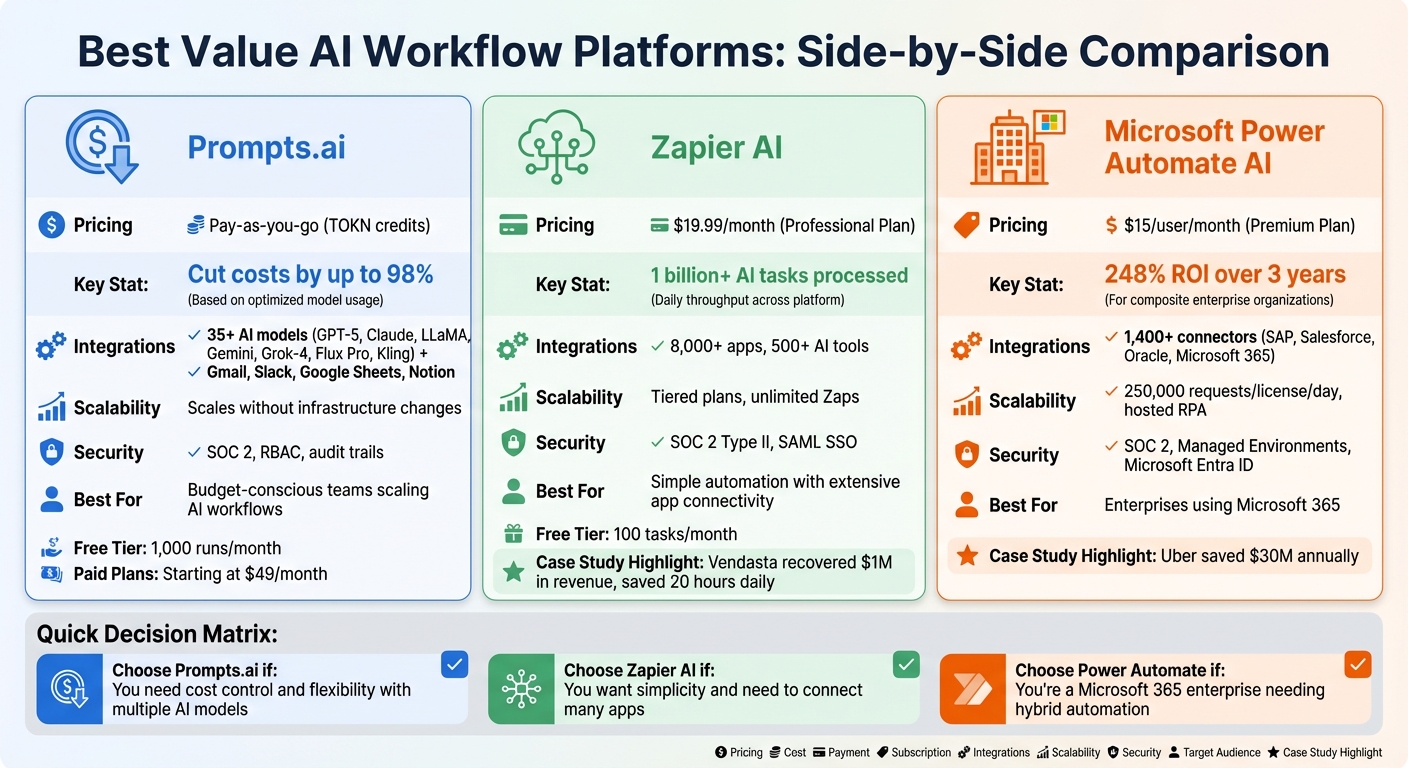
AI Workflow Platforms Comparison: Prompts.ai vs Zapier AI vs Microsoft Power Automate
Prompts.ai operates on a pay-as-you-go system using TOKN credits, ensuring you only pay for what you use. This approach can cut AI software expenses by up to 98% compared to maintaining multiple subscriptions for different models. With its built-in FinOps layer, the platform tracks token usage in real time, flagging costly workflows before they spiral out of control. This transparency allows finance teams to align AI spending with business objectives. Plus, during periods of low activity, you avoid unnecessary costs altogether.
Prompts.ai brings together over 35 leading large language models - including GPT-5, Claude, LLaMA, Gemini, Grok-4, Flux Pro, and Kling - into one cohesive interface. Teams can link everyday tools like Gmail, Slack, Google Sheets, and Notion to these models using an intuitive visual interface. By centralizing access, the platform simplifies workflows and reduces the inefficiencies caused by juggling multiple tools.
From small-scale pilots to full enterprise rollouts, Prompts.ai adapts without requiring major infrastructure changes. Adding new models, users, or teams is a matter of minutes, not months. The platform handles increased demand while keeping costs transparent, so scaling up doesn’t lead to surprise expenses or reduced performance. Its flexible architecture is paired with robust governance features to ensure smooth growth.
Prompts.ai prioritizes security with enterprise-grade controls like SOC 2 certification, role-based access control (RBAC), and detailed audit trails. These tools protect sensitive data while ensuring compliance with regulatory standards. Every AI interaction is auditable and traceable, giving security teams full visibility without slowing down deployment. This balance of security and usability helps organizations maintain trust and efficiency.
Zapier stands out in AI workflow automation by charging only for completed actions, or "tasks." Triggers and data checks don’t count against your quota, making costs easier to predict compared to credit-based systems. Tools like Filters and Paths are included at no extra cost, allowing you to create advanced workflows without additional fees. Plus, AI tools such as Zapier Copilot and AI by Zapier, powered by OpenAI, are included in every plan, eliminating the need for separate AI subscriptions.
In October 2025, Vendasta recovered $1 million in lost revenue by automating lead enrichment and CRM updates. Jacob Sirrs, their Marketing Operations Specialist, led this initiative, saving the sales team 20 hours of manual work daily. Similarly, Premiere Property Group saved $115,000 annually by automating onboarding and marketing workflows for over 1,300 real estate agents.
Zapier offers flexible pricing, starting with a free plan at $0/month for 100 tasks. The Professional plan, priced at $19.99/month (billed annually), supports 750 tasks and multi-step automation, while the Team plan costs $69/month for 2,000+ tasks and includes shared connections for up to 25 users. If you exceed your task limit, Zapier uses a pay-per-task model at 1.25x the base rate, ensuring workflows continue uninterrupted without requiring an immediate upgrade.
With connections to over 8,000 apps, including nearly 500 AI-specific tools, Zapier ensures seamless integration with essential platforms like Slack, Gmail, Salesforce, HubSpot, Microsoft Outlook, and Google Workspace. The Model Context Protocol (MCP) acts as a bridge, enabling external AI platforms like ChatGPT and Claude to perform over 30,000 actions across Zapier’s app ecosystem. Each MCP tool call consumes two tasks from your quota.
Between 2024 and 2025, Remote’s three-person IT team used Zapier to automate 1,100 monthly support tickets by integrating Slack, Okta, ChatGPT, and Notion. This automation resolved 28% of tickets automatically, saving over 600 hours monthly and avoiding $500,000 in staffing costs. Marcus Saito, Head of IT and AI Automation, remarked:
"Zapier makes our team of three feel like a team of ten."
For apps without native integrations, Zapier provides Webhooks and a developer platform for custom connections. Additionally, it can pull context from internal data stored in tools like Google Drive, Notion, and Confluence, enhancing AI-driven decisions.
Zapier’s tiered plans cater to everyone from individual users to large enterprises, scaling effortlessly without infrastructure changes. The platform has processed over 1 billion AI tasks and supports more than 1 million companies. All plans include unlimited Zaps, and the cost per task decreases with higher-tier plans. The Enterprise plan offers unlimited users, advanced admin controls, and VPC Peering for secure connections to internal data.
For example, Popl, a digital business card company, automated over 100 workflows using Zapier and OpenAI. By managing demo requests from HubSpot and Salesforce, triaging emails, and enriching lead data in real time, Popl saved $20,000 annually by eliminating the need for custom integrations. The no-code visual editor empowers non-technical staff to build and adjust workflows, avoiding IT bottlenecks as operations grow.
Zapier prioritizes security with SOC 2 Type II and SOC 3 compliance. Features like audit logs and role-based access controls provide enhanced oversight. The Team plan includes SAML SSO and shared app connections, eliminating the need to share passwords or API keys. For Enterprise customers, advanced admin permissions, custom data retention policies, and detailed audit trails ensure secure and compliant workflow management.
Microsoft Power Automate AI offers pricing that starts at $15 per user per month for the Premium plan. This includes features like cloud flows, attended RPA, 5,000 monthly AI Builder credits, and process mining tools. For organizations aiming to scale unattended automation, the Process license is $150 per bot per month, while the Hosted Process option costs $215 per bot per month. The Hosted Process option eliminates the need for infrastructure management by running bots on Microsoft-hosted virtual machines.
The platform boasts an impressive 248% ROI over three years, with notable success stories such as Uber saving $30 million annually and CoreLogic achieving a fivefold reduction in costs. John Haisch, VP of AI and Automation at Nsure, detailed their transformation:
"It used to take over 100 people to validate and standardize data to and from carriers. With generative AI and Power Automate, this same process can be managed by just a few people."
This shift has resulted in a 50% cost reduction, with generative AI-enabled workflows replacing manual processes. The inclusion of Copilot in Power Automate allows users to create workflows using natural language, cutting development time by up to 60% in enterprise scenarios. Additionally, the 5,000 AI Builder credits included with paid licenses cover document processing and prediction models, eliminating extra per-transaction fees.
Beyond cost savings, Power Automate integrates seamlessly with existing enterprise systems, enhancing its overall value.
Power Automate connects to over 1,400 prebuilt connectors, enabling integration with major enterprise platforms like SAP, Salesforce, Oracle, and the Microsoft 365 suite (Teams, Excel, SharePoint, Outlook). This connectivity minimizes context switching and maximizes the value of existing software investments. The platform combines Digital Process Automation for cloud-based services with Robotic Process Automation for legacy systems, ensuring smooth operations across diverse environments.
For example, Komatsu Australia saved over 300 hours of manual data entry for a single supplier during a pilot project for invoice automation, which was completed in just three weeks. The platform's modular design also allows for quick reuse of functions, as noted by Michael O'Brien of CoreLogic:
"Power Automate has made it really easy to build commonly used functions and piece them together quickly like bricks."
This flexible integration framework supports scalability to meet the needs of growing enterprises.
Power Automate is designed to scale from individual users to enterprise-wide operations through its flexible licensing model. The Hosted Process license offers zero-infrastructure RPA, complete with auto-scaling capabilities in hosted machine groups. These groups adapt to demand spikes and balance workloads across bot pools. For organizations with higher automation needs, Power Platform Request limits can be stacked - Premium plans allow 40,000 requests per user/day, while Process plans accommodate 250,000 requests per license/day.
A case study from Brisa highlights the platform's scalability: training 40 users in Power Automate resulted in annual savings of 233 person-days. Employees engaged in high-impact RPA tasks save around 200 hours per year. Governance at scale is managed through "Managed Environments", which provide centralized visibility, comprehensive monitoring, and data loss prevention policies. Chad Aronson, Global Head of Intelligent Automation at Uber, praised the platform's alignment with their strategic goals:
"With Power Automate, we get the benefits of a Power Platform ecosystem that aligns with our future plans, including what we see as leading generative AI and process mining capabilities."
Microsoft Power Automate has been recognized as a Leader in the 2025 Gartner® Magic Quadrant™ for Robotic Process Automation, underscoring its strong governance and security features. Managed Environments offer centralized controls, audit trails, and data loss prevention (DLP) policies to safeguard sensitive information across workflows. Role-based access controls and integration with Microsoft Entra ID (formerly Azure AD) ensure secure authentication and authorization throughout the organization. These robust security measures enhance the platform’s reliability, making it a trusted choice for organizations focused on efficient and secure AI workflows.
This section outlines the trade-offs between cost, functionality, and usability for each platform.
Prompts.ai stands out for its affordability, offering a generous free tier of 1,000 runs per month and starter plans starting at $49 per month. It supports advanced workflow features like loops, branches, and parallelism, making it a strong choice for technical teams. Additionally, built-in observability tools track token costs and execution traces, helping teams stay within budget. However, its ecosystem is still in its early stages compared to more established platforms, though features like versioning and role-based access control make it production-ready for many use cases.
Zapier AI is known for its simplicity, offering over 8,000 integrations that connect nearly any business app without requiring code. While it’s easy to use, costs can quickly rise - running 100 active workflows on the Professional plan costs approximately $588 per month. Moreover, the platform lacks support for advanced loops and branching, which can limit its effectiveness for more complex automation needs.
Microsoft Power Automate AI offers competitive pricing starting at $15 per user per month, making it a good fit for enterprises already using Microsoft 365. It excels in hybrid automation by combining cloud workflows with desktop RPA, allowing integration with legacy systems. Its deep integration with Teams, SharePoint, and Outlook helps businesses maximize their existing software investments. However, the platform has a steep learning curve for non-technical users and may lead to ecosystem lock-in, reducing flexibility outside the Microsoft suite.
When choosing a platform, broader operational needs should also be considered. Organizations focused on cost control might prefer self-hosted options to avoid per-execution fees. Teams managing complex workflows will benefit from platforms that support true loops and parallelism rather than linear triggers. On the other hand, simpler tools are ideal for low-volume tasks where quick setup is more important than monthly subscription costs. Balancing affordability with advanced features is key to creating scalable AI workflows.
Prompts.ai stands out as a versatile platform, offering practical solutions for teams of all sizes. By combining cost-effective tools, real-time budgeting capabilities, and scalable automation, it ensures users can efficiently manage workflows without breaking the bank. For teams handling high-volume tasks, the integrated FinOps tools provide detailed insights into token costs, allowing for better budget management as usage scales up.
For individual users or those new to automation, Prompts.ai simplifies the process with user-friendly integrations and an easy-to-navigate interface. If you're already using ChatGPT Plus, the included Agent Builder adds immediate value to your workflows without adding extra software costs.
Small teams with technical expertise benefit from Prompts.ai's clear cost controls and straightforward pricing structure. For example, a lead qualification workflow managing 1,000 daily leads can create significant computational demands. However, Prompts.ai's pay-as-you-go TOKN credit system ensures costs remain tied to actual usage, avoiding the unexpected spikes often seen with traditional pricing models.
Larger organizations and industries with strict regulations will appreciate the platform's built-in versioning, role-based access control, and detailed compliance features. With SOC 2 certification and robust security measures, Prompts.ai supports production-grade applications while maintaining the highest security standards.
What truly sets Prompts.ai apart is its ability to balance ease of use with the flexibility to scale. Its pricing adapts to the complexity of your workflows, enabling comprehensive automation solutions without penalizing growth. With Prompts.ai, you can count on predictable costs, efficient operations, and a platform designed to grow with your automation needs.
Prompts.ai offers budget-friendly AI workflow solutions with a pay-as-you-go pricing model, ensuring you pay solely for what you use. The platform includes real-time cost tracking, enabling you to keep a close eye on your expenses and maintain control over your budget.
Its dynamic prompt routing feature further reduces costs by directing simpler tasks to more affordable AI models, potentially cutting expenses by as much as 40%. These tools make it possible for businesses to achieve efficiency and scale their operations without stretching their budgets, positioning Prompts.ai as a smart option for professionals in search of cost-conscious AI solutions.
Prompts.ai places a strong emphasis on keeping your data secure by using Role-Based Access Control (RBAC). This system ensures that only the right people can access specific data, limiting exposure to unauthorized users. To further bolster security, audit logs are maintained, allowing all activities to be monitored and tracked for added transparency and accountability.
These measures are crafted to safeguard sensitive information while supporting smooth and secure workflows for your AI-powered operations.
Prompts.ai grows alongside your business by providing flexible and scalable solutions that align with your specific requirements. Its pay-as-you-go pricing model ensures you only pay for the resources you use, helping you manage costs effectively as your business scales.
With real-time expense tracking, budgeting and cost forecasting become more manageable. Whether you're running a small startup or overseeing a large enterprise, Prompts.ai equips you with the tools to expand seamlessly without sacrificing performance or affordability.