Pay As You Go - AI Model Orchestration and Workflows Platform



The right AI platform can transform how your business operates. From cutting costs to improving efficiency, AI integration platforms streamline workflows, connect tools, and reduce manual work by up to 80%. This article compares three leading options - Prompts.ai, Zapier, and Workato - focusing on connectivity, automation, cost efficiency, and governance. Here’s what you need to know:
Quick Comparison:
| Feature | Prompts.ai | Zapier | Workato |
|---|---|---|---|
| Strength | AI orchestration | App integration | Enterprise tools |
| Pricing | Pay-as-you-go | Per-task ($19.99+) | Premium ($1,000+) |
| Best For | AI-focused teams | Non-technical users | IT teams |
| Integration | 35+ AI models | 8,000+ apps | 1,200+ apps |
| Deployment | Cloud, enterprise-ready | Cloud-only | Cloud/on-premises |
| Learning Curve | Moderate | Low | High |
Next Steps: Evaluate your team’s needs, technical skills, and budget. Prompts.ai is a great choice for AI-heavy workflows, Zapier excels in app compatibility, and Workato suits enterprises with complex systems.
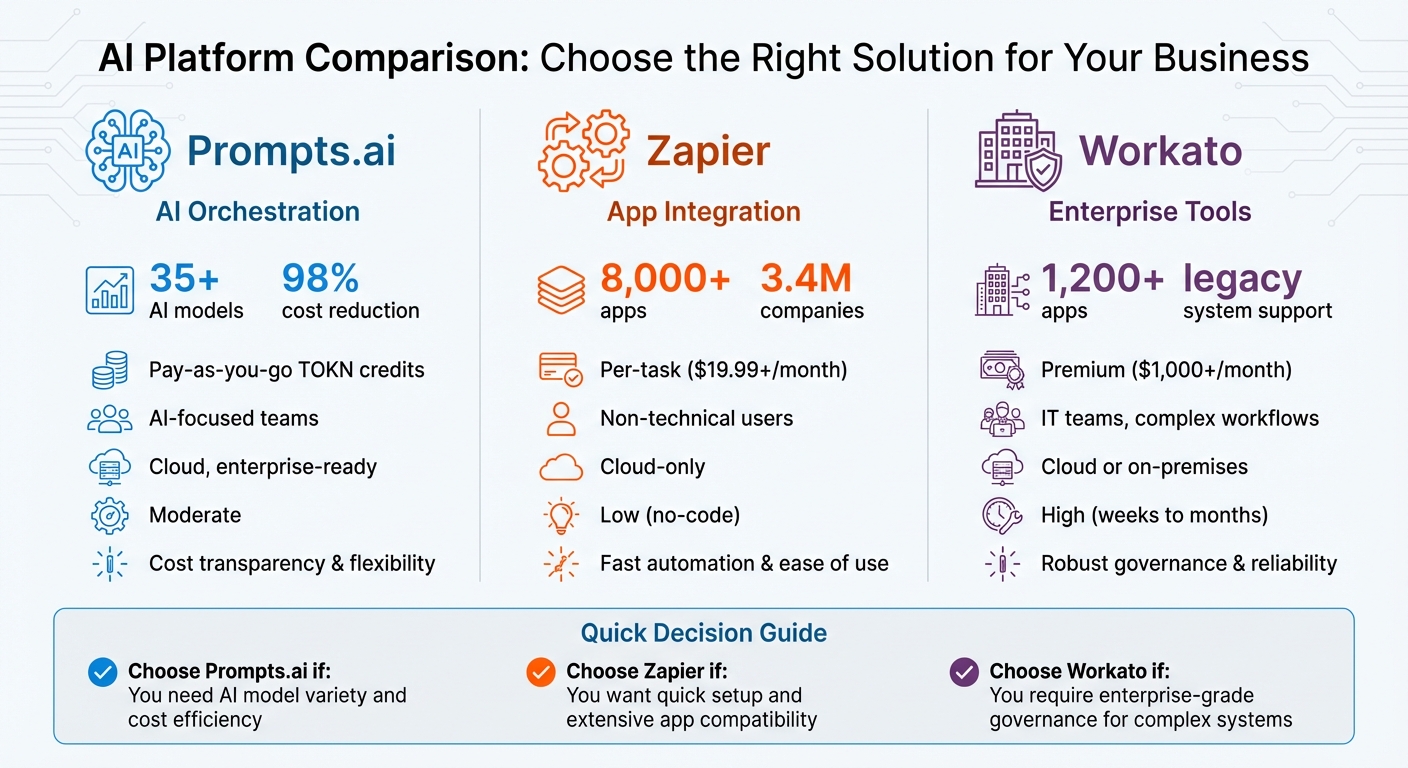
AI Platform Comparison: Prompts.ai vs Zapier vs Workato Features and Pricing
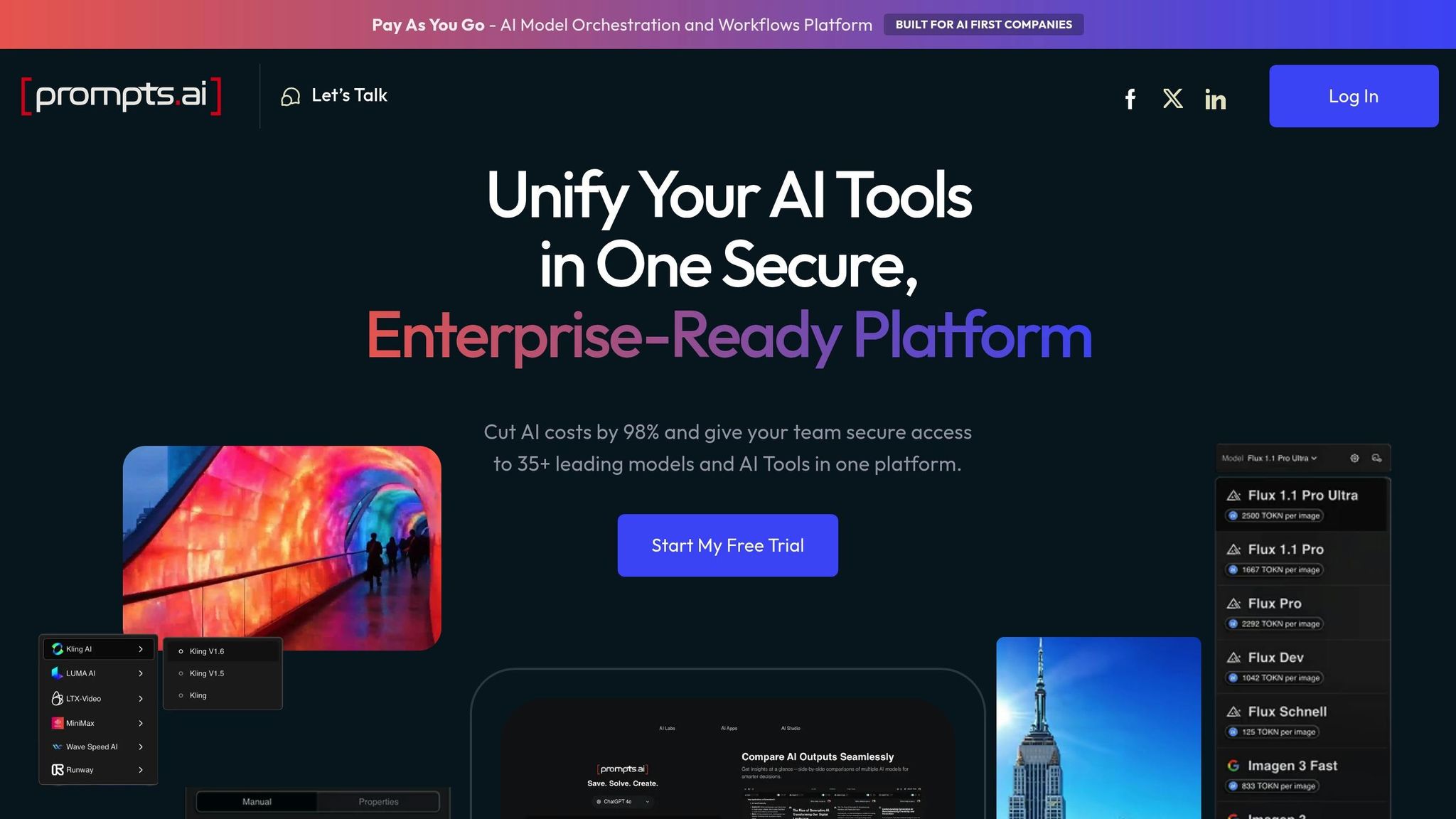
Prompts.ai simplifies how businesses connect their systems by using the Model Context Protocol (MCP). This protocol integrates over 35 top-tier large language models (LLMs) directly into existing workflows and tools, creating a unified AI orchestration layer. It ensures smooth communication between apps, data sources, and AI models, so teams don’t have to juggle multiple platforms or APIs.
With its no-code capabilities, even non-technical users can link advanced LLMs like GPT-5, Claude, LLaMA, and Gemini without writing code. This ease of use empowers marketing, sales, and operations teams to build advanced workflows in minutes, bypassing the need for IT intervention. This streamlined connectivity paves the way for faster and smarter automation.
Prompts.ai speeds up AI model development, helping teams build, test, and refine their processes up to 10× faster. Its unified interface eliminates the hassle of switching between disconnected tools, allowing teams to focus on creative and strategic tasks instead of administrative ones. For example, sales teams can reclaim hours previously lost to non-selling tasks, while customer service teams can use AI workflows to handle over 175 inquiries monthly, cutting inbound call handling time by as much as 50%. Many businesses see measurable returns on investment within 30 to 90 days of implementation. This efficiency leads to lower costs and better allocation of resources.
Prompts.ai’s pay-as-you-go TOKN credit system replaces traditional subscription fees, aligning costs directly with actual usage. This model, combined with real-time FinOps controls, can reduce AI software expenses by up to 98% compared to managing multiple vendor subscriptions. The platform’s cost transparency ties spending to specific business outcomes, making budget discussions clearer and more data-driven.
Security is a cornerstone of Prompts.ai’s design. The platform offers role-based access, detailed audit trails, and compliance frameworks that don’t slow down deployment. Teams can enforce governance policies across all AI interactions, monitoring model access and usage while retaining the flexibility needed for quick experimentation and iteration.
Platform B, known as Zapier, connects over 8,000 apps and more than 300 AI tools, offering businesses an extensive integration network. It supports major large language models like ChatGPT, Claude, Gemini, and Perplexity, enabling teams to create workflows that integrate seamlessly across their entire tech stack. Its secure protocol links AI platforms to over 30,000 specific actions within Zapier's ecosystem. The platform’s visual orchestration layer simplifies workflow mapping with minimal setup. Trusted by over 3.4 million companies globally, including 87% of the Forbes Cloud 100, Zapier powers automation at scale with ease.
Zapier’s Zaps incorporate AI steps to summarize, respond, and analyze data within a single tool. The platform also features AI Agents that can be trained using natural language to handle research-intensive tasks and execute actions autonomously across connected systems. For example, Remote.com automated 27.5% of its IT tickets, saving $500,000 per month and dramatically improving operational efficiency.
Marcus Saito, Head of IT and AI Automation at Remote.com, shared: "Zapier makes our team of three seem like a team of ten."
Each month, users automate more than 23 million AI tasks on Zapier, leveraging these tools to streamline operations and control costs effectively.
Zapier helps users manage costs with features like cost-cap alerts and its Copilot tool. Cost-cap alerts automatically halt AI calls once budget limits are reached, preventing unexpected expenses. The Copilot feature simplifies building automation workflows using straightforward prompts, reducing the time and technical expertise required to implement solutions.
Zapier ensures secure and compliant operations with a range of governance tools. Enterprise features include SSO, SCIM, two-factor authentication, detailed audit logs, and secure data access through VPC Peering. The platform complies with SOC 2 Type II, SOC 3, GDPR, and CCPA standards. Organizations can restrict third-party AI app integrations and benefit from a Model Training Opt-out feature, ensuring Enterprise customers’ data is excluded from AI training models by default. These measures provide peace of mind while maintaining operational control.
Platform C, known as Workato, bridges the gap between modern SaaS tools, on-premises ERP systems, and older legacy systems. It connects widely-used applications like Salesforce and Workday, integrates with on-premises ERP solutions such as SAP, and even supports outdated systems still in operation.
The platform works seamlessly with enterprise databases like Oracle, SQL Server, and MySQL, while also supporting cloud-based data platforms such as Snowflake and Redshift. Beyond structured data, Workato can integrate unstructured sources like documents and transcripts, offering a broad range of data integration options. For custom applications, its no-code REST connector makes integration quick and efficient, expanding its versatility.
These capabilities enable businesses to create workflows that are intelligent and responsive to evolving needs.
Workato embeds AI agents directly into workflows, enabling systems to make informed decisions based on real-time data. This feature allows workflows to adjust to varying tasks and shifting business demands.
The platform also incorporates human oversight through approval actions in tools like Slack. Teams can review AI-generated outputs and validate critical decisions before they are implemented. By blending automated processes with human input, Workato ensures operational decisions are both efficient and reliable. With tools like Canvas for workflow mapping, Interfaces for creating custom applications, and orchestration features, Workato delivers a comprehensive system for automating entire business processes. These responsive workflows contribute to noticeable gains in efficiency.
Workato enhances its integration and workflow tools with a strong focus on security and control.
The platform offers centralized identity management through SSO/SAML and SCIM for automated user provisioning. IT administrators can also use domain capture to monitor all accounts created under their corporate domain, ensuring full visibility.
Granular permission settings let IT teams enforce security policies at every level. Administrators can control which third-party AI applications are granted access to their systems and can disable or limit specific integrations to uphold compliance and security standards. This combination of flexibility and robust governance helps organizations maintain a secure and controlled environment.
Here's a comparison of the strengths and challenges of three platforms, highlighting how each one optimizes workflows and integrates data across both legacy and modern systems.
Prompts.ai stands out by consolidating 35+ AI models into a single interface, providing transparent FinOps controls that can cut AI software costs by up to 98%. This is achieved through its pay-as-you-go TOKN credit system, ensuring spending aligns with actual usage. It also offers enterprise-grade governance for secure data handling. Additionally, the Prompt Engineer Certification program and the community-driven "Time Savers" library enable teams to quickly build expertise and scale operations across departments.
Platform B (Zapier) shines with its extensive app integration ecosystem and an intuitive no-code interface, allowing non-technical users to create workflows in a matter of hours. For example, in early 2026, the European real-estate CRM SweepBright used Zapier Enterprise to automate 27 million tasks per month. However, its per-task pricing can become costly at scale, and it lacks advanced branching logic and a dedicated IDE for developers who require deeper customization.
Platform C (Workato) offers enterprise-level reliability with pre-built AI agents, known as "Genies", and a customizable Agent Studio. It is well-suited for mission-critical infrastructure. That said, its premium pricing starts at $1,000 per month or $10,000–$25,000 annually, and implementing complex workflows often requires weeks or even months.
The table below provides a concise comparison of the core features, pricing models, and ideal users for each platform:
| Feature | Prompts.ai | Platform B (Zapier) | Platform C (Workato) |
|---|---|---|---|
| Primary Strength | Unified AI orchestration with 98% cost savings | 8,000+ integrations, rapid deployment | Enterprise reliability and governance |
| Pricing Model | Pay-as-you-go TOKN credits | Per-task ($19.99/mo+) | Premium ($1,000+/mo) |
| Best For | AI-focused teams needing flexibility | Non-technical users, fast automation | IT teams managing complex workflows |
| Integration Library | 35+ AI models, business systems | 8,000+ apps | ~1,200 apps |
| Deployment | Cloud, enterprise-ready | Cloud-only | Cloud or on-premises |
| Learning Curve | Moderate (community support) | Very low (no-code) | Steep (weeks to months) |
Choosing the right platform depends on factors like technical expertise, workflow complexity, and budget. Teams focused on AI model variety and cost efficiency often lean toward Prompts.ai. Those who need extensive app compatibility may prefer Platform B, while Platform C is ideal for enterprises needing robust governance for critical systems.
Prompts.ai brings together powerful features to simplify operations through advanced AI orchestration. By offering access to over 35 AI models and transparent cost management via the pay-as-you-go TOKN system, the platform helps businesses consolidate tools and cut software expenses by as much as 98%. With its "Time Savers" library and Prompt Engineer Certification, teams can implement workflows across departments quickly and without requiring extensive technical expertise.
For companies focused on automating workflows and controlling costs, Prompts.ai combines enterprise-level governance with the flexibility to experiment and innovate. The Model Context Protocol ensures smooth communication between applications, data sources, and AI models, removing the hassle of managing multiple platforms or APIs. Teams can design, test, and optimize processes up to 10× faster, with many organizations reporting noticeable returns within 30 to 90 days.
By aligning Prompts.ai with your business goals, you can seamlessly integrate AI into your operations, boosting productivity by up to 40%. This makes choosing Prompts.ai more than just a software decision - it’s a strategic investment in your company’s future.
To get started, assess your current technology, team readiness, and the processes you want to automate. Prompts.ai provides trial options, so you can explore its capabilities and see how unified AI orchestration can transform your workflows before committing to a full-scale deployment.
Prompts.ai’s pay-as-you-go TOKN credit system gives you access to more than 35 AI models while allowing you to manage costs effectively. With TOKN credits, you’re only charged for what you use, enabling real-time expense tracking and better budget management.
This approach can help businesses cut AI-related expenses by as much as 98%, offering a smart way to incorporate AI into workflows without exceeding your budget. Built for clarity and scalability, it lets you streamline operations and enhance teamwork without financial surprises.
Prompts.ai provides strong governance tools designed to keep businesses secure and efficient. Key features include role-based access controls for managing user permissions, real-time audit logs to monitor activity, and adherence to global regulations such as GDPR, HIPAA, and the EU AI Act.
The platform also prioritizes cost management with tools like real-time cost tracking and a flexible pay-as-you-go TOKN credits system, giving businesses full control over their AI usage and expenses.
Prompts.ai offers a streamlined platform that connects over 35 AI models, including GPT-4 and Claude, all under a pay-as-you-go pricing structure. By centralizing these tools, it eliminates the hassle of juggling multiple systems, making AI model development and scaling far more efficient.
The platform’s built-in orchestration features handle workflows by seamlessly linking AI models and managing data flows. This automation reduces manual tasks, shortens development timelines, and boosts productivity. Additional tools like real-time cost tracking and enterprise-level security ensure businesses can stay within budget while adhering to compliance standards.
By tackling challenges such as tool overload, budget control, and security concerns, Prompts.ai enables organizations to concentrate on building impactful AI solutions without unnecessary distractions.