Pay As You Go - AI Model Orchestration and Workflows Platform



AI workflow platforms have become essential for scaling AI in 2026, but challenges like interoperability, cost control, and governance remain barriers. With 95% of generative AI pilots failing to reach production and only 2% of organizations deploying AI agents at scale, choosing the right platform is critical. This article evaluates three platforms - Prompts.ai, Platform X, and Solution Y - based on key factors like efficiency, compliance, and scalability.
| Feature | Prompts.ai | Platform X | Solution Y |
|---|---|---|---|
| Target Audience | Enterprises, all teams | Developers, large-scale | Non-technical users |
| Interoperability | 35+ LLMs, unified interface | Open Agent Protocol | MCP-supported workflows |
| Pricing Model | Pay-as-you-go (TOKN credits) | Execution-based | Enterprise consultation |
| Governance | Role-based, audit trails | Self-hosted option | Centralized safeguards |
| Scalability | Add models/users easily | 220 executions/second | Prebuilt tools, templates |
For cost efficiency and governance, Prompts.ai is ideal. Platform X suits regulated industries needing self-hosted options, while Solution Y simplifies AI for non-technical teams. Start with a 30-day pilot to test workflows and ensure alignment with your goals.
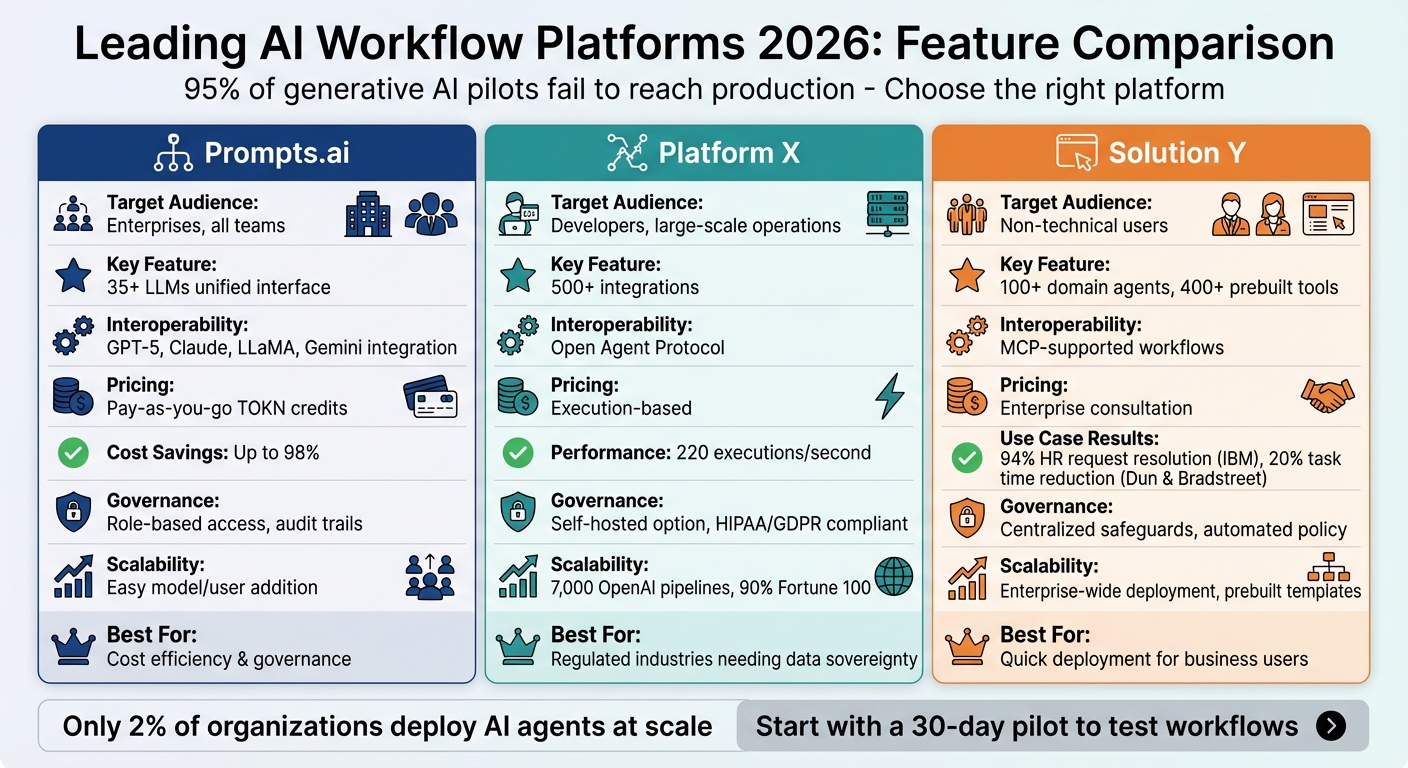
AI Workflow Platform Comparison 2026: Prompts.ai vs Platform X vs Solution Y
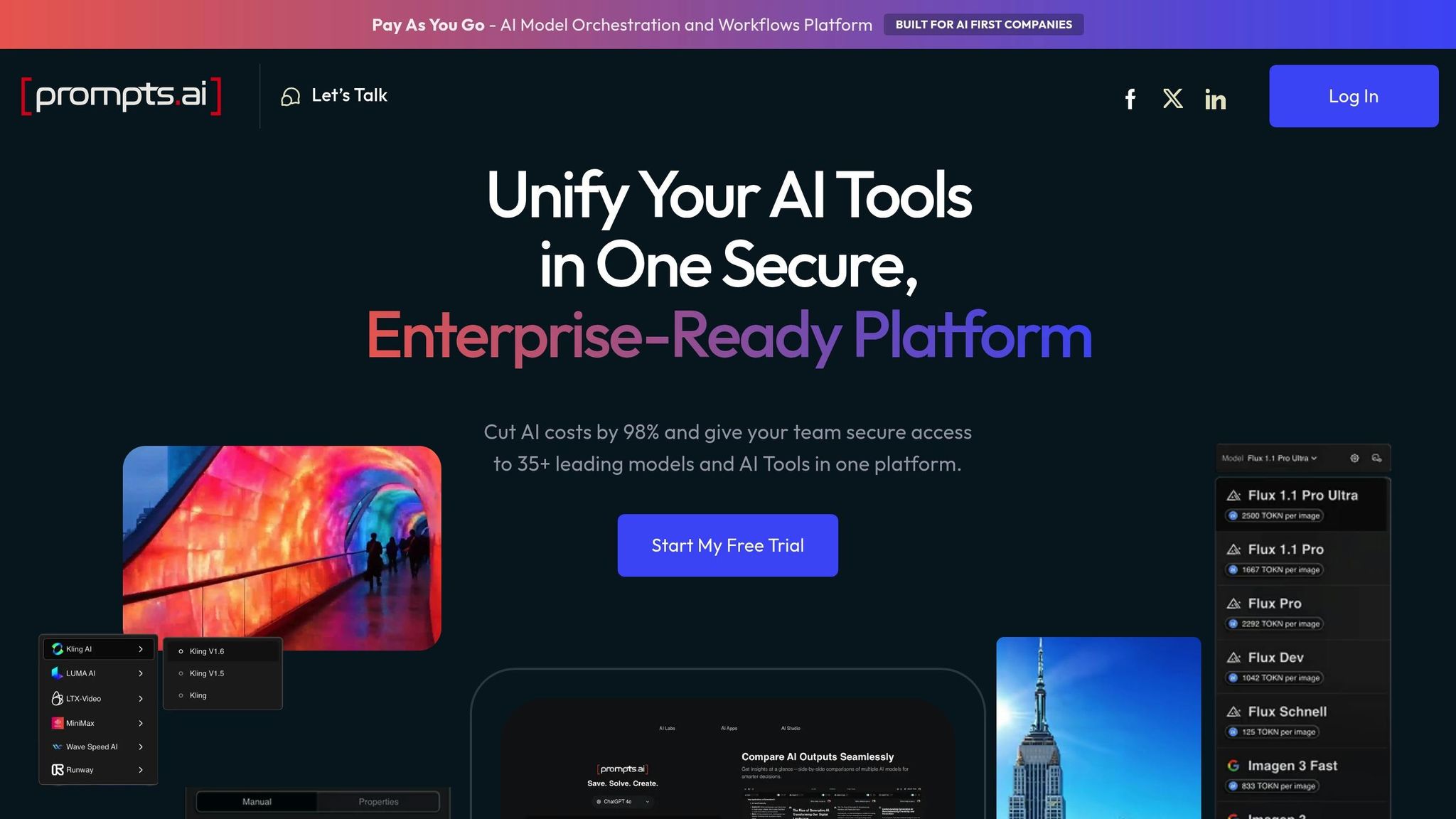
Prompts.ai introduces itself as an enterprise-level AI orchestration platform, bringing together over 35 large language models, such as GPT-5, Claude, LLaMA, and Gemini, into a single, secure interface. It tackles challenges like interoperability, cost management, and governance while simplifying integration processes.
Prompts.ai offers a unified interface that makes managing multiple vendors and API configurations far simpler. Teams can switch effortlessly between models like GPT-5, Grok-4, Claude, and Gemini without needing to rebuild integrations or rewrite code. The platform provides side-by-side performance comparisons and standardized workflows, enabling organizations to test and select the best model for specific tasks without being tied to a single vendor. This approach ensures streamlined operations that are both cost-effective and compliant.
Prompts.ai's financial operations (FinOps) system tracks token usage in real time, linking AI expenditures directly to business outcomes. The platform claims it can cut AI software costs by up to 98% using its TOKN credit system, which replaces subscription fees with a pay-as-you-go model based on actual usage. Additionally, the visual builder and prompt-based agent creation tools allow non-technical teams - such as those in marketing, operations, and finance - to independently build and refine AI agents. This reduces dependence on specialized engineering teams, saving resources and accelerating results.
Prompts.ai integrates enterprise-grade governance tools into every workflow, providing features like role-based access controls and detailed audit trails for AI interactions. These tools support compliance with regulatory requirements and offer full transparency into model usage, team activities, and data flows. This makes it easier for organizations to implement and maintain strong governance policies.
The platform is designed to grow with organizations, allowing them to add new models, users, and teams quickly. Prompts.ai offers hands-on onboarding, enterprise training, and a Prompt Engineer Certification program that promotes best practices and develops internal experts. This collaborative approach helps teams move from one-off experiments to scalable, repeatable, and compliant processes.
In a world where integration and governance are critical, Platform X brings a fresh perspective to AI workflow management. By leveraging a graph-based approach, it structures workflows as directed graphs. Each node represents a computational step, while edges dictate the execution flow. This setup allows teams to fine-tune how AI agents interact and communicate, even in the most intricate workflows.
Platform X utilizes the open Agent Protocol to enable smooth communication between AI agents across various frameworks. This means workflows created in Platform X can easily connect with systems like CrewAI or Microsoft Agent Framework without requiring extra integration work. For organizations using multiple AI frameworks, this centralized orchestration reduces the complexity of managing different systems.
The platform offers a hybrid deployment model, keeping control in the cloud while ensuring sensitive workloads stay on-premises. This feature is particularly important for industries like healthcare and banking, where regulations such as HIPAA demand that data remains on internal servers. Additionally, Platform X meets GDPR standards, making it a reliable choice for companies operating in regions with strict data protection laws.
Platform X’s infrastructure supports 7,000 OpenAI pipelines, is a key component of GitHub Copilot, and serves 90% of Fortune 100 companies. Furthermore, it’s used by 60% of enterprises with over 50,000 employees. The platform also features an AI assistant that enhances data engineer productivity by a factor of ten, enabling teams to handle complex workflows with greater ease. These capabilities highlight its ability to meet the demands of large-scale operations.
Built upon Platform X's graph-based methodology, Solution Y provides an alternative approach tailored for non-technical users. Its intuitive scenario builder connects AI tools through branching, iteration, and data transformation, making it easier to design workflows without technical expertise. By focusing on connectivity and operational efficiency, Solution Y enables businesses to integrate AI tools seamlessly into existing systems, eliminating the need to overhaul their infrastructure.
Solution Y supports integration with multiple AI models and includes a Model Context Protocol (MCP) server option to ensure smooth connectivity. Pre-built workflow templates simplify common tasks, such as summarizing Gmail content with OpenAI and directing the results to Slack. Advanced routing and mapping features offer flexibility to adapt workflows as business needs change. With these capabilities, the platform ensures that integration is not only simple but also adaptable as organizations grow.
The platform prioritizes centralized control with built-in safeguards and automated policy enforcement, ensuring AI agents operate within corporate and regulatory guidelines. Its secure infrastructure protects sensitive business data while enabling efficient deployment of AI agents. For instance, IBM used Solution Y to instantly resolve 94% of over 10 million annual HR requests, and Dun & Bradstreet reduced procurement task times by 20% using the platform.
Designed for efficiency and large-scale operations, Solution Y supports enterprise-wide deployment across diverse business units. It manages the entire machine learning lifecycle, including training, tuning, deployment, and monitoring. With a library of over 100 domain-specific agents and 400+ prebuilt tools, the platform facilitates multi-agent orchestration across departments. Recognized for its excellence, Solution Y was named a Leader in the 2025 Magic Quadrant™ for AI Application Development Platforms and received the 2025 iF and Red Dot awards for its product design.
This section provides a clear look at the strengths and challenges of each platform, offering insights into how they align with operational needs.
Prompts.ai stands out by integrating over 35 models into a single, secure interface. Its pay-as-you-go TOKN credit system, combined with real-time FinOps controls, can reduce AI software costs by up to 98%. Additionally, its enterprise-level governance tools and extensive prompt workflow library make it a strong choice for teams prioritizing secure and compliant orchestration without the hassle of managing multiple subscriptions.
Platform X takes a developer-focused approach with 500 integrations and flexible code-based connectivity. Its execution-based pricing ensures predictable costs even in complex workflows. The option for self-hosted deployment provides data sovereignty, a key benefit for regulated industries, though this requires DevOps expertise for setup and ongoing maintenance.
Solution Y is tailored for non-technical users, offering an intuitive interface and a library of prebuilt tools. It supports interoperability standards like the Model Context Protocol (MCP), enabling AI agents to work with third-party tools through a unified interface. While its enterprise pricing requires consultation for specifics, Solution Y is designed for quick, scalable deployment with minimal technical effort.
When comparing these platforms side by side, key distinctions emerge. Platform X's code fallback allows developers to integrate APIs using JavaScript or Python, while Solution Y's prebuilt tools enable business users to start quickly. Prompts.ai’s pay-as-you-go model ensures expenses align with actual usage, offering a cost-efficient alternative. Additionally, Prompts.ai’s centralized interface and audit trails simplify management, whereas Platform X’s self-hosted option gives security teams direct control. For scalability, Platform X supports up to 220 workflow executions per second on a single instance, while Prompts.ai easily scales by adding models and users without requiring additional infrastructure.
"73% of enterprises choose the wrong AI workflow orchestration platform - costing them upward of $500K in wasted infrastructure, 6-12 months of deployment delays, and irrecoverable technical debt." - Likhon, AI Engineer
Organizations working with sensitive data in regulated environments may prefer the self-hosted flexibility of Platform X. On the other hand, teams looking for immediate productivity and transparent pricing might find Prompts.ai to be the better match. These factors help frame how each platform can meet specific organizational goals.
Selecting the right AI workflow platform in 2026 requires aligning your team's technical expertise with your operational goals. Code-first platforms work best for Python-savvy teams, while no-code solutions enable non-technical departments to test and iterate quickly.
Cost structure should take precedence over the initial price tag. Execution-based pricing models are more efficient for workflows that involve frequent iterations, whereas activity-based models can escalate costs as usage scales. Prompts.ai's pay-as-you-go TOKN credit system ties expenses directly to usage, avoiding the pitfalls of wasted subscription fees.
For industries dealing with sensitive data, deployment flexibility is critical. Platform X offers a self-hosted option, allowing security teams full control but requiring dedicated DevOps resources. In contrast, Prompts.ai provides centralized audit trails and role-based access controls, delivering enterprise-grade governance without additional overhead.
Bridging the gap between pilot projects and production remains a challenge - 95% of generative AI pilots fail to transition into production[1]. The lack of observability and collaboration tools often contributes to this issue. Platforms that include features like detailed logs, version control, and shared workspaces for both technical and non-technical teams can significantly improve deployment success rates. As Nicolas Zeeb from Vellum AI explains:
The path forward in 2026 is making a huge leap from being a AI automation dev-only discipline to a team sport.
To navigate this landscape effectively, adopt a focused, tactical approach. Begin with a 30-day pilot aimed at solving a specific productivity bottleneck rather than attempting an enterprise-wide transformation. Assess whether a functional workflow can be shipped within the first week and production readiness achieved by week four. This method helps identify hidden costs and integration hurdles early, ensuring the platform aligns with your team’s workflow goals.
The majority of generative AI pilots stumble before reaching full-scale production due to the complexities of managing and scaling AI workflows. Many organizations face hurdles like integrating a variety of tools, ensuring scalability, and maintaining robust security - all while keeping costs under control. While these pilots may perform well in controlled environments, they often encounter technical roadblocks such as tool incompatibility, poor interoperability, and governance challenges when attempting to scale.
On top of that, businesses frequently lack the infrastructure or specialized knowledge to handle the intricate demands of AI workflows. This includes tasks like processing unstructured data or enabling real-time decision-making. Platforms designed to unify and scale workflows while simplifying orchestration offer a practical solution to these challenges, helping organizations move from pilot projects to successful, full-scale AI deployment.
Prompts.ai helps businesses cut expenses by up to 98% by consolidating access to over 35 AI models into a single, easy-to-use platform. With real-time cost tracking, users can keep a close eye on their spending and maintain control over their budgets. The platform’s pay-as-you-go TOKN credits system ensures that you’re only charged for what you actually use, minimizing waste and optimizing your overall cost management.
Platform X, powered by Prompts.ai, is built to address the rigorous requirements of regulated industries by focusing on compliance and security. Supporting more than 35 AI models, it aligns with critical regulatory standards such as SOC 2 Type II, HIPAA, and GDPR.
With features like real-time cost tracking and smooth integration capabilities, the platform enables businesses to stay efficient while meeting compliance needs. Its secure data management and automated compliance checks reduce risks and ensure governance requirements are met, making it a reliable solution for industries under strict regulatory scrutiny.