Pay As You Go - AI Model Orchestration and Workflows Platform



Choosing the right AI workflow platform can save time, reduce costs, and streamline operations. This article reviews Prompts.ai, RunwayML, and DataRobot, highlighting their features, strengths, and limitations to help you make an informed decision.
| Platform | Key Features | Best For | Pricing Model |
|---|---|---|---|
| Prompts.ai | Unified access to 35+ LLMs, TOKN credits, FinOps tracking | Teams needing LLM orchestration | Usage-based |
| RunwayML | No-code media tools, multi-modal workflows | Visual content creators | Free tier + usage-based |
| DataRobot | Governance, compliance, automated pipelines | Enterprises with strict regulations | Flexible (SaaS, VPC, on-prem) |
Each platform addresses specific needs, from orchestrating LLMs to managing creative or enterprise workflows. Explore further details below to find the right fit for your team.
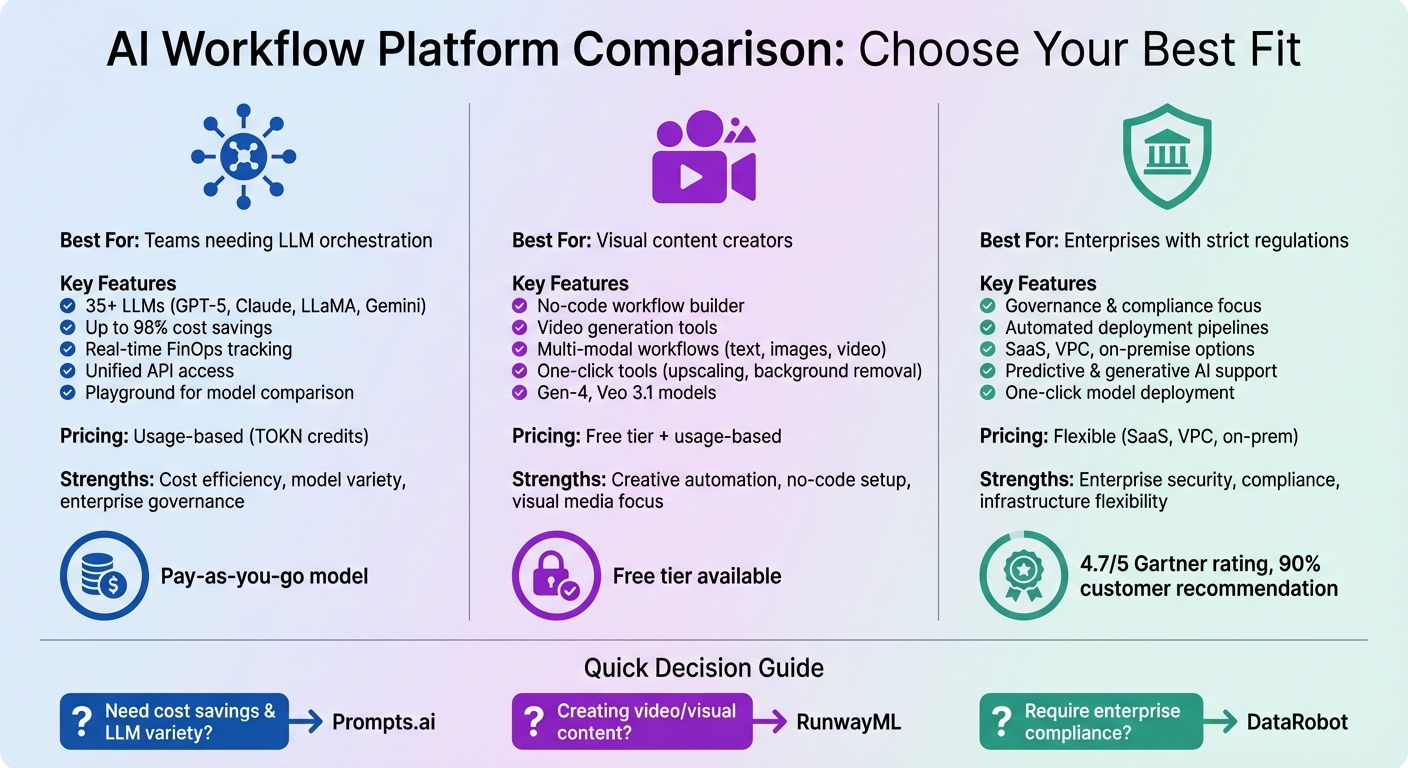
AI Workflow Platform Comparison: Prompts.ai vs RunwayML vs DataRobot
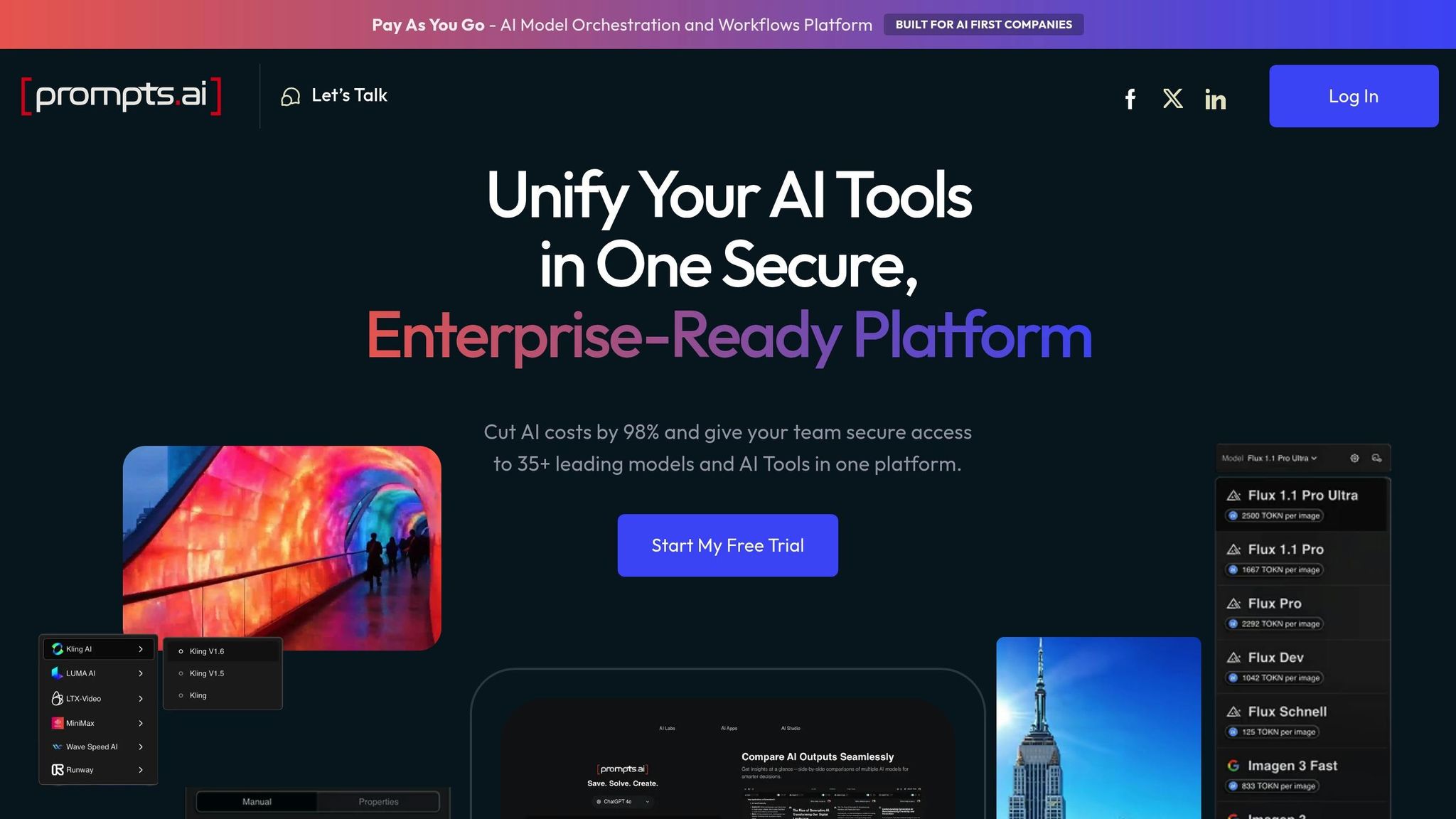
Prompts.ai serves as a central hub for AI orchestration, combining over 35 top-tier large language models like GPT-5, Claude, LLaMA, and Gemini into a single platform. By unifying these tools, it eliminates the hassle of juggling multiple vendor accounts, APIs, and billing systems, which often lead to inefficiencies and increased costs. Below is an overview of its key features.
Prompts.ai's centralized architecture simplifies the integration process with its unified API. This design removes the need for complex model-specific setups, enabling smooth transitions between models and ensuring centralized oversight. Teams can seamlessly connect AI workflows to their existing enterprise systems while maintaining robust audit capabilities. This functionality is especially valuable for businesses aiming to streamline operations and maintain consistent control across various AI tools.
The platform takes integration to the next level with its Playground environment, a testing space where users can compare different models side by side. By running the same prompt across multiple models simultaneously, teams can assess performance, accuracy, and cost in real time. This feature removes the uncertainty from choosing the right model and helps identify the most cost-effective solution for specific tasks. With support for over 35 models, Prompts.ai enables users to manage, version, and deploy prompts without the hassle of handling separate APIs or credentials.
Prompts.ai offers a transparent, usage-based pricing model that aligns costs directly with usage, eliminating recurring subscription fees. Through its pay-as-you-go TOKN credit system, users only pay for what they use. Additionally, the platform includes a FinOps layer to monitor financial operations, tracking token usage and linking expenses to specific workflows and outcomes. This approach has allowed organizations to reduce AI software costs by as much as 98%, while its real-time cost tracking helps ensure budgets stay on target.
RunwayML is a platform designed with visual content creators in mind, focusing on video generation and multi-modal workflows. Unlike platforms centered around text-based outputs, RunwayML caters to those working with visual media, streamlining video production and blending text and visual workflows seamlessly. This commitment to simplifying creative automation shapes the platform’s core features.
RunwayML’s Workflows feature enables seamless integration of different models and media types, including text, images, and video. This flexibility allows creators to design creative pipelines that suit their needs. Its API supports video generation workflows, and the platform’s no-code setup lets users combine models like Gen-4, Gen-4 Turbo, and Veo 3.1 effortlessly. This approach removes the need for technical expertise, making it accessible for teams of all skill levels.
Automation is at the heart of RunwayML. Users can save workflows as templates, ensuring consistent results while cutting down on repetitive setup tasks. The platform includes one-click tools for tasks like video upscaling, background removal, and scene relighting. By integrating prompting, generation, and refinement into a single workflow, RunwayML eliminates the need for multiple tools and manual processes, enabling teams to execute complex creative projects with ease. These features work seamlessly alongside its large language model (LLM) integrations.
RunwayML incorporates LLM nodes to enhance creative workflows. These nodes convert simple prompts into detailed instructions for media models, analyze images to produce descriptive text, and ensure consistent prompts across multiple outputs. Outputs can be directly routed into media model nodes like Gen-4 and Flash 2.5. Additionally, RunwayML supports integration with third-party tools like Zapier, enabling connections with external LLMs such as ChatGPT. This allows users to refine video concepts while maintaining creative control through customizable input nodes.
RunwayML provides a free tier alongside a usage-based pricing structure, offering flexibility for users with varying needs and budgets.
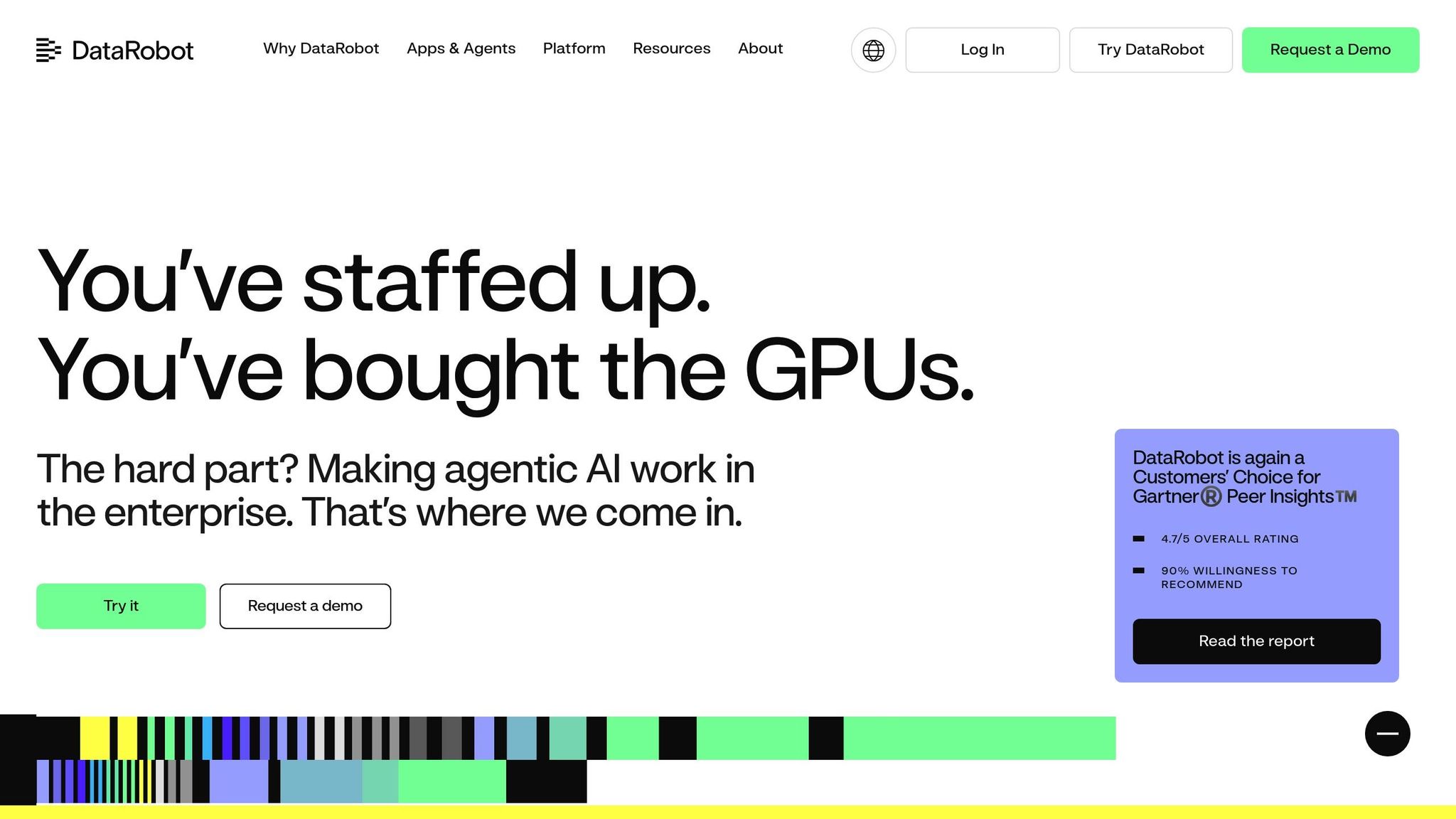
DataRobot offers a comprehensive platform for managing AI workflows, focusing on governance, compliance, and infrastructure adaptability. It caters to organizations handling both predictive and generative AI projects, ensuring strict audit trails and adherence to regulatory requirements. These features make it a strong choice for enterprises prioritizing secure and well-regulated AI operations.
DataRobot is designed as an open platform, integrating seamlessly with various data systems, including warehouses, lakes, on-premise databases, and orchestration tools. It supports frameworks like CrewAI, LangGraph, LlamaIndex, NVIDIA NeMo, and LangChain. The Model Context Protocol (MCP) ensures smooth connections between servers and tools, while the ToolClient class from the datarobot-genai package manages tool call processing across agent frameworks. Its infrastructure-neutral design allows deployments across managed SaaS, virtual private clouds, and self-managed on-premise setups.
The platform simplifies the deployment process with its automated pipeline, enabling one-click transitions from model registry to production. It automatically sets up API endpoints, observability tools, and compliance documentation, significantly reducing deployment time. As Tom Thomas, Vice President of Data Strategy, Analytics & Business Intelligence at FordDirect, shared:
"DataRobot helps us deploy AI solutions to market in half the time we used to do it before and easily manage the entire AI journey."
DataRobot also offers AI Accelerators, which include pre-designed templates for API workflows with partners like Snowflake, GCP, Azure, and AWS, removing the need for users to create workflows from scratch.
The platform supports a wide range of LLMs and SLMs, whether open-source or proprietary, giving users the flexibility to choose models that best suit their needs. Its NextGen interface brings together GenAI experiments, notebooks, and applications under a unified system, ensuring governance across the generative AI lifecycle. Additionally, the Registry centralizes model performance tracking and generates model packages for deployment. DataRobot has earned a 4.7/5 rating on Gartner Peer Insights, with 90% of customers saying they would recommend it.
DataRobot also focuses on cost control through its integration with NVIDIA GPUs, which accelerates inference and training processes. Its serverless environment further enhances efficiency by monitoring compute tasks in real time. Dynamic compute orchestration and automated resource provisioning reduce the need for manual server management and minimize wasted compute resources through intelligent workload distribution.
When choosing an AI workflow platform, it's essential to weigh the benefits and challenges of each option. This evaluation can simplify decisions, especially when considering factors like interoperability, automation, and cost savings. Below is a table summarizing the key strengths and limitations of three prominent platforms, offering a quick view of their impact on operational efficiency and system integration.
| Platform | Strengths | Weaknesses |
|---|---|---|
| Prompts.ai | Access to 35+ top LLMs (GPT-5, Claude, LLaMA, Gemini); up to 98% cost savings with pay-as-you-go TOKN credits; real-time FinOps tracking; enterprise-grade governance with full audit trails; Prompt Engineer Certification and community support | Limited details on handling state persistence for long-running agent operations |
| RunwayML | No-code visual workflow builder; one-click tools for video upscaling and background removal; smooth multi-modal integration (text, images, video); free tier with flexible usage-based pricing | Faces industry-wide issues like integration barriers, observability gaps, and state persistence challenges |
| DataRobot | Deploys across SaaS, VPC, and on-premise environments; automated one-click deployment pipelines; strong governance and compliance features; 4.7/5 Gartner rating with a 90% customer recommendation rate | Struggles with integration hurdles, limited observability for diagnosing AI decisions, and state persistence problems |
While each platform has its unique advantages, the broader AI industry continues to grapple with common challenges. One significant issue is the lack of robust tools for understanding and debugging AI decision-making processes - what some experts call the missing "Debugger for AI Thoughts." These observability gaps make it harder to identify why an agent failed or to trace its reasoning, which can delay troubleshooting and fine-tuning of workflows.
Prompts.ai is designed to cater to a wide range of users, from individuals to large-scale enterprises, by providing scalable and budget-friendly automation tailored to your specific needs.
For individual users and freelancers, the platform offers an accessible and straightforward interface that reduces complexity and minimizes upfront costs. Those with technical expertise who prefer self-hosting can take advantage of its robust automation tools without worrying about recurring expenses.
Small teams and startups often require tools that connect technical developers with non-technical team members. Prompts.ai provides seamless collaboration, efficient execution, and the ability to scale as teams expand. The platform grows with your team, no matter its size.
For larger organizations, Prompts.ai delivers enterprise-level governance, compliance, and automation capabilities. These features allow teams to integrate AI solutions without sacrificing control. Additionally, the Prompt Engineer Certification program and ongoing community support ensure smooth adoption and effective use of AI across the organization.
Whether your focus is simplicity, cost savings, access to a variety of models, or enterprise-grade security, Prompts.ai offers features that align with your specific workflow, team size, and budget. By combining advanced automation, interoperability, and a cost-conscious approach, Prompts.ai provides an all-in-one solution for optimizing AI workflows.
Prompts.ai offers businesses the opportunity to cut up to 98% on AI costs with its flexible "Pay As You Go" pricing model. This system provides access to more than 35 AI models, including advanced options like GPT-4 and Claude, while ensuring users only pay for the resources they actually use.
By removing the burden of pricey subscriptions or rigid fixed-cost plans, Prompts.ai empowers companies to adjust their AI usage based on their needs. Its real-time cost tracking and built-in governance tools further help organizations stay on top of expenses and allocate resources effectively, maximizing their return on investment. This transparent and efficient approach makes Prompts.ai an ideal choice for businesses aiming to harness AI without unnecessary financial strain.
Prompts.ai caters to the requirements of both small teams and large enterprises through its scalable pricing options. For startups or smaller teams, the platform provides an affordable entry point at $99 per user per month, offering key features like model comparisons, real-time cost monitoring, and enterprise-level security - delivering value without the need for a hefty initial investment.
For larger organizations, Prompts.ai stands out with its advanced tools for interoperability and governance, making it easier to manage intricate AI workflows. The platform integrates smoothly with over 35 top AI models, enabling efficient operations, enhanced collaboration, and substantial cost reductions - cutting AI expenses by as much as 98%. This flexibility ensures Prompts.ai is well-suited for businesses of any size, adapting to their growth and changing demands seamlessly.
Prompts.ai simplifies integration with enterprise systems through advanced app connectors, powerful APIs, and user-friendly visual workflow tools. These capabilities make it easy to link with various SaaS platforms and enterprise data sources.
With a focus on interoperability and simplicity, Prompts.ai enables businesses to optimize their AI workflows seamlessly, avoiding disruptions to current operations and minimizing the need for specialized technical skills.