Pay As You Go - AI Model Orchestration and Workflows Platform



Artificial intelligence tools are transforming how businesses operate, but costs can quickly escalate. Subscriptions to advanced models like ChatGPT Plus, Claude Pro, or Google Gemini Advanced often total $500+ per month, making affordability a key concern for small teams and solo users. This guide compares five cost-effective AI services - Prompts.ai, ChatGPT, Google Gemini, Claude.ai, and Mistral AI - to help you choose the right option for your needs.
Key Takeaways:
Each service has its strengths, whether you're looking for multi-model access, cost-efficient APIs, or robust tools for coding and research. Below is a detailed breakdown of pricing, features, and hidden costs to help you make an informed decision.
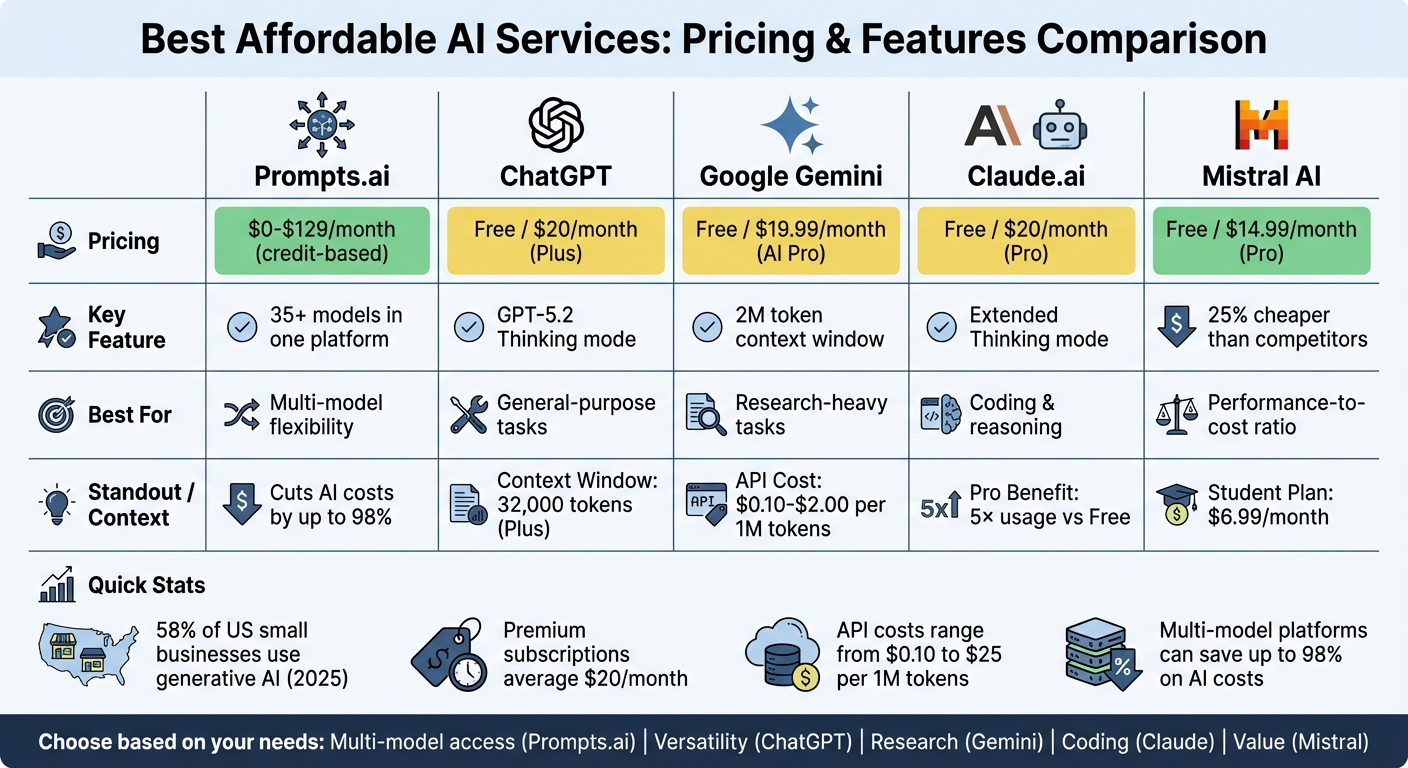
AI Service Pricing Comparison: Features and Costs of 5 Affordable AI Models
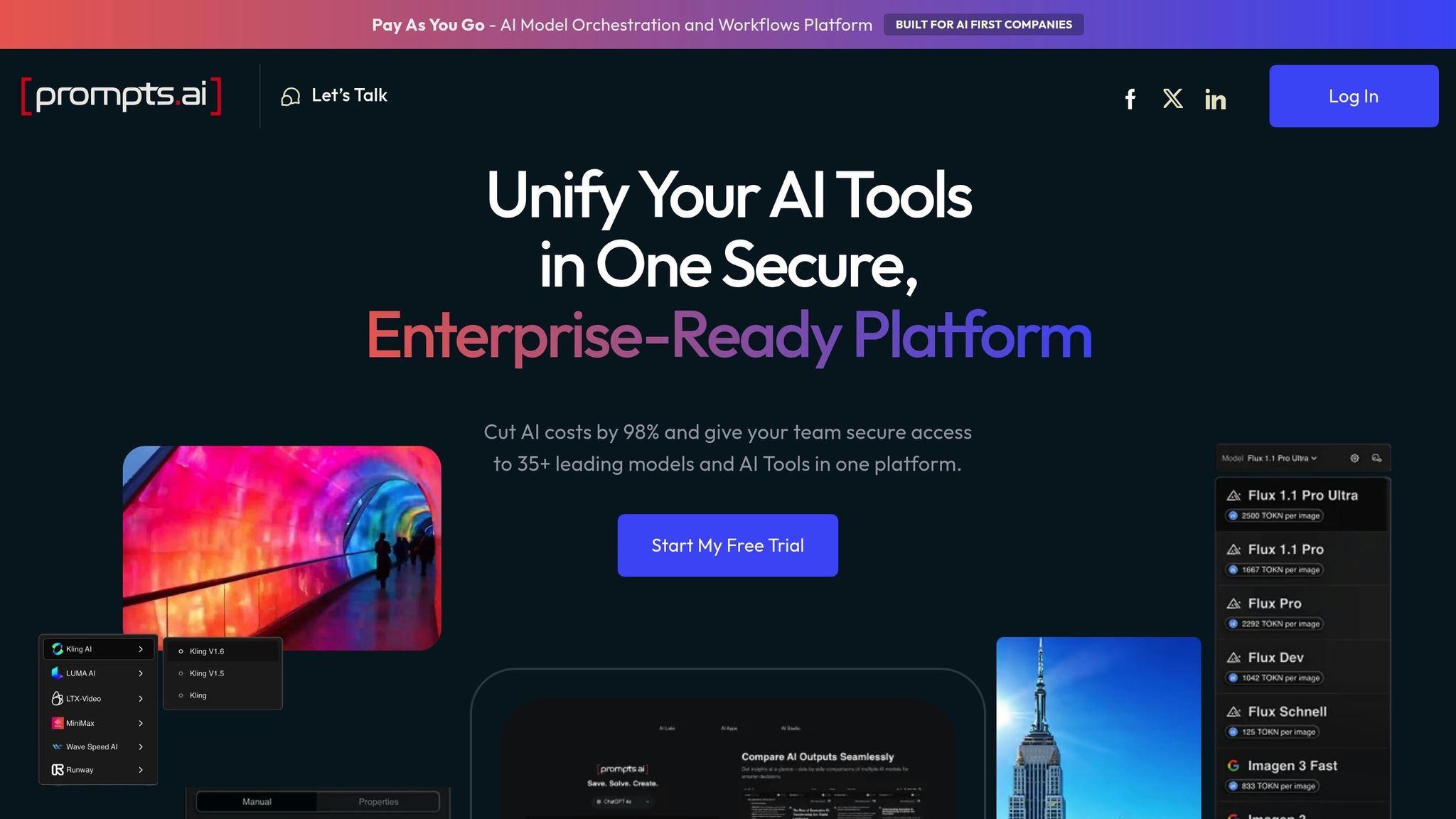
Prompts.ai offers a credit-based system designed to eliminate recurring subscription fees. Users can choose from several plans: Pay As You Go at $0, Creator at $29/month, Family at $99/month, and three business-tier options - Core at $99, Pro at $119, and Elite at $129 per member per month. The Pro plan, for instance, includes approximately 60,000 credits each month. Different AI models consume varying amounts of credits, with more advanced models requiring more credits, giving users the flexibility to allocate their resources based on specific needs.
This pricing approach supports access to a broad ecosystem of AI models.
Prompts.ai brings together over 35 top-tier AI models - including GPT-5, Claude 4 Sonnet, Grok-4, Gemini 2.5 Pro, LLaMA, Flux Pro, and Kling - all accessible through a single, unified dashboard. These models handle a wide range of tasks, from generating text to creating images. Instead of juggling multiple subscriptions and logins, users can seamlessly switch between models within the platform and even compare their outputs side by side to determine the best tool for each specific task.
This streamlined access is particularly useful for specialized needs. Whether it’s leveraging GPT-5 for complex reasoning, Claude for detailed analysis, or an image-based model for creative projects, everything is available in one place - no need to manage separate billing or accounts.
The credit-based structure ensures users only pay for what they use, with no charges during periods of inactivity. By consolidating access to numerous AI models under a single subscription, businesses can significantly cut down on software expenses. This cost-effective approach is ideal for organizations looking to integrate AI without overspending.
ChatGPT offers two subscription tiers: the Free plan, which costs $0 per month, and the Plus plan, priced at $20 per month. The Free plan is suitable for basic tasks, while the Plus plan provides enhanced features and improved performance. According to OpenAI, this pricing strategy ensures that free access remains available for a broad user base. The differences in pricing reflect variations in model capabilities and performance.
Both plans grant access to GPT-5.2, OpenAI's leading model as of early 2026. However, the Free plan imposes stricter usage limits, which reset every five hours. Plus subscribers enjoy extended access to GPT-5.2 Thinking, a feature designed for tackling complex problems, while Free users have only minimal access to this capability.
The Plus plan also unlocks additional professional tools, including:
Additionally, Plus users benefit from a larger 32,000-token context window for non-reasoning tasks, compared to the 16,000 tokens available to Free users. This tiered setup allows users to pay for advanced features as needed, keeping the service accessible for varying levels of usage.
While the Plus plan has a fixed monthly fee of $20, users who exceed their limits for advanced features can purchase additional credits to avoid interruptions. For instance:
Free users face limitations on advanced features, including slower response times during periods of high demand. Both Free and Plus users can opt out of having their content used to train OpenAI models, but this requires manual configuration in the settings.
Google Gemini offers pricing tailored for consumers, businesses, and developers. For individual users, the Free plan costs $0 and includes Gemini 3 Flash and limited access to Gemini 3 Pro. For more advanced needs, the AI Pro plan is available at $19.99/month. Business customers can choose Google Workspace at $14 per user/month or Gemini Enterprise at $21 per user/month. Developers, on the other hand, can access the API via a Free Tier, which comes with generous usage limits but allows submitted content to be used for model training, or a Paid Tier with pay-as-you-go pricing that ensures data privacy.
API pricing is model-dependent. For example, Gemini 2.5 Flash-Lite costs $0.10 per 1 million input tokens and $0.40 per 1 million output tokens, while Gemini 3 Pro charges $2.00 per 1 million input tokens for prompts under 200,000 tokens, with costs doubling for longer prompts. A Batch API option is also available, offering a 50% cost reduction for non-urgent tasks. These pricing tiers provide flexibility for both casual users and professionals.
The Free plan includes Gemini 3 Flash, limited Gemini 3 Pro access, image generation capabilities, and basic Deep Research. Upgrading to the AI Pro plan unlocks expanded Gemini 3 Pro access, Veo 3.1 Fast for video generation, integration with Gmail and Docs, and 1,000 AI credits each month. Business users can utilize Gemini through Google Workspace, which integrates with Gmail, Docs, Meet, and Vids. The Enterprise plan takes it further by connecting AI agents with tools like Microsoft 365, ERP systems, and CRM platforms.
Gemini supports a massive context window of up to 2 million tokens, giving it the ability to handle extensive inputs. Developers can optimize costs by routing simpler tasks to Flash-Lite, saving higher-tier models for complex queries. Additionally, context caching can reduce input costs by up to 75%.
While Gemini offers robust features, there are additional charges to consider. After the first 5,000 free monthly search queries, each additional 1,000 queries costs $14. Context caching fees range from $1.00 to $4.50 per 1 million tokens/hour, potentially slashing input costs by as much as 90%. However, prompts exceeding 200,000 tokens result in doubled pricing, and output tokens are priced 3–4 times higher than input tokens.
These costs underscore the importance of understanding usage patterns to maximize Gemini's value.

Claude.ai provides two main subscription options: a Free plan at $0/month for basic functionality and a Pro plan at $20/month for those seeking more advanced features when billed monthly. If billed annually, the Pro plan costs $17/month, requiring a $200 upfront payment, which saves users around $40 per year. For teams, pricing starts at $30 per person/month with monthly billing or $25 per person/month for annual billing, with a minimum of 5 members required. For heavy users, the Max plan is available at $100/month, offering 5–20 times the usage of the Pro plan. Note that the Pro plan does not include API access; developers need to use the Anthropic API Console, which operates on a separate usage-based pricing model.
The Free plan includes essential tools such as web and mobile chat, vision analysis, web search, and basic coding capabilities. Pro users enjoy 5× the usage limits of the Free plan, enabling more extended conversations and handling more complex tasks. Additional Pro features include:
Pro subscribers also gain access to the latest Claude models, such as Sonnet 4, and can integrate with Google Workspace tools like Email, Calendar, and Docs. They can also utilize remote Model Context Protocol connectors for enhanced functionality. Another standout feature is memory across conversations, which retains context over time, removing the need to repeatedly upload or reintroduce prior information.
While the Pro plan offers a range of powerful features, there are some additional costs and limitations to keep in mind. The $20/month pricing excludes applicable sales tax, which varies depending on the user's location. Furthermore, despite the higher usage limits of the Pro tier, usage caps still apply, depending on factors like model demand and task complexity.
For users looking to save, the annual Pro subscription offers better value at $17/month compared to the $20/month monthly rate. According to Ryan Doser, the "Pro plan provides an affordable way to increase usage and access cutting-edge features". Pro subscribers also benefit from priority access during peak usage times and early availability of new features, making it a worthwhile investment for those who frequently push the platform's limits.
Mistral AI stands out as a budget-friendly option among AI assistants, offering plans that cater to various needs without breaking the bank. The Free plan, priced at $0/month, provides generous access to flagship models like Mistral Large. For those looking for more, the Pro plan costs $14.99/month, which is 25% lower than the typical standard rate. Students can take advantage of a discounted $6.99/month Pro plan (a 53% savings) by verifying their .edu email address. Teams can opt for pricing starting at $24.99 per user/month with monthly billing or $19.99 per user/month when billed annually.
The Free plan offers 2-4 times more message capacity before hitting usage limits compared to many competitors. Pro users enjoy even more benefits, including up to 6x more messages, 200 Flash Answers per day (compared to 150 on the Free plan), and 15GB of document storage for retrieval-augmented generation (RAG) tasks. These features make Mistral AI a strong contender in terms of affordability and functionality.
Mistral AI doesn’t just offer competitive pricing - it also provides access to advanced tools and capabilities. Both Free and Pro plans include state-of-the-art models such as Mistral Large for complex reasoning, Codestral for coding tasks, and Pixtral 12B for image-related analysis. Pro users gain additional perks, including 30x more extended thinking capacity, 5x more Deep Research reports, 40x more image generation capabilities, and 5x more code interpretation power.
A standout feature of the Pro plan is the "No Telemetry Mode", which allows users to prevent their prompts from being used for model training with a simple toggle. Free users, on the other hand, need to manually opt out of data collection. Both plans also include unlimited projects for organizing chats and documents, as well as access to the beta Connectors directory for integrating external data sources.
Mistral AI offers clear and straightforward pricing, with the $14.99/month Pro plan providing excellent value for its features. However, applicable sales taxes may vary depending on your location. Both the Free and Pro tiers utilize the same flagship models, with differences in usage limits.
For developers, Mistral's API uses a token-based pricing model: Mistral Large costs $2.00 per million input tokens and $6.00 per million output tokens. Meanwhile, Mistral Medium 3 delivers about 90% of GPT-4-level reasoning at just 20% of the cost. According to Mistral's analysis, “If your organization spends more than $3,000/month on OpenAI credits, shifting 70% of calls to Medium 3 can typically cut compute costs in half”.
Pro users also benefit from an expanded memory capacity, doubling from 500 to 1,000 memories, which helps maintain context across extended conversations. With its blend of affordability, robust features, and transparent pricing, Mistral AI positions itself as a strong choice in the competitive AI market.
When choosing an AI service, it’s essential to balance their strengths and limitations. Below, we delve into the trade-offs of each platform, building on the pricing structures and features previously discussed. This breakdown aims to help you make an informed decision.
ChatGPT is praised for its versatility and ease of use, making it a great choice for general-purpose tasks like brainstorming or drafting content. However, its broad focus can sometimes lead to less specialized outputs unless guided by precise prompts. While the free plan provides great value, the $20/month Plus subscription unlocks enhanced features.
Google Gemini excels in research-heavy tasks and multi-modal applications, offering seamless integration for data retrieval. Its capabilities make it a strong contender for users focused on these areas.
Claude.ai shines in coding and complex reasoning tasks. However, its high-end models, such as Opus, come with steep costs - $5.00 per 1 million input tokens and $25.00 per 1 million output tokens - making it less budget-friendly for heavy users.
Mistral AI offers excellent performance at a lower cost, making it an attractive option for developers seeking efficiency. The downside is its requirement for a more technical setup, which contrasts with ChatGPT’s more straightforward interface.
Many users are now gravitating toward bundled subscriptions that offer multiple models for around $20/month. These plans provide cost predictability, which is especially appealing to small businesses aiming to avoid unexpected expenses as their usage grows.
The table below provides a concise comparison of each service’s main advantages and challenges to help guide your decision.
| Service | Key Advantage | Key Disadvantage | Best For |
|---|---|---|---|
| Prompts.ai | Access to 35+ models in one platform; cuts AI costs by up to 98% | Requires initial setup and onboarding | Teams needing multi-model flexibility with cost control |
| ChatGPT | Versatile and user-friendly | May produce generic answers without specific prompting | General-purpose tasks and brainstorming |
| Google Gemini | Strong integration for research and data retrieval | - | Research and multi-modal tasks |
| Claude.ai | Strong in coding and reasoning | High-end models (Opus) are significantly more expensive | Coding and technical reasoning tasks |
| Mistral AI | High performance-to-cost ratio | Requires more technical setup compared to ChatGPT | Open-source projects and efficiency-focused tasks |
This comparison highlights the trade-offs each service entails, helping you identify the best fit for your specific needs.
Selecting the right AI service boils down to aligning your specific requirements with the appropriate pricing structure and features. By late 2025, 58% of small businesses in the United States are utilizing generative AI solutions, reflecting its growing adoption across industries. The market generally divides into two categories: budget-friendly models for routine tasks and premium options designed for more complex challenges.
For individual users, ChatGPT Plus offers a well-rounded option at $20 per month, while Mistral AI Pro provides high performance at a lower cost of $15 per month. Beginners can explore free tiers, such as those offered by ChatGPT or Google Gemini, to handle everyday tasks without spending a dime.
When it comes to small teams, avoiding steep pricing increases as usage scales is essential. Mistral AI delivers excellent value at $20 per user per month, offering a strong return on investment for growing teams. For teams needing access to multiple models without juggling multiple subscriptions, Prompts.ai simplifies the process. With access to over 35 models on one platform, it significantly reduces expenses while allowing teams to choose the best model for each task.
For enterprises, scalability and seamless integration with existing tools like Google Workspace and Microsoft 365 are critical. Solutions like Google Gemini and OpenAI Enterprise offer flexible, consumption-based pricing that adapts to your needs as they grow. High-volume operations can achieve significant savings - up to 60–80% - by using a routing layer. This approach directs simpler queries to cost-efficient models like Gemini Flash-Lite (priced at $0.10 per million input tokens) while reserving premium models for more demanding tasks.
Given the diverse needs of enterprises, testing and budgeting are key. Explore free tiers to evaluate how each model performs with your specific prompts, as identical inputs can yield varying results across platforms. Use budget caps in your billing dashboard to avoid unexpected costs, and ensure the service integrates seamlessly with your existing tools, whether it’s Slack, Google Workspace, or your help desk software. Tailor your choice to fit your workflow - whether you're an individual, part of a small team, or managing enterprise-level operations.
Prompts.ai’s credit-based pricing operates on a pay-as-you-go model, allowing you to pay solely for what you use. With no upfront fees, this structure adjusts to match your actual workload, offering a budget-friendly option for both businesses and individuals.
By aligning costs with usage, this model helps you avoid overspending and provides a practical way to incorporate AI into your workflows without straining your finances.
ChatGPT Plus takes the free version up a notch by offering priority access during peak times, ensuring a smoother experience with minimal interruptions, even when demand surges. For just $20 per month, subscribers benefit from faster response times and quicker processing speeds, making interactions more fluid and efficient.
Subscribers also unlock advanced features, including access to the cutting-edge GPT-5 model. This includes tools like voice conversations, image generation, file analysis, and custom GPTs. The plan also expands usage limits, allowing for more messages, larger file uploads, and higher-capacity image generation. These enhancements make ChatGPT Plus a robust choice for users who need greater performance and advanced capabilities.
Mistral AI offers a budget-friendly solution for developers, starting with a free tier that includes access to flagship models and up to 500 stored memories. For those needing more, paid plans are reasonably priced at $14.99 per month for individuals and $24.99 per user per month for teams.
The platform prioritizes cost efficiency with its models. The Mistral Medium 3 model is priced at just $0.40 per million input tokens and $2.00 per million output tokens, while the Mistral Small 3.1 model offers even lower rates at $0.10 and $0.30 respectively. These competitive prices make Mistral AI a smart choice for hobbyists, startups, and teams aiming to integrate AI capabilities without overspending.