Pay As You Go - AI Model Orchestration and Workflows Platform


AI model orchestration platforms simplify how businesses manage and connect multiple AI tools, ensuring smoother workflows, cost savings, and compliance. In the U.S., three standout options dominate: Prompts.ai, IBM watsonx Orchestrate, and Service Y. Each platform offers unique benefits tailored to enterprise needs, from integrating dozens of AI models to providing governance and reducing expenses. Here’s a quick breakdown:
Key Stats: Businesses report up to 70% cost reductions, 10× agility improvements, and 80–90% fewer manual tasks with these platforms. Whether you’re cutting costs, improving workflows, or ensuring compliance, these services deliver measurable results.

Comparison of Top 3 AI Model Orchestration Platforms in the United States
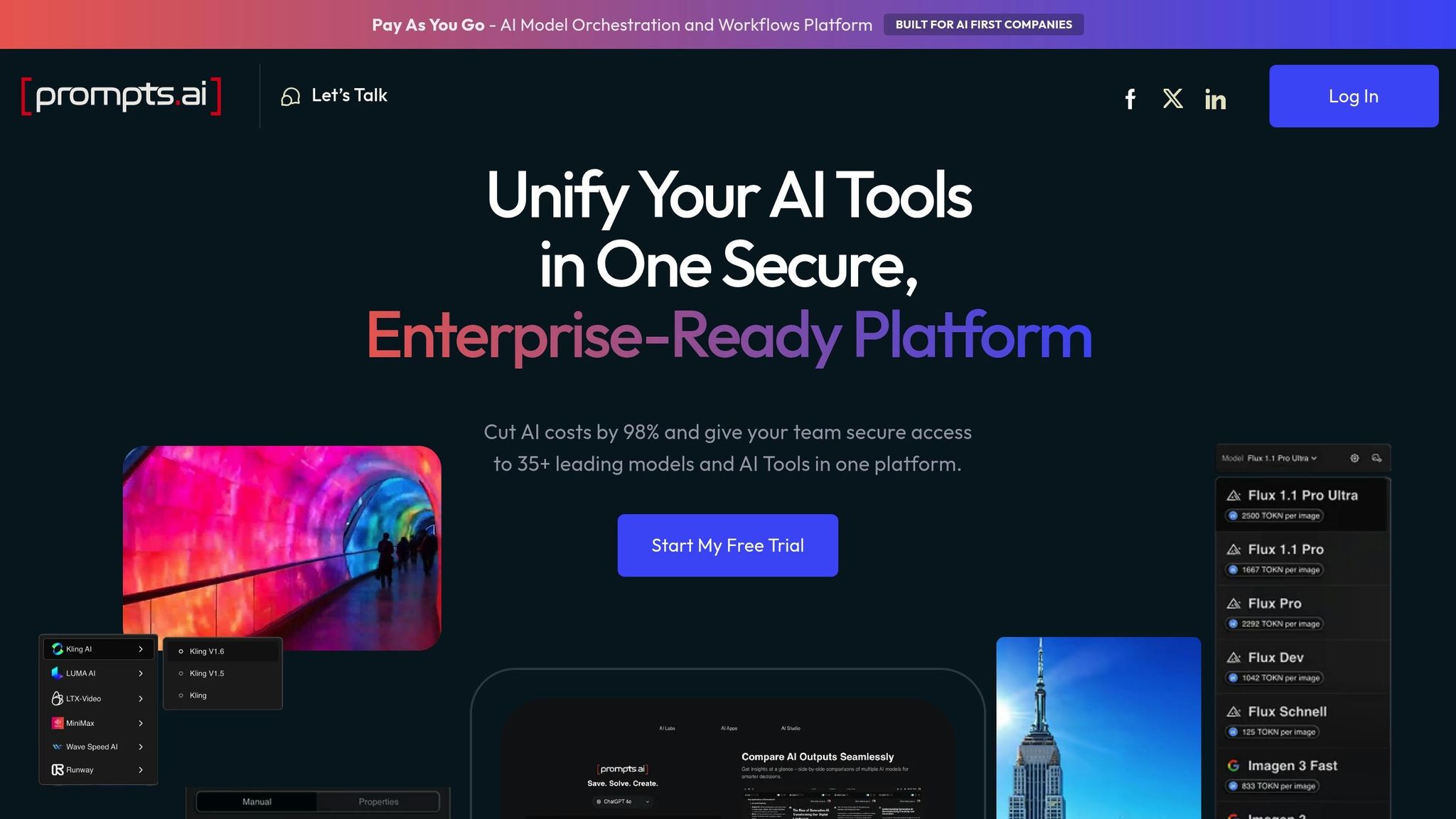
Prompts.ai brings together over 35 leading AI models - including GPT-5, Claude, LLaMA, Gemini, Grok-4, Flux Pro, and Kling - into a single, secure platform. Founded by Emmy Award-winning Creative Director Steven P. Simmons, the platform tackles a key problem for U.S. enterprises: the disarray caused by disconnected AI tools. By unifying these models, Prompts.ai ensures businesses retain full control and visibility over every interaction, streamlining operations and decision-making.
The platform’s design allows teams to seamlessly switch between AI models without juggling multiple subscriptions or interfaces. This eliminates the inefficiencies of tool sprawl. With side-by-side performance comparisons, organizations can evaluate and choose the best model for tasks such as content creation, data analysis, or creative projects. Deployment is quick - any leading model can be operational within minutes, not months.
Prompts.ai turns scattered experiments into structured, repeatable workflows. Its prompt workflow system includes Time Savers, pre-designed workflows that are ready for immediate use. Additionally, the Prompt Engineer Certification program equips teams with the skills to create internal experts, fostering collaboration and efficiency. Teams can automate repetitive tasks, share workflows across departments, and scale AI initiatives - all while avoiding unnecessary complexity.
Security and compliance are at the core of the platform. With SOC 2, HIPAA, and GDPR compliance, along with continuous monitoring via Vanta, Prompts.ai ensures that every AI interaction is secure and auditable. The system tracks activity in detail, enforces role-based access controls, and aligns with U.S. regulatory frameworks like the National AI Initiative Act and NIST cybersecurity standards. These features make it particularly suitable for industries with strict regulations, such as finance and healthcare.
Managing costs is simplified with the pay-as-you-go TOKN credit system, which tracks token usage across all models. This eliminates the need for recurring subscriptions and offers real-time insights into AI spending. Organizations can break down expenses by team members or specific use cases, with potential savings of up to 98% compared to managing separate subscriptions. The platform’s financial transparency links spending directly to business outcomes, enabling finance teams to measure and justify AI investments effectively.
IBM watsonx Orchestrate brings enterprise AI agents and assistants together under one roof. Recognized as a 2025 Gartner® Magic Quadrant™ Leader, it provides U.S. businesses with an open architecture that integrates seamlessly with existing systems - no need for a costly overhaul.
The platform supports integration with over 400 prebuilt tools and 100 domain-specific agents, enabling smooth connectivity between older systems and modern technologies. Whether you're a seasoned developer or new to the field, you can use no-code tools or advanced coding options to build agents tailored to your needs. This flexible framework effortlessly integrates into automated workflows, making it adaptable for various teams and industries.
With IBM watsonx Orchestrate, managing multiple AI agents becomes simple through a unified interface. It automates complex processes, delivering measurable results: Dun & Bradstreet, for instance, cut procurement task times by 20%, while IBM's HR department resolved 94% of over 10 million annual inquiries almost instantly. The platform's Agent Builder and extensive tool catalog allow teams to design custom workflows that connect directly to business data and systems, boosting overall efficiency.
The platform ensures compliance with corporate policies and U.S. regulatory standards through centralized oversight, automated safeguards, and policy enforcement. Role-based access controls and encryption protect sensitive data, making it a reliable choice for industries like finance and healthcare. Additionally, hybrid cloud deployment options give organizations control over data residency and processing, meeting regulatory requirements while maintaining operational efficiency.
To make adoption easy, IBM watsonx Orchestrate offers a free 30-day trial, providing businesses a risk-free opportunity to experience streamlined AI operations firsthand.
IBM watsonx Orchestrate delivers orchestration tailored for U.S. enterprises, adhering to federal standards like FedRAMP and NIST. Its widespread adoption - used by 64% of Fortune 500 companies - highlights its credibility and effectiveness. Unlike earlier solutions, Service Y emphasizes multi-cloud deployment and strict compliance with federal regulations.
IBM watsonx Orchestrate stands out as a vendor-neutral platform, seamlessly integrating various AI frameworks and enterprise applications without locking users into a single vendor. With built-in compliance checks, it simplifies connectivity between older enterprise tools and modern AI models. This flexibility allows technical teams to create custom integrations that align with their existing technology stack while ensuring adherence to regulatory standards.
The platform empowers users, even those without technical expertise, to manage complex AI workflows through simple natural language commands. At the core is a central orchestrator agent, which translates high-level business objectives into smaller, actionable subtasks. These are then assigned to specialized agents in real time. By automating this task sequencing, the system removes manual coordination bottlenecks, enabling teams to concentrate on strategic decisions instead of routine operations.
Service Y goes beyond workflow automation by ensuring compliance with audit-grade observability that connects AI activities to critical business metrics. Deployment options such as single-tenant SaaS and customer-managed cloud configurations address U.S.-specific data sovereignty needs. Additionally, industry-specific playbooks for sectors like healthcare, finance, and public services guide organizations in meeting regulatory requirements. Role-based approvals further enhance accountability, ensuring secure and compliant enterprise operations.
"The net effect is an orchestration capability that fits enterprises with complex estates, strict compliance expectations, and a preference for vendor stability and hybrid deployment choice." - MarketsandMarkets
With a usage-based, per-user pricing model, the platform lowers barriers to entry. This flexible structure enables businesses to scale their AI operations gradually, paying only for active users. It’s an appealing option for mid-sized U.S. companies looking to explore orchestration capabilities before committing to full-scale deployment.
When evaluating AI orchestration services, U.S. businesses must weigh the unique strengths and challenges each platform offers. Below is a comparison of key features and trade-offs across the platforms discussed.
| Platform | Primary Advantages | Key Limitations |
|---|---|---|
| prompts.ai | Integrates 35+ models in a single interface; reduces AI software costs by up to 98%; pay-as-you-go TOKN credits eliminate recurring fees; enterprise-grade governance with audit trails | A newer platform compared to established enterprise systems; may require adjustments in organizational processes |
| Platform X | Edge-native execution with <50ms cold starts; 10x latency reduction via multi-layer caching; distributed across 200+ regions for near-zero global latency | 100MB payload limit; free tier limited to 30-second execution time |
| Service Y | Offers 400+ prebuilt tools; features a no-code natural language interface | Usage-based per-user pricing can quickly escalate costs for larger teams; enterprise focus may be excessive for smaller organizations |
While each service shines in specific areas, businesses need to evaluate their unique operational priorities to select the most suitable orchestration solution.
For instance, developer-centric tools like Prefect and Apache Airflow are highly customizable and extensible but often demand expertise in Python or Kubernetes, posing a steep learning curve for less technical teams. In contrast, the platforms reviewed here focus on ease of use, offering prebuilt connectors and templates that minimize the need for coding. These business-oriented solutions prioritize quick deployment and straightforward functionality over deep customization.
Cost structures and deployment speeds also set these services apart. Traditional revenue orchestration stacks can cost between $400 and $500 per user per month, while AI-native platforms are more budget-friendly, starting at just $19 per user per month. A mid-market SaaS company, for example, achieved substantial savings by switching to a cost-effective AI-native platform instead of traditional revenue stacks. Deployment times further highlight the differences: AI-native platforms typically roll out in 1–2 weeks with adoption rates surpassing 90%, whereas traditional enterprise solutions often require 3–6 months of setup and extensive training.
For industries like finance or healthcare, where regulatory compliance is critical, platforms offering single-tenant SaaS or on-premises deployment provide enhanced data isolation and control. However, these options come with higher infrastructure costs.
Ultimately, the choice of orchestration platform can significantly influence operational agility, a point emphasized earlier in this article. By carefully considering these factors, businesses can align their AI infrastructure with both current needs and long-term goals.
Choosing the right AI orchestration service depends on how well it meets your organization's needs for integration, governance, and cost management. If your goal is to cut down on tool sprawl while maintaining strong oversight and reducing expenses, prompts.ai offers access to over 35 models through a single, secure interface. Its pay-as-you-go TOKN credit system can help significantly lower AI software costs. For teams that need a vast array of prebuilt integrations, IBM watsonx Orchestrate delivers with over 400 tools and has successfully handled 94% of its 10 million+ annual HR requests instantly. Meanwhile, enterprises focused on federal compliance and hybrid deployment can turn to Service Y, which ensures FedRAMP and NIST adherence while offering vendor-neutral flexibility.
Beyond these features, deployment speed and technical requirements are key differentiators. Edge-native platforms, for example, can achieve cold starts in under 50 milliseconds, making them a strong choice for latency-sensitive applications. With Gartner forecasting that by 2027, one-third of enterprise AI implementations will rely on autonomous agents, platforms that effectively balance affordability, scalability, and governance are likely to lead the way.
When evaluating options, focus on integration compatibility, governance standards, and transparent cost structures. Organizations that align these factors with their operational goals will be better equipped to scale AI solutions efficiently and responsibly.
AI model orchestration platforms, such as Prompts.ai, streamline the process of managing multiple large-language models through a single, unified dashboard. Instead of juggling separate APIs and credentials for more than 35 models - like GPT-4 and Claude - teams can easily prototype, test, and deploy projects across all models in one place. This eliminates the hassle of integration and saves valuable time, allowing businesses to focus on driving progress and creativity.
Beyond simplifying operations, these platforms offer real-time cost tracking, providing clear insights into token usage and pricing. This transparency supports pay-as-you-go billing and can slash expenses by as much as 98%. With features like automated workflows, compliance monitoring, and enterprise-grade security, Prompts.ai empowers organizations to scale their AI efforts with confidence while boosting efficiency and reducing costs for businesses across the U.S.
Prompts.ai weaves regulatory compliance seamlessly into its orchestration platform, offering a secure and centralized way to manage over 35 large language models (LLMs). With features such as role-based permissions, end-to-end encryption, and detailed audit trails, the platform enables organizations to monitor data usage and actions effectively, ensuring they meet rigorous compliance standards.
The platform holds certifications like SOC 2 Type II, complies with HIPAA for managing protected health information, and aligns with GDPR privacy regulations. It also includes automated policy checks and real-time monitoring to continually validate compliance. Businesses benefit from instant reporting and cost-tracking dashboards, making it easier to stay within regulatory limits. These capabilities empower companies to scale their AI operations securely, even in industries with strict regulatory demands.
Prompts.ai provides businesses with effective tools to manage AI spending while maintaining transparency and control. Through its pay-as-you-go TOKN credit system, teams are charged only for the compute they actually use, eliminating hefty upfront licensing fees. This approach can lead to savings of up to 98% compared to traditional pricing structures.
The platform also features real-time FinOps dashboards that allow users to keep a close eye on costs across more than 35 integrated AI models. These dashboards enable live tracking of cost metrics, budget alert setup, and detailed spending analysis by workflow. This ensures teams can manage budgets effectively and quickly pinpoint areas driving costs. Pricing is straightforward and predictable, starting at $99–$129 per user per month, while still offering the flexibility of the credit system.
With these capabilities, U.S. businesses can scale their AI workflows efficiently, maintain complete budget oversight, and avoid surprises in their expenses.