Pay As You Go - AI Model Orchestration and Workflows Platform



Cut Costs, Compare Models, and Scale Smarter
Managing multiple LLMs like GPT-5, Claude 3.7, and LLaMA 4 can be complex and costly. Orchestration platforms simplify this by unifying workflows, reducing expenses by up to 98%, and enhancing governance. From Prompts.ai's real-time cost tracking to LangChain's detailed audit trails, these tools help enterprises optimize AI investments.
| Platform | Model Access | Scalability | Cost | Governance |
|---|---|---|---|---|
| Prompts.ai | 35+ LLMs | High | TOKN credits, $0–$129/month | Real-time FinOps, audit trails |
| LangChain | Universal APIs | High | Free to $39+/month | Audit trails, safety checks |
| Amazon Bedrock | AWS-native | Very High | Pay-as-you-go | HIPAA/GDPR compliance |
| CrewAI | Broad | High | Free to $1,000/month | HITL, role-based controls |
Choose the platform that aligns with your workflow, budget, and compliance needs to streamline your AI operations.

LLM Orchestration Platform Comparison: Features, Pricing, and Scalability
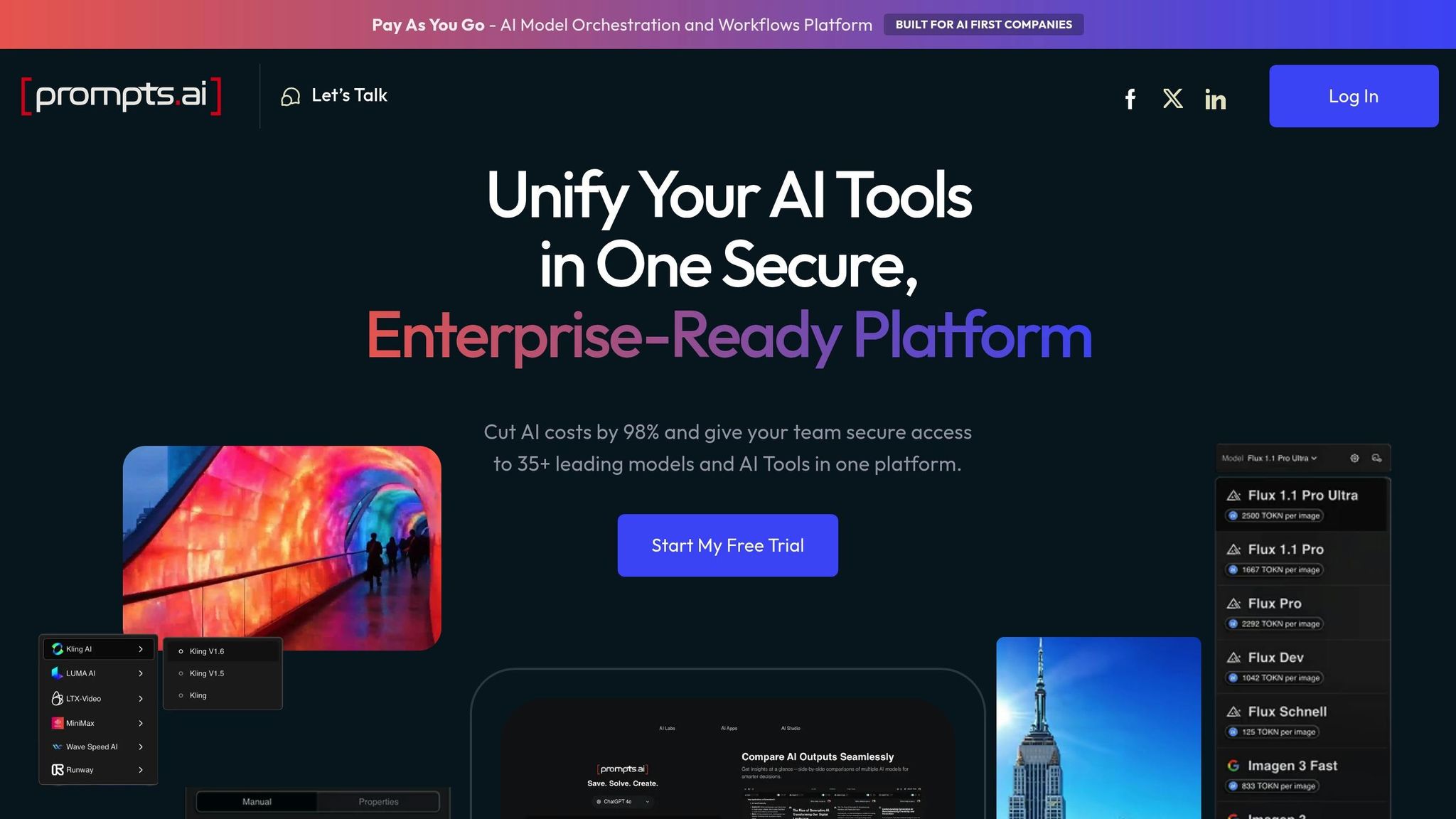
Prompts.ai brings together over 35 leading LLMs into a single, enterprise-ready orchestration platform. By consolidating access, it eliminates the hassle of juggling multiple API keys and billing systems. Teams can work seamlessly with all models through one platform, removing the need for custom connections and reducing technical complexity. Below, we’ll explore how Prompts.ai supports integration, scalability, cost management, and governance.
Prompts.ai's design makes it easy to compare model performance side by side without needing to rewrite code. With a single prompt, you can test multiple models simultaneously, evaluating factors like quality, latency, and token usage in real time. This feature is especially valuable for determining whether a budget-friendly open-source model, such as LLaMA, can handle tasks like customer service inquiries as effectively as a premium model like GPT-5, but at a fraction of the cost.
The platform goes beyond simple integration by enabling scalable deployments without requiring custom coding. It automates critical tasks like state management, prompt versioning, and multi-step agent coordination. This allows teams to move from testing to full-scale production without reworking their architecture. Plus, with its pay-as-you-go TOKN credit system, organizations only pay for the tokens they use, avoiding subscription fees and aligning costs with actual usage.
Prompts.ai is designed to make AI cost-effective. Using hybrid routing, it reduces AI expenses by 10–15×. Routine tasks are directed to lower-cost models, while more complex problems use premium APIs only when necessary. The platform's cost management tools track token usage across all models, providing detailed insights into cost drivers and identifying areas for savings. Some users have reported cutting their AI software costs by as much as 98%.
With centralized orchestration, Prompts.ai ensures data security and compliance. It supports PII sanitization, enforces data residency rules, and logs every interaction with the models. Organizations can also set up intervention checkpoints to review responses before they are delivered to end users. These features are essential for enterprises operating under strict regulations, ensuring sensitive data stays within approved regions and that all AI decisions are fully auditable. This robust governance framework simplifies compliance while maintaining transparency in model usage.
LangChain is an open-source framework designed to streamline interactions with various large language model (LLM) providers. By offering a standardized interface, it simplifies the process of comparing LLMs and analyzing their performance. Instead of writing unique code for each vendor, developers can rely on a unified abstraction layer, making it easy to test and switch models without altering the core application logic. As noted in the LangChain documentation:
LangChain standardizes how you interact with models so that you can seamlessly swap providers and avoid lock-in.
LangChain's LangSmith Comparison View enables side-by-side evaluations of models, clearly marking improvements in green and regressions in red when compared to a baseline. It assesses metrics like correctness, latency, token usage, and cosine similarity. For instance, in a RAG benchmark, Mistral-7b achieved a median response time of 18 seconds - 11 seconds faster than GPT-3.5. The framework also records complete execution traces for every run, allowing developers to inspect detailed steps and identify why one model outperformed another. Additionally, LangChain simplifies the execution of complex workflows through automated integrations.
LangChain works seamlessly with LangGraph, which supports durable execution and state management for multi-step workflows. The LangSmith client enhances scalability by enabling parallel execution through a concurrency parameter, allowing evaluations across extensive datasets simultaneously. Built-in rate limiting ensures smooth operations during high-demand testing, avoiding throttling issues. As Hazal Şimşek from AI Multiple explains:
LangGraph executes fastest with the most efficient state management.
The framework also includes automatic regression tracking, eliminating the need for manual comparisons across experiment runs. This focus on scalability is complemented by features that enhance governance and compliance.
LangChain incorporates tools for safety checks, such as evaluating toxicity and personally identifiable information (PII). A traceable decorator ensures complete audit trails, capturing inputs, outputs, and intermediate steps for every model interaction. Annotation queues allow for structured human reviews, supporting multiple reviewers and custom ethical guidelines. For organizations with stringent data residency needs, LangSmith offers flexible deployment options, including cloud, hybrid, and self-hosted setups. Additionally, format validation ensures model outputs adhere to predefined JSON schemas, reducing the risk of downstream errors.
Amazon Bedrock stands out as a serverless platform that simplifies LLM comparison by offering a unified API to access over 100 foundation models. These models come from top providers like Anthropic, Meta, Mistral AI, Cohere, AI21 Labs, Stability AI, and Amazon itself. Trusted by more than 100,000 organizations worldwide, Bedrock operates on a pay-as-you-go model, ensuring users only pay for what they use.
With Bedrock's unified API, managing multiple integrations across different providers becomes a thing of the past. Its built-in "LLM-as-a-judge" feature leverages a high-performing model to evaluate responses based on factors like correctness, completeness, and harmfulness. Bedrock Guardrails enhance safety by blocking up to 88% of harmful content while identifying correct responses with 99% accuracy. Additionally, organizations can import their proprietary models into the ecosystem, enabling direct comparisons with foundation models through a single interface.
This streamlined integration not only simplifies operations but also supports scaling complex workflows effectively.
Amazon Bedrock uses Distributed Map with AWS Step Functions to handle large-scale workflows. This approach allows for concurrent processing of extensive datasets by coordinating parallel API calls across multiple models. AWS Step Functions can manage over 9,000 API actions from more than 200 services, making it ideal for intricate AI workflows. For example, Robinhood expanded its generative AI operations from 500 million to 5 billion tokens daily in just six months with Bedrock. Dev Tagare, Head of AI at Robinhood, highlighted:
Amazon Bedrock's model diversity, security, and compliance features are purpose-built for regulated industries.
Bedrock tackles cost management through features like Intelligent Prompt Routing (IPR), which dynamically directs requests to the most suitable model within a family based on predicted quality and cost. This approach can reduce expenses by up to 30% without compromising performance. In one test using Retrieval Augmented Generation datasets, IPR achieved 63.6% cost savings by routing 87% of prompts to Claude 3.5 Haiku.
Bedrock also employs model distillation, creating smaller, faster models that operate up to 500% more efficiently and cost up to 75% less while maintaining accuracy. Robinhood experienced an 80% reduction in AI costs and cut development time by 50% after implementation. Additionally, prompt caching further minimizes costs by storing commonly used prompt segments, reducing redundant token processing.
Amazon Bedrock complies with key standards like ISO, SOC, GDPR, FedRAMP High, and HIPAA eligibility, ensuring it meets the needs of regulated industries. The platform prioritizes privacy by never storing or using customer data to train its foundation models. Automated evaluation jobs further enhance governance by identifying the most cost-effective model and prompt combinations for specific tasks, providing a systematic approach to optimization.
CrewAI offers a distinct method for comparing large language models (LLMs) by coordinating them as a team of specialized agents. Through LiteLLM integration, it connects with over 100 LLM providers - such as OpenAI, Anthropic, Google, Azure, and AWS Bedrock - via a single, streamlined interface. This setup allows developers to assign different models to specific agents within the same workflow, making it easy to determine which LLM excels at tasks like research, coding, or content review. Below, we explore CrewAI's strengths in model integration, scalability, cost management, and compliance.
CrewAI's agent-specific LLM assignment lets users combine multiple models in a single workflow. For instance, you can assign GPT-4 to one agent while another uses Claude, all managed through a standardized identifier. The platform ensures fair comparisons by standardizing parameters like temperature, max tokens, and penalty settings. Additionally, CrewAI supports local models through Ollama integration, enabling you to run models like Llama 3.2 on your own infrastructure and directly compare them to cloud-based alternatives.
CrewAI is built for large-scale benchmarking, featuring tools like Kickoff for Each, which automates multiple runs of the same crew structure with varying inputs. Its asynchronous execution reduces latency during high-volume operations, though autonomous agent deliberation may introduce slight delays before executing tool calls. These capabilities are bolstered by the Enterprise console, which offers robust tools for managing environments, safely redeploying workflows, and monitoring live runs - ideal for production-level benchmarking pipelines.
CrewAI employs a flexible, tiered pricing model starting with a free plan, followed by paid options: $99/month (Basic), $500/month (Standard), $1,000/month (Pro), and custom pricing for Enterprise users. By delegating simpler tasks to more affordable models and reserving premium models for complex reasoning, CrewAI helps optimize costs. Its provider-agnostic design prevents vendor lock-in, allowing seamless switching between API providers to manage rate limits and leverage the best-performing models.
CrewAI prioritizes safety and compliance with built-in guardrails and Human-in-the-Loop (HITL) functionality, enabling human oversight and approval at critical stages before tasks are finalized. The Enterprise version adds advanced features like Role-Based Access Control (RBAC) to manage team permissions and secure production environments. Real-time tracing captures every step of an agent's reasoning, generating detailed audit trails essential for compliance monitoring. CrewAI also integrates with tools like Datadog, MLflow, and Arize Phoenix to track pipeline performance and identify potential issues.
Here’s an overview of the strengths and challenges associated with each orchestration platform, based on the detailed evaluations provided earlier.
Prompts.ai provides access to more than 35 top-tier LLMs through a single, secure interface. Its FinOps layer offers real-time tracking of token usage, enabling cost reductions of up to 98%. Additionally, it provides instant performance insights with side-by-side model comparisons, making it an excellent choice for enterprises focused on cost transparency and governance in managing LLM workflows.
LangChain shines with its extensive ecosystem and broad integration capabilities. The inclusion of LangSmith brings strong observability features, such as structured traces and regression tests, which are ideal for teams requiring detailed audit trails. However, its abstraction layers can cause a latency increase of 15–25% compared to direct model calls, and frequent updates sometimes lead to disruptions in production pipelines.
Amazon Bedrock is designed for enterprise-grade security and compliance, supporting standards like HIPAA and GDPR. Its token-based, pay-as-you-go pricing model allows for flexible scaling. However, its reliance on AWS infrastructure may pose challenges for organizations needing highly customized or self-hosted model deployments.
CrewAI focuses on low-latency edge deployments with its lightweight 8kB core and asynchronous operations. Its role-based multi-agent coordination is particularly effective for specialized workflows. On the downside, it has a smaller connector library compared to LangChain and relies on external systems for detailed observability.
The table below provides a concise comparison of these platforms' key features:
| Criterion | Prompts.ai | LangChain | Amazon Bedrock | CrewAI |
|---|---|---|---|---|
| Model Access | 35+ LLMs | Universal (70+ DBs, all major APIs) | AWS-native & select partners | Broad |
| Scalability | Enterprise-ready | High (K8s/Serverless) | Very High (managed infrastructure) | High (lean/async, 8kB core) |
| Cost | Pay-as-you-go TOKN credits; $0–$129/member/mo | Developer: Free; Plus: $39/mo; Enterprise: Custom | Pay-as-you-go (token-based) | Free; Basic: $99/mo; Standard: $500/mo; Pro: $1,000/mo |
| Governance | Excellent (real-time FinOps, audit trails, compliance) | Excellent (LangSmith versioning, traces) | Excellent (AWS-native, HIPAA/GDPR) | Moderate |
This breakdown highlights the unique strengths and limitations of each platform, helping users determine which option best fits their specific needs.
When selecting a platform, consider how quickly you need to deploy and how much customization your workflows require. For enterprise teams that prioritize governance, transparent costs, and immediate access to over 35 models, Prompts.ai offers a unified interface combined with real-time FinOps tracking. If your focus is on detailed tracing and access to a wide range of plugins, LangChain - with its 70+ million monthly downloads and a manageable 15–25% latency overhead - stands out as a solid option.
For organizations already integrated into AWS, Amazon Bedrock is a strong contender, particularly for those requiring HIPAA and GDPR compliance at scale. However, its managed infrastructure may restrict flexibility for teams needing custom deployments. Meanwhile, CrewAI shines in handling role-specific workflows and coordinating multi-agent tasks, though you may need additional tools to enhance its observability.
Cost considerations are just as critical as feature sets. For teams with limited AI infrastructure, predictable pricing models like Prompts.ai's $0–$129/month per user can help avoid unexpected expenses. On the other hand, technically adept teams managing Kubernetes clusters can cut costs significantly by adopting hybrid routing. For example, routine tasks can be sent to models like Mistral at $0.40 per million input tokens, while reserving premium models like Claude 3.7 Sonnet at $3.00 per million input tokens - achieving a potential 10–15× reduction in expenses.
For workflows requiring strict SLAs and enterprise-grade performance, Amazon Bedrock offers the reliability and support necessary to meet high demands. Startups and research labs, however, may benefit from the free tiers of LangChain or CrewAI, which provide ample resources to test and validate use cases before committing to paid plans. The right AI platform simplifies complex tasks, turning model comparisons into actionable insights.
"Agent-based orchestration could generate trillions of dollars in economic value by 2028."
Choosing the right orchestration tool is a strategic move toward achieving seamless and scalable AI workflows.
Orchestration platforms can slash AI costs - sometimes by up to 98% - by using smarter resource allocation, automating workflows, and employing advanced routing techniques. These systems streamline how models are deployed and managed, cutting out inefficiencies and trimming unnecessary expenses.
A key advantage is their reliance on pay-as-you-go pricing models paired with centralized access to multiple LLMs, so you only pay for the resources you actually use. On top of that, intelligent workload routing and scaling systems help balance factors like performance, cost, and latency. By reducing GPU usage and other resource demands, these platforms make it easier for organizations to scale their AI efforts without overspending.
When choosing a platform to manage and compare large language models (LLMs), focusing on a few critical aspects can make all the difference in meeting your requirements. Start with model compatibility - verify that the platform supports the LLMs you’re currently using and offers the flexibility to integrate others down the line. This ensures your setup can adapt as your needs evolve.
Scalability is equally important, especially if your workflows involve complex processes or large datasets. A platform that can grow with your demands will prevent bottlenecks and maintain smooth operations.
Look into cost management and real-time monitoring tools. These features help you keep expenses under control while identifying potential issues like performance slowdowns or inaccuracies before they escalate. Lastly, don’t overlook security and compliance. The platform should adhere to industry standards, particularly if you work in a regulated field, to safeguard sensitive data and meet legal requirements.
By weighing these factors carefully, you can select a platform that enhances efficiency and ensures dependable outcomes for your AI workflows.
Orchestration platforms like Prompts.ai play a key role in ensuring compliance with regulations such as GDPR and HIPAA by incorporating stringent security protocols. These measures typically include data encryption, access controls, and audit logging, all designed to protect sensitive information effectively. Additionally, many platforms adopt privacy-by-design principles, embedding data protection into every stage of their workflows.
To bolster compliance efforts, these platforms often provide certifications and documentation that verify alignment with regulatory requirements. By focusing on security, transparency, and strong data management practices, they enable organizations to handle multiple LLMs while adhering to both legal standards and ethical responsibilities.