Pay As You Go - AI Model Orchestration and Workflows Platform



AI model orchestration simplifies managing complex workflows by unifying models, data pipelines, and tools into one system. With businesses scaling AI operations, choosing the right orchestration tool is critical to reducing costs, enhancing efficiency, and maintaining compliance. Here are five leading platforms transforming AI workflows in 2026:
| Platform | Key Features | Cost Savings | Pricing | Best For |
|---|---|---|---|---|
| Prompts.ai | 35+ LLMs, pay-as-you-go TOKN credits | Up to 98% | Starting at $99/user/mo | Multi-model operations |
| Microsoft Autogen | Open-source, model-agnostic workflows | Varies (Azure costs) | Free software | Developers in Azure ecosystem |
| UiPath Maestro | AI + RPA integration, governance tools | 60% ROI | Custom pricing | End-to-end automation |
| IBM Watsonx | 400+ tools, compliance-focused | 20–90% | From $530/month | Regulated industries |
| DataRobot | Predictive + generative AI, SAP-certified | Varies | Enterprise pricing | Predictive AI at scale |
These tools streamline workflows, reduce inefficiencies, and ensure compliance, enabling businesses to scale AI confidently. Select the platform that aligns with your goals and existing systems.
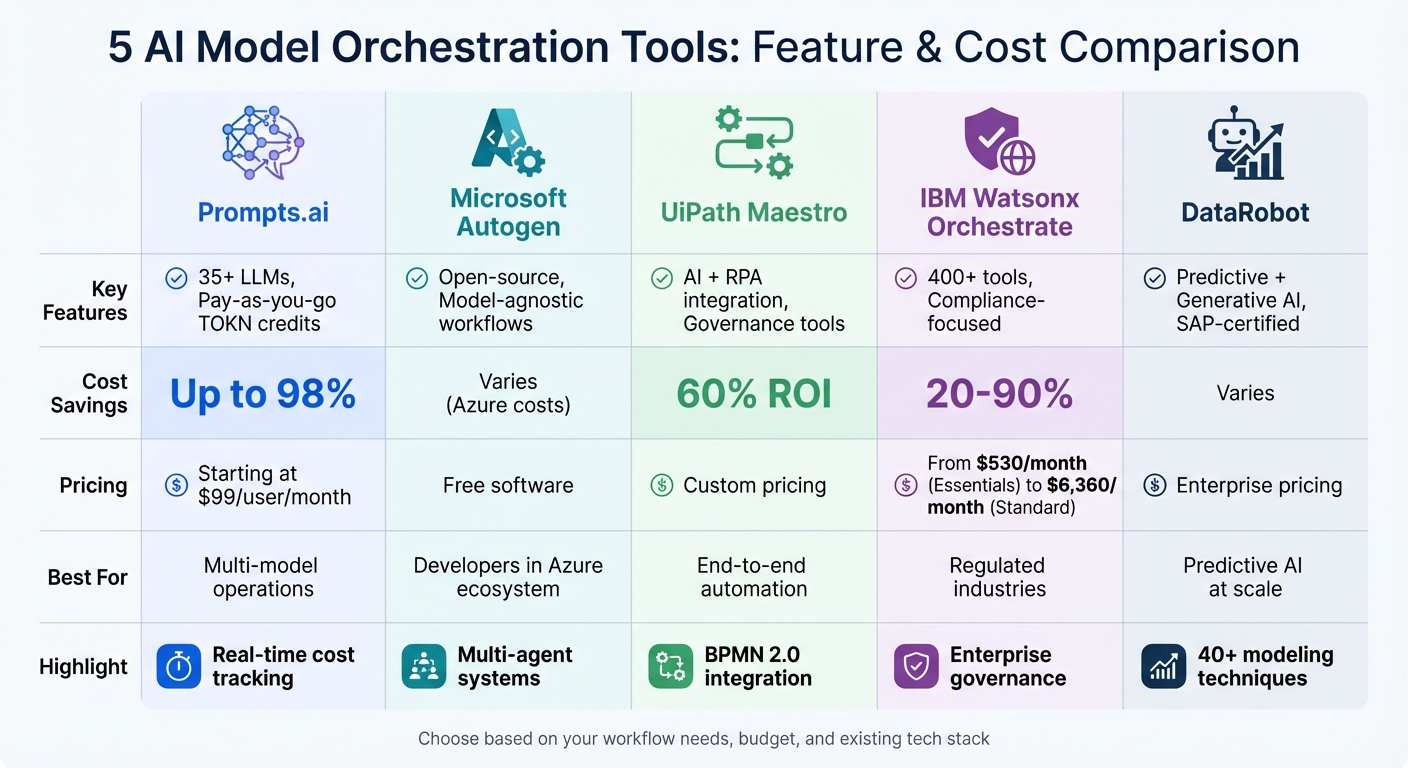
AI Model Orchestration Tools Comparison: Features, Pricing & Cost Savings
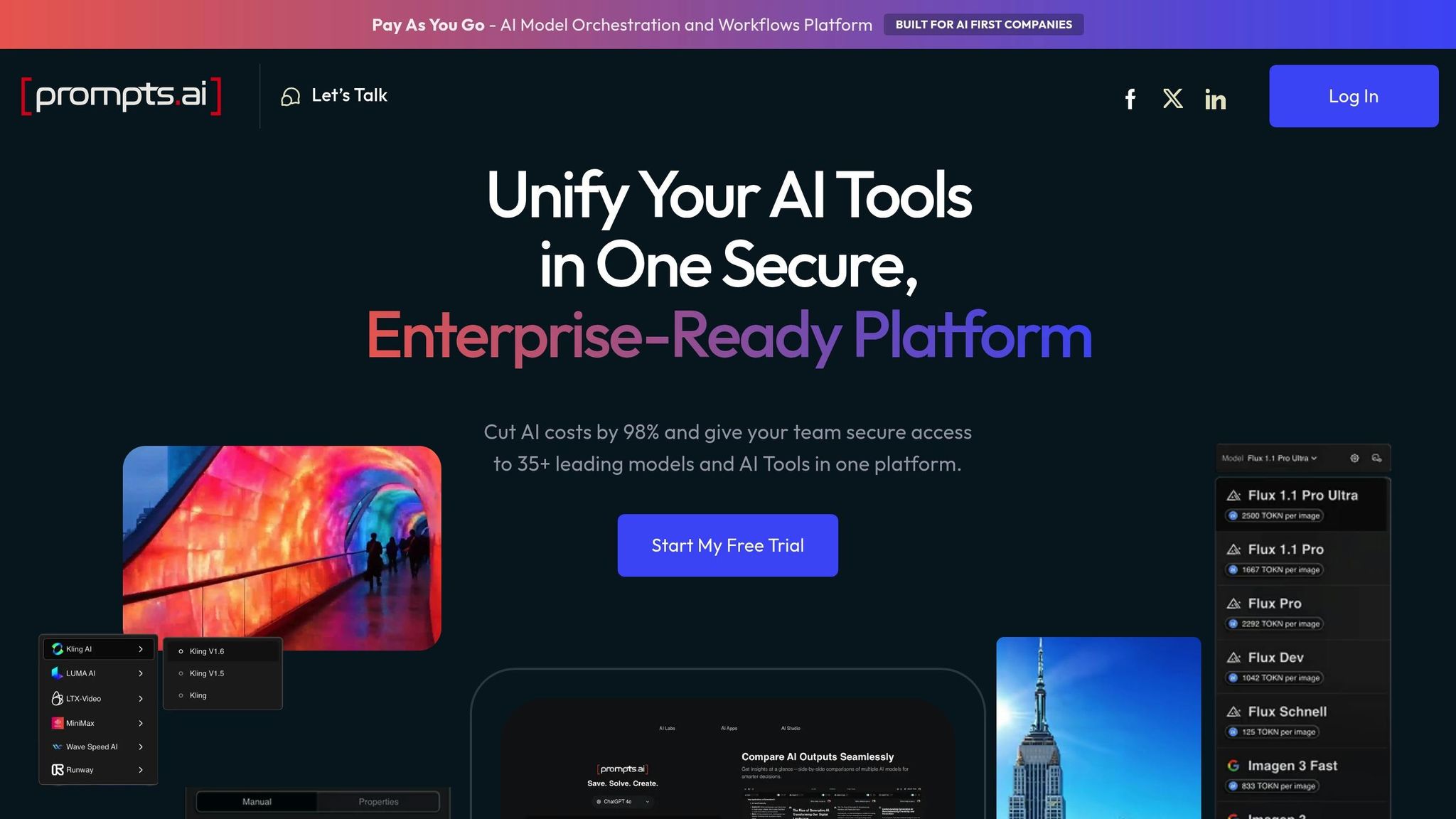
Prompts.ai is an enterprise-level AI platform that brings together over 35 top large language models - such as GPT-5, Claude, LLaMA, Gemini, Grok-4, Flux Pro, and Kling - into one secure and streamlined interface. Instead of managing multiple subscriptions and tools, businesses can access and deploy these models in a unified workspace, ensuring workflows stay intact and sensitive data remains protected from external platforms.
One of the platform’s standout features is its ability to integrate various AI models through a single interface. Teams can compare model performance in real-time without the hassle of juggling separate accounts, API keys, or billing setups. This flexibility allows organizations to switch between models based on cost, performance, or compliance requirements - all without needing to rewrite integrations or retrain staff. This streamlined approach not only saves time but also helps cut down on operational costs.
Prompts.ai tackles the issue of rising AI costs with its built-in cost-management tools. These tools monitor every token used across models and users, all through a pay-as-you-go TOKN credit system - eliminating the need for recurring subscription fees. By consolidating various tools into one platform, organizations can cut AI expenses by up to 98%. Real-time dashboards provide insights into spending, tying costs to specific teams, projects, and outcomes. This transparency makes it easier to pinpoint inefficiencies and optimize model usage to fit budget limits. Additionally, the platform’s simplified deployment process allows teams to adapt quickly to changing workflows.
Prompts.ai is designed for quick setup, letting businesses add models, users, and teams in just minutes. With pre-built prompt workflows and a Prompt Engineer Certification program, organizations can fast-track adoption and get their teams up to speed. Pricing starts at $99 per member per month for the Core plan, while the Elite plan, at $129 per member per month, caters to creative teams needing advanced model capabilities.
The platform ensures complete audit trails for every AI interaction, tracking which models were used, by whom, and for what purpose. This level of transparency is essential for businesses that must meet strict regulatory standards or handle sensitive data. Governance policies are enforced at the workflow level, preventing teams from accidentally sharing proprietary information with unapproved models or bypassing compliance measures. By centralizing all AI operations in a single, monitored environment, Prompts.ai helps businesses maintain data control while expanding AI use across their organization.
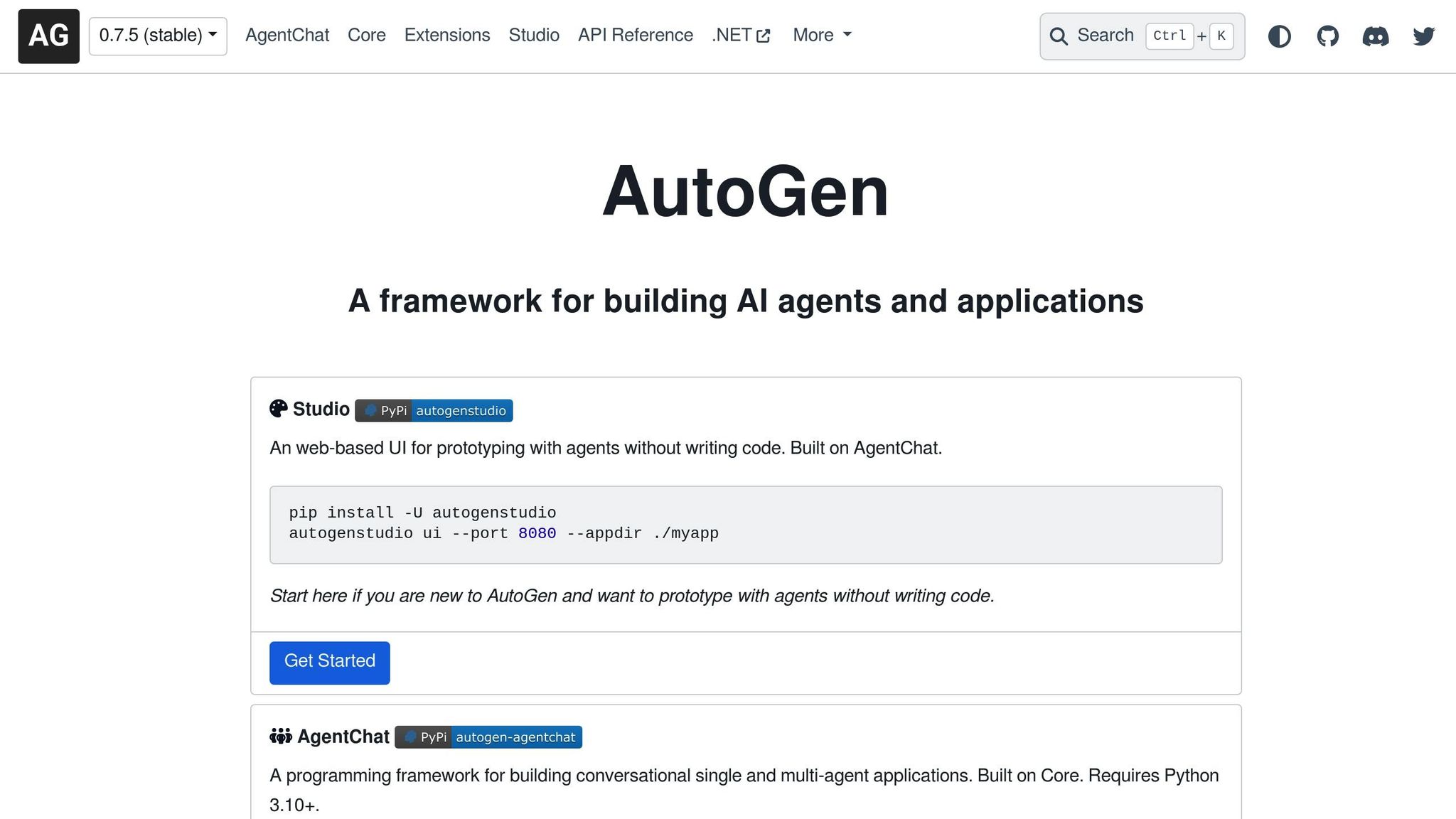
Microsoft Autogen is an open-source framework designed to streamline workflows using specialized AI agents. It simplifies complex tasks by breaking them into smaller components, assigning each to an agent best suited for the job. These agents can leverage various models - such as GPT-4, GPT-3.5, or open-source options like Llama - depending on the specific requirements of each task.
Autogen's multi-agent system allows businesses to incorporate different AI models into a single workflow. Each agent can operate with a distinct model, tool, or even human input. For instance, one agent might use a cost-efficient model for initial data processing, while another employs a more advanced LLM for intricate reasoning. This model-agnostic approach eliminates vendor lock-in, offering flexibility and efficiency. In real-world applications like supply-chain optimization, Autogen has reduced manual interactions by three to ten times and cut coding efforts for complex AI projects by over four times. This adaptable framework not only improves efficiency but also supports cost management and scalability.
"Capabilities like AutoGen are poised to fundamentally transform and extend what large language models are capable of. This is one of the most exciting developments I have seen in AI recently." - Doug Burger, Technical Fellow, Microsoft
Being free and open-source, Autogen ensures businesses only pay for the models they use and the Azure infrastructure that supports them. By assigning simpler tasks to less expensive models and reserving advanced LLMs for more demanding tasks, it keeps operational costs down. This modular approach also aligns with the industry trend of unifying AI operations, addressing a common challenge for many organizations. Within just four months of its release, over 10,000 organizations adopted Microsoft's Agent Service to build and scale AI systems. The framework supports diverse orchestration patterns - sequential for step-by-step tasks, concurrent for parallel processes, and dynamic handoffs for multi-domain challenges. This versatility allows businesses to scale operations efficiently without overhauling their systems.
Autogen is designed to integrate seamlessly into existing business processes. It offers three levels of integration: AutoGen Studio for no-code prototyping, AgentChat for Python-based development, and Core for building production-grade systems. Developers can use a VS Code extension to debug locally and deploy directly to Azure Foundry Agent Service with just one click. Users can start with the intuitive web-based interface and later transition to more advanced, code-based implementations. Additionally, Autogen integrates smoothly with enterprise platforms like Dynamics 365 and Teams through Azure Logic Apps, making it easy to connect AI agents to existing business tools.
When implemented via Azure Foundry, Autogen workflows benefit from enterprise-grade security measures. These include Microsoft Entra identity management, role-based access control, and content filters to guard against prompt injection attacks. Every interaction is logged through Application Insights, ensuring full traceability. This comprehensive audit trail helps businesses meet regulatory standards while maintaining control over how sensitive data is accessed and processed across teams and projects.
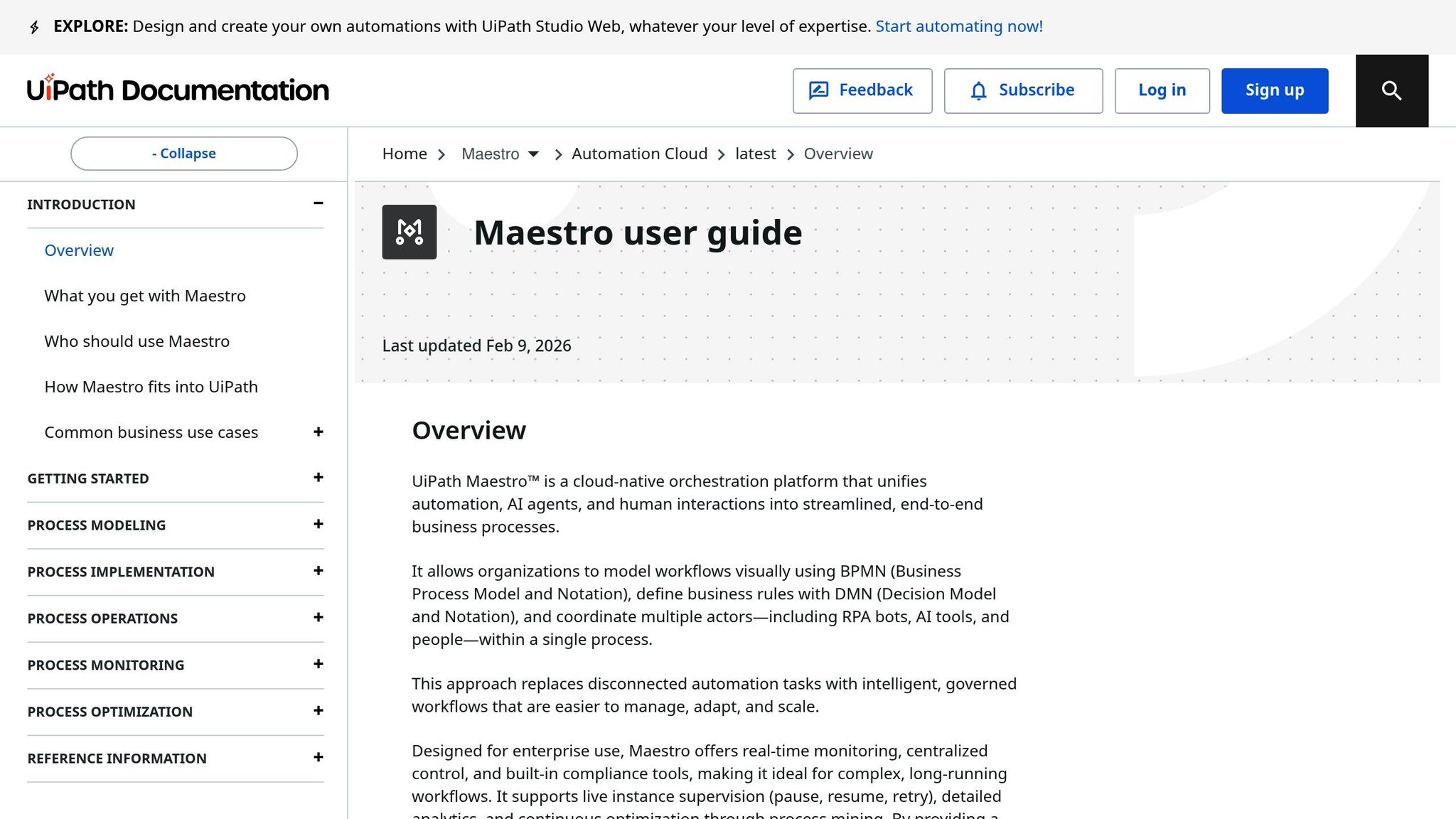
As businesses seek tighter integration across diverse AI systems, UiPath Maestro provides a unified solution. By connecting AI agents, RPA bots, and human workers through BPMN 2.0 and DMN for process design and business rules, Maestro ensures compatibility across enterprise systems. This standardized framework simplifies collaboration between technical and business teams, eliminating the challenges of proprietary formats in workflow development.
Maestro's design enables seamless orchestration of various AI models and autonomous agents, making it possible to address complex business challenges. Through standardized APIs, it connects models, data sources, and enterprise applications, ensuring smooth data exchange across different tech stacks. The platform integrates language models and vector stores using frameworks like LangChain. When AI confidence falters or exceptions arise, Maestro automatically redirects tasks to human supervisors, ensuring accuracy without disrupting operations. This capability not only enhances workflow efficiency but also reduces costs significantly.
"UiPath Maestro is the orchestration layer that connects everything - robots, AI agents, and systems inside and outside UiPath – ensuring seamless coordination across several complex automated processes." - Brian Lucas, Sr. Manager of Automation, Abercrombie & Fitch
Organizations leveraging AI orchestration frameworks report up to 60% higher ROI on their AI investments. For instance, SunExpress Airlines implemented orchestration in three operational areas, saving over $200,000 while cutting administrative backlogs by as much as two months. With its cloud-native architecture, Maestro supports scalable operations across geographies and workloads, avoiding infrastructure limitations. An insurance company, for example, used Maestro to streamline AI-driven triage and automated claim submissions, reducing claim processing time from three days to just two hours.
Maestro’s Autopilot™ feature accelerates process creation with prompt-based modeling, making it easier to integrate AI into workflows. Its unified workspace reduces unnecessary handoffs between agents, robots, and human workers. One enterprise used Maestro for HR onboarding, combining AI document reviews with RPA bots to cut onboarding time by 85%, dropping from 20 minutes to under three minutes. This efficiency allowed the company to scale its onboarding capacity from 200 to over 800 employees weekly without increasing staff. The platform’s streamlined integration is further supported by strong governance measures.
Maestro actively monitors for model drift and performance issues, offering real-time capabilities to pause, resume, or retry process instances as needed. Human-in-the-loop checkpoints provide oversight for high-risk tasks, addressing the common issue where 95% of enterprise AI pilots fail to deliver results due to poor coordination and governance. This ensures that AI initiatives remain reliable and aligned with business goals.
IBM Watsonx Orchestrate addresses the challenge of managing diverse AI models and agents while avoiding vendor restrictions. Its AI Gateway allows businesses to switch seamlessly between foundation models like IBM Granite, OpenAI, Anthropic, Google Gemini, Mistral, and Llama, depending on specific workflow needs. For example, IBM's HR department used Orchestrate to instantly resolve 94% of over 10 million annual requests, enabling staff to focus on more strategic tasks. These capabilities naturally extend into its strong integration features.
The platform supports over 400 prebuilt tools and 100 domain-specific agents, integrating effortlessly with systems like Microsoft Dynamics, SAP Ariba, Salesforce, and Red Hat Ansible. Its Agent Connect feature allows developers to embed AI agents built on any framework directly into enterprise workflows. Additionally, Watsonx Orchestrate supports OpenAPI documents and Model Context Protocol (MCP) for connecting external services without the need for custom code. IBM's recognition as a Leader in the 2025 Gartner Magic Quadrant for AI Application Development Platforms highlights its success in creating flexible and efficient workflows.
Watsonx Orchestrate combines integration capabilities with cost-saving measures. Dun & Bradstreet, for instance, used the platform to streamline procurement workflows, cutting task times by 20% and supplier risk evaluation times by 10%. IBM's Granite models offer over 90% cost savings compared to larger models. The platform provides two pricing tiers: Essentials starts at $530.00 per month, offering agent-building and AI tools, while Standard begins at $6,360.00 per month, catering to higher throughput and concurrent usage. Businesses can choose to deploy on IBM Cloud, AWS, or on-premises, balancing cost efficiency with compliance needs.
Watsonx Orchestrate ensures secure and compliant AI operations with centralized monitoring and built-in guardrails that prevent "agent sprawl." The AI Gateway enforces routing policies and includes advanced credential management, while on-premises deployment options provide full data control for industries with strict regulatory requirements. The newly introduced flow inspector tool allows teams to trace execution paths and validate workflow behavior across environments, ensuring compliance as operations grow.
DataRobot stands out by supporting both proprietary and open-source models, eliminating vendor lock-in. Its model-agnostic Registry manages various AI assets, including DataRobot-native, custom, and external models. The platform combines predictive AI (such as regression, classification, and time series) and generative AI (like foundational models) within a single environment. It addresses nine problem types and utilizes over 40 modeling techniques. This flexibility has proven its worth for companies like FordDirect. Tom Thomas, Vice President of Data Strategy, Analytics & Business Intelligence at FordDirect, shared:
"What we find really valuable with DataRobot is the time to value... DataRobot helps us deploy AI solutions to market in half the time we used to do it before."
DataRobot integrates effortlessly into existing workflows, with native support for Apache Airflow to automate end-to-end machine learning pipelines. Operators can handle tasks such as project creation, training, deployment, and scoring. The platform also connects smoothly with leading data platforms like Snowflake, AWS S3, and SQL databases. Notably, it stands as the only agentic AI partner certified for the SAP ecosystem. For instance, Venkatesh Sekar, Enterprise Architect at NetApp, leveraged these integrations to link data from Snowflake, SQL, and S3, automating the company’s entire forecasting process. Success stories include a top 5 global bank achieving a $70 million ROI across 40+ AI use cases and a global energy leader reporting a $200 million ROI across more than 600 AI applications.
DataRobot’s dynamic compute orchestration simplifies resource management by automatically provisioning and assigning workloads. Its serverless environment features autoscaling, which minimizes resource waste, and NVIDIA-powered GPU optimization accelerates training and inference at a large scale. Businesses can monitor costs in real time, balancing availability, latency, and budgets. Thibaut Joncquez, Director of Data Science at Turo, highlighted the platform’s value:
"Nothing else out there is as integrated, easy-to-use, standardized, and all-in-one as DataRobot. DataRobot provided us with a structured framework to ensure everybody has the same standard."
The platform emphasizes governance with automated compliance documentation generated through its Registry. Its centralized Console offers real-time model performance monitoring and automated intervention tools. Features like Role-Based Access Control (RBAC), versioning, and lineage tracking ensure scalable operations without increasing regulatory risks. DataRobot supports deployment across managed SaaS, virtual private clouds, or self-managed on-premise infrastructure, catering to stringent compliance needs. With a 4.7/5 rating on Gartner Peer Insights and a 90% recommendation rate, DataRobot has been repeatedly recognized as a leader in the Gartner Magic Quadrant for DSML Platforms. These comprehensive compliance and governance tools make it a strong contender for businesses seeking reliable orchestration solutions.
This breakdown highlights the core strengths of each platform, helping you choose the orchestration tool that aligns best with your business goals.
Prompts.ai stands out with access to over 35 large language models, along with real-time cost tracking that can cut expenses by up to 98%. Its pay-as-you-go TOKN system eliminates recurring fees, while enterprise-grade governance, including role-based access and audit trails, ensures security. The platform also offers a Prompt Engineer Certification program to help teams develop in-house expertise.
Microsoft Autogen is ideal for developers working on complex multi-agent systems within the Azure ecosystem. It provides free, open-source software but requires advanced Python skills and incurs separate costs for Azure OpenAI API infrastructure.
UiPath Maestro is highly rated for process automation, integrating AI models with robotic process automation to deliver seamless end-to-end workflows. Its centralized governance dashboards are especially appealing to organizations already leveraging UiPath’s automation tools.
IBM Watsonx Orchestrate caters to industries like finance and healthcare, where compliance is critical. It offers robust frameworks, SSO/SAML support, and low-code interfaces that reduce technical barriers. Its subscription-based pricing model provides predictable costs, aiding budget planning.
DataRobot offers flexibility by supporting both proprietary and open-source models. However, its focus leans more toward managing predictive and generative AI models rather than lightweight task automation.
When it comes to interoperability, Prompts.ai allows multi-cloud deployments without vendor lock-in, while other platforms are often optimized for specific ecosystems. Pricing structures also vary: Prompts.ai uses straightforward per-token pricing, IBM Watsonx employs fixed monthly tiers, and DataRobot typically offers enterprise licensing options. With 78% of organizations now using AI in at least one business function and 25% of AI budgets allocated to AI agents, choosing a platform with features like fine-grained access controls, immutable audit logs, and data residency options is crucial for meeting SOC 2, GDPR, and HIPAA standards.
Scalability remains a priority for growing businesses. Both Prompts.ai and DataRobot support hybrid and multi-cloud setups with automated resource scaling. Meanwhile, UiPath and IBM offer high-availability SLAs, making them suitable for global operations. As demand increases for user-friendly visual workflow builders, platforms with low-code or no-code development tools are becoming essential for empowering non-technical teams.
Choosing the ideal AI orchestration tool hinges on aligning its features with your specific workflow requirements. For instance, Prompts.ai stands out by providing access to over 35 advanced large language models, offering transparent per-token pricing, and delivering up to 98% cost savings. This makes it a compelling option for organizations seeking both flexibility and efficiency in multi-model operations.
When evaluating solutions, consider whether your workflows rely on fixed processes or require real-time adaptability. If your AI agents need to make dynamic runtime decisions based on unpredictable outputs, focus on tools that handle both structured workflows and adaptive control mechanisms.
Operational efficiency is another key factor. Assess whether your workflows require human-in-the-loop functionality, particularly for tasks involving compliance checkpoints or manual approvals. Look for tools with integrated UI features that allow for pausing and resuming workflows, as well as result caching to prevent redundant operations. Tools that streamline tuning experiments can dramatically cut processing time, turning days of work into minutes.
For enterprise-level deployments, governance is critical. Prioritize solutions with robust features like role-based access controls, immutable audit trails, and data residency options to ensure compliance. Scalability is equally important - verify that the tool can handle parallel tasks efficiently and integrates smoothly with your existing technology stack. In essence, the right orchestration tool should simplify complexities while enabling seamless and efficient AI operations.
AI model orchestration refers to managing and coordinating various AI models, tools, and data pipelines to effectively meet business objectives. This process integrates, automates, and oversees components such as large language models (LLMs) and APIs. By doing so, it simplifies workflows, minimizes errors, and enhances scalability. For businesses, this means centralized control, better resource allocation, and ensuring that AI systems run securely, efficiently, and cohesively as their use expands.
Choosing the right orchestration tool requires careful consideration of your AI workflow's size, complexity, and specific technical demands. Key factors to evaluate include how well the tool integrates with your existing systems, its governance and compliance capabilities, and its approach to cost management. Tools that consolidate models, provide real-time cost monitoring, and emphasize compliance can simplify your operations significantly. Make sure the tool matches your business's needs for scalability, security, and budget to achieve the best outcomes.
An AI orchestration platform needs to prioritize governance to manage workflows responsibly and securely. Essential features include cost management tools for real-time expense tracking, compliance tools to enforce policies and manage access controls, and robust security measures like data governance and audit trails. These tools work together to promote transparency, meet regulatory requirements, and safeguard against data breaches or unauthorized access.