Pay As You Go - AI Model Orchestration and Workflows Platform



AI orchestration tools simplify and unify the management of multiple AI models and processes, making them essential for modern enterprises. These platforms streamline workflows, reduce costs, and ensure compliance, especially in industries like healthcare and finance. By 2026, they are indispensable for scalable, production-ready AI solutions, with the market projected to grow from $11.47 billion in 2025 to $30 billion by 2030.
Here’s a quick look at the top tools:
Each tool offers unique strengths in model compatibility, governance, pricing, and scalability. Choose based on your enterprise’s specific needs, starting with a clear business goal and scaling from there.
| Tool | Model Support | Pricing | Governance | Scalability |
|---|---|---|---|---|
| Prompts.ai | 35+ LLMs, BYOM support | $0–$129/member/month | Built-in RBAC, audit logs | Scales across teams and departments |
| IBM Watsonx Orchestrate | 100+ agents, hybrid deployments | $530–$6,360/month | Pre-deployment checks, dashboard | Handles large workflows |
| UiPath Maestro | AI, RPA, BPMN workflows | Custom | SLA-driven control, RBAC | Dynamic cloud-native architecture |
| DataRobot | Predictive and generative AI models | Custom | Centralized compliance tools | Hybrid and multi-cloud deployments |
| Microsoft Autogen | GPT-4, Llama, Azure AI Foundry | Free SDK, Azure costs | Entra Agent Identity, Purview | Event-driven multi-agent systems |
| Google Vertex AI Pipelines | AutoML, BigQuery ML, custom models | $0.44–$9.80/hour GPUs | VPC controls, CMEK encryption | High-performance TPU Pods |
| ServiceNow Orchestrator | Prebuilt and custom AI agents | Custom | AI Control Tower, NIST compliance | Multi-agent enterprise workflows |
| Apache Airflow | Python-based, cloud/on-premise | Free (open-source) | Version control, secure logging | Kubernetes support for large tasks |
Pick the right tool to cut costs, streamline workflows, and ensure compliance as you scale your AI operations.

AI Orchestration Tools Comparison: Features, Pricing, and Capabilities
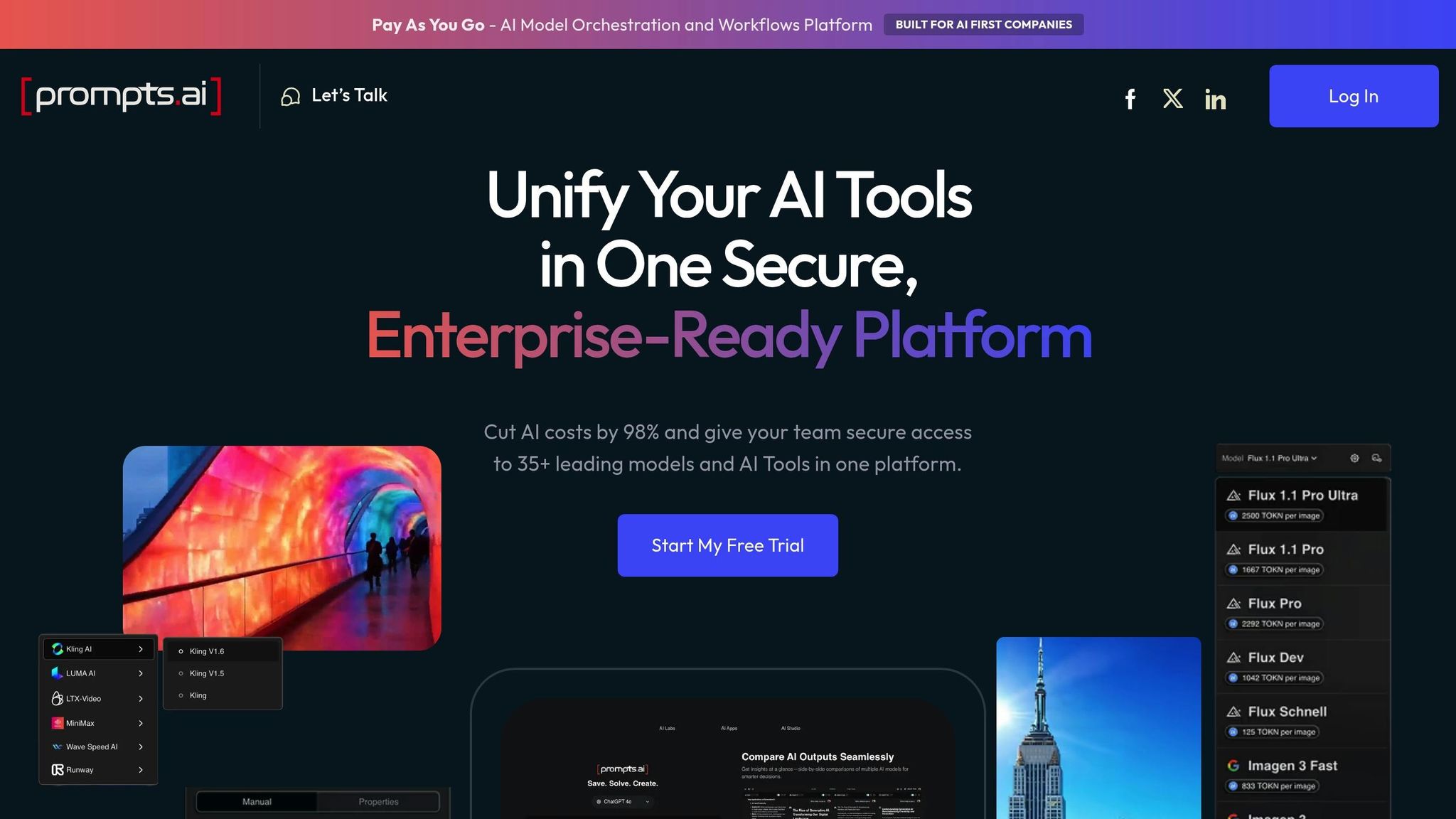
Prompts.ai is an enterprise-grade AI orchestration platform that brings together over 35 top large language models, including GPT-5, Claude, LLaMA, Gemini, Grok-4, and Flux Pro, into one secure, unified interface. By consolidating these tools, it eliminates the need for juggling multiple accounts or APIs, giving enterprises a centralized workspace to select models, build workflows, and compare performance side-by-side. This setup simplifies model integration and offers flexibility for a wide range of business needs.
Prompts.ai supports a variety of foundational models from providers like OpenAI, Anthropic, and Google. It also offers Bring Your Own Model (BYOM) functionality, allowing enterprises to incorporate proprietary or custom-trained models. The platform adapts to different deployment needs, supporting private or hybrid cloud environments to meet data security and residency requirements. Teams can seamlessly switch between models in real time, testing and identifying the best fit for specific tasks - all without the hassle of rewriting code or reconfiguring integrations.
Prompts.ai is designed with cost-conscious enterprises in mind. Its pay-as-you-go TOKN credit system eliminates recurring subscription fees, aligning costs directly with actual usage. The platform includes a FinOps layer that tracks token usage in real time and connects spending to measurable business outcomes. This approach can reduce AI software costs by as much as 98% compared to maintaining separate subscriptions for various model providers. Pricing starts at $99 per member per month for the Core plan, with Pro and Elite plans available at $119 and $129 per member per month, respectively. Personal plans range from $0 (Pay As You Go) to $99 for the Family Plan.
Prompts.ai offers centralized control of AI workflows through features like role-based access control (RBAC), audit logs, and policy enforcement. Every interaction is logged for full traceability, ensuring compliance with regulatory standards. Governance is built directly into the workflow design, allowing teams to securely deploy AI solutions without exposing sensitive data to external systems. Additionally, the platform includes a Prompt Engineer Certification program, which helps organizations establish internal experts who can balance technical capabilities with compliance requirements.
The platform is built to grow with organizations, enabling teams to add models, users, and departments in minutes without disrupting workflows. It supports thousands of concurrent users and a wide range of use cases across different business functions. Hands-on onboarding and enterprise training help businesses transition from experimentation to production-ready processes quickly. A community of skilled prompt engineers also shares pre-built workflows, speeding up implementation and delivering faster results. These features make it easy for enterprises to scale their AI orchestration efforts as their needs evolve.
IBM Watsonx Orchestrate is a flexible platform designed to work within diverse IT environments. It supports IBM Granite models, open-source frameworks, and third-party models, making it possible for organizations to leverage their current AI tools. The platform connects seamlessly with enterprise systems such as Microsoft 365, Salesforce, SAP, Workday, AWS, and ServiceNow using prebuilt connectors and authentication tools. Through its Agent Connect program, businesses can integrate external or custom-built agents into a unified catalog, creating a cohesive system for AI-driven workflows.
The platform offers a catalog featuring over 100 domain-specific AI agents and 400+ prebuilt tools tailored for tasks in HR, sales, procurement, and more. Users can create agents with a no-code Agent Builder or develop advanced solutions using the Agent Development Kit (ADK). With support for hybrid deployments across cloud and on-premises environments, it accommodates specific security and data residency needs. This open framework ensures organizations can reuse their existing agent investments without starting from scratch, avoiding vendor lock-in.
IBM offers a 30-day free trial to help organizations explore the platform. The Essentials Plan costs $530/month, while the Standard Plan, starting at $6,360/month, is designed for higher usage scenarios. Both plans include access to the Agent Catalog and integration tools, with the Standard Plan catering to teams managing agents across multiple departments and handling larger workloads.
Watsonx Orchestrate ensures centralized governance with built-in protections to prevent prompt injection and misuse of sensitive data. Agents undergo thorough pre-deployment checks for accuracy, tool reliability, and successful task completion before being added to the catalog. A governance dashboard tracks metrics like performance, drift detection, and latency in real time. For example, IBM HR resolved 94% of more than 10 million annual requests instantly, showcasing its ability to handle high-volume operations while maintaining compliance. The platform’s reliability earned it recognition as a Leader in the 2025 Gartner Magic Quadrant for AI Application Development Platforms.
The platform is designed to coordinate multiple agents for managing complex workflows across large organizations. Dun & Bradstreet reported a 20% reduction in procurement task time by leveraging AI for supplier risk evaluations. Similarly, the Georgia Institute of Technology, in collaboration with Avid Solutions, achieved a 60% decrease in manual field response times through smart workflow implementation. The Standard Plan supports scaling to handle larger document volumes and higher throughput, while the unified Agent Catalog helps streamline operations and reduce inefficiencies.
UiPath Maestro brings together AI agents, RPA robots, APIs, and human tasks into a single, streamlined platform. It uses BPMN 2.0 (Business Process Model and Notation) for visual workflow design and DMN (Decision Model and Notation) for rule-based decision-making, ensuring processes are clear and easy to manage. With its Model Context Protocol (MCP), Maestro standardizes how AI systems connect, making it more reliable to integrate tools like Google Vertex, Microsoft Copilot, Databricks, and Salesforce. This standardized approach also supports live data streams and automated decision-making.
Maestro’s Data Fabric integration employs a zero-copy architecture, enabling direct connections to live data sources such as Snowflake and Databricks without duplicating data. This reduces delays and minimizes security risks tied to moving data. The Autopilot for Maestro tool, powered by generative AI, allows teams to create executable process models using natural language or by uploading existing diagrams. Additionally, the platform includes over 30 BPMN templates to speed up the deployment of common workflows. For tasks requiring human input, Maestro includes human-in-the-loop escalation to ensure accuracy while scaling automated processes.
Maestro pairs its technical integrations with strong governance features. Through role-based access control (RBAC), AI agents inherit existing security policies and permissions when deployed into Orchestrator folders. Every interaction is logged to meet regulatory requirements such as GDPR, HIPAA, and FDA standards. The platform’s SLA-driven control allows real-time monitoring of active cases, helping identify bottlenecks and ensuring critical deadlines are met.
Cameron Mehin, Director of AI Product Marketing at UiPath, noted: "Maestro captures a unified view of what each agent is doing, in which process, and at what stage, enabling cross-platform observability and auditability that was previously impossible."
Maestro’s design supports large-scale operations with strong governance and efficient model integration. Real-world results include savings of over $200,000, an 85% reduction in onboarding time, and claim processing times cut from days to hours. Its cloud-native architecture adjusts dynamically to demand, with early adopters reporting up to 60% less human review time and 95% reliability for AI agents.
DataRobot brings the entire AI lifecycle under one roof, offering a comprehensive platform that integrates over 50 AI tools for building, deploying, and managing both predictive and generative AI models. This platform supports more than 40 modeling techniques across nine problem types, including time series analysis, anomaly detection, and agentic AI workflows. With a 4.7/5 rating on Gartner Peer Insights and 90% of users recommending it, DataRobot has proven itself as a trusted choice for enterprises. Its unified design simplifies operations, making it easier to handle predictive and generative AI together.
DataRobot supports a wide range of models, from predictive AI (like classification, regression, and time series) to generative AI, including LLMs and SLMs. It integrates seamlessly with major data platforms such as Snowflake, AWS, Azure, and Google Cloud. The platform’s Apache Airflow provider automates retraining and redeployment when model performance dips or new data becomes available. Users can deploy models in four ways: either through DataRobot’s infrastructure or external prediction servers, using DataRobot or custom-built models. Deployment options include on-premises setups, Virtual Private Cloud (VPC) environments, or managed SaaS, ensuring compliance with strict data residency requirements.
DataRobot excels in governance with features like one-click, customizable documentation that generates audit-ready reports. The platform incorporates built-in frameworks to ensure compliance with regulations such as the EU AI Act, NYC Law No. 144, and Colorado SB21-1. Model versioning and documentation are centrally managed through DataRobot's Registry, while the Console enables real-time performance tracking and automatic interventions. These governance tools also extend to external models stored in MLflow or other cloud-based environments, ensuring consistent oversight across an organization’s entire portfolio.
"Nothing else out there is as integrated, easy-to-use, standardized, and all-in-one as DataRobot. DataRobot provided us with a structured framework to ensure everybody has the same standard", said Thibaut Joncquez, Director of Data Science at Turo.
DataRobot’s flexible architecture supports hybrid and multi-cloud deployments, optimizing compute resources across edge, cloud, and on-premise environments. The platform is certified for use within the SAP ecosystem and validated under NVIDIA's Enterprise AI Factory reference design. Success stories highlight its enterprise capabilities: a global energy company achieved $200 million in ROI across more than 600 AI use cases, while a top 5 global bank reported $70 million in ROI through 40+ implementations. FordDirect also noted that the platform allowed them to deploy AI solutions in half the time compared to previous methods, underscoring its ability to streamline large-scale AI initiatives.
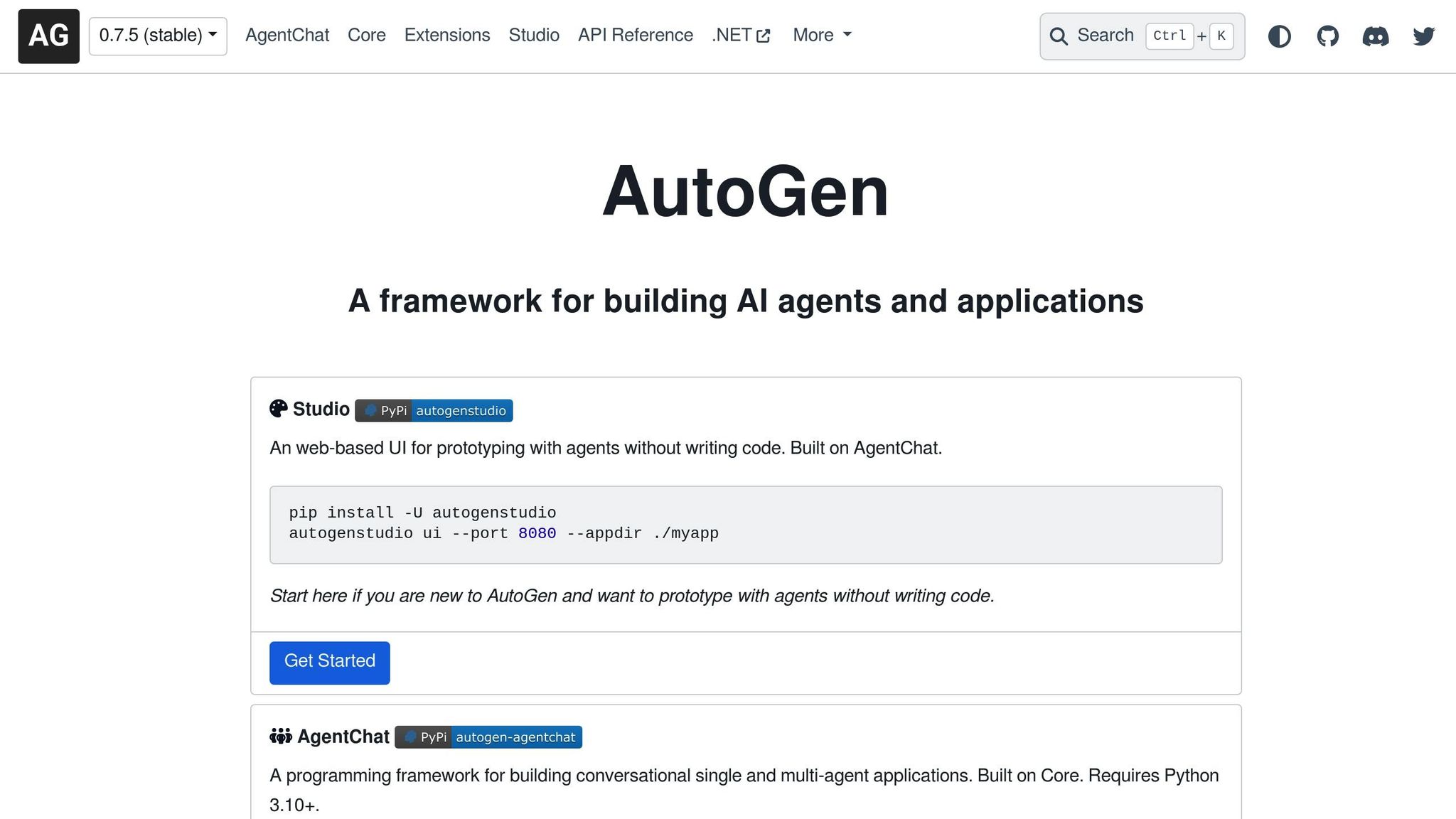
Microsoft Autogen is an open-source framework designed to help AI agents work together, enabling them to tackle complex enterprise challenges independently. This framework plays a key role in turning disjointed AI systems into unified, scalable solutions. It features a multi-agent conversation framework, where agents take on specific roles - such as the AssistantAgent for task execution and the UserProxyAgent for human input - collaborating to simplify intricate workflows. As of November 2025, Novo Nordisk has been utilizing Autogen to create a production-ready multi-agent system, aiding their scientific teams in analyzing and extracting insights from highly technical data.
Autogen supports GPT-4, GPT-3.5, and open-source models like Llama, all accessible through Azure AI Foundry. It is compatible with both Python and .NET environments. When integrated with Azure Logic Apps, the platform connects to over 1,400 enterprise tools and data sources, offering extensive flexibility. Built-in database connectors for PostgreSQL and Microsoft SQL Server enable agents to query live business data using natural language. Tasks are routed based on complexity - simpler ones go to faster, more cost-efficient models, while advanced reasoning is handled by GPT-4o. This setup ensures efficient resource use while maintaining strong operational oversight.
Each agent in the framework is assigned a unique Microsoft Entra Agent Identity, ensuring precise access control and accountability. Microsoft Purview Compliance Manager is integrated to help enforce regulatory standards. Azure AI Content Safety protects against harmful content generation and prompt injection attacks, while Microsoft Defender for Cloud monitors for jailbreak attempts and unauthorized data access in real time. All agent activities are logged through Azure Log Analytics and Application Insights, providing a complete audit trail for compliance purposes.
"Capabilities like AutoGen are poised to fundamentally transform and extend what large language models are capable of. This is one of the most exciting developments I have seen in AI recently." - Doug Burger, Technical Fellow, Microsoft
The version 0.4 update introduced an asynchronous, event-driven architecture that supports large-scale multi-agent interactions. Deployment options include Docker, Kubernetes, and Azure Container Apps, with OpenTelemetry providing interaction tracing and Azure Cosmos DB ensuring recovery during outages. Companies using Autogen to implement specialized AI agents have seen a 30% boost in operational efficiency, while those incorporating human-in-the-loop practices reported a 40% improvement in AI decision-making accuracy. The core SDK is free and open-source, with costs tied mainly to Azure services like Azure AI Foundry Agent Service or Copilot Studio for managed solutions.
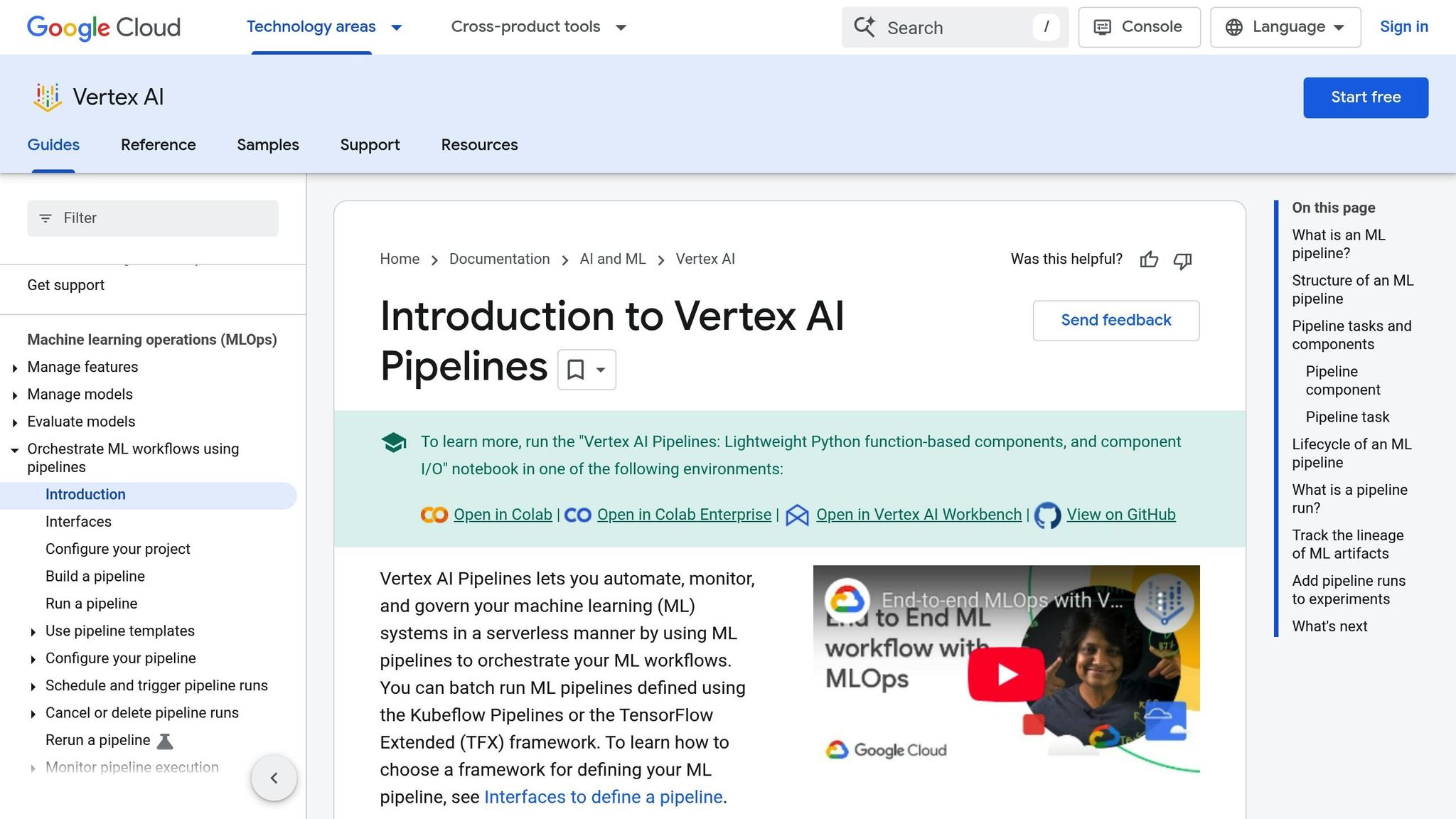
Google Vertex AI Pipelines automates machine learning workflows without the need for managing servers. It supports pipelines created with the latest versions of Kubeflow and TFX SDKs. The platform brings together Google's AutoML models (for Image, Tabular, Video, Text, and Forecasting tasks), BigQuery ML, and custom-trained models built using Python or Docker containers. With specialized LLM components, it handles tasks like model inference and reinforcement learning with human feedback (RLHF). This setup integrates various services efficiently, ensuring smooth workflow execution and compatibility.
The platform ensures compatibility across workflows by leveraging the Google Cloud Pipeline Components (GCPC) SDK, which includes prebuilt tools for connecting services like Dataflow, Dataproc (Spark), and BigQuery into a single DAG-based structure. Developers can execute pipelines using the Cloud Console, Python SDK, REST API, or client libraries for Java, Node.js, and Go. Additionally, Vertex ML Metadata automatically tracks the lineage of datasets, models, and metrics, documenting every step for easy reproducibility. For enterprises managing large-scale structured or text data, the TFX SDK provides high-performance processing tailored for massive workloads.
Vertex AI Pipelines is designed with cost-conscious features. Execution caching minimizes redundant tasks by reusing outputs when inputs haven't changed, while 30-second increment billing ensures users only pay for the precise time spent on training and predictions, avoiding fixed minimum charges. Custom training costs range from $0.44 per hour for A100 GPUs to $1.47 per hour for H100 GPUs, with additional accelerator fees of $3.93 per hour for NVIDIA A100 80GB and $9.80 per hour for NVIDIA H100 80GB. Each pipeline run includes a billing label for detailed cost tracking through Cloud Billing export to BigQuery. Resource labels also extend to all related Google Cloud services, offering full transparency for budget oversight.
The platform prioritizes data security and compliance, making it suitable for industries with strict regulations. VPC Service Controls establish a secure boundary to prevent data, models, and results from leaving the organization’s environment, reducing the risk of data breaches. Additionally, Customer-Managed Encryption Keys (CMEK), managed via Cloud Key Management Service, allow organizations to maintain control over their data access. To enhance security, individual pipeline components can operate under specific service accounts with the least-privilege principle enforced through IAM. Integration with Dataplex Universal Catalog provides a unified view of pipeline artifacts and lineage, while Cloud Logging ensures a complete audit trail of all pipeline activities.
The platform’s Directed Acyclic Graph (DAG) structure supports parallel task execution, delegating work to engines like BigQuery, Dataflow, or Spark for efficient resource usage. For large-scale model training, Cloud TPU Pods are available with core counts in multiples of 32. Developers can securely store and version pipeline templates in the Artifact Registry (up to 10 MiB per template) for easy sharing and reuse. The KFP SDK also allows local execution using a DockerRunner, enabling developers to debug components locally before deploying them to the cloud.
ServiceNow AI Agent Orchestrator brings together AI agents across various enterprise functions such as IT, HR, customer service, and finance, simplifying complex workflows. By leveraging a unified architecture, it enables these specialized agents to collaborate on multi-step processes. For instance, when a network issue occurs, the orchestrator coordinates AI agents that pull data from network management tools and other sources to diagnose the problem, propose solutions, and implement fixes after receiving human approval. Below, we explore its model integration, pricing approach, governance tools, and scalability for large-scale deployments.
The Workflow Data Fabric serves as the backbone for coordinating agents, connecting data from multiple sources without duplication. Using Zero Copy Connectors, enterprises can link ERPs and data lakes in just minutes, with prebuilt connectors offering speeds up to six times faster. The platform integrates seamlessly with multiple large language model providers via the Now Assist framework, giving businesses the flexibility to select or switch models as necessary. Through AI Agent Studio, users can create custom agents using natural language prompts in a no-code environment. Additionally, the ServiceNow Store offers thousands of pre-built agents from partners like Accenture, Cognizant, and Deloitte, enabling rapid deployment.
ServiceNow markets the orchestrator as a tool designed to lower costs, claiming it reduces integration expenses by up to 70%. This is achieved through its Workflow Data Fabric and prebuilt connectors, which minimize redundant integration tasks. The AI Agent Orchestrator and AI Agent Studio became available to enterprise customers in March 2025, offering a streamlined approach to integration and cost-saving opportunities.
The platform’s integrated architecture includes the AI Control Tower, which provides centralized governance for all orchestrated agents. This feature supports compliance with frameworks like the NIST AI Risk Management Framework and the EU AI Act. By leveraging the Workflow Data Fabric, it ensures data lineage is tracked and policy-based controls are applied, guaranteeing that AI decisions are made using trusted and compliant sources. Human-in-the-loop oversight can also be configured to require approval before agents execute certain actions. By early 2025, over 1,000 customers had adopted ServiceNow's AI agents, and 85% of Fortune 500 companies were already using ServiceNow products.
Designed for large-scale operations, the orchestrator ensures smooth and secure management of multi-agent workflows. It operates on RaptorDB, a high-speed database optimized for handling enterprise-scale workflows. Multi-agent coordination enables teams of specialized agents to tackle extensive operations, such as onboarding customers or managing security incidents. The platform supports both supervised modes, requiring human approval, and fully autonomous modes for background tasks, allowing businesses to tailor oversight based on the complexity and volume of tasks.
"There are going to be millions of agentic agents, and besides the data ... we're going to have to manage and orchestrate these things. There's a lot behind successful, highly valued outcomes that these AI agents will need to perform, so the orchestration layer is increasingly critical." - IDC analyst Stephen Elliot
Apache Airflow stands out among AI orchestration tools by focusing heavily on data engineering and lifecycle management. This open-source platform uses Directed Acyclic Graphs (DAGs) to define, schedule, and monitor complex workflows, ensuring tasks are executed in the right sequence. Workflows are written in Python, which means enterprises can use version control, peer reviews, and automated testing to maintain transparency and control. According to the Apache Airflow Survey 2025, which gathered 5,818 responses from 122 countries, the platform's global adoption is undeniable. Its adaptability makes it a strong contender for discussions around pricing and governance.
Airflow’s Python-centric design allows for extensive customization and seamless integration with Python-based AI models or enterprise systems. It supports numerous community-built providers, enabling connections to major cloud platforms like AWS, GCP, and Azure, as well as on-premise setups. Centralized logging ensures reliability, which is critical for high-stakes environments. Notably, the April 2025 release of Airflow 3 introduced features tailored for AI workloads, such as event-driven scheduling and remote execution to address compliance needs for sensitive data.
The base Apache Airflow platform is free under the Apache License 2.0, making it an attractive option for organizations looking to avoid licensing costs. For those seeking managed solutions, services like Amazon MWAA and Google Cloud Composer offer usage-based pricing, which includes additional compute expenses. Astronomer provides another alternative with its enterprise-grade managed Airflow, offering custom pricing options designed to fit specific organizational requirements.
Airflow’s "workflows as code" approach allows enterprises to adopt standard software development practices for change management and auditability. Its support for Kerberos ensures secure network authentication, while integration with secrets management tools like HashiCorp Vault and AWS Secrets Manager keeps sensitive credentials safe. With centralized logging and a user-friendly web interface, teams can easily track task execution, statuses, and histories to meet regulatory requirements. Additionally, Airflow’s extensibility through custom listeners and plugins enables integration with third-party governance tools and the implementation of tailored compliance checks.
"Airflow can be an enterprise scheduling tool if used properly. Its ability to run 'any command, on any node' is amazing." - Apache Airflow Testimonials
Airflow’s modular design supports scaling from a single process to distributed systems capable of handling enormous workloads. For instance, many enterprises deploy Airflow on Kubernetes to enable distributed task processing across hybrid IT environments, showcasing its ability to meet diverse operational demands. Google Cloud Composer, which is built on Airflow, has earned a 4.1/5 rating on Gartner Peer Insights, with users applauding its extensibility and efficiency in managing complex workflows. However, self-hosted deployments require significant technical expertise to set up and maintain, which can be a hurdle for some organizations. Nonetheless, with the right resources, Airflow proves to be a powerful tool for enterprise-scale orchestration.
Selecting the right AI orchestration tool involves considering model access, pricing, governance, and scalability in relation to your enterprise's specific requirements. The tools reviewed here range from free, open-source options to fully customized enterprise solutions. Below is a breakdown of how they perform across these essential categories.
In terms of cost efficiency, the options vary significantly. Prompts.ai uses a pay-as-you-go TOKN credit system, offering FinOps controls for real-time tracking. It starts at $0/month, with business plans ranging from $99 to $129 per member/month. On the other hand, Microsoft AutoGen and Apache Airflow are free and open-source. IBM Watsonx Orchestrate provides clear tiered pricing, while platforms like UiPath Maestro, DataRobot, Google Vertex AI Pipelines, and ServiceNow AI Agent Orchestrator require custom quotes, making them more suited for large-scale, tailored implementations.
Looking at governance, each platform takes a unique approach to ensure compliance. DataRobot prioritizes model monitoring, while Google Vertex AI Pipelines emphasizes metadata tracking. Prompts.ai integrates audit trails directly into workflows, streamlining oversight. Meanwhile, Apache Airflow offers version control and peer review capabilities but demands more hands-on management.
When it comes to scalability, the tools provide a range of solutions. Whether it’s managing AI agents through BPMN workflows, facilitating multi-agent interactions, scaling from single processes to distributed Kubernetes systems, or quickly adding models and users, these platforms cater to different enterprise needs. Balancing operational priorities like cost, control, and scalability is critical for organizations looking to enhance productivity and efficiency.
AI orchestration bridges the gap between disconnected systems, transforming them into unified, production-ready workflows. The platforms discussed address key business priorities: boosting operational efficiency, cutting costs through intelligent model routing and real-time spend tracking, and maintaining compliance with centralized governance and audit trails. Companies with advanced orchestration strategies often achieve 2–3× greater returns on their AI investments compared to those relying on fragmented setups.
The global AI orchestration market was valued at $11.47 billion in 2025 and is expected to surpass $30 billion by 2030, highlighting how streamlined orchestration not only reduces costs but also drives a competitive edge. Gartner predicts that by 2028, 33% of enterprise software will incorporate agentic AI, a sharp rise from less than 1% in 2024. Choosing the right orchestration platform now will play a pivotal role in how well your organization adapts to this rapidly changing landscape.
When selecting a solution, start by defining your business goals. Decide whether you need deep customization that requires developer expertise or prefer low-code interfaces for quick experimentation. Evaluate your current cloud setup - platforms like Prompts.ai provide cloud-agnostic flexibility with access to 35+ models, while others may align closely with specific ecosystems like Azure or AWS.
Begin with a single, impactful workflow, such as automating customer support escalation or qualifying leads, to demonstrate value before scaling further. Ensure error handling and detailed logging are part of your setup from the start to monitor latency, errors, and API costs. For organizations in regulated industries, it’s crucial to prioritize tools with features like built-in monitoring, role-based access controls, and certifications such as SOC 2 Type II and GDPR compliance.
The platforms reviewed here - ranging from Prompts.ai's pay-as-you-go TOKN credit system starting at $0/month to enterprise-grade solutions with custom pricing - offer diverse options for cost, control, and scalability. Ready to elevate your AI operations? Discover how the right orchestration platform can deliver tangible results for your business today.
AI orchestration in an enterprise involves bringing together various AI models, tools, and workflows to operate as a single, cohesive system. This process ensures smooth management of tasks, data movement, and interactions between different components. By adopting this approach, businesses can streamline the use of multiple models, cut costs, and uphold proper oversight. It allows organizations to expand their AI efforts effectively while avoiding challenges such as tool overload and inconsistent management.
To select the best AI orchestration tool, start by evaluating the complexity of your workflows, the scale of your operations, and specific needs such as governance or cost control. Platforms like Prompts.ai provide centralized access to various models, along with features like real-time cost tracking and compliance management. It's also important to consider your team's technical skills and ensure the tool aligns with your operational goals, budget constraints, and scalability needs, making integration into your existing infrastructure smooth and efficient.
Regulated industries demand robust governance tools to ensure AI systems adhere to legal, ethical, and safety standards. Key features include mechanisms to comply with regulations such as HIPAA or SOC 2, along with audit trails that enhance transparency. Detailed logging of AI decisions is essential for accountability. Additionally, cost control measures and risk management tools play a crucial role in preventing tool sprawl and mitigating regulatory risks, ensuring AI operations remain secure and compliant in these tightly regulated sectors.